Category Archives: Research tips

FamilySearch indexing – How you can become involved

The following article was written for Genealogy Ensemble by Marian Bulford, a genealogist from the West Island of Montreal who has been indexing for many years. She gives us valuable insight about indexing and how we all benefit from the contributions of those who index the records we use in our genealogical pursuits.

Indexing is the data entry of human records worldwide in any language you choose. If you can type, then you can index, so why not get started today?!

Keyboard01_MicrosoftThe FamilySearch website has provided a way for anyone with an internet connection to assist in the monumental task of indexing world genealogical records. It is run by the Church of Jesus Christ of Latter-day Saints, more commonly known as The Mormons.

The Church of Jesus Christ of Latter-day Saints is in the process of digitizing the bulk of their genealogical records, as well as partnering with genealogical societies and other groups to digitize other records of genealogical value. Most of the websites today have obtained their records from this church.

As indexing is entered, the records are checked and arbitrated a few times. Then these digitized records are uploaded to the online FamilySearch Indexing project site for anyone, including you, to view free of charge.

Easy to download software and index
The indexing software is free and easy to download, and the online tutorials should get you started quickly. There is also an online help desk if you have questions.

You do not have to be a church member to index or search this free website. To start, simply go to the website link here. It takes only a few minutes to download your selected batch of records — in any language and in any part of the world you choose — and transcribe the entries using the provided software you will find on the web page.

Alternatively, if you just want to research a wonderful database for free with no obligation or fees, go to https://familysearch.org.

If you volunteer to index for FamilySearch, just remember, you are helping to add millions of data for us genealogists to find plus, as a side benefit, indexing can help you become a better researcher as you become more familiar with the wide variety of historical documents available to you and the type of information each contains. You can choose a beginner, intermediate, or advanced batch to index.

Where to start?
Indexing consists of births, deaths, marriages, banns, obituaries, christenings, or baptisms. In addition, there are historical records consisting of many other interesting items worldwide. For instance, how about indexing the following databases?

  • France, Diocèse de Coutances et Avranches – Registres Paroissiau from 1796 to 1880
  • UK Sussex Church of England Parish Records from 1538 to 1910
  • US Louisiana WW2 Draft Registration cards from 1940 to 1945
  • South African Free State, Estate Files from 1951 to 1980
  • Polska, Radom Roman Catholic Church Books from 1733 to 1868
  • Brazil, Pernambuco Recife Registro Civil from 1900 to 1920

All of the above databases, and many more, now await us to index them and provide a name or a lead for someone who is searching for their ancestors.

To help you through the indexing process, there are Help fields on the right of every batch you download. You never know, you may even come across some of your family names whilst indexing.

Once records have been indexed through FamilySearch Indexing, the new indices (and sometimes the document images) are posted online for free access at FamilySearch.

How I started
Because I am originally from the UK, I usually go to the UK batches for my indexing as I love history and I find so much of interest there, but I also like to mix it up and, as long as it is in English, I will index it.

Last year, I helped index the US 1940 Census. (As you well know, the census is usually the first place we go to find an ancestor’s name.) That monumental task was also completed well within the time range expected and up and running far sooner than anticipated.

Tremendous response to call for volunteers last month
Last month the FamilySearch website asked for volunteers for two days of indexing by asking everyone you know to join in. This, in part, is their response after that weekend. “We hoped to have an unprecedented 50,000 contributors in a 24-hour period. FamilySearch volunteers excelled, surpassing that goal by 16,511! That’s right—66,511 participants in one day! Incredible! We are grateful for the patience and persistence of many volunteers who faced technical difficulties due to an overwhelming response.” To read more, visit the blog post, FamilySearch Volunteers Set Historic Record.

According to some sources, volunteers participating in online indexing projects are adding over a million names a day in total.

Once records have been indexed through FamilySearch Indexing, the new indices (and sometimes the document images) are posted online for free access at FamilySearch Record Search.

So, log on and go see what you get back for a few hours, or even minutes, of indexing. Why not try a test drive on the above links and be part of the many people proud to add to the billions of records that amateur and professional genealogists like us search for daily.

French Canadian Research tips

To look up French-Canadian Catholics:
1. Plug in the name of your ancestor in to the BAnQ archives directly (refer to our link for the right address): no need to know the church or village name.
2. Remember that in Quebec, women are listed under their birth family name in records, from birth to death, regardless of whether they married or not. There may ‘’wife of’’ or ‘’widow of’’ also included.
3. To make it even easier, parents are listed on marriage records.
You can use the Drouin collection of books, one for men and one for women, with marriages 1760-1935, or online Drouin or Ancestry or Family Search at home or at the Quebec family History Society or at numerous other sources.

Acadian research guide contains hundreds of resource links

On this 259th anniversary of the Acadian deportation, those researching their Acadian heritage might find the research guide, Acadians of Nova Scotia, New Brunswick, Prince Edward Island, Newfoundland of interest. It consists of Acadian Parish Registers under the French and British regimes in addition to the modern-day period under Confederation.

Click on this link, Acadians of Nova Scotia, New Brunswick, Prince Edward Island, Newfoundland, to see a 162-page downloadable document that will help you find your family’s name in community parish records, etc.

2014 Acadian Congress
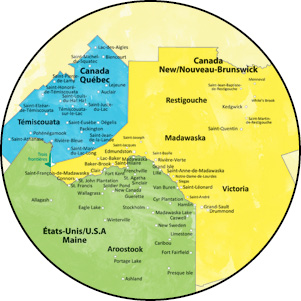
The Acadian Congress takes place August 8 to 24, 2014. The map below indicates the areas where many of the Congress activities will take place.

Carte3RegionsPetit

“Then uprose their commander, and  spake from the steps of the altar. Holding aloft in his hands, with its seals, the royal commission. “You are convened this day,” he said, “by his Majesty’s orders… Painful the task is I do, which to you I know must be grievous. Yet must I bow and obey, and deliver the will of our monarch; Namely, that all your lands, and dwellings, and cattle of all kinds, forfeited be to the crown; and that you yourselves from this province be transported to other lands. God grant you may dwell there. Ever as faithful subjects, a happy and peaceable people! “

“Prisoners, now I declare you; for such is his Majesty’s pleasure!”

Silent a moment they stood in speechless wonder, and then arose louder and ever louder a wail of sorrow and anger. “

Source: Henry Wadsworth Longfellow, Évangéline and other selected poems Penguin Books, 1988.

The Irish Catholic Churches of Quebec

St. Brendan Parish in Rosemont


Here’s a guide to the Irish Catholic Churches of Quebec.

Use this guide to find out where the documents you want to find are located. You can also find photos of the church parishes your ancestors attended.

See: the-irish-catholic-churches-of-quebec

This compilation was edited on Nov. 21, 2018. A new version will be coming in 2019.


Learn How to Research French Archives

One of the most experienced researchers in the Quebec Family History Society is also one of the group’s most generous members. Jacques Gagné, who has researched the records of the Protestant churches of Quebec, Scandinavian genealogy, the Huguenots, Loyalists, Acadians, Aboriginal families and other ancestral groups, has recently turned his attention to France. Now he is willing to train other members of the QFHS to research their ancestors in France. This is a unique opportunity, not only for anyone with French Canadian roots, but for those who want to expand their genealogical skills and to give back to the genealogical community.

Jacques has compiled links to the archives of 92 out of 95 departments of France into a single pdf document, which you can download from this link: Master copy 10 12 13 Les Archives départementales en France. Also included are maps so that you can figure out which modern department holds the historic records you need to find.

Updated dates: Jacques will be volunteering at the QFHS library on May 20 and May 23, from 10 a.m. to 3 p.m. If you are interested in researching your ancestors in France, come to the library on one of those days to learn how. Once you have experience in researching your own ancestors, Jacques hopes you will be willing to pass on that knowledge to others.


Indexing Records for LDS

Have you ever wondered who does some of the indexing for the Mormon Church in Salt Lake City? The Church of Jesus Christ of Latter Day Saints is actively involved in a very unique program in conjunction with the Utah State Prison. “Inmates who volunteered at the Utah State Prison Center last year indexed more than 2 million records…..They put approximately 50,000 hours of personal family research in the project.” This recent article in The Huffington Post  http://www.huffingtonpost.com/2014/04/03/utah-prisoners-mormon-genealogy_n_5079776.html was like a breath of fresh air to learn that these prisoners are contributing in a very positive way to help genealogists. Perhaps the next time you access familysearch. org  you might think about many of those prisoners who  are involved in preparing the records we as genealogist  so often seek .

French-Canadian-genealogy-how-to podcast

Maple stars and stripes podcast is a new podcast for anglophoneswho want to do genealogical research in Quebec.  Go to maplestarsandstripes.com so you can subscribe for free and also get the notes for each.  I found out while listening to Lisa Louise Cook’s Genealogy Gems podcast, another great one to listen to.  I even heard her talk about our Janice Hamilton’s (QFHS) blog Writing up the Ancestors Driving from Montreal to Quebec city to a fencing competition listening to podcats for 3 hours (and another 3 coming back)…my god time flies when you are listening to great ideas.  Only problem is not being able to note down what comes to mind.  But I definitely made sure I did not forget the Maple one. Of  course, before my tournament, I just had to go to the Quebec National Archives (BAnQ) and their next dorr neighbour, La société de généalogie de Québec: great resources.  Next time I’ll plan a trip all the way to Natashquan, so i can listen to so much more podcasts!

Maple Stars and Stripes

En route de Montréal à Québec vers le championnat d’escrime du Québec, j’écoutais les baladodiffusions de Lisa Louise Cook, Genealogy Gems.  Une peu de rattrapage pour les derniers mois. J’ai même entendu l’animatrice citer notre Janice Hamilton, à la QFHS, à propos de son blog Writing up the Ancestors.  Merveilleux toutes les bonnes idées ou pistes que nous fournissent ces podcasts.  Une de celles-ci: Maplestarsandstripes.com.  Cette dernière est un mini mode d’emploi pour les anglophones, pour débuter des recherches généalogique au Québec.  On y présente Drouin, les filles du Roy, les noms-dit, de la prononciation française…  Sur le site, on peut s’abonner à la baladodiffusion de même que trouver des notes sur chacune.  Quand on a les mains et les yeux occupés, rien de tel que d’écouter.  Le temps passe si vite, que j’aurai pu continuer jusqu’à Natashquan!  Bien sûr, j’ai fais un petit tour à la bibliothèque et archives nationales du Québec (BAnQ) avant mon tournois, ainsi qu’à la société de généalogie de Québec, la porte juste à côté.

Marriage Contracts in New France 1635-1765

Contrats de mariage du Régime Français 1635-1765

Typical marriage contract during the French Regime in Nouvelle France from 1635 to 1765
Please note, the text below has been reproduced precisely in the French language as it was written from 1635 to about 1765.

Pardevant le greffier et notaire de lisle de Montreal et temoins soubzsignez furent presant en leurs personnes sieur Anthoine Athanville marchand bourgeois demeurant de presant au Montreal fils de deffunt sieur Nicollas Athanville marchand bourgeois de Paris et de Marie Leducq ses peres et meres demeurans en la rue de la pelleterie proche le pallais a Paris paroisse de Saint Jacques la Boucherie d’une par et Jeanne Gadois fille de Pierre Gadois maître armurier et bourgeois de ce lieu et de Jeanne Begnard sa femme…
Référence: le 2 janvier 1683, Claude Maugue, notaire, Montréal

Translation of a same marriage contract during the French Regime in Nouvelle France

In the presence of the court clerk and notary of the Island of Montréal and witnesses listed below being present at said reading, Sieur Anthoine Athanville merchant and member of the middle class of Montréal, son of the late Sieur Nicollas Athanville, merchant and member of the middle class of Paris and of Marie Leducq his father and mother whom resided on de la Pelleterie street, near the Palace in Paris within the parish of Saint Jacques la Boucherie in the first part and Jeanne Gadois, daughter of Pierre Gadois, master gunsmith and member of the middle class of this city of Montréal and of Jeanne Begnard, his wife…
Reference: January 2 1683, Claude Maugue, notary, Montréal

At the QFHS Library, one will find 6 volumes of indexes of marriage contracts written by notaries during the French Regime of Nouvelle France from 1635 to 1765.

A total of about 27,000 marriage contracts are listed in about 1,800 pages.

QFHS books #GN-150.3 R6 – Vol 1 to 6
Inventaire des Contrats de mariage du Régime Français – Archives judiciaires du Québec

A typical index will read as follow:
> Gagné (Gasnier), Pierre, et Louise Faure (Auber, 28 octobre 1668)
The latter refers to Claude Auber, notary who served in Québec City from 1650 to 1693

Furthermore in order to determine precisely which Archives nationales du Québec (nine in total across the province plus one research centre), one must determine in which ”district judiciaire” (judicial district) a notary served. For notarial acts prior to 1900 in the majority of cases are stored within the nine Archives nationales du Québec, depending of the location a notary served during the years of his or her practice.

In order to determine precisely where a notary practiced, refer to the following index kept at the QFHS Library.

QFHS book #GS-150.3 L3
Parchemin s’explique Guide de dépouillement des actes notariés du Québec ancien
284 pages

In order to facilitate the access to the above books, they have been moved to the Estelle Brisson cabinet.

A future posting will deal with the availability online of notarial acts at www.banq.qc.ca

Posted by Jacques Gagné for Genealogy Ensemble

History of Compton County by L.S. Channell

History of Compton County in the Eastern Townships of Québec by L.S. Channell
QFHS Library #UEL-REF HG-153.01 C46
295 pages large format – Two copies available at the Library.

Being a U.E.L. Reference book, said books cannot be taken out of the Library.

The history of 400 pioneer families of Compton County plus those in Sherbrooke County and those within the district of St. Francis from the birth of the region in 1782.

At the close of the Revolutionary War in 1782, many thousand United Empire Loyalists were offered lands in Canada by the British Government. A few hundred families came to the townships of Eastern Canada.

There can be no doubt that United Empire Loyalists took up their residence in our Townships before 1792, but the official records of such are missing.

The first settlers are heard of on Missisquoi Bay and Lake Memphremagog. At the head of the Connecticut River in the township of Hereford, Colonel John Pope settled as early as 1792, and there is not much doubt but that settlers were there for several years previously.

In the year 1796 the first lands in Lower Canada were granted in free and common soccage.

In 1803 the courts of Montréal rendered a decision that no right of property in slaves could exist in Lower Canada, and the few slaves in this country were thus manumitted. The people in the Townships were too poor to own slaves in those days, and two only are known to have been in what is now Compton County. They belonged to Colonel John Pope, and remained with him until their death when they were sent back to the old plantation in Massachusetts for burial.

L.S. Channell

Posted by Jacques Gagné for Genealogy Ensemble

Huguenot Refugees

On August 25, 1572, on the feast day of St Bartholomew, thousands of Huguenots were massacred by government forces in Paris and in other regions of France.

From the same year of 1572 a large-scale emigration from France by Protestant familiies began.

Over the next few weeks, I will post web site addresses which are known to many family researchers but perhaps some of you who might be beginners in the field of family searches, some of these web sites might open doors to your research endeavours.

As part of these overviews I will concentrate on web sites which are linked indirectly to Canada and especially to Québec.

Michel Barbeau in his precise and well researched web site Huguenots in Canada has identified 321 Huguenots who settled into Nouvelle France from about 1634 to 1763. You can find this important database online at http://pages.infinit.net/barbeaum/fichier/index.htm

Unfortunately, Protestants were not welcomed to Nouvelle France. The majority of Protestant families during the period under the French Regime were forced to abjure (renounce) their Protestant faith, see: http://www.guyperron.com/ptdaniel_perron_abjuration.html.

On the subject of abjuration in Nouvelle France, I will address this issue at a later date and indicate where one can obtain copies of acts of abjuration in Québec during the period under the French authorities.

Following the British conquest at the Battle of the Plains of Abraham in Québec on September 13th 1759 by the Imperial Army under the command of General James Wolfe, French language Protestants were welcomed into the new British Colony of Québec.

And in future postings I will try to identify some of the families who were considered to be Huguenots in Québec.

A limited number of United Empire Loyalists who settled into Québec and Lower Canada were Huguenots, I will also address these immigrants to Québec and Lower Canada.

Subsequent postings to this blog will include shortly research guides dealing with the Huguenot emigration routes through France, Switzerland, the Netherlands and the Walloon region of modern-day Belgium from about 1596 onward.

For the time being I have selected a few web addresses which might shed lights on your research process of the Huguenot families who might have settled into Québec (British North America) and Lower Canada from 1759 onward.

> Huguenots of France and Elsewhere http://huguenots-france.org/english.htm
> Huguenot & Walloon Genealogy  – http://www.olivetreegenealogy.com/hug/index.shtml
> Huguenot Surname Index  – http://www.aftc.com.au/Huguenot/Hug.html#A
> Huguenots in the Channel Islandshttp://www.theislandwiki.org/index.php/Huguenot_refugees
> The Huguenots in France and the Atlantic Diasporahttp://www.huguenot.netnation.com/books/Diaspora.html

Much more to follow over the next few weeks.

Jacques Gagné