Category Archives: United States

Where Are All The Cousins?

Some branches of family trees flourish while others wither and die out. I have traced one branch of my tree back to Pierre Gadois and Louise Mauger, two of my one thousand and twenty four 8th great-grandparents who arrived in Quebec in 1636. This couple has many thousands of descendants alive today, probably even more. But even though some of my great-grandparents had many children there aren’t the expected number of cousins. I have only seven first cousins while a friend says she has more than fifty. My granddaughter has only two so far.

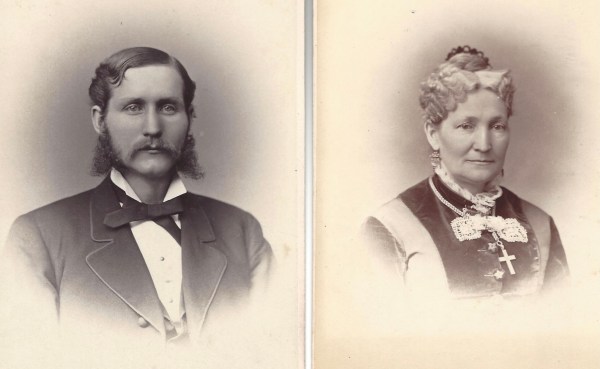
Barnabé Bruneau and Sophie Marie Prudhomme my two-times great-grandparents had 13 children. They all survived to adulthood. One would have expected that they would all marry and have a number of children. Even if they each had only four children, that would be 52 cousins but that is not what happened.
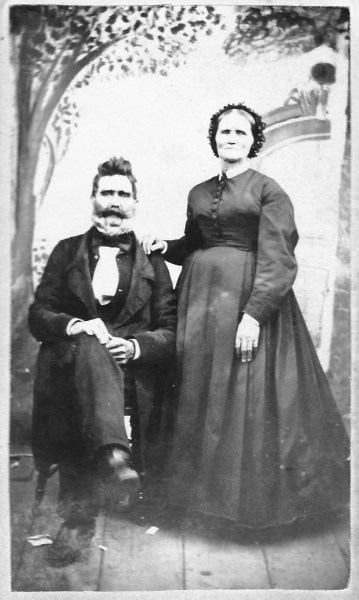
Barnabe & Sophie Marie Bruneau

These 13 siblings only had 17 children with 10 of the children born to Ismael Bruneau and Ida Girod. Seven of their ten children have descendants alive today. I haven’t counted up how many relatives this is but quite a number. It is hard to keep track of your second and third cousins and those once removed as they marry and have children.

When my great uncle Herbert Bruneau, Ismael’s son, drew up a family tree in the 1960s, he wasn’t able to find a record of any of his cousin’s children. He thought that he and his sibling’s descendants were the only branches.

When I had my DNA analyzed by Ancestry, one of my matches, “Shedmore” rang a bell. Ancestry said he was a 4th – 6th cousin but in fact, his great-grandmother Elmire Bruneau was my great-grandfather Ismael’s sister and so we are third cousins. The tree did have another branch.
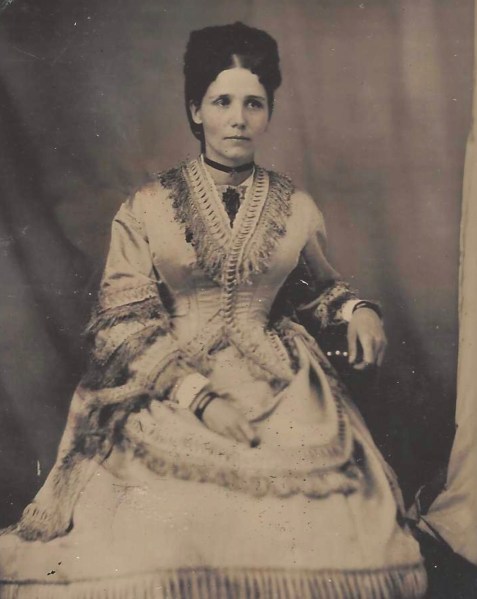
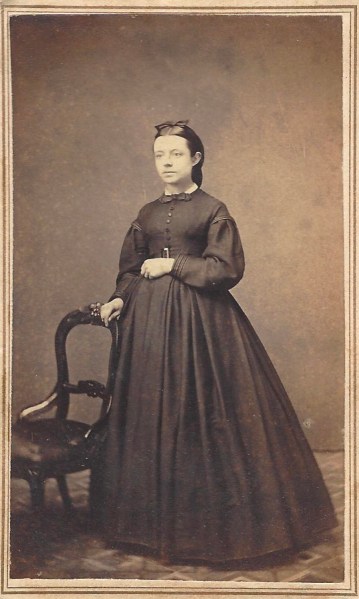
Elmire Bruneau Huntley

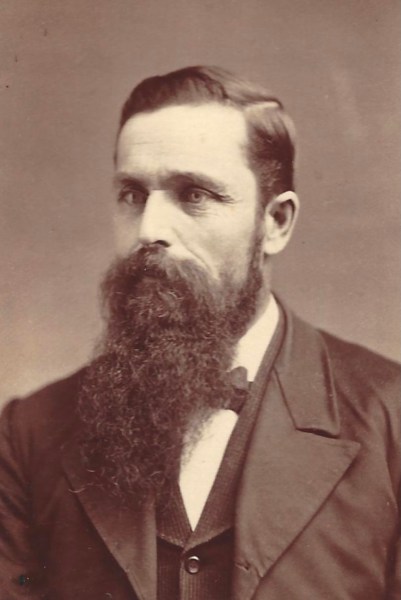
Elmire, born in St-Constant, Quebec, immigrated to the United States in 1864 and worked in New York City as a French governess. She is said to have met Andrew Washington Huntley around 1867 in the choir of the Plymouth Church in Brooklyn Heights. His family lived in Mooers, New York. He was a veteran of the Civil War having served in a number of units from 1862-1865. This couple moved many times during their marriage according to census records. First to Wells, Minnesota, then to Bridport, Vermont to farm, then Chicago, Illinois where he was a ticket agent on the Electric Railroad and finally to Los Angeles, California. Elmire died there in 1922. Her body accompanied by her daughter Faith, went by train back to Bridport, Vermont where she was buried beside her son Howard.
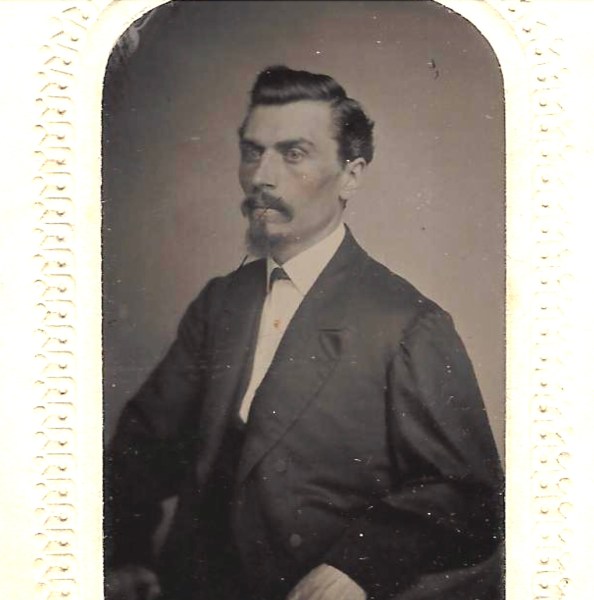
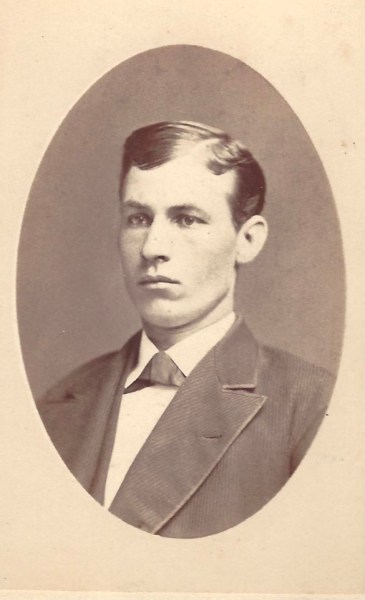
Andrew Washington Huntley

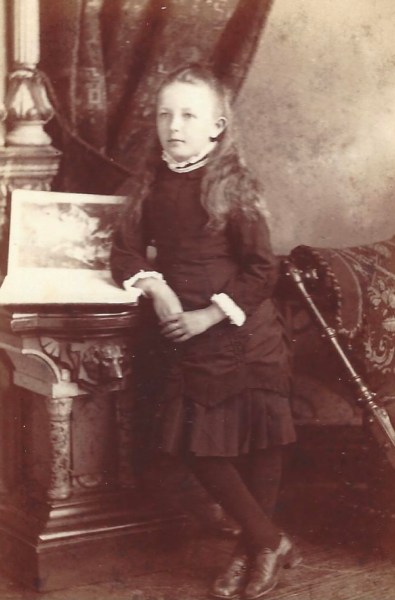
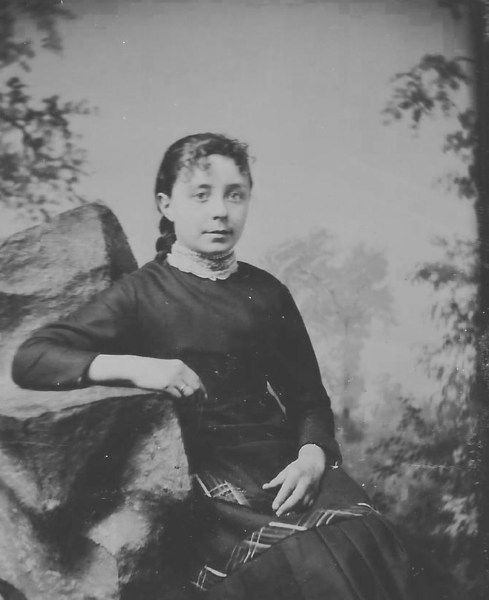
Howard died at 18 without children. It was her daughter Faith, who married Smith C. Shedrick and had four children, Etta Elmere, Howard S., Helena F. and Howard H. who kept the family tree growing. “Shedmore” turned out to be Etta’s son. He does not have any children but his brother had three children, five grandchildren and some great-grandchildren so Elmire’s Bruneau line lives on. Both Helena and Howard also married so there might be even more twigs on those branches.
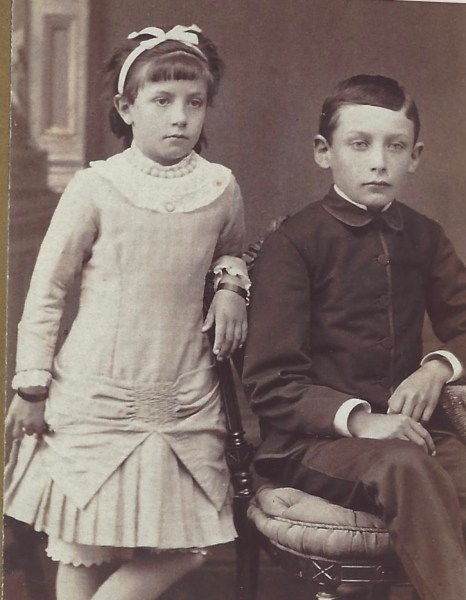
Faith and Howard Huntley

It is nice to have cousins. Some might not be close but you do have a family connection. Reach out to your cousins, you never know who you will find or what they may know.

Notes:

All photographs are from Ismael Bruneau and Ida Girod’s albums in the possession of the author.

Elmire Huntley Obituary: Middlebury Register, Middlebury Vermont. Dec. 1 1922, Friday page 7. Newspapers.com accessed Mar 29, 2022.

Year: 1870; Census Place: Clark or Wells, Faribault, Minnesota; Roll: T132_3; Page: 1440 Ancestry.com. 1870 United States Federal Census [database on-line]. Lehi, UT, USA: Ancestry.com Operations, Inc., 2009. Images reproduced by FamilySearch.Accessed Nov 22, 2021.

Year: 1880; Census Place: Bridport, Addison, Vermont; Roll: 1340; Page: 20A; Enumeration District: 002Ancestry.com and The Church of Jesus Christ of Latter-day Saints. 1880 United States Federal Census [database on-line]. Lehi, UT, USA: Ancestry.com Operations Inc, 2010. 1880 U.S. Census Index provided by The Church of Jesus Christ of Latter-day Saints © Copyright 1999 Intellectual Reserve, Inc. Accessed Nov 22, 2021.

Year: 1900; Census Place: Chicago Ward 21, Cook, Illinois; Roll: 271; Page: 17; Enumeration District: 0638 Ancestry.com. 1900 United States Federal Census [database on-line]. Lehi, UT, USA: Ancestry.com Operations Inc, 2004. Accessed Mar 29, 2022.

Year: 1910; Census Place: Oak Park, Cook, Illinois; Roll: T624_239; Page: 21b; Enumeration District: 0077; FHL microfilm: 1374252 Ancestry.com. 1910 United States Federal Census [database on-line]. Lehi, UT, USA: Ancestry.com Operations Inc, 2006. AccessedNov 22, 2021.

Year: 1920; Census Place: Los Angeles Assembly District 73, Los Angeles, California; Roll: T625_114; Page: 17A; Enumeration District: 393 Ancestry.com. 1920 United States Federal Census [database on-line]. Provo, UT, USA: Ancestry.com Operations, Inc., 2010. Images reproduced by FamilySearch. Accessed Nov 22, 2021.
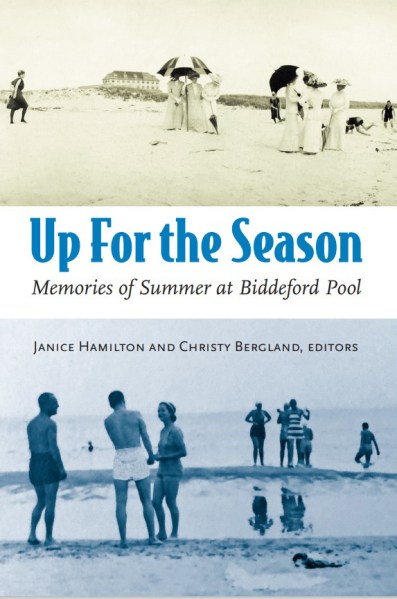
Launching “Up for the Season”

I was a journalist and magazine writer for many years, and I have written dozens of articles about my ancestors, but none of these projects has been as well received as the small book I recently co-edited about the small coastal community where I spend my summers.

Biddeford Pool, Maine has been welcoming summer residents for several generations. My mother came here as a child, and I have summered here since I was four.  Now, only a few long-lived members of my mother’s generation are still with us, and stories from the past are disappearing.

So in 2019, inspired by the success of my family history blog, I started a blog about the Pool’s summer community. I wrote some of the articles, but the main goal was for people to write their own stories.  My friend Dabney described the Sunday mornings of her childhood when everyone went to church wearing their Sunday best, then returned home to enjoy roast beef or fried chicken for lunch. Jesse told readers what he learned about life while racing his sailboat in the mid-1960s. Lisa recalled the 1950s when Mr. Anderson, dressed in a summer suit and straw hat, delighted the neighbourhood children by taking out his false teeth and giving them a toothless smile.

These were great stories, but the blog was a failure. Nobody noticed the publicity flyers I made up, and the posts were not frequent enough to land on people’s radar. When one friend asked, “what is a blog?” I knew the project was doomed.  

Upon our return to Maine in 2022, after a two-year absence due to Covid, I asked some friends what they thought I should do with the blog: delete it as a failed experiment, try to revive it, or turn it into a book? We decided on a book. We included all the articles from the blog and added many new stories.

The book is called, Up for the Season: Memories of Summer at Biddeford Pool, edited by myself and Christy Bergland, an artist from Baltimore whose grandfather first came to the Pool as the summer doctor in 1907. The title is a quote attributed to a local lobster fisherman who knew many of the summer residents in the 1950s. When he saw a cottager for the first time each summer, he would ask, “Up for the season?”

co-editors Janice Hamilton, left, and Christy Bergland, right. photo by Richard Levy

The theme of the book is, when and why did your family first start coming to Biddeford Pool? It turns out that many of the men who started coming to the Pool in the late 1800s and early 1900s lived and worked together in mid-western cities such as Cincinnati and St. Louis, and they recommended it to their friends as a good place to bring their families.

The book is probably a hit for several reasons. First, people love to hear these stories about the days when men wore tuxedos to the annual Labour Day dance at the golf club and children got their first taste of freedom as they explored this safe little peninsula. unsupervised by parents.

The quality of the writing is another reason. While most of the contributors are not professional writers, they are nevertheless gifted storytellers. Eagles Nest, a turreted house overlooking the rocky shore, came to life when LeeLee mentioned the seagull who arrives for cocktails on the porch. This was a perfect example of “show, don’t tell.”

For me, putting this project together was a lot of fun because it was a group effort. Christy and several other friends helped with all the important decisions, such as the title choice.

A fun book launch. photo by Harold Rosenberg.

We hired a copy editor to catch the typos and a book designer to do the layout. The printing was done by Rapido Books, a Montreal printing company that I had previously used for a family history book. They shipped two boxes of 50 books seamlessly across the border, and they have an online bookstore for print-on-demand copies. Over the course of this summer, Christy and Mary handled the book sales and accounting with Jo’s assistance. As of the end of August, we have sold more than 100 copies and accumulated a profit of several hundred dollars that we donated to the Biddeford Pool Community Center.

Marketing in a small community where everyone knows everyone is not complicated. We put up posters in key locations advertising an early July book launch, and an announcement appeared in the Community Center newsletter. The launch, held at Lisa’s old shingled family cottage by the bay, was an overwhelming success. We also held a smaller event at the end of the summer where several of the authors read their stories aloud.

Today, many family historians are taking the next step beyond researching their ancestors’ BMDs , and they are writing about their families. Writing about the individuals, families and businesses in a community is not very different from writing about ancestors, and the sources of information — interviews, newspaper articles, city directories, census data and so on – are also the same.

Now that Up for the Season has been so well received, we are hoping that people will be inspired to start writing volume two. Many stories are waiting to be told.

Mathilde Bruneau Career Woman

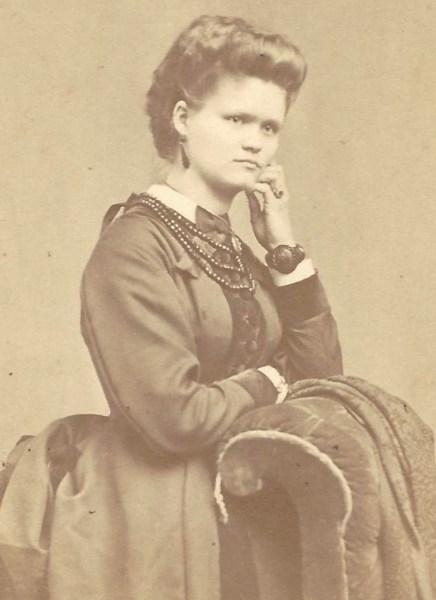
Marie Mathilde Bruneau

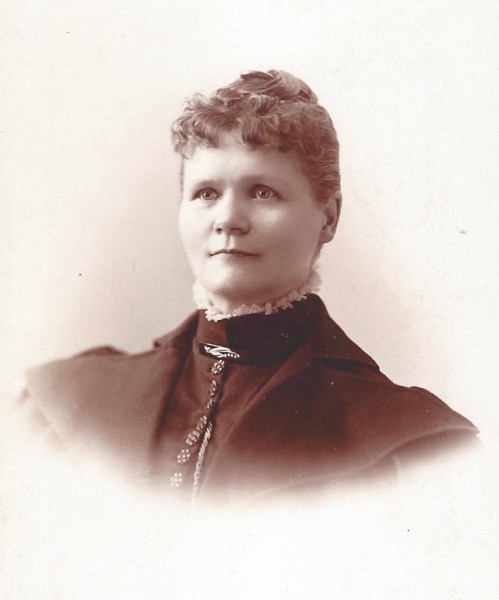
I never expected to find much information about my great-grandfather’s sister, Mathilde Bruneau. I knew her name, dates, the fact she had a twin brother and that she never married. That was all. Then when searching Newspapers.com, Mathilde, born on a farm in southern Quebec appeared on the social page of the Fall River, Massachusetts Daily Herald. It was reported that she had been visiting her brother Aimé Bruneau and then returned to her teaching duties at the Rhode Island Institute for the Deaf in Providence, Rhode Island, only twenty miles from her brother’s home.

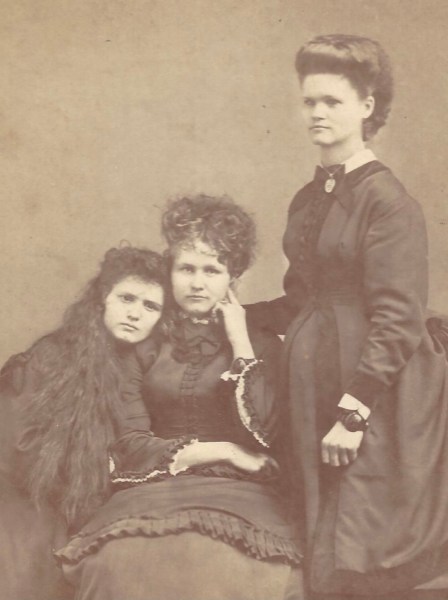
Sophie, Helene & Mathilde Bruneau in New York

Mrs. Mary Ann Lippitt founded the school in 1876. Her daughter Jeanie became deaf after a bout of scarlet fever so her mother taught her daughter to speak and read lips, as no schools for the deaf existed at that time. Mary Ann’s husband Henry Lippitt was the Governor of Rhode Island and had political influence, so he persuaded the state to take over the operation of the school. In 1893 the school moved to a large new building which could hold 60 students. This might have been the time Mathilde began teaching there. The school is still operating today.

I don’t know how Mathilde ended up teaching deaf students. Did she answer a newspaper ad while visiting her brother? Before teaching the deaf, Mathilde had been a French teacher in New York City along with her sister Virginie. Virginie didn’t stay there but returned to Quebec to marry.

Mathilde had not yet moved to Rhode Island 1887 when the social page reported on an earlier visit to her brother Aimé, in Fall River. I don’t know where Mathilde obtained her teaching credentials as I haven’t found records of her training. Her sister Virginie attended McGill Normal School. Did Mathilde begin her teaching career in Montreal before moving to New York?

Mathilde was one of thirteen children of Barnabé Bruneau and Sophie Marie Prudhomme, born in St-Constant, Quebec, south of Montreal, in 1844. She had a twin brother Napoleon, one of very few twins in my family tree. In the 1871 Canadian census, she was listed as living with her parents in St-Constant (and two years older than her twin brother), so she was at least 27 when she moved to New York City. Napoleon stayed on the farm but he also had a career as a veterinarian and a Justice of the Peace.

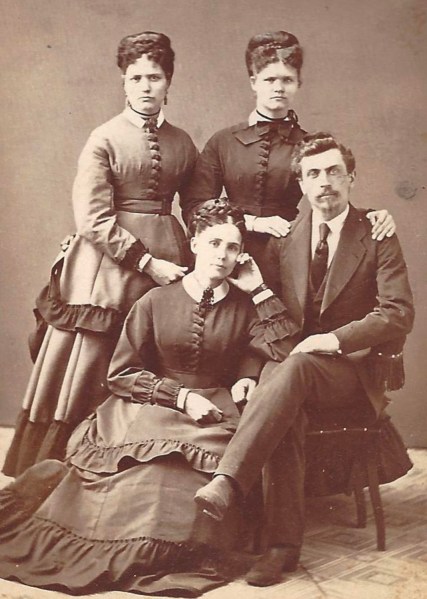
Sisters Sophie, Mathilde& Elmire with Washington Huntley

Although some of her siblings became American citizens, it seems she never did. After Mathilde retired from teaching, she moved back to Quebec. She maintained her independence and didn’t live with her twin brother in St-Constant or even with one of her sisters, instead she was a lodger in John Dooley’s house on Bordeaux Street in Montreal.

Mathilde Bruneau

She appeared again in a newspaper in April 1912, “Miss Matilda Bruneau 68, 1149 Bordeaux St. fell on the sidewalk corner of Mary Ann and Erables last night and broke her left leg. She was taken to the Royal Victoria Hospital” reported the Montreal Gazette. The weather the day before, Easter Sunday, had been very rainy and well above freezing so an icy sidewalk probably wasn’t the cause of her fall.

She died only four months later. PerhapsHer her leg never healed. I didn’t find a death certificate or cause of death, just a certificate of burial signed by two of her sisters. Marie Mathilde Prud’homme Bruneau was buried with her parents in the Baptist cemetery in Grande-Ligne, Quebec.

Notes:

Rhode Island School for the Deaf https://rideaf.ri.gov/AboutUs/index.php

Mabel Hubbard, who later became the wife of Dr. Alexander Graham Bell was deaf and also taught by Mrs. Lippitt. Jeanie Lippitt later went to Dr. Bell for voice training lessons. Dr. Bell had to discontinue these lessons to devote himself full-time to the development of the talking machine.

Fall River Daily Herald June 30 1898, Page 7. Newspapers.com accessed Jan 12, 2023. Miss M P (Prudhomme) Bruneau was an instructor at RI School of the Deaf.

The Providence News February 21, 1893 Newspapers.com accessed Feb 17, 2023. A new school building was dedicated. 35 pupils enrolled with a capacity for 60. 

In the 1911 Canadian census, Matilde was living on Bordeaux Street in the Maisonneuve district of Montreal as a lodger with a Mr John Dooley and his family.

Fell and Broke Leg: Montreal Gazette April 8, 1912, page 3. Newspapers.com accessed Jan 23, 2023.

Her sisters Virginie and Sophie signed her burial record. There is no cause of death April 15, 1912.

Robert Mitcheson, Philadelphia Merchant

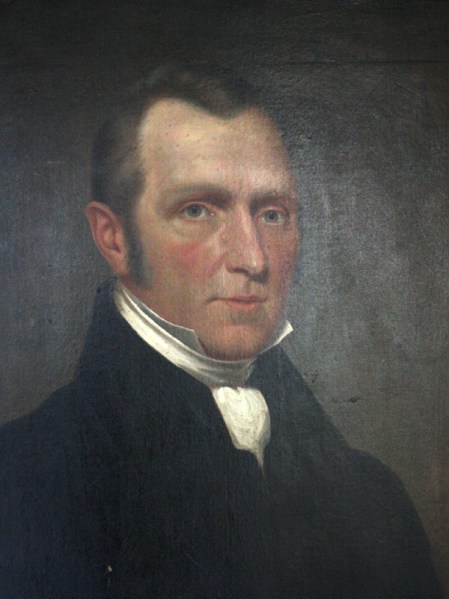
When my English-born three-times great-grandfather Robert Mitcheson arrived in Philadelphia from the West Indies in 1817, he was a 38-year-old unattached merchant. Within two years he was married and had started a family, established a new career and was on the way to becoming an American citizen.

Robert (1779-1859) grew up in County Durham, England, where his father was a farmer and small-scale landowner. Robert became an iron manufacturer as a young man, then spent some time in the West Indies. Family stories say he was largely occupied in the West Indies trade. In 1817 he sailed from Antigua to Philadelphia with the intention of settling in the United States. He applied for naturalization – a first step towards citizenship — in July, 18201 and took an oath of citizenship on Sept. 12, 1825.

Robert Mitcheson, portrait probably painted in Philadelphia in the 1830s. Artist unknown. Bagg family collection.

Perhaps he had met his future wife, Scottish-born Mary Frances (Fanny) MacGregor, on a previous trip to the city. I have not found a record of their marriage, but it probably took place in Philadelphia. The couple’s first child, Robert McGregor Mitcheson, was born on August 15, 1818 and baptized at St. John’s Episcopal Church in north-end Philadelphia.2

In 1819 Robert was listed in a city directory as a distiller, and the following year’s directory clarified that he made brandy and cordials. The business was located at 275 North Third Street, in the Northern Liberties area of the city. The distillery continued to appear in each annual directory until 1835, when Robert was simply listed as “gentleman”, with his home address on Coates Street.

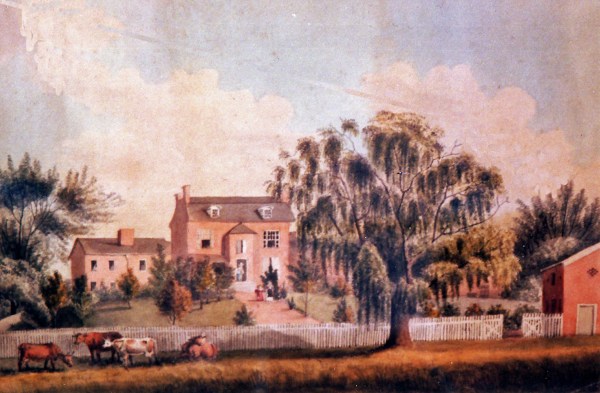
The family appeared in the U.S. census for the first time in 1830,3 living in Spring Garden, then a largely rural part of Philadelphia. Robert owned a large lot bounded by Coates (later renamed Fairmount Street) and Olive Streets, between Eleventh and Twelfth Streets. There, he and Fanny raised their five children: Robert McGregor (1818-1877), Catharine (my two-times great-grandmother, 1822-1914), Duncan (1827-1904), Joseph McGregor (1828-1886) and Mary Frances (1833-1919). Two other children, Sarah and Virginia, died as babies. Two of their sons graduated from the University of Pennsylvania. Robert M. became an Episcopal minister, and Joseph, who went by the name MacGregor J. Mitcheson, was a lawyer.

This painting of Monteith House, the family home in Spring Garden, was painted by daughter Catharine Mitcheson. Bagg family collection.

Robert never became part of city’s elite, despite his financial success. For one thing, he was a newcomer living in an old city. Founded in 1682, Philadelphia was the birthplace of the United States and many of its citizens were known as the descendants of colonial and revolutionary families. Also, Robert appears to have been a low-key person. A search for his name in local newspapers brought up only one article that named a long list of people involved in establishing a refuge for boys.

The only obituary I was able to find appeared in a Montreal newspaper, where daughter Catharine Mitcheson Bagg and her husband, Stanley Clark Bagg, lived.4 It said: “As a citizen of Philadelphia for more than 40 years, he has done much, in a quiet and unostentatious manner, for the advancement of her interests and the relief of the distressed. He enjoyed a well-earned reputation for unwavering integrity in all the transactions of his long life – prolonged almost to his 80th birthday — and his remarkable urbanity of manner which the firm, yet elastic step of his manly person, were but slightly impaired up to the period of his dissolution. He was universally respected and died serenely, with a Christian’s hope and faith.”5

Robert appears to have travelled back to England at least once, probably to visit family members and take care of some business, as he had inherited property in Durham when his father died in 1821. A land transfer document dated September 16, 1835 described him as “Robert Mitcheson, iron manufacturer, late of Swalwell, now of Philadelphia”.6 Several weeks later Robert Mitcheson, gentleman, appeared as a passenger on the Pocahontas, sailing from Liverpool to Philadelphia.7  

Perhaps he also visited his brother William, an anchor maker and ship owner in London. A short biography of his son published by the St. Andrews Society in Philadelphia described Robert as a “retired merchant and shipowner,”8 however, I cannot confirm whether Robert owned any ships or perhaps invested in his brother’s business.

After Robert left the distillery business he reinvented himself again, this time as a landlord. The city was rapidly expanding and there was a need for housing. Many people lived in boarding houses and Robert saw rents from boarders as a way to generate income for his grown children after he died. In his will, he left 14 “dwelling houses” located near his house, as well as several nearby other buildings, in trust to sons Robert M. and MacGregor J..9 They were to collect the income and pay certain sums every year to their other three siblings, and to look after repairs to the buildings.

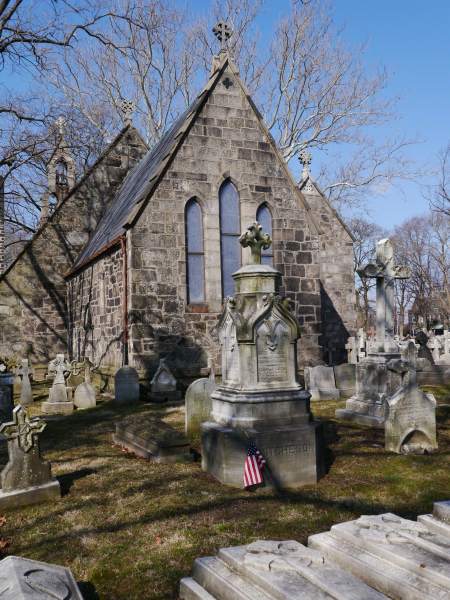
This large monument in the cemetery of St. James the Less Episcopal Church is in memory of Robert Mitcheson, his wife and several other family members. JH photo, 2013.

Robert died at age 79 and was buried in the cemetery at St. James the Less, a small, Gothic-style Episcopal church built around 1846 as a chapel of ease for wealthy families in the area. Robert is said to have helped found that church.

His story doesn’t end there, however. Sadly, his estate was the focus of a court battle that took almost 30 years to resolve, by which time both executors had also died. In addition to a dispute between the brothers, the case focused on a legal error in the way the trust was set up10 and who was to inherit the final balance of income.11  

To Learn More: Robert Mitcheson’s younger years are the subject of “A Restless Young Man,” Writing Up the Ancestors, Jan. 24, 2023, https://www.writinguptheancestors.ca/2023/01/a-restless-young-man.html. You can also search for articles about Robert’s parents and grandparents in England, his wife, sister Mary and other siblings, and some of his descendants on http://www.writinguptheancestors.ca.

Notes and Sources

1. Ancestry.com. Pennsylvania, U.S., Federal Naturalization Records, 1795-1931 [database on-line]. Original data: Naturalization Records. National Archives at Philadelphia, Philadelphia, Pennsylvania. Accessed Feb. 15, 2023.

2. I found records from St. John’s Church at the Historical Society of Pennsylvania, Philadelphia in 2013.

3. “United States Census, 1830,” database with images, FamilySearch (https://familysearch.org/ark:/61903/1:1:XH5W-MC3, accessed Feb. 16, 2023), Robt Mitchinson, Spring Garden, Philadelphia, Pennsylvania, United States; citing 323, NARA microfilm publication M19, (Washington D.C.: National Archives and Records Administration, n.d.), roll 158; FHL microfilm 20,632.

4. Stanley Clark Bagg (SCB) was Robert’s son-in-law and also his nephew: Robert’s older sister, Mary Mitcheson Clark, was SCB’s maternal grandmother.

5. Montreal Herald and Daily Commercial Gazette, 28 March 1859, p. 2, Bibliothèque et archives nationale du Québec, https://numerique.banq.qc.ca/patrimoine/details/52327/3169230, accessed Feb. 17, 2023.

6. Clayton and Gibson, Ref No. D/CG 7/379, 16 September 1835, Durham County Record Office, https://www.durham.gov.uk/recordoffice.

7. “Pennsylvania, Philadelphia Passenger Lists Index, 1800-1906,” database with images, FamilySearch (https://familysearch.org/ark:/61903/1:1:QV9Y-VXJ9, accessed Feb. 17, 2023), Robert Mitcheson, 1835; citing ship Pocahontas, NARA microfilm publication M360 (Washington, D.C.: National Archives and Records Administration, n.d.); FHL microfilm 419,525.

8. Biography of MacGregor Joseph Mitcheson in An Historical Catalogue of the St. Andrews Society of Philadelphia with Biographical Sketches of Deceased Members, 1749-1907, printed for the Society 1907; p. 287, Google Books, accessed July 19, 2013.

9. Will of Robert Mitcheson, March 5, 1859. Philadelphia County (Pennsylvania) Register of Wills, 1862-1916, Index to wills, 1682-1924. Volume 41, #105, FamilySearch, (https://www.familysearch.org/ark:/61903/3:1:3Q9M-C9B2-5S45-H?i=190&cat=353446, image 191-194, accessed Feb. 18, 2023.)

10. Mitcheson’s Estate, Orphan’s Court. Weekly Notes of Cases Argued and Determined in the Supreme Court of Pennsylvania, the County Courts of Philadelphia, and the United States District and Circuit Courts for the Eastern District of Pennsylvania by Members of the Bar. Volume XI, December 1881 to August 1882; p. 240. Philadelphia: Kay and Brother, 1882. Google Books, accessed Feb. 17, 2023.

11. Mitcheson’s Estate, Pennsylvania Court Reports, containing cases decided in the courts of the several counties of the Commonwealth of Pennsylvania, Vol. V, p. 99. Philadelphia, T. & J.W. Johnson & Co., 1888. Google Books, accessed Feb. 17, 2023.

This article is also posted on my family history blog, www.writinguptheancestors.ca

Virginie Bruneau Dutauld The Protestant Teacher

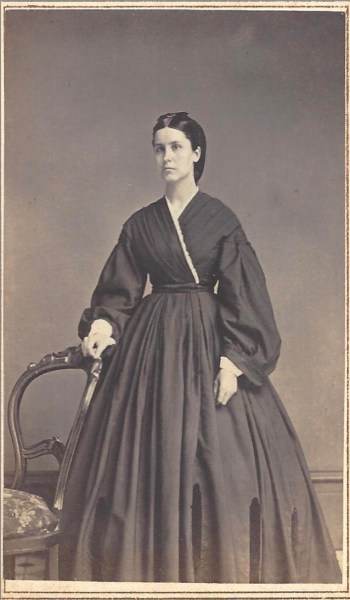
Virginie Bruneau in New York City

Virginie Bruneau, born in St. Constant, Quebec in 1840, became a teacher. “She enjoyed the distinction of being one of the group of teachers to receive the first French Canadian diplomas from the McGill Normal School.”

The school was established in 1857 by John William Dawson, McGill’s first Principal with an agreement between the university, the government and the Colonial Church and School Society to educate Quebec’s protestant public elementary and secondary school teachers and produce teachers who could turn young minds into university material. The Colonial Church and School Society had been dedicated to the maintenance and financing of Anglican schools.

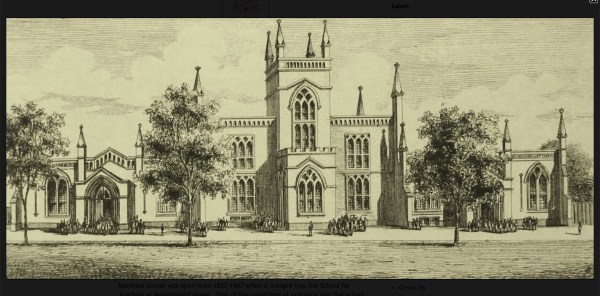
McGill Normal School 30 Belmont Street, Montreal

Applicants to McGill’s Normal School were examined in reading, writing, the elements of grammar and arithmetic and “needed to produce certificates of good moral character from their clergyman or minister of religion under whose charge they have last been.” The earlier schools judged teachers qualifications only on their common sense and reputation. The one-year course earned an elementary diploma and students attended for two years for a Model School diploma required to teach higher grades. Students had to be at least 16 years old and teach at least three years after graduating.  The first class contained 35 women and five men. So Virginie, born in 1840 could have been in the first class.

The school opened at 30 Belmont Street in downtown Montreal. In 1907 it moved to the west of the island and became part of MacDonald College.

After graduating, Virginie first taught in Montreal and then later, of all places, New York City. She was my great grandfather Ismael’s sister, the third child and second daughter of Barnabé Bruneau and Sophie Marie Prudhomme. Like many of her siblings, she looked for a life beyond the farm in St Constant.

I don’t know how or where she met her husband Francois Dutaud. He was from the same region of Quebec, born in Napierville, to Joseph Dutaud and Isabelle Cyr but he also spent time in the United States. He lived in Boston for several years. There, he worked for the Tuft Brick Company. He returned to Canada in 1875, where he farmed and had a successful grain business in Grande-Ligne, Quebec.

Francois Dutauld

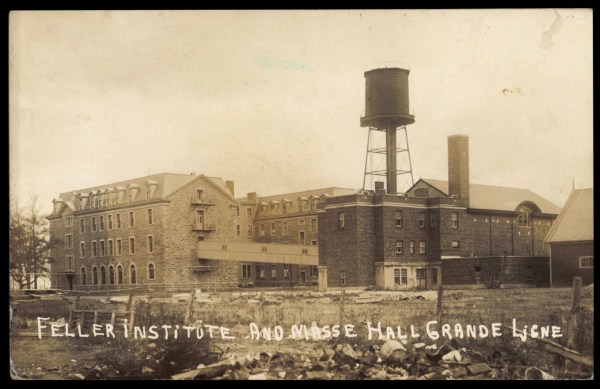
Did Virginie give up the bright lights of New York City to teach at the Feller Institute in Grand-Ligne? Is that where she met Francois? Henriette Feller was a Baptist missionary from Switzerland who came to Quebec to convert Catholics to Protestantism. The hostility of Catholics in Montreal forced her to move south. Madame Feller’s first school was in the attic of her log cabin but eventually a large stone building was constructed. She and Charles Roussy her colleague, were responsible for the conversion of Virginie’s parents in the 1850s.

Virginie was 38 when she married and she and Francois had only one child, Gustave Dutaud, born in Grand Ligne in 1879.


The couple moved to Montreal to live with their son when Francois became ill. He died a year later. Virginie continued to live with Gustave until her death in 1926 from arteriole sclerosis. Her obituary said she was of proud Huguenot stock but I don’t think this was necessarily true. Yes, she was a French Protestant but her Bruneau line had been practising Catholics for centuries.

Notes:

Picture of Virginie by S.A. Thomas 717 Sixth Ave New York. He was a photographer from 1853 to 1894 when he died at 71.

https://numerique.banq.qc.ca/patrimoine/details/52327/4280081

The Educational Record of the Province of Quebec April – June 1964 Vol LXXX No. 2

McGill Normal School: https://education150.mcgill.ca/images/MNS-dOC20.pdf

McGill.ca/about/history/features/dawson accessed September 12, 2022.

Virginie Bruneau Dutaud Obituary. Montreal Star, Montreal, Quebec. April 28, 1926 page 31. Newspapers.com accessed April 19, 2022.

https://numerique.banq.qc.ca/patrimoine/details/52327/1955334 Picture of Feller Institute

Walter N. Wyeth D.D. – Madame Feller and the Grande Ligne Mission, Philadelphia Pennsylvania. WN Wyeth 1898

https://archive.org/details/henriettafellerg00wyetuoft

The History of a Summer Community    

I spent the past two months working on the history of my summer community in Maine. It is not exactly family history, although my family has been vacationing in this place by the ocean for almost 100 years, so bear with me while I tell you what I learned about writing local history.

Local history is essential to understanding our ancestors. The towns, cities and rural neighbourhoods where they lived were the places where they went to work, to shop, to worship, to play. By researching their communities, we can get hints about their daily activities, their values, their friends and acquaintances and the educational opportunities open to them.

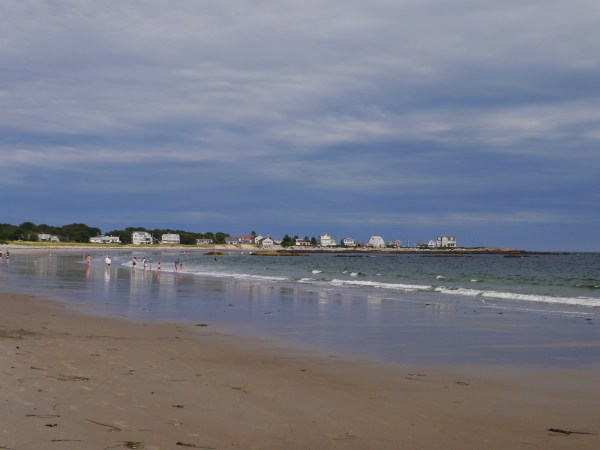
Biddeford Pool, the community where I spend my summers, is on a tiny peninsula that juts out into the Atlantic Ocean, flanked on one side by a sandy beach and on the other by the rocky shore of Saco Bay. Originally known as Winter Harbor, the peninsula was once home to a thriving fishing village with a herring fleet and shipbuilding industry. In the mid-1800s, several enterprising local residents decided to build hotels and rent out rooms to boarders for the summer.

The big beach, low tide, Biddeford Pool, Maine

Families from big cities such as Cincinnati, St. Louis, Memphis and Montreal have been going there for generations. Eventually, some summer visitors decided to build their own cottages, and they encouraged friends and family members to join them on the coast. Today, many of their descendants are still vacationing at Biddeford Pool, still sailing the same waters, swimming at the same beach and playing on the same golf course that their grandparents and great-grandparents enjoyed.

Many of these families are interrelated, although no one has ever done a big family tree of the summer resident families.

Inspired by my experiences with Genealogy Ensemble, several of us started a blog a few years ago and encouraged people to write their own stories. We invited them to find out how their families first came to Maine, and we asked for childhood memories and other stories. Most people were polite, smiled and nodded, but did not write a word. I can’t say I was totally surprised. People are on holiday there, busy with friends and family, and once they get home, they get into their regular routines. Privacy may have been a concern for some. Also, writing is not easy for everyone.

Even more disappointing was that many people never looked at the blog. Maybe they are just not comfortable with digital media, and perhaps we were too successful in trying to keep it low-key. But it seemed the entire effort was a failure.

This spring I took a fresh look at the two dozen stories that were posted on the blog and enjoyed them. And at a time when most of my parents’ generation have already died or are now well into their 90s, the articles preserve memories of the way things used to be in the community – the bad and the good. So now, a group of about half a dozen of us are again copying what the members of Genealogy Ensemble did: we putting together a collection of short articles in a self-published book. At the very least, it will be on the shelves of the community’s little library, and filed beside the hundreds of old photographs that the Biddeford Pool Historical Society has collected and digitized. Hopefully, future researchers and family members will read it.

Some of us went to the county registry of deeds office to research the histories of our century-old cottages, and we used genealogy sources such as Familysearch.org to find marriage records, census records and city directories, as well as old newspaper databases. Others wrote personal anecdotes.

This project is a bit haphazard. It depends on who volunteered to participate and what he or she chose to write about. It is far from a one-place study or a carefully structured oral history project. And we left out most of the local residents who once lived there year-round, such as the lobster fishermen. That is unfortunate, however, narrowing the focus of the book has made it possible to get the project finished in one season, plus we know clearly who the target audience of the book will be.

I will let you know next summer how it turns out. 

Aime Bruneau- Jewels and Glasses

The Fall River Daily Evening News reported in Our Folks and Other Folks Column, “ He sustained an accident and narrowly escaped serious injury in Brookline on Saturday, by jumping from an electric without signalling for a stop. A sliver in the platform step caught in his shoe heel and threw him, as he jumped, and he was dragged some distance. He sustained severe bruises, his clothes were badly torn and his shoe, one of a new pair, was ripped from his foot.” This is one of the more interesting things written about my two times great uncle, Aimé B. Bruneau.

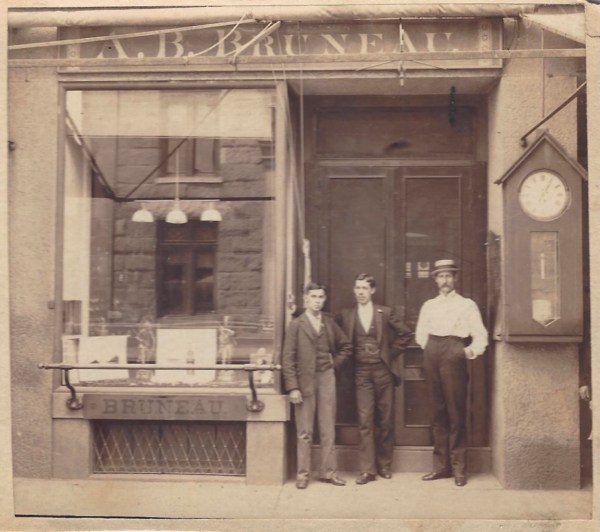
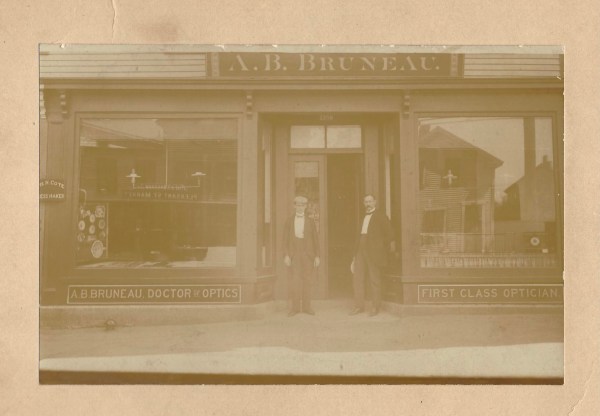
Aimé was a jeweller and studying to be an optometrist in 1897 when the accident happened. He must have been attending the Klein School of Optics in Boston’s South End. The school, founded three years earlier by ophthalmologist Dr. August Klein, was one of America’s first formal training programs in optics and refraction. After one year of study, Aimé could make glasses as well as jewellery.

He had travelled far from his roots. Aimé Benjamin Bruneau was born in Saint Constant, Quebec to Barnabé Bruneau and Sophie Marie Prud’Homme. He grew up on the family farm but as the seventh of 13 children, he had to find employment elsewhere. He left home as a teenager and went with his brother Dolphis to Adams, South Berkshire, Massachusetts where they were probably attracted by jobs in a mill.

I am not sure where he met Mary Floretta Mann. She lived in Rutland Vermont. Her husband, Steven Mann had died in 1869 and the widow was living with her three children. Four other children had died in early childhood. Mary couldn’t have been looking for financial support as she had real estate worth $16,000 and a personal estate of $5,000. When they married in 1871 Aimé was 26 and Mary 43.

The couple soon moved to Fall River, Massachusetts, which after the Civil War was the leading textile city in America. Aimé didn’t work in a mill but as a clerk in Fred Macomber’s jewellery store and eventually bought him out. It was a prosperous business in the Granite Block, a block-long commercial building in downtown Fall River and one of the leading jewellery stores in the area for almost twenty years.

Aime Bruneau on right in front of his jewellery store, Fall River MA.

Mr. Bruneau was of a very social nature and made many friends here (Fall River). He greatly lived out of door life and was noted as a walker, covering all the country about this city in his tramps. A walk to Newport or Providence, (almost 20 miles away) on a pleasant Sunday was an ordinary thing with him.

Then in 1897, his business fell off, he closed his store, sold his stock at auction and studied to be an optometrist. A year later he re-established in a smaller way as an oculist. In the next few years, he can be found in Leominster, Massachusetts, Dover New Hampshire and finally in Auburn, Maine with Aime’s occupation listed as a jeweller but also as an Insurance Agent working for the Manhattan Company Federal Street, Boston. During this time Mary appeared to be living in Fall River.

Aimé died unexpectedly of an internal hemorrhage in January 1910. He was 65 and still living in Auburn, Maine. His wife continued to live in Fall River, Massachusetts with her daughter Ida. Mary died there, just six months later at the age of 82. I can speculate about why he wasn’t living with his wife but the long and painful illness noted in her obituary might be the story.

Notes:

Aime B. Bruneau Obituary, The Evening Herald, Fall River Massachusetts. Tuesday 18 January 1910 pg 4. Newspapers.com December 25, 2021. The only Bruneau family member mentioned in his obituary was his brother Ismael as a Congregationalist minister in Montreal.

Our Folks and Other Folks column. Fall River Daily Evening News, Fall River Massachusetts. Tuesday, August 24, 1897. Page 1. Newspapers.com Dec 23, 2021. 

Death of Mrs. Mary F. Bruneau: Fall River Daily Evening News, Fall River Massachusetts. Tuesday Aug 23, 1910. Page 8. Newspapers.com Dec 23, 2021. 

The New England College of Optometry, NECO was founded as the Klein School of Optics by Dr. August Klein in 1894. Located at 2 Rutland Street in Boston’s South End, the Klein School offered a one-year program that centred on optics, anatomy, and refraction. As optometry quickly became a more established profession, the school’s name changed in 1901 to the Massachusetts School of Optometry. The school began offering a two-year program in 1909, and that same year the National Board of State Examiners in Optometry was established as other new optometry schools sprang up around the country.

The Mass School of Optometry also began requiring incoming students to have completed four years of high school and to possess “good moral character.”

The Mystery of Lavinia Patterson

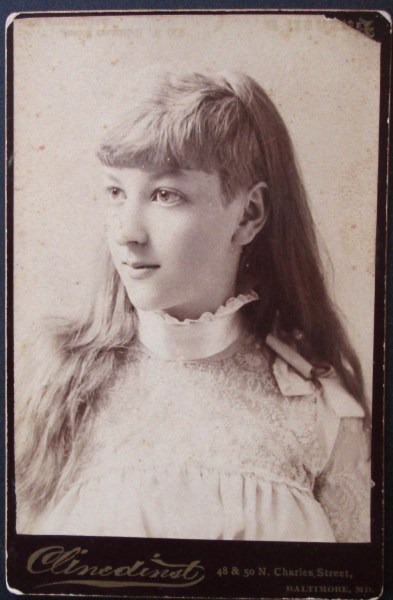
Who was Lavinia Patterson? I found a cabinet photograph of her in one of the boxes from my mother’s cousin. Written on the back, her name, the date and place. It wasn’t in one of the albums, just in an envelope with other pictures. She was a good looking girl with what I thought was an unusual haircut. She had very long hair hanging free with bangs and a short boy cut around her ears. Cutting or shaving some of one’s hair is a style seen now but in 1886?

The first clue was the photographer’s name and address. Barnett M. Clinedinst Sr and Jr had a studio in Baltimore from 1880 to at least 1891. Clinedinst Sr. began as an artist and turned to photography after the Civil War. He built up a prosperous business in Staunton, Virginia and later settled with his wife Caroline McFee and children in Baltimore. His son followed him into the business and they opened a studio in Washington DC where they photographed Presidents, military men and societie’s elite. Barnett Jr became the official White House photographer for three administrations. They were also innovators and were some of the first to use flash lighting.

Much information about the photographers exists but what about Lavinia? In an 1887 Erie PA directory, Lavinia B. Patterson, a student, lived at the corner of 7th and Sassafras, the same address as a Revered James G. Patterson of Park Church. Two years later Rev Patterson resigned as pastor of the 2nd Presbyterian Church of Erie. There was also a Lavinia and Anne Patterson going to a school in 1881 but so far no proof that either is this Lavinia.

This picture was with other photographs that had belonged to my great grandmother, Ida Girod Bruneau. Ida taught school in Baltimore before she married Ismael Bruneau in 1886. Was Lavinia one of her pupils saying goodbye to Ida, a favourite teacher?

Notes:

The photograph was taken on June 8th 136 years ago.

Dolphis Bruneau – Life in North Adams

Many French Canadians left the farms of Quebec and migrated to the mills of New England in the mid 1800s. Some worked and then returned home while other like Dolphis Bruneau settled in the United States. 

Dolphis was the eldest son of Barnabé Bruneau (1807-1880) and Sophie Marie Prud’homme (1812-1892) my great great grandparents. One would think he would inherit the family farm in Saint Constant, Quebec but he had moved to North Adams, Massachusetts, long before his father’s death.

North Adams, a mill town in Berkshire County, grew at the convergence of two branches of the Hoosic River, which gave the town excellent water power for the developing industries. Dolphis arrived there 1864, at the end of the Civil War. He first lived in a rooming house and worked as an operative, presumably in a mill. At the same time, his younger brothers, Aimé and possibly Napoleon also lived and worked there.

He married Nellie Saunders the daughter of an Irish immigrant Thomas Saunders. She worked in a shoe factory. They started a family with Maude born in 1871 and another daughter Nellie three years later. Tragically, his wife died during that childbirth so Dolphis was left to raise his two daughters alone. He must have had help from Nellie’s family, as he didn’t move back to Quebec like his brother Napoleon and applied for his United States Naturalization Petition in 1895.

Dolphis’ wife Nellie Saunders

Dolphis continued his quiet life in North Adams. He worked as a carpenter possibly not at a mill but for for a cabinet maker. He kept in contact with his family in Quebec. Some pictures of his growing girls were taken in Montreal so they certainly went north to visit. He didn’t move much as his address, a rental property, is listed as 15 N Holden St for most of his life. His daughters continued to live with him. Maud seems to have kept house and Nellie worked as a bookkeeper.

Dolphis remarried eleven years after his wife died to a widow, Ester Mary Halse Tingue. Information about his second wife is scant and rather confusing. Ester received a Civil War pension from her first husband and so had some income. The census and city directories show them living apart although listed as married. He lived with his daughters and she lived with her daughter Emma Tingue. Dolphis died in 1909 and Ester in 1924. In her obituary she is refered to as Mrs. Ester T. Bruneau, living at 108 Quincey Street and survived only by Emma. “Her death will bring deep sorrow to her many acquaintances,” it said. Dolphis and Ester were buried in different cemeteries.

The year after her father’s death, Nellie married Arthur Henwood. They moved in with her sister Maud at 15 N Holdon Street. Nellie and Arthur never had any children. Arthur kept a steady job working for James Hunter Machinery as a machinist. His draft registration cards for both WWI and WWII showed him working at the same company. Nellie continued to work as a bookkeeper and Maude continued to keep house. Both sisters had a close involvement with the First Baptist Church.

Maude never married and after her sister’s death in 1939, she and her brother-in-law continued to live together for the next twenty plus years, still at 15 N Holden Street. Arthur died in 1960 and Maude then moved to the Sweet Brook Nursing Home in Williamstown, Massachusetts where she died two years later. Maude’s death ended the Bruneau line in North Adams although most of the family are buried in Maple Street Cemetery.

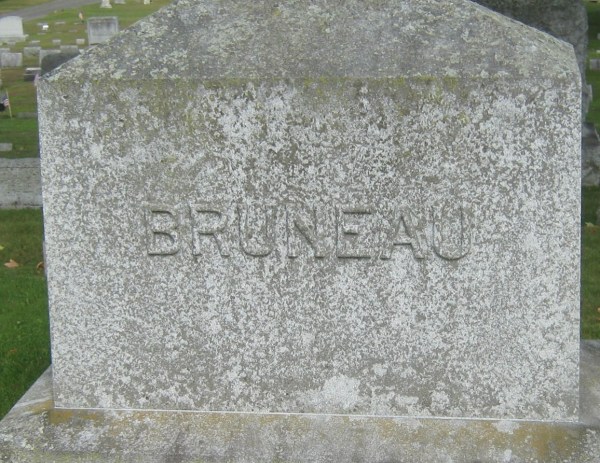
Bruneau Family Tombstone North Adams, MA

Notes:

Dolphis Bruneau Massachusetts, U.S., Death Records, 1841-1915 [database on-line]. Provo, UT, USA: Ancestry.com Operations, Inc., 2013. Original data:Massachusetts Vital Records, 1840–1911. New England Historic Genealogical Society, Boston, Massachusetts.Massachusetts Vital Records, 1911–1915. New England Historic Genealogical Society, Boston, Massachusetts. Accesses March 15, 2022.

Dolphis Bruneau – Massachusetts, U.S., State and Federal Naturalization Records, 1798-1950 [database on-line] NAI Number: 4752894; Record Group Title: Records of the Immigration and Naturalization Service, 1787-2004; Record Group Number: R G 85.  Provo, UT, USA: Ancestry.com Operations, Inc., 2011. Accessed Mar 12, 2022.

Nellie Bruneau Henwood Obituary.The North Adams Transcript (North Adams, Massachusetts) December 27,1939, Page 3. Accessed on Newspapers.com Mar 27, 2022.

Maude L Bruneau Obituary. North Adams Transcript (North Adams, Massachusetts) March 17, 1962, Page 3. Accessed on Newspapers.com Mar 23, 2022.

Mrs Ester T Bruneau Obituary. North Adams Transcript (North Adams, Massachusetts) Dec 19, 1924, page 14. Accessed on Newspapers.com Mar 30, 2022.

1900 Census: North Adams Ward 3, Berkshire, Massachusetts;Roll:632;Page:7;Enumeration District:0051;FHL microfilm:1240632Ancestry.com.1900 United States Federal Census[database on-line]. Provo, UT, USA: Ancestry.com Operations Inc, 2004. Original data: United States of America, Bureau of the Census. Twelfth Census of the United States, 1900. Washington, D.C.: National Archives and Records Administration, 1900. T623, 1854 rolls. Accessed Mar 2, 2022.

Arthur Henwood: Draft Card H. Registration State:Massachusetts; Registration County: Berkshire Source Information Ancestry.com. U.S., World War I Draft Registration Cards, 1917-1918.Imaged from Family History Library microfilm M1509, 4,582 rolls. Provo, UT, USA: Ancestry.com Operations Inc, 2005. Accessed April 5, 2022.

Frances McGregor’s Notebook

The old notebook has a scuffed brown cover, but its pages are full of poetry, transcribed in neat handwriting. Clearly, this notebook once belonged to a woman who admired Lord Byron and other early 19th century English poets. Her name was Frances – or Fanny – McGregor, and she may have been my ancestor.

I came across it while searching for the name McGregor in the online catalogue of the Historical Society of Pennsylvania. The first result to pop up was “Frances McGregor autograph book, 1825.” In response to my query, the society forwarded a digitized copy of the entire notebook.

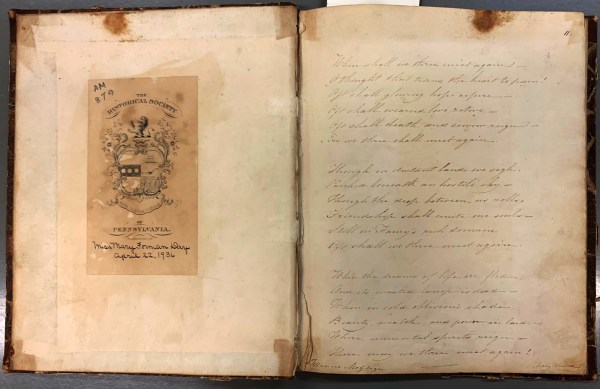
There’s a note clipped to the front, “Frances McGregor? selections from English poets,” which is a more accurate description of it. The label inside the cover indicates it was given to the historical society by “Miss Mary Forman Day, April 22, 1936,” more than 100 years after the last entry was made in 1829.

the donation plate and first page (page 11) of the notebook

Who was Mary Forman Day? She could have been a friend of one of Fanny’s grandchildren.1 Born in Philadelphia in 1860, and died in 1950 in Washington, D.C., she was probably the person who gave many documents pertaining to her Forman ancestors — early Maryland settlers — to area historical societies.2

As for my three-times great-grandmother Mary Frances McGregor, she was born near Port of Menteith, Perthshire, Scotland around 1792. She usually went by her nickname, Fanny. According to family lore, she finished her education in Edinburgh and then came to America. She married English-born Philadelphia merchant Robert Mitcheson, and the census shows they lived in the Spring Garden district, on the outskirts of Philadelpia. I am descended from her eldest daughter, Catharine, who was born in 1822.

I tried to eliminate the possibility that another Frances McGregor owned this notebook, but that proved difficult. Only the head of the household was named in census records and city directories at that time, making women especially hard to find.

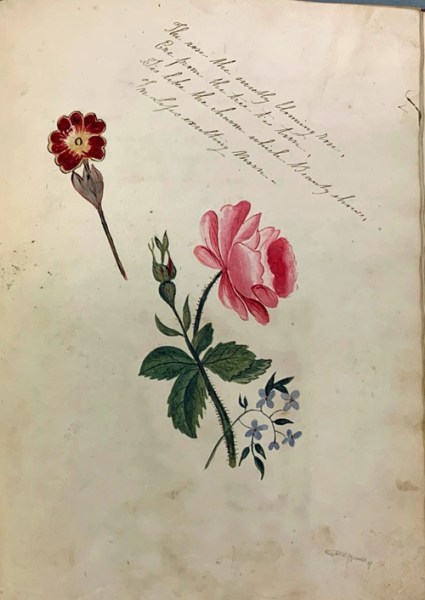
If a title page ever existed, someone tore it out long ago, and the notebook begins on page 11.  Nevertheless, Frances’s name appears three times: she signed “Fanny” on a small botanical painting on the last page, and she wrote “Frances” on the inside back cover.

Her name also appears on page 11, at the bottom of a poem that begins, “When shall we three meet again?” Those words were spoken by the three witches in Shakespeare’s Macbeth, but this is a different poem, expressing the sadness of friends about to be parted. Perhaps Fanny included this poem because she knew she would be leaving her life in Scotland for a new one in the United States.

Many of the poems Frances included in the notebook were written by Lord Byron. She also included a passage from Milton’s Paradise Lost, a short excerpt from an opera and “A Canadian Boat Song, written on the River St. Lawrence”, written by Irish poet Thomas Moore and first published in 1805. The notebook ends with several poems about England’s Princess Charlotte. In 1817, her baby was stillborn and the princess also died. These tragic events inspired much public sympathy at the time.

Frances seems to have written at least one of the notebook’s entries herself. “A Poem – On Home, written by a Young lady at School in the Year 1814” described memories of a loving mother and a happy childhood, but complained of loneliness and disillusionment as the young author moved toward adulthood.  

Besides poetry, Frances included several “puzzles” such as, “Why are your eyes like coach horses?” and “Why is a washerwoman like a church bell?” and “How is a lady of loquacity like a lady of veracity?” She did not include the answers.

One of the botanical sketches in the notebook.

My other favourite entries are the botanical paintings: simple but colourful images of wild geraniums, wild violets and roses.

Whoever created this notebook, it is clear that she was well educated, probably from the upper middle class, and had a quirky sense of humour. The more I think about it, the more strongly I suspect it belonged to my Frances McGregor, but I can’t prove it.

Photo credits: “Frances McGregor autograph book, 1825,” courtesy the Historical Society of Pennsylvania

Notes

1. Grandchildren of Fanny McGregor Mitcheson who could have known Mary Forman:
Joseph McGregor Mitcheson (1870-1926) WW1 navy officer and Philadelphia lawyer;
Mary Frances (Mitcheson) Nunns (1874-1959);
Robert S. J. Mitcheson (1862-1931) Philadelphia physician and art collector;
Helen Patience Mitcheson (1854-1885);
Fanny Mary (Mitcheson) Smith (1851-1937) wife of Philadelphia lawyer and collector of historical documents Uselma Clarke Smith.
Fanny had five other grandchildren in Canada through daughter Catharine Mitcheson Bagg.

2. For example, Mary donated the Forman papers, MS 0403. H. Furlong Baldwin Library., Maryland Center for History and Culture, https://mdhistory.libraryhost.com/repositories/2/resources/49

This article is also posted to https://writinguptheancestors.ca