What is in a name? Aglae Bruneau (1837 – 1906) was the oldest of 13 children in my great-grandfather’s family. How did her parents Barnabe Bruneau and Sophie Marie Prud’homme come up with that name? Aglae is a name of Greek origin meaning splendour, brilliance and the shining one. She was one of Zeus’s three daughters, with her sisters Euphrosyne and Thalia known as the three graces. Apparently, it is not as strange a name as I thought, as the BAnQ (Bibliothèque et Archives nationales du Québec) website has many references to Aglaes even other Aglae Bruneaus.
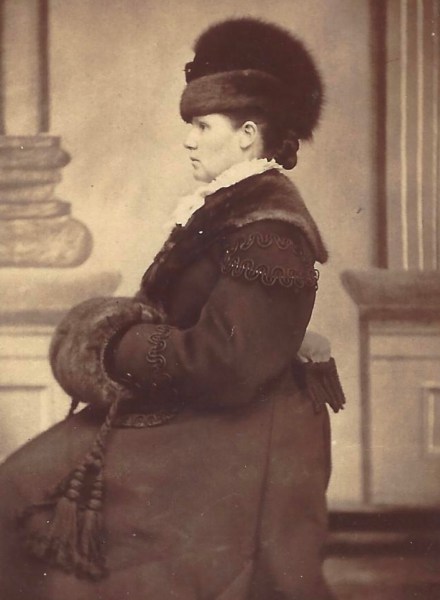
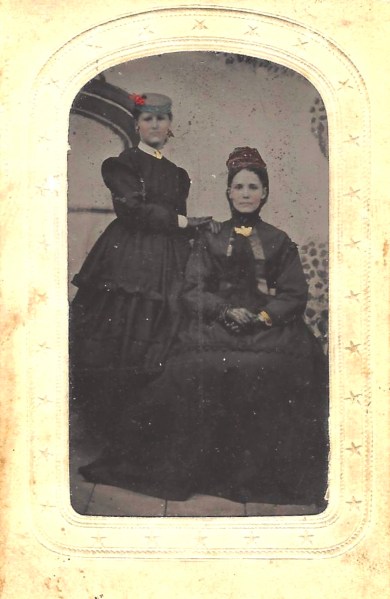
Aglae seated and her youngest sister Anais
Aglae was born on her parent’s farm in St. Constant, Quebec. The family was Catholic as recorded in the 1851 census but converted to Protestantism soon after. Aglae married Pierre Charles Paumier (1828 – 1914) in the First Baptist Church in Montreal in 1860. He was born in France and immigrated to the United States in 1856. He had a farm in Mooers Forks, New York close to the Quebec border. It is possible that they met at religious services held at the Felleur Institute in Grande Ligne, Quebec as French Protestants often moved back and forth across the border for religious events.
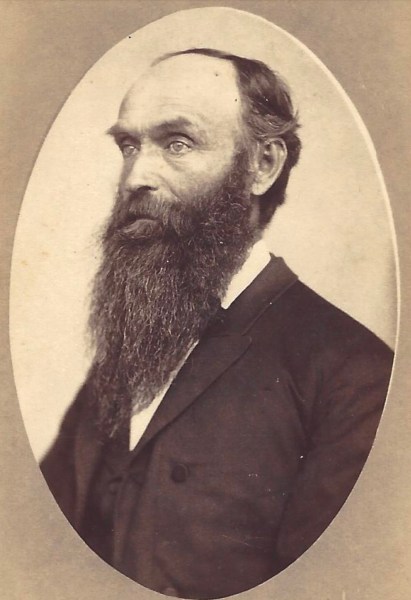
Pierre Charles Paumier
On many of the US census, Pierre Paumier is listed as a farmer but was he originally a Baptist minister from France? My great uncle, Sydney Bruneau, wrote in his recollections “One of my aunts had married a Baptist minister from France, a man who made no secret of loving his pipe and his homemade brew of well-fermented cider, to the no small scandal of his congregation. When he was informed of complaints which had reached the higher authorities, he lost no time in preaching his farewell sermon, flaying his listeners without mercy for their narrowness of mind and their intolerance of the harmless pleasures of life, and retired to a farm where he grew his own tobacco and lived to a ripe old age.”
Like many of Aglae’s siblings, they only had one child Sophie F. Paumier. The family continued to live on their farm which Pierre owned outright and Aglae “kept house” until she died in 1906.
It appears that after Aglae died Sophie and her father sold the farm, packed up and moved to California, as they were living in Los Angeles according to the 1910 census. Two of Aglae’s sisters had also moved west to California. Pierre owned the house and neither he nor his daughter had an occupation listed so he continued to be a man of some means. In some directories, he is listed as Rev. Peter Pomier. Sophie died in LA only five years after her father.
The name Aglae has not been used again in our family. Aglae herself called her daughter Sophie after her mother rather than naming her after another Greek goddess.
Notes:
Census of 1851 (Canada East, Canada West, New Brunswick and Nova Scotia) for Image No.: e002302444 Archives Canada.
Bruneau A. Sydney. Walking With God in Dequen. Page 6. A memoir of his early childhood through the summer of 1910. Written by A. Sydney Bruneau in the late 1960s and transscribed by his granddaughter Virginia Greene, in January 2017. The author has a copy.
Tobacco was grown in Upstate New York and in Quebec and Ontario in the mid to late 1800’s. This shade tobacco was used commercially as cigar wrappers.
In April, 2008 I received an unsolicited email from a Mrs. Joan Hague of Montreal with just one word in the subject line: Changi.
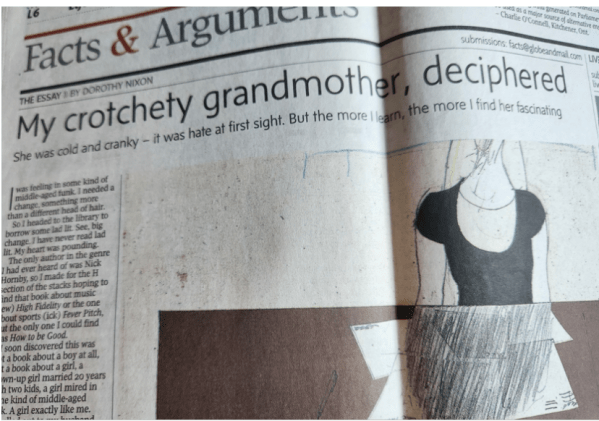
She had seen an article I had written about my grandmother in the Facts and Arguments1section of the Globe and Mail. She wanted to tell me about her father, Thomas Kitching, who had been interned at Changi Internment Camp in Singapore during WWII, just like my grandmother Dorothy Nixon.
I visited the gracious Mrs. Hague (recently deceased at the ripe old age of 99) only to discover something extraordinary: Mrs. H. and my own father, Dorothy’s first son, Peter, had led parallel lives!
My father, Peter, was born on October 24, 1922 in Kuala Lumpur, to a Selangor planter, Robert Nixon of North Yorkshire and his wife, Dorothy Forster of Teesdale, County Durham. Mrs. H. was born in Batu Gajah, Malaya in early November, 1922, to Thomas Kitching, the Surveyor of Singapore and his wife Nora.
As was the custom for British Colonials in the era, Mrs. H. was sent away at age six to go to school in England. She attended Harrogate Ladies’ College in North Yorkshire. My father was sent away at age five to go to a school in Maryport, Cumberland and then he went on to St. Bees prep school on the coast of Cumberland.
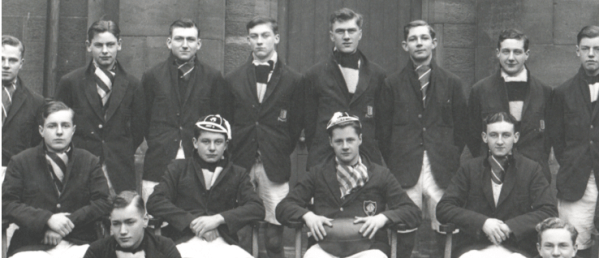
Senior Rugby St Bees School, Cumberland. My father at top, fourth from left. Courtesy St. Bees School Website.
Mrs. Hague told me she spent her holidays with a loving grandmother in Lancashire. My father and his even younger sister, Denise, were shuttled on vacations between random relatives who resented having to care for them.
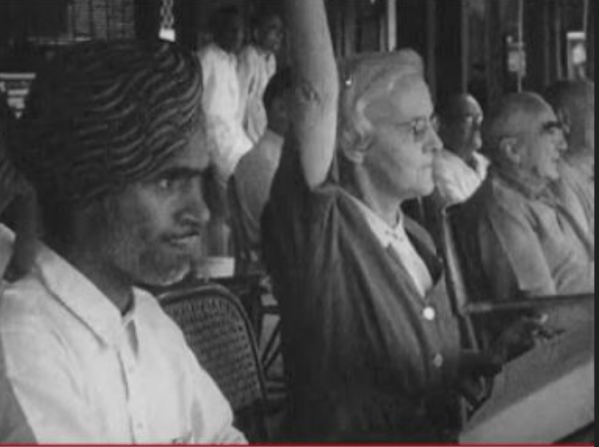
Mrs. Hague’s mother, Nora, a nurse by profession, filled the void in her life with sports, golf mostly. She also scored cricket for Singapore. My grandmother, Dorothy, became the librarian at the Kuala Lumpur Book Club and she was Selangor’s official cricket scorer.
My grandmother, scoring cricket at Royal Selanor Club in K.L in 1952. Courtesy of a March of Time Newsreel. She was the ‘grand dame’ of Malayan cricket apparently. She told a reporter that she got into cricket because her husband, my grandfather, was one of the finest players in Malaya in the 1920’s and 30’s.
In 1939, when the phony war broke out in England, my father was about to go to Oxford. Mrs. H. was in her last year at her ladies’ college. The Harrogate students were evacuated to another town. Mrs. H’s parents, in England for a time, brought her back to Singapore because they thought she would be safer. After two years at Oxford’s St Edmund Hall (where he was awarded ‘colours’ for rugby) my father signed up with the RAF and went to train in Saskatchewan, Canada.
The Japanese invaded Malaya on Boxing Day, 1942.The Japanese planes bombed “the green” at the center of KL, the site of many government buildings. My grandmother’s library building, adjacent the legendary Royal Selangor Club, was hit. During the bombing my grandmother hid under a desk. Later, she helped dig four dead bodies from out of the rubble.
On that ominous day, Mrs. H and her mom were safely in “fortress” Singapore. They joined up as VADs, tending to the severely burned survivors of two navy ships that had been blown up by the Japanese in Singapore Harbour. Mrs. H. had a vivid memory of unfolding the hospital cots that were all covered in a sticky goo to prevent rusting.
Kuala Lumpur soon fell. My grandmother was commanded to take a noisy, unlit night train to Singapore. Upon arriving, she immediately joined the ‘resistance’ at the Malaya Broadcasting Corporation.2
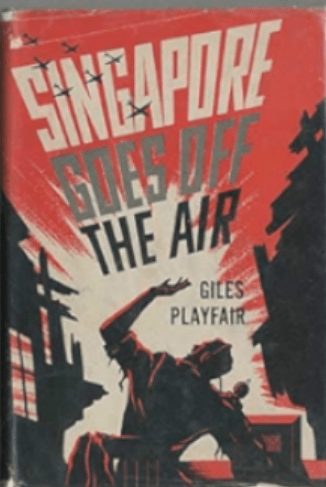
Giles Playfair, a reporter, wrote Singapore Goes off the Air in 1943, so it was likely a bit of wartime propaganda. He oft mentions my grandmother and seems to like her, but he disparages Colonial Wives as lazy and living above their station.
To everyone’s surprise and to Winston Churchill’s embarrassment Singapore soon fell as well. Mrs. H. escaped to Batavia and made it back to England but tragically Nora, her mother, took another boat, the Kuala, with 500 others including 250 women and children, and was lost at sea when her ship was bombed by the enemy.
Mrs. H. trained as a physiotherapist at St Thomas Hospital, London and volunteered at the Canadian Camp.
Mrs. H’s father, Thomas Kitching, was interned at Changi Internment Camp, as were my grandmother and grandfather, Dorothy and Robert Nixon. (Upon the fall of Singapore, Dorothy had stubbornly refused to escape to Batavia, staying instead to support wounded soldiers. A good thing, perhaps.)
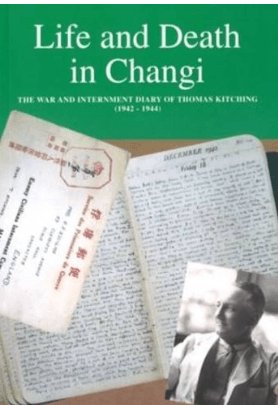
Thomas Kitching’s diary was published posthumously. Mrs. H. lent me a copy.
Kitching died of throat cancer in the men’s section of Changi prison in 1944 but he kept a diary of his time there that was later published. For a six month period my grandmother was Commandant of the Women’s Camp and according to her own unpublished memoirs she liked sneaking into the men’s camp, which was strictly against the rules, to gather information. The men had secret radio sets, you see, and she was an amateur radio enthusiast.
Malaya Straits Times 1936. The only woman among men. From what I have learned, that’s how “Granny,” educated at a co-eductional quaker school, liked it. This is why she just had to sneak into the men’s camp, a very dangerous act, I think. it certainly got her into trouble! Here she is described as Mrs. Dorothy Nixon. In those days and well into the 1960’s in newspapers in North America women were referred to as Mrs. John Smith.” They had no first names.
On October 10, 1944 many of these men and a few women were accused of spying in the infamous Double Tenth incident and taken by the Japanese Gestapo to a room in the basement of the local YMCA to be harshly interrogated, some men horribly tortured. My grandmother stayed in that stifling, bug-infested room with the crazed, half-starved men for a month, enduring a kick in the ribs on occasion, and then she was put in solitary confinement for another five months.
She survived her ordeal, but barely.
My father, meanwhile, was posted to the Ferry Command based in Dorval, Quebec, a suburb of Montreal. A member of both the RAF and RCAF, he flew planes around the world, mostly mosquitos he told me.
A range of Mosquitos were manufactured to do everything from reconnaissance to bombing. Some were made in Downsview, Ontario. Ferrying planes from Canada to Europe was dangerous and many planes didn’t make it, but, hey, it was war.
In Montreal he met my mother, a French Canadian stenographer at RKO Radio Pictures probably at a party at the Mount Royal Hotel. They married after the war in 1949 once my father had finished his war-shortened math degree at Oxford.
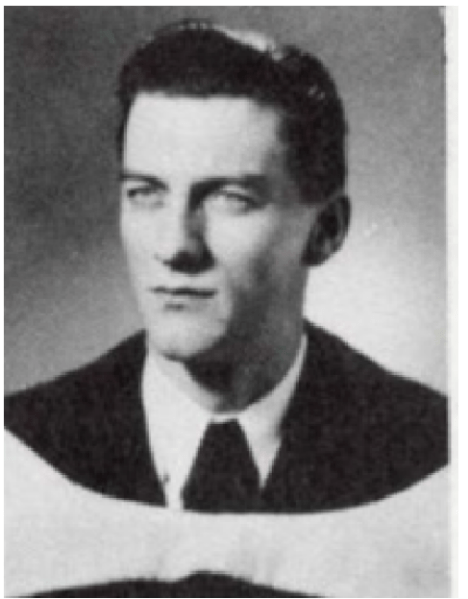
My father’s Sir George Williams grad pic, 1952, that I recently found online. Sir George Williams University night school was designed for returning soldiers, many of whom already had families.
In Montreal, my father added on a night time Commerce Degree from Sir George Williams University and a CA from McGill while working full time and raising a family.
Mrs. H. met her future husband, Mr H., the son of a prominent Westmount banker, during the war in London at a party for Canadian soldiers. The invitees brought with them a big juicy turkey apparently. The couple married in Morecambe Parish Church and moved to Montreal on the war bride scheme.
It is too bad I never got the chance to introduce Mrs. H. to my father as he succumbed to Alzheimer’s in the St. Anne de Bellevue Veteran’s Hospital in 2005. They certainly would have had a great deal to talk about!
Indeed, they may have already met. They both sent their sons to Lower Canada College on Royal Avenue in NDG in the 1960’s.
2. Chronicled in a 1945 book Singapore Goes off the Air by Giles Playfair. The author wrote fondly of my grandmother, although he held the common belief (from back then) that Colonial women were indolent parvenues, ‘who would be sweeping out a four bedroom cottage back home’ were they not in Malaya attending fancy liquor-oiled soirees and waited on at home by a slew of servants.
3. Joan Hague obituary, chronicling her ‘interesting’ life with portrait young and old. I wrote this piece years ago and posted it on my personal blog after passing it by Joan Hague but also added two tidbits from her online obituary: Her marriage details and her work details.LINK HERE
On a recent family trip to Cork, Ireland, we detoured briefly looking for the Anglin Family farmhouse ruins from the early 1800’s. Several Anglin cousins over the years recorded and shared their trips so that with copious precious notes in hand we thought we were well equipped for our adventure!
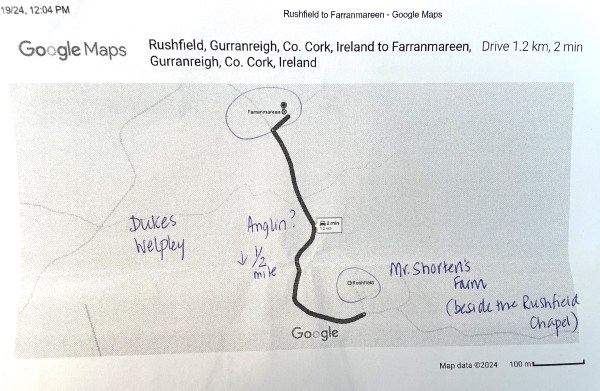
An Anglin letter from 1963 pinpointed the location of the family home somewhere between Farranmareen in the north and Rushfield (one kilometre further south) “near Bandon” just 36 kilometres west of Cork. We looked up the two geographic latitude and longitude (GPS) coordinates for the two markers so … how hard could it be?
All eyes were focused left and right as we drove the kilometre between the two points. Alas! Nothing to see but green fields everywhere and a scattering of houses. Where were the signs with “The Anglin Farm was HERE”?
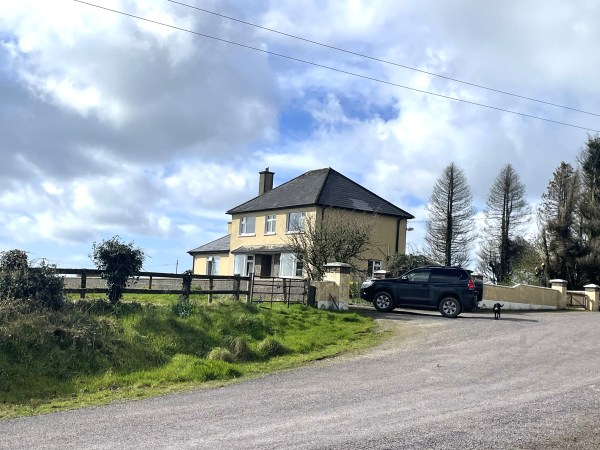
Upon reaching Rushfield, my notes referred to a chapel not far from a farmhouse on the corner. Spying a farmhouse nearby, we made our way through the barking dogs and knocked on the door, but no one answered. We persevered as there was a vehicle in the driveway and a huge transport truck parked nearby. Another knock. Suddenly a farmer walked around from the side of the house munching on a bit of lunch.
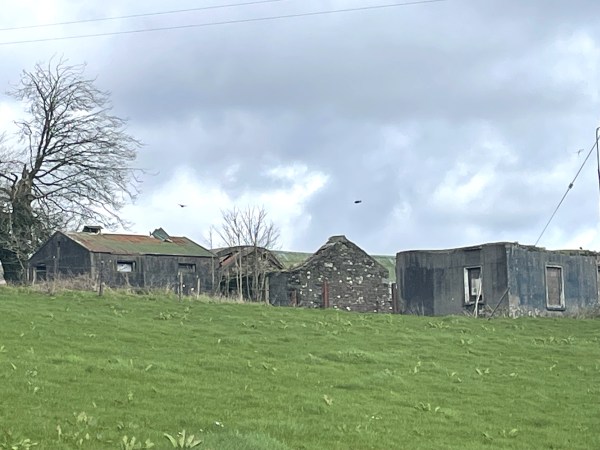
I introduced myself as an Anglin and referred to the cousins over the years who had made the same pilgrimage. The farmer looked puzzled. So I inquired about the whereabouts of the Rushfield Chapel to which in reply he pointed to some ruins across the road that barely even looked like a building anymore. Disappointed but refusing to give up, I checked my notes and inquired if he knew a Mr. Shorten who was helpful to my cousin in 1963. He smiled and introduced himself as … Mr. Shorten!
Rushfield Chapel ruins
This Mr. Shorten didn’t recognize the Anglin name (it must have been his father in 1963) but guessed where the Anglin farm might have been. Back up the road to Farranmarren we drove to knock on a few more doors. The next stop was a bungalow with another barking dog. A middle-aged lady came to the end of the drive and thought the Anglin farm might have been in the field beside her. However, she suggested that her elderly neighbour across the road might know more and brought me to meet her.
“Looking for the farm some years ago, with my wife and two Anglin cousins, we could not find any buildings. But we knocked on a door at a corner where you leave the main road. The door was answered by an older lady whose maiden name turned out to be Duke. She gave us tea and said that our Anglin ancestors operated mixed farming and would have been comfortable during the famine.” (Perry Anglin)
After a brief introduction, I couldn’t resist asking her: “Is your maiden name ‘Duke’ by any chance?” Well her eyes lit up and she smiled saying: “Yes!” My great great grandfather William’s oldest brother John Anglin married Sarah Duke in 1836 in Cork. I was speaking with my (very) distant cousin!
William and John’s parents, Robert Anglin and Sarah Whelpley, had four sons and one daughter. All four sons emigrated to Kingston, Ontario, one by one, with my great great grandfather William (the youngest son) leaving Ireland in 1843 just before the Great Famine. John eventually joined the others in Kingston but only after the death of their parents. Their sister emigrated to the States possibly not wanting to stop in Kingston to care for four brothers!
William married Mary Gardiner in 1847 in Kingston and had two daughters (both died young) and two sons (William and James) who both became doctors and surgeons.
It appears likely that over the years Mother Nature reclaimed the Anglin Family farm with its defining stone walls having disappeared completely beneath the greenery. However, I can attest to the fact that the view described by my cousin remains the same:
“It is a stunning view from the farm down into the Bandon River and beyond to a coastal range tinted mauve in the distance.”
I would like to finish my little story by sharing some helpful information with my Anglin cousins! Here are the GPS coordinates of the Anglin Family farm: 51°47’00.3″N 8°56’09.8″W
When I was a teenager, I came across a book in my parents’ house called Intention and Survival, written by T. Glen Hamilton, my grandfather. Inside a plain beige cover, the text was illustrated with grainy black and white photographs. Many of them showed a middle-aged woman, her eyes closed, with a white substance coming from her mouth or nostrils. Tiny images of the faces of deceased individuals seemed to be embedded in this substance.
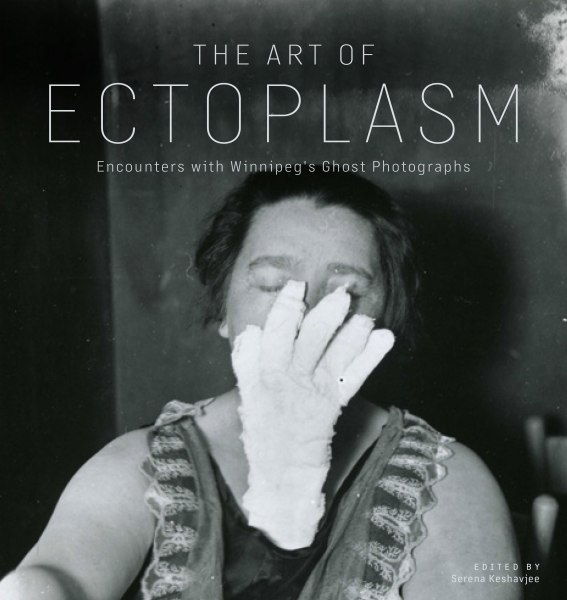
Those photos gave me nightmares, and for decades, I have been trying to figure out what to make of them. Now, a new book called The Art of Ectoplasm: Encounters with Winnipeg’s Ghost Photographs is helping me understand them.
Edited by Serena Keshavjee, a professor of art and architectural history at the University of Winnipeg, and published by the University of Manitoba Press, The Art of Ectoplasm looks at the context in which my grandparents researched and photographed psychic phenomena, including that white substance called ectoplasm. The book describes their work and the many artistic projects it has inspired.
Published on large-format paper, the book itself is a work of art. The black and white, sepia and contemporary colour photographs almost glow. Most of the old photos were taken during séances held at the Hamiltons’ Winnipeg, Manitoba home 100 years ago. Shot in a darkened room, lit by flash, with large-format cameras, these are sharp, high-contrast images that can be seen as both documentary photos and as art. Meanwhile, the 300-page text explores the history of these séances and includes an extensive bibliography.
Dr. Thomas Glendenning Hamilton (1879-1935), known to most of his friends as T.G., was a family physician and surgeon, president of the Manitoba Medical Association and member of the Manitoba Legislative Assembly. He was a strict Presbyterian and elder of his church. He and his wife, Lillian (Forrester) Hamilton (1880-1956), had four children, including twin boys. Everyone in the household got sick during the 1918-1919 influenza pandemic, and one of the twins, three-year-old Arthur, died of the flu.
At the time, many people were strongly religious and believed in personal survival after death. Some tried to communicate with deceased loved ones. Alhough T.G.’s experiments in telepathy date from 1918, before the influenza pandemic, Arthur’s death may have stimulated the Hamiltons’ interest in the psychic field. Lillian started experimenting with table movements and rapping, and eventually T.G. was encouraged to participate. He decided to take a scientific approach. He prepared a room in the family home where the conditions could be carefully controlled and, in 1923, he began to conduct a series of experiments related to telekinesis, trance and mediumship that included the appearance of ectoplasm. These séances took place once or twice a week over a twelve-year span.
Lillian encouraged and collaborated with her husband, conducted research to make sense of alleged trance communications, did much of the organizing and often chaperoned the mediums. After T.G.’s death, she compiled the notes taken during the séances, as well as the photographs, her husband’s speeches and other material. She also continued to attend séances. She has received little public credit for her contributions, but that is beginning to change as Katie Oates, of Western University in London, Ontario, contributed a chapter in this book that focuses on Lillian’s role.
In 1979, T.G. and Lillian’s daughter, Margaret Hamilton Bach (1909-1986), donated the original photographic plates and documents to the archives at the University of Manitoba. Since then, the university has received many other collections of material related to psychical research and, as archivist Brian Hubner writes in The Art of Ectoplasm, the city has become known as “weird Winnipeg, an unlikely centre of the paranormal”.
Shelley Sweeney, archivist emerita and retired head of the University of Manitoba Archives and Special Collections, notes that the Hamilton Family Fonds has inspired a variety of projects, including books, plays and visual arts. It is the most utilized collection of personal records held by the archives, and photographs from the Hamilton collection have been exhibited in museums around the world.
In another article, Esyllt W. Jones, a professor of history and community health sciences at the University of Manitoba, puts the Hamiltons’ séances into the context of the couple’s grief following their child’s death. She also shows how their experience was an example of the trauma caused by the pandemic and the loss of loved ones during World War I.
Miniature face in ectoplasm of C.H. Spurgeon, with medium Mary Marshall, taken by T.G. Hamilton, May 1, 1929. UMASC H.A.V. Green Fonds
Thanks to the movie Ghostbusters, the word ectoplasm became popular in the 1980s, long after T.G.’s research involving ectoplasm took place between 1928 and 1934. Ectoplasm has been described as a vaporous substance that appears from the mouth or other orifices of a medium. Formless at first, it can change to resemble muslin or cotton batting before being reabsorbed into the medium’s body. T.G. thought of it as a living thing, directed by an internal intelligence. Ectoplasm has not been tested in a laboratory and, since World War II, it has not been considered a topic for credible scientific study.
The scientific methods that T.G. used in his “laboratory” are outdated today, but during his lifetime, as editor and contributor Keshavjee writes, psychical research was considered within the bounds of accepted scientific inquiry. There was a large body of literature on the topic and a number of well-respected scientists of the era accepted that strange things happened in the séance room. But, Keshavjee suggests, when the Hamilton séance activities began to be directed by an unseen personality called Walter, T.G.’s claims that he followed scientific methods lost credibility.
Today, questions about fraud hang over many psychic activities. Some people are convinced the Hamilton séances were fraudulent, others believe they were genuine. For the most part, this book accepts the Hamilton séance photographs without trying to address the issue.
In his chapter defending the Hamilton family psychical research legacy, Walter Meyer zu Erpen, founder of the Survival Research Institute of Canada and an archivist who has spent more than 30 years investigating these events and the people involved, concludes that the ectoplasm photographed by the Hamiltons was genuine.
Whether the appearance of ectoplasm was proof of survival after death is another question. In general, Keshavjee writes, there is little basis for belief that psychic phenomena inherently provide evidence of life after death. Meyer zu Erpen admits he is taking a middle-of-the-road position when he suggests that, in the Hamilton séances, only the ectoplasm samples with miniature faces of the deceased contribute to evidence for survival of human personality beyond death.
T.G. was convinced, however, that what he experienced in the séance room could only be the work of surviving spirts. For him, and for Lillian, survival was a fact.
The Art of Ectoplasm did not answer all my concerns, but for anyone interested in the Hamilton séances from an artistic, historical or psychical research perspective, it is worth going beyond the amazing photos and reading the text.
Full disclosure: as family historian, my research has been quoted several times in The Art of Ectoplasm and my father edited Intention and Survival.
The Art of Ectoplasm is available from the University of Manitoba Press, https://uofmpress.ca/books. It can also be ordered from Amazon, Indigo and other booksellers.
I had a great-granduncle who went by the name of William Richard Case Palmer O’Bray. William Richard was a brother to my great-grandfather. William Richard and his wife Margaret Elizabeth Burnett had a family of 14 children eight girls and six boys.
Three of his girls died within a month of each other and William Richard died at quite a young age, 44.
A shipwright by trade he lived, worked and died in New Brompton and Gillingham Kent, England. It would appear he had a hard life at work and at home.
William Richard’s occupation, in St. Mary, Pembrokeshire, Wales in 1871 when he was sixteen years old, was as an apprentice blacksmith. In 1881 he was a shipwright in Gillingham, Kent. By 1891, he lived in New Brompton, now part of the Medway District still working as a shipwright.
Shipwrights were responsible for constructing the structure of a ship and most of the internal fittings. Shipbuilding was a tough job, ships were built in open-air shipyards throughout the year, even in winter. The tools used, such as drills and riveters were loud and dangerous. (1)
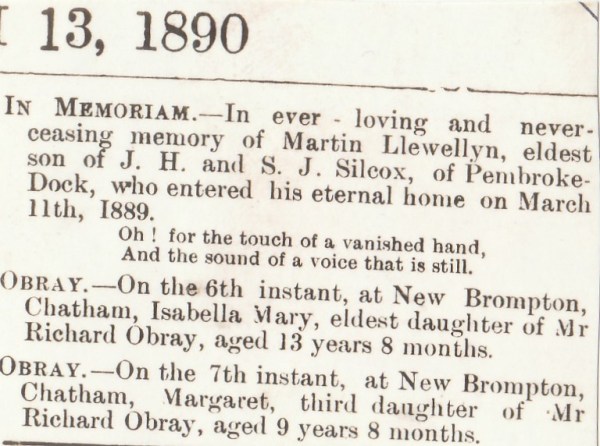
However, upon researching his family I discovered to my sadness that in 1890 on the 6th of March his eldest daughter, Isabella Mary aged 13, died. The very next day, Margaret Elizabeth, aged 9 years and 8 months died.
On the 13th of March 1890, the family posted an obituary for Isabella and Margaret.
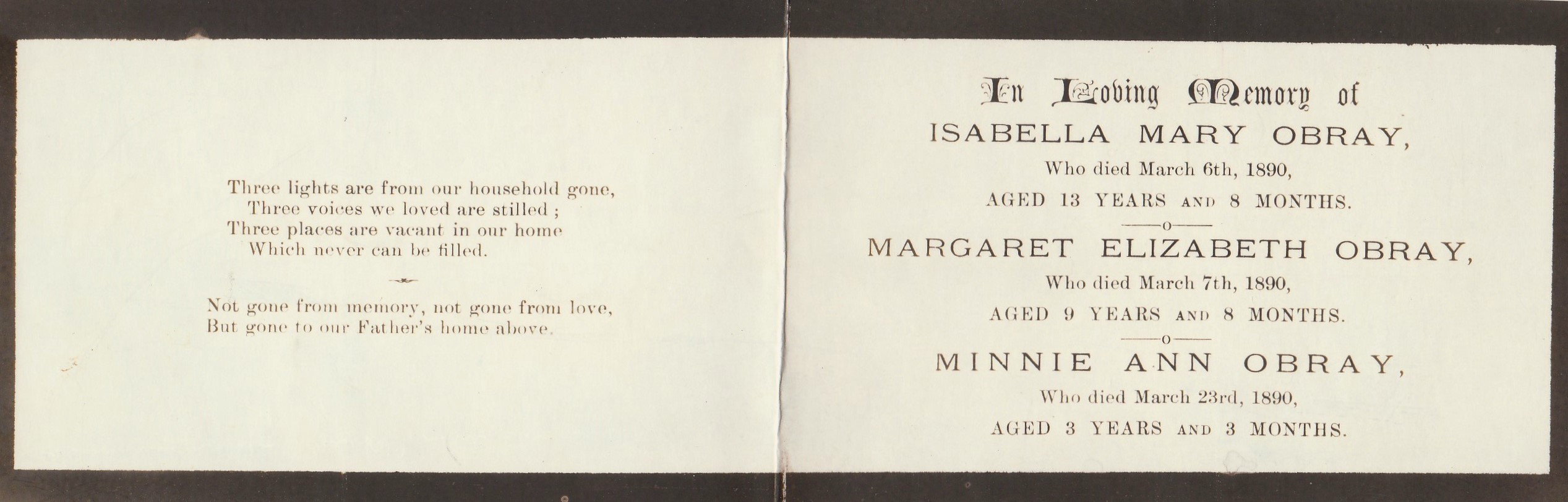
Unfortunately, on the 23rd of March 1890, Minnie Ann (twin to Florence Ann), aged 3 years and 3 months also died. Below is the death card, typical for that era, for the three sisters. (3)
The text reads:
Three lights are from our household gone, three voices we loved are stilled; three places are vacant in our home, which never can be filled.
Not gone from memory, not gone from love, but gone to our Father’s home above”
I am in the process of obtaining the death certificates of the three girls, and I hope to add an update later on the cause of their deaths.
The 19th century in England was marked by the widespread prevalence of diseases such as tuberculosis, cholera, typhus fever and smallpox. These diseases posed significant medical challenges to society, with limited medical knowledge and resources available to combat them.(2)
My first thought was the profound shock my poor family must have suffered. William Richard Case Palmer suffered many tragedies in his short life.
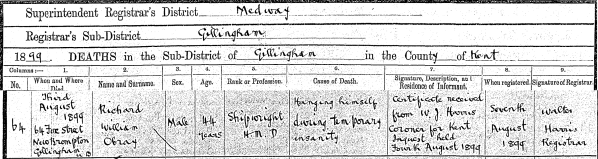
Ten years later, on the 3rd of August 1899, William Richard Case Palmer O’Bray died by his own hand. His death certificate reads:
“Hanging himself during temporary insanity”
Losing a child is not what a parent should experience, but to lose three in the same month is unimaginable. Was he depressed? I would think so, even 10 years later. There was nothing to help with the heartfelt losses in the 1800s. His wife, Margaret Elizabeth died in June 1919 aged 62 in Medway, Kent.
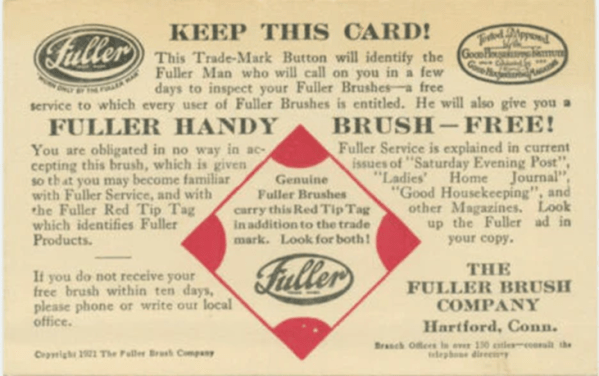
The advertisement in the February 24, 1928 edition of the Montreal Star called for three reliable men to apply for a special sales campaign for the Fuller Brush Company.
My dad, Edward McHugh, probably answered an advertisement similar to this one when he finished school in the late 1920s. He worked as a Fuller Brush salesman for two years in Montreal. Alfred Fuller founded the Fuller Brush Company in 1906. The company produced good quality brushes and increased its sales force by advertising for salesmen. But the secret of its selling success was that each salesman (they preferred men in those days) had to sign a pledge in which they promised that “I will be courteous; I will be kind; I will be sincere; I will be helpful.”1
The salesmen left cards like this one when no one was home:
As you can see in the above picture, my dad was a snazzy dresser. Knowing him, he probably took a lot of care with his appearance when he was out selling brushes. I remember him polishing his shoes every morning before going to work.
I assume that he succeeded fairly well at selling Fuller Brushes.2 But he must have been restless and in search of adventure because he left Montreal after just two years of selling brushes. Just travelling to Bermuda would have been quite an adventure in itself. He would have started his trip by going to New York City by train where he would then take an ocean liner. The Furness Bermuda Line and operated regular passenger and mail service between New York and Hamilton, Bermuda at the time.3
Edward must have encountered some challenges selling Fuller Brushes in Bermuda as he ended up working as a bell hop in a hotel that catered to rich patrons from the U.S. and Canada. The tips he earned helped him pay for business college when he returned home to Montreal.4
The Princess Hotel, Hamilton, Bermuda5
By the time Dad completed his business and accounting courses, Canada was in the Great Depression. He again got itchy feet again and moved to Drummondville, Quebec with his older brother, Thomas McHugh, his sister, Sarah Jane McHugh, and her husband, Jack Day. In Drummondville, he did not work as a Fuller Brush salesman, a bell hop, or in business or accounting. He apprenticed as an electrician at the Celanese and worked there for eight years until 1940, when he enrolled in the Royal Canadian Air Force as an aircraft mechanic at the outset of World War II. The RCAF trained my dad in aircraft hydraulics and he was assigned to Bomber Command stationed in Yorkshire, England, for the remainder of the war.6
It is no surprise that Dad did not become an aircraft mechanic after the war. He loved being an electrician and his started his own electrical company, Provincial Engineering. He eventually sold his portion of the business. I remember him saying, “the boss always gets paid last.” After that, he joined a firm and worked in a supervisory capacity on the electrification of towns in regional Quebec such as Sept-Iles and Chibougamau.
Dad was curious and loved trying new things. He never backed down from a challenge.
When my dad retired, he and my mom travelled to Bermuda regularly for their winter getaways. He must have enjoyed going back and perhaps even having a meal or two at the hotel he worked at when he was a young bell hop.
James Cecil Hunt (1879-1937) worked a 30-year career as a Locomotive Engineer in Manitoba, Canada. He left his birthplace in Owen Sound, Ontario, at the age of 22, and headed west to Port Arthur (now Thunder Bay), Ontario. There he met and married Cassie (Catherine Elizabeth Grummett 1884-1966), a glamorous Winnipeg girl, at the age of 28. They raised their five children in Brandon, Manitoba, and eventually moved back to Winnipeg where they bought a house and stayed the rest of his life.
Cecil and Cassie’s Wedding 1907Cassie on her wedding day 1907
His first job as a “labourer” according to the 1901 Census might have been with the Canadian Northern Railway (CNoR). “The Canadian Northern Railway was incorporated (1899) as a result of the amalgamation of two small Manitoba branch lines. It was built up over the next 20 years by its principal promoters, William Mackenzie and Donald Mann, to become a 16,093 km transcontinental railway system.”
However, the competition with their transcontinental rivals proved to be insurmountable and Mackenzie and Mann were forced out of the company, which then became one of the first major components of the soon publicly owned Canadian National Railways (CNR).1
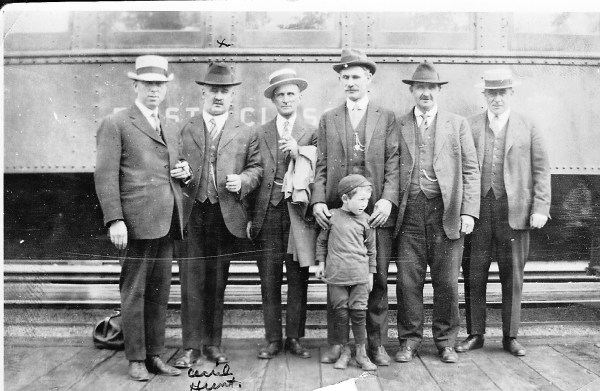
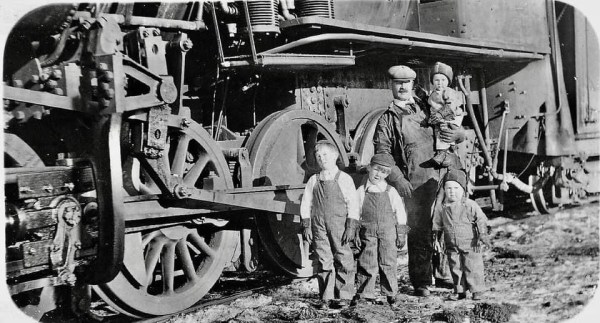
Cecil Hunt (second from the left) and other locomotive engineers posing in front of a First Class car.
After 18 years working up the CNoR ladder, Cecil’s career as a Locomotive Engineer began shortly after the June 1919 incorporation of the CNR, which then consisted of several other bankrupt railways belonging to the Canadian government.2 The CNR is the longest railway system in North America, controlling more than 31,000 km of track in Canada and the United States. It is the only transcontinental rail network in North America, connecting to three coasts: Atlantic, Pacific and the Gulf of Mexico.3
As a Locomotive Engineer, Cecil would have operated and controlled a locomotive engine (No. 73083.5 to be exact) that powered the train on railways. His responsibilities would have included controlling the speed, acceleration, and braking to ensure smooth and timely journeys as well as a thorough knowledge of the entire railway system, signals, and track conditions, all while adhering to strict safety regulations and protocols.4
Cecil and children Allan, Lyndon, Holman and Beatrice circa 1916
Cecil’sCNR Steam Engine no. 7308(scrapped in November 1951)
According to the 1931 Census, Cecil at age 52 owned a three-story eight room stucco house at 588 Warsaw Avenue, in Winnipeg not far from the Red River, and made an annual salary of $3,200 ($65,000 in today’s dollars). Locomotive engineers easily make double that today.5
Cecil had obviously done well for himself since ten years before becoming a proud homeowner, he already owned a Model T Ford which, according to this photo, the whole family enjoyed!
Cecil, Sydney, Cassie, Beatrice, Holman, Lyndon and Allan (my husband’s father) circa 1920
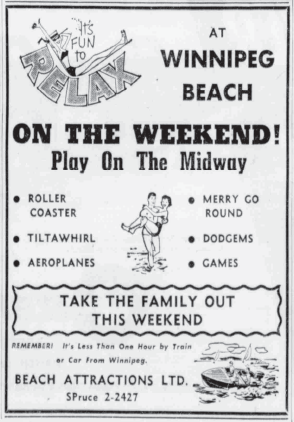
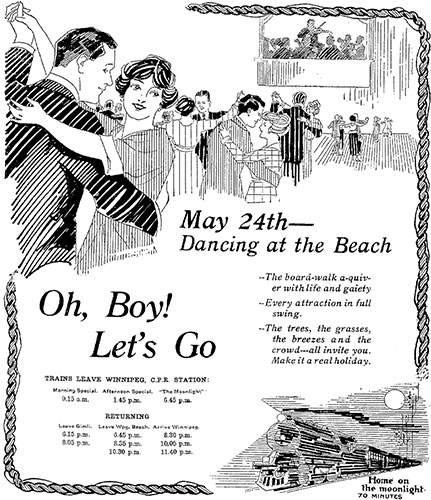
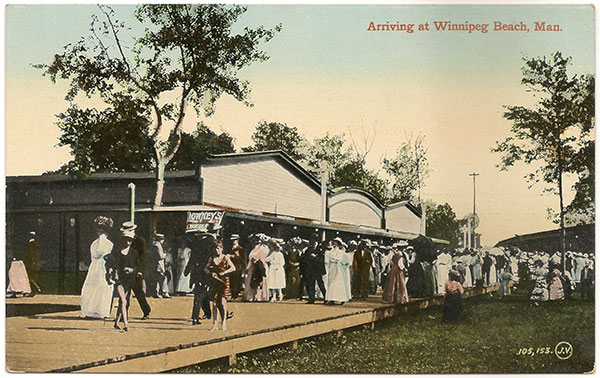
Although, travel by car did not become common until the mid-1920’s, most people could take the “beach train” for their excursions to the famous nearby Winnipeg Beach. By 1912, ten trains took 40,000 vacationers to the beach each weekend.5.5
Winnipeg Beach had developed into an impressive amusement park – complete with a roller coaster, merry-go-round, and “moving picture house”. Over the years, more attractions were added, including bumper cars and an airplane ride. All this as well as the very popular dance pavilion and multiple arcades along the boardwalk. The “Moonlight Special” provided a round trip by train for 50 cents and a night of dancing could be purchased for another nickel. It is rumoured that “many generations of people owe their existence to the fact that their parents, grandparents or great-grandparents met on the ‘Moonlight’.”6
Winnipeg Beach: L to R – Beatrice, Sydney, Cecil, Cassie, Allan, Lyndon and Holman (notice the locker keys pinned to their bathing suits!)
In May 1937, Cecil and Cassie attended their son Allan’s wedding to Agnes Kirk (my husband’s parents). Allan worked his whole life in aviation with several airlines culminating in a 37-year career with Trans-Canada Airlines (which later became Air Canada) and my husband also had a 30-year career with Air Canada. Three generations of Hunts working in national transportation!
Shortly after that May wedding, Cecil suffered heart failure and Cassie nursed him at home until November when he died at age 58. The “weak heart” gene plagued all the Hunt men and continues to do so even to this day.
Tall stylish Cassie, however, lived almost another 30 years, and as a CNR widow, travelled with her train pass visiting her family from coast-to-coast every few years. After Cecil’s death, she lived for a while with her son Holman in the Slate River district near Thunder Bay, and then with her daughter Beatrice in Richmond, British Columbia until she died at the age of 82. Her obituary pays tribute to her lifelong commitment to the Order of the Eastern Star (part of the Masonic Family) both in Winnipeg and in Richmond.
Cassie and her two sons Allan and Sydney
The glimpse into the life of any ancestor makes writing about genealogy so gratifying … and the best part about this story is my husband getting to know a little about the grandfather he never met.
Please read my story about my husband and his father Allan Hunt:
In the summer of 1948 one sunny afternoon, our dad called my brother, Paul, seven years old, and me eight, to hop in our 1947 black Ford. This did not seem unusual. Often on a Sunday afternoon, he would take us for a long drive around the Eastern Townships. However, this was not a Sunday. We both gave each other a quizzical look and wondered, “What’s up?”
Dad soon explained. We were on our way to the Richmond train station, about fifteen miles from home to meet an important person. “Who could this person be?” Our curiosity was aroused. Before long Dad had us reciting a Finnish greeting: “Hei isoaiti.”
We were on our way to welcome our grandmother.
As life would have it, this was the only opportunity I had to spend time with my grand-mother, Ida Susanna Karhu. She lived in Ashtabula, Ohio, far from Asbestos, Quebec. Over the years she visited her son, Karl, my dad, only twice. The second time in 1954 she visited the family with her third husband, Gust and his son, Elmer..
Ida was born in Isokyro, Finland in 1886 and emigrated at nine. In 1903 at sixteen, she married, Johan Hjalmar Lindell, nine years her senior. During their forty-one years of marriage, they had eight healthy children and their ninth child lived only 4 days.
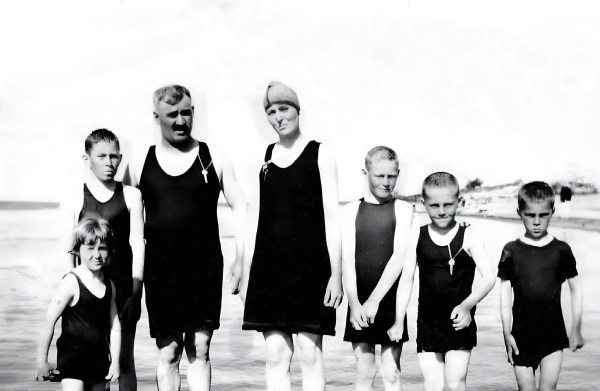
Johan and Ida
Grandfather Lindell was a blacksmith with four forges and shod the horses of large brewery wagons that were drawn by these very large strong horses. With the advent of trucks, automobiles, and the Temperance League, circumstances forced him to close shop.
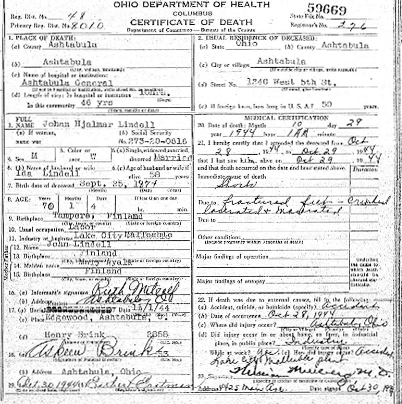
Johan began working in a munition factory. In October of 1944, he was tragically struck by a forklift and ultimately died due to his injuries.
Johan Herman Lindell’s 1944 death certificate
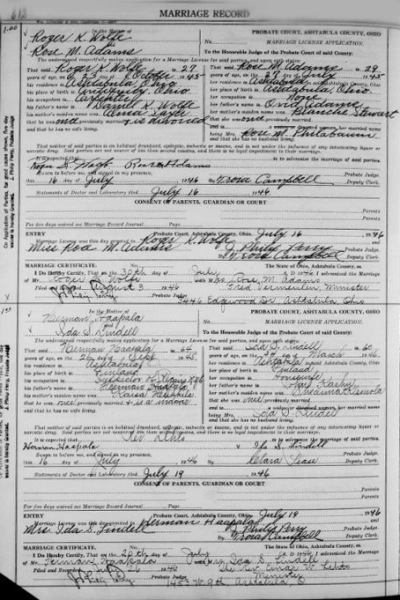
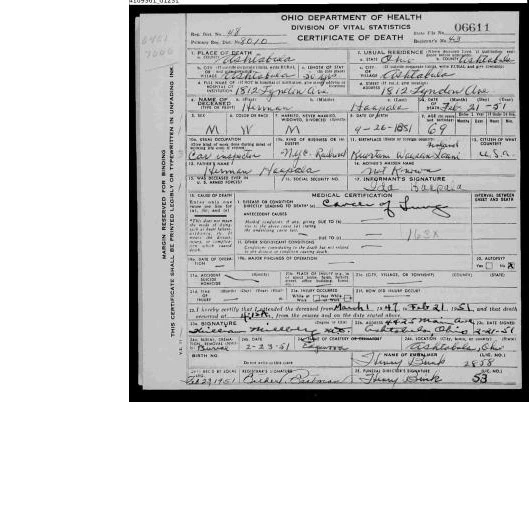
Two years after Johan’s passing in 1946, Ida married Heman Haapala from Ashtabula. He had been employed as a car repair man for the railroad company. They were both in their sixties and in good health. This allowed them to travel to Florida during the winter months. Alas! this union lasted a few short years. Herman died of lung cancer in February 1951.
Ida and Herman’s Marriage Record
Herman’s Death Record
Ida found herself a widow once more. However, not long after Herman’s passing, only after a few brief months, she met a Swedish dairy farmer from Cook, Minnesot, Gust Gustafson. He had been widowed twice. How they met is a mystery. Perhaps they knew one another from their traveling days. Together they embarked on their third marriage, June 16th of 1951.
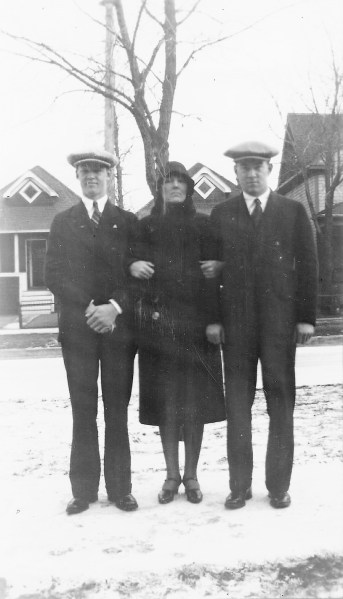
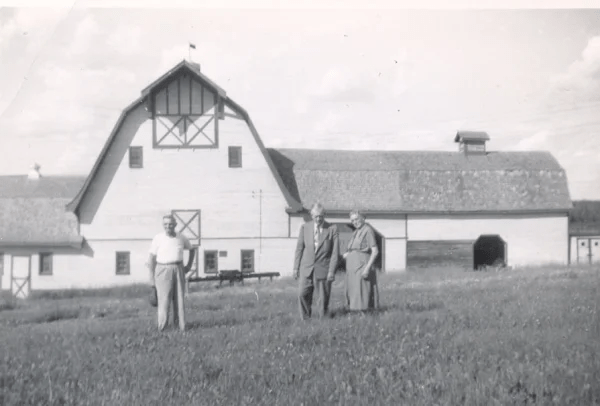
Ida and Gust (circa 1952)
The dairy farm in Minnesota
In 1954 Ida, Gust, and his son Elmer visited Mom and Dad at their recently acquired farm in Asbestos.
Ida and Gust were together for many years. Just how many is a bit of a conundrum. At this point, I can only speculate as to the outcome of their marriage. I surmise that perhaps my grandmother decided to visit California. Her children, my Uncle Milton and Aunt Helen Lindell Lev had settled there with their families. Ida always enjoyed travelling and visiting her children.
Had she moved to be closer to family or was she visiting? While in California she died on December 17, 1967, In Belleflower. She was eighty-one years old at the time of her death and had led a full and interesting life. She had been active in the Ashtabula community, Bethany Lutheran Church, and the Ladies of Kavela, while raising her family, and in later years enjoyed travelling.
She is buried in Edgewood Cemetery in Ashtabula, Ohio beside Johan Hjalmar, her first love and husband of forty-one years.
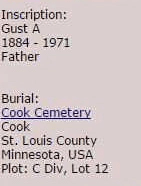
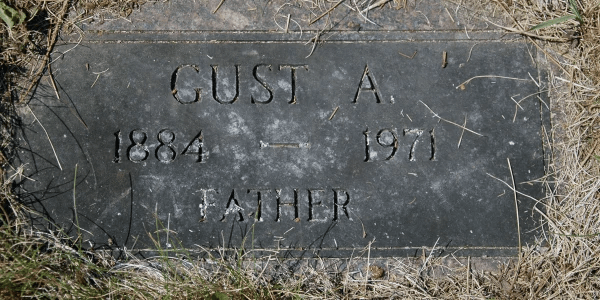
Gust Atiel Gustafson born in 1884 lived another 4 years after Ida’s passing. He died at the age of 86 in the spring of 1971 and is buried in Cook, Minnesota beside his first wife, Josefina
Below is a link to a previous story about Ida Susanna Karhu, my Finnish grandmother, written in 2017 for Genealogy Ensemble: “Sisu, Saunas and Ida Susanna”. More records about her life’s pursuits have become available since that first story was written.
“Selene J. Bruneau brother of A.B. Bruneau who has been visiting at his mother’s, in St. Constant, near Montreal, Canada, for the past six weeks returned home this morning. His many friends will be glad to hear his health is much improved.” as reported in the Fall River Evening Daily News 1880. Unfortunately, two years later Selene died at only 31 years of age.
Selene (1850-1882) was the first of Barnabé Bruneau and Sophie Marie Prudhomme’s 13 children to die. According to his obituary, he died of consumption, at his mother’s in St-Constatnt. What used to be called consumption is tuberculosis or TB. It became known as the wasting disease as those afflicted seemed consumed by their disease as bacteria grew in their lungs and digestive tract. They lost energy, coughed up blood and slowly died. “The slow progress of the disease allowed for a “good death” as those affected could arrange their affairs.”
Most typical 19th-century victims of TB lived in tenements and or worked in factories, places where the disease spread quickly because of close contact and poor hygiene. Even when TB was known to be a contagious disease, people ignored public health campaigns to quarantine the sick and continued to spit on the streets. Selene, not a typical victim, lived in Fall River Massachusetts in a house with his brother Amie’s family. Although some of his older brothers had come to the US earlier and worked in factories, Selene worked in Aime’s jewellery store as a watchmaker.
He seemed content living in the United States as he had the support of some family, friends and a good job although he never married. Selene petitioned for naturalization and took his oath allegiance in 1879 with Aime and his wife Mary as witnesses.
Selene Bruneau in Montreal QC
It appears Selene went home to his mother’s to try and recuperate from his illness. This was before there were any sanitoriums for TB patients. The first one in the US opened in Saranac Lake, New York in 1884 and the first one in Canada, Muskoka Cottage Sanitorium, Ontario in 1897. These sanitoriums isolated infected patients and provided nutritious food, plenty of rest and fresh air. Selene undoubtedly was given this treatment by his mother but at this time 80% of those who developed active TB died from it
The BCG vaccine against TB (Bacille Calmette-Guérin) was first used in humans in 1922. In Canada, only Quebec and Newfoundland had mass vaccinations of school children from the 1950s to the 1970s. In 1944 streptomysin was isolated, the first antibiotic effective against tuberculosis. Medical professional’s hopes that the disease could be eliminated were dashed in the 1980s with the rise of drug-resistant strains. Surgery was also used where infected portions of the lungs were cut out which produced some cures, relieved pain and various anatomic obstructions. Still today, worldwide, there are over ten million new cases of TB a year.
Selene’s burial place is in the St Blaise Sur Richelieu Cemetery, the Baptist Cemetery in Grande Ligne associated with the Feller Institute, alongside his parents and some of his siblings. His mother outlived him by ten years.
Selene wasn’t a lucky name. His brother Ismael called one of his sons, Selene Fernand and this child died early, in his first year of life. My grandmother told us it was his strange name that killed him although he was called Fernand and not Selene. This from a family with girls called Helvetia, Hermanie and Edmee. Little did she know it was the Selene that was the problem!
Fall River Daily Evening News 14 August, 1882 Monday Page 2. Selene J Bruneau Obituary.
United States, New England Petitions for Naturalization Index, 1791-1906″, , FamilySearch(https://www.familysearch.org/ark:/61903/1:1:VXRD-LZ2 : Tue Nov 14 02:51:28 UTC 2023), Entry for Selene J Bruneau.Oath of Alliengence to the US Oct 11, 1879 Bristol County Superior Court, Taunton, Massacheuttes.
In Canada, vaccinations of all children 10-14 continued until 2005 when it was decided the TB rates in the general population had fallen to such a low level that universal BCG vaccination was nolonger needed.
M. tuberculosis infection is spread almost exclusively by the airborne route. The droplets may remain suspended in the air and are inhaled by a susceptible host. The duration of exposure required for infection to occur is generally prolonged (commonly weeks, months or even years). The risk of infection with M. tuberculosis varies with the duration and intensity of exposure, the infectiousness of the source case, the susceptibility of the exposed person, and environmental factors. Although treatment courses are prolonged, effective treatment of the individual with active TB disease can reduce the infectiousness after two weeks.
The path my 2 times great grandmother Anne Nesfield took to work and marry in 1860 era. People in Sleights tended to stay put until the opening of the railroad in 1840.
My father, Peter, born Kuala Lumpur, Malaya in 1922 of hardscrabble North of England stock, always signed his name Peter N.F. Nixon Esq., something I found a wee bit pretentious. He was just a chartered accountant, after all. The F stood for Forster, the N for Nesfield.
I knew Forster was his mother’s surname. I didn’t know until very recently upon doing his genealogy that Nesfield was his father’s paternal grandmother’s name.
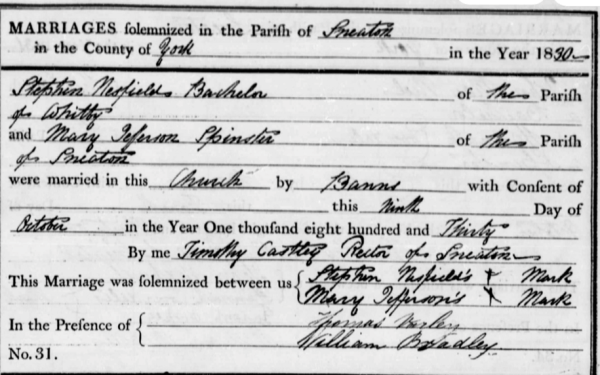
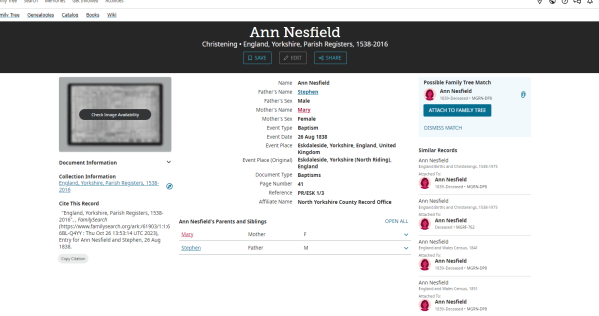
Ann Nesfield, my 2x GG was born in 1838A in Sleights near the lovely coastal town of Whitby at the North East corner of the North Yorkshire Moors to Stephen Nesfield of that place and Mary Jeferson of nearby Sneaton.
Stephen was a labourer. He and Mary were both illiterate as they signed their 1830 marriage certificate with an X.
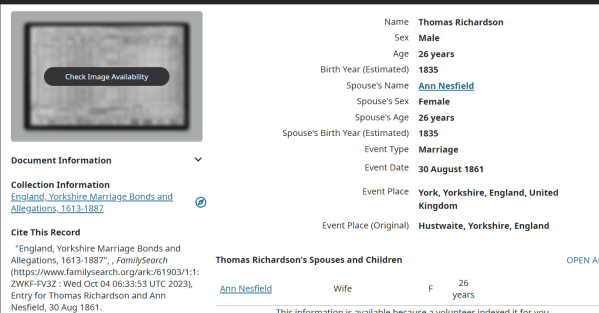
The August 30, 1861B marriage record for Thomas Richardson and Ann Nesfield has them wed in Husthwaite, 40 miles to the south west but still on the Moors. Thomas was from nearby Rievaulx, a small town of 229 people (10 farms and 26 cottages, one school house and no pub) famous then as now for its monastery ruins.
According to the 1861 UK Census, Ann had been working in Husthwaite as a cook at an estate/farm, Highthorne, belonging to one Nathaniel Thomas Lumley Hodgson, Esquire (sic) gentleman horse-breeder who had been a crony of Charles Darwin’s at Cambridge! 3Thomas according to the same Census is living in Rievaulx with an older sister.
Ann and Thomas Richardson go on to have ten children over twenty years with my father’s grandmother Mary-Ellen, 2nd born in 1862, destined to marry one Robert Nixon, a quarryman from the adjacent market town of Helmsley.1
Now, I imagine Ann Nesfield’s existence in rural England post-Industrial Revolution wasn’t that easy despite her initial skilled position as a cook for a small family at a Yorkshire Dales farm/estate. And who can know about her 1861 marriage to Thomas Richardson. Tailors and drapers, especially in small towns, were still solidly working class.
It is also possible Ann married right then out of necessity. It was announced in the 24th of August 1861 Yorkshire Gazette (just one week before Ann’s marriage) that Lumley-Hodgson Esq. was selling off some fine animals and leaving his farm for the winter ‘due to the health of his daughters.’
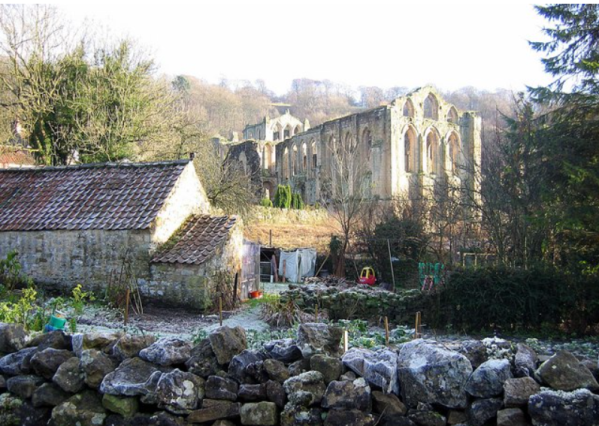
Abbot’s Well cottage on Google Earth with ruins behind. The oldest standing non-monastery building in Rievaulx, designated by the National Trust as Medieval, a period that ended in 1450.
The view from the garden. Roger Smith. Geograph Project Creative Commons
In the beginning, Thomas and Ann Richardson lived at the Richardson family abode, Abbot’s Well, a cozy-looking medieval cottage in Rievaulx, a town that started out as the inner court of one of the richest Cistercian Monasteries in England founded in 1132. The Monastery was destroyed by Henry VIII in 1532 at the very beginning of the infamous dissolution. New homes were then built with stone from the monastery, homes that were used to house various workers from the nearby Duncombe Park Estate of Lord Feversham.
The view from the little garden of Ann’s heritage house, by all accounts, was simply stupendous.
I discovered a 1830’s travelogue online that already describes the town of Rievaulx as ‘quaint’ and ‘picturesque’ and ‘historic,’ claiming the view from the ridge of the vale and ruins “offers a combination of beauties that must be seen to be enjoyed and once seen can never be forgotten.”2
A century later, in the 1930’s, a nephew of the 1st Lord Feversham of Duncombe Park in Helmsley was living at Abbot’s Well House (built 1906 and 30 meters away from the cottage) and Lady Beckett, the widow of the 2nd Lord Feversham, was offering tours of the cottage in benefit of local nurses “with the small garden providing an excellent prospect overlooking the monastery ruins.” Her tours continued well into the 1950’s.
And in May, 1984, the London Times remarked upon a recent sale of the modern Abbot’s Well House. “That a view is worth something is proved by the recent million pound plus sale of the modern Abbot’s Well with a two acre garden that has a view of the 12th century abbey and the Rye Valley beyond.”
I have to wonder, in the 1860’s, did Ann’s heart sing out every time she went out to hang the laundry with my great-grandmother, Mary-Ellen, at her feet? Or did she lament the leaky roof, drafty windows or the lack of bedrooms for her growing family? Was living beside these majestic monastery ruins a comfort to her or merely a haunting reminder of how things can fall apart?
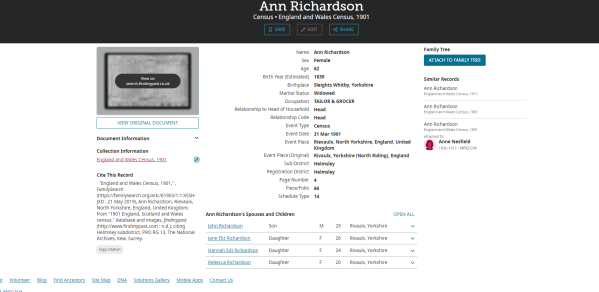
As it happens, the Richardsons did move out of Abbot’s Well sometimes after 1881 and before 1891, but they did stay in town. The 1891 UK Census has the family living at New Cottage in Rievaulx, with Thomas still a tailor and draper but also, now, a grocer. The 1901 CensusC has Ann a widow with four grown children still at home, one son working as a general labourer but three girls in their twenties performing “home duties.” Ann is now the tailor/grocer in the family. In 1911, one year before her death at 74, Ann is still at New Cottage, working as a grocer and living with her youngest daughter who is 30 and married.
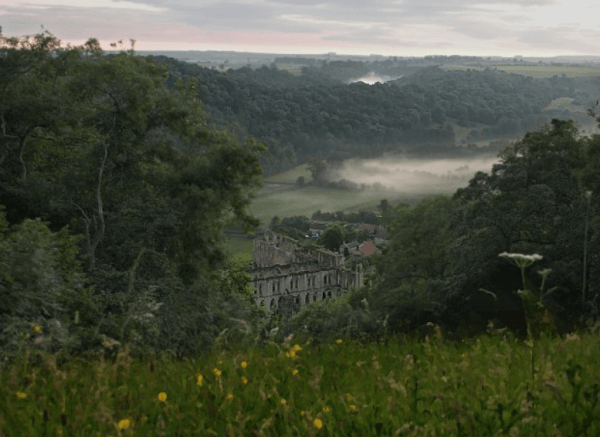
Recent Photo: Rievaulx Abbey and Rye Valley beyond from Rievaulx Terrace. Colin Grice. Geograph Project. Creative Commons.
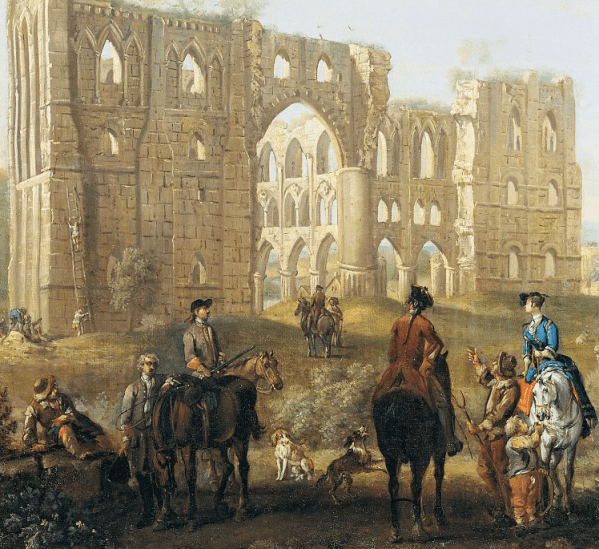
Duncombe Hunting Party. 1728. John Wooten. Yale Collection of British Art. Creative Commons . My ancestors would be the labourers in the background or the scruffy attendants:)
My father’s working-class ancestors lived in picturesque towns all along the route from Whitby to Helmsley; pretty places with colourful names like Goathland, Kirbymoorside and Ugglebarnby. Whitby, where Ann Nesfield lived her early years, is also a North of England beauty spot from what I see on YouTube with surrounding coastal villages as lovely as anything in Italy’s Cinque Terre.
So, although little of consequence about Ann Nesfield’s life can be gleaned from the genealogical record, one thing about the woman cannot be denied. She spent her entire existence surrounded by the breath-taking beauty of the North Yorkshire Moors. That, I think, has to have taken the edge off her own hard-scrabble existence.
Notes:
Thank you to the Ryedale Family History Group for all their kind and expert help and especially to Valerie Slater for helping me sort out the many Ann Nesfields in the Whitby area born circa 1838.
(Apparently, there’s a lot of mix up over these Anns in online family trees. I have to redo part of my tree, now! And it doesn’t help birth dates on the UK Census are only guesstimates 🙂
Robert Nixon Sr, my great grandfather, 1863-1937, who married Nesfield’s daughter, Mary Ellen Richardson, was a delver in the quarry in 1911 according to the UK Census, but he had other occupations. I know because I found his short obit from 1937 from the Yorkshire Post on the British Newspaper Archive database:
“Mr. Nixon was for man years foreman timber leader with messrs William Frank and Sons and with Mr Bentham King. Later worked for the Duncombe Park Estate, and during the war was put in charge of the felling of timber at Waterloo. He was a Sunday school superintendent and a local preacher in the Methodist circuit for over half a century.”
The 1921 census says Robert is working as head quarryman at Duncombe for the Trustees of the Earl of Feversham who was under age. The former Earl had died in 1915 in the war.*I wonder if the Nixons had an IN with the Earl? A Nixon and a Richardson were pallbearers at the Dowager Feversham’s 1889 funeral.
2. Ross, Stephanie. The Picturesque, an eighteenth century debate. Journal of Aesthetics and Art Criticism. 1967
Esquire: Modern British. Polite term as appendix to a surname of someone without any other title implying genteel birth. Earlier, for English gentry rank below a Knight.
3. Both Darwin and Lumley Hodgson were ‘admitted pensioners under Mr. Shaw 1827. at Christ’s College a Divinity School.” Apparently, nature studies and divinity studies were considered compatible back then, as in ‘all God’s creatures.” Both graduated in 1832, although Darwin completed his exams in 1831. The Darwin Archives of Cambridge contains a January 1831 letter where a friend is asking Darwin if Lumley Hodgson has passed. “I don’t see his name anywhere, I am almost afraid to ask.”
Nesfield Rugby genes. My father’s nephew 1973, Rugby for Cambridge and England. My father, co-captain, 1939 Rugby for St Bees School Cumberland. My grandfather, 1912 Rugby for Duncombe Park where he was a footman. Through DNA I discovered other Ann Nesfield descendants played rugby for Scotland.
CITATIONS
A: Ann Nesfield Baptism 1838 Family Search2. Ann’s marriage to Thomas Richardson 1861 Family SearchC: 1901 Census. Ann at Home running the family business with her girls.



















 Genealogy Ensemble