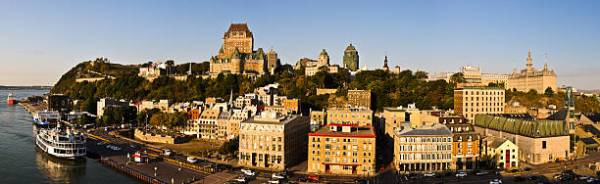
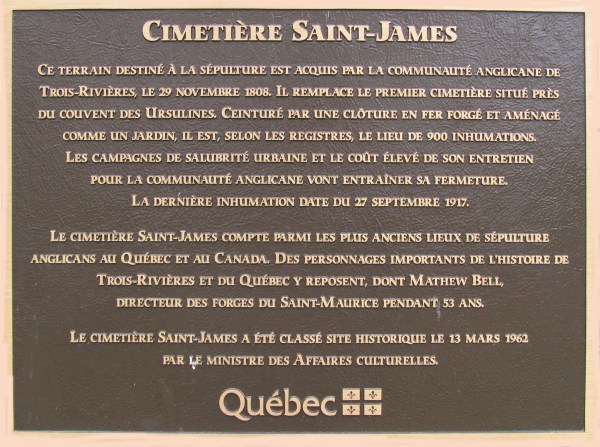
Located at the corner of Saint Francois Xavier and de Tonnancour Streets in the old part of Trois Rivieres. It was classified as a Quebec Historic Site in 1962 and is one of the oldest Anglican cemeteries in Canada. The land was acquired by the Three Rivers Anglican Community in 1808 and the cemetery was used until 1917. (It is also known as Cimetiere Saint-James) https://www.findagrave.com/cemetery/2517306/saint-james-cemetery
The database presented below consists of two extensive lists of names of Protestant Families that resided in Quebec during those years.
Genealogy is usually of little interest to children probably because their parents already seem from the Dark Ages and their grandparents from the times when Tyrannosaurus Rex tramped the planet.
It was the same thing for me way back in the 1960’s – except for the one day when I was about twelve years old. My mother came home all excited with some important news passed on to her by a cousin who had researched the Crepeau family tree.
My mom’s father, Jules Crepeau of Montreal, was descended from one Abraham Martin dit L’Ecossais, a pioneering (boat) pilot and land-owner in New France. My French Canadian mom found this fact highly entertaining. “I am descended from a Scotsman,” she told me, laughing. “What a joke.”
I remember this episode only because of another part of the story. Apparently, this Abraham Martin fellow owned the Plains of Abraham. THOSE Plains of Abraham. Now that I could sink my tweenage incisors into.
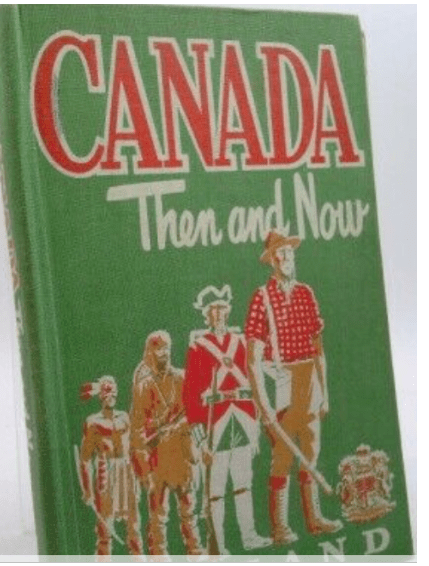
You see, I was learning about Canadian history in school. Our text was Canada Then and Now, a bright green text with a very iconographic cover pic.
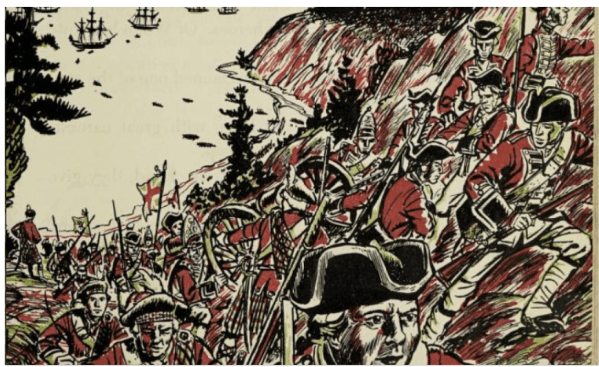
From this textbook, I was learning for the first time how the French and British were always at war with each other, way back then, in Europe and in North America. In North America, the fought over control of the lucrative fur trade and, apparently, it all came to a head one morning on the 1th of September, 1759 when a British general named Samuel Wolfe, after being rebuffed a few times by the superior French forces, led a cagey attack on the French General named Louis Joseph Marquis de Montcalm on the cliffs of Quebec City, cutting off his supplies and defeating his superior forces. This was all part of something called The Seven Years War.
All night long kept quietly landing the men on Wolfe’s cove. By morning, 5000 British soldiers were drawn up ready on the Plains of Abraham. The French had avoided battle, believing they were safe because they had more men than the British and plenty of supplies. They knew the British wold have to withdraw before freeze up. But now tht the British had landed above the town and cut off supplies from Quebec. The time had come for battle.
The textbook instructed us Canadian children, in subtle terms, to take no especial pride in this seminal event:
Wolfe and Montcalm were great generals and gallant men. Today, on the Plains outside of Quebec, a monument stands to honor them both. Wolfe’s name is on one side, Montcalm’s on the other. There is a Latin inscription that says, “Valour gave them a common death. History a common fame and posterity a common memorial.”
Illustration from Canada Then and Now. Storming the Plains of Abraham
Today, I am much older and predictably I am into genealogy. I have written many many family stories from both sides of my tree.
My mother’s French Canadian side was easy-peasy to patch together thanks to all those fabulous Catholic church records on Drouin available. And yes, if the Mons Origins website information is correct, my mom was indeed descended from this Abraham Martin.
Should I write about this pioneer ancestor? I have long wondered.
Truth be told, I would very much like to puzzle out the story of my earlier French Canadian ancestors, as Tracey Arial and Claire Lindle have done so brilliantly on this blog. I’d like to discover exciting new tidbits of information about my ancestors to add to the historical record (perhaps using some of the stellar resources catalogued on Genealogy Ensemble by Jacques Gagne) but it all seems so difficult, so labour intensive and so hard on the eyes.
In the past, I have explored the lives of Les Filles de Roi – because I am particularly interested in the lives of women ancestors – only to find there doesn’t exist much detailed information about these pioneering females from Normandy and Ile de Paris. It seems no one bothered to document the day-to-day lives or unique personal stories of these ‘mothers of millions’ back then– either in Europe or New France.
When it comes to this Abraham Martin dit L’Ecossais character, it would be a real waste of time to try to find a new angle or to write something fresh about him. There are already reams and reams (or pixels and pixels) of information written about him. It appears that Abraham Martin dit L’Ecossais is one of the most famous French Canadian pioneers and a father to millions of North Americans, including Madonna and Justin Bieber – and, ah, little ole me.
Long story short: He married Marguerite Langlois. Had 14 children. I am descended through Vitaline Forget-Despatie, my mother’s father’s mother.
The kicker to this non-story of mine: Abraham wasn’t necessarily Scottish. He could have invented the epithet to avoid criminal prosecution or he was a war deserter. His name might have generated from the fact that he had visited Scotland many times in his youth.*1
Now, lately I have dug out one very interesting fact about my mom’s French Canadian ancestors on her dad’s side, one she didn’t know about. My mother always told me that the name Crepeau meant “curly haired one.” She had very very curly hair herself, as did her father. I have no idea how long she had known this fact or who originally informed her.
If that same cousin, back in 1967, had provided her with a paper genealogy, my mother would have noticed that the original Crepeaus, going back six to eight generations, were Crespeaus, from Poitou Charent. I have recently learned that the name Crespeau almost certainly came from Crespo, a very Spanish name – and not only that a Sephardic Jewish name.
I found this tidbit on sephardim.com:
“The name Crespo has been identified by the Holy Office of the Church of Spain as a Sephardic Jewish surname.”
How fascinating.
So, it seems, even genealogically-timid I can dig out an interesting fact or two about a distant French Canadian ancestor. Maybe I should keep trying.
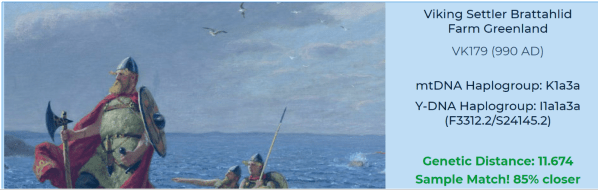
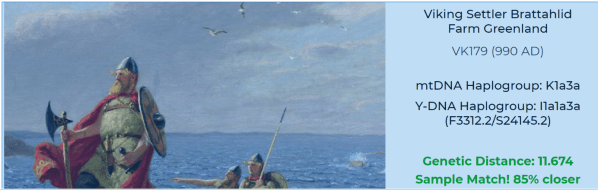
1. Even if Abraham Martin wasn’t born to the Tartan, he likely had English, Scottish and even Viking dna. Normandy, Normans, North men, Norsemen. Ancestry gives most of my many many French Canadian cousins a little bit of Norwegian ethnicity. I have a very vague 0-8 percent.
Wouldn’t it be funny if my mom were related to Eric the Red, chronicled in the second chapter of Canadian Then and Now, after the first chapter on “Indians” and “Eskimos.”
If you believe mytrueancestry.com, my husband, whose Mom comes from Isle of Lewis Scots, apparently is connected genetically to Eric’s clan. How very romantic! If I didn’t love him before, I’d have to love him now!
2. I checked the Y dna lists online at Family Tree and someone is trying to see if French Canadians have Semitic genes. There are very few members. On a regular French from France Y dna site I can see that some French Canadians have J M172, an Anatolian line, often thought of as the Greek Diaspora. Cote and Leger are the names that crop up. There are no Crespos, Crespeau’s or Crepeaus.
Montreal’s Italian community is one of the largest in Canada, second only to Toronto. With 279,795 residents of Italian ancestry as of the 2016 census in Greater Montreal,[2] Montreal has many Italian districts, such as La Petite-Italie, Saint-Leonard (Città Italiana), Rivière-des-Prairies, and LaSalle. Italian is the third most spoken language in Montreal and in the province of Quebec.
The Italian Immigrant Presence in Canada, 1840-1990 John E. Zucchi McGill University.
In the last one-hundred years, more than 650,000 Italians have immigrated to Canada, almost three-quarters of them in the period following World War I1 (Rosoli, 1978:35%5). They have settled primarily in Toronto and Montreal, and to a lesser degree in Vancouver, but also in significant numbers in scores of small and large mining and industrial towns in British Columbia, Alberta, Ontario and Nova Scotia….. The literature on Italian immigration to Canada is extensive and is represented by a number of fields, primarily history, sociology, anthropology, geography, political science and literature.1.
In the early 20th century, a new wave of European immigrants made its way to Québec and to Montréal. Among them were thousands of Italians who brought with them their traditions, their values, and their customs, going on to form one of the oldest and largest immigrant cultural communities in Montréal.2.
Of all the immigrants Montreal has welcomed since its founding, the Italians have had the greatest impact on the city. From the arts to politics, agriculture, real estate, gastronomy and sports, the Italian community has influenced every sector of life in Montreal.
The Italian presence on Quebec soil goes back to the founding of Montreal. Italian settlers served in the French regiment of Carignan-Salières (1670) to help fight the Iroquois. In return, the King of France gave them land. More Italian migrants arrived, and in 1860, 60 Italian families called Montreal home. From 1900 to 1915, more than eight million Italians left their country. Many headed for Europe, while others ended up in North America, especially the United States, and a few settled in Quebec, primarily in Montreal.
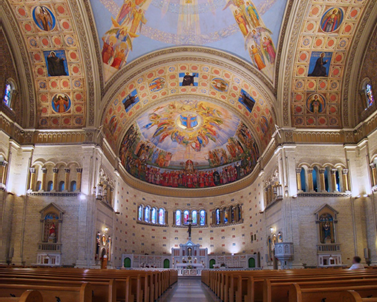
Notre-Dame-de-la-Défense parish, also known by its Italian name, Madonna della Difesa, is the first Italian parish in Canada. It is located along Saint-Laurent Boulevard, with Saint-Zotique and Jean-Talon streets marking its limits. Educational, assistance, recreational and sports establishments quickly sprung up in the community. It was here that, in 1927, the grand Notre-Dame-de-la-Défense Church was inaugurated. In 2002, the Government of Canada designated this church a national historic site.3.
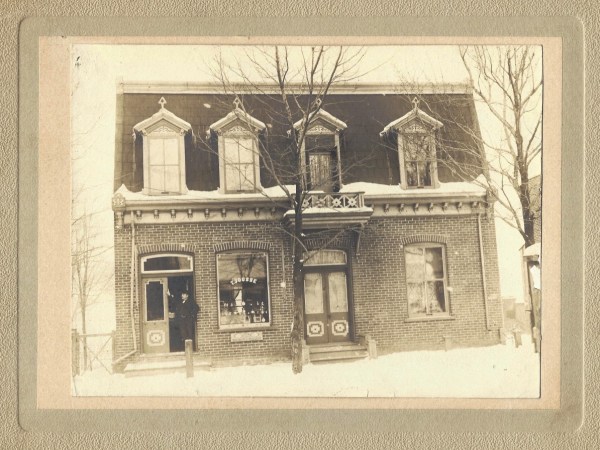
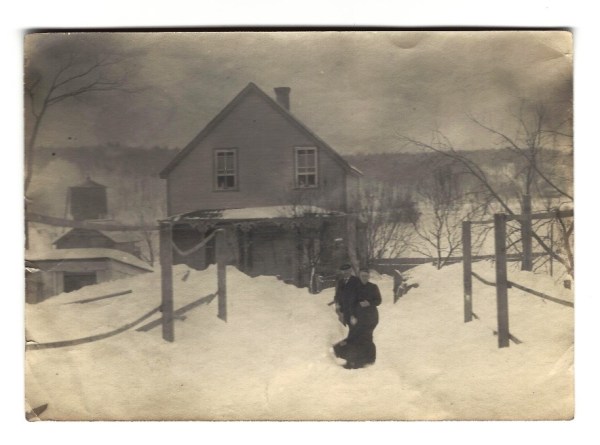
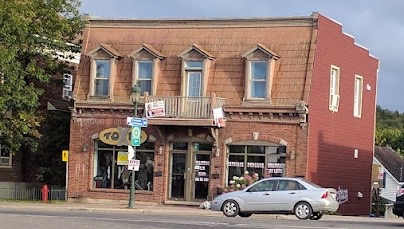
There is a house on Main Street (now Rue Principale), in Lachute, Quebec that my mother said had ties to our family. We would drive by it on most shopping trips to Lachute from our summer cottage. Mom said her Aunt Helvetia and Uncle Eugene Jousse had lived there and for a short time her grandmother Ida Bruneau. I thought it was a different house but old pictures clearly show which was the house. It now looks out on a Canadian Tire gas station and a Tim Horton’s.
Eugene’s father Theophile Jousse, had the house built in 1887, as a copy of his family home outside of Paris destroyed by a fire during the Paris Commune of 1870-71.
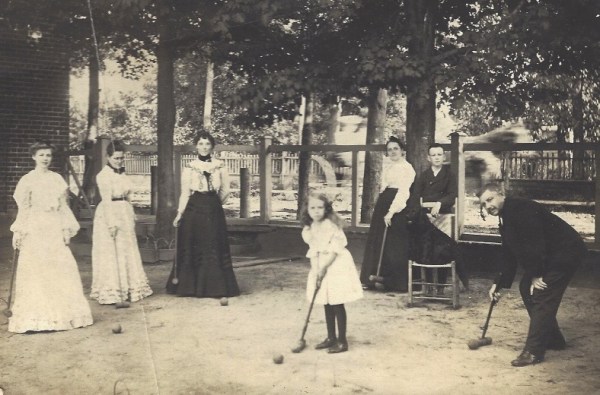
The house, built in the French style, right on the street with a small overhead balcony and dormer windows stands out. To the west of the house was a croquet lawn. A small cottage was built behind for his parents.
Theophile Jousse was born in 1855 in Vincennes, a commune in the Val-de-Maren department in the eastern suburbs of Paris. His father the Reverend Jean Felix Jousse, his mother Gorgette Haerrig and the family lived through the Prussian War, only to be caught up in the Paris Commune of 1870-71. Soldiers of the National Guard had seized control of Paris, refusing to accept the authority of the French government and tried to establish an independent state.
Felix and Theophile immigrated to Canada around 1874 with the rest of the family coming soon after. When Theophile first saw Ephyse Piché at L’Oratoire, the French Baptist Church in Montreal he knew right away that she was the woman he would going to marry and they did in 1876.
Theophile, an apprentice watchmaker moved from Montreal to Waterloo, Quebec and opened a jewellery store. When his business failed he moved his family to Lachute as his wife Ephyse was originally from nearby Saint Scholastic. There he opened another jewellery store and his parents moved into the cottage behind. Felix Jousse died in 1890 while his wife Georgette lived in the cottage for almost 20 years.
Theophile and Ephyse had three sons, Paul, Albin who died as a child and Eugene 13 years younger than Paul. Both sons apprenticed as watchmakers and jewellers under their father. Paul moved to Vankleek Hill, Ontario, just west of Lachute and opened his jewellery shop while Eugene inherited the Lachute house and business from his father. This caused some family problems.
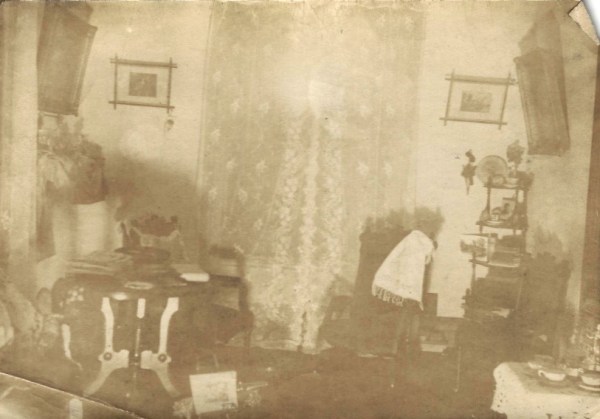
When Eugene Jousse married Helvetia Bruneau they moved into the small house behind the store as both Theophile’s parents had died. They lived there until Eugene’s mother Ephyse died and then moved into the big house to look after Theophile. While Helvetia had furnished and redecorated the cottage she wasn’t allowed to move or change anything in the big house. It had to remain as Ephyse had left it.
Helvetia and Eugene had two children, Eugene Theophile and Ephyse Marie. Theophile insisted his granddaughter be called Ephyse after his wife. When Helvetia’s father died in 1918 her mother Ida Bruneau and two younger brothers Herbert and Gerald came to live with them. They had the space as Theophile died in 1916 and they still had the two houses. Herbert finished high school in Lachute and Gerald was still living there in 1921.
In the twenties the jewellery business in Lachute couldn’t support the family so in 1927 they moved to Montreal and Eugene went to work at Birks.
The house is still there. It must have had many owners as the businesses have changed over the years. It has recently been renovated and a tattoo parlour and a clothing shop called Toxic have been replaced by a children’s clothing boutique. The grandmother’s cottage still sits behind but the croquet lawn is long gone.
Notes:
Letter from Ephyse Jousse Hawks to Donald Walcot October 10, 1986. Copy in author’s possession.
The Walcots of Montreal West by Donald T. Walcot. Toronto 1984.
Lachute Chapter IV The Period of Expansion. 1876- 1900.
The house was built in 1887 by a local builder Riddell and Sutherland but designed by Theophile Jousse.
In 1921 the house was number 57 and now it is number 601, 603 and 603A Rue Principale
In 1986 Ephyse Jousse Hawkes said the house housed a delicatessen. She looked through the window and didn’t recognize her old home.
The Jousses:
Jean Felix Jousse: 1825 -1890 He was a Limonadier and an evangelist
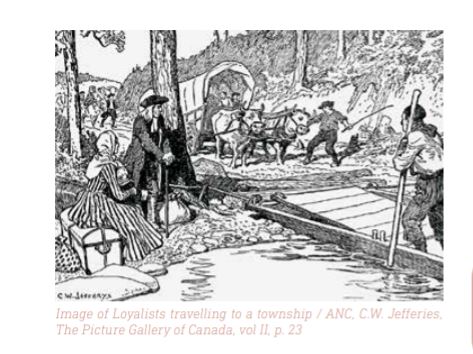
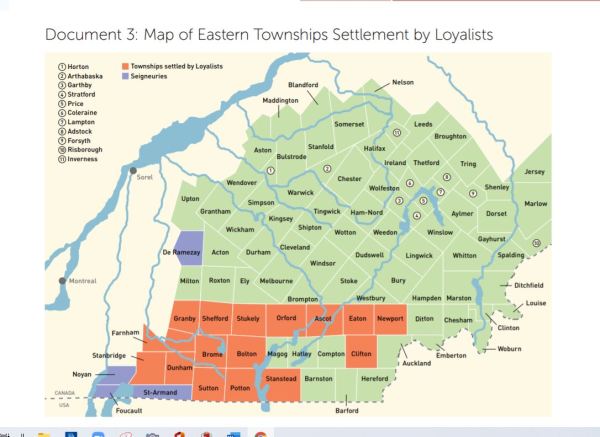
Following the American War of Independence, the Thirteen Colonies became the United States. Those who wished to remain faithful to the British Crown were obliged to leave their home to reach British territory. Consequently, following the 1783 Treaty that ended the War of Independence, Loyalists moved to British-occupied territories. Fifty thousand Loyalists reached British territories. Today, these territories make up Ontario, Quebec and New Brunswick. Of these 50 000 Loyalists, 500 fled to the Upper Richelieu Valley, to Noyan, Focault and St. Armand, unoccupied seigneuries of the Province of Quebec. These lands were ideal for clearing and their geographical location facilitated trade with the United States.
Various online databases at BAnQ (Bibliothèque et Archives nationales du Québec) list books, papers, original documents, government decrees, proclamations by the British authorities during the British Military period and during the Lower Canada time frame about who the Loyalist people of Québec were.
Click the link below to access the database. Open link in a new window.
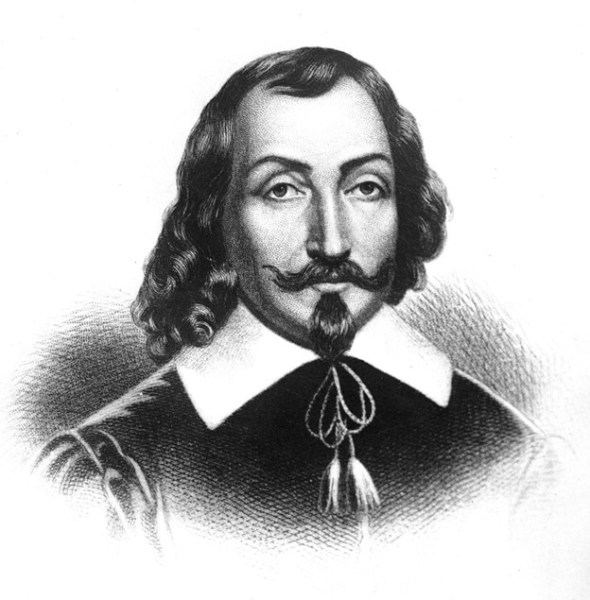
Samuel de Champlain was a man with a plan; actually, many plans. His explorations of New France began in the early 1600s. Along the way he set his sites on Trois Rivieres, given its strategic location at the mouth of the St. Maurice River where it flows into the St. Lawrence River.1.
Samuel de Champlain
An early view of Trois Rivières
Trois Rivières derived its name from the delta at the mouth of the river where there are two islands that separate the river into three branches as it flows into the St. Lawrence. “… the Three Rivers name is used for the first time in 1599 by Sieur François Gravé Du Pont, a geographer under Champlain, whose records confirmed the name in 1603”. 2.
Map of Trois Rivieres
The area was settled by a small group of colonists on July 4th, 1634. At the time it was the second largest New France settlement, the first being Quebec City in 1608. Montreal would follow about 8 years after Trois Rivières in 1642. 3.
The young colony of Trois Rivières was constantly under attack by the Iroquois.4.
“Under the orders of Champlain, LaViolette, (a commander) travels to the mouth of the Saint-Maurice River to found a fur trading post and build a fort on ‘le Platon’, a plateau situated on a hillock of land along the St. Lawrence River. The fort would enclose a few homes and shops, and the settlement would become known as Trois-Rivières. For a long time, this site will be one of the most advantageous for the activities of fur traders.” 5.
In 1656, Claude Jutras dit Lavallée, a young 29-year-old soldier arrived in Trois Rivières and was stationed at the garrison. One of his first transactions was to purchase land. This was the first of many transactions he would be involved in over the years.
Soldier
What is a ‘dit/dite’ name? When the first settlers came to Québec from France it was a custom to add a ‘dit’ nickname to the surname. The English translation of ‘dit’ is ‘said’. The Colonists of Nouvelle France added ‘dit’ names as distinguishers. A settler might have wanted to differentiate their family from their siblings by taking a ‘dit’ name that described the locale to which they had relocated. The Colonists of Nouvelle France added ‘dit’ names as distinguishers. 6.
Within a year of his arrival Claude married Elisabeth Radisson, my 7th great-grandmother, the sister of Pierre Esprit Radisson, the famous explorer and coureur de bois. (see previous blogs: A Very Marriageable Young Girl and Allegiances)
Claude was born in the parish of Saint Severin, Paris, Ile de France, France in about 1627. He was the son of Pierre Jutras dit Lavallee Desrosiers and Marie Claude Boucher d’Avancon. They were married in Paris and there are questions about the date of the marriage. Little is known or written about the family or about Claude’s early years.
Claude Jutras dit LaValléeis a bourgeois in 1699. This fact is noted frequently in the many BanQ NUmerique records shown in the documents below.11.
Eventually, the King of France realized that the young colony needed better protection if they truly wanted to establish a permanent settlement. The Carignan-Salieres Regiment consisting of 1,500 regular soldiers arrived in New France in 1663. 12.
Claude did not remain in the garrison for very long. The Talon census of 1666 indicated that he was living in Trois Rivières and had become a settler, a habitant, with a growing family.13.
After serving time as a soldier, he became a farmer. The family settled in the community and prospered and was recognized in 1679 as a member of the ‘bourgeoisie’. This is also noted in many of the court records and that both Claude and Elisabeth could sign their names.
Above is a sample of Claude’s signature and that of Medard Chouart DesGroseilleurs, a brother-in-law.
Claude died on the 28th of November 1710 and was laid to rest in the cemetery in Trois Rivières. Elisabeth lived another twelve years surrounded by her extended family
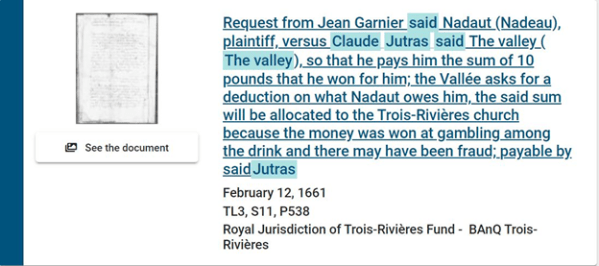
While researching records at BanQ Numerique for information on Claude Jutras, it was interesting to note that Claude and Elisabeth had many irons in the fire. He had a variety of requests both as a plaintiff and a defendant.
One can glean glimpses into the insights of these settlers, how they lived, and the issues that were important to them: land purchases, settling of accounts, being dismissed from duties, gambling issues, and damages to property. Example: one’s ox, just to name a few. In the case of the Jutras family there are 195 records during a period of nearly fifty years.14.
Below are three records of transactions by Claude Jutras dit Lavallée.
Results of the research
results Keyword : Claude Jutras dit Lavallée – Quebec heritage– Judgment referring Claude Jutras dit Lavallée, elected tutor of the minor children of Marguerite Hayot, widow of sieur Grandmesnil, now wife of Medard Chouart DesGroseilliers before the judge of Trois-Rivières, to be discharged from the guardianship. Quebec heritage. New France. Sovereign Council. September 3, 1664
Transcription of the text with modernized spelling: “On what was represented by the Attorney General of the King. Translated by DeepL
Marguerite Hayet Des Groseilliers was the half-sister of Elisabeth Radisson.
2. Request from Claude Jutras (Jutrat) dit Lavallée (La Vallée), plaintiff, to be compensated by master Guillaume Pépin for an ox which was mistreated by his people who would have inflicted a wound on his hip by blows. Said Pépin is ordered to dress and medicate the beef in order to cure it. Quebec heritage -New France. Royal jurisdiction of Trois-Rivières. August 31, 1669 . Translated by DeepL
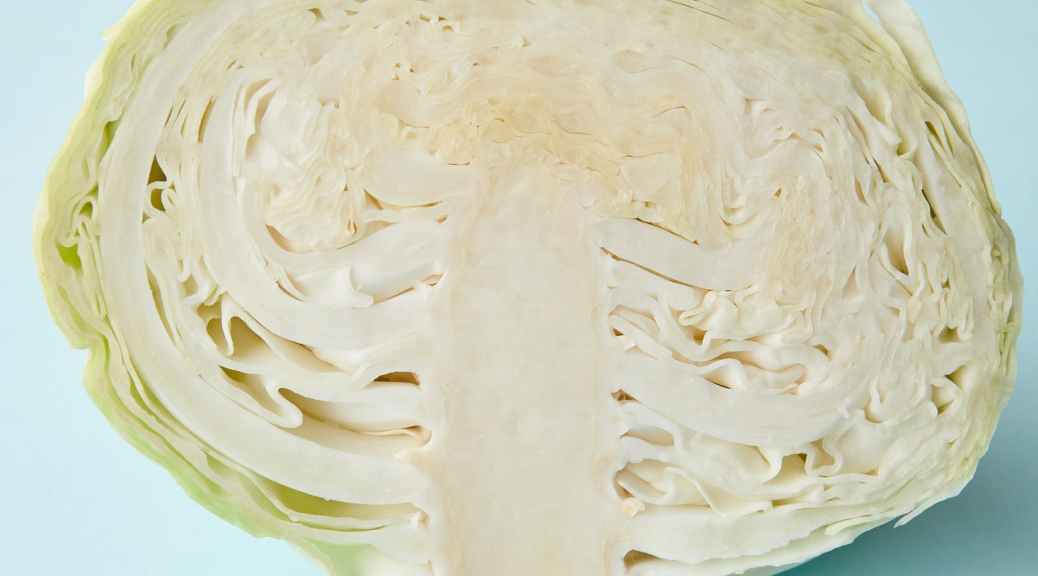
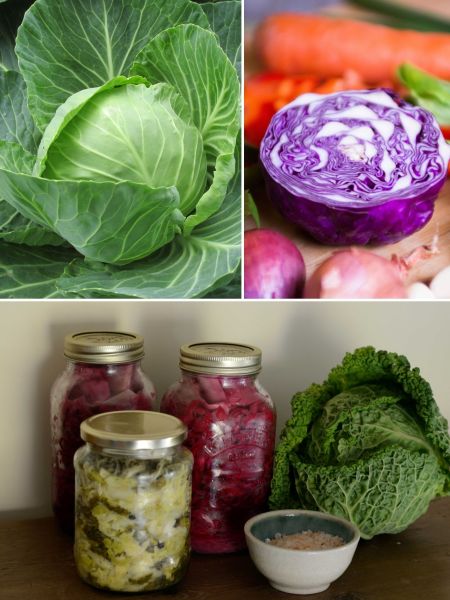
When I was a child, October meant a weekend of gathering in my grandparents’ garage with lots of other family members to make a massive batch of sauerkraut and coleslaw.
I remember the smell of boiling cabbage, although I’m not sure why, since you can make sauerkraut without boiling anything. Perhaps they used boiled cabbage in their recipe. Or perhaps the family made other dishes that day as well, like stuffed cabbage rolls. I can’t really remember. My family skipped the annual weekend in later years.
We still got a jar or two of yummy sauerkraut for Christmas during those years.
I’m not sure when that autumn tradition began, but it probably ended when my grandparents started wintering in Florida. Dividing a life between two homes was difficult enough without adding a big weekend chore to the year. By then, making it through the winter no longer meant relying on tons of jars of sauerkraut.
I’m sad that our family has lost this historic tradition and I’m not even sure which side of the family it comes from. Joseph Gabriel Arial and Marguerite Ann Hurtubese Arial both came from families that had been farming in Canada for generations. They lived through the dust bowl, the depression and World War II.
Perhaps sauerkraut got both families through many winters when food was scarce.
The word “sauerkraut” makes one think that my family’s recipe began in Germany, but even if the modern name came from that country, the recipe itself probably didn’t. Eventually, most cultures figured out that salt transforms cabbage into something that would last through the winter.
Canadian experiments storing the vegetable over winter began in 1541, when Jacques Cartier planted seeds from France along the shores of the Saint Lawrence River.
By the time that writer, botanist and surgeon Sieur de Diéreville visited Acadia 150 years later, local Mi’kmaq had learned to prepare cabbages in ways unlike recipes from the original mother country.
 l’exception des Artichaux & des Asperges, ils ont en abondance toutes sortes de légumes, & tous excellens. Ils ont des champs couverts de Choux pommez ,-& de Navets qu’ils conservent toute l’année. Ils mettent les Navets à la cave, ils font moëlleux & sucrez, & beaucoup meilleurs qu’en France; aussi les mangent-ils comme des Marons cuits dans les cendres. Ils laissent les Choux dans le champs après les avoir arrachez, la tête en bas etla jambe en haut; la neige qui vient les couvrir de cinq ou six pieds d’épais les conserve aussi & on n’en tire qu’à melure qu’on abesoin; on ne laisse pas d’en mettre aussi à la cave. Ces deux légumes ne vont jamais dans le pot l’un sans l’autre, et on en fait de plantureuses soupes avec de grosses pièces de lard. Il faut fur tout avoir beaucoup de Choux, que lesGens n’en mangent que le pignon, & les Cochons etle reste pendant tout l’hyver, c’est leur unique nourriture, & ces goulus animaux dont ils ont beaucoup, ne se contient pas de peu. Il y a de certaines iles le long de la Rivière Saint Jean, où il ne coûte rien à les nourir pendant l’Eté, &: une partie de l’Automne, les Chênes & les Hêtres y étant communs. Dés le Printemps on y jette sept ou huit Truyes pleines, elles y mettent bas leurs petits s’engraissent des fruits des arbres que j’ay marquez; lorsque l’hyver commence elles les ramènent à l’habitation , & on n’a que la peine de les tuer pour les mettre au saloir : Ces petits Cochons sont excellens en petit sale& il faut aller là pour en manger de lait tant ils sont délicats ; c’eft un plaisir d’en voir les bandes dans la saison : il sont plus courts etplus petits que les nôtres.
[With the exception of Artichokes & Asparagus, they have all kinds of vegetables in abundance, and all excellent. They have fields covered with Cabbage & Turnips which they keep all year round. They put the Turnips in the cellar, they are soft & sweet, & much better than in France; so they eat them like Marons cooked in ashes. They leave the Cabbages in the field after having pulled them up and placed them upside down; the snow which covers them with five or six feet thick also preserves them, and we only take out the meals that we need; we do not stop putting it in the cellar as well. These two vegetables never go into the pot without each other, and we make thick soups with large pieces of bacon. You have to have a lot of Cabbages all over the place, so that the People only eat the pine nuts, & the Pigs and the rest throughout the winter, it is their only food, and these greedy animals of which they have a lot, contain little skin. There are some islands along the Rivière Saint Jean, where it costs nothing to feed them during the Summer, &: part of the Autumn, Oaks & Beeches being common there. From Spring we throw in seven or eight full Truyes, they give birth to their young, grated with the fruits of the trees that I mention before; when the winter begins they bring them back to the house, and we only have to kill them to put them in the salting tub: These little Pigs are excellent in a little salt& you have to go there to eat them with milk as they are delicate; It’s a pleasure to see the bands in the season: they’re shorter and smaller than ours.]1
1Diéreville, N. de. Relation du voyage du Port Royal de l’Acadie, ou de la Nouvelle France : dans laquelle on voit un détail des divers mouvemens de la mer dans une traversée de long cours : la description du païs, les occupations des François qui y sont établis, les maniéres des differentes nations sauvages, leurs superstitions, & leurs chasses : avec une dissertation exacte sur le castor. A Amsterdam : Chez Pierre Humbert, 1710. http://archive.org/details/relationduvoyage00dire, based on travels to Acadia and New France from from October 1699 to October 1700.
More than 330 years since that description, cabbage and pork remained popular throughout Canada. As a child, our family enjoyed cottage roll dinners every Sunday night. A cottage roll is a very fatty salted roast of pork and it was always served with lots of cabbage, potatoes and onions. I still drool thinking about it. It was my mother’s recipe and I suspect that it came from my great great great grandmother Mary Willard, who came from Ireland. It doesn’t seem far off from the “Jigs” dinners they still serve in Newfoundland, although those include split peas as well as salty pork, cabbage and potatoes.
Many immigrants to Canada brought favourite cabbage recipes with them. Food historian Dorothy Duncan has written about Pennsylvania Germans bringing sauerkraut to Canada and Scottish settlers pickling cabbage in barrels and combining it with cheese and potatoes in a dish called “rumbledethumps.”
There’s a neighbourhood in Toronto named “Cabbagetown” to this day because Irish immigrants escaping the famine used to fill their front yards with the vegetable in the 1840s.
It’s said that Polish immigrants brought us cabbage rolls, but our family enjoyed those often when I was a kid too and as far as I know, we have no Polish in our blood. I love cabbage rolls and still make them to this day. My mom used to boil the cabbage in huge pots and then rolled hot cabbage around a mixture of beef and rice; coating the whole thing with a can of tomatoes and tomato juice. My recipe is a bit easier and vegetarian to boot. I just put the cabbage in the freezer for a day until it wilts enough to wrap around a mix of rice and lentils. I have to add twice as much tomato juice as she did so that there’s enough liquid in the tray to cook my cabbage rolls for at least an hour and half, but other than that, my cabbage rolls taste close to hers.
It’s nice to continue traditions. Perhaps I’ll make some sauerkraut this weekend in memory of my grandparents.
Maliseet Viger First Nation / Première Nation Malécite de Viger
A people who are still residing in 2021 in Lower St. Lawrence – Bas Saint-Laurent, Western New Brunswick at the junction with the Maine / Quebec borders, Northwestern Maine at same USA-Canada border.
A number of First Nation families resisted living among the families in traditional First Nation Reserves organized by the Federal Government and the Quebec Government. This was the main reason, why so many villages, towns, and cities are listed in the links.
They are a peaceful people who fully integrated with the descendants of European nations who had settled in said Lower St. Lawrence, Northwestern Maine and Western New Brunswick.
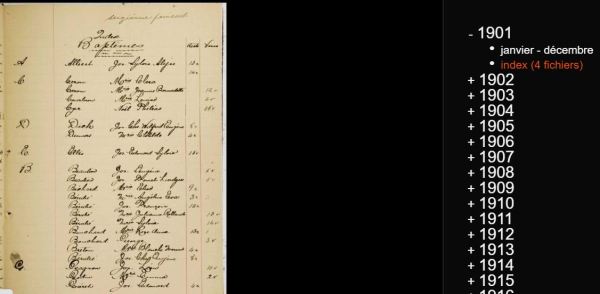
Example: In this database the following link on page 14 for Saint-Mathias-de-Cabano – consists of 4 pages of lists of baptisms, marriages and deaths.
There are many pages like the example above which also contain lists of baptism, marriages and deaths for the parish wherever the https://numerique… followed by Documents online is indicated.
Seventy years ago in 1951, my grandmother Millicent (1895-1982) Granny-Lin finally got the cottage she had always wanted. My grandfather Sydenham (1887-1975)The Priest had it built for her on the waterfront of Shediac Bay in New Brunswick.
Truly a dream come true, she aptly named it “Iona Cottage” for “I own a cottage”!
Iona Cottage 1955
The person who designed their simple cottage somehow knew exactly what they wanted. A small eating nook off the kitchen led into the living room with a fireplace and the three small bedrooms branched off from there. A simple door leading to the patio enticed family and guests outside to enjoy the view of the Bay.
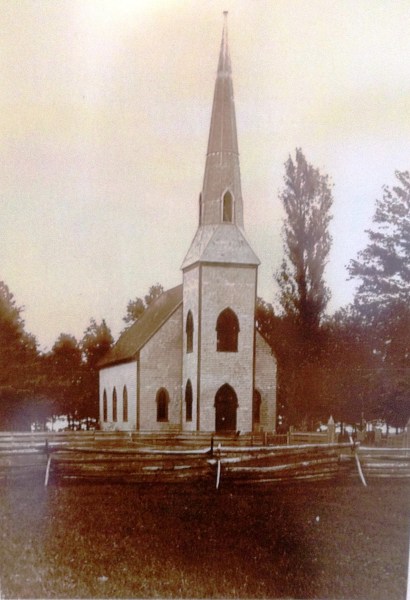
Just around the corner from Iona Cottage stands St. Martin’s-in-the-Woods Anglican Church built almost 200 years ago by Millicent’s great grandfather, and the founder of Shediac, William Hanington. There is a huge monument beside the church where he and some of his family are buried. On Sunday mornings during their summers, Millicent and Sydenham would stroll down the lane to church. Sydenham was an Anglican priest and would sometimes hold the summer church services thereby giving the local priest a break.
St Martin’s-in-the-Woods Anglican Church est.1822
Millicent grew up in Montreal as the youngest of six girls. Her pharmacist father moved the family from Shediac to Montreal in 1890 to study medicine at McGill…at the age of 45! During the summer breaks, the family returned “home” to Shediac. After completing his degree in 1894, Dr. Hanington Pharmacist then Doctor and family remained in Montreal where he set up a practice… but they always spent their summer holidays in Shediac.
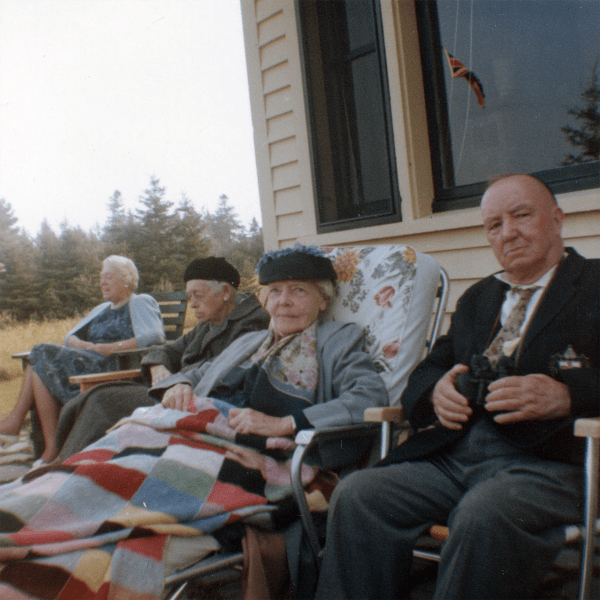
Millicent and Sydenham hosted many summer family gatherings at their Shediac cottage over the years. There are numerous photos taken on the patio in front of the impressive red brick chimney. An endless assortment of Millicent’s sisters (and sometimes their husbands) would line up along the side of the house enjoying the sun and cool breeze off the water. A few photos have captured some of the bravest taking an icy cold dip in the bay.
Millicent’s sisters and brother-in-law circa 1965
In July 2015, my sister and I took a “sister pilgrimage” trip to the New Brunswick area, and finding Iona Cottage was the top priority. We recognized it immediately even although the light yellow cottage from our memories had been painted a lovely country blue. The surrounding grounds looked immaculate and a quick peek in the window assured us that it was well loved inside and out. What a terrible disappointment when no one answered our knock at the door. We snapped a few photos of house and garden (and us!) for our travel album and to share with the rest of the family.
Iona Cottage – July 2015
Upon my return home, I wrote a short story about our “sister pilgrimage” and published it on the Genealogy Ensemble website Sister Pilgrimage. A year ago, the current owners of Iona Cottage read my story and contacted me by email. They are the fourth owners (since 2018) and are thrilled to share my scanned copies of the old photos of their cottage.
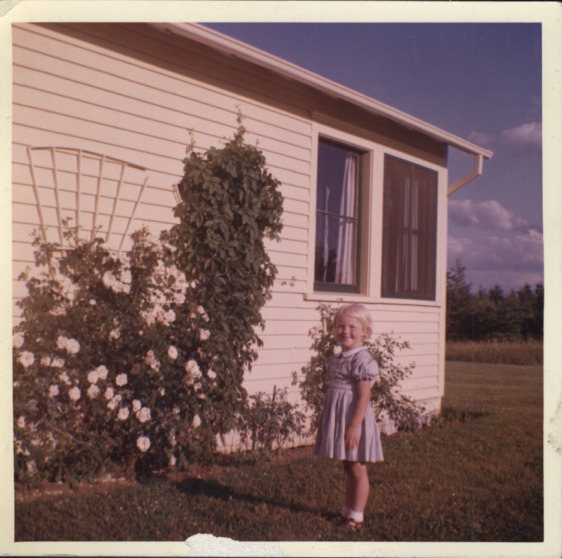
How surprising to learn that they already had a copy of my favourite photo… a gift from their neighbour. It captured four-year old me in front of Iona Cottage during the summer of 1961 when I visited with my mother shortly before she died of cancer that November.
Here I am at Iona Cottage – Summer 1961
My only other stay at Iona Cottage was some twenty years later when my cousin and I flew into Moncton to spend a long weekend with our grandmother. In an era before highways, two lane roads between Quebec and New Brunswick made the drive impossibly long, which might explain the lack of visits over the years
Notes for Blueprints for Iona Cottage – Feb 1951 – by Tom Anglin
Recently my cousin unearthed a real treasure in his inherited boxes of memorabilia – an envelope marked: “Blueprints – Iona Cottage”. I took a quick look before sending them off to the current owners and to my utter amazement I saw that MY FATHER had drawn up the plans for his in-law’s cottage! I had no idea. What a joy for me to see his handwritten notes in the lower right-hand corner…and no wonder the cottage was so perfect for Millicent and Sydenham.
Happy 70th Anniversary Iona Cottage!
L to R – Neighbour, Sydenham and Millicent (Iona cottage at the right)
The Atikamekw of Central Quebec is the smallest First Nation in Quebec regarding the number of residents within their territory. Authors and historians have researched the Atikamekw. They have written numerous articles.
Included within this database one can access numerous Parish Church Register documents as noted in the example below. BanQ numerique documents of baptism, marriage and deaths are accessible through the many BanQ numerique links throughout the database.










 Genealogy Ensemble