When we think of emigration from Europe, we think of crossing the Atlantic to North America or going to Australia. For the Irish, immigrating to Scotland would have been just as difficult as if they had moved to a new continent.
The Irish started to arrive in Dundee, Scotland around 1825, lured by the prospect of regular employment in the growing jute industry. Within 30 years, the Irish community of Dundee had grown to 14,000.3
This quote from James Myles, a local Dundee author, in Rambles in Forfarshire, 1850, gives us a taste of how the Irish immigrants were perceived by the Dundonians:
A great proportion of them are Irish. Drawn hither by the work they obtain at the spinning mills; and it is to be deeply lamented that the vast hordes that have migrated to the Scouringburn are composed of the most debased and ignorant of their countrymen. Their vile slang and immoral habits have seriously injured the poor population of Dundee.2
The first Irish McHughs to move to Dundee, Scotland were brothers John and Patrick McHugh. They both married in Dundee and worked in the jute mills all their lives. And their families continued to work in the mills for generations, almost a century.3 Like most of the Irish immigrants, John and Patrick probably already had experience in the textile industry in Ireland and most likely came from one of the counties that produced linen and yarn.4
The Irish settled where the jute mills were located in Lochee, Dundee, also known as Little Tipperary. 5 The McHughs, like the other Irish immigrants and unlike most Dundonians, were Roman Catholics. The Church of Scotland has been the dominant religion in Scotland since the Scottish Reformation of 1560 and the Roman Catholics would have been looked upon with disapproval and suspicion.
St. Joseph Roman Catholic Church, Dundee, Scotland, built in 1873
It is not surprising that the Irish Roman Catholics lived in the same area and worshipped at the same Catholic churches in Lochee for decades. I can find registrations of marriages, baptisms, and deaths for the McHughs for generations. The McHughs remained steadfast Catholics during their century of living in Dundee and only branched out into other religions once they arrived in Canada in 1912.
The Irish were also seen as carriers of disease, such as typhus, also known as ‘Irish fever.’ Of course, this was due to unsanitary and crowded living conditions in which they lived.6
In 1904, the Lochee Harp Football team was formed by Lochee Irishmen to provide recreation for the poor immigrants. Even today, Lochee is considered the Irish quarter of Dundee.7
I have taken advantage of all the extra free time at home over the past year to write a family history book about my father’s ancestors. It has been the perfect pandemic project, but now it is almost time to launch it into the world.
This book brings together the many blog posts I have written about my father’s extended family over the past eight years for my personal family history blog, Writing Up the Ancestors, and for the collaborative blog Genealogy Ensemble. As someone once told me, a blog is a good cousin catcher, and indeed, blogging has allowed me to connect with cousins I never knew I had. Also, I got a lot of the research done and written up in small bites. But the stories about the Hamilton and Forrester families (my paternal grandmother was a Forrester) jump all over the place on the blog; in the book, they are in historical sequence and geographical context.
A book that you can hold in your hands and store on your bookshelf for years also feels more permanent. People read a blog post, then jump to the next shiny object on the Internet. You might only read part of a book, or look at the photos, but you can keep it for a long time and pass it on to the next generation. I’m dedicating this book to my grandchildren, in the hope that one day, maybe 50 years from now, they will sit down and discover all the astonishing things their ancestors risked and achieved.
I have called this book Reinventing Themselves: a History of the Hamilton and Forrester Families. These people reinvented themselves several times. Most male members of the immigrant generation grew up in lowland Scotland where they were weavers, stonemasons, tenant farmers and carpenters. When they landed in Upper Canada around 1830, they had to reinvent themselves as farmers in an unfamiliar climate. Members of the next generation retained most of their Scottish customs and religious beliefs, but moved on to a new landscape as they became grain famers on Canada’s western prairies. Their sons and daughters were the first to give up farming and forge careers in the city.
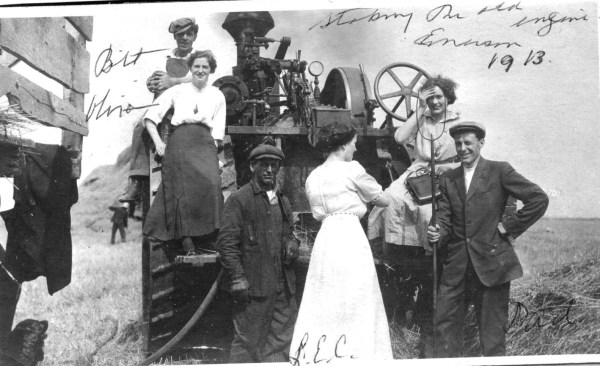
Working on the Forrester family farm near Emerson, Manitoba, 1913.
Many Canadian pioneer families followed similar paths, so what makes this story special? Part of its value is that it does represent the experiences of many 19th century immigrant families.
Luckily, many accounts of my ancestors’ unique experiences have survived. In a letter to his father back in Scotland, immigrant Robert Hamilton (1789-1875) recounted the family’s voyage across the Atlantic. Fifty years later, his granddaughter Maggie Hamilton (1862-1886) wrote a letter from Saskatoon in which she described baking bread for the government soldiers following the North West Rebellion in 1885. Fast forward another eighty years and Charles Forrester (1889-1984) wrote a book about life on the farm near Emerson, Manitoba, from hauling water for the livestock to singing Scottish ballads at family gatherings.
I used to envy people who were members of various ethnic groups. They seemed so exotic, while my ancestors were pretty boring. But writing this book has helped me appreciate the values these Scots brought with them: their deep sense of community and their competitiveness, their love of books and learning, their love/hate relationships with alcohol, and their strong work ethic.
The book also has its share of surprises, from the discovery of my great-grandmother’s illegitimate birth and the story of brothers who were globe-trotting plant collectors to the death of my father’s twin in the 1918 flu pandemic and my grandparents’ subsequent investigations into psychical phenomena.
The research, writing and editing are done. It’s too late now for changes, although I will always be itching to tweak something. The manuscript and many, many photos are in the hands of a book designer. I’ll let you know soon when and how to get a copy.
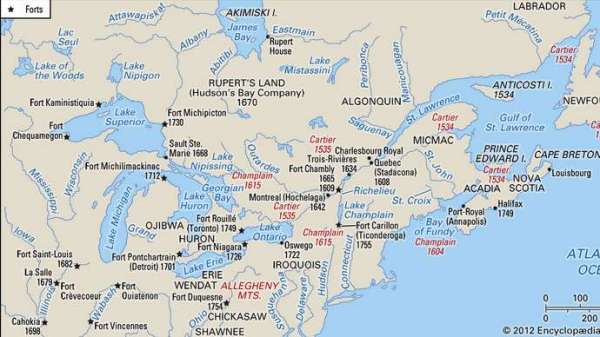
Part 1 Historic Forts and Trading Posts of the French Regime in New France and the English Fur Trading Companies 1564 – 1759
It will be followed by Part 2 in Jacques’ next posting. It contains an extensive list of Authors who wrote about the fur trade and the explorers.
Part 3 will follow and it consists of the History of fur trading during the French Regime as seen through the eyes of Authors and Historical societies. It includes a lengthy list of libraries and publishers.
When I say that my grandfather, Thomas McHugh, worked as a cipher, Bletchley Park, MI5, and Russian spies immediately come to mind. He was neither a Russian spy nor did he work as a cipher during the war. His employer was the Bank of Montreal and it was his first job when he came to Canada in 1912.
The decision to immigrate to Canada was not easy for Thomas. He was in his mid-30s and already had seven children, between the ages of one and fifteen. For over 40 years, the jute manufacturers of Dundee, Scotland had been providing employment for his parents, aunts, uncles, siblings, wife, and for him. However, by the early 1900s, he was facing a precarious future for his children.
By the early 1900s, Dundee had suffered a serious decline in the textile industry and more significantly, the jute industry. Jute was imported from India, however, the mill owners realized that it would significantly lower the cost of production to open mills in India to prepare the jute and import the finished product to Scotland. Once mills were established in India, the jute production in the mills in Dundee decreased substantially.1
So when Thomas arrived in Canada, a little ahead of his wife and his children, he was eager and prepared to do any job so that he could. The Bank of Montreal had its headquarters in Montreal, Quebec. In the early 1900s, the bank had significant dealings with Great Britain and there were correspondence and banking instructions back and forth between Canada and Great Britain daily. These instructions were mainly sent by telegraph overnight. There were two reasons for this. Some of these instructions were confidential and it was preferred that they remain so. Overnight instructions reduced the number of people who would have access to them. Another reason was the time difference between Montreal and the United Kingdom. The banks in London and Edinburgh were open for business while Montreal was still asleep.
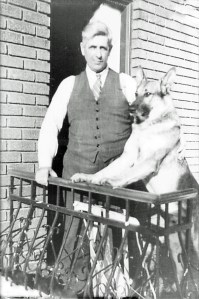
Thomas McHugh with Pal
Even in those days, the banks were concerned about security, privacy, and confidentiality. The banking instructions and transactions were submitted by telegraph and were encrypted. It was the job of the cipher clerk to decipher them so that the bank staff could then ensure that the instructions were carried out as required.
To be a cipher clerk, one had to be reliable, meticulous, and honest, and ensure the confidentiality of the bank’s business. The cipher clerk used a cipher handbook to decipher the information. Also, the cipher clerk worked overnight, so it was a difficult job for a man with a family.
So while my grandfather, the cipher, did not work in espionage, I still think that his first job in Canada was rather interesting.2
Can someone leave a lasting legacy in less than 26 years? That’s the first thing I thought about when I began researching my seven times great grandmother on my fathers’ side.
I think so. The era they lived, the names they called their children, the way they responded to pressure—it all combines to create the culture that immediately follows them. Every generation leaves a mark on its culture. We today are artifacts of our ancestors, even those born more than 300 years ago, like my ancestor Barbe Dodier.
It’s hard to tell, but names definitely continue throughout families. Several of the people in my family still carry names from our ancestors.
My middle name Louise has been used on both sides of the family beginning with Barbe, since it was her middle name. Her husband Gabriel Robert Dufour passed monikers down to my son, my dad, his dad and his grandfather. I can’t help but wonder what other cultural remnants remain in our family.
Some of us are still Catholic and others French-speaking. Many others are not–and that’s a legacy too.
But what of less obvious legacies? The way we shake a head, a hand shake or a practical sense? These are evident three generations back. My son rubs his neck when he’s tired, just as I do. My father has the same habit, as did his father before him. How many generations does that go back? I don’t know.
Did Barbe share that trait? I don’t know that either. In fact, I know very little about her.
One record that remains of her life comes from her marriage, clearly recorded on page 97 of the Sainte-Anne de Beauprés church register. She married Ignace Gasnier on November 5, 1680.1
After they were married, Ignace and Barbe rented a two-arpent-sized lot in the Seignerie de Beaupré (Beaupré Manor). I know this, because the 1681 Census by New France Intendant DuCheseau lists Ignace and Barbe, along with their rifle and a cow.
Ignace Gasnier 25 ; Barbe Dodier, sa femme 18 ; 1 fusil ; 1 vache ; 2 arpents en valeur.1
Part of the Beaupré Manor still exists today. Now run jointly by the l’organisme de bassins versants charlevoix-montmorency (obv-cm) and the séminaire de québec – seigneurie de beaupré, the territory covers a 20 by 95 km band north of the Saint Lawrence River. Today, the manor spans 1,600 square kilometres west of Stoneham and east of St-Urbain in Charlevoix. Hunting, fishing and outdoors clubs share the space with loggers, Boralex and Gaz Métro/Valener.2
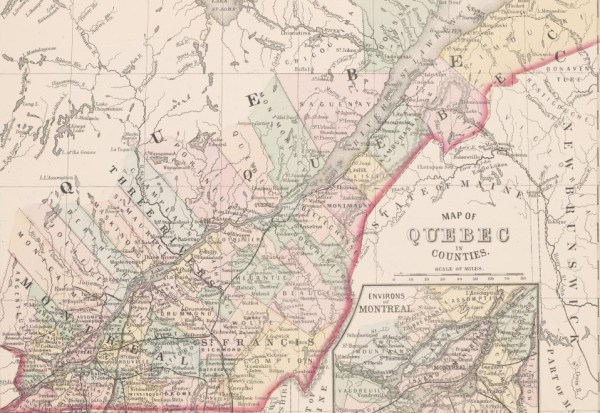
My ancestors probably lived much closer to the river near the current Beaupré, but I’m not sure. A circa-1680 map of the area shows the long settlement patterns typical of Quebec between 1627 and 1850, but the date isn’t precise. Ignace’s brother, Louis Gasnier, appears on the map next to the date 1683.3
Ignace and Barbe don’t appear on that map, but many Manor residents aren’t there.
The seigneurial land management system came to Quebec and the rest of New France in 1627. At that time, New France extended from the Arctic to Florida.
The Compagnie de Cent Associes (Company of 100 associates) granted important colonists and groups, including religious ones like the Seminaire de St. Joachim, land masses extended one by three leagues (5 by 15 km) along major rivers, including the Saint Lawrence. The land would then be divided into 3 x 30 arpent sections perpendicular to the river so that everyone had access to boat transportation. Arpents measured 190 feet (58m).
In 1663, French King Louis XIV gave New France a new constitution but it didn’t interfere with seigneuries, like the one Gasnier leased from the Saint-Joachim Seminary.
Pioneers like Barbe and Ignace probably survived using subsistence farming and hunting. My direct ancestor Louise was born two years after that census. Her little sister Geneviève came along when she turned three years old and her brother Jacques arrived when she was five.
By the time she died on February 7, 1689 in Petite-Rivière, Capitale-Nationale Region, Quebec, Canada, my ancestor went by the name Barbe Gagné. She’s buried in Baie-Saint-Paul Cemetery in Charlevoix. The Tanguay dictionary of French families lists her birth year as 1665, but if the 1681 census was correct, she would have been born in 1663.4
In that case, she was either 25 or 26 years old when she died.
Sources
1Sulte, Benjamin. Histoire des Canadiens-Français 1608-1880, Tome V, Montreal, Wilson @ Cir, Editeurs, 1882, p78.
3Renaud, Alain. Plan de propriété des terres à Sainte-Anne-de-Beaupré en 1680, Archives de Sainte-Anne-de-Beaupré.
4Register of Saint-Pierre-et-Saint-Paul-de-Baie, Quebec, 1689, p8 viaFind a Grave, database and images (https://www.findagrave.com : accessed 21 October 2020), memorial page for Barbe Dodier Gagné (1665–7 Feb 1689), Find a Grave Memorial no. 93294269, citing Baie-Saint-Paul Cemetery, Baie-Saint-Paul, Capitale-Nationale Region, Quebec, Canada ; Maintained by Pat and Billy (contributor 47767337).
Slavery in British Quebec and Lower Canada is the subject of this database. Various authors have given us insight into slavery in the Montreal area, the Eastern townships and basically what slavery looked like in Lower Canada in the late 1700s
The following quotations are taken fromA Short History of Slavery in Canada by Jean Bellefeuille
“Slavery became a common practice in New France and the Church became the largest slave owner.”
“In fact, the ports are the first places where slaves are put to work.”
“The historian Marcel Trudel has counted 4,092 slaves throughout Canadian history, of which 2,692 were Indians (the favorites of French settlers) and 1,400 Blacks (the favorites of English settlers) owned by approximately 1,400 masters.”.
May Wells and her daughter, Virginia and son, Thomas, my father-in-law. Don’t let the pic deceive you: May did not like boys and she often said so. She grew up in a female dominated family.
She was not your run-of-the mill granny, that’s for sure, my husband’s father’s mother, May
In fact, she was something of a catfish-out-of-water in 1940’s and 50’s Montreal, taking her skinny six foot tall frame for a tromp down Ste Catherine Street, sticking her head into Marshall’s to ask the price of a pretty fabric on window display only to slam the door shut with a “YOU KEEP IT” when she didn’t like the answer.
It didn’t help that she had a very loud, raspy voice with a pronounced Southern drawl that would draw attention anywhere let alone in a francophone city.
One day in 1944 in a pediatrician’s office, May made my mother-in-law shrink down into her chair when she exclaimed in her embarrassingly loud twang,“It’s plain to see, we have the only good-looking child in the room.”
Granny May was a strong-willed southern belle who came of age in Warrenton, Virginia in the Edwardian Era, the age of ‘the new woman.’ New women were brash and often broke the rules so it helped to be born into a wealthy family if one wanted to follow that route. And she was.
May was so proud of her southern heritage that for years she hid the fact she was actually born in the North.
Mary Pinkney Hardy Fair was born in 1880 in Wallingford, Connecticut to Robert J. Fair formerly of Galway, Ireland*1 and Elizabeth Hardy of the Virginia merchant class who grew up on a lavish Norfolk plantation, Riveredge.
Her mother, Elizabeth Mohun Hardy was one of fourteen children with long roots in Norfolk. Virginia and North Carolina. (No surprise, my husband gets this very ‘community’ on his DNA results.)
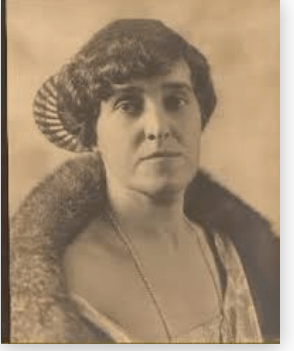
Elizabeth Mohun Hardy Fair (I assume as we have the original. Norfolk photographer. She looks a lot like her sister Mary Pinkney. Just check on the Net.)
One of Elizabeth’s sisters, Mary Pinkney Hardy, married Arthur MacArthur, a military captain and gave birth to Douglas, the future American general.
Elizabeth and Robert Fair married in Norfolk in 1870 but lived in Massachusetts and then Wallingford where Robert prospered in dry goods.*1 The couple had six children, three girls and three boys. Fair died young in 1885. The eldest son died soon after. Elizabeth moved back to Virginia and lived comfortably as a widow the rest of her life. The boys got Ivy League educations. The girls received a genteel, privileged upbringing, their social life chronicled in numerous society columns.
Thanks to the General Douglas MacArthur connection, May’s Hardy line has been traced by multiple genealogists: it goes back to the mid 1600s in Pembrokeshire, Wales and includes many generations of land-owners as well as Methodist Minister and a Sea-Captain who founded a trading post with the West Indies. *
May’s uncles fought in the Civil War for the South under Robert E. Lee. Two of them refused to attend the MacArthur wedding.
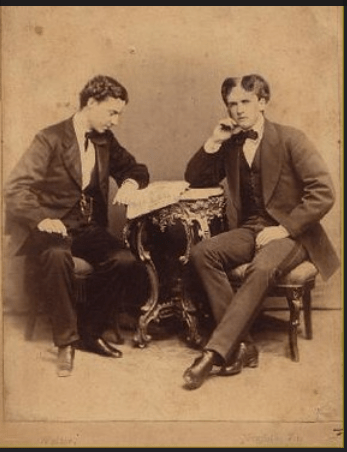
Two of May’s Uncles.
The many Hardy sisters of Norfolk, by all accounts, were tall and willowy, strong-willed and vivacious.
Every MacArthur bio has at least a short paragraph on the attractive Hardy women, but it’s an obscure epistolary volume from 1850 we own that suggests that these traits were inherited from the mother, Margaret Pierce*2
”Mrs. H is somewhat larger than myself; her complexion is a dark brunette; she has jet black eyes and her raven tresses nearly touch the ground. Some say she is a descendant of Pocahontas. I do love a real Southern character it makes one so cordial, generous and impulsive.”
Mary Pinkney Hardy Fair Wells of Westmount, Quebec was certainly impulsive. She tied-the-knot for the first time ‘on a dare.’ Her second marriage was to a handsome Italian whom she left because ‘he couldn’t have children.’
Somewhere, I have Thomas and Mary’s 1917 marriage certificate. The line “publication of banns” is crossed out, so it is likely, as May often hinted, that she didn’t get a proper divorce from one or both of these men.
As an ingenue May was thrown out of New York’s Waldorf Astoria Hotel for smoking a cigar in the lobby. Still, she was a more practical and mature 31 when she married the thrice-widowed Thomas G. Wells, 49, of Montreal.
When May first set eyes on the affable, much older Thomas Wells in Montreal sometimes prior to or during WWI, as her sister, Elizabeth, had married a Montrealer in 1911.*3 May told her sister, “If he is ever widowed again, call me.” When Thomas’ third wife passed away, May hightailed it up to Canada and made her successful play for “Tommy,” the President of Laurentian Spring Water. (Thomas’ favorite first wife, Maude Walker of Ingersoll, Ontario also had North Carolina roots, I have recently discovered. This fact might have been an icebreaker.)
Thomas recounted to his children the first time he ever noticed May. It was on a boat and she was seated and when she got up “she went up and Up and UP!”
Although Thomas was bringing in a hefty salary, it was May’s large dowry that allowed them to live the high life in Westmount. Tall and skinny, she could really rock the 1920’s flapper styles. Still, May, a typical wife of the era, spent most nights at home while her husband shmoozed at his elite social clubs. She liked it that way. She had servants and a singleton sister, Emily, to keep her company.
That Flapper Style
Later in life, Mary was somewhat frail herself. My mother-in-law said May kept scores of medicinal bottles on her bedside table. Her favourite medicine was by far the bourbon and it was kept this ‘southern comfort’ in a flask by her side at all times.
In the 1920’s the Wells family lived on Chesterfield Street in the dry Westmount section of Montreal where she routinely scandalized her friends by pouring booze into her afternoon tea. She didn’t let American Prohibition get in her way, either. The story goes that when travelling back to America by train with her two girls* in the 1920’s she hid bottles of liquor under their pillows. She also sewed pockets into her petticoat to hold small flasks.
The one time she did get caught, she attempted to bribe the border guard. She got plunked on Ellis Island. Thomas was so angry at her he sent his chauffeur out alone to bail her out.
A flask engraved EHF likely, my husband’s great aunt Emily’s. We have inherited quite a few silver flasks from that family 🙂
After Thomas passed away in 1951 (receiving a note of condolence bordered in black from Mayor Camillien Houde) May moved to an apartment on Coolbrook above Cote Ste Luc, where my husband, as a little boy, often visited her and where she lived until her death in 1967.
And, yes, she even managed to make a splash on that occasion. She passed away on her eldest granddaughter’s wedding day.
Apparently, my father-in-law was ashen-faced as he walked his first-born daughter (that good-looking baby) down the aisle, but no one else at the wedding had been told.
May is buried in her famously all-female family crypt in Norfolk, Virginia. Here’s the pic.
Well, Thomas Hardy Fair, her older brother is buried there, too.
Poor little rich boy: My father-in-law may have missed out on maternal affection but he didn’t lack for material comfort. Besides, his Aunt “OMIE” (Emily) took care of him, even taking him -against the law -to the movies in the late 20’s and early 30’s to a Verdun movie theatre that looked the other way when it came to kids.
1. According to an obit (May 17, 1885) I found online from a New Haven, Connecticut newspaper, Robert Fair, from Fair Hill Galway, Ireland, had got his start as a new immigrant with a cousin, Edward Malley who owned a successful department store in New Haven. The obit also said he ended up as a breeder of fine Jersey cows which makes it sounds as if he was so prosperous, in his early 40’s, he could devote himself to a gentleman’s hobby.
The obit doesn’t say that he first landed in Quebec. Robert’s sister Elizabeth stayed in Quebec and married a Samuel James Bennett, a lumber merchant, of St. Romuauld D’etchemin.
2. The book is Place in the Memory by S.H. de Kroyft New York John F. Thow 1850. It was given to Emily Fair my husband’s great aunt by her Mom. In pencil is written, “I wish my daughter Emily H. Fair to preserve this book carefully as a letter from Oyster Bay speaks of her grandmother and mother, who went for the Water Cure there in 1848.” A page later: “Page 13 speaks of your grandmother.”
On page 13 of the book is written “Tomorrow a lovely family Mr and Mrs Hardy and daughter of Virginia leave for their home and will be much missed in our social circle. Mrs. H is somewhat larger than myself; her complexion is a dark brunette; she has jet black eyes and her raven tresses nearly touch the ground. Some say she is a descendant of Pocahontas or Metoka as her father called her. I do love a real Southern character it makes one so cordial, generous and impulsive. Mrs. Hardy and myself have climbed these hill together, crossed valleys and traversed winding footpaths and waded the brooks, and plunged and bathed together till she almost seems a part of myself.”
This Mrs. Hardy was the former Margaret Pierce, also of the Norfolk merchant class.
3. Robert’s sister stayed in Quebec and married a Samuel James Bennett, a lumber merchant, of St. Romuauld D’etchemin. They had nine children, the eldest of whom, Benson, became President of the Asbestos mine in Thetford Mines and the first Mayor of that city. May and her two sisters often came up North to visit their many cousins, to escape the heat and, apparently,to scout for husbands.
James Fair’s sister’s marriage record on Drouin says that she is from Fair Hill, agreeing with his obit. . The Drouin record also says her father James (married to Bedelia Keyes) is ‘ecurie’ as far as I can decipher. From records online the Fairs were land agents for the Berminghams and Earls of Leitram and Rosshill in Galway. James in 1838, was a land agent for the Provost of Trinity College Dublin. He rented the land from them and sublet it to tenants. They raised potatoes and oats, so the upcoming potato famine couldn’t have been easy on their tenants and maybe that’s why James Fair, my husband’s great grandfather, came to Canada and then the US. Descendants of the Fairs in Galway run the Fairhill House Hotel and have a law firm Fair and Murtagh. Www.landedestates.ie
Notes:
- 1.One MacArthur bio The General’s General, claims that the Hardy’s family were Scottish –and proud of it – and that’s why he fell in love with her. (The Hardy surname is Scottish or Irish. Pierce appears Scottish but, hey, we’re talking way back.) This book claims the Hardy’s dealt in fertilizer so came out of the Civil War relatively unscathed. Most other books say the Hardy’s dealt in cotton. MacArthur’s memoirs seem to leave that detail out. He calls them ____merchants. The Hardy’s had to leave their Riveredge plantation for a time during the Civil War when the Union Army took it over. Of course, they were slave owners.
2. May never took her son, Thomas, on trips. He stayed at home and played hockey on the Westmount rink. She wasn’t a total loss as a mother. She was a crack seamstress and made all over kids and grand kids fancy winter coats with fur trim. (She was scared of the cold Canadian winters.)Thomas wasn’t so keen on the fashion. It made him stand out at the rink.
3. As you can see, most of my stories of May come from my father-in-law, her son, and my mother-in-law. I am sure other family members have other stories that perhaps could put another slant on her personality.
4. My husband’s grandmother referred to Douglas MacArthur as “Dougie”. Watching a newsreel she might say “Dougie’s looking good.” Someone kept a stash of news clippings which I once had. I tossed them. May danced the first dance at his 1903 West Point Graduation Elizabeth the second. May’s dance card was donated to the MacArthur Museum. My husband’s aunt visited Douglas in retirement and she said that he was very bossy. LOL
5. May was embarrassed about being born in the North. She didn’t tell anyone until she absolutely had to. She had an older brother Thomas, who went to Cornell and studied engineering and died a widower, I think, in an Upper East Side apartment off Central Park. (My father in law claimed he was the private secretary to Dupont but I have found nothing to collaborate this.). She also had younger brother,
Charlie, who worked as a doctor for free (the story goes) but she clearly grew up in a comfortable female-run environment. I wrote about sister Elizabeth’s dizzying social life here.
Below: Thomas Hardy Fair, May’s eldest brother. It’s written on the back.
Of the 136 trees on Ancestry with Elizabeth Mohun Hardy Fair and Robert Fair, only two mention this son. This is what happens when you have no children. He liked to hunt in Canada. I have his hunting picture album. (Too many dead animals, but a few pics of women in their voluminous turn of the 20th century ‘white dresses’ posing on the porch of small log hunting shacks.)
Hillary Rodham Clinton, Justin Trudeau, Prince Charles’ wife, Camilla Parker-Bowles, Justin Bieber, Angelina Jolie, Madonna, Ryan Gosling, Celine Dion, and me.
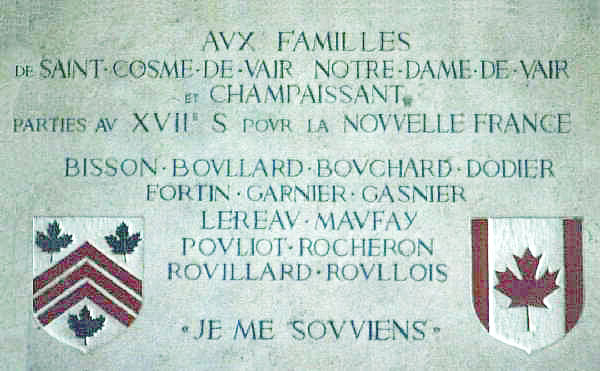
This year (2021) is the 400th Anniversary of the baptism of our common ancestor. Julien Fortin saw the first light of day on February 9th, 1621 in the village of Saint Cosme-de-Vairais in the old province of Perche. Julien’s parents were Marie Lavye and Julien his father, a butcher by trade. 1. & 2.
At the age of seven young Julien’s mother died. The young fellow had a good relationship with his grandfather, Gervais Lavye, the owner of L’Auberge du Cheval Blanc. In 1634 at that inn, Julien, now a lad of thirteen first heard Robert Giffard speak at the request of the French King Louis XIV. Giffard’s mission was to recruit settlers, in particular tradesmen and their families to join him in developing a colony in New France.
It was at this point that maybe a seed was planted in his memory as he listened to the adventures of Giffard, that he too, would someday be able to participate in this endeavour?
L’Auberge -du- Cheval-Blanc
Robert Giffard, proprietor of the Seigneurie of Beaupré went back to New France with a small number of settlers and later, around 1650 he returned to Saint Cosme-de-Vairais with the same mission, to recruit more settlers. Julien, now an adult with a bright future ahead, chose to join the group taking on the challenge of an adventure into the unknown. What lay ahead? Could they possibly imagine?
The enthusiastic families made their way perhaps with a certain degree of skepticism to Dieppe where they boarded a ship for a long three-month arduous, perilous voyage, arriving in Quebec City in late August of 1650.
Young Julien had worked as a butcher and would appear to have saved some money. When he arrived in New France, his savings were sufficient that his first notarial act took place on December 26, 1650 when he purchased a prime lot of waterfront property along the Saint Lawrence River in Ste-Anne de Beaupré. It was the first notarial transaction of more than 85 notarial records prepared during his lifetime.
Over the years he became an astute businessman buying and selling land, often using beaver pelts as payments for these transactions. He soon became known as Julien ‘de Bellefontaine”, a name given when he bought his first property which had a source of fresh spring water.
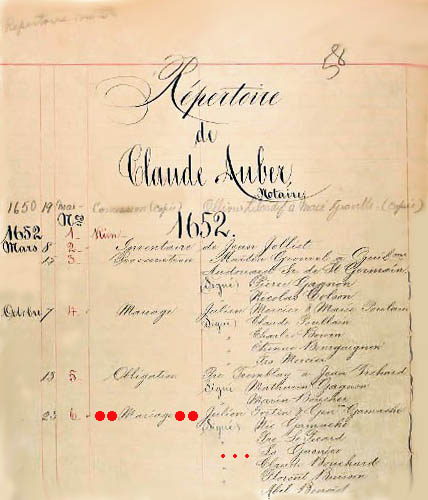
Marriage contract of Julien and Genevieve
Julien, now in his thirties, settled in his new environment and the time came for him to consider marriage. He chose his bride to be, a young seventeen-year-old, Genevieve Gamache, a ’fille a marier’, a marriageable young woman, who had arrived in New France with the hope of finding a suitable husband. At the time many young women were sponsored. She arrived before King Louis XIVs program of “les filles du roi” or King’s daughters who arrived during the years 1663-1673. These young women sponsored by the King came with the intention of marrying and developing the new colony.
Genevieve came to New France accompanied by her brother, Nicolas Gamache dit Lamarre. A marriage contract was drawn up by Claude Auber and signed on the 22nd of August 1652 in the future home of Toussaint while the celebration of the marriage and blessing took place in the chapel of Saint Joachim de Montmorency in Cape Tourmente on the 11th of November 1652. A festive gathering followed at the home of Louis Gagné, whose name appears on the notarial contract, a friend of Julien’s. Both men came from the same village in France.3.& 6.
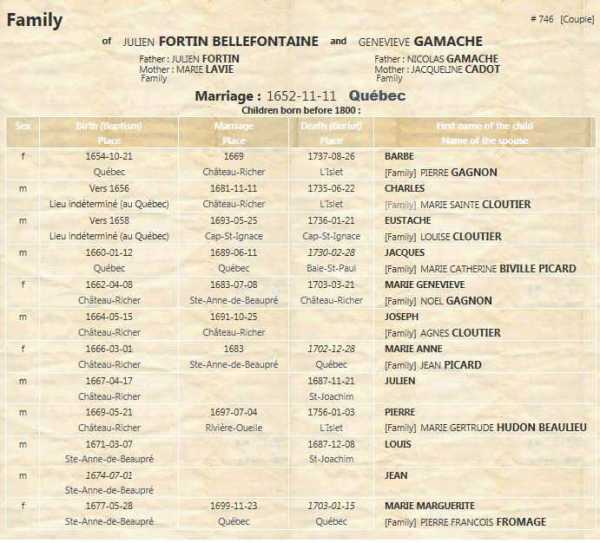
It was not long before there was a family celebration, one of great joy. Julien and Genevieve had given birth to a daughter, Barbe. She was the first of twelve children, eight boys and four girls from their union.4. Over the years there were many occasions for family festivities. The twelve children were all healthy at birth.
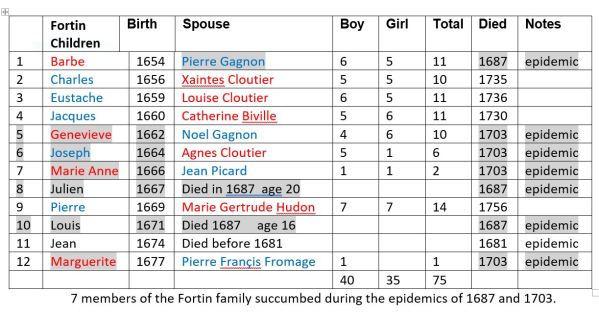
The fate of six of Julien Fortin and Genevieve Gamache’s children.
Chart prepared by the author.
The above chart indicates the devastation that the epidemics of 1687 and 1703 brought on the Fortin family. Some of the younger children contracted scarlet fever, measles and later in 1703 others were taken by smallpox. Julien, the son, died at the age of 20 in 1687, as did Louis at 16. Around 1681 Jean had also succumbed to an epidemic and in 1703 when another outbreak of smallpox occurred Marguerite, Genevieve, Marie-Anne, and Joseph also lost their battles with these devastating diseases. Along the way Barbe lost her first husband, Pierre also due to an epidemic.
On a positive note, it shows the progeny of Julien and Genevieve. They had a total of 75 grandchildren. Julien certainly upheld his part of the bargain in developing and populating New France.
Despite trials, tribulations and the loss of family members and the constant attacks by the Iroquois, life in the new colony continued to thrive. By 1668, Cape Tourmente with its fertile plains along the St. Lawrence River had become an agricultural hub that provided the settlers with plenty of food.
Julien was a generous, prosperous, and deeply religious man with a strong devotion to Saint Anne. He gave to the churches of Chateau Richer and Sainte Anne. He bestowed a house near the church, and a bake house to be used by the two churches. He donated a monetary gift of 20 sous and 2.1 bushels of wheat to the church. He owned several guns, several beasts and twenty acres of land.
The exact death of Julien Fortin is unknown. Archivists have concluded that he was not present at the second marriage of his daughter, Barbe on the 16th of April 1690. The date of his death appears in a document and that the death occurred at Hotel-Dieu hospital in Quebec City August 10, 1692.
Julien Fortin de Bellefontaine faced the unknown, undaunted by the challenges and adventures that lay before him as he set sail for New France in 1650. He was a man of honour and integrity. As he and his wife were among the early pioneers that survived hardships’ They worked diligently and produced a long prolific line of Fortin descendants in North America. Approximately 90% of the Fortins are related to Julien and Genevieve Fortin.5.
Are you a descendant of Julien Fortin dit Bellefontaine?”
I am a proud to be a descendant of this honorable man and his family.
Louisa Seraphina Fortin, my mother’s mother, my grandmother was a direct descendant of Julien Fortin, my 7th great grandfather.
7.
7.
Note:
There is a distinction between ‘dit’ names and ‘de’ names. “dit” names were given to people by giving them an additional second name to distinguish them from others with the same family name.











 Genealogy Ensemble