The above blog was originally posted in August of 2015.
***
The following database “Protestant Churches of Northern Quebec” is an extensive list of churches recently prepared by the Archivists noted below.
Archivist Jody Robinson at the Anglican Archives Quebec Diocese at Bishop’s University (ETRC)
Julie Roy – Archivist at BAnQ Sherbrooke in regard to the United Church of Canada Fonds addressing acts of baptisms, marriages, deaths of regions north of the St. Lawrence River, east and north of Quebec City.
Marthe Brown – Archivist Anglican Archives Diocese of Moosonee at Laurentian University in Sudbury, ON.
There is a section that includes Historical societies listed by county
During the past year racism and the Covid19 pandemic have been uppermost in the news. The Black Lives Matter movement protesters have been out in full force, particularly since the death of George Floyd. People from all walks of life around the world have been expressing their desire, their dreams and hopes for change.
In the United States in 1947 Jackie Robinson broke the color barrier in Major League Baseball, prior to that he played for the Montreal Royals as a stepping stone toward the big leagues!
New York Amsterdam News
In 1955 Rosa Parks was arrested and fingerprinted for refusing to give up her seat. At the time people of color were designated seats in the back of the bus.
britannica.com
Martin Luther King Jr. had not yet come upon the scene. It was in1963 that the famous march on Washington, DC took place. It was there that he gave a powerful “I Have a Dream “speech.
AP/REX Shutterestock.com
The current turmoil of systemic racism is slowly being addressed and is changing. Will the Black Lives Matter movement leave a lasting positive message?
Growing up in a small mining town in the Eastern Townships in the 50s the population was predominantly Caucasians, either French or English speaking . There were no other ethnic groups at the time. When I made frequent trips to the orthodontist in Montreal, I became aware of many diverse groups in our country. That was not the case in our small town. There were no people of African American descent or other ethnic groups.
Life’s adventures are ongoing learning experiences.
On a crisp October morning in 1956 the ’54 Hudson was all packed and we were looking forward to our long trip. Sarasota, Florida was our destination. At that time it was the winter home of the Ringling Brothers and Barnum and Bailey Circus.
The three of us were embarking on a long journey. Mac, the golf professional, and his wife Midge would be spending the winter months in their home in Sarasota. Every spring they would make their way back to Canada where Mac was the manager of the local golf course. I, on the other hand had just finished High School and was too young to pursue further studies. The plan was for me to spend the winter in Florida with them and broaden my horizons.
Among the many stops on our journey south was one that brings bac memories. Winston Salem, North Carolina was on our itinerary and we planned to spend the weekend with Midge’s sister, Elsie. She and her family lived in a luxurious home. Like most wealthy folks in the south, they had servants. Their daughter, Lucretia and I were about the same age. She began showing me around their home. Most likely we had just finished breakfast and she wanted me to meet the cook and her little granddaughter.
Looking at this little four-year-old who had the biggest smile, my first instinct was to go toward her, bend down and chat. In the process of moving toward her I froze and could not budge. No matter how hard I tried, I could not bring myself to go near her. What was happening? What was preventing me from touching her and chatting.
Shortly after this occurred I began to realize how much we are swayed and influenced by others.
The experience has left a lifelong impression. To this day, I get goose bumps thinking about my actions and the way I handled the situation as a young teenager. It was a valuable lesson at the time and still is.
With so much of the news revolving around Black Lives Matter will the movement be a major turning point in eradicating systemic racism?
Alphabetical listing of voyageurs (wood runners / bush-lopers) who navigated by canoes from the villages of Lachine and Sainte-Anne-de-Bellevue on the shores of the St. Lawrence River near Montreal to the far regions of Western North America from 1788 to 1821
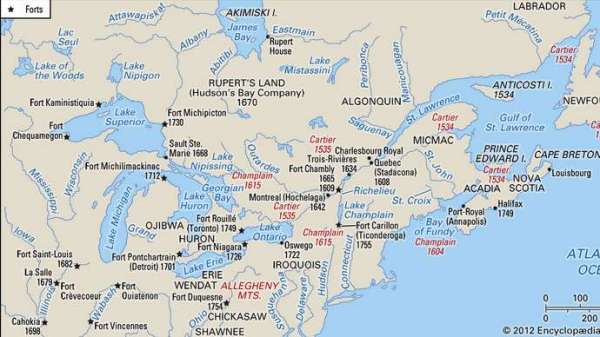
Below is a map by Ernest Voorhis. It includes the numbers in this database indicating all the forts that coincide with the fort numbers in each of the links..
Open this database link below in the incognito window
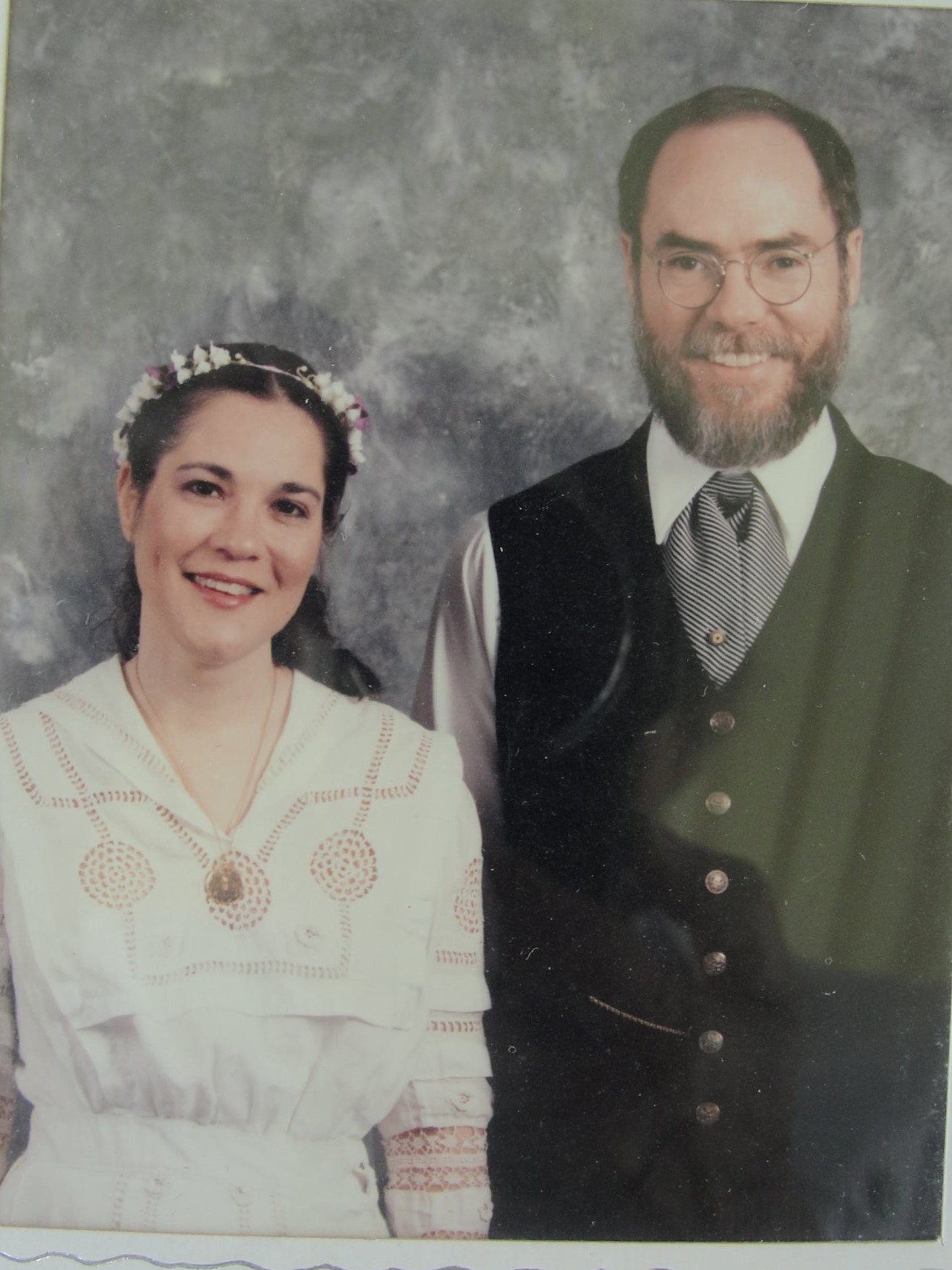
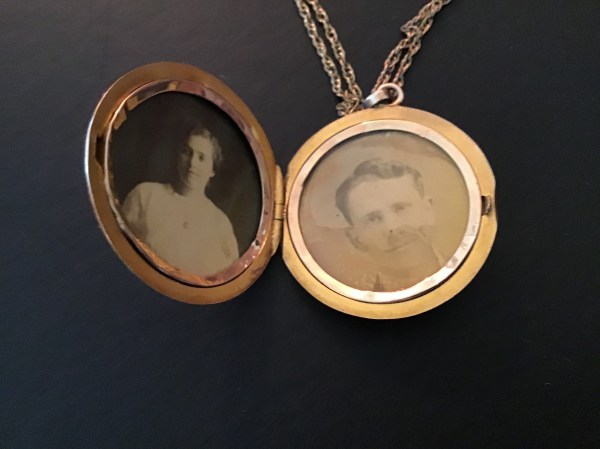
In a drawer, safely tucked away, is Barb’s locket, shown here in her wedding day photo with John. Much to my regret, I never met my American cousin Barbara Jane Mulcahy in person.
However, we first got together in 2016 via Ancestry where I saw a family tree with three names including my surname, Bulford in it and in brackets (Adopted) I was intrigued enough to email the tree owner and ask how we were related.
Barb emailed me back almost immediately, like me very excited to meet a relative from across the pond, and me to meet an American relative. She sent me an invite to her family tree, and I sent one to her, so we could collaborate on our history. I asked her about the word ‘adopted’ after the names.
Barb told me, that her adopted mother was Elizabeth (Bulford) Smith and Elizabeth and her husband, Ira, adopted Barb soon after Barb’s birth in 1953. Barb’s families, both her adoptive family and her birth family, were very important to her and she told me later, of her excitement when, shortly after our meeting she located some birth cousins too.
She had a George Bulford born 16th of March 1889 in Mevagissy, Cornwall. We were related!
George Bulford was my Great Uncle, born to my paternal great-grandparents and he was Barb’s much-loved grandfather We emailed each other with information and worked out that I was a cousin – one time removed – of her mother Elizabeth, still alive at 96 years old, which made Barb, my second cousin – good enough for us!
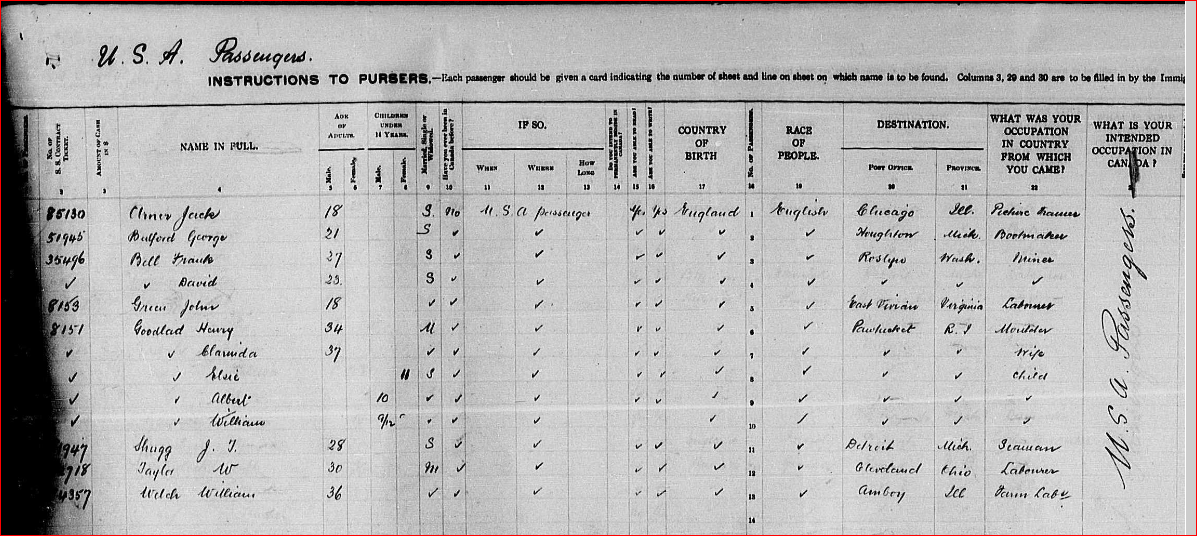
George, at the age of 21 on the 7th May 1910, sailed on the SS Canada from Liverpool, emigrating to the USA. He landed in Quebec, on 16th May 1910 and from there, his final destination was Houghton, Michigan. First, he was a miner and later worked for the Ford Motor Company for 5$ a day.
She thought he may have also had some experience in shoemaking, as he had all the tools in his house, and frequently repaired hers and the family shoes. She was right! Uncle George had his occupation on the passenger list as ‘Boot maker’
Passenger List George Bulford, second from the top left
Barb and her husband, John Mulcahy lived on a farm in Britton, Michigan a village in Lenawee County. The population was 586 at the 2010 census. [1] From the photos, it looks like a beautiful spot.
In no time at all, Barb and I were emailing and telling each other about our lives. We both had dogs and sent each other a ‘Bark Box’ for our dogs, full of treats and toys. Barb was a dedicated vegetarian and loved animals and the outdoor life. We exchanged photos and Christmas cards and I told Barb all about my life here and introduced her to Genealogyensemble.com so she could read all about our family and other stories. She loved it!
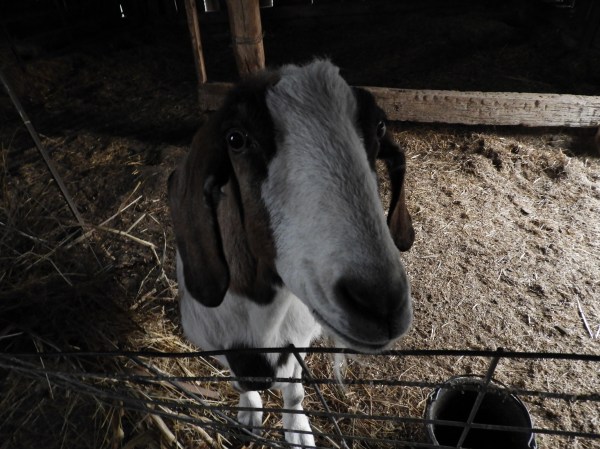
She told me about the farm she lived on and her dog Missy, a goat named Leo, and two barn cats. They had fruit bushes, trees, and plenty of vegetables.
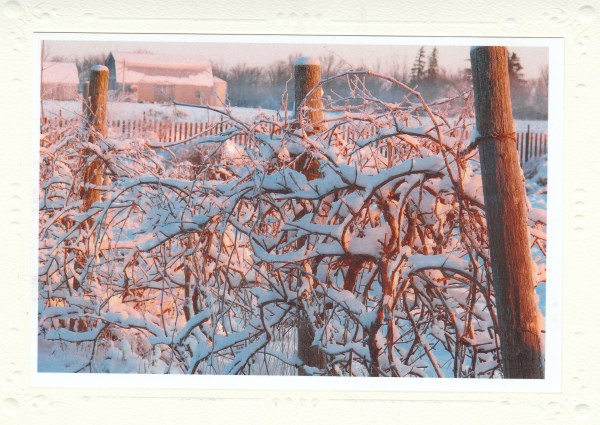
Barb was also an avid photographer, and at Christmas, I would receive a lovely Christmas card with a photo of hers on the front, like this one:
Winter in Britton, Michigan
Her husband John told me that her hobbies included dancing, wheat weaving, historical reenactment and she had an interest in architecture too. She was a talented lady. John wrote and told me:
“When we moved to Tecumseh, in 1991, the first thing that Barb signed up for was a class in agriculture at the local school. She learned how to drive a tractor and saw some things that displeased her, such as a chicken butchering business. One of the projects of the class was to plant pine trees in long rows at the sides of the fields as windbreaks, they are useful around here because it is so flat and open. One day, I came home from work and found Barb lying on the couch. Apparently, her muscles, were all sore from hours of stoop labour, planting the pine seedlings. [2]
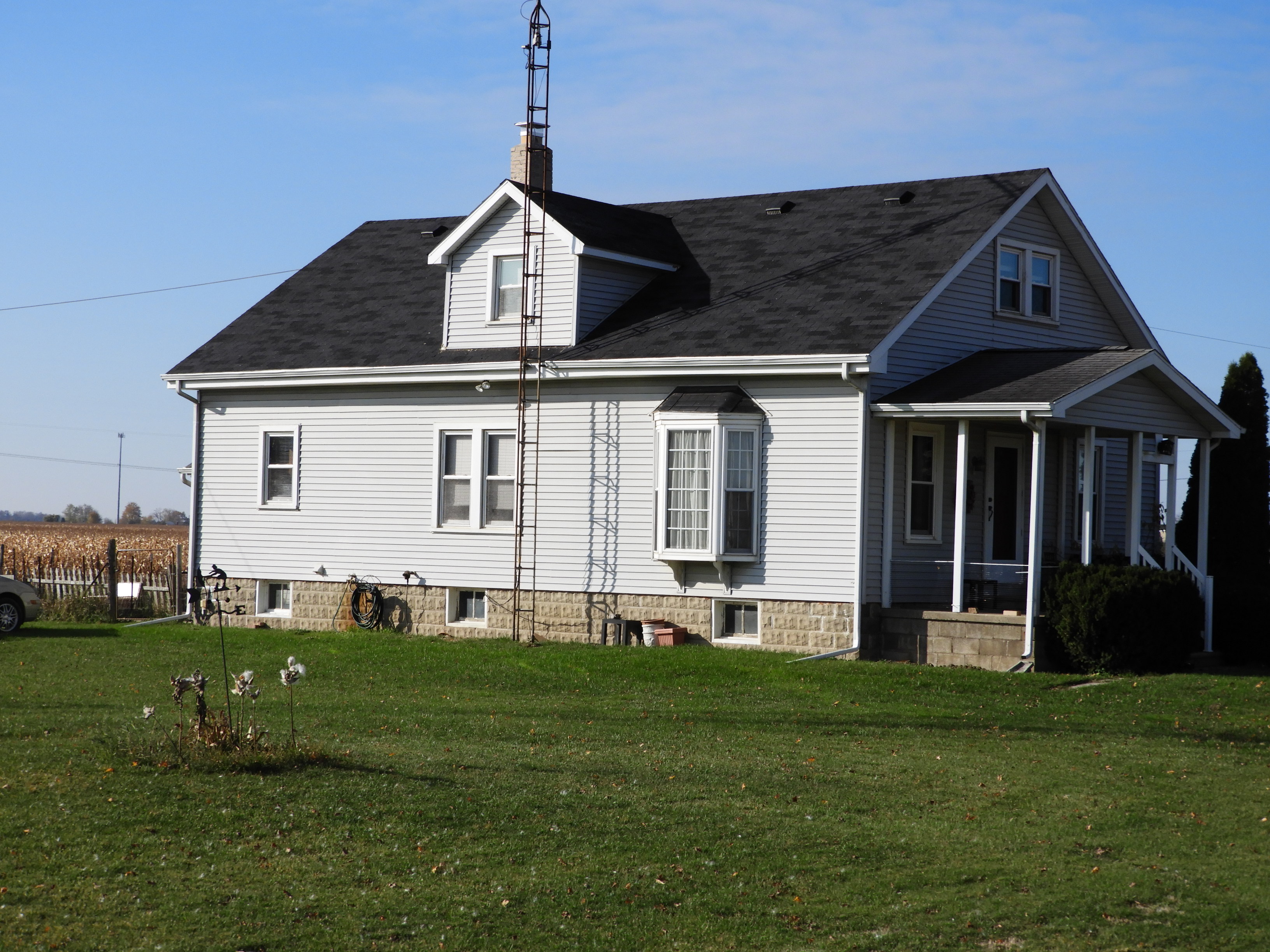
John continues: “The house looks nice, and that is Barb’s doing. She insisted on the new siding in 2001, and she designed the bay window you see on the side of the house. The red door was also her idea, a nice punctuation point with the grey siding. Barb was gifted as an architect, though she had no degree. She also came up with the name Macon River Farm when we began selling at the farmers market in Tecumseh.” [2]
Barb and John’s home with the bay window.
The Red Door
Leo The Goat
Via email, I ‘introduced’ her to my cousin Diane – Di – in the UK, and so, the three of us started to email including each other, and we learned more about our ancestors, exchanging information and photos we three had. Cousin Di and I were enchanted with these photos and Di commented for both of us when she wrote:
“John, your home is absolutely lovely, exactly what we Brits imagine a rural American farmhouse should look like, in a beautiful setting. The red door is inspirational, very Barb. It must be both a comfort and refuge for you, but also a constant reminder of your Barb, who put so much of herself into it. We are a crowded island, and you have so much space” [3]
Soon, Barb and I started to Skype too and shared even more of our ancestors’ lives and ours. We had a very good relationship going and we seemed to hit it off from our first emails to each other.
We all felt we got to know each other really well and enjoyed our relationship.
At the end of January, 2020 I noticed that I had not had a reply to a few emails which was not like Barb at all, so I wrote and asked if all was well. It was not.
She apologised for not answering sooner and told me she was making end of life arrangements.
I immediately emailed and asked her for whom she was making arrangements and said that I volunteered at the local Hospice and if I could be of any help, please let me know. Barb responded that she was making end of life arrangements for herself!
The shock to her husband John, her family, friends, and me and cousin Di in the UK, was profound. Even in the midst of all this turmoil, Barb took the time to email me, saying she wanted me to have her gold locket, that Barb is wearing in her wedding day photo.
She told me, that it belonged to her grandparents, and contains photos of her grandfather, George – my great Uncle – and his wife, Elizabeth Jane Curnow. It was a wedding day gift to Elizabeth from George, and she wore it on her wedding day, as did Barb.
Barb wrote that she wanted to keep it in the Bulford family. I was so very touched. After all, our friendship had lasted for only four years, even though it seemed much longer. I reassured Barb that it would be kept in our family, and eventually, I was going to give it to my Granddaughter Molly Marguerite.
Later, John sent her beautiful locket to me. To be honest, I had forgotten about it, so when I received it in the mail, I was very weepy and thrilled, all at the same time. I will treasure it.
Elizabeth Curnow and George Bulford were married on the 20th November, 1915
Our dear cousin, Barbara Jane Mulcahy died on the 15th of May 2020 at 3.40am. She is missed very much by us all, but especially by her dear husband John, who Di and I frequently email, just to keep in touch and for us all to be able to keep Barb in our memories. John very generously shares his memories of Barb with us, and we are grateful.
Rest in Peace, cuz, we love you and will never forget you.
Family Names in 59 Ancient Regions of France, Belgium, Switzerland and Luxembourg
This database consists of a list of authors, book sellers and publishers containing the family names in the regions. Most of the books are in the French language.
The list contains several complete books online which can be downloaded.
For many of the regions there is a short description of the region.
For exmple :
Auvergne
The origin of the name auvergne comes from the Gallic people of the Arvernes. On the death of Charlemagne and then Louix-le-Pieux,the Carolingian empire was divided between his sons and Auvergne finally returned to Charles the Bald. In the 12th century the county of Auvergne was the subject of a conflict between William VII, the rightful heir returning from the Crusades, and his uncle William VIII. The county will eventually be divided between a new county of Auvergne and the Dauphiné d’Auvergne. This conflict will be in line with the war between France and England since the new county of Auvergne will depend on the Aquitaine and therefore the Plantagenêts,the Dauphiné d’Auvergne will take the side of the King of France. During the French Revolution, the territory formed the departments of Haute-Auvergne (then Cantal), Lower Auvergne (then Puy-de-Dôme), Haute-Loire and Allier and an accompanying map indicating the region.
About a year ago, my cousin and I were invited to luncheon with a distant family member who wanted to share her inherited Lindsay papers. The delicious luncheon filled our bellies and the precious family papers filled our souls. Among the papers were copious legible (!) handwritten notes by my great uncle, Stanley Bagg Lindsay, with some details of the lives of all three William Lindsays.
A Sample of Stanley Bagg Lindsay’s Notes (my great-uncle)
Why the second William (Burns) Lindsay (1796-1862) mantained two careers
In many families the eldest son often follows in his father’s footsteps when choosing a career. However, the second William Lindsay’s older brother died in 1817 when William was only 21.
Before then, in 1808, 12-year old William actually began work as an apprentice writer* in his father’s office, who was the recently appointed Clerk of the House of Assembly for Lower Canada. However, instead of eventually following in his father’s footsteps full time, William first pursued a career in banking.
William worked as one of three employees when the Bank of Montreal first opened in Quebec City in 18171. He began as the bank teller and eventually worked his way up to became an officer of the bank. During his time at the bank, William requested and obtained leaves of absence to attend to his duties at this father’s office during the Assembly sessions.*
At the age of 23, William married Maria Jones in Quebec City in 1819 and eventually they had 11 children. Their first son was his namesake, William Burns Lindsay, who would also continue the family tradition as the Legislative Clerk (see next story).
William Burns Lindsay and his wife Maria Jones
About ten years after they married, William’s father resigned from the Assembly in 1829 due to his failing health. (see The Three William Lindsays part 1) Not surprisingly, thirty-three year old William was unanimously appointed Clerk of the House of Lower Canada thus providing a fairly smooth transition and continuity of management. After 12 years establishing his own career in banking, he ultimately did step into his father’s political shoes.
At the time of his resignation from the Bank, “he had earned and obtained the good will and esteem both of his employers and of their customers, the merchants of Quebec.”* His unique combination of careers would have provided him with useful contacts with not only the elite “but young Canada’s most enterprising merchants and aspiring financiers”2 at that time. It must have placed him in a very powerful position indeed.
His work continued as Clerk of the Assembly right up until the 1837 rebellions (also known as the Patriots’ War)3, pitting the rebels against the colonial government of Lower Canada in an armed conflict, that had been brewing for nearly three decades. For the next few years, William commanded a volunteer artillery company*, until the restoration of order.
At this point, William was appointed Clerk to the Special Council4 set up to administer the affairs of Lower Canada until the Act of Union of 1840 when Lower Canada and Upper Canada were united into the one Province of Canada, as a result of these rebellions.
Lord Sydenham5,the first Governor General for the United Province of Canada, convened the first Parliament of Canada in 1841 in Kingston, Ontario6, and appointed William to be the clerk of the Legislative Assembly. Perhaps the Grand Trunk Railway enabled a commute between Assembly sessions while Kingston was the capital, as the 1842 census listed Quebec City still as his home.7 William held this office for the next 21 years until, according to his obituary, he died “almost in harness: for, though very unwell, he attended his place in the House … and within a few days of his death he signed official papers.”*
William died in Quebec City in 1862 at the age of 65 years.
The funeral took place from his residence in Quebec City while the flag on the Parliament Buildings flew at half mast during the funeral. An eloquent tribute to his worth was paid by the premier Hon. Mr. Cartier8 and the House of Assembly adjourned to testify respect to his memory. The members attended the funeral together putting any differences aside for that day. “As an efficient public officer, Mr. Lindsay was a very remarkable man…he was emphatically the right man in the right place … he never suffered himself to become a political partisan or to show more favour or grant more facilities to one side than the other.”*
Upon his death in 1862, William’s namesake (the third William Lindsay), succeeded to the clerkship of the Legislative Assembly thereby taking his father’s place and continuing the family history.
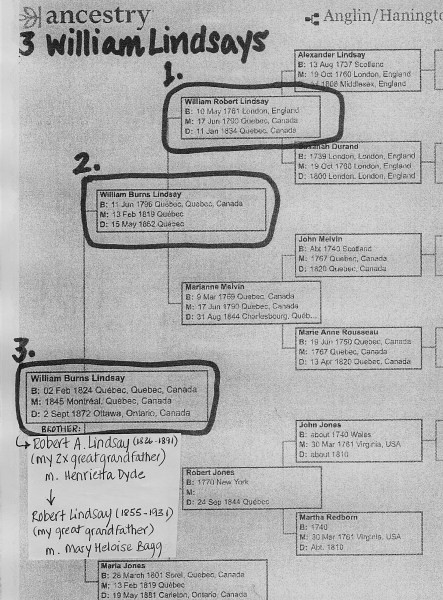
My great great grandfather, Robert A. Lindsay, was the brother of the third William Lindsay
Next: Why the third William Lindsay gave up a promising career as a lawyer
Notes:
As the family genealogist, I research my ancestors and write their stories. Recently, I found three generations of ancestors with the same name and the same role in an evolving Canada.
Their birth and death dates were vital as the first step to sorting them out. I noticed, however, that previous genealogists also struggled to sort them, as two of the three were sometimes labelled “Senior” and “Junior” (and sometimes in reverse order) and then “The Elder” and “The Younger” were assigned to another two. To keep things simple in my story, I will label them first, second and third – in the order of their births.
* Handwritten notes – Stanley Bagg Lindsay – dated March 1939
6Kingston was named the first capital of the United Province of Canada on February 10, 1841. While its time as a capital was short (ending in 1844), the community has remained an important military installation.
7The capital moved from Kingston to Montreal in 1844 and then alternated between Quebec City and Toronto from 1849 until Queen Victoria declared Ottawa the permanent capital in 1866.
This week’s blog is a repetition of a previous blog with the addition of a reference to the article in the Gaspesian HerItage Webmagazine that contains an overview of “The Great Upheaval.”
French Canadian and Acadian Family Lineage in Quebec
“In 1755, the British authorities began to dismantle the former Acadian colony by deporting its entire population… unleashing a French-speaking exodus to various regions, including many areas of Québec”.
“At the time of the Deportation, many Acadians made their way into Québec, where they were granted farmlands.”
“It is estimated that today, among Québec’s population, more than a million (or more than 15%) people bear Acadian origins.”
…….
This database focuses on the Historical and Genealogical Societies in Quebec counties and includes books by authors who have written about the various communities.
When we think of emigration from Europe, we think of crossing the Atlantic to North America or going to Australia. For the Irish, immigrating to Scotland would have been just as difficult as if they had moved to a new continent.
The Irish started to arrive in Dundee, Scotland around 1825, lured by the prospect of regular employment in the growing jute industry. Within 30 years, the Irish community of Dundee had grown to 14,000.3
This quote from James Myles, a local Dundee author, in Rambles in Forfarshire, 1850, gives us a taste of how the Irish immigrants were perceived by the Dundonians:
A great proportion of them are Irish. Drawn hither by the work they obtain at the spinning mills; and it is to be deeply lamented that the vast hordes that have migrated to the Scouringburn are composed of the most debased and ignorant of their countrymen. Their vile slang and immoral habits have seriously injured the poor population of Dundee.2
The first Irish McHughs to move to Dundee, Scotland were brothers John and Patrick McHugh. They both married in Dundee and worked in the jute mills all their lives. And their families continued to work in the mills for generations, almost a century.3 Like most of the Irish immigrants, John and Patrick probably already had experience in the textile industry in Ireland and most likely came from one of the counties that produced linen and yarn.4
The Irish settled where the jute mills were located in Lochee, Dundee, also known as Little Tipperary. 5 The McHughs, like the other Irish immigrants and unlike most Dundonians, were Roman Catholics. The Church of Scotland has been the dominant religion in Scotland since the Scottish Reformation of 1560 and the Roman Catholics would have been looked upon with disapproval and suspicion.
St. Joseph Roman Catholic Church, Dundee, Scotland, built in 1873
It is not surprising that the Irish Roman Catholics lived in the same area and worshipped at the same Catholic churches in Lochee for decades. I can find registrations of marriages, baptisms, and deaths for the McHughs for generations. The McHughs remained steadfast Catholics during their century of living in Dundee and only branched out into other religions once they arrived in Canada in 1912.
The Irish were also seen as carriers of disease, such as typhus, also known as ‘Irish fever.’ Of course, this was due to unsanitary and crowded living conditions in which they lived.6
In 1904, the Lochee Harp Football team was formed by Lochee Irishmen to provide recreation for the poor immigrants. Even today, Lochee is considered the Irish quarter of Dundee.7
I have taken advantage of all the extra free time at home over the past year to write a family history book about my father’s ancestors. It has been the perfect pandemic project, but now it is almost time to launch it into the world.
This book brings together the many blog posts I have written about my father’s extended family over the past eight years for my personal family history blog, Writing Up the Ancestors, and for the collaborative blog Genealogy Ensemble. As someone once told me, a blog is a good cousin catcher, and indeed, blogging has allowed me to connect with cousins I never knew I had. Also, I got a lot of the research done and written up in small bites. But the stories about the Hamilton and Forrester families (my paternal grandmother was a Forrester) jump all over the place on the blog; in the book, they are in historical sequence and geographical context.
A book that you can hold in your hands and store on your bookshelf for years also feels more permanent. People read a blog post, then jump to the next shiny object on the Internet. You might only read part of a book, or look at the photos, but you can keep it for a long time and pass it on to the next generation. I’m dedicating this book to my grandchildren, in the hope that one day, maybe 50 years from now, they will sit down and discover all the astonishing things their ancestors risked and achieved.
I have called this book Reinventing Themselves: a History of the Hamilton and Forrester Families. These people reinvented themselves several times. Most male members of the immigrant generation grew up in lowland Scotland where they were weavers, stonemasons, tenant farmers and carpenters. When they landed in Upper Canada around 1830, they had to reinvent themselves as farmers in an unfamiliar climate. Members of the next generation retained most of their Scottish customs and religious beliefs, but moved on to a new landscape as they became grain famers on Canada’s western prairies. Their sons and daughters were the first to give up farming and forge careers in the city.
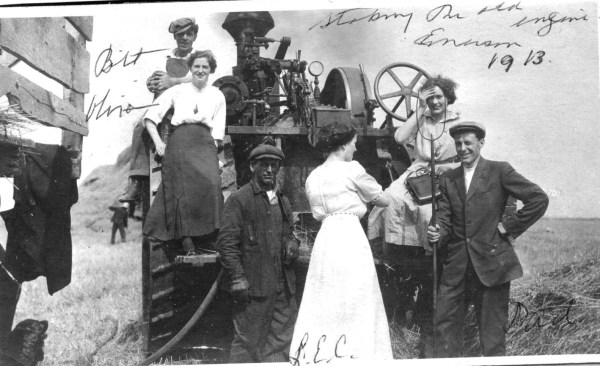
Working on the Forrester family farm near Emerson, Manitoba, 1913.
Many Canadian pioneer families followed similar paths, so what makes this story special? Part of its value is that it does represent the experiences of many 19th century immigrant families.
Luckily, many accounts of my ancestors’ unique experiences have survived. In a letter to his father back in Scotland, immigrant Robert Hamilton (1789-1875) recounted the family’s voyage across the Atlantic. Fifty years later, his granddaughter Maggie Hamilton (1862-1886) wrote a letter from Saskatoon in which she described baking bread for the government soldiers following the North West Rebellion in 1885. Fast forward another eighty years and Charles Forrester (1889-1984) wrote a book about life on the farm near Emerson, Manitoba, from hauling water for the livestock to singing Scottish ballads at family gatherings.
I used to envy people who were members of various ethnic groups. They seemed so exotic, while my ancestors were pretty boring. But writing this book has helped me appreciate the values these Scots brought with them: their deep sense of community and their competitiveness, their love of books and learning, their love/hate relationships with alcohol, and their strong work ethic.
The book also has its share of surprises, from the discovery of my great-grandmother’s illegitimate birth and the story of brothers who were globe-trotting plant collectors to the death of my father’s twin in the 1918 flu pandemic and my grandparents’ subsequent investigations into psychical phenomena.
The research, writing and editing are done. It’s too late now for changes, although I will always be itching to tweak something. The manuscript and many, many photos are in the hands of a book designer. I’ll let you know soon when and how to get a copy.








 Genealogy Ensemble