Spitfire Service Socks

My grandmother, Grace Hunter, used to knit, read, and watch television at the same time. She sat in her well-worn high-backed armchair, with her Women’s Own magazine or her Harlequin romance flattened open on the wide armrest, and watch her soap opera or a game show. I realize now that she was reading when the commercials were on but when I was a child, it seemed to me that she could follow the television and read simultaneously. Her lips moved silently to the beat of the clicking knitting needles. Every so often I heard her take in a deep breath as she concentrated on her knitting rather than the television or her book.

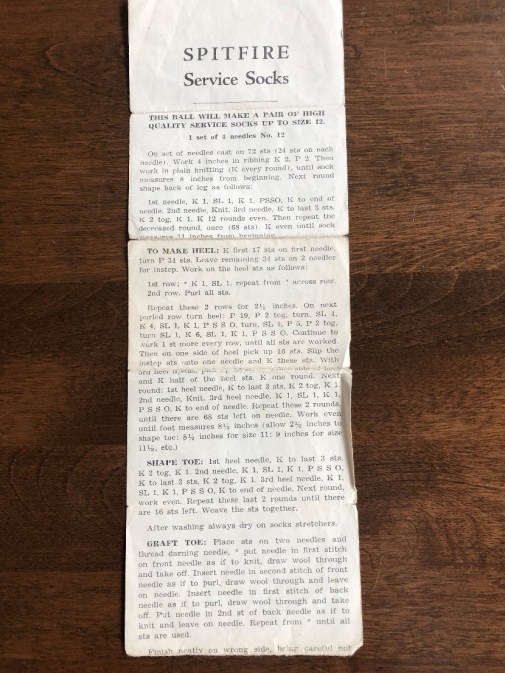
My memories of Nana knitting were more than thirty years after the end of World War II. She was a volunteer knitter for the war effort. This well-worn knitting instruction sheet for Spitfire Service Socks suggests that it was used often.

Spitfire

It is most likely that Nana learned to knit as a young girl. She came from a modest working class family so knitting would have been a necessary skill. During World War I, Grace’s father, John Hunter, was stationed in France. Knitting for the soldiers was an act of patriotism and is was highly likely that Grace, thirteen when her dad went off to war, would have knitted so that the care package that the family sent overseas would contain some warm socks and other knitted clothing.

My mom told me that when World War II broke out, my grandmother was active in the war effort. She belonged to the women’s auxiliary in the church and they held knitting bees, held fund raisers, and catered parties for the men on the eve of their departure for war. Knitting socks and other clothing was one way, among many, of doing something tangible for the men who had gone to war.

During both World Wars, the Canadian Red Cross issued knitting instructions to civilians so that they could contribute to the war effort.  Below is a picture of a booklet published during World War II. 1

Red Cross

The Red Cross was also in charge of collecting and distributing the knitting. Before sending the knitting overseas, the Red Cross inspected all items. Volunteers also helped with the quality control inspections and some knitters corrected mistakes made by others, such as taking out knots in heels of socks. Some volunteers would take the knitting completely apart and redo it, if needed. 2

The Canadian Red Cross estimated that 750,000 women knitted more than 50 million garments for the military in World War II.3

Even the style of knitting underwent a transformation. Continental-style knitting was popular in Germany but it fell out of favour in English speaking countries during World War II. Knitters changed to English-style knitting. The difference between the two styles is the hand in which the yarn is held. Continental-style knitters hold the yard in the left hand, not the right. Nana always had her yarn in the right hand, as her reading material was on the left armrest of her chair.4 She needed her left hand free to turn the page.


  1. Canadian Red Cross, WWII Civilian Knitting Instructions, https://www.redcross.ca/history/artifacts/wwii-civilian-knitting-instructions, accessed April 26, 2020
  2. Canadian War Museum, An Army of Knitters in Support of the War Effort, March 10, 2014, https://www.warmuseum.ca/blog/an-army-of-knitters-in-support-of-the-war-effort/, accessed April 26, 2020
  3. Idem.
  4. Weightman, Judy, More Knitting History, World War II, October 9, 2012, https://judyweightman.wordpress.com/2012/10/09/more-knitting-history-world-war-ii/, accessed April 26, 2020

The Missionary Couple

When Jessie Jean Forrester (1896-1961) married a Presbyterian minister, she committed herself to a very different life from the one she had been accustomed to growing up on the Manitoba prairie. For almost 25 years, the couple lived in India, where he served as a missionary. There they were surrounded by the soaring Himalayas and elaborate temples, they suffered the heat of the central plains and humidity of monsoons, and they enjoyed eating Indian food.

There were some scary moments too. On one occasion, they were staying in a camp, complete with tea service. Jessie got up to go to the bathroom during the night and, as she was passing through the privacy screen, she saw a tiger roaming the camp.

The youngest daughter of farmers Jack and Samantha (Rixon) Forrester, Jessie first left Manitoba as a teenager, accompanying her parents when they retired to Los Angeles around 1911.

The 1920 U.S. census found her at age 24, living with her parents and working as a book keeper for a hardware store. The following year, she and her mother were counted in the 1921 census of Canada, staying with Jessie’s older sister (and my grandmother,) Lillian Hamilton, and her family in Winnipeg. They were probably busy preparing for the wedding.

Jessie Jean Forrester and her mother, photo taken in Los Angeles

Jessie’s husband-to-be, Thomas Benjamin McMillan, was born in 1888 in Margaret, Manitoba. The McMillan family eventually moved to Winnipeg. Tom graduated from Manitoba College with a degree in economics, then served as a lieutenant in the Royal Flying Corps during World War I. After the war, he returned to Winnipeg and completed a two-year course in theology. 

Jessie and Tom were married on August 17, 1921.Three weeks later, the newlyweds left for India. Daughter Hazel Lillian (born 1922) and son Hugh Forrester (born 1924) were both born in India and attended Woodstock School, Landour, a school founded in the 19th century to educate the children of American missionaries. They also attended school in Winnipeg during extended visits to Canada.

Tom went to India as a Presbyterian minister, but after the creation of the United Church of Canada by Presbyterian, Methodist and Congregationalist congregations in 1925, he became a United Church missionary.  Much of his work was based in the central Indian cities of Hat Piplia, Neemuch and Indore, in the state of Madhya Pradesh. When the weather in central India became too hot, the family retreated to the twin cities of Landour and Mussoorie, in the foothills of the Himalayas. When son Hugh McMillan and his wife visited Mussoorie in 1979, they found the cosmos flowers Jessie had planted many years before still seeding themselves and blooming.1

Besides serving as a pastor, Tom was also active on several committees. In central India, he served as chairman of the building committee for 10 years and secretary of the Evangelistic Commission for three years, and he was a delegate to the General Assembly of the United Church of North India and chairman of the Assembly Business Commission.

Tom and Jessie remained in India during World War II, but 19-year-old Hazel returned to North America in 1941 to stay her uncle and aunt in Los Angeles, and Hugh sailed to California in 1944. Both were accustomed to long sea voyages, having travelled back and forth with their parents every few years to visit friends and relatives in Winnipeg and Los Angeles, but it must have been frightening for them to travel alone in wartime. Tom and Jessie came back to Canada for good after the war ended and before Indian independence. 

The McMillans settled in British Columbia, where Tom ministered to several United Church congregations. After he retired in 1960 at age 72, they settled in Victoria, where he continued to visit the sick and served as an associate minister at Oak Bay United Church until 1964.

When Jessie died in 1961, aged 65, her obituary in the Ladysmith-Chemainus Chronicle called her “a woman of great dignity and artistic ability,” adding that the bazaars and festive occasions at the two local United churches where Tom had been minister for four years were made more attractive by her deft floral arrangements.

Tom died in 1965 at age 77 and was buried beside his wife in Royal Oak Burial Park, Saanich, B.C..

Sources.

  1. Walter Meyer zu Erpen, “Mrs. Jessie Jean (Forrester) McMillan (29 March 1896-16 September 1961), sister of Mrs. T.G. Hamilton (1880-1956), and Reverend Thomas Benjamin McMillan (26 June 1888-25 July 1965), BA (University of Manitoba). Draft research report, 2015/12/26. Note: Walter gathered his research from a number of sources, including telephone interviews with family members and United Church of Canada records.

(This article is also posted on Writinguptheancestors.blogspot.ca)

The Protestants of Auvergne, Limousin, Lyonnais and Marche of the 16th and 17th centuries

Auvergne

Auvergne is a former region of south-central France. Prior to the French Revolution (1789 to 1799,) Clermont-Ferrand was its capital. After the revolution, Auvergne was sliced up into four modern-day départements: Allier with eight Protestant communes (villages, towns, townships, cities); Cantal with 17 Protestant communes; Haute-Loire with 13 Protestant communes and Puy-de-Dôme with 11 Protestant communes. – Sources: Wikipedia & Archives des consistoires 1317-1446 – 1520-1740 at the Archives nationales de France, Pierrefitte-sur-Seine (Paris)

Limousin

A former region of southwest-central France, Limoges was the regional capital prior to the French Revolution. Then, Limousin was divided into three modern-day départements: Corrèze with four Protestant communes; Creuse with six Protestant communes (a portion) and Haute-Vienne with 22 Protestant communes. – Sources: Wikipedia & Archives des consistoires 1317-1446 – 1520-1740 at the Archives nationales de France, Pierrefitte-sur-Seine (Paris)

Lyonnais

A former province of France in the south-east of France, this territory includes most of the greater region of the city of Lyon. Following the French Revolution, Lyonnais became the modern-day département of Rhône with six Protestant communes.  – Sources: Wikipedia & Archives des consistoires 1317-1446 – 1520-1740 at the Archives nationales de France, Pierrefitte-sur-Seine (Paris)

Marche

This former province in south-central France had Guéret as its capital prior to 1789. Post revolution, Marche became the modern-day département of Creuse with six Protestant communes. Sources: Wikipedia & Archives des consistoires 1317-1446 – 1520-1740 at the -Archives nationales de France, Pierrefitte-sur-Seine (Paris)

Here is the link to a 39-page research guide to the Protestants of this area: Protestants of Auvergne, Lyonnais, Marche

This is the last of a series of research guides to the Protestants of France of the 16th and 17th centuries. These regional guides were posted by Jacques Gagné between January and June, 2020. Most of the people who immigrated to New France were from the country’s north-west region, including Normandy. The majority of those who came to New France were Catholic, but some were Protestant. The research guide to this area can be accessed here : https://genealogyensemble.com/2020/03/02/the-protestants-of-anjou-beauce-bretagne-maine-normandie-perche-poitou-touraine-of-the-16th-and-17th-centuries/

Here are some resources to help you research Protestant ancestors in France:

How to Search for Huguenot Ancestors in France, May 20, 2018, https://genealogyensemble.com/2018/05/20/how-to-search-for-huguenot-ancestors-in-france/

Huguenot Family Lineage Searches, June 3, 2018, https://genealogyensemble.com/2018/06/03/huguenot-family-lineage-searches/

Researching Your French Ancestors Online, May 13, 2018, (the attached updated PDF describes how to research in the Archives départementales de France, the country’s 95 regional archives)  https://genealogyensemble.com/2018/05/13/researching-your-french-ancestors-online/

The National Archives of France, Jan. 27, 2019, https://genealogyensemble.com/2019/01/27/the-national-archives-of-france/

BNF Gallica (Bibliothèque nationale de France), Dec. 16, 2018, https://genealogyensemble.com/2018/12/16/bnf-gallica/

Finding Ancestors in French Municipal Archives, Sept. 23, 2018, https://genealogyensemble.com/2018/09/23/finding-ancestors-in-french-municipal-archives/

 

Living outside city walls

Settlers have long been attracted to Saint Roch, a neighbourhood on the banks of the St. Charles River next to the cliff leading up to Quebec’s walled Upper Town.

My great great great grandparents—Joseph Gabriel Arial Robert Content and Judith/Julie Belleau-dit-LaRose —both grew up in the neighbourhood. They knew it as the Saint Roch parish, which was officially founded in 1829. By then, the swampy neighbourhood housed 20 different shipyards and most of Quebec’s French-speaking families.

The neighbourhood began in 1620 as a small religious community set up by French missionaries known as the Recollets. They built a chapel in 1620. That chapel has long since gone, as were those built in 1811, 1816 and 1841.1 A stone church built in 1923 now sits on the same site as all the others at 160, rue Saint Josephe Est. For some great photos of the area and a discussion in French about all the different churches on the site, refer to Jérôme Ouellet’s 2014 blog post.

Joseph and Judith got married in the 1816 version of the church on September 4, 1832.2 Her parents Joseph Belleau and Marie-Anne Ratté married in a predecessor on November 5, 1808.3

I don’t know exactly where in Quebec Joseph lived prior to their marriage, but his dad Jean Baptiste worked as a day labourer.4

Judith’s family lived at 28 Saint Vallier. Her dad Joseph Bélau (Belleau) worked as a baker.5

Just down from the Bélau home sat an opulent stone house built by businessman Henry Hiché. He built his mansion on the foundations of a farmhouse originally built by Charles Aubert de la Chesnaye in 1679. The building later became known as the “White House” due to a covering of white plaster.

Most of the neighbourhood, including the White House, burned down in the Great Saint-Roche Fire of 1845. A total of 1,200 houses burned down, leaving 12,000 people homeless that year. Another smaller fire swept through in 1866.

You can still see the third rendition of the home built by Scottish immigrant William Grant on the original vaulted cellars of the previous home at 870 Saint-Vallier East. The stone house gives you a rough idea of the beginnings of the neighbourhood built outside of Quebec City’s walls.

Joseph Belleau appears again in the 1851 Canada East agricultural census in St. Roche, Quebec on line 24.6 Joseph and Judith/Julie don’t appear on the 1851 census, but they and their eight children (one of whom was my direct ancestor “Pete”) appear on the census 10 years later, still living in St. Roche.7

If my grandmother’s notes are accurate, Joseph moved to Manitoba sometime after that. He died in St. Boniface on November 4, 1880.8

At some point, I hope to go on a walking tour of the area and reconnect to the neighbourhood that housed my ancestors 200 years ago.

-30-

To read more about Joseph and Julie’s son Pete and see a photo of him and his children, refer to Original Arial Family of Western Canada

2 Mariage certificate #3816438, The Programme de recherche en démographie historique (PRDH), Quebec, 1621 to 1849.

3 Mariage certificate #2337256, The Programme de recherche en démographie historique (PRDH), Quebec, 1621 to 1849.

4 Mariage certificate #3816438, The Programme de recherche en démographie historique (PRDH), Quebec, 1621 to 1849.

5 Archives de la paroisse de Notre-Dame-de-Québec, CM1/F1, 3, vol. 4, p. 36. Visite générale de la paroisse de Québec commencée le 1er octobre 1805, p 36.

6 Census of 1851 (Canada East, Canada West, New Brunswick and Nova Scotia), Item Numbers: 93934, and 93935.

7 Census of 1861 (Canada East, Canada West, Prince Edward Island, New Brunswick and Nova Scotia) for Image No.: 4108628_01187, Item Number 2159833.

8 Handwritten notes from my grandmother.

The Protestants of Agenais – Angoumois – Aquitaine – Béarn – Gascogne – Guyenne – Limousin

This area of Southern France has a long and complex history which makes things difficult for genealogists.

Its regions, Aquitaine, Gascogne, Guyenne and Basse-Guyenne, go back to the 13th century and, even before the era of knights and noblemen, the territory was in constant flux, and borders and place names often changed.

For this reason, North American family lineage researchers, not schooled in the fine points of French history, may have a hard time looking up ancestors, Protestant or Catholic, who lived in this region prior to 1790.  Here is some information that might help.

Here is the link to the 50-page PDF research guide to Protestants in this area: Protestants of Agenais-1  Almost all of these resources are in French. For translation help, try Google Translate or www.deepL.com.

Agenais

Agenais is an ancient region of the provinces of Gascogne and Guyenne. Its capital was the city of Agen and consists today of the département of Lot-et-Garonne and a portion of the départements of Tarn-et-Garonne and Gironde. From 1530, Protestant temples were built in 78 cities, towns, townships and villages of Lot-et-Garonne. The exact location of these temples from 1565 to 1721 is listed on the first four pages of the Genealogy Ensemble research guide https://genealogyensemble.com/wp-content/uploads/2018/05/huguenot-families-in-france-1565-1721.pdf  See also Gironde – Listings of Protestant communes (villages, towns, townships, cities) obtained from the files of Archives des Consistoires 1317-1446 & 1520-1740 #TT-230-276B stored at the Archives nationales de France at Pierrefitte-sur-Seine,  a suburb of Paris.

Angoumois

Today ancient Angoumois consists of the département de la Charente and a small portion of the Haute-Vienne. Its capital city is Angoulême. Protestantism in Angoumois took root in 1533 in Angoulême, La Roche-Foucault-en-Angoulême, Royan. Sources; Wikipedia and Musée protestant

Aquitaine

Ancient Aquitaine, with Bordeaux as the capital, is comprised today of Dordogne, Gironde, Landes, Lot-et-Garonne, Pyrénées-Atlantiques.  Protestantism was present in all or part of 262 communes (villages, towns, townships, cities) from about 1530. Information obtained from the files of the Archives des consistoires 1317-1446 – 1520-1740 #TT-230-276B stored at the Archives nationales de France – Pierrefitte-sur-Seine (Paris.)

Béarn

Béarn had Orthez as its capital from 1242 to 1464 and Pau from 1464 on. Today’s département of Pyrénées-Atlantiques covers the same territory.  Protestants were present in the city of Lescar in 1549 and in 52 other cities, towns, townships and villages (communes.) Source: Archives des consistoires 1317-1446 – 1520-1740 #TT-230-276B stored at the Archives nationales de France – Pierrefitte-sur-Seine (Paris)

Gascogne

The ancient province of Gascogne had two capitals, Auch and Saint-Sever. Today it is covered by the départements of Gers, Landes, Hautes-Pyrénées and a part of Ariège, Gironde, Haute-Garonne, Lot-et-Garonne, Pyrénées-Atlantiques, Tarn-et-Garonne. Protestantism took root in the Gascogne in 1559. There were 61 Protestant communes (villages, towns, townships, cities) existing within two modern-day départements, Gironde and Landes. Source: Archives des consistoires 1317-1446 – 1520-1740 #TT-230-276B stored at the Archives nationales de France – Pierrefitte-sur-Seine (Paris)

Basse-Guyenne

Around 1660, the Protestant population of the Basse-Guyenne stood at 97,000 réformés (members of the Reform Church of France,) with 72 temples within the cities of Bordeaux, Sainte-Foy, Bergerac, Clairac, Nérac. Source: Musée protestant

Guyenne

Bordeaux was the capital of this ancient region prior to 1790. Today’s départements of Aveyron, Dordogne, Gironde, and Lot cover the same territory. Protestantism was established in the Vallée de la Dordogne in 1626. The cities where Protestantism had an impact were Bordeaux, Coutras, Nérac, Saint-Affrique, Saint-Antonin-Noble-Val. Sources: Musée protestant, Wikipedia, Archives des consistoires 1317-1446 – 1520-1740 #TT230-276B – Archives nationales de France – Pierrefitte-sur-Seine (Paris)

Limousin

The city of Limoges was once the capital of the ancient territory of Limousin. Today Limousin is comprised of the départements of Corrèze, Creuse, and Haute-Vienne. Protestantism first appeared here around 1520 in the cities of Limoges, Villefavard, Madranges, La Souteraine, Confolens, Uzerches, Beaulieu-sur-Dordogne, Argentat, Turenne. Sources: Musée protestant and Archives des consistoires 1317-1446 – 1520-1740 #TT 230-276B – Archives nationales de France – Pierrefitte-sur-Seine (Paris.)

Périgord

Périgord is an ancient county with Périgueux as its former capital, while Bergerac and Sarlat-la-Canéda are its principal cities.

The centre of Protestantism in Périgord was Bergerac. Modern-day Périgord is Dordogne. This area was home to 79 Protestant communes (villages, towns, townships, cities.) Source: Archives des consistoires 1317-1446 – 1520-1740 #TT230-276B – Archives nationales de France – Pierrefitte-sur-Seine (Paris.)

The Family Genealogist


letterpic

The truth is, family genealogists haven’t changed that much over the years. They are still the one in the family with time on their hands and the fierce determination to stick with it through all the brick walls and misinformation and family myth muddles. They still wonder, when all is said and done, if anyone in the future will value their hard work.

Well, I think future generations will care and something happened to me lately to prove it:

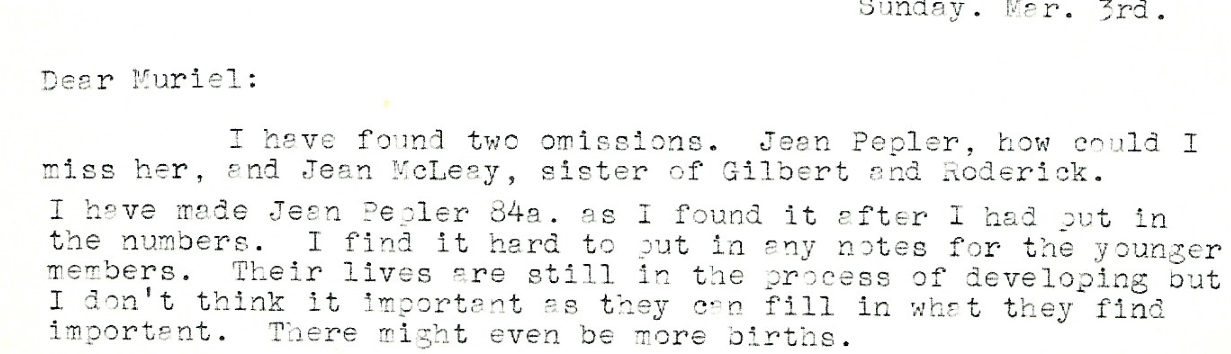
The evidence comes in the form of a letter dated only March 3rd, but I know it must be from the 1970’s. It is from a certain Isabel to a Muriel. The type-written missive appears to be the last in a series on the subject of creating a family tree– and, without ceremony, after the “Dear Muriel” salutation, the letter gets right to the point.

“I have found two omissions, Jean Pepler, how could I miss her? and Jean McLeah. I have made Jean Pepler 84a as I found it after I had put in the numbers.”

Jean Pepler is my husband’s great grandmother’s niece. I know this from a family tree I once had on hand, the McLeod Family Tree, and more particularly from about 300 family letters from the 1908-1913 period, letters I long ago transcribed and published in an online book, A FAMILY IN CRISIS.

But, until recently, when I received this 50 year old note, I did not know anything about Isabel or Muriel

Isabel, the genealogist of the letter, discovers another error. “I just found another error in these family notes. The Millers have two daughters. I forgot Annie…I’ll have to correct it before I send it.”

Yes, like all genealogists, past and present, Isabel has poured a lot of energy into her family project and after she’s typed out the family tree, just when she thinks she’s finished, she finds some errors!

Not wanting to retype the whole tree chart, Isabel merely creates an in-between number for Jean Pepler, an esteemed Quebec educator, to use on the summary list at the of her document.

This wonderful letter was sent to me by my husband’s cousin, Debbi who still lives in Quebec. We didn’t know about Debbi either, not before then.

You see, when my husband got his DNA done a few years ago on Ancestry, he immediately discovered two first cousins (whom he knew very well) and a third cousin, Jean, he didn’t know at all.

He assumed this person was a third cousin because he shared 60 centimorgans of DNA with her, the average amount for third cousins. I contacted the woman to confirm the exact relationship.

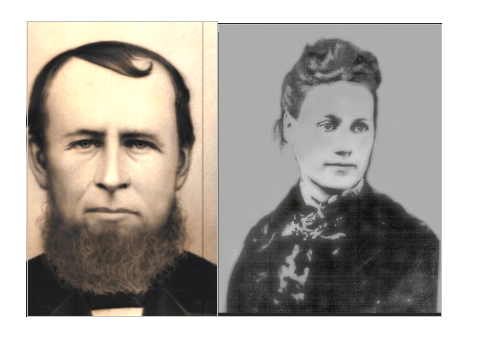
My husband and Jean were second cousins once removed, related through my husband’s two times great grandparents John McLeod and Sara Maclean of Uig Carnish, Isle of Lewis Scotland. My husband’s great grandmother, Margaret Nicholson and Jean’s grandmother, Isabella Hill, were sisters living around the corner from each other in Richmond, Quebec in early 1900.

mcleod

John McLeod of Uig Carnish Isle of Lewis, Scotland (Crayon Drawing) and his wife Sarah McLean McLeod, tintype.

These days, due to the Coronavirus, Jean is hunkering down with her daughter, Debbi, and they are passing the time exploring genealogy. Debbi saw my years old note on Ancestry.

“ I’m the one who is most interested in family,” Debbi wrote me. “Can you tell me more?”

So, I sent Debbi my compilation of Nicholson Family Letters that contain numerous mentions of Clayton and Isabella Hill. Clayton was a prosperous stone mason in Richmond who lived in a big house on ritzy College Street. Their son, Stanley, is Jean’s father. Their daughter Isabel (Hill Knott) is Jean’s aunt and Muriel (the letter’s recipient) is Jean’s mother, Stanley’s wife.

Isabel and Muriel were sisters-in-law.

Floraa

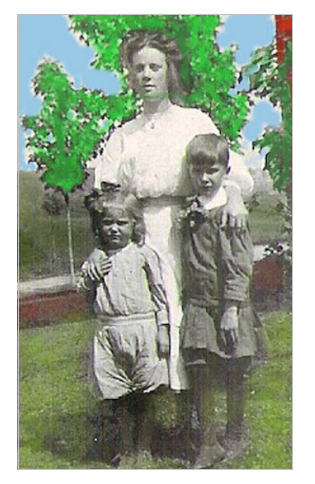
Flora Nicholson (1895-1978) my husband’s great aunt, with Stanley Hill and future family genealogist Isabel Hill Knott circa 1906

“Were there any other siblings in the McLeod Richmond family?” Debbi enquired of me. “ I’ve heard of Dan and Flora. Maybe a Mary-Jane, too?”

“I think I remember Mary-Jane from the letters, “ I replied. “ There was also a Christie in Illinois and a Sarah in Sarnia. But, I can’t remember any other siblings.”

I then explained to her that I once in my possession a McLeod family genealogy, neatly tied with shoelaces in a sturdy flip-board cover, but I’ve since misplaced it. Sad!

But, only a few days later, checking out some stored data on some random memory sticks, I stumbled upon some gifs of that same McLeod genealogy. (And, yes, we had missed some siblings!)

I emailed the gifs off to Debbi and that’s when she emailed me back a scan of her Great Aunt Isabel’s March 3rd letter from the 1970’s.

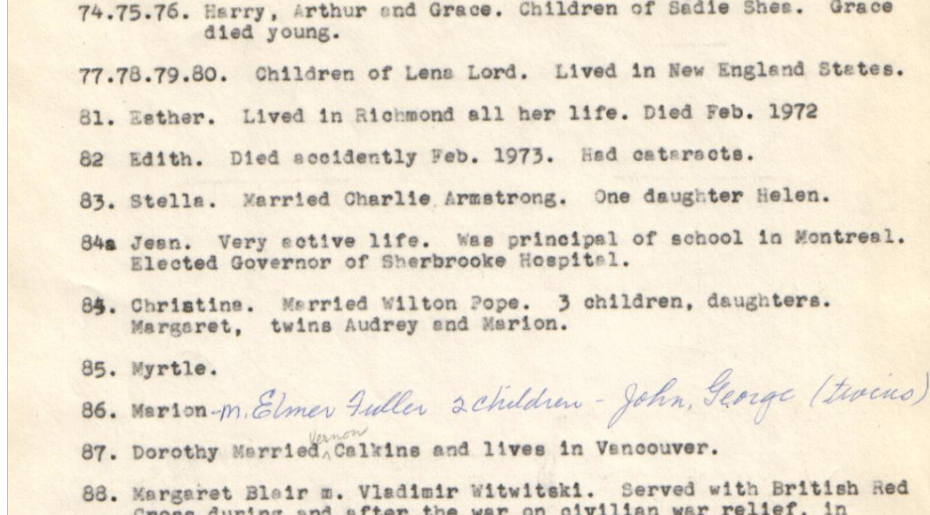
“As you can see, it’s the same genealogy. Jean Pepler is there at 84a!” Debbi wrote in the email.

What a serendipitous string of events had to unfold to marry these two documents, once again, almost half a century later!


peppler

Isabel’s Pepler page with new info added by a relation.

Today, with electronic communications, genealogists have so many tools at their disposal it is simply dizzying. Isabel’s letter reminds us that in the good old days it could take years and years of correspondence by mail or telephone to build a family tree – and typing it out before the age of White Out and word processors was an especially arduous task.

Isabel did, indeed, take a long, long time researching the tree:

“You should see my desk in the kitchen. At least now I can clean it up, getting rid of all the bits of notes I have gathered over the years.”

Isabel says that she spent three weeks at her kitchen table to type out the seven page genealogy.

“As this is all I have done for the past three weeks, I have no news….This has been hard work and has taken a lot of time but that is something I have plenty of.”

Isabel wasn’t sure, in the end, if she had done a good enough job:

“I find it hard to put in any notes for the younger members. There lives are still in the process of developing, but they can fill in what they find important. There might be even more births.”

And like many genealogists, then and now, she wondered if it was all worth the effort.

“What a job! Probably nobody will be interested because we have to accept that the world has changed.”

Well, it was worth the time and effort, Isabel, I can tell you that. Fifty years later many of us still do care. So, thank you for all the hard work you put into piecing together your (well, our) family tree.


Living in Westmount

One Sunday after the service at St. Andrew’s United Church, Westmount, a friend of my mother’s commented on an article in the Westmount Examiner. My mother said she didn’t read that paper as she’d never lived in Westmount. “Yes you did dear,” my father replied, “but you didn’t like it!”

img_0198

My parents, Donald William Sutherland and Dorothy Isabel Raguin were married on June 25, 1948. The recent war and the return of the soldiers made finding apartments very difficult. That summer they lived in Dorothy’s family home on Woodbury Ave in Outremont. Her parents, Beatrice and René Raguin were spending the summer at their cottage in Dunany, north of Montreal. Come fall and the return of the Raguins, there was no room for them there so they moved in with Donald’s mother, Minnie Eagle Sutherland and his sister, Dorothy on Arlington Avenue in Westmount.

IMG_0199

My mother found it difficult being a new bride and living with her mother-in-law. She didn’t have much to do. Two women came in to do the housework. Mrs Mikalachki did the heavy work and Mrs Boutilier the light cleaning and ironing. When Mom tried to do things for her husband she came up against Minnie Sutherland, a proud, willful woman who wanted all things done her way. Dorothy had been a Wren during the war and worked as a sick berth attendant in Halifax, Nova Scotia.  On leaving the navy, she renewed her teaching certificate and taught at Iona School in Montreal up until the day of her marriage. Sitting around listening to her mother-in-law tell her how things should be done wasn’t making her happy. She certainly didn’t want to start a family living there.

Luckily, one of her husband’s friends had an apartment on Maplewood (now Edouard Montpetit). He and his wife had bought a house and offered to have the apartment lease transferred to Dorothy and Don. My mother was thrilled with her own place but my father hated paying rent. My sister, Elizabeth Anne was born there and it was up to my mother to push the baby carriage to the post office to pay the monthly rent.

In the early fifties, the construction of new houses increased so my parents looked for a home to buy. What had been farmland and apple orchards in western Notre Dame de Grace were now streets with semi-detached brick houses. The show house on Cumberland Avenue, little longer and wider than others on the street was the one my father wanted. It had three bedrooms, a large basement and a good-sized backyard. The house was purchased on February 21, 1951, my sister’s first birthday. It was bought for $19,000 with a small mortgage. My father hated the mortgage payments and paid it off as quickly as he could.

One child soon became four with the births of Mary Ellen, Donald John and Dorothy Jean. The house became too small. My parents considered moving, although they liked the area. They looked at houses in the West Island of Montreal, but none were just what they wanted. So, in 1960 they had an addition built onto their house. A bedroom, bathroom and den were built over the garage and the kitchen was enlarged, including a laundry room.

unnamed-4

In the mid-sixties, it became apparent that both grandmothers would soon need help. My parents considered buying a bigger house with a grannie suite, so both grandmothers could live with the family. This time they did look at houses in Westmount. My maternal grandmother lived with us for a short while but in the end, we didn’t need to move as both grandmothers died in 1967.

My mother continued to live in the house after my father died. She went into a residence in NDG in 2011 where she died in 2017 and never moved back to Westmount.


Notes:

This Sunday was mother’s Day  and May 11, 2020, would have been my mother’s 98th birthday so I posted this story as a remembrance of her.

My mother’s story of serving as a Wren https://wordpress.com/block-editor/post/genealogyensemble.com/4470

Personal recollections by Dorothy and Donald Sutherland told to the author.

One house in Pointe-Claire had a large closet with sliding doors in the upstairs hall where two little girls put their dolls during the visit and forgot them. The agent returned to look for them but they were gone and never seen again.

The Protestants of Alpes – Dauphiné – Languedoc – Midi-Pyrénées – Provence of the 16th and 17th centuries

 In the 17th century, southern France harboured more Protestant families than any other part of the country. In 1660, the six provinces of the Midi (Southern France) accounted for close to 50% of the total Protestant population of France: 369,000 individuals and 298 temples (churches.)

This region included: Haut-Languedoc (Haute-Guyenne) – 80,000 individuals and 64 temples; Bas-Languedoc – 81,000 individuals and 63 temples;  Cévennes – 74,000 individuals and 59 temples; Vivarais – 48,000 individuals and 29 temples; Provence – 8,000 individuals and 12 temples; Dauphiné – 78,000 individuals and 71 temples. (Source : Les seize provinces synodales (1660) https://www.museeprotestant.org/)

The Region (updated May 15)

This is the oldest region of France, although some will argue that the city of Paris is even older. The city of Marseille was a Roman Empire outpost.

The ancient provinces and regions of this south eastern region of France were assigned various names over the centuries, so I listed all of them. In the 1790s, following the French Revolution, the old provinces of France were carved-out into départements. The boundaries of the territories of ancient  France were not respected when France was reorganized into départements. Some of the départements were formed in the 1790s and onward from portions of two distinct ancient provinces.

Alpes-de-Haute-Provence

Alpes de Haute-Provence formerly part of the province of Provence. Its main cities are Digne-les-Bains, Manosque, Sisteron, Barcelonnette, Castellane and Forcalquier. After 1790, this alpine region became Alpes-de-Haute-Provence. Between about 1565 to 1791, Protestant Temples were erected in 14 communes (villages, towns, townships, cities.) Sources: Archives des Consistoires 1317-1446 – 1520-1740 at the Archives nationales de France – Pierrefitte-sur-Seine (Paris) & Wikipedia

Dauphiné

Dauphiné is an ancient province in southeast France which was also referred to as Viennois. Its capital was Vienne. The Dauphiné de Viennois from the eleventh century to 1343 was part of the Holy Roman Empire. In 1349 under Philippe VI de Valois it became a province of France. Following the French Revolution this region became the départements of Drôme, with 76 Protestant communes (villages, towns, townships, cities), Hautes-Alpes with 35 Protestant communes and Isère with 39 Protestant communes. Sources: Archives des Consistoires 1317-1446 – 1520-1740 at the Archives nationales de France – Pierrefitte-sur-Seine (Paris) & Wikipedia

Languedoc- Roussillon

The ancient province of Languedoc began in the XIII century. In 2020 it is known as région française d’Occitanie. The two largest cities are Toulouse and Montpellier. After the French Revolution, Languedoc was divided into 11 regional départements; Ardèche with 140 Protestant communes, a portion of Ariège with 20 Protestant communes, Aude with 32 Protestant communes, Gard with 274 Protestant communes, a portion of Haute-Garonne with 23 Protestant communes, Hérault with 46 Protestant communes, a portion of Haute-Loire with 14 Protestant communes, Lozère with 44 Protestant communes, a portion of Tarn-et-Garonne with 40 Protestant communes, Tarn with 18 Protestant communes, a portion of Pyrénées-Orientales with 3 Protestant communes. Sources: Wikipedia & Archives des consistoires 1317-1446 – 1520-1740 at the Archives nationales de France – Pierrefitte-sur-Seine (Paris)

Midi-Pyrénées

This part of southern France was known in ancient times as Haut-Languedoc. Its largest city being Toulouse, the region regroups eight modern-day départements. Ariège with 20 Protestant communes (villages, towns, townships, cities), Aveyron with 26 Protestant communes, Haute-Garonne with 23 Protestant communes, Gers with 18 Protestant communes, Lot with 11 Protestant communes, Hautes-Pyrénées with 11 Protestant communes, Tarn with 54 Protestant communes, Tarn-et-Garonne with 40 Protestant communes. Sources: Wikipedia & Archives des consistoires 1317-1446 – 1520-1740 at the Archives nationales de France, Pierrefitte-sur-Seine (Paris)

Provence-Alpes-Côte-d’Azur

This is an ancient region of the south of France and its oldest city, Marseille, dates back to the Roman Empire. Following the French Revolution (1789-1799), modern-day Provence-Alpes-Côte-d’Azur became six regional départements of France; Alpes-de-Haute-Provence with 10 Protestant communes (villages, towns, townships, cities), Hautes-Alpes with 35 Protestant communes, Alpes-Maritimes with nine Protestant communes, Bouches-du-Rhône with 15 Protestant communes, Var with 11 Protestant communes. Sources: Wikipedia & Archives des consistoires 1317-1446 – 1520-1740 at the Archives nationales de France, Pierrefitte-sur-Seine (Paris)

Rhône-Alpes

This is another ancient region of south-eastern France. The cities of Lyon and Grenoble are the largest. Following the French Revolution of the 1790s, Rhône-Alpes was divided into eight regional départements; Ain with 48 Protestant communes (villages, towns, townships, cities), Ardèche with 148 Protestant communes, Drôme with 76 Protestant communes, Isère with 40 Protestant communes, Loire with four Protestant communes, Rhône with six Protestants communes, Savoie with 21 Protestant communes, Haute-Savoie with five Protestants communes. Sources: Wikipedia & Archives des consistoires 1317-1446 – 1520-1740 at the Archives nationales de France, Pierrefitte-sur-Seine (Paris)

                                             The Research Guide

The attached 100-page research guide to Protestant records from this area  includes a variety of resources, including a long list of books by various authors and academics, online resources, and links to archives and historical, genealogical and Protestant societies in France.

In this guide, you will find an alphabetical list of the villages, towns, cities, townships and counties of this region of France where Protestant families once established a temple or a house of worship. The guide includes the largest listing of place-names addressing the Protestants of France of the 16th and 17th centuries available up to this point. These dossiers can be obtained from the Archives nationales de France in Pierrefitte-sur-Seine near Paris or requested by email or text-message as part of the Archives des consistoires TT-230-276B (1317-1446 & 1520-1740). A consistoire in France is a Protestant diocese. To this day, consistoires still exist in most regions of France.

Within the Collectif portion I have reproduced the texts in the old French language of the 14th, 15th, 16th and 17th centuries, precisely as they appear within the collection at the Archives in Paris within the Archives des consistoires (1317-1446 & 1520-1740.)

Another listing , the Trésor des Chartes (1204-1407) on page 10 contains, most likely, the oldest dossiers in France addressing the bourgeoisie de France (elite families) from 1204 to 1407.

I have also included a new feature: Theses.fr (academic theses), from page 95 to page 97, theses by regions of France addressing Protestants (Huguenots).

Most of these books, websites and other resources are in French. For help understanding these resources, you can use online translation tools such as Google Translate or DeepL.

You can access this research guide here: Protestants of Alpes, Dauphiné, Languedoc, Midi-Pyrénées, Provence

There are two more research guides to come in this series on French Protestants. I hope you find them helpful. We will eventually post a similar series on Catholic records in France.

You can find more background information on Protestant records in France in the introductions to the other guides in this series. Here are links to the previous research guides on Protestant records, plus guides to researching French archival records in general:

Protestants of Bourbonnais, Bourgogne and area, April 26, 2020, https://genealogyensemble.com/2020/04/26/protestants-of-bourbonnais-bourgogne-and-area/

The Protestants of Champagne-Ardenne of the 16th and 17th Centuries, April 12, 2020, https://genealogyensemble.com/2020/04/12/the-protestants-of-champagne-ardenne-of-the-16th-and-17th-centuries/

The Protestants of Centre – Val-de-Loire of the 16th and 17th Centuries, March 29, 2020, https://genealogyensemble.com/2020/03/29/the-protestants-of-centre-val-de-loire-of-the-16th-and-17th-centuries/

Hauts-de-France – The Protestants of Artois, Calaisis, Flandre, Picardie of the 16th and 17th centuries, March 12, 2020 https://genealogyensemble.com/2020/03/15/hauts-de-france-the-protestants-of-artois-calaisis-flandre-picardie-of-the-16th-and-17th-centuries/

Protestants of  Anjou, Beauce, Bretagne, Perche, Poitou, Touraine of the 16th and 17th Centuries, March 2, 2020,  https://genealogyensemble.com/2020/03/02/the-protestants-of-anjou-beauce-bretagne-maine-normandie-perche-poitou-touraine-of-the-16th-and-17th-centuries/

Protestants of  Alsace-Lorraine of the 16th and 17th Centuries, Feb. 16, 2020, https://genealogyensemble.com/2020/02/16/the-protestants-of-alsace-lorraine-of-the-16th-and-17th-centuries/

Protestants of Paris in the 16th and 17th Centuries,  Jan. 19, 2020, https://genealogyensemble.com/2020/01/19/the-protestants-of-paris-in-the-16th-and-17th-centuries/

See also

How to Search for Huguenot Ancestors in France, May 20, 2018, https://genealogyensemble.com/2018/05/20/how-to-search-for-huguenot-ancestors-in-france/

Huguenot Family Lineage Searches, June 3, 2018, https://genealogyensemble.com/2018/06/03/huguenot-family-lineage-searches/

Researching Your French Ancestors Online, May 13, 2018, (the attached updated PDF describes how to research in the Archives départementales de France, the country’s 95 regional archives)  https://genealogyensemble.com/2018/05/13/researching-your-french-ancestors-online/

The National Archives of France, Jan. 27, 2019, https://genealogyensemble.com/2019/01/27/the-national-archives-of-france/

BNF Gallica (Bibliothèque nationale de France), Dec. 16, 2018, https://genealogyensemble.com/2018/12/16/bnf-gallica/

Finding Ancestors in French Municipal Archives, Sept. 23, 2018, https://genealogyensemble.com/2018/09/23/finding-ancestors-in-french-municipal-archives/

 

The Antoine Pilon Home

In the mid 1600’s New France welcomed many of my ancestors from France. Among them, Genevieve Gamache a ‘marriageable young woman’, contracted to marry. She is, a sixth great grandmother, who was privately sponsored. She settled in the Quebec City area.

At the request of Louis XIV who offered incentives for people to settle in a new country  Anne Thomas, also a sixth great grandmother, in 1665 along with 90 other ‘filles du roi’ (young women) boarded the ‘St. Jean Baptiste’ and sailed from Dieppe to Montreal.1.

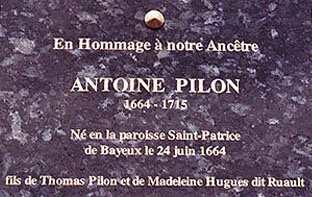
At about the same time, in the town of Bayeux, Normandy, France, where the famous tapestry depicts the Norman Conquest of 1066, there was a young man seeking adventure. Antoine was born on the Feast of St. John the Baptist in 1664 (June 24th).2. His father Thomas Pilon, a butcher and his wife Madeleine Hugues dit  Rouault had 5 children.

At the age of twenty-four Antoine left his homeland to cross the Atlantic seeking a new life in what was then a fledgling country where he became a farmer and later a landowner.

hommage


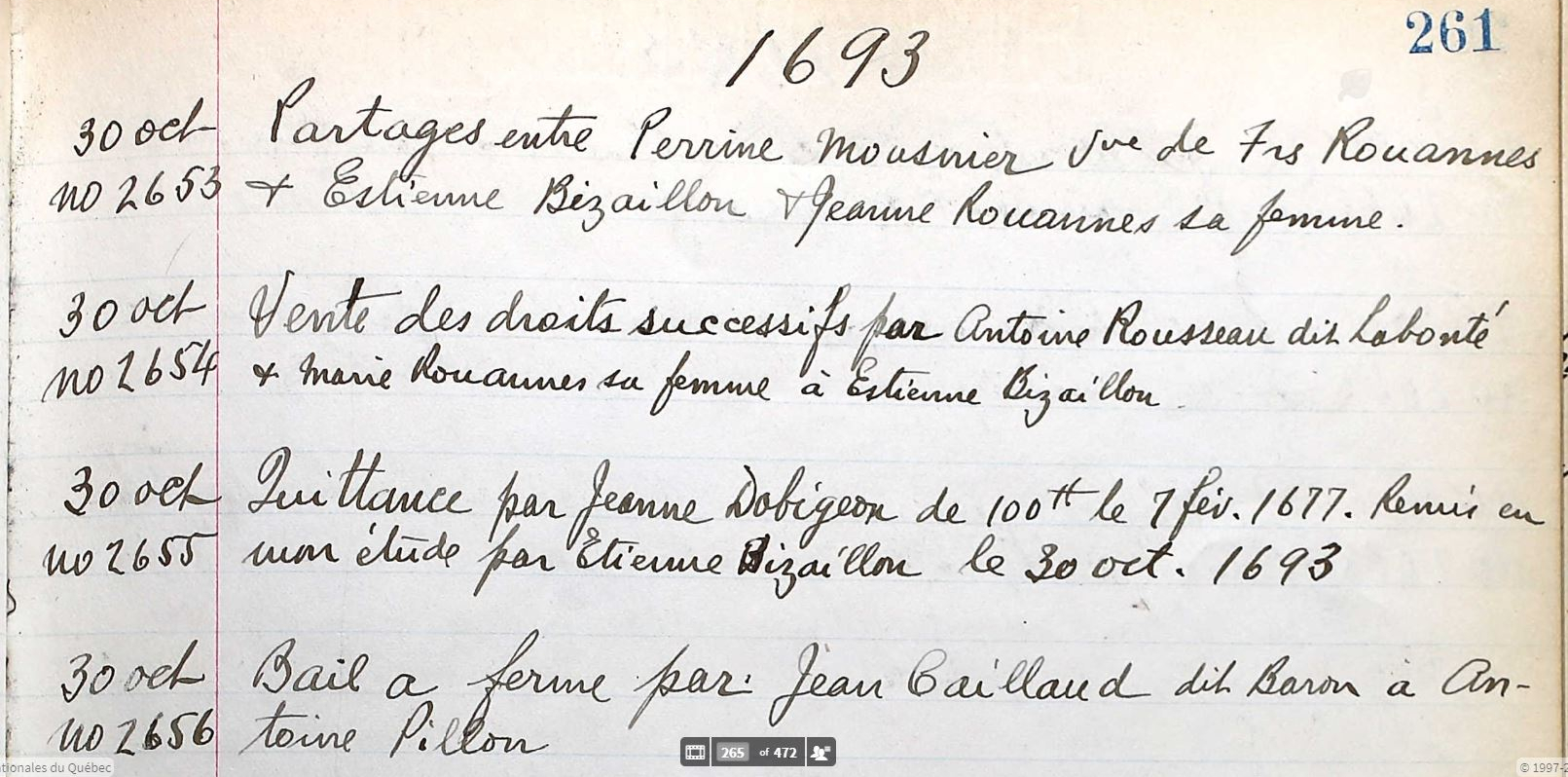
Capture.JPG Pilon lease on a farm 1693

30 oct   no.2656   Notarial Record – Lease on a farm 3.

Shortly after his arrival in Ville Marie Antoine, my 7th greatgrandfather chose his bride to be, Anne Brunet. Michel Mathieu Brunet dit L’Etang and Marie Madeleine Blanchard brought Anne into the world on January 1, 1672.4. Michel was a farmer and a prosperous fur trader. At the time of Anne’s birth, the family was living near Trois Rivieres. The family moved to Lachine at a later date.

Antoine and Anne were married in Notre Dame parish church in Montreal on January 29, 1689. Their first child, Jeanne was born in Montreal, December 9th of that same year. Over a period of 24 years the couple had 14 children.6. The first 3 children were born in Montreal, two, in Laprairie and the others in Lachine and Pointe-Claire. In those days not all children survived, and they lost three infants. However, several of their children lived well into their 80`s.

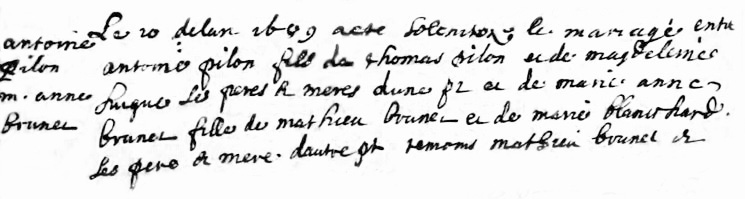
Capture.JPG Marriage Church Record Notre Dame

Church record of the marriage of Antoine and Anne 5.

Translation:

On the 20 of January 1689  a solemn marriage between Antoine Pilon, son of Thomas Pilon and Madeleine Hugues, the father and mother on one hand and Marieanne (Anne) Brunet daughter of Michel Mathieu Brunet and Marie Blanchard, the father and mother on the other. Mathieu Brunet was a witness.

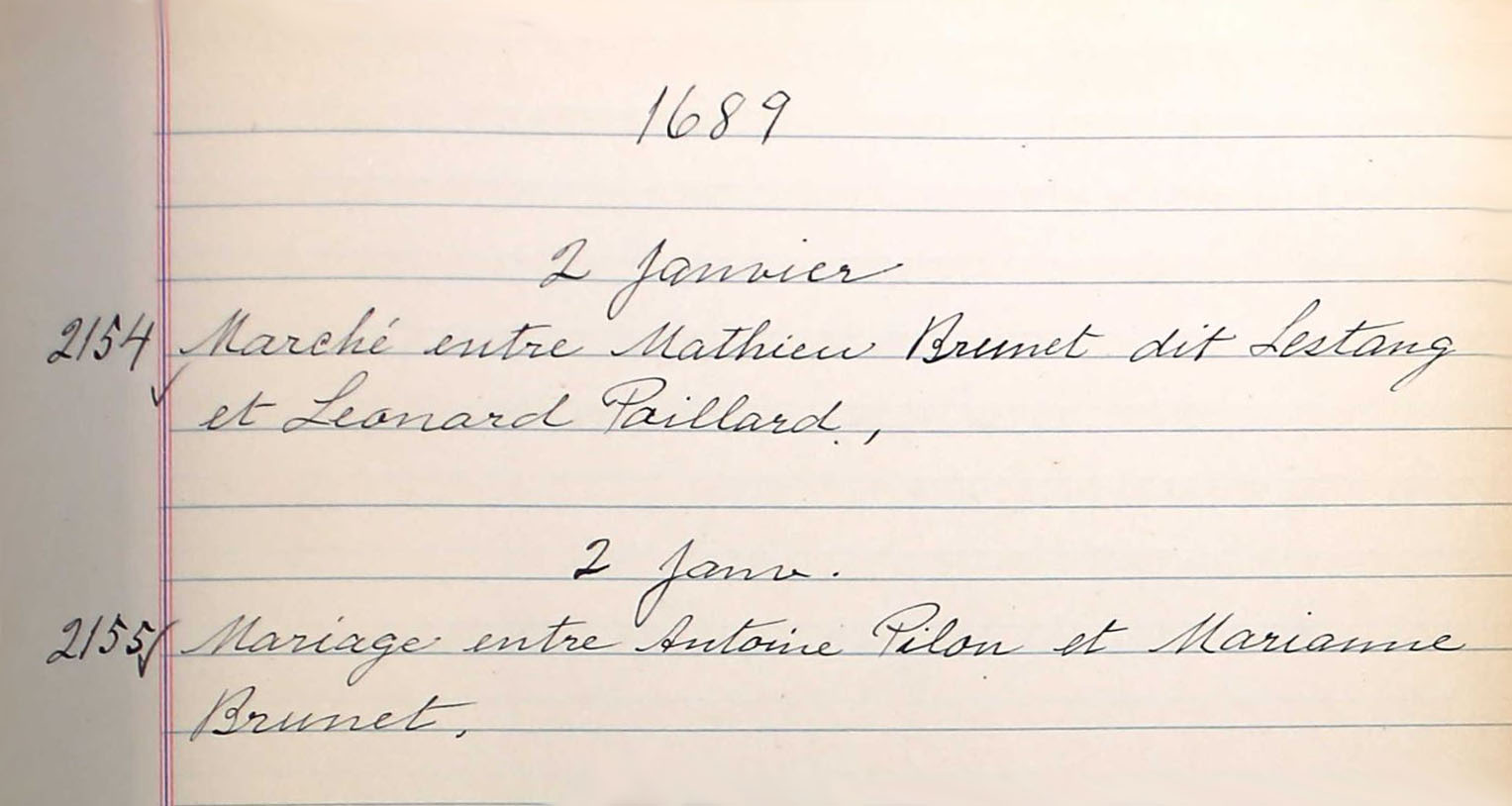
Capture.JPG Notarial act marriage Antoine Pilon and Marieanne BRUNET copy

1689   2 janvier    21551    Notarial record of marriage 5.

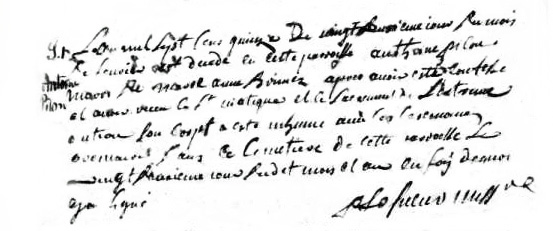
Antoine was not as fortunate as his children. He died at the age of 50 on February 24th, 1715.7. He is buried in St. Joachim Ancient Cemetery beside the church in the village of Pointe-Claire not far from the home he built.

Antoine Burial

Church Record of Antoine Pilon’s burial

During those early years Ville Marie, as Montreal was called at that time, experienced numerous Indian raids. One of them being the devastating Lachine Massacre in August 1689. Many lives were lost. During the next few years efforts were made to find a peaceful resolution.

The Great Peace of Montreal (FrenchLa Grande paix de Montréal) was a peace treaty between New France and 39 First Nations of North America. It was signed on August 4, 1701, by Louis-Hector de Callière, governor of New France, ….and provided 16 years of peaceful relations and trade before war started again.”.8.

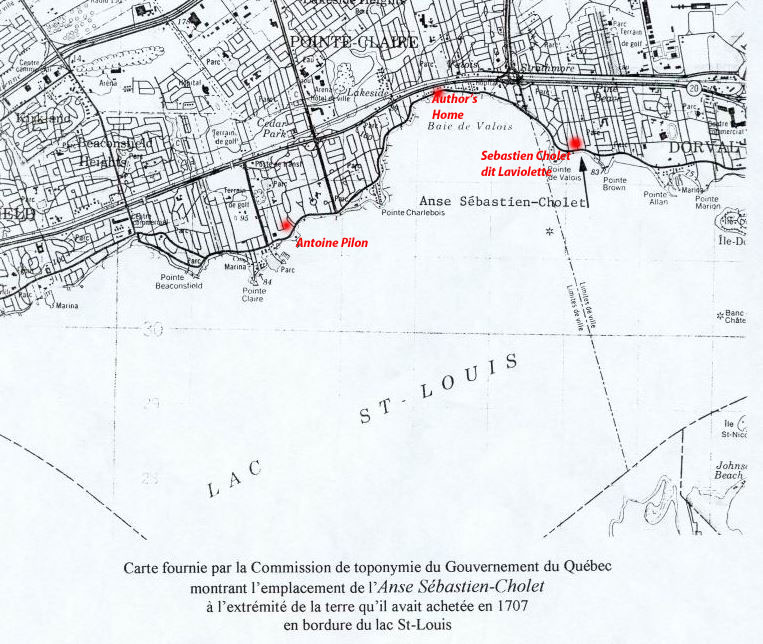
After the signing of the peace treaty, the Sulpicians, administrators, and seigneurs of the land began conceding properties. Several of my ancestors were among those who benefited from this opportunity. They chose to move westward to what we now refer to as the West Island. The first, Sebastien Cholet dit Laviolette,  my 6th great-grandfather, a weaver started the trend along with his wife Anne Thomas, the ‘fille du roi’. He and his family settled in the community of present day Dorval. Their home lay  on the eastern tip of Valois Bay in a small cove that bears his name, overlooking Lake St. Louis.

Antoine Pilon my 7th great-grandfather also chose to settle west of Ville Marie, following in Sebastien’s footsteps, He also purchased land in Pointe-Claire with frontage on the shores of Lake St. Louis. 9.

map of Cholet cove copy

All the land transactions, from the original owner Pierre Sauvé to Antoine Pilon are all documented to the current date.10.

The Antoine Pilon House lies on lot 88 of the present survey, forming a part of lot number 154 in the original land registry of the Island of Montreal. Lot 154-D was conceded by the Sulpicians to Pierre Sauvé dit Laplante on November 24th,1698. Then, the size of the property was 3 acres of frontage and 60 acres deep, on the shore of Lac Saint-Louis.

Pierre Sauvé and his wife Marie-Michel sold this land to Jean du Tartre dit Desrosiers on October 27th, 1700. Two transactions took place on the same day, September 19,1706. DuTartre gave a concession to Madeleine LeMoyne, already in possession of the adjoining lot. She immediately sold lot 154-D to Antoine Pilon, having already purchased from her the adjoining lot 155-D.

Anne Brunet, Antoine’s widow, inherited the lot after Antoine`s death and she gave the land to her son Mathieu on January 22nd, 1729. The deed (acte de donation) indicates land of 5 acres of frontage to 20 acres deep, consisting of lots 154-D and 155-D. In this deed we learned that the lot contained a house, and a small barn, possibly built during the summer of 1707.

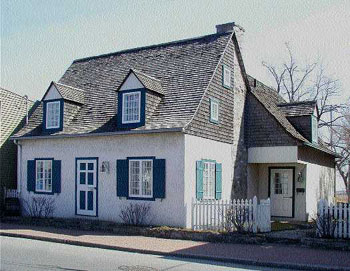
The house Antoine built remained in the Pilon family, passed on from his wife, Anne to their son Mathieu and then from father to son for 120 years.11. Remarkably it is still standing today. One can see the home when driving along 258 Lakeshore Road-Bord-du-lac near the entrance to Pointe-Claire village.

maison_antoine_pilon

Antoine Pilon House

      Footnotes:

  1. http://www.migrations.fr/ACTESFILLESDUROY/actesfillesduroy_index.htm
  2. http://www.piloninternational.ca/international/genealogies/bayeuxplus.htm
  3. Bibliothèque et Archives nationales du Québec; Montréal, Quebec, Canada; Collection: Fonds Cour Supérieure. District judiciaire de Montréal. Cote CN601. Greffes de notaires, 1648-1967.; District: Montréal; Title: Saint Martin, Antoine Adhemar dit (1668-1699)com. Quebec, Canada, Notarial Records, 1637-1935 [database on-line]. Lehi, UT, USA: Ancestry.com Operations, Inc., 2016. Repertoire de notaires (Notarial catalogs), Montreal. Maugue, Claude (1677-1696)
  4. http://www.francogene.com/genealogie-quebec-genealogy/000/000796.php
  5. Ancestry.com. Quebec, Canada, Vital and Church Records (Drouin Collection), 1621- 1968[database on-line]. Provo, UT, USA: Ancestry.com Operations, Inc., 2008.Quebec, Canada, Vital and Church Records (Drouin Collection), 1621-1968
  6. http://www.francogene.com/genealogie-quebec-genealogy/005/005837.php7
  7. .Ancestry.com. Quebec, Genealogical Dictionary of Canadian Families (Tanguay Collection), 1608-1890[database on-line]. Provo, UT, USA: Ancestry.com Operations, Inc., 2011. [database on-line]. Provo, UT, USA: Ancestry.com Operations, Inc., 2011.Original data: Tanguay, Cyprien. Dictionnaire généalogique des familles canadiennes depuis la fondation de la colonie jusqu’à nos jours. Québec, Canada: Eusèbe Senécal, 1871-1890. Library and Archives Canada, Ottawa, Canada
  8. https://en.wikipedia.org/wiki/Peace_treaty
  9. http://www.genealogie.org/famille/cholette/eindex.html
  10. https://www.wikitree.com/photo/jpg/Pilon-239
  11. https://grandquebec.com/montreal-touristique/maison-antoine-pilon/


Ring Around a Rosie

                                     Ring around the rosie, a pocket full of posie.

IMG_3883 (002)

In a video my son posted on Facebook, my granddaughters Evelyn and Marisa, hands clasped, laugh happily as they as they sing and swirl in circles to the nursery rhyme.

                                                       Husha, husha, we all fall down.

The girls tumble to the grass, still laughing. The activity appears to be great fun and certainly a way for them to expend some energy during the pandemic shut- down.

The rhyme dates back to the 1600s and the Great Bubonic Plague. The fatalism of the rhyme is brutal: the roses represent the deadly rashes, the posies are the herbs used in an attempt to treat the disease, and the falling down is the almost inevitable death.

Today we are entering the seventh week of a country-wide shut-down in an attempt to mediate the spread of the world’s most recent pandemic, the Corona-19. As of May 3rd, the total number of cases in just one country, Canada, is approaching 57,148 confirmed cases with the total number of deaths at 3,606. Television ads constantly urge Canadians to wash their hands frequently, wear masks in public, keep two metres apart, and stay at home.

Schools, stores, businesses, restaurants, sports and entertainment facilities, barbers and hair salons are all closed. Borders are shut. Airline flights are cancelled. Streets are all but empty. Only essential workers are employed and they must all wear masks.

The pandemic began in Wuhan, China in December of 2019 and was initially spread by international travellers. Very soon it spread rapidly through community transfer. The first Canadian cases emerged in a Senior’s Home in Vancouver. Seniors, not children, have been the hardest hit by this pandemic, most of them confined to care homes where a single case becomes rampant. Front line workers fall ill and cannot care for their patients. Hundreds of our elderly have died resulting in what has been referred to as geriatric genocide.

So far, my family is healthy. My son and his wife are able to work from home and, unlike thousands of others, their income remains intact. The girls are bored and restless with schools closed, parks and playgrounds barred, sports and extracurricular activities cancelled. While child care is not an issue for them as it is for many families, they struggle with home schooling the girls via on-line learning. A simple childhood game of Ring Around the Rosie is a welcome reprieve.

This is not the first time that family members have been impacted by a pandemic. During the Spanish Flu, the disease was formally documented for two ancestors in their military service files.

In June of 1918, my son’s grandfather, Laurence Tarrant, contracted the Spanish flu while convalescing at the Epsom Military Hospital in England from surgery to save an arm badly injured during the Battle of Arras. He survived.

My great aunt, Ella Willett, a nursing sister in WW1, also survived the Spanish flu. She contracted it in June of 1919 during the second wave of the flu and recovered in the Basingstoke Military Hospital, England.

The Spanish flu began in an American army camp in Kansas and moved back and forth across the Atlantic with the troops. The military provided an ideal incubator. The soldiers lived in conditions conducive to its spread. Stressed, dirty, hungry, wet and cold, massed in camps, huddled in trenches and tents or jammed into troop trains and ships, soldiers and nursing sisters were easy prey.

Unlike today’s Covid-19 flu, the Spanish Flu attacked more young adults than those who were elderly and it moved with grim speed. Symptoms experienced during the second wave were far more severe than those of the first wave. Victims’ lungs filled with bloody, frothy liquid and their faces turned blue as they drowned in their own fluids, often overnight.

The first wave of the Spanish flu killed 3-5 million people world-wide; the second wave killed 20-50 million. Without today’s computers, it is difficult to be definitive.

World economies have suffered dreadfully during this corona pandemic. In Canada, the Federal and Provincial governments have poured out billions and billions of dollars to aid of closed businesses and unemployed workers leaving the country with a mountain of debt.

In the last week we have heard much talk of when and how to reopen the economy. In most provinces, the number of those infected has not yet peaked despite all our interventions. The virus will clearly not go away until there is a vaccine.  Our reopening must be done slowly, gradually, and very cautiously or all our efforts thus far will be for naught. We do not want a second wave with the number of dead exceeding that of the first.

Ultimately, we can never return to the way we once were in pre-covid-19. We must instead create a new, safer normal. Test, trace and isolate and treat will be the key strategy.

Look back at the photo of the girls playing Ring Around the Rosie. There is a black hearse very clearly parked in the background. Let that be our warning.

Sources

Tarrant, Lawrence. Service File, Archives Canada

Willett, Ella. Service File, Archives Canada

www.canada.ca/covid-19/coronavirus

Sharon Adams. “War and the Spanish Flu.” Legion: Canada’s Military History, Sept. 2018.


Working together to help genealogists discover their ancestors