Dear Uncle Bill

Dear Uncle Bill,

While rummaging through the Dusty Old Boxes containing family memorabilia, I came upon letters written by you to your only brother, my father, Tom.  There were also letters written to your sweetheart during WWII while you were stationed in England serving with the RCAF. So I thought the best way to remember you would be in the form of a letter.

Please allow me to introduce myself. My name is Lucy and I am one of your nieces.

Our paths never crossed.  I was only born in 1957 and you died in 1943. Your brother had seven children.  I was his fourth.  His eldest son, born in 1949, was named after you – William Sherron Anglin II.

While staying with my family in England in 2016, I visited you in person at your last known address:  Runnymede Memorial[1], Panel 179, Surrey, UK.  My grandchildren, who always enjoy a challenge, accompanied me in my search to find you. It didn’t take them long to find your panel and you – or your name, that is – inscribed on one of several stone walls, along with 20,000 other airmen,  at this dedicated memorial building on Cooper’s Hill overlooking the Thames River.

Your name was too high up for the children to touch but I brushed my fingers lovingly over your name and told you we were there. I am quite sure you knew it. You had an interest in mental telepathy, as did your grandfather, and his story was documented in the family boxes as well.  (Surgeon and Mentalist)

Throughout your letters to Tom, along with childhood memories, you shared and referred to an interest in The Rosicrucian Order which “is a community of mystics who study and practice the metaphysical laws governing the universe”.[2]

You maintained the belief in an ability to “project” yourself and to send mental messages. I can only guess that a feeling of closeness to your brother by any means must have consoled you greatly while away at war in England.

In your letters to your sweetheart, you described England in general (with the usual complaints about the rainy weather), your life with the RCAF, weekend leaves to Scotland and dances in the mess hall “wishing you were there”.  Although I don’t have her letters in response, I am sure you took great comfort in hearing from her.

You were sent on a training course at the end of May 1943 and, while away, your crew went on a mission without you – never to return. In the last letter to your girl, you confided that you were feeling “depressed” at their loss.  On the very next mission, you went missing as well.

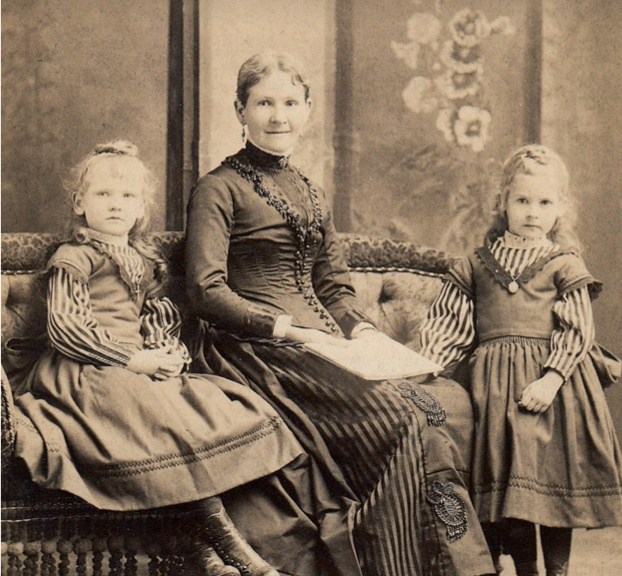
Last picture of Uncle William
Last picture of Uncle Bill (far left) – 1943

Not long afterwards, your sweetheart sent a bundle of your cherished letters, wrapped in a bow, to your mother and wrote “I know I want to forget as soon as I am able, everything – and so I am sending you the few letters I had saved from those Bill sent me from England.  I hope that you would rather have them, than not … perhaps they will make you glad to have something more – to know something else of Bill’s life in England … rather than rake up memories you are trying to forget. For while I want to forget, I feel so sure that you will want to remember.”

Your mother never gave up hope that you would return one day.

Wendling & Josephine Anglin and sons Bill and Tom (1940)

Bill, Wendling  (the stock broker), Josephine, Tom and family dog (1940).

The abundant number of photos found with the letters in these boxes show your 27 years filled with family times – gatherings, annual trips, formal portraits, a few pets and a full life.

You will not be forgotten.

Lovingly,

Your niece Lucy

Note:

http://www.aircrewremembered.com/richmond-bruce.html

William Sherron Anglin was an Air/Gunner and Warrants Officer II with the 429 Squadron flying in a Wellington X bomber, Serial no. HZ471.

Reason for Loss:

Took off from R.A.F. East Moor, North Yorkshire at 22.36 hrs joining 719 aircraft attacking the town of Wuppertal, the home of the Goldchmitt firm which produced Tego-Film, a wood adhesive used in the production of the HE162 and TA154 (aircraft).  Around 1000 acres was destroyed in the firestorm that followed – 211 industrial buildings and nearly 4,000 houses were totally destroyed. A figure of 3,400 fatalities on the ground has been recorded. Bomber command did not escape lightly on this operation losing some 36 aircraft.

It is thought “probable” that HZ471 was shot down by Lt. Rolf Bussmann, flying out of Venlo airfield, and attacking this Wellington at 3,700 meters with the aircraft falling into the sea off Vlissingen.
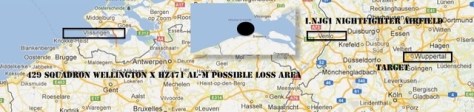
429 Squadron possible loss area

[1] https://wiki2.org/en/Runnymede as at November 19, 2017

[2] https://www.rosicrucian.org/ as at November 19, 2017.
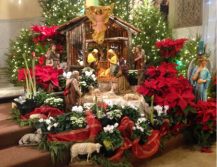
Dad’s Favourite Christmas Story

2016-SOLP-Christmas-decorations-11.1-450x348

My Dad always took great delight in regaling us with his favourite Christmas story. It was a story from my mother’s youth, and he had not yet met my mother when it happened, but he enjoyed recounting it every year and we never tired of hearing it.

My Mom came from a family of nine children. She grew up in Sudbury, Ontario, and the story took place in her family home on Christmas Eve of 1924, when she was 15 years old.

Her older brother, my Uncle Eugene, had come home safely from World War I and had married a young widow, Della Sinnett, from Arnprior, Ontario. When their son, Frankie, was born at the end of 1921, there was great joy.

Unfortunately, the happy occasion was short-lived. In spring of 1923, when Della was expecting their second child, she succumbed to septicemia.

Who would take care of young Frankie?

Frankie stayed with his grandparents. My grandmother was a warm, loving lady and she took care of the young toddler, with the help of her daughters still living at home.

On Christmas Eve of 1924, the family gathered and made their way to St. Anne’s Catholic Church for Midnight Mass, but Frankie did not go. Someone stayed home to take care of him. Who it was we never knew. That person must have dropped off to sleep but Frankie woke up. The little three-year-old, mesmerized and filled with curiosity, he made his way in to the parlour where all the presents were under the Christmas tree.

Christmas_Tree_01_210px

I like to imagine him as, with great  gusto, he proceeded to open each one of them, scattering paper, ribbons, bows and boxes all over the room! You can imagine the chaos when the family returned from church expecting to sit at the large dining room table and enjoy a traditional French Canadian Réveillons, when families gathered after Midnight Mass. Tourtiére, the famous French Canadian meat pies were freshly baked for this special occasion, along with many other favourite dishes.

img65795.623x402

All the family could do was to laugh and try to sort out the presents while some of the family members prepared the traditional Reveillons feast, one that our family kept for many years.

Eventually, Frankie’s father, Uncle Eugene, moved to Kirkland Lake, Ontario and remarried. He died in 1969 and is buried there. Frankie died at the age of 61 and is buried in Lasalle Cemetery in Sudbury, Ontario beside his mother, Della Sinnett and close to his Granny and Granpa Jodouin.

Notes:

You might want to visit the following website. Although they focus on Quebec, the Reveillons is traditional among French Canadians throughout the country,

http://www.greatbritishchefs.com/features/the-reveillon-christmas-canada


Did they travel on the same ship?

It has always bothered me that on the passenger lists of the S.S. Grampian, sailing from Glasgow to Quebec City, my grandfather, Thomas McHugh, was not listed with his wife, Elsie McHugh and their seven children.

My father was always clear that Thomas arrived ahead of his large family in the early 1900s. The plan was that Thomas would have time to find work and a place to live, and get settled in.

I first found my grandmother, Elsie McHugh and the seven children listed on the passenger list of the S.S. Grampian, leaving Glasgow and arriving in Quebec City. The year was 1912.  I knew that I also had to find out when Thomas arrived. I returned again and again to passenger lists for travel between Scotland and Canada in 1910 and 1911. No luck. It was only when I started to research my great-uncle, Edward McHugh that I discovered Thomas also on the passenger list of the S.S. Grampian in 1912, leaving Glasgow and arriving in Quebec City. Thomas was accompanied by his mother and two brothers.

Harrumph. It seemed as if Thomas didn’t leave ahead of time. But why in the world were Elsie and the children not listed with Thomas? Were they separated because of the children? This didn’t make sense. Elsie would have needed all the help she could get. Little Adam was just three and his brother, Thomas was one year old.

I kept going back to these entries. There was something about them that bothered me. I looked up potential reasons to be separated on a ship. I looked up whether families would be divided for any reason in the list of passengers. No luck.

Also, I kept getting mixed up whether it was May or October 1912. I would look at my notes and if it said May, I realized that the date was October and I would change it. I would then go back later and change it back to May. Argh. I needed to get it right.

This week I decided to establish definitely whether Thomas came over to Canada first. Perhaps he came to Canada and then went back to Scotland for his mother, his brothers, his wife, and his children. This would make perfect sense. This would explain why my father was so sure that he came ahead of the family and all the evidence that I had said that he came over with his family.

Well, I could find no trace of Thomas on passenger lists of 1910 or 1911. He wouldn’t have come before 1910, I would think.  I did find him again on the passenger list of the S.S. Grampian, May 1912. And I found Elsie again. Wait a minute. October 1912! The penny dropped. They both travelled over on the S.S. Grampian but at different times of the year. I was so blinded by the name of the ship that I did not realize that even though they were on the same ship, they travelled on different dates.

While this was not a brick wall, it was certainly a puzzle for me. A puzzle of my own making. Once again, this reaffirms that, while primary genealogical research is important, it is also valuable to revisit assumptions, documents, and notes. Look and look again and again.  Most genealogists I know enthusiastically forge ahead and tend to neglect reviewing previous finds. I am no exception.


“Those of us already deep in the accumulation may also benefit from revisiting our past research.”

Brenda Dougall Merriman, Genealogical Standards of Evidence: A Guide for Family Historians


Our book “Beads in a Necklace” launches today!

I’m so excited. Our book comes home from the printer today and we’re planning a fun celebration of its existence tonight.

Here’s how we’ve described our creation on the backcover:

Book back cover photo

A Fun Collaboration

This work came to shape slowly over time. Lucy Anglin, Barb Angus, Marian Bulford, Janice Hamilton, Claire Lindell, Sandra McHugh, Dorothy Nixon, Mary Sutherland and I have been gathering monthly for five years. Together, we’ve learned how to craft our research into our ancestors into compelling literary non-fiction  that anyone might enjoy reading.

Late last year, we began speaking about the possibility of putting our favourite stories together into a book.

Today, our dream takes shape. In this work, you’ll meet several of our ancestors, including:

  • Fille du roi Anne Thomas, who married master carpenter Claude Jodoin in Montreal way back in 1666;
  • Felicité Poulin, 18th-century career woman, Ursuline nun and matchmaker;
  • Stanley Bagg, Massachusetts-born merchant who helped build the Lachine Canal in the 1820s;
  • Gospel singer Edward McHugh, whose 1910-period debut at the Montreal Hunt Club launched an international career; and
  • William Anglin, respected Victorian-era Kingston, Ontario surgeon and wannabe thought-reader.

For more information, refer to our book webpage.

Official Book Launch Tonight

Tonight from 7 until 9 p.m., we’ll be celebrating our creation in the hall of the St. John the Baptist Church, 233 St. Claire Street in Pointe-Claire. If you’re in Montreal, feel free to join us for wine, cheese, sandwiches, home-made treats and a couple of readings from the book.

We’ve also put together some photographs and heritage items for a display to highlight some of the stories.

A self-published limited edition paperback will be on sale for $20.

To Get Your Copy

It’s on sale for $20 in Montreal at

  • Livres Presque 9/Nearly New Books, 5885 Sherbrooke O; Montreal, Quebec H4A 1X6, (514)482-7323;
  • Coles, 366 Avenue Dorval, Dorval, QC H9S 3H8;
  • Clio, Plaza Point-Claire, 215 N. St. Jean, Pointe-Claire, Quebec H9R 3J1; and
  • May’s Studio, 459 Main Road, Hudson, Quebec.

The Ontario Genealogical Society has a digital copy available for $3.80.

An Amazon Kindle edition is also available for $3.89.

Hope you enjoy reading our work as much as we enjoyed writing it. I’d love to hear your comments below.

Etiennette Alton’s Verdun Years

Imagine my surprise to discover that my ancestors lived in my neighbourhood more than three hundred years ago.

At that time, Verdun’s Crawford Park was a very different place than it is today. Today, the neighbourhood encompasses about 1000 people in about 20 city blocks between the St. Lawrence River to the aquaduct in the north and between the Douglas Research Institute and the borough of LaSalle to the west. In 2006, more than 20,000 people lived here.

When my ancestor Étiennette Alton lived here, however, the neighbourhood was known as the fief de Verdun and it extended further north through Angrignon Park and the St. Jacques Escarpment.

She moved here after marrying her second husband, Barthélémy Vinet dit La Reinte on Monday, June 13, 1672. She already had three sons and a daughter from her first marriage. Her fifth child, their first son, Martin was born a little later the same year.

The family were among 83 families in the neighbourhood, according to the 1681 census.

The census reads :

« Barthelemy Vinet 48; Etiennet Alton, sa femme 42; enfants : Pierre 20, Jean 16, Louis 14, Marie 11, Martin 9, Gunégonde 7, Madeleine 6, Guillaume 3; 3 fusils; 18 bêtes à cornes; 20 arpents en valeur. »

The couple had five more children in the following fifteen years. They could afford them. Her husband worked for Sieur Jean-Baptiste Migeon de Branssat, an attorney and later judge with the manor of Montréal.

At that time most men—including Vinet, Migeon, and Montreal Governor Francois-Marie Perrot—earned significant portions of their income from hunting and selling furs. The market for furs, however, was diminishing.

In 1676, a new law forced fur traders to obtain licences, although few bothered to do so.

A year later, Migeon was appointed judge and asked to create a public inquiry into the fur trade industry. During that inquiry, he discovered that most elite, including the Governor himself, were illegally involved in the fur trade. The Governor responded by accusing Migeon of breaking the same laws and putting him under house arrest to halt the inquiry before its results could be known.

“Piccole Donne” and Why We Write Family Stories

margMcleod
Margaret McLeod Nicholson, born 1853 in Richmond, Quebec. During the US Civil War she, too, would have been a ‘little woman.’


The first novel I ever read was Little Women by Louisa May Alcott.  I was ten or eleven years old.  I didn’t read the book in school. My mother bought it for me along with a number of Deluxe Junior Classics published by the Doubleday Company.

I can remember the look of the book: grey with a yellow spine and sketches of the four March girls in blue ink embossed on the cover. I can remember the feel of the book: the pages thick and slightly hairy, typical of Book-of-the-Month Club editions. I can remember the smell of the book: inky and acidy. It was a new book, after all. And I especially recall the thrill of opening the book, which I understood was my rite of passage into the brave new world of grown-up reading.

I loved Little Women. It changed my life as great books often do, but I can’t say the plot stayed with me. It was only recently, when I decided to learn Italian by listening to ‘easier’ audio books, that I became re-acquainted with Louisa May Alcott’s American classic. Over and over again, I listened to each delightful chapter, first in English, then in French, then in Italian. “Piccole Donne”. Superbo in any language.

It is understood that Louisa May Alcott used her own Massachusetts family as a model for Little Women, a work of fiction.  Authors often lean on real-life characters for inspiration. Who wants to read about unrealistic characters?

1967
Me at 11 with Mickey Finn, the Jr. Deluxe Big Red and very badly cut bangs courtesy of my mom.

The authors at Genealogy Ensemble are publishing a book of authentic short stories about their ancestors, Beads in a Necklace: Family Stories from Genealogy Ensemble. These stories, many of which saw first light on this blog, will soon be available in a glossy hold-in-your-hands hardcopy format.

Beads in a Necklace also includes personal essays by the nine authors, explaining how each of us was inspired to begin the long, difficult and rewarding journey of writing down our family stories.

Claire Lindell was surfing the Net, way back in its early days, when she came upon an article about her father, a pioneer in the Canadian mining industry.

Barb Angus was inspired by missed opportunities and a book called The Wolfe Pack by a McGill University author, Dr. Mildred Burns.

Lucy Anglin lost her mother very early in life and feels that her stories help honour her memory.

Janice Hamilton grew up with oil paintings of her ancestors on the walls around her.

Tracey Arial first wrote about genealogy for a classroom exercise; not a great experience, but one she looks back on with amusement.

Marian Bulford immigrated to Canada from Great Britain in 1978, but it’s her English sea-side roots that move her to write.

Mary Sutherland was inspired by her father once saying, “Find your way home,” and by some fine family heirlooms.

Sandra McHugh was inspired by her ‘two solitudes’ marriage and her Greek husband’s very different kind of family.

I myself got my start when I found 300 family letters from the 1910 period that had belonged to my husband’s ancestors from Richmond, Quebec.  I read them out loud to a good friend who said, “Ick. They sound so old-fashioned.”

But I saw something else in these letters. I saw the story of a strong matriarch and her very spirited young daughters, who had known much better financial times but were making the best it.

I saw women who were on their own, in their fine house in the good part of town, because their men-folk were far away.

I saw proud, independent women who sometimes relied on the kindness of a well-off, gentlemanly neighbour to drive them to the post office or to shovel out their walk in winter.

It was the plot of Little Women, but with characters from real-life closely related to my husband and my very own children! How could I possibly resist that?


Beads in a Necklace: family stories from Genealogy Ensemble will be launched in mid-November. A limited number of hard copies will be available for purchase, locally. 

Check back with http://www.genealogyensemble.com to find out how to buy one of these rare first editions.  An e-book  version will be available at launch, as well, with print-on-demand capability by Christmas.


pagefromCanadthenandnow

The chapter on the Laurier Era from Canada Then and Now, my fifth grade history textbook. I read this, too, back in the day, but I was not impressed.  This was a typical textbook, filled with sturdy but dull prose and employing a narrative style devoid of colour and controversy. This chapter, about a most pivotal time in history, made no mention of suffragettes and restless young women in harem pants.  In fact, there are only two women in the entire textbook: Marguerite Bourgeoys and Jeanne Mance, worthy women, no question, but only two? Beads in a Necklace showcases many of our worthy women ancestors. It’s terrific social history.

Dr. Joseph Workman, Pioneer in Treating Mental Illness

If you have been watching the miniseries “Alias Grace” on CBC television or Netflix, you may remember a scene featuring a grey-haired gentleman with long sideburns. That character was based on the real-life physician Dr. Joseph Workman, known as the Father of Canadian Psychiatry.

The television show is based on the book of the same name by Margaret Atwood, a fictionalized account of the life of Grace Marks, an Irish-born servant girl convicted in 1843 of a double murder near Toronto. Grace was held at the Provincial Lunatic Asylum in Toronto at about the time that Dr. Workman became superintendent of the asylum.

Neither the book nor the television show makes it clear whether Grace was insane, or whether she was guilty of murder. There is little doubt, however, that Joseph Workman was a kind and intelligent man who made important contributions to the treatment of mental illness. In fact, he came from quite an extraordinary family.

Joseph (1805-1894) was born in Ballymacash, near Lisburn, County Antrim, Ireland (now Northern Ireland). His parents were Joseph Workman Sr. (1759-1848) and Catherine Gowdie (1769-1872). Joseph Jr. was the fourth of nine children — eight boys and one girl. His only sister, Ann Workman (1809-1882), who married Montreal hardware merchant Henry Mulholland, was my direct ancestor.

The Workmans brought up their children to value hard work, education and Christian charity. Holding liberal views, they were members of the Non-subscribing Presbyterian Church of Ireland and they eventually became Unitarians.

The Workmans were not wealthy and they lived in a cozy cottage in the village, surrounded by fields and farmland. Joseph Sr. worked as a miller and as a teacher, then as land steward (manager) for a local landowner.

Joseph Jr. attended school around Lisburn and, after graduation, worked as a land surveyor for three years. In 1819, his oldest brother, Benjamin, immigrated to Montreal, where he became a teacher and newspaper publisher. Over the next 10 years, the Workman siblings, tired of the poverty, poor harvests and religious strife around them, all left Ireland for Canada. Joseph and his parents arrived in Montreal in 1829.

Joseph taught school and studied to become a doctor at the same time, obtaining a medical degree from McGill University in 1835. His thesis focused on the infectious nature of cholera (a radical idea at the time) after he watched the deadly disease sweep through the city in 1832 and 1834.

He married Elizabeth Wasnidge in 1835 and the couple eventually had 10 children, four of whom died young. In 1836, they moved to Toronto, where Joseph ran the Wasnidge family hardware business. For 10 years, he kept up his reading on medicine before finally leaving the business to concentrate on medicine. He built up a busy practice and taught at the Toronto School of Medicine.

He was appointed superintendent of the Provincial Lunatic Asylum in 1853 and remained there until 1882. At first, Joseph knew little about mental illness, but it was easy to see that the asylum was filthy and overcrowded, and that the patients were neglected. He improved the institution’s efficiency and made sure the patients had good food and generous amounts of alcohol. His treatment approach focused on moral therapy:  kindness, truthfulness, social entertainment and religious instruction. Although cure rates did not improve, he did make progress in the humane treatment of the mentally ill.

The Workman brothers all achieved success in Canada. Alexander Workman became mayor of Ottawa, William was a successful hardware merchant and mayor of Montreal, Thomas became a prosperous businessman, and Benjamin had several careers, including teaching and medicine. Joseph and Benjamin were instrumental in establishing the Unitarian Church in Toronto and Montreal.

But biographer Christine L.M. Johnston considered Joseph to be the greatest of them all “because he radically changed the whole field of psychiatry, and not just in Canada. He influenced as well American superintendents of Lunatic Asylums…. Like most pioneers, he did not claim to be totally original – he introduced the new ideas initiated in Europe. Yet he was constantly exploring new avenues on his own after that.”1

This story is also posted on http://writinguptheancestors.blogspot.ca

See also:

Janice Hamilton, “Henry Mulholland, Montreal Hardware Merchant,” Writing Up the Ancestors, March 17, 2016, http://writinguptheancestors.blogspot.ca/2016/03/henry-mulholland-montreal-hardware.html

Footnotes:

  1. Christine Johnston. “The Irish Connection: Benjamin and Joseph and their Brothers and their Coats of Many Colours,” CUUHS Meeting, May 1982, Paper #4, p. 6.

Other sources:

Christine I. M. Johnston, The Father of Canadian Psychiatry: Joseph Workman, Victoria: The Ogden Press, 2000.

Thomas E. Brown, “Joseph Workman,” Dictionary of Canadian Biography, vol. 12, University of Toronto Press/Université Laval, 1990, http://www.biographi.ca/en/bio/workman_joseph_12E.html, accessed Oct. 23, 2017.

The Digger, One Family’s Journey from Ballymacash to Canada, Lisburn.com, http://lisburn.com/history/digger/Digger-2011/digger-19-08-2011.html, accessed Oct. 20, 2017.

There is an extensive database of the Workman family online called A Family Orchard: Leaves from the Workman Tree, http://freepages.misc.rootsweb.ancestry.com/~database/WORKMAN.htm


What is a Limonadier?


When you are lucky enough to find original documents pertaining to your ancestors do you really read everything on them or do you just glance through them, copy them and file them for later? One thing I have recently learned is to thoroughly read all documents. What a novel tip for genealogy research!

I was sending information to a fellow writing about my grandfather, Rene Raguin. He told me that Rene’s father Marie Joseph Raguin had been a Limonadier. What kind of occupation is that I wondered? I wrote back and asked him how he knew that information. He responded that it was on my grandparent’s marriage licence.

I had never looked up their documents as I knew when and where they were married. One of my great uncles, Herbert Bruneau had done a lot of Genealogy research and I had his family tree. I was more interested in people I didn’t know and had put off confirming other’s research. The document was easy to find and there under “profession of father of husband” was “Limonadier”. There is a lot of information on Ontario, Canada marriage certificates.

What was this profession? It sounded like someone who made lemonade. The marriage was in 1912 when bottled soft drinks were not available. According to Wikipedia, a Limonadier made and sold lemonade, could also make and sell alcohol or run a cafe.

Aside from being an interesting occupation, this explained some of our family traditions. My mother had a recipe that we called “Grandfather’s Lemon Syrup”. It was a lemon syrup that when added to water made lemonade. My mother used to make it and on visits to my grandparents, we had the lemon drink in little glasses that once contained cream cheese and home-baked sugar cookies. My cousins called my aunt’s version of it, “Grannie’s Lemon Drink” but they were obviously wrong about the origin.

It is also possible that Marie Joseph did run a cafe in Fleurier, Switzerland. One story that we heard growing up was that grandfather used to take a big pan of plum pie to the bakery to have it cooked as the pan didn’t fit in their oven. Why would a family of four need such a big pie? So making it for a cafe makes sense. It was a simple dish, pie crust covered by half plums with sugar sprinkled on top, a dessert that my mother also used to make.

It is amazing how much information one can get from a single word.

Notes:

Ontario Marriages, 1869-1927,” database with images, FamilySearch (https://familysearch.org/ark:/61903/1:1:KS8D-G3N : 10 April 2015), René Emile Raguin and Cecile Béatrice Bruneau, 09 Jul 1912; citing registration, Cornwall, Stormont, Ontario, Canada, Archives of Ontario, Toronto; FHL microfilm 1,906,765. On Feb 22, 2017.

https://fr.wikipedia.org/wiki/Limonadier accessed Feb 22, 2017.

Sundays and the Great Depression

I used to hate Sundays. I had to go to Sunday school. I really didn’t understand why I had to attend because my parents just dropped me off. That’s right. They didn’t even go to church. And no one asked me if I wanted to go.

After they picked me up, things got worse. It was homework time until lunch. Of course, I could have done my homework on Friday night but Fridays were reserved for movies on the television and reading in bed with a flashlight until all hours.

And worst of all, some Sunday afternoons were for Visiting the Elderly Relatives. In my mind, my aunts and uncles were ancient. Plus my brother, being a boy and older than me, was apparently able to take care of himself, as he always seemed to be absent from these visits. So I would sit in the living rooms of my aunts and uncles, with no toys or any other amusements, and listen to the adults talk.

I now cherish the memories of these visits because they provided me with an appreciation of the social history of Montreal, as well as significant events such as the Depression and World War II.

The stories about the Depression are the ones that struck me the most. During the Depression, a quarter of Canada’s workforce was unemployed.1  My dad, Edward McHugh, was a young man out of work in Montreal and he joined his older brother and sister in Drummondville, to work for the Celanese. At the peak of the Depression, the Celanese employed 1,757 workers.2

None of the McHughs had cars in those days so they must have travelled back and forth to Drummondville by train. And Uncle Thomas McHugh married a local girl. I can just imagine the McHughs, from Verdun, arriving in Drummondville for the wedding. I doubt very many people spoke English in Drummondville at the time. The culture shock must have been intense.

My aunts and uncles, even into the 1960s, were thankful that they were able to have some work during the Depression. Uncle Al Scott worked for the Northern Telecom for 40 years, although with reduced hours during the Depression. Luckily Uncle Frank McHugh worked for the Montreal Tramway Company so he was able to keep working during the Depression. He was a tram driver for tram number 24 that started in Montreal West and crossed the city on Sherbrooke Street. His job was safe.

My aunts and uncles loved to have a good time and the Depression did not stop them. My Aunt Elsie used to describe their card parties. There was only one bottle of scotch, some ginger ale, one can of salmon and one loaf of sliced white bread. My aunt was able to spread the salmon so thinly that she could make sandwiches out of the whole loaf of bread.

It was very clear to me that the Depression was a very frightening time in their lives. During this period, the future must have seemed bleak. Life was a struggle to make ends meet.


Notes

1 https://en.wikipedia.org/wiki/Great_Depression_in_Canada

2 http://www.patrimoine-culturel.gouv.qc.ca/rpcq/detail.do?methode=consulter&id=14311&type=pge#.WSNY7Gg1-Uk


Working together to help genealogists discover their ancestors