Germanic Presence in Quebec City

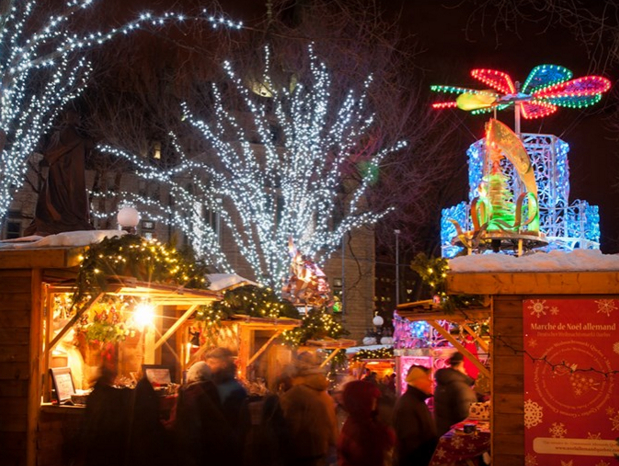
The 2015 German Christmas Market in Quebec City, http://www.noelallemandquebec.com/
The 2015 German Christmas Market in Quebec City

Jacques begins his latest compilation, The German Presence in Quebec City, with a translated quote by German Quebec expert University of Montreal Professor Manuel Meune. In this quote, Meune describes the context of German immigration to Quebec over the years.

The circumstances Meune describes challenge family researchers with ancestors from Germany who might wonder where original records might be stored. To help sort out the information, Jacques has highlighted books and document collections in churches, libraries, schools and societies in and around the Quebec City area.

He’s also included Facebook or other contact information for each repository so researchers can visit these locations to explore what might be available.

German Churches and Cemeteries of Western Quebec and the Upper Ottawa Valley

This compilation is designed to help researchers find German-speaking ancestors in Western Quebec and the Upper Ottawa River Valley area of Ontario. It identifies several books that cover the topic, the towns where German-speaking immigrants settled, the Lutheran churches that served their spiritual needs and the cemeteries where they were buried. It also lists repositories where the archives of these institutions can be found and genealogical societies in these areas.

The German Churches and Cemeteries in Western Quebec January 12, 2016


Protestant Churches of Beauharnois, Chateauguay, Huntingdon, Napierville, Soulanges and Vaudreuil

This compilation covers an area south and west of Montreal, Quebec, in a triangle between the St. Lawrence River, the United States border and Ontario. Today many English-speaking Quebecers know the region as the Chateauguay Valley, but on a map of Quebec, you’ll find it as the Haut-Saint-Laurent region, or part of the Montérégie. This is an attractive area of orchards, farms and small towns.

Archaeologists have found traces of occupation by Iroquoian First Nations people dating from the 14th century. As of 1729, it became the Seigneury of Beauharnois, but at that time there were few inhabitants.

Some Americans and immigrants from Scotland and Ireland arrived in the area around the early 1800s, with most pioneers establishing themselves along the banks of the Chateauguay, Trout and English Rivers. Brick making, which took advantage of the area’s extensive clay deposits, began. Other early industries included agriculture, logging and potash.

If you had Protestant ancestors in this region, this compilation should help you begin to understand the histories of the area’s communities and counties. It outlines the histories of the churches and visiting preachers who served the religious needs of the area’s Protestant residents. It will help you search for the cemeteries where your ancestors might have been buried, and find the church records of your family’s baptisms, weddings and burials.

Thank you to Claire Lindell for editing this compilation and adding the table of contents and maps.

Protestant Churches of Beauharnois, Chateauguay, Huntingdon, Napierville, Soulanges & Vaudreuil

Hogmanay

By Sandra McHugh

The Scots call the New Year’s Eve celebration Hogmanay.1 Hogmanay is part of my family’s history.

My grandfather, Thomas McHugh, came to Canada from Scotland with his family in 1912.  The family maintained the Scottish traditions and they celebrated Hogmanay.  My father, Edward McHugh, was usually the “first-footer.” This means that he was the first one to step across the threshold after midnight, bearing gifts.  Traditionally, to ensure good luck, the first-footer is a tall and dark haired male.  Fair haired first-footers were not welcome, as it is believed that fair-haired first-footers were associated with the Viking invasions.2 My father brought gifts of coal and a herring, but some of the other traditional gifts include shortbread, a black bun, and whiskey to toast the new year.3

There are a few theories about the origin of the word Hogmanay.  The Scandinavian word for the feast preceding Yule was Hoggonott. The Flemish words hoog min dag mean great love day. Some believe that the origin of the word Hogmanay can be traced back to the Anglo-Saxon Haleg monath or Holy Month or the Gaelic words for new morning, oge maidne. Many believe that the source is French, homme est né for man is born. In France, the last day of the year when gifts were exchanged, was called aguillaneuf and in Normandy, this was called hoguignetes.4

Hogmanay is an important celebration in Scotland.  It is believed that this festival was first brought to Scotland by the Vikings for whom the passing of the shortest day of the year, the winter solstice, was an event to be celebrated.5 The importance of Hogmanay took on an even greater significance because Christmas was banned in Scotland for about 400 years.  A 1640 Act of the Parliament of Scotland abolished the “Yule vacation and observation thereof in time coming.”6 This Act of Parliament reflected the changing attitudes towards the Christmas Feast Days during the Reformation. Christmas Day only became a public holiday in 1958 and Boxing Day in 1974 .7

The partying and hospitality that goes on at Hogmanay is a way of wishing family, friends, and strangers a Guid New Year.  The old is swept out, sometimes literally by giving the home a good cleaning, and by clearing up any debts before the bells ring at midnight.8

I wish you all a very Guid New Year.

Sources

1 http://www.scotland.org/features/hogmanay-top-facts

2 Idem

3 Idem

4 http://www.rampantscotland.com/know/blknow12.htm

5 Idem

6 https://en.wikipedia.org/wiki/Christmas_in_Scotland

7 Idem

8 Idem

Difficult holiday for two families

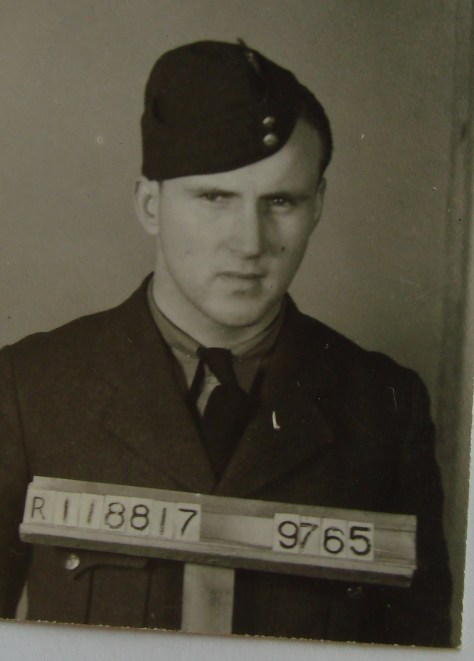
The plane crashed just after one in the afternoon Eastern Time on December 22, 1944. He probably died right then, or soon after.

Devittphoto2

James Frederick (Fredrick or Federic) Devitt left at least two families mourning for him, one in the United Kingdom and his own in Ontario.

His service file shows that the man was 22 years old when he died. His birth had been a Valentine’s Day gift for his parents. Prior to joining the Air Force, he worked for the Canada Bread Company in Peterborough as a driver and route manager. He played hockey and softball and owned a motor boat.[1]

His last trip as a flight engineer/pilot officer left from Gransden Lodge just prior to 4 p.m. in the afternoon, December 22, 1944, exactly 71 years ago yesterday.

His Lancaster and 13 others were on a Pathfinder mission to mark a small railway freight yard in Germany’s Rhine Valley. He was in Lancaster 405/D, which was seen crashing about three hours later by four pathfinders at 50:02 N. 06:25 E., southwest of Leimbach.

Blind Sky Marker failed to return from this operation and nothing has been heard from any member of the crew since time of take-off. This was F/O Tite’s 35th operation.” [2]

His mother’s notes to the Air Force show how difficult these situations were for families.

The telegram and letter reporting him going missing within a month of the crash was the only official news, but she still had hope that he had lived in May.

Can nothing be done to locate my son Fred? I have waited for days thinking some message would come through. I had word from two of the fathers from two of his crew saying their sons were prisoners of war. This was some time ago. Try and help a heart-broken mother please.”

Henrietta was 65 when her Devitt died, but she had already known great loss. His father Robert Campbell Devitt had already died of complications following a stomach ulcer operation when he was three years old, his older brothers were  five, 15 and 21 and his five sisters were eight, 11, 14, 17 and 19.

When she got news about her youngest son going missing, she was already dealing with the death of his elder brother Alexander, who had died the previous January in the Battle of Ortano, Italy.[3]

She wrote the Royal Air Force a second note three months later:

I have not heard any further word about my son Jas Fredric Devitt except what the three members of his crew who came back told me by letter. They said the plane burst into flames. One bailed out and two were blown out and what happened the rest is not known. Surely some identification marks were found. If he was killed and buried like my other son I wouldn’t take it so hard.

Two of the boys were taken as prisoners and the other wounded and put in a German hospital. All any one says is missing.”

A month later she wrote again.

Surely you can tell me something of my son Pilot Officer Jas Fud shot down over Germany December 22…If I know he was died and his body found my mind would be at rest—as it is I’m afraid of results.”

Another woman who loved him also worried. Eight months after his plane went down, a Mrs. S. Hitchings wrote the Royal Air Force from 111 Connaught Road, Roath Park, Cardiff. She too had heard that two airmen from his plane were taken prisoner and she hoped that perhaps they provided the Red Cross with information about Devitt.

I feel sure that if he was alive we would have heard from him, since he became part of our family whilst he was stationed in this country.”[4]

It would take another three years to be sure about what happened to the Lancaster, but Devitt’s service record indicates that:

This 4 engined aircraft fell 60 or 70 yards behind the fam of MARTIN STOMMES in WIERSDORF (L.0357). It was shot down by a German night fighter and was burning in the air, it hit the ground, turned on its back and burned for 3 hours. One engine and the tail unit fell off before it crashed.”

Three bodies and the remains of a fourth were buried in an unmarked grave.[5]

Devitt’s remains have since been moved to Rheinberg War Cemetery in Germany. For more information, refer to his Veterans Affairs Canada memorial page.

Sources:

[1] Devitt, James Frederick; Library and Archives Canada, RG-24, volume 25203, General Information.

[2] No. 405 R.C.A.F. Squadron (P.E.F.) Operations Record Book, Gransden Lodge, photocopies of secret book, December 22, 1944, Appendix 212.

[3] Devitt, James Frederick; Library and Archives Canada, RG-24, volume 25203, National Estates Branch, form C92768FD269, October 29, 1945.

[4] Devitt, James Frederick; Library and Archives Canada, RG-24, volume 25203, report from Officer Commanding No 2, MR&E Unit RAF, dated January 17, 1947.

[5] Devitt, James Frederick; Library and Archives Canada, RG-24, volume 25203, letter from S. Hitchings, received August 25, 1945.

Note: This article was also published on http://www.Arialview.ca today.

Am I My Father’s Son, or Genealogy Revisited

By René Péron, Ottawa, 2015

Have you ever considered? At a certain point did you ever imagine that ………………?

We are inclined to approach our genealogical research in a manner which may not be quite exact, if not incorrect! That is particularly so in our present day context, with our so-called free lifestyle, not to say libertine one, when words such as marriage and spouse seem to have lost their importance, their value as transmitted to us by our ancestors.

I would say that we are all guilty! In this our twenty-first century, it would seem less important and more difficult to try to find out who is the father of a given child, often for reasons of divorce or of couples splitting up. Children are bounced hither and thither, given the father’s or the mother’s family name, or even the name of a new father or mother.

And what can one really say about those new partnerships between women where one of the two, or even both, claim the right to have or to bring up children, to adopt one or to pass on their name? All of this over and above the present system when one can adopt a child whose mother is perforce almost always known by the very nature of things, but where the father may be anonymous. Etc…. Etc….

However, let us not cast stones on our current era or on the twentieth century only. Take an honest look at the past here in North America, as well as in Europe. Without casting that same stone on any one of our female or male ancestors, what do we perceive through the ages?

So many children were born of incest, of concubinage, of adulterous unions! How does one view the matter of those children born during a gestation period which does not at all correspond with the presence of the father, or whose features or other characteristics have a strange resemblance to those of the village priest, of the uncle, of……..and so on?

And now we have come into an era where one openly discusses the merits of the egg being fertilized by frozen, donated or bought sperm, supplied through a sperm bank. In such an event, because of requested anonymity or confidentiality, the biological father or mother are often unknown.

Facing this situation, would it not be more logical to trace the ascendancy of a person or the descendancy of a family from one female to the other? Save but in a few rare occurrences today, the biological mother is nearly always known in the normal course of events. The father?????

And just as such a solution seems simple, we now find ourselves in a period where one woman’s egg, fertilized via the sperm of a man, either known or unknown, may be inserted into the body of another woman known as a surrogate. Tackling the question head on, who would be the mother, who would be the father, what should be the child’s name?

In The Seven Daughters of Eve (New York: W.W. Norton, 2001), author and scientist Bryan Sykes describes how all humans share one ancient mother in Africa: Mitochondrial Eve. In the future, where will our descendants find themselves in their genealogical searches? Already some researchers have hit an almost insurmountable wall in the past, dates which did not correspond with reality in timing, or mysteries hidden in confidential orphanage records.

For the last twenty years or so, authors relate for us that very obscure past which was that of our ancestors here and abroad. And what can one say of the situation, mainly in the United States, where, in order to clarify a dubious lineage, people have begun to use the new science of DNA? What normally confidential situations will be encountered there?

Will the future bring clarification as well as problems to the field of genealogy? It will be up to the younger generations to watch for this, as the whole matter risks becoming clouded at the expense of serious genealogical research. At least that is what I surmise, whilst hoping that I am in error.

Granny-Lin

Millicent Thorpe Hanington (1895-1982)

Millicent’s one indulgence in later life was watching “Hockey Night in Canada” on television.  She was a committed fan and watched every game without fail.  One night during the game, Sydenham, her husband, felt light headed and fainted.  She gave him a gentle slap to wake him up, got him to swallow a couple of aspirins and warned him with:  “Don’t you dare die during my hockey game!”[1]

The birth of this sixth daughter, Millicent, in 1895, could have been in celebration of James Peters Hanington ’s graduation from McGill Medical School a year earlier, at the ripe old age of 49.  Millicent (my grandmother) was the baby of this family of girls, and eventually looked after all her sisters in their old age.

The Hanington family had strong roots in Shediac, New Brunswick, given that William Hanington (Millicent’s great grandfather) founded the town in 1784.  Millicent grew up spending the summers at her father’s cottage in Shediac Cape and soon after she married, she bought her own summer cottage there and named it “Iona Cottage”.  The family story told was that she was so thrilled, that the name was really code for “I own a cottage”!

Sydenham Bagg Lindsay, an Anglican priest in Montreal, actively pursued Millicent with marriage proposals until she finally accepted him ….on the condition that he look after all her sisters as well.[2]  Poor guy got six women for the price of one! Two of her sisters, however, were married and only three were spinsters.

Married in 1918, Millicent was a young bride of 23 years and Sydenham, a frail young man of 29.  She led a demanding life as a full time minister’s wife in addition to having four children of her own.  Their first child was born in 1920, a frail little girl called Mary Thorpe who strengthened as she grew and was talented in art and theatre.  In 1923, their son, Paul, was born, a jolly little fellow who was to be their life long tower of strength.  In 1926, their daughter Ann (my mother) appeared, a sweet tranquil baby, who was to become a marvellous mother.  Finally, in 1930, came Katharin, a whirlwind if there ever was one. [3]

Millicent’s lively spirit and sense of humour carried her through many a trial. As they moved from parish to parish, her fame preceded her.  Her superb cooking kept the whole family well and strong, including their parents and all her sisters!  There are photos galore of a dozen or so family members around her Sunday table. When Sunday lunch after church became too much for her to manage, the family began a new tradition of eating Sunday lunch regularly at Murray’s Restaurant, which she thought was the closest thing to her own cooking.Dodo, Mary, Bob, Mrs JP Hanington, Granny, Grampa, Kay, guest, Tom, Tootie, Ann, friend Bobby

She kept an eye on her mother and her sisters as they aged and needed attention.  In 1950, her mother died in her 99th year and Millicent missed her terribly the rest of her life.

With the strain of WWII, parish duties and his family, Sydenham’s health suffered.  As his strength waned so did that of his daughter, Ann, who had developed Hodgkin’s disease.  Both parents suffered through her illness and death and the problems that beset her grieving husband and their four children.

Seven years after Sydenham died in 1975, Millicent felt ill and didn’t know why.  She had leukemia.  Six weeks later she died, still the gallant lively Spirit she’d always been.

[1] Personal recollections in a telephone interview October 2013 – with Katharin Lindsay Welch. (her youngest daughter)

[2]Personal recollections in a telephone interview October 2013 – with Katharin Lindsay Welch. (her youngest daughter)

[3] Personal recollections by Mary Thorpe Kerr – Victoria, BC – 1993

Turkeys

IMG_7959

The mention of Thanksgiving or Christmas always brings up thoughts and smells of roasting turkey with stuffing, mashed potatoes covered with gravy, turnips, bright red cranberry sauce and fizzy cranberry drink with ginger-ale. There are also the family hors d’oeuvres; crackers, often Ritz, with cheese and an olive slice or just an anchovy. This is our traditional holiday dinner and apparently my ancestors also enjoyed turkey.

I am lucky to have a few letters written by my great grandparents, Donald and Alice Sutherland and funnily enough, most of them mentioned turkeys. They might have raised turkeys at one time, on their farm in Bruce County. William Sutherland obtained crown land in Carrick, Ontario in 1855. He and his family cleared the land and began farming but they later realized that farming wasn’t in their blood. Donald and some of his siblings had left for Toronto before William sold the farm in 1876 to his son William. Even this William preferred the big city and by 1879 the farm was sold again and all the Sutherlands were living in Toronto. They  still had ties to the country as many cousins remained farmers in Bruce County. Although they preferred urban life, it seems they would rather have farm fresh produce on their table.

The first note written by Donald on January 6, 1899 said, “We received the butter and turkeys alright. They are very nice. We will forward the amount next week.”

On December 17th 1900, Donald writes a long letter about his trip to Scotland and London and in closing says, “I want to know if you can send us three or four good fat turkies for Christmas. If you can please ship them by express early on Saturday before Christmas and I think we will get them on Monday, address to store 288 Yonge Street. We will give whatever price is going.” One can just picture a crate of gobbling turkeys in the middle of the book store. Mail service must have been very reliable at the time! There was no haggling over the price.

The third letter was written by his wife Alice, December 19, 1901. Christmas was again approaching and and she wanted to know, “well what about turkeys if you have any to sell you might send us three or four, they were fine last year, if you have none to sell let us know as soon as you can.” She continues giving a little news about other family members and closes with“hoping you can let us have some turkey I remain your cousin Alice.” It seemed late to place a turkey order but they probably received them.

There was another letter in Carol’s book and of course it also mentioned turkeys. January 7, 1904, “Dear Cousins, I must apologize for delay in answering. The Turkeys came alright and was very acceptable. Thanks for same. We weighed the two largest ones but the smaller one was missed however as the two weighed 9 lbs each and the other not any more we will reckon 27 lbs @ 12 c = $3.24. You will find enclosed a P.O. Order for $3.25 to cover the three turkeys. If you have any more left and could send us other three we could use them. We never get beat eating Turkey although a little more expensive than ordinary meat yet they are good.”

When I received copies of the letters, I sent them on to my siblings. We all had a good laugh and this prompted, in many subsequent emails the mention of turkeys in every way shape and form. We thought these letters were really funny and have continued telling turkey jokes. It’s only a little thing but they bring the ancestors to life.

Bibliography:

Small, Carol A. The McIntoshes of Inchverry. Denfield, Ont.: Maple Hurst, 2008. Print.

Sutherland, Donald. Letter to Gordon McIntosh. 06 Jan. 1899. MS. 204 Younge Street, Toronto, Ontario, Canada.

Sutherland, Donald. Letter to McIntosh Cousins. 17 Dec. 1900. MS. 288 Yonge Street, Toronto, Ontario, Canada.

Sutherland, Alice. Letter to McIntosh Cousins. 19 Dec. 1901. MS 167 Seaton Street, Toronto, Ontario, Canada

Sutherland, Donald. Letter to McIntosh Cousins. Jan 7, 1904. MS 167 Seaton Street, Toronto, Ontario, Canada

Postcard: The Montreal Standard’s Christmas Greeting card No. 9 printed in Canada

Protestant Churches of Arthabaska, Bagot, Drummond, Nicolet, Richmond, Wolfe, Yamaska

This compilation looks at the Protestant churches in seven counties of Quebec east of Sherbrooke and north toward the St. Lawrence River, including the cities of Drummondville, Victoriaville and Richmond. The guide includes a list of names of Protestant families who settled in this area, a list of ministers who served these congregations and brief descriptions of the towns and villages where these churches were located. It guides researchers to the repositories where the records of these churches can be found. Protestant cemeteries in these counties are also listed.

Protestant Churches of Arthabaska, Bagot, Drummond, Nicolet

The Biography of Stanley Clark Bagg

Don’t Believe Everything You Read

­As a well-known Montreal land-owner, writer and philanthropist, my great-great grandfather Stanley Clark Bagg (1820-1873) was profiled in the Dictionary of Canadian Biography (DCB). Unfortunately, several errors appeared in that article and, when researchers look to the DCB as a reliable source of information, these mistakes are perpetuated.

SCB

The DBC is correct in saying that SCB, as I like to call him, was the only son of Stanley Bagg, a Montreal merchant, and his wife, Mary Ann Clark. The entry adds that SCB was a notary, large landowner and president of the Numismatic and Antiquarian Society of Montreal and of the English Workingmen’s Benefit Society.

Then it states, “The Bagg family claimed to be of Norman descent. At the end of the 18th century Stanley Clark’s grandfather emigrated from England to America. At his death he left large estates in Durham County, England to his son Stanley.” This paragraph seems to refer to SCB’s grandfather Bagg. In fact, it was SCB’s maternal grandfather, John Clark, who emigrated from Durham, England. A butcher by trade, Clark owned property in Durham and he purchased a number of farm properties in Montreal that his grandson inherited.

Far from being wealthy, SCB’s paternal grandfather, Phineas Bagg, brought his family to Canada after he lost his farm in Pittsfield, Massachusetts to pay off his debts. On this side of the family, SCB’s immigrant ancestor was John Bagg, possibly from Plymouth, England, whose marriage in Springfield, Massachusetts was recorded in 1657.

The DCB was correct in saying that Stanley Clark Bagg married Catharine, eldest daughter of Robert Mitcheson and Frances MacGregor of Philadelphia in 1844, however, it went too far in adding that Frances was descended from the chiefs of the MacGregor clan and the old Scottish kings. This is a family story that may or may not be true. My research on Mary Frances MacGregor’s ancestry has come up against a brick wall.

The Dictionary says that SCB and Catharine “had one son, Robert Stanley.” True, Robert Stanley Clark Bagg was their only son, but they also had four daughters: Katharine Sophia, Amelia Josephine, Mary Heloise and Helen Frances.

The final inaccuracy in the DCB article was the statement that “his family was one of the oldest English families on Montreal Island .…” Both the Bagg and Clark families arrived in Montreal in the late 1790s, three decades after the British conquered New France and after many English, Scottish and Loyalist families had made their way here.

These errors may be minor (although the descendants of SCB’s daughters might consider them quite important), but the online version of the DCB should be corrected quickly when issues are brought to their attention. The home page of the DCB (http://www.biographi.ca/en/index.php) invites readers to suggest corrections or additions, so I assume SCB’s biography will eventually be fixed. Meanwhile, in 2013, I wrote them and included extensive footnotes so they could verify my sources. Not long after that, without changing a word, they highlighted Stanley Clark Bagg as the Biography of the Day. Two years later, the corrections have yet to be made.

The takeaway from this article: even if you read about your ancestor in a source you consider reliable, check as many details as possible and be skeptical about sweeping or grandiose claims.

Photo: Stanley Clark Bagg, portrait by William Raphael; private collection.

Related articles:

Janice Hamilton, “John Clark of Durham, England,” http://writinguptheancestors.blogspot.ca/2014/05/john-clark-of-durham-england.html

Janice Hamilton, “An Economic Emigrant,” http://writinguptheancestors.blogspot.ca/2013/10/an-economic-emigrant.html

Janice Hamilton, “The MacGregors: Family Legend or True Story?” http://writinguptheancestors.blogspot.ca/2014/03/the-macgregors-family-legend-or-true.html

Notes:

The wording I have quoted here is from the online version of SCB’s biography: Pierre Landry, “Bagg, Stanley Clark” in Dictionary of Canadian Biography, vol. 10, University of Toronto/Université Laval, 2003–, http://www.biographi.ca/en/bio/bagg_stanley_clark_10E.html, accessed November 29, 2015. This is a rewrite of the original print version of SCB’s biography, published in Volume X of the DCB in 1972, which had even more errors.

I decided to blog about this after a friend showed me an article about Robert Stanley Bagg and Stanley Clark Bagg in a book edited by Col. William Wood, William Henry Atherton and Edwin P. Conklin, The Storied Province of Quebec, Past and Present, vol. IV, Toronto: Dominion Publishing Company Ltd., 1931, 435; http://www.ourroots.ca/page.aspx?id=3660140&qryID=7ac7b13a-a7be-4ef4-9eb9-ab5b20789894, accessed Nov. 29, 2015. That article not only invented a military career for SCB, it also erroneously stated that Stanley Bagg was born in England.

The most extensive biography of SCB was written shortly after his death and appeared in the journal to which he had been a regular contributor. The article is “In Memoriam, Stanley Clark Bagg, Esq, J.P., F.N.S.”, The Canadian Antiquarian and Numismatic Journal, vol. II, no. 2 (Montreal, Oct. 1873), p. 73, accessed through Google Books, Nov. 29, 2015.


Working together to help genealogists discover their ancestors