Huguenot Refugees

On August 25, 1572, on the feast day of St Bartholomew, thousands of Huguenots were massacred by government forces in Paris and in other regions of France.

From the same year of 1572 a large-scale emigration from France by Protestant familiies began.

Over the next few weeks, I will post web site addresses which are known to many family researchers but perhaps some of you who might be beginners in the field of family searches, some of these web sites might open doors to your research endeavours.

As part of these overviews I will concentrate on web sites which are linked indirectly to Canada and especially to Québec.

Michel Barbeau in his precise and well researched web site Huguenots in Canada has identified 321 Huguenots who settled into Nouvelle France from about 1634 to 1763. You can find this important database online at http://pages.infinit.net/barbeaum/fichier/index.htm

Unfortunately, Protestants were not welcomed to Nouvelle France. The majority of Protestant families during the period under the French Regime were forced to abjure (renounce) their Protestant faith, see: http://www.guyperron.com/ptdaniel_perron_abjuration.html.

On the subject of abjuration in Nouvelle France, I will address this issue at a later date and indicate where one can obtain copies of acts of abjuration in Québec during the period under the French authorities.

Following the British conquest at the Battle of the Plains of Abraham in Québec on September 13th 1759 by the Imperial Army under the command of General James Wolfe, French language Protestants were welcomed into the new British Colony of Québec.

And in future postings I will try to identify some of the families who were considered to be Huguenots in Québec.

A limited number of United Empire Loyalists who settled into Québec and Lower Canada were Huguenots, I will also address these immigrants to Québec and Lower Canada.

Subsequent postings to this blog will include shortly research guides dealing with the Huguenot emigration routes through France, Switzerland, the Netherlands and the Walloon region of modern-day Belgium from about 1596 onward.

For the time being I have selected a few web addresses which might shed lights on your research process of the Huguenot families who might have settled into Québec (British North America) and Lower Canada from 1759 onward.

> Huguenots of France and Elsewhere http://huguenots-france.org/english.htm
> Huguenot & Walloon Genealogy  – http://www.olivetreegenealogy.com/hug/index.shtml
> Huguenot Surname Index  – http://www.aftc.com.au/Huguenot/Hug.html#A
> Huguenots in the Channel Islandshttp://www.theislandwiki.org/index.php/Huguenot_refugees
> The Huguenots in France and the Atlantic Diasporahttp://www.huguenot.netnation.com/books/Diaspora.html

Much more to follow over the next few weeks.

Jacques Gagné

Canada’s Forgotten Slaves: Two Centuries of Bondage – Marcel Trudel

Canada’s Forgotten Slaves: Two Centuries of Bondage

Author: Marcel Trudel

English translation by: George Tombs

http://www.vehiculepress.com/q.php?EAN=9781550653274

The attached deals with a book at the QFHS Library in Pointe-Claire, Québec within theEstelle Brisson cabinet by Marcel Trudel entitled L’esclavage au Canada français“. This book of 324 pages has been translated into the English language by George Tombs and based from comments from reviewers, George Tombs did a well done translation.

Based on the writings of the late Marcel Trudel, there were 4,185 legally owned slaves in Nouvelle France from 1689 to 1759.

Governor Jacques-René de Brisay, Marquis de Denonville, governor of Nouvelle France from 1685 to 1689, had secured from King of France Louis XIV permission for some of the privileged “Seigneurs of Nouvelle France” to keep slaves in the French North American colony – France itself had abolished slavery but allowed the practice in its colonies.

Many family researchers in Québec are not aware of the content of Marcel Trudel’s book about slavery in New France, perhaps to be associated somehow with slavery might not be a subject we care to explore too deeply.

We might not like what we may find about our ancestors in Nouvelle France.

Book in question, English language version, translated by George Tombs, available at Véhicule Press

255 pages –

ISBN10: 155065327X

ISBN13:  9781550653274

CDN $27.95


In Consequence of Loyalty – A pioneer history – John and Kay Chesser

QFHS Library book # UEL-HG-157.9 C5 2002

Book donated by the authors in 2005

This book of 177 pages deals with a young Scottish soldier who fought with the British Army in 1757 during the Seven Years War.

The flight of his family from New York State to Canada.

A son of this Scottish soldier prospered and raised a large family in the bicultural surroundings of Lower Canada.

The authors describe the exodus routes taken by hundreds of Loyalists from 1783 onward from Albany, New York, through Saratoga, Fort George, Lake George, Fort Anne, Ticonderoga, Crown Point, Plattsburgh to Québec.

A second exodus route originated in Bennington, Vermont, through Fort Edward, Skenesborough, Burlington, Milton to Québec.

The authors describe the hamlets in which the Loyalists settled into; Hemmingford, St-Jean-sur-Richelieu (St. John’s), Chateauguay, Chambly, Sorel, Saint-Eustache, Pointe Fortune, L’Orignal, Papineauville.

Other books within the United Empire Loyalist section at QFHS describe the exodus routes taken by other families to regions such as Machiche (Yamachiche), Berthierville, Sorel, Brandon (Saint-Gabriel-de-Brandon), Three Rivers (Trois-Rivières)

Other books describe the exodus routes from Stanford County of the region of Fairfield in Connecticut.

Other books describe the exodus routes from Rhode Island to the Yamachiche (Machiche) region of Québec and subsequently to the Gaspé Peninsula.

Other books describe the exodus routes from a region described at the time as the Catskill State of New York, the latter group of Loyalists appear to have settled hamlets along the shores of the Richelieu River and Missisquoi Bay.

This precious collection of books within the United Empire Loyalist section contains dozens of books about the Loyalists of Québec.

W. Stanford Reid, An Evangelical Calvinist in the Academy

ReidMy copy of this 401 page-tome by A. Donald MacLeod has a few coffee stains and a few highlighted portions but overall it’s still in good shape.

Rev. W. Stanford Reid was a leading Presbyterian Minister in Montreal after World War 2 – He was a Professor at McGill University – He was associated with the Presbyterian College at McGill University.

He was the son of another Presbyterian Minister, he was the grandson of another Presbyterian Minister, the latter born in Scotland who settled with his family  in Compton County and opened a large Church of Scotland for the Hebridean Scots of the region.

He was a Pastor at some of the leading Presbyterian Churches in Montreal and Westmount after WWII.

At one point in time at the Presbyterian College in Montreal, he was influenced by the teachings on Calvinism by Rev. Donald Harvey MacVicar,  at the time, a leading Presbyterian Minister in Montreal and also a distinguished professor at the Presbyterian College at McGill University.

Pastor W. Stanford Reid as indicated above and for the rest of his life embraced the teachings of John Calvin (Huguenots) which was taught and promoted by Rev. Donald Harvey MacVicar and others in Québec and other parts of Canada, especially Ontario at the time.

Pastor W. Stanford Reid eventually opened one of the largest Presbyterian Churches in Montréal in the Town of Mount-Royal. It’s now a United Church of Canada parish.

This book is not for your average reader but if one wants to understand fully why there were so many variations to the Church of Scotland and later the Presbyterian Church in Québec and in the rest of Canada, this explains it.

A copy of the book is available for purchase at

http://www.mqup.ca/w–stanford-reid-products-9780773528185.php.

Visiter le Londres de Shakespeare

London in 1561.  Go see this amazing map at Agas map, university of Victoria:  it is a bird’s eyeview of the city, first printed on wooden blocks.  I heard about it on the French CBC radio show, La tête ailleurs.


J’écoutais La tête ailleurs le dimanche 23 février 2014 comme chaque dimanche, à la radio 95.1 fm radio-canada première.  J’ai été très intéressée lorsqu’ils ont parlé de cette carte,imprimée sur des blocs de bois

Détail de la carte d'Agas montrant Londres vers 1561
Détail de la carte d’Agas montrant Londres vers 1561     Photo : Université de Victoria

Une carte de Londres datant de 1561 permet aux internautes de visiter la ville au temps de Shakespeare grâce à Janelle Jenstad, de l’Université de Victoria, en Colombie-Britannique. Notre collaborateur Thomas Leblanc présente cette étonnante expérience dans sa chronique « Le cartographe amateur ».

Dans ses cours sur la littérature anglaise, Janelle Jenstad utilise cette carte de Londres, appeléeCivitas Londinum ou carte d’Agas, pour faire voyager ses étudiants dans les rues, les tavernes, les églises, les cafés et les théâtres du 16e siècle. Ces lieux ont presque tous disparu à la suite du grand incendie de 1666.

La carte d’Agas – Université de Victoria


Jacques Gagné’s book review

M Jacques Gagné est un chercheur en généalogie, bénévole depuis plus de dix ans à la Quebec Family History Society.  Il a compilé plusieurs dizaines de listes de ressources pour les chercheurs.  On en retrouve en ligne,  dans la section des membres de la QFHS, certaines de ses nombreuses compilations.  On en nretrouve en bibliothèque aussi à la société.  Il a travaillé, entre-autres, sur les actes manquants des églises protestante du territoire que couvre le Québec contemporain pour la période 1759-1899.  Il a travaillé sur maints projets, dont les églises des missions des premières nations, sur les Huguenots, tant en Europe qu’en Amérique, sur les missionnaires itinérants, sur les ressources disponibles sur les Acadiens, les Canadiens- Français et en ce moment  sur les départements français.

M Gagné a écrit une série de critiques de livre dont voici la première que nous vous présentons.

Members of QFHS know him, and in the members only section of the QFHS you find some of his compilations.  Many of his works are available at the QFHS library.  He has been working hard for years to provide tools to help us look up and find genealogical information on French, Huguenots, First Nations….

”Jacques Gagné has been a volunteer genealogical researcher at the Quebec Family History Society for the past ten years, handling a wide variety of genealogical cases. For several years, Jacques has conducted in-depth research on the missing Protestant Church Registers for what is now the province of Quebec, from 1759 to 1899. To date, more than 1,000 churches are listed. Now he has provided an extensive guide to Family Searches on the Internet.”

Here is one of a series of book reviews he has prepared for the French Research Group at QFHS.

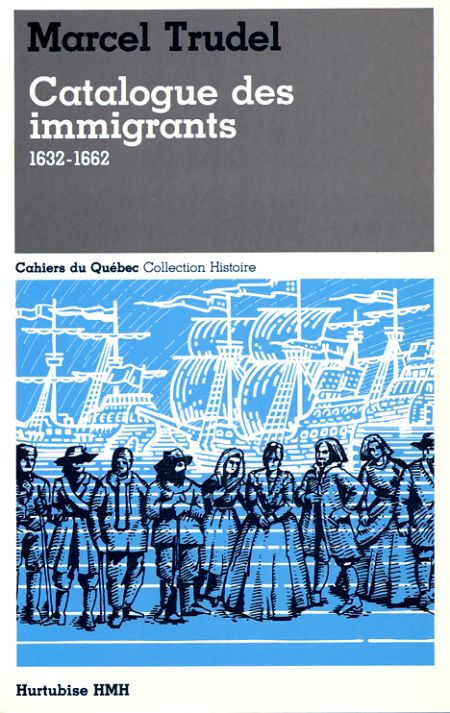
Marcel Trudel
Catalogue des immigrants 1632-1662
569 pages
QFHS #REF HG-150.99 T7

Trudel

Marcel Trudel (1917-2011) was a longtime professor at the Université Laval in Québec City and at the University of Ottawa. Recipient of many awards during his lifetime as an historian. In 1971 he was made Officer of the Order of Canada – In 2004 he was made a Grand Officer of the National Order of Québec.

Within this 569 pages detailed research guide, Marcel Trudel has addressed 3,000 immigrants from 1632 to 1662 who had settled in Nouvelle France.

Monsieur Trudel in comparison to Marcel Fournier and René Jetté has taken a different approach in his work.

All three historians in my opinion are offering a different perspective to the research process of one’s ancestor in France.

I have never taken the time to compare the results posted by Marcel Trudel or by René Jetté or by Marcel Fournier, but in my opinion, all three have researched and compiled superb material.

Marcel Trudel as part of is excellent dictionary has spent considerable time in offering his readers, precise details such as the age of an immigrant, the type of work he or she did in France, from where they came from, were these immigrants capable of signing their names to documents such as acts of baptism, marriage, death or notarial records and what type of work they did once they settled into Nouvelle France.

Jacques Gagné


French and French-Canadian resources at QFHS

L’association Quebec Family History Society, à Pointe -Claire dans l’ouest de l’ile de Montréal, a une groupe de recherche francophone en plus de toutes les activités orientées vers les recherches anglophones.  M Jacques Gagné, un membre de la société et chercheur chevronné du côté de la recherche française, nous offre quelques mots et conseils:
” En plus de posséder un des plus grands dépôt de revues et publications anglophone des iles britanniques et du Canada, à part de celui du BAnQ sur Viger  à Montréal, la société reçoit plusieurs publication en français.  Le plus importantes étant:
>> Mémoires de la Société généalogique canadienne-française
>> L’Ancêtre de la Société de généalogie de Québec
>> L’Entraide généalogique de la Société de généalogie des Cantons de l’est
Les membres de la QFHS qui désirent devenir des experts en recherches d’ancêtres de France, devraient commencer par les publications à la QFHS.
C’est en fait comment j’ai débuté il y a plusieurs années”
Jacques Gagné
La QFHS a même un spécial pour nouveaux membres jusqu’en juillet 2014
QFHS_Logo

The Quebec Family History Society in Pointe-Claire (West Island of Montreal) has a wonderful library that is opened quite a few hours a week, and from which members from out of town may even borrow books by mail.

Jacques Gagné, one or our members for quite a few years, our local French research expert supports the  France Research Group at

QFHS.  Here’s his two cents worth about starting some French Quebec research:

”Periodicals at QFHSOver the years under the leadership of Claire LindellMary Plawutsky, Daphne PhillipsBruce HendersonTed Granger, Diane Bissegger, the QFHS Library has been a primary repository of periodicals from the British Isles and from most provinces of Canada.To my knowledge, only the Archives nationales du Québec on Viger has a larger collection of genealogical magazines.This article will only address the aspect of research tips dealing with France.

Three periodicals in Québec, all three kept at the QFHS Library are superior to others in regard to the French Canadians and Acadians;
>> Mémoires de la Société généalogique canadienne-française
>> L’Ancêtre de la Société de généalogie de Québec
>> L’Entraide généalogique de la Société de généalogie des Cantons de l’est

Others revues (periodicals) dealing with the French Canadians and Acadians are also stored within the shelves of the QFHS Library.

QFHS members who wish of becoming experts in the research process of ancestors in France, should begin their expertise journey with the French language periodicals kept at the QFHS Library.

This is basically how I started a number of years back.”

Jacques Gagné

The QFHS is even having a new-members special until July 2014

A Pembroke Pioneer

Many years ago while visiting the red brick house with the huge front porch at 202 Isabella Street in Pembroke, I had little idea about the people who lived in that grand home.

Francois Evariste Fortin, my great grandfather spent his early years on the banks of the Ottawa River in Montebello Quebec.

Francois was born on the 6th of July 1845. At the age of twenty he married Adele Chevrier from Rigaud. She was also twenty. The marriage took place in Bon Secours Church in Montebello in mid-May of 1866. They settled in Hull, Quebec  where he was an innkeeper.

Several years later, in 1874 after the birth of Louisa, their third child, ( my grandmother) Francois, Adele and their children  moved up the Ottawa River to Pembroke, Ontario where the family grew. They had one son, Frank, who worked for Eastman Kodak in Rochester, New York and five daughters, Emma, Julia  (Sr. St. Gabriel) who became a Grey nun, Louisa, my grandmother, Alice who taught music for the City of New York until she was seventy-five and Aline who remained a spinster caring for her parents.

Francois began a business as a merchant-tailor and according to the  1881 and 1891 Census he had thirteen employees. Later census records indicate that he became a  contractor for the railroads and an inspector. He was actively involved with the Pembroke Southern Railway  (PSR) and an original director and in time was named Vice-President. Francois invested substantially in the PSR. The railway linked Pembroke to other local communities. It was eventually  bought out by C.N.R. and at the time became a spur line.

His interest in municipal affairs and a genuine  concern for the welfare of the town led him to run for town council and eventually  for the mayoralty in 1894. He was the first Mayor to serve three years in succession, 1894 – 1896. Francois-Evariste was also interested in politics and a staunch supporter of the Liberals. He worked tirelessly for the party.

Francois and his family were devout Roman Catholics. They would gather in their home each evening to recite the Rosary. He played an active role during the construction of Saint Columbkille Cathedral just blocks from their home. Along the way he  had a falling out with the Church and refused to participate in the evening recitation of the Rosary. He would seclude himself in his office. The family made certain that he could hear their prayers.

Over the years, Francois eventually was brought back in to the fold and made peace with the Church. He died less than two weeks before his ninety-first birthday, July 17th. He had lived in that community for sixty-two years. He was mourned by his family and the citizens of Pembroke alike and remembered as a well respected pioneer in the community. A Requiem High Mass was celebrated in Saint Columbkille. He is buried in the Roman Catholic Cemetery in Pembroke, beside his wife, Adele who predeceased him by ten years.

             Francois Evariste Fortin Adele Chevrier grave_edited-aaa

Bibliography:

Obituaries: The Ottawa Journal, July 7, 1936. p.10

Census of Canada 1851, 1871, 1881, 1891 1911, 1921

Interview with Madelyn Smith (Percival) 2011 my ninety year old cousin.

Canada Voter’s List 1935

Canadian Dominion Directory for 1871. John Lovell’s Province of Quebec Directory for 1871. Volume 1 p.998  John Lovell & Son, Montreal,1871

Ontario, Canada, Deaths,1869-1938 and Deaths Overseas 1838-1847

Copyright 2013 Drouin Institute (Lafrance) dlp_32631325.jpg

Le centre de genealogie francphone d’Amerique 1997-2006 GEDCOMn155 #Individu 19607

special thanks to fellow genealogist Oskar Keller for finding the grave.

Of interest:     Excerpt from The History of Pembroke  http://www.pembrokeontario..com/city-hall/history-of-pembroke#sthash.rCHphQZD.groK4XiT.dpuf/

Pembroke was the first town in Canada in which electric power was generated for commercial use. On October 8,1884 the very first street lights in Canada cast their glow down Pembroke Street. A small building on Pembroke Street east of the Muskrat River provided electricity for street lighting as well as for the factories in the Town.

In 2003 a fully redundant fibre optic cable was installed around Pembroke, enabling local businesses to work anywhere in the world – without leaving their desks- through a telecommunications infrastructure that is vital to remaining competitive in today’s global economy.

Working together to help genealogists discover their ancestors