Which family members lived during World War II?

According to my genealogy software, there are 66 people in my current family tree who were alive when Canada declared war on Germany on September 9, 1939, including all four of my grandparents.

DSC09387
Richard Charles Himphen’s only will was a note about his wifeat the back of his log book. He died in Italy.

By the time the last battle in continental Europe ended on May 20, 1945 the number of people alive was up to 70, even though 45,400 Canadians died in the war, including my mother’s father. My mother and father were among the people born during this time.

According to demographer David Foot, 2.2 million people were born in Canada during this time, just ahead of the baby boom that began two years later.

I never realized how clear demographic trends become while doing genealogy.

What does researching our ancestors tell us?

The first ancestor I chose to research in detail was a woman who lived in Quebec City two centuries ago. She was born during a war, married a carpenter at 18, bore 10 children, grieved the death of four children, and died when she was only 38 years old.

Other than feeling grateful that my life is easier and longer than hers, what can I possibly gain by learning about her life?

More importantly, why should you, my reader, care about her at all?

There are lots of answers to this, depending on who you are, what you’re doing and what you need now, but for me, all these reasons can be described in a single word: hope.

The best thing about researching and reading about ancestors is the feeling of hope created by those actions.

Much of my drive is personal. I’m writing to learn about myself. If you’re one of my relatives, you probably read my stories hoping to learn something about yourself too. We both want to know whether the lives of our ancestors affected those of our grandparents and parents especially if that changed where we live now and who we know.

In the case of that woman from two hundred years ago, if her children died because of genetic health risks, we’ll want to know so that we can try to prevent the same thing happening to ourselves or our loved ones.

Her history might illuminate some of the personality quirks in our family, or you might wonder whether our long line of strong independent women began with her.

If you’re questioning whether that applies to you, think again. The more I do genealogy, the more I realize how many people might be connected to my family either through blood, historic friendship or past quarrels. Anyone in the world might be related somehow. Judy Russell writes about discovering some of these lost family members via genealogical research and new DNA tools in “Oh Charlie” at http://www.legalgenealogist.com/blog/2014/02/02/oh-charlie/. Her article is making me reconsider genetic testing.

Researching our ancestors and sharing about the experience enables all of us to contribute to a wider understanding about who we are, what we’ve been and where we live in a bigger context too.

Even if we aren’t related in any way, the stories genealogists tell have lessons for anyone interested in righting past wrongs, illuminating communities or exploring a particular place. Janice Hamilton’s research on one of her ancestors, for example, has provided helpful background to a group of locals who provide tours of the Mile End neighbourhood of Montreal. You can read her stories about the Baggs and the community they helped found at http://writinguptheancestors.blogspot.ca/.

So often, the stories we hear about the past are myths made up of half-truths. Looking into the details of an actual person’s life reveals a series of events that are complicated, nuanced and full of foibles. Circumstances often carry people in different directions than what might have otherwise been expected.

By figuring out what actually happened to whom and sharing any surprises we discover widely, we all get closer to the truth. Getting closer to truth creates possibilities for beauty, understanding and diversity.

Note: This post is cross-posted from http://arialview.ca.
Then again, maybe you’re different? Why do you research your family history?

Family History Writing 2014 Begins!

Today is the beginning of Family History Writing 2014.

Lynne Palermo, from http://www.thearmchairgenealogist.com/ challenges all of us to place a family history story on our blogs every day this month. She’s also created an online forum so that those of us participating can ask questions and share our work with one-another.

AnneMargueriteMarieHurtubiseArial

I’m participating for the first time. My challenge is to begin communicating some of the stories about ancestors identified by my grandmother, Anne Marguerite Hurtubise Arial, in a family tree that goes back to 1589. Looking through her documents shows how hard researching family history used to be prior to the on-line resources we have today. Marguerite’s documents include letters to researchers, cousins and authorities, mostly in Quebec, where many of her ancestors hail from. She’d be blown away by the National Archives digital resources now available via http://www.banq.qc.ca/, especially Iris and Pistard.

Although all of her work seems to be accurate so far, few sources and original documents are included in the package of material passed on to me. After digitizing her work, I’m now redoing her research and attaching sources to it for future generations. I’m also working on the family tree on my mother’s side.

This month, I’ll share some of the stories I’ve discovered while redoing her research.

Note: This post is cross-posted from http://arialview.ca.

RootsTech announces free online conference presentation schedule

Great news! RootsTech, the world’s largest family history and technology conference held in Salt Lake City, Utah, February 6-8, 2014, announced today that 15 of its popular sessions will be broadcast live and complimentary over the Internet. The live broadcasts will give those unable to attend in person a sample of this year’s conference content. Click here to view the online broadcast schedule. Interested viewers can watch the live presentations at https://rootstech.org/. Here is the link to download RootsTech syllabus materials. Get on it as soon as possible because, according to Amy Coffin in her blog, The We Tree Genealogy, these are available for a limited time.The syllabus material is already Note the times listed are in Mountain Time.

RootTech-from-Woody-480x200

Watching live presentations from home is an easy, relaxing, and no-cost way to learn about genealogy and improve your research skills. The list of speakers this year includes several rock stars, such as Lisa Louise Cooke, Lisa Alzo, Josh Taylor, and Randy Whited.

So, pour yourself a cup of tea, grab a notebook, watch, and learn.

Tuesday’s tip

Brigham Young University in Utah offers several free online genealogy courses, including one about France. While this course is not for credit, it is a great way to learn something new at no cost. To review the lessons, you must first enroll online. You will then work at your own speed and choose the time and place. When you have completed the course, you will have learned how to identify the place of origin of your ancestors, explained why you must analyze your information, and discussed some French emigration groups and sources to help you find your French ancestor’s place of origin.

A list of courses, including the French course, is available on BYU’s Independent Study web page.

Writing Your Family History

For some people, genealogy is enough. BMDs, children’s names and extended family trees keep them busy. But some of us want more. We want to learn the details of our ancestors’ lives, find out what historical events affected them – and then write about them.

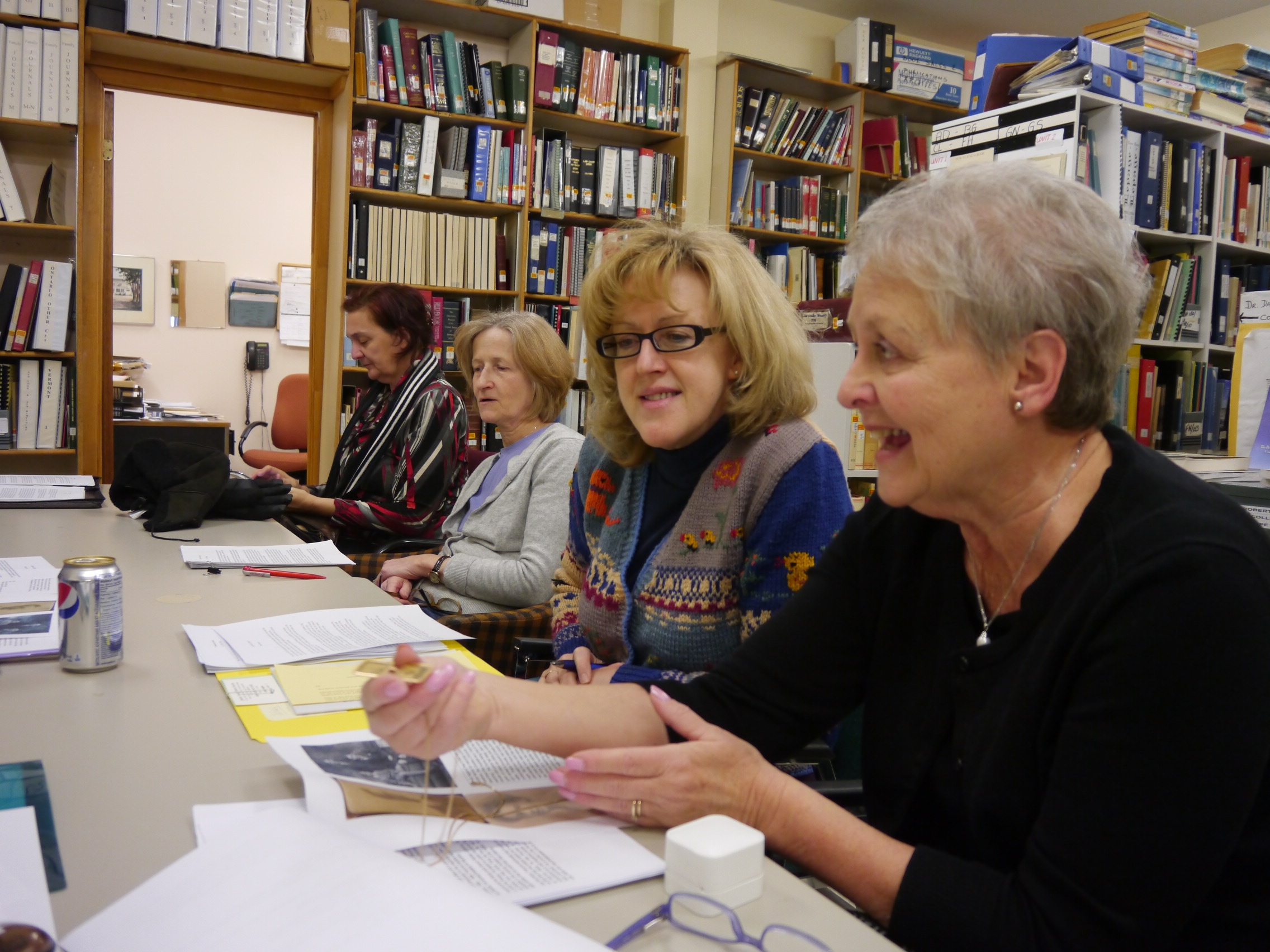
Once a month a group of us meet at the Quebec Family History Society library to share our ancestor’s stories, try to improve our writing skills, and learn from each other. There are two rules: articles are limited to 500 words, and we must list our sources. It isn’t always easy, but it is fun.

Image

This month Claire wrote about her great-grandfather François Evariste Fortin, a merchant and contractor in Pembroke, Ontario who lost and then rediscovered his Catholic faith. Barb’s story was about her grandfather James Rankin Angus, a Scottish carpenter who worked on the construction of the ocean liner Lusitania, then spent 20 years running a book store in Quebec City.

Lucy has been writing about the Hanington family, the first English settlers in Shediac, New Brunswick. Janice’s subject was Robert Hamilton, a Scottish weaver who took up farming in Scarborough, Upper Canada. Mary told the story of great-grandfather Ismael Bruneau, a French-speaking Protestant minister.

Dorothy wrote about Norman Nicholson, her husband’s great-grandfather, an ordinary man who had one extraordinary habit: for five decades he kept track of every aspect of his life, from business expenses to a dating diary.

Oskar focused on Abraham Martin, from whom his granddaughter is descended. The Battle of the Plains of Abraham was fought on his land, but consensus about Abraham’s life ends there. Some stories say he was a farmer, others call him a river pilot. Some accounts say he returned to France for several years, others say he stayed in Quebec. Oskar clarified the confusion even if he didn’t resolve the conflicts.

Ruth wrote about her search for John Morrison. This being a common name, she couldn’t figure out which John Morrison in the 1861 census of Scotland was hers. John’s mother’s name was the less common Robina, and his daughter was also Robina, so she looked for Robina and found John in Illinois.

Next month some of us may do rewrites and others will tackle new subjects, but we are all making progress on writing our family histories, 500 words at a time. To learn more about this Special Interest Group, go to http://qfhs.ca/cpage.php?pt=90.

Webinars this week

Almost every week Legacy Family Tree offers free webinars (online seminars). The next two appear especially interesting.

Wednesday, January 22, 2 PM (Eastern): Irish Research 101: Learning the Research Process with Judith Eccles Wight.

Wednesday, January 29, 2 PM (Eastern): Ten Reasons Your Ancestor was in Canada with Kathryn Lake Hogan.

You must register to watch the live presentation. Or you may watch the archived version at your leisure without registering during the following six or seven days. A complete list of webinars, descriptions, and registration are available at Legacy Family Tree.

Discovery Channel airs new series about Yukon gold rush

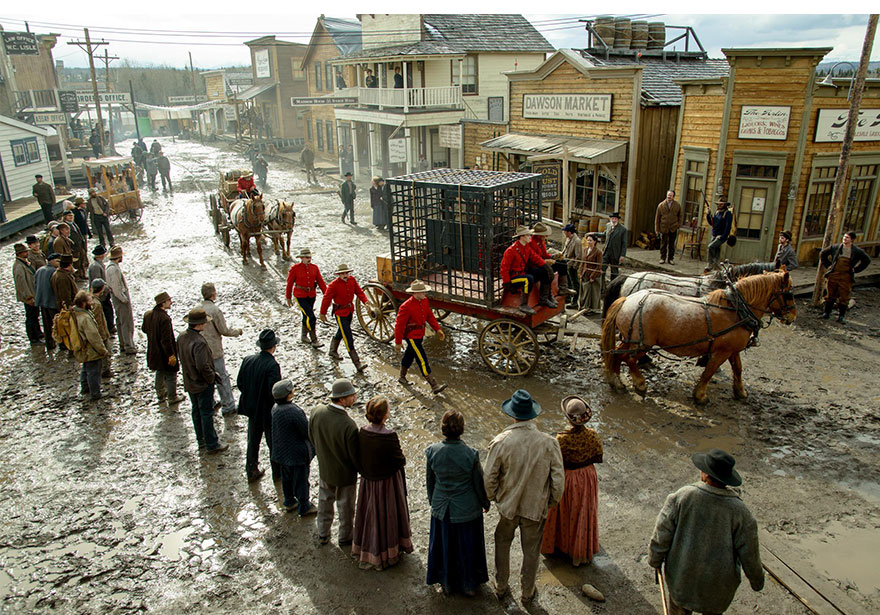
On Monday, January 20 at 9 PM (ET and PT), the Discovery Channel in Canada will broadcast a new three-part series, Klondike, about the Yukon gold rush in the late 1890s. Parts two and three will air on Tuesday and Wednesday, January 21 and 22. The series is based on Charlotte Gray’s book, Gold Diggers: Striking It Rich in the Klondike.  This is a rare opportunity to see part of Canada’s history on the small screen.

As genealogists, we often try to picture how our ancestors lived. While admittedly, TV and movies may not provide the most accurate portrayal of the time, they can still provide a sense of how people dressed and acted. As far as I know, none of my Canadian ancestors ventured to the wilds of the Yukon Territory. During the Klondike period, most of them were living in Montreal and Toronto. Nevertheless, I expect my ancestors were aware of the gold rush and perhaps some of them even dreamt of taking part.

Klondike Street Scene

The National Archives asks for your help

Any opportunity to help other genealogists and researchers is a good one, and The National Archives in Great Britain announced an interesting project this week.

The National Archives (TNA) has spent the past three years digitising WWI unit war diaries and now they are looking for volunteers. These diaries are among the most popular records at TNA.

With this project, TNA hopes to create new Citizen Historians, working together to make previously inaccessible information available to academics, researchers and family historians worldwide, leaving a lasting legacy for the centenary of the First World War. They need volunteers who can spend an hour of their time — or more — to read and tag a few diary pages.

Earlier this week, TNA published the first batch of diaries online as part of First World War 100. You can search and download more than 300,000 diary pages of the first three cavalry divisions and the first seven infantry divisions to arrive on the Western Front. By the end of this year, TNA will have published the rest of the diaries that they have digitised, around 1.5 million pages in total, opening up an already popular record series to historians worldwide.

To learn more about the project and how you can get involved, visit The National Archives Blog. Thanks to Dick Eastman who brought this story to our attention in his eNewsletter article, Operation War Diary: A Crowd Crowdsourcing Project.

Working together to help genealogists discover their ancestors