Tag Archives: genealogy

private radio inspector

The black-leather-lined plasticized bilingual identity card wacked my arm as it fell from the shelf. Until then, I had never really noticed the card among the many items my grandmother left me.

Luckily, its heavy construction protected the words on the card, which remain as legible as they were when my grandfather received it on January 4, 1936.
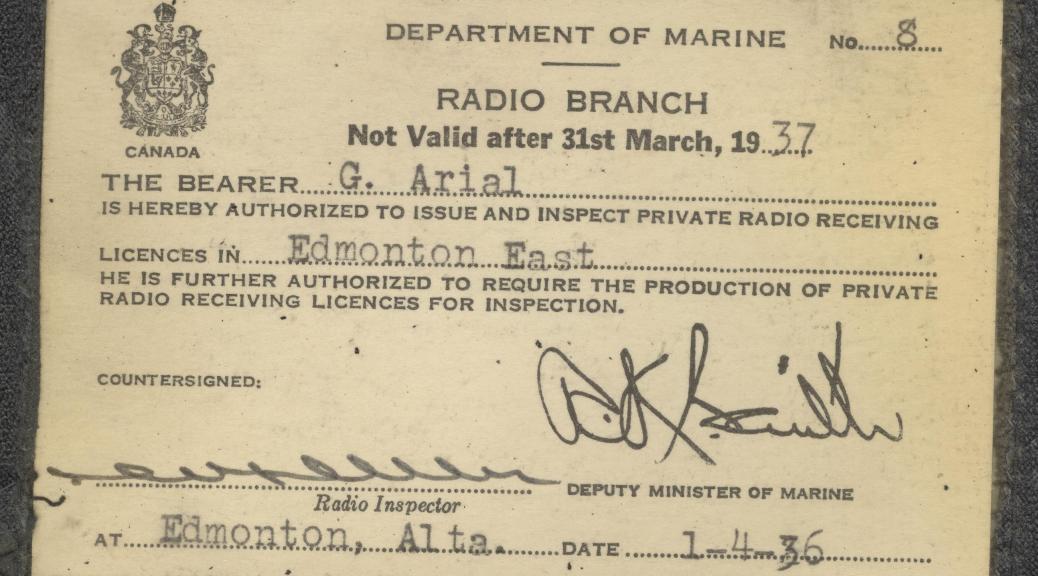
The Canadian federal “Department of Marine” issued the card to give my grandfather credibility as a radio inspector. It says:

“The bearer G. Arial is hereby authorized to issue and inspect private radio receiving licences in Edmonton East. He is further authorized to require the production of private radio receiving licences for inspection.”

Turns out that this little artifact hints at a short-lived controversy in Canadian history. The card expired on March 31, 1937, but it would be defunct before then.

The Department of Marine seems like an odd overseer of radio licences until you realize that early broadcasting began in the 1890s when Morse Code was used to enable ship-to-ship and ship-to-shore communication. The idea of a public broadcaster begin in May, 1907, when the Marconi station in Camperdown, Nova Scotia began broadcasting regular time signals to the public.

The “wireless telegraphy” industry continued to develop with private individuals investing in ham radios with no regulation. By June 1913, the federal government decided to regulate the industry to protect military communication.

When World War I began in August 1914, private licenses were banned altogether. Only the Marconi Wireless Telegraph Company of Canada, Ltd. kept operating during the war years, in part because it became a research arm of the military.i

After the war, the private industry blossomed, particularly in Western Canada. Many of the new broadcasters came from multiple religious communities, a situation the federal government tried to prevent by setting up a public broadcasting system through the Radio Broadcasting Act of 1932.

That act led to the establishment of a licensing commission called the Canadian Radio Broadcasting Commission under the leadership of Hector Charlesworth. Charlesworth’s group censored many religious groups and political groups, but none more than the Jehovah’s Witnesses.

Norman James Fennema described the controversy in his 2003 dissertation, Remote Control.

…in Canada we find a situation in which the original impetus for regulating radio broadcasting began with the specific aim of putting a rein on religious broadcasting. Originally directed at the radio activities of the Watchtower Bible and Tract Society, this expanded in the early 1930’s into a policy against the licensing of religious broadcasters, a policy initially justified on the basis of the scarcity of the broadcasting spectrum, but that survived the expansion of the system.ii

By 1935, Clarence Decateur Howe became both the Minister of Railways and Canals and the Minister of Marine,iii the ministry under which my grandfather’s job was created.

Howe favoured private broadcasting, and encouraged new private entities to flourish.

Prime Minister Mackenzie King preferred a public broadcast system however. In February, 1936, the Canadian Broadcasting Corporation (CBC) came into being, and my grandfather’s job ended.

Sources

i https://en.wikipedia.org/wiki/History_of_broadcasting_in_Canada, accessed May 26, 2020.

ii Fennema, Norman James. REMOTE CONTROL: A History of the Regulation of Religion in the Canadian Public Square, PhD thesis, 2003, https://dspace.library.uvic.ca/bitstream/handle/1828/10314/Fennema_Norman James_PhD_2003.pdf?sequence=1&isAllowed=y.

iii https://en.wikipedia.org/wiki/Minister_of_Transport_(Canada), accessed May 26, 2020.
The Family Historian

Ten years ago in July 2015, my sister and I shared a “Sister Pilgrimage” to Shediac, New Brunswick, the home of our maternal ancestors. Here is a part of the story I wrote upon our return:

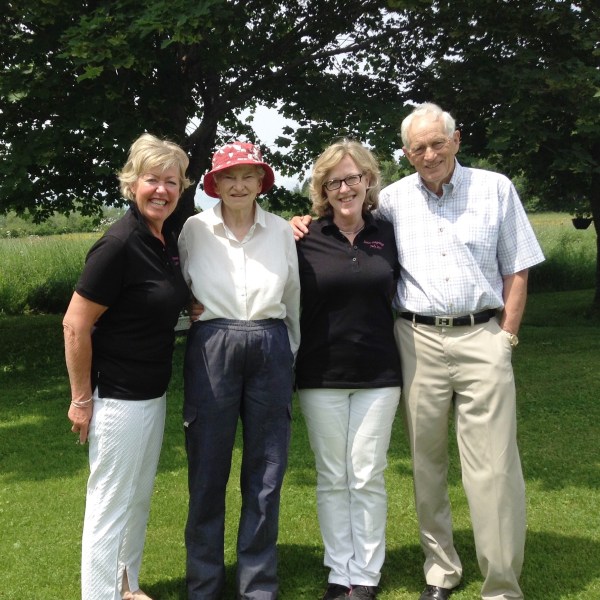
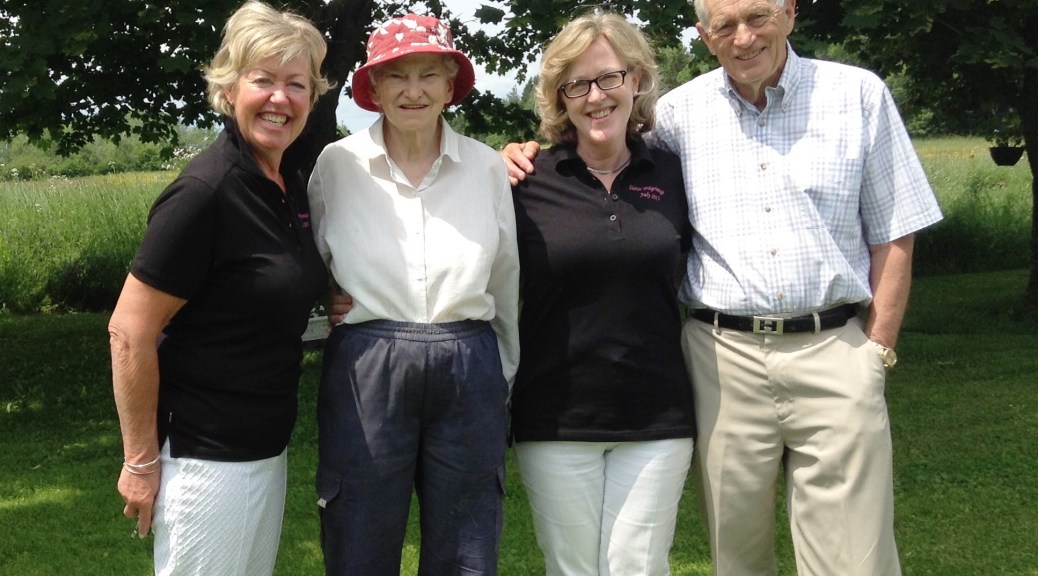
Early Sunday morning, dressed in our special t-shirts, we left in plenty of time for the morning church service at St Martin’s-in-the-Woods.  The greeter welcomed us warmly, and we asked if there might be any Haningtons at church that day.  She beckoned down the aisle to her husband who then introduced himself as Allen Hanington.  Overjoyed, we threw our arms around our surprised distant cousin and snapped a commemorative photo.  And so our journey began.

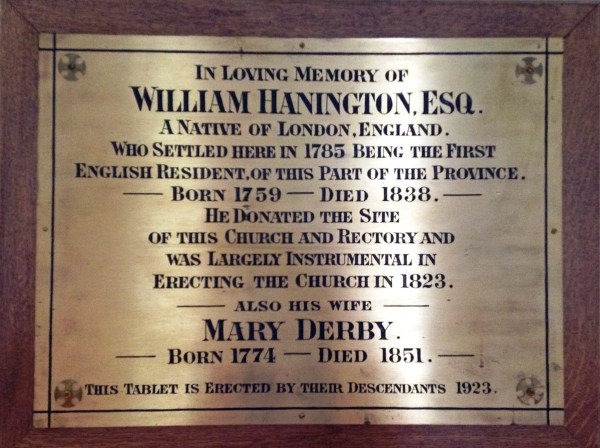
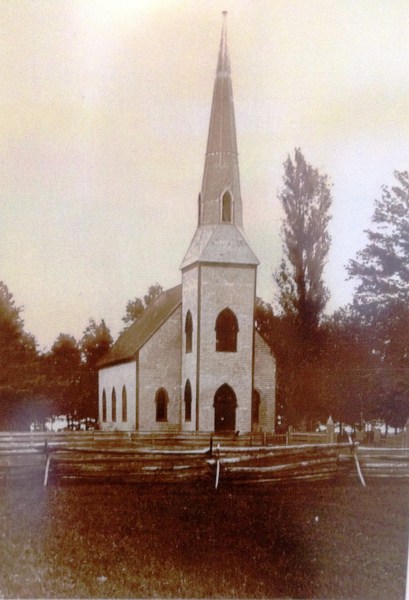
My 3x great grandfather, William Hanington William Hanington comes to Canada, was the first English settler in Shediac, New Brunswick, in 1785.  He was an amazing fellow who emigrated from England at the age of twenty-six, built a whole community, set up lumber exports, built ships, married a PEI girl Shediac’s First English Woman Settlerand had a family of thirteen.   Later in life, in 1823, he donated a piece of land and built St Martin’s-in-the-Woods Anglican Church, where he was buried in 1838.Later on that Sunday after the morning service at St Martin’s-in-the-Woods, we visited with Allen’s charming sister Lilian, the family historian who knew our exact location in the Hanington family tree!

… PS  The August 2015 family newsletter, the Hanington Herald, just arrived by mail! Included in the comments from the President’s Desk (that would be our cousin Allen!), it says: “We just experienced a lovely visit from the Anglin sisters; Lucy (Montreal) and Margaret (Ottawa) who were visiting in the area and attended morning service at St Martin’s-in-the-Woods Anglican Church on Sunday, July 5th 2015.  We had a very nice visit on Sunday afternoon.  They are descendants of Daniel Hanington.” Roaring Dan

After the recent passing of Allen Hanington, I spoke with his sister Lilian—and it quickly became clear that her story deserved to be shared.

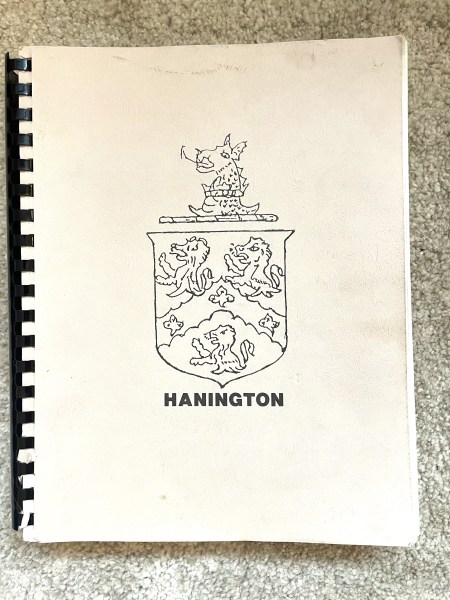
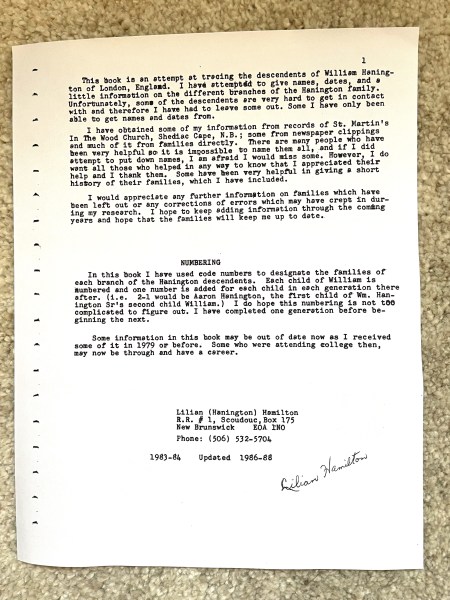
Lilian is my third cousin once removed on the Hanington side, and she’s made a lasting impact as our family historian. Her most significant legacy is the Hanington Book—a detailed 394-page family tree that she compiled and first published in 1983, then updated in 1988. Every Hanington was assigned a unique number to trace their lineage. Lilian herself is #2-4-6-10, meaning she is the 10th child of the 6th child of the 4th child of the 2nd child of our original Shediac settler, William Hanington. I now have a PDF copy of the Hanington book and happily share it with cousins near and far.

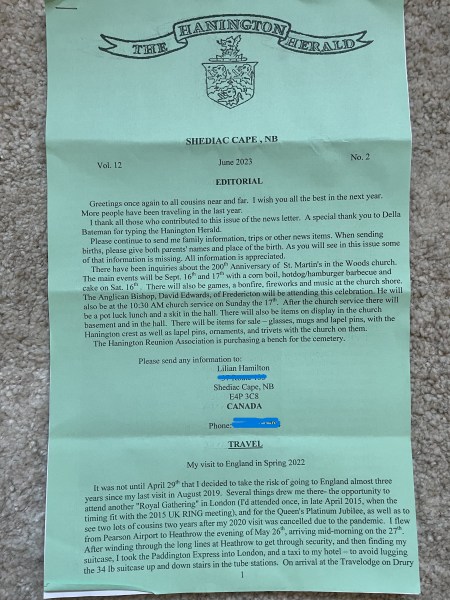
To keep the family connected, Lilian also created The Hanington Herald, an annual newsletter filled with updates on births, deaths, travels, and all things Hanington. She maintained it faithfully, offering four years of family news for the modest subscription price of just $12.

Lilian’s father, John Moore Hanington (1886–1967) ventured west from his birthplace in Shediac, N.B., in the early 1900s on a “grain excursion,” later joining the 145th Battalion in WWI, though he never served overseas. A skilled carpenter, he worked on the Scoudouc airport and maintained a thriving farm when he returned to Shediac. At one point, he had over 100 plum trees and picked more than 100 pints of raspberries in a single day. He also kept cattle, pigs, and hens for the family’s use.

His wife, Ada, came to Canada from Cheshunt, England at age 12. Together, they raised a large family—Lilian, their tenth child, was born in 1940.
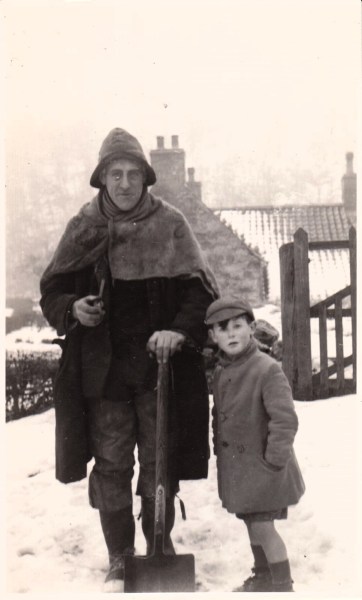
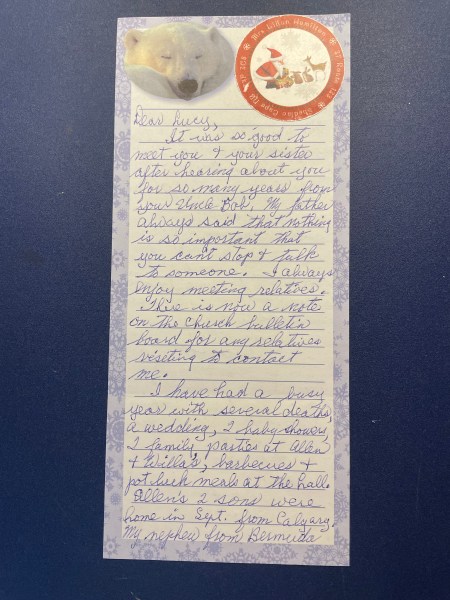
Lilian attended Moncton High School, graduated from Teacher’s College in Fredericton, and taught school briefly before working at T. Eaton Co. Mail Order for 12 years. Like her father, she grew fruits and vegetables, ran a farm stand, and still maintains a huge garden. Her beautifully handwritten multi-page Christmas letters always include updates on her abundant harvest of that year.
I received my first Christmas letter after we met in 2015… and now I look forward to it every year:

Christmas 2015

Dear Lucy,

It was so good to meet you & your sister after hearing about you for so long from your Uncle Bob. My father always said that nothing is so important that you can’t stop & talk to someone. I always enjoy meeting relatives. There is now a note on the church bulletin board for any relatives visiting to contact me…

My garden did well in spite of the late planting. I had peas to freeze, beans to sell, bushels of potatoes, some large carrots, cucumbers & small tomatoes to give away. I also had lots of gooseberries, pears & grapes. Allen had black currants and crab apples so I made lots of jam, jelly, preserves & marmalade. Some of which I will give as Christmas gifts. I also make dozens of cookies, many of which I give as gifts also. Easier shopping that way…

I wish you a very Merry Christmas with peace, joy, love & happiness. All the best in 2016. It was so nice to meet you. Please keep in touch.

Love,

Lilian

It feels fitting that I met Lilian at St. Martin’s in the Wood Anglican Church—a place deeply rooted in our family history. Built by her 2x great-grandfather (my 3x great-grandfather), the church has been a cornerstone of her life. She married Robert Hamilton there in 1967 and served faithfully for over 20 years as a Sunday school teacher, sewer, knitter, and superintendent.

In 1985, Lilian helped organize the 200th Hanington Reunion, a celebration that brought together 400 relatives for a parade and lobster dinner—honouring a legacy built on faith, hard work, and community. I only wish I had been there to witness it!

Before we ended our phone call, she fondly recalled my grandparents’ summer cottage Iona Cottage down the lane from the church and how my grandfather, an Anglican priest The Priest, would occasionally step in to lead summer Sunday services.

A natural historian and gifted storyteller, Lilian clearly inherited not only her father’s green thumb but also an extraordinary memory.

Lucy Hanington Anglin

#6-9-7-3-4

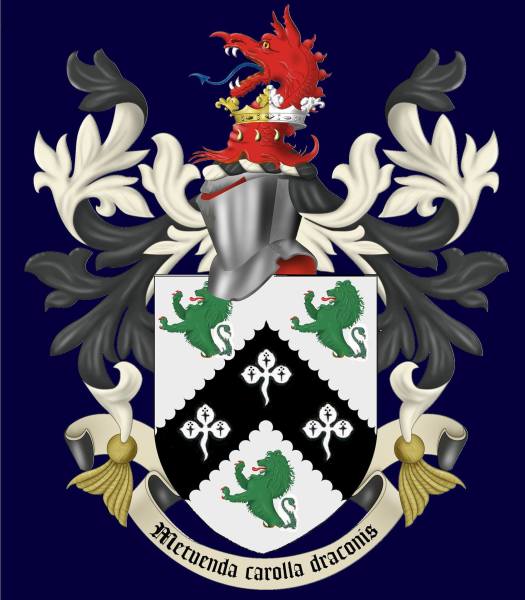
The Hanington Coat of Arms

Not Just A Kingston Girl

My great-grandparents, Harriet Eva Gould and William Gardiner (WG) Anglin shared 48 years of marriage together, and their lives exemplify the saying “Behind every great man is a great woman.” In many cases, when we look into our family history, finding information about our female ancestors can be tough. After they marry, their maiden names are often forgotten, their careers aren’t recorded, and their lives tend to be defined by their roles as wives, mothers and community participants. Such was the case for Harriet too, as is clear from her obituary.

Mrs. Harriet Anglin – there passed away at her home on 52 Earl Street, on Saturday evening, Mrs. Anglin wife of Dr. W.G. Anglin, deceased, who was before her marriage Harriet Eva Gould, had lived in Kingston since her girlhood days. For the past year and a half, she had been ill. Mrs. Anglin who was of retiring nature, was most widely known through her membership in Sydenham Street United Church.

Surviving her are two sons, Douglas Anglin of Anglin-Norcross Construction Company, Montreal, and Wendling Anglin of the Johnston and Ward firm, Montreal; also three daughters Mrs. McLaren Ewert of Moosejaw, Sask.; Mrs. R. M. Horsey of Montreal and Miss Mary Anglin, secretary to the Principal of Queen’s University; also one sister, Mrs. John Hunter of Goderich and three brothers, George, Harry and William Gould. Ten grandchildren also survive.

Prior to meeting each other, Harriet and WG gained experiences that would serve them well when they married.

Harriet Joins Kingston Society

For the first decade of her life, Harriet grew up as the eldest child of William Gould and Mary Wartman in Ancaster, Ontario. When she was about 11 years old, according to the 1871 census, her parents sent her to Kingston, Ontario, to live with her mother’s sister Susanna, who was married to a wealthy businessman named James Richardson. It’s not clear why they made this decision, but it’s believed that the Gould family couldn’t support all their children. At the same time, Aunt Susanna, who had only sons, longed for a daughter. 

The arrangement worked well for everyone: Harriet was raised in a comfortable home and Aunt Susanna got the daughter she always wanted. While living with her aunt, Harriet received a good education and was introduced to Kingston society. She became known for her connections to the prominent Richardson family and her Loyalist heritage through her mother’s side. This social standing would play a part in her future, especially when she married.

William Gardiner (WG) Becomes a Surgeon

Before their marriage in 1886, WG went to Edinburgh, Scotland, where he learned new surgical techniques from Dr. James Lister, a pioneer in antiseptic surgery. After his return and marriage to Harriet, WG was invited to teach at Queen’s Women’s Medical College. Surgeon and Mentalist

Career and Family Life

WG’s skill and dedication quickly earned him a spot on the prestigious faculty at Queen’s University. By 1887, he was appointed as a Professor of Pathology and head of the Clinical Surgery department. He shared the groundbreaking techniques he had learned in Edinburgh with his students, shaping the future of surgery in Canada. 

He and Harriet had their first daughter, Mary (1888-1979), that same year. In the following years came Susan (1889–1982), Douglas (1890–1955), Wendling (1892–1955) The Stock Broker, and Ruth (1895–1976). It’s believed that Mary and Susan were named after Harriet’s Aunt Susanna.

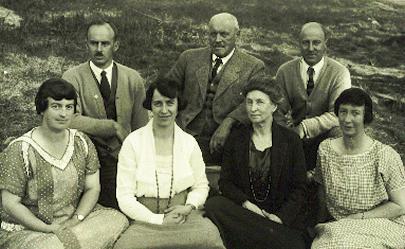
1923 – Douglas, WG, Wendling, Susan, Ruth, Harriet, Mary

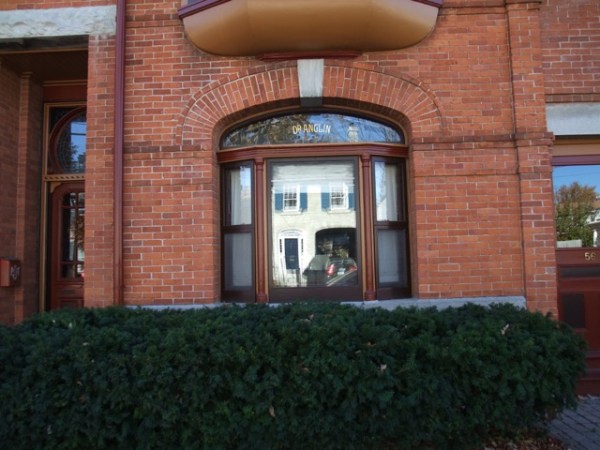
Throughout these years, W.G. ran a private medical practice from their home on Earl Street, which allowed him to spend time with the family. His name was even etched in stained glass in the window of their office building.

52 Earl Street with “Dr. Anglin” etched in top glass


Going to War

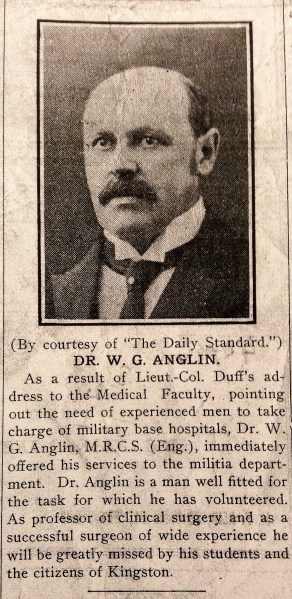
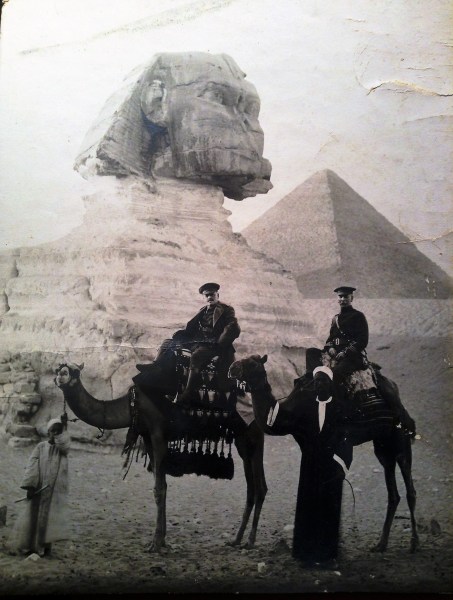
In 1915, WG left his teaching job and volunteered to go to Cairo, Egypt, with the Queen’s Stationary Hospital at 59 years old, in response to a plea from Lieutenant Colonel H.R. Duff, who needed someone with “experience and wisdom.” He caught Malta Fever and had to return to Canada a year later. Although he recovered a bit, the illness affected his health for the rest of his life. Duff, however, died of pneumonia in Cairo.

1915 – Cairo, Egypt, WG on the left camel

Community Leaders

After the war, WG continued working in medicine on a limited basis and served as an examiner for the Canadian Pension Board. He also worked at Kingston Penitentiary, where he introduced medical and administrative improvements and treated the inmates with dignity until he retired in 1928. 

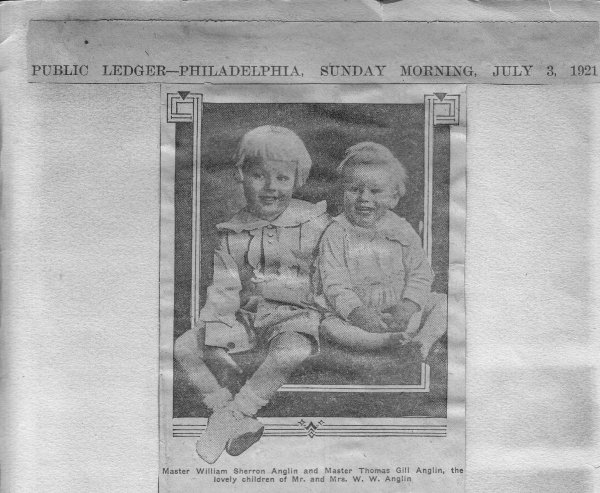
Harriet remained dedicated to her children, their families and her church. As a proud grandmother, she tucked a newspaper clipping of a photo of my father and his brother into a random book where it slipped out 90 years later into the hands of a distant cousin who then made contact with me!

1921 newspaper clipping of my Uncle Bill and my father Tom Social Media – Then and Now

In their later years, Harriet and WG were well-respected members of their Kingston community until he died in 1934. She died only two years later and they are now buried together in the Anglin plot at Cataraqui Cemetery.

Philadelphia Story

After my great grandfather retired from a successful 40-year career in the wholesale food business, he took an active interest in the stock market and managed his own investments during the time of the Great Stock Market Crash of 1929. Would he lose his life savings like so many unfortunate others at the time?

In a letter to his eldest daughter Josephine, my grandmother, dated June 2, 1932, he wrote:

“…if we could get rid of a lot of these Rotten Banks and Stock Market thieves the world would come around all right in no time. A person has no show with that New York Stock Exchange. Just a lot of crooks and I don’t think these common stocks have any value at all, not worth the paper they are written on, most of them, but all this will come (out) all right but people have got to lose a lot of money and that’s that.”

William Thomson Sherron (1863-1932) was born in Salem, New Jersey, the son of Albert Wood Sherron and Eveline Stokes Gaunt Githens. His wife, Gertrude Gill, (1869-1940), born in Philadelphia, was the daughter of Thomas Reeves Gill and Josephine Love.

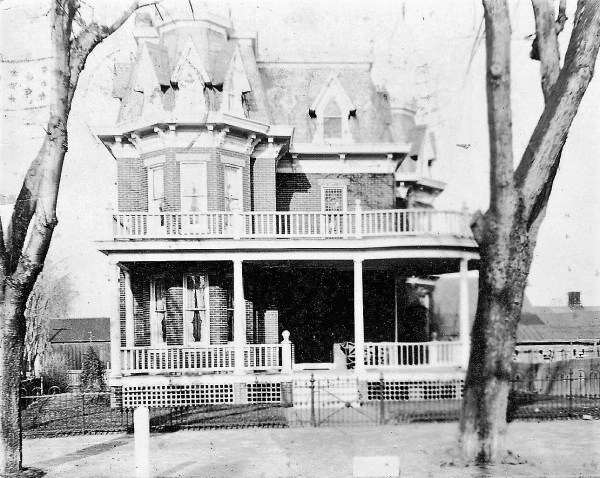
In November 1891, William and his bride settled in their new family home at 100 W. Broadway, Salem, New Jersey, where they stayed for the next twenty years. This beautifully refurbished Queen Anne style Victorian house still proudly stands today.

(Their first home -100 W. Broadway, Salem, New Jersey)

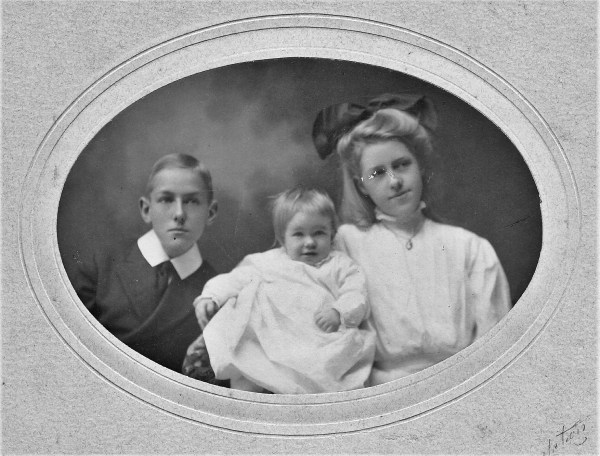
The couple had three children – Josephine (1893-1964) Social Media – Then and Now, Roger (1895-1963) Sherron and his Texas Betty and Alberta (1906-1992) Elopement … or not?. Josephine, my grandmother, her stockbroker husband and their two sons eventually settled in Montreal, Quebec. Their son Roger had mental health issues and lived with them until their deaths. Alberta married very young, had a son nine months later and remarried happily a while after that and had three more children.

(Roger, Alberta and Josephine Sherron – 1906)

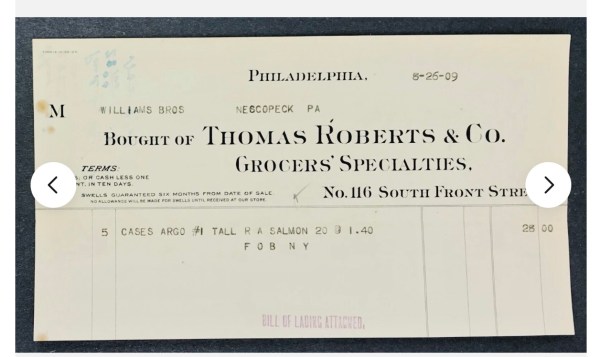
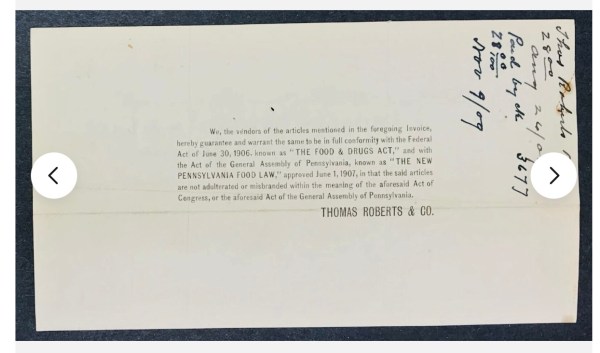
William first worked for Thomas Roberts & Co. in the wholesale grocery business for 25 years in Philadelphia before going into the same business for himself in 1905 at the age of 42. He opened his own office at no. 37 South Front Street, Philadelphia, about a half mile from their new home at 261 W. Harvey where they lived for the another twenty years.

(Invoice – front and back from the grocery wholesale business)

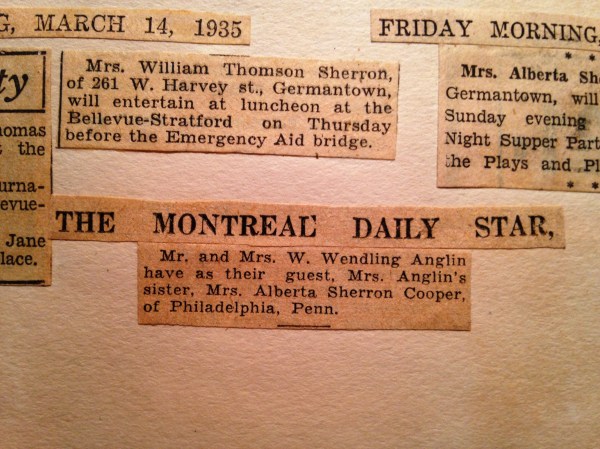
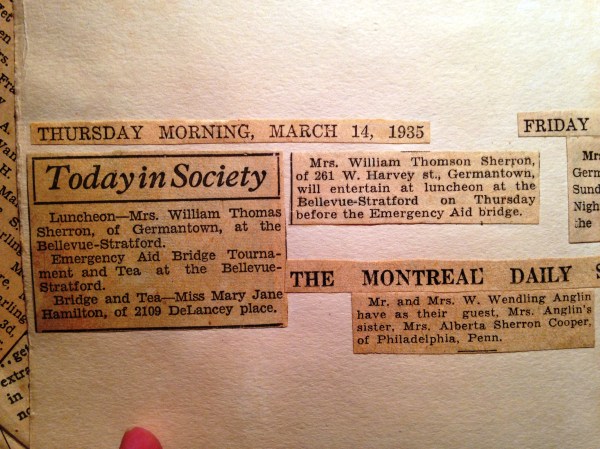
His wife and daughters took an active role the local Germantown social scene. Their endless teas, luncheons, bridge parties and charity fundraisers were regularly featured in the social pages of the local newspaper.

(Gertrude Sherron and her daughters in the Society Pages)

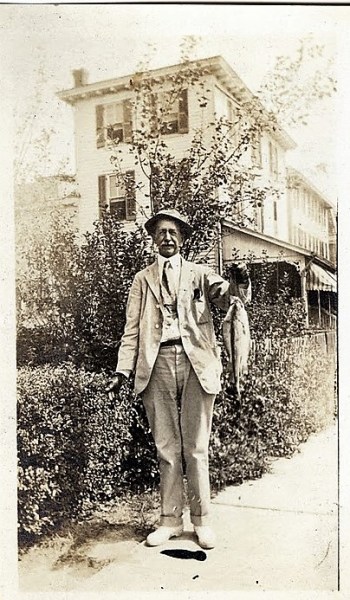
Along with the usual collection of family posed photographs in my dusty old boxes, I found a delightful photo of 55-year old William. He is holding up a string of sizable fish, possibly bass, outside “the Windsor Avenue cottage” (which looks more like an old country inn). He is wearing a light coloured baggy jacket and matching pants with a proper shirt and tie, white shoes and a floppy “fishing” hat. The smile on his face reflects pure joy for the day’s “catch”.

(William and his catch of the day!)

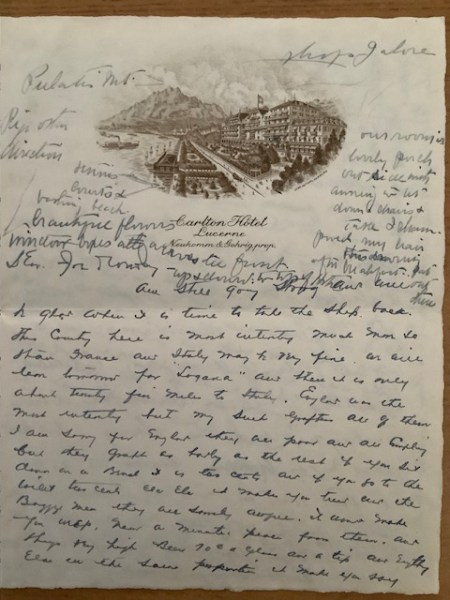
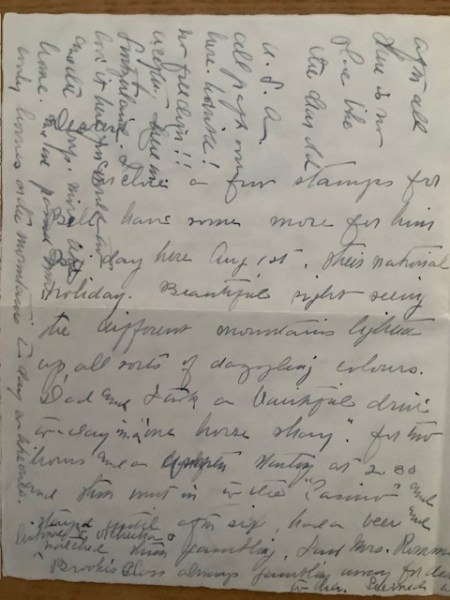
In 1930, just a couple of years before William’s death, the couple enjoyed an extended trip to Europe. They stayed at the famous luxurious Carlton Hotel in Lucerne while visiting Switzerland and I have the note sent to their daughter Josephine. William began the correspondence writing at a slant that became a little more difficult to maintain as he ran out of room on the notepaper. Then Gertrude took over filling every remaining inch of the note – to the bottom, up the sides and finishing up at the top of the page! Nevertheless, I could just barely make out from their undecipherable scrawls that they “adored Switzerland”, the hotel was “a dream” and “Interlaken was perfect”. As for Paris, Gertrude didn’t mince words when she exclaimed “Paris is a horribly dirty city.” However, she “loved London” and thought the people dressed “heaps better than in Paris.” At one point in the note, William generously invited their daughter to join them and wrote “I will pay the fare.”

(Excerpt of their note to their daughter Josephine)

So, it seems that William didn’t lose his money in the stock market after all, and had plenty to splurge on a once-in-a-lifetime trip to Europe with his wife.

Not…Quite…Forgotten

Driving into Helmsley.

The North Yorkshire town

Where my ancestors toiled

In the nearby fields

And laboured

In the limestone quarry

Or – in one case – bent over smartly

As footman to the local Earl

Is now a pristine tourist destination

For posh Londoners

(Who like to hunt partridge, grouse and pheasant)

With high-end clothing shops

And luxury gift boutiques

Lining the old market square

Two wellness spas

And at least one pricey Micheline-recommended restaurant

Serving up the likes of Whitby crab

(with elderflower)

Or herb-fed squab

On a bed of

Black Pudding.

The oh-so pretty North Yorkshire town

Where my two-times great-grandmother

A tailor’s wife

Bore her ten children

And worked ‘til her death at 71

As a grocer

(So says the online documentation)

Now has food specialty shops as eye-pleasing as any in Paris or Montreal

With berrisome cupcakes and buttery French pastries

(Some gluten-free, some vegan)

Mild Wendsleydale cheese

(From the udders of contented cows)

Locally-sourced artisanal game meats

Hormone-free, naturally

And free-range hen’s eggs with big bright orange yolks

That light up my morning mixing bowl like little suns gone super-nova.

And, for the culturally curious

Packages of the traditional North Country oatcakes

(Dry like cardboard if you ask me.)

It cannot be denied

Nary a wild rose nor red poppy is out of place

In this picturesque

Sheepy place

3000 years old!

(Apparently)

Where my great-grandfather

During WW1

Managed the Duncombe saw mill

Supplying timber for telephone poles

And trench walls.

Where because of the highly variable weather

(I’m assuming)

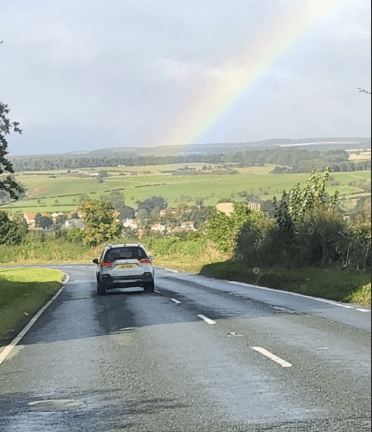
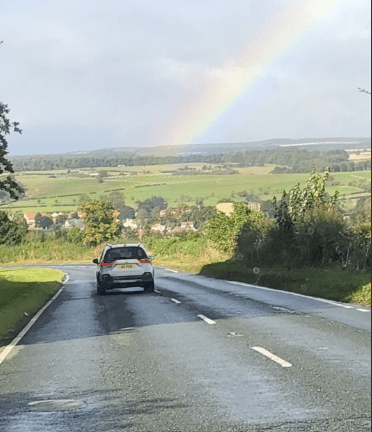
Rainbows regularly arched over the hills and dales

From Herriotville to Heathcliffetown,

Back then

As they

Do now.

(At least I met with one as I drove into my ancestral town– and thought it a good sign.)

Off-season,

This is a town for locals

Not for overseas imposters like us.

I was told…

The natives drive only short distances as a rule

From dirtier, busier places

like Northallerton

(but an hour away)

Through the awesome

(no hyperbole here)

Primeval forests and heathery plateaus

Of the much storied Moors

On narrow snaking highways.

Wearing rainproof quilted jackets in boring colours

They walk their well-behaved dogs

Spaniels mostly

In and out of ice cream shops

And cafes

Or up and down

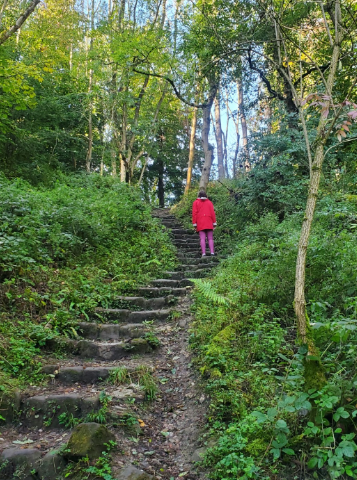
the daunting (to me)

muddy

….medieval

…………..Fairy

…………………….Staircase

…………………………………..along

…………………………………………..the Cleveland

…………………………………………………………………….Way.

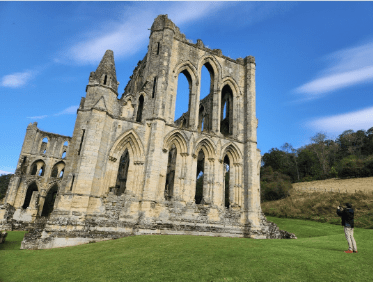
To visit quaint Rievaulx

And admire the Grade II Heritage cottages

With their bewitching thatched roofs

And wisteria-laced windows

Where the skeleton of the old Cisterian monastery

Rules the blue horizon

Like a giant antique crustacean trapped in grim History.

(Unlike myself, they do not pay the ten plus pounds to visit the Monastery ruins.

“And would you like to donate an extra 75p to the National Trust?”

Sure. Why not?)

They just like to walk their dogs.

Yes, all is picture-perfect these days

(It’s early October in 2024)

In my ancestral town

In the North of England

Where at least two in my family tree

Travelled the Evangelical Circuit

From Carlisle to Whitby

Preaching thrift and abstinence

And other old-fashioned values

To men and women with calloused hands

And a poor grasp of the alphabet.

Except, maybe, for the Old Methodist Cemetery

*no entrance fee required

Just around the corner from our charming air bnb

Where the crows, flocking for winter (I guess)

Caw maniacally in the moulting trees

And a black cat might cross your path

(It did for me)

And the old tombstones jut out helter-skelter like crooked mouldy teeth

From the soft-sinking Earth under which some of my ancestors lie,

Mostly

,,,,,,,But

Not ,,,,,,,,

,,,,,,,,,Entirely

Forgotten.,,,,,,,,,,

Transportation carries people west

It constantly amazes me how technology can influence where people live.

When I was examining the lives of my great great grandparents and their predecessors on my fathers’ side for instance, I noticed that their moves usually followed easier travelling circumstances.

In 1815, for example, a small settlement known as Bear Brook arose along the border of a small creek by the same name. The area is now in Russell County. Initially, settlers from Montreal used the waterway to get there. By 1820, a new road from Montreal replaced it to link then-Bytown (Ottawa) through Cumberland, Clarence Point, Plantagenet Mills, L’Orignal and Hawkesbury.

My great great great grandparents were among many French-Canadian families from Lower Canada who travelled along the new road to settle in the area in 1854 to farm.

There must have been some Irish among them too, because part of the community was renamed Sarsfield twenty years later to honour Irish hero Patrick Sarsfield.

By then, loggers used the old creek and to float timber to mills in Carlsbad Springs. They were still doing so when Gustave Hurtubise was born in Sarsfield in 1884. Gustave, the elder brother of my great great grandfather was the first child from our family born in the town. Two years later, our cousin Sévère D’Aoust built the Roman Catholic Church in the village where my great grandfather Jean-Baptist would be christened. That same year, the community lobbied for a local stop along J.R. Booth’s Railway line in 1886. They built a small building to entice Booth.

Jean-Baptist Hurtubise arrived in Sarsfield on February 16, 1889. His future wife, Marie-Berthe (known as Martha) Gourdine, was born in a neighbouring town, Clarence Creek, October 3 the same year.

The year the youngsters turned eight, the Old Montreal Road got paved and engineers constructed the Canadian Northern Railroad through Cumberland to Hawkesbury.

They were only 16 years old when the two got married in Clarence Creek on January 7, 1915

My grandmother, Anne Marguerite Hurtubise was born in the same town the following November. Her sister Donna came a year and a half later.

The family left Sarsfield and moved to Cluny, Bow River, Alberta, sometime between Donna’s birth in 1917 and the 1921 Canadian Census. By this time, the train was established across the country, so they and others took it to go west.

For some great shots of various buildings in the town from that period, refer to the images on http://www.prairie-towns.com/cluny-images.html.

Somehow, the couple got land and a home. In 1921, the Census reported that 31-year-old Jean owned a farm with a three-bedroom wooden house on it.1 It was located in section 7, township 22, range 21, Meridian 4. His wife Martha and the two girls didn’t work.

Unfortunately, they arrived just in time for five successive droughts that we now know as the Prairie Dry Belt Disaster.

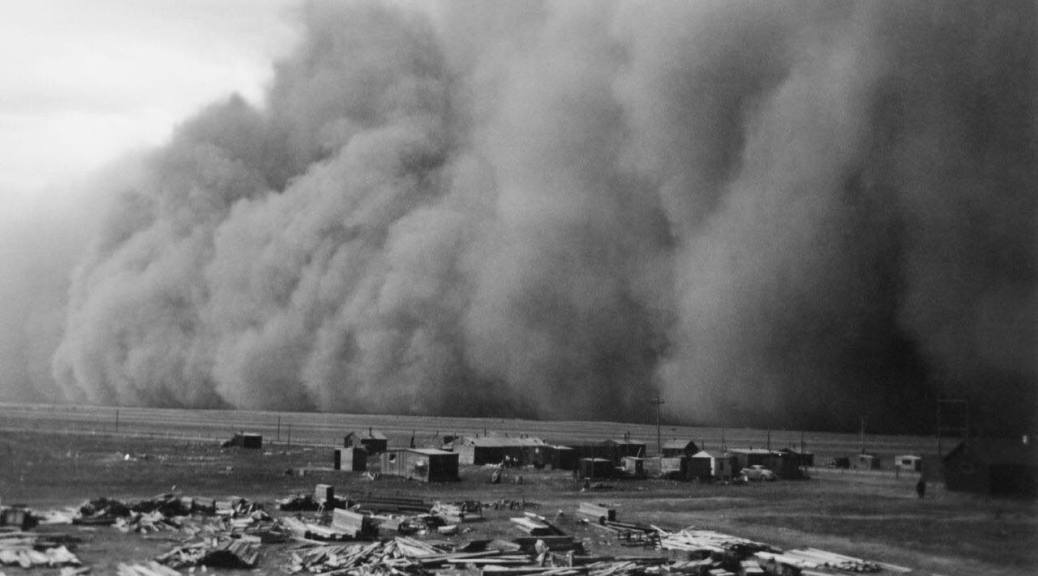
In 1931 and 1932 they suffered from the dustbowl, when top soil was so dry that it blew into homes.

Then the locusts came in 1933.

I grew up listening to stories about those times, but got a better understanding of what they faced when looking at the photos on a University of Saskatchewan website https://drc.usask.ca/projects/climate/.

My great great grandparents were among 750,000 farmers who had to abandon their farms between 1930 and 1935.

By 1938, the family had moved to Edmonton and my grandfather and his wife had to depend on the incomes from their daughters’ jobs, my grandmother as a nurse and her sister as a clerk, to survive.

1Data from the 1921 Census of Canada, Enumeration District 2, Bow River, Alberta, section 7, township 22, range 21, Meridian 4, page 6, line 28.

Sherron and his Texas Betty

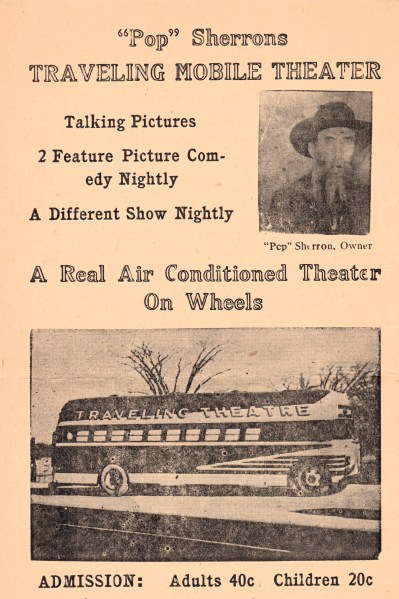
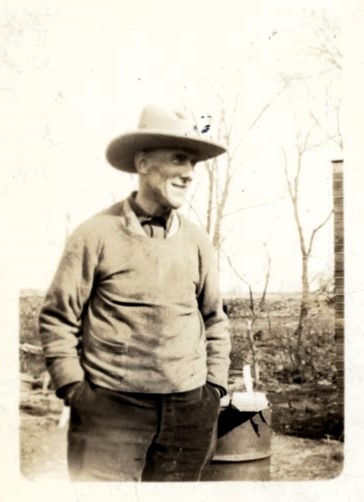
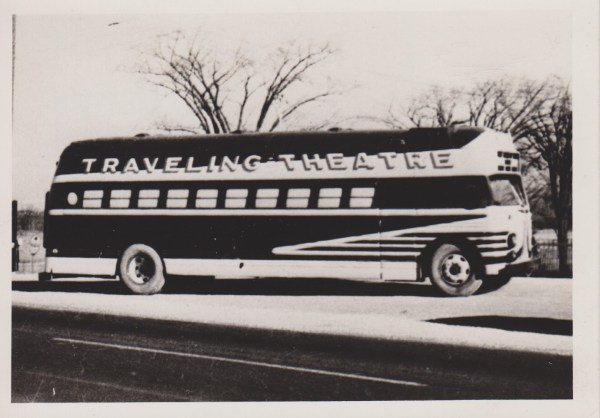
“Pop” Sherron and “Texas Betty” (his air-conditioned travelling mobile theatre bus) must have been a welcome sight whenever they pulled into small towns in and around Phoenix, Arizona, in the 1940’s.

Sherron, my great-uncle, charged admissions of 40 cents per adult and 20 cents per child to enjoy “two feature picture comedies nightly” and “a different show nightly” on his travelling mobile theatre bus.

Sherron’s Advertisement Flyer

Roger Sherron (1895-1963) was a somewhat “reclusive” man or what one might consider a “hermit” and, according to a phone conversation with his nephew, his own family labelled him as “odd.” These opinions were supported on his WW1 registration (and rejection) in 1917 (age 22) with “arrested development mentally” entered by hand in the exemption section by officials.

Fortunately, we have come to better identify and understand mental conditions nowadays.

The Sherron family belonged to Philadelphia’s high society. Roger’s father owned and operated a wholesale grocery business while his mother and two sisters were frequently featured in the society pages of the local newspapers with their luncheons, tea parties, bridge games, fundraisers and such. This was not Roger’s “cup of tea” so to speak.

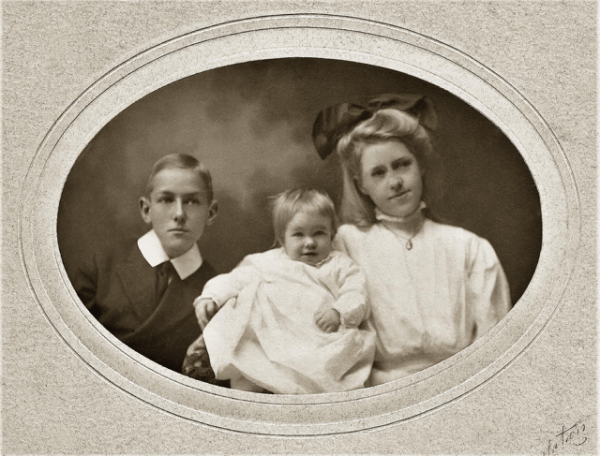
Roger, Alberta and Josephine Sherron (my grandmother) – 1906

Young Roger briefly attended the Wenonah Military Academy in New Jersey, a private secondary school “where a diploma entitled the graduate admission to West Point, Annapolis, or one of the best colleges or universities in the country, usually without qualifying tests.” He left school before he finished his studies but luckily could read and write by then even if his handwriting remained somewhat childish.

According to the censuses, Roger sometimes worked at odd jobs (in 1920 – grocery sales at age 25 and in 1930 – game warden for the State Government at age 35) but otherwise he was listed as “unemployed.”

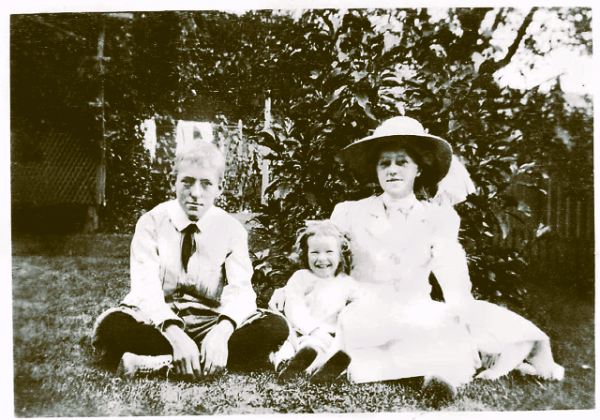
Roger and his sisters Alberta and Josephine circa 1910

He never married, living with his parents in Philadelphia until 1940 when his mother died. His father passed away in 1932. His younger sister Alberta also remained nearby with her family but his older sister Josephine (my grandmother) moved to Montreal, Quebec, with her stockbroker husband, Wendling Anglin, and her two sons (my father, Tom, and his brother Bill).

Roger was 44 years old when his mother died, alone in the world for the first time and without a place to live.

Roger and his nephew Donnie – 1932 – visiting his sister Alberta after his father died

Sometime, after the death of his mother, he moved west to a very different world and a warmer climate.

Once in Arizona in 1942, at 47 years old, and possibly homeless and jobless, he tried yet again to enlist with the WWII Draft. According to the registration form, he stood at 5’7” tall and 125 lbs with tattoos on his left arm. Unsurprisingly, Uncle Sam didn’t accept him this time either.

He must have inherited some money from his parents’ estate because this is where he acquired a retrofitted theatre bus he named “Texas Betty” which enabled him to start a rather unique business and support himself. At some point, it appears he might have attempted to expand his business as I have a piece of printed letterhead stating:

POP SHERRON’S FAMILY

Travelling Amusement Center and Big Free Circus

In Route – Pop Roger Sherron

Texas Betty Sherron

Owners

Texas Betty

Again, according to my phone conversation with his nephew, Roger’s home in Phoenix was just “a shack.” He lived in the Hispanic part of town and it is likely the entire neighbourhood consisted of similar housing.

At the age of 50, some six years after he left Philadelphia, he wrote a Christmas letter to his older sister Josephine from Tempe, Arizona, which is half way between Phoenix and Mesa. He settled in this new community (and dare I say new family) who it seems wholeheartedly accepted him.

“I spent Christmas eve with some Spanish friends five houses down the road. They had tamales and Spanish food. They are nice people.”

“I got a lot of Christmas presents. The people next door gave me a fine shirt. The people three houses down gave me some handkerchiefs, a Coke, a comb, pen and ink and envelopes…the Spanish fellow who owns the store gave me a big bag of candy and nuts.”

“The television has come here now. The people next door have a fine set. It don’t hurt your eyes or nothing. Down at the bus station at Mesa, they have a set but it hurts your eyes.”

His neighbours might have struggled but they were rich in love and support for one another.

The letter continued with what might seem like “odd ball” concerns about the ongoing war, the atomic bomb and politics:

“I think the country will go Republican next election. I hope so. People are getting tired of this New Deal bussiness (sp). The Republicans will jump right in and fight Rushea (sp) and China. Lots of Chinese arround (sp) here in Phoenix and Mesa. They are aloude (sp) to run loose. They ought to put them in camps till after the war.”

Paranoia? No, just a typical American way of thinking at the time.

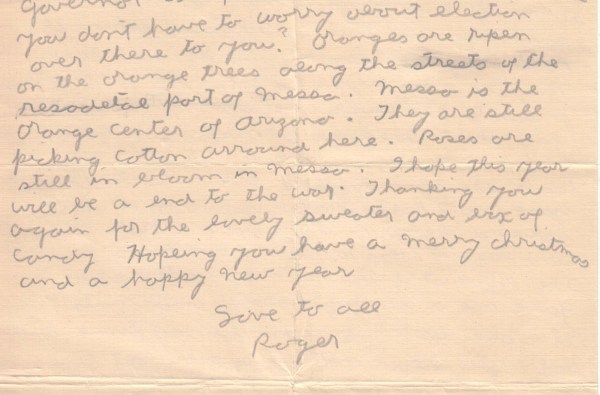
Roger, revealing his good prep school manners and poetic side, continued with a lovely description of his immediate surroundings: “Oranges ripen on the orange trees along the streets of the resodental (sp) part of Mesa. Mesa is the orange center of Arizona. They are still picking cotton arround (sp) here. Roses are still in bloom in Mesa.”

His letter ended with hope the war would end soon, another thank you for the gifts of a sweater and box of candy, and finally Roger wished his sister well and sent his “love to all.”


Roger died of a heart condition in 1963 at the age of 68. So he spent
the last 20 years of his life in the Arizona desert with his one-of-a-kind air-conditioned cinema bus Texas Betty and his kind-hearted friends, no longer considered a hermit, reclusive or even odd.

Sherron in the Pocono Mountains, Pennsylvania in 1939

Elopement … or not?

Social Media – Then and Now

Elopement … or not?

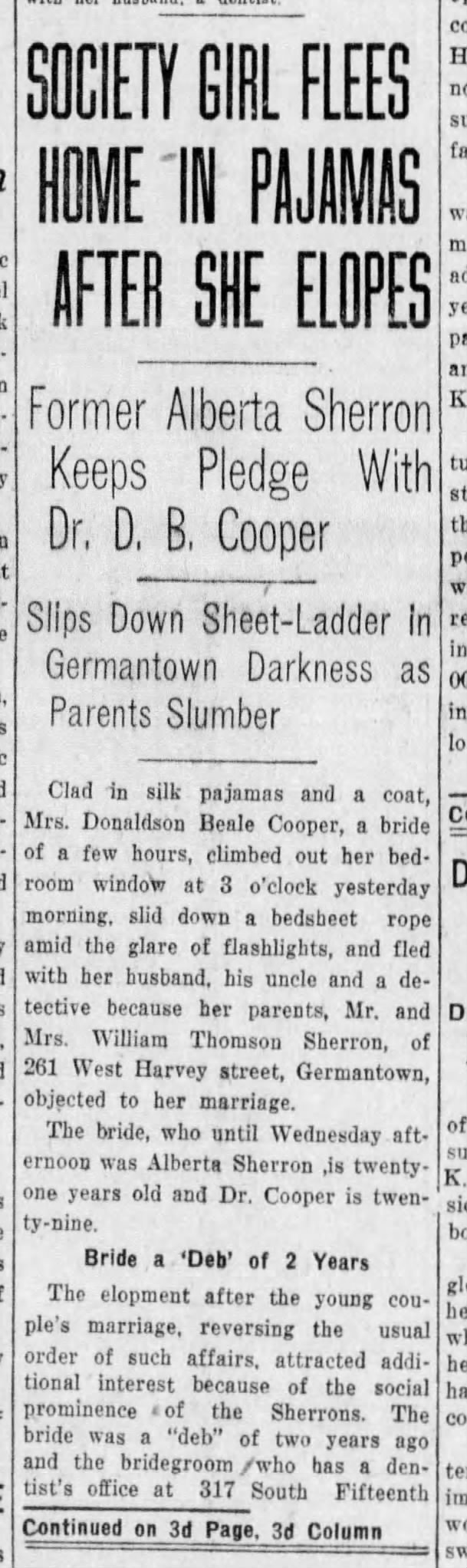
– “Society Woman flees home in pyjamas after she elopes”

– “Former Alberta Sherron keeps pledge with Dr. D.B. Cooper”

– “Slips down sheet ladder in Germantown darkness as parents slumber”

The Philadelphia Inquirer dated November 18, 1927, covered my great-aunt’s private life in great gossipy detail for its hungry readers. Alberta Sherron (1906-1992), my grandmother’s younger sister by 13 years, was just a girl in love at 21. Her 29-year old dentist boyfriend must have been equally enamoured as they couldn’t wait for the expected high society wedding that their well established families would have insisted upon.

Alberta graduated from Miss Irwin’s School1 and made her debut at the Acorn Club2 two seasons before her wedding. On her paternal side, she descended directly from Sir John of Gaunt, Duke of Lancaster, and on her maternal side, she descended from Sir Anthony Loupe, who was knighted under Mary, Queen of Scots3, in the mid-sixteenth century.

Donald Cooper’s grandfather was the late Senator Thomas V. Cooper of Media. On his paternal side, the groom descended from Andrew Griscom, who came to the USA with William Penn in 1682, and maternally from Richard Sanger, the Puritan, who settled in Massachussetts in 1632.

Unbeknownst to the both sets of parents, the wedding took place at the Church of the Holy Trinity4 on the Wednesday afternoon of November 16, 1927, with Reverend Dr. Floyd W. Tomkins5 officiating. It was a simple ceremony with only a few friends invited.

According to the Philadelphia Inquirer – “The bride was a “debutante” two years ago and the bridegroom who has a dentist’s office at 317 South 15th Street, is a graduate of the Germantown Friend’s School6 and the University of Pennsylvania – where he was president of the senior class – and is a former instructor in bacteriology at the Evans Institute of the University of Pennsylvania.”

After the wedding, Alberta returned home to her family as usual and prepared for her “elopement” that evening.

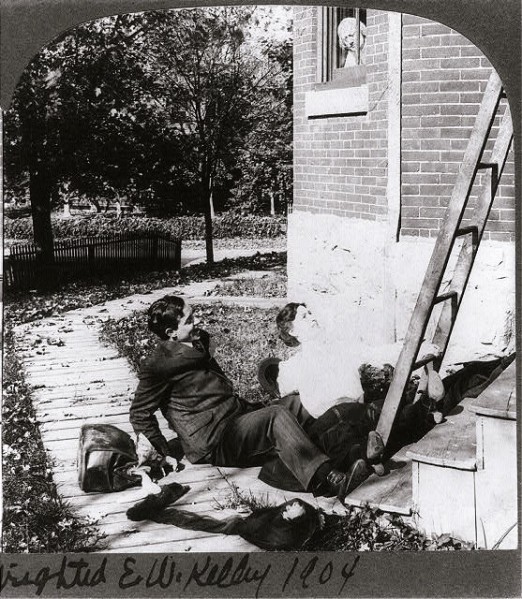
I don’t think the tabloids could resist using the word “elopement” in their sensational coverage of the events that took place that evening (given that the marriage had already taken place) and how did they even know the details? What a great “tip-off”! The couple went the extra mile (an added bonus for the paper) when she climbed out her window and descended using a knotted sheet instead of the traditional ladder.

(“Elopement-A Hasty Descent” by E.W. Kelley)

According to the newspaper, the couple left a note for her parents to find in the mailbox the next morning after “she eloped with her new husband.” Her parents, when interviewed, flatly denied ever locking their daughter in her room nor did they object to her marrying Dr. Cooper. That stopped any rumour that they had some young millionaire in mind for their daughter to marry. They finished their comment saying that they think the couple will be very happy and “Dr. Cooper is a fine young man.”

Thankfully, the destination of their month long honeymoon remained a mystery to all. And, nine months later, Donalson Beale Cooper, Jr. was born!

Alberta Sherron Cooper (24) and her son Donald (2-1/2) – 1931

Unfortunately, the marriage didn’t last and Donald remarried nine years later in 1936 and then so did Alberta in 1938.

By the time Alberta married her second husband, Bruce Lewis (1903-1971) in 1938, her son Donald was already 10 years old. Alberta and Bruce had three more children together – two daughters and a son. The last one born in 1950 when Alberta was 44 years old! Donald and his younger brother were 22 years apart.

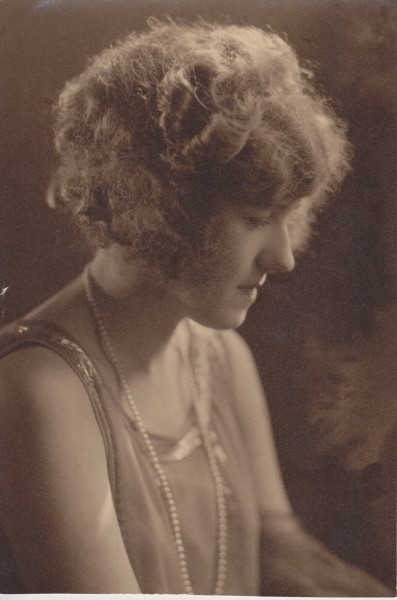
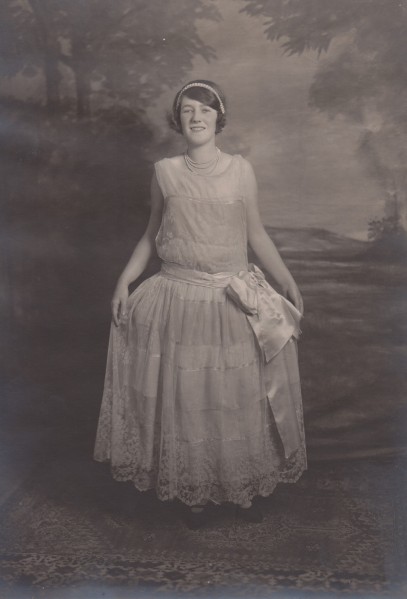
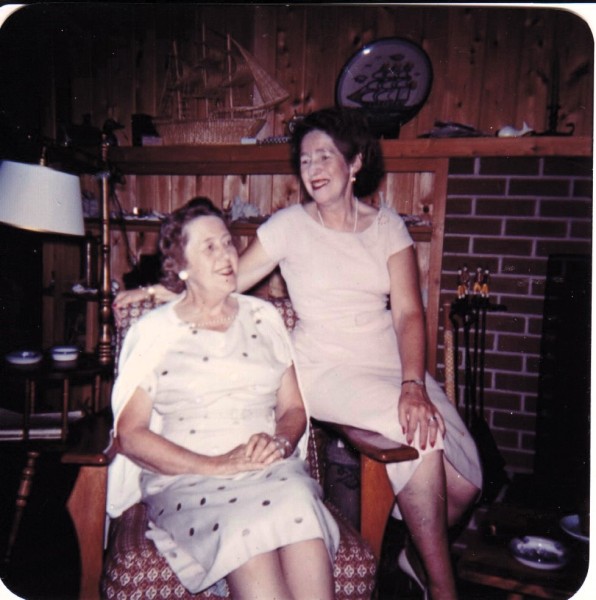
My grandmother Josephine and her younger sister Alberta.

My grandmother Josephine (left) and her younger sister Alberta.

1https://www.agnesirwin.org/about

2https://www.acornclub.org/

3https://wiki2.org/en/Mary,_Queen_of_Scots

4https://wiki2.org/en/Church_of_the_Holy_Trinity,_Philadelphia

5https://wiki2.org/en/Floyd_W._Tomkins

6https://www.germantownfriends.org/about-us

Finding the Family Farm in Ireland

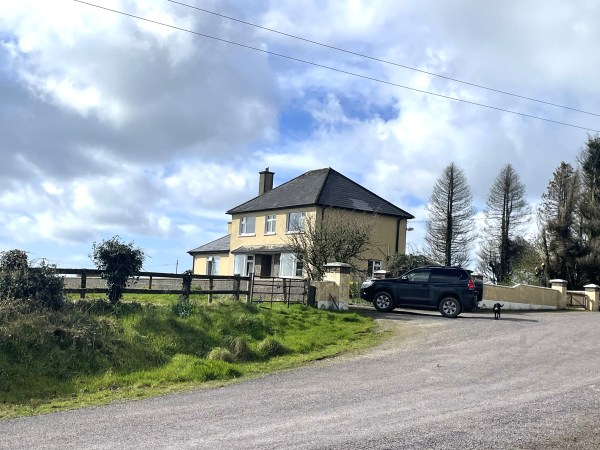
On a recent family trip to Cork, Ireland, we detoured briefly looking for the Anglin Family farmhouse ruins from the early 1800’s. Several Anglin cousins over the years recorded and shared their trips so that with copious precious notes in hand we thought we were well equipped for our adventure!

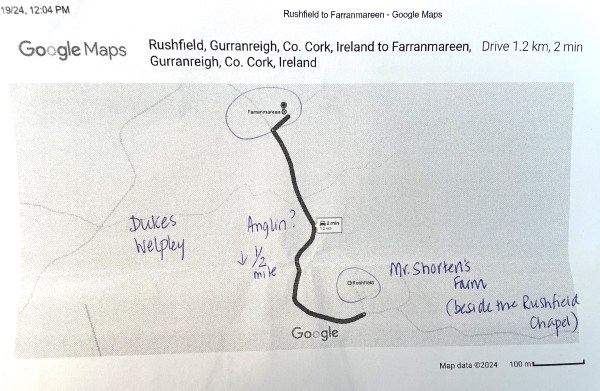
An Anglin letter from 1963 pinpointed the location of the family home somewhere between Farranmareen in the north and Rushfield (one kilometre further south) “near Bandon” just 36 kilometres west of Cork. We looked up the two geographic latitude and longitude (GPS) coordinates for the two markers so … how hard could it be?

All eyes were focused left and right as we drove the kilometre between the two points. Alas! Nothing to see but green fields everywhere and a scattering of houses. Where were the signs with “The Anglin Farm was HERE”?

Upon reaching Rushfield, my notes referred to a chapel not far from a farmhouse on the corner. Spying a farmhouse nearby, we made our way through the barking dogs and knocked on the door, but no one answered. We persevered as there was a vehicle in the driveway and a huge transport truck parked nearby. Another knock. Suddenly a farmer walked around from the side of the house munching on a bit of lunch.

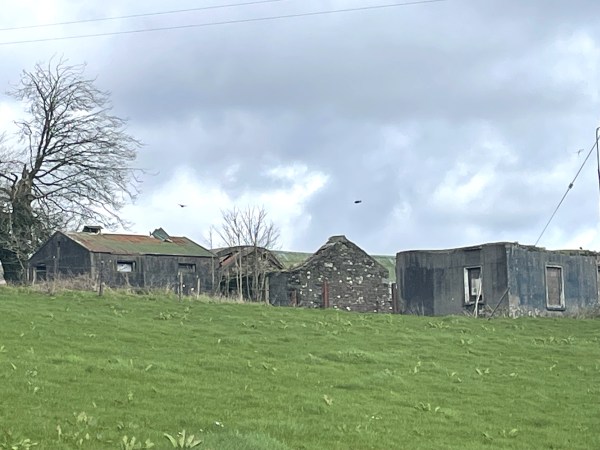
I introduced myself as an Anglin and referred to the cousins over the years who had made the same pilgrimage. The farmer looked puzzled. So I inquired about the whereabouts of the Rushfield Chapel to which in reply he pointed to some ruins across the road that barely even looked like a building anymore. Disappointed but refusing to give up, I checked my notes and inquired if he knew a Mr. Shorten who was helpful to my cousin in 1963. He smiled and introduced himself as … Mr. Shorten!

Rushfield Chapel ruins

This Mr. Shorten didn’t recognize the Anglin name (it must have been his father in 1963) but guessed where the Anglin farm might have been. Back up the road to Farranmarren we drove to knock on a few more doors. The next stop was a bungalow with another barking dog. A middle-aged lady came to the end of the drive and thought the Anglin farm might have been in the field beside her. However, she suggested that her elderly neighbour across the road might know more and brought me to meet her.

“Looking for the farm some years ago, with my wife and two Anglin cousins, we could not find any buildings. But we knocked on a door at a corner where you leave the main road. The door was answered by an older lady whose maiden name turned out to be Duke. She gave us tea and said that our Anglin ancestors operated mixed farming and would have been comfortable during the famine.” (Perry Anglin)

After a brief introduction, I couldn’t resist asking her: “Is your maiden name ‘Duke’ by any chance?” Well her eyes lit up and she smiled saying: “Yes!” My great great grandfather William’s oldest brother John Anglin married Sarah Duke in 1836 in Cork. I was speaking with my (very) distant cousin!

William and John’s parents, Robert Anglin and Sarah Whelpley, had four sons and one daughter. All four sons emigrated to Kingston, Ontario, one by one, with my great great grandfather William (the youngest son) leaving Ireland in 1843 just before the Great Famine. John eventually joined the others in Kingston but only after the death of their parents. Their sister emigrated to the States possibly not wanting to stop in Kingston to care for four brothers!

William married Mary Gardiner in 1847 in Kingston and had two daughters (both died young) and two sons (William and James) who both became doctors and surgeons.

It appears likely that over the years Mother Nature reclaimed the Anglin Family farm with its defining stone walls having disappeared completely beneath the greenery. However, I can attest to the fact that the view described by my cousin remains the same:

“It is a stunning view from the farm down into the Bandon River and beyond to a coastal range tinted mauve in the distance.”

I would like to finish my little story by sharing some helpful information with my Anglin cousins! Here are the GPS coordinates of the Anglin Family farm: 51°47’00.3″N 8°56’09.8″W

https://genealogyensemble.com/2017/02/01/the-anglin-brothers/: Finding the Family Farm in Ireland https://genealogyensemble.com/2016/07/13/surgeon-and-mentalist/: Finding the Family Farm in Ireland

Learning about the Acadian Diet

Some of the most interesting information about my ancestors comes from documents detailing what they ate.

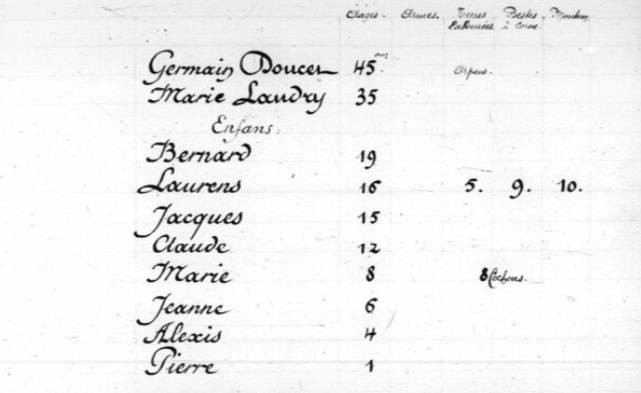
The 1686 Acadian Census, for example, shows my ancestor Alexis Doucet at four years old living in Port Royal with his parents and seven brothers and sisters on “5 arpents of cultivable land with 9 cattle, 10 sheep and eight pigs.”1

The census detailed our ancestors’ cattle and livestock along with the cultivated land because those elements were the primary elements of wealth in North America at that time. The settlers’ ability to nourish themselves determined whether they would be able to thrive, multiple, and permanently inhabit a place on behalf of whichever European colony to which they belonged.

Doucet’s family and their neighbours were ingenious at this task, as Caroline‐Isabelle Caron points out in her delightful booklet about Acadians in Canada.

Indeed, the Acadians set roots in the marshy salines left untouched by the First Nations, in the tidal flood plain which they proceed to dry and put into culture thanks to a complex system of dykes (levées) affixed with drying valves called aboiteaux. This technology was imported from France, probably from the Loudunais region where some early settlers originated. The vast network of dykes the Acadians created inside and beyond the marshlands before 1755, ensured the fertilization of vast meadows for the culture of wheat but also the growth of salt‐hay pastures, a particularly attractive source food for cattle. At this time, Acadian agriculture ranked among the most fertile in the world, boasting near constant, abundant crops.

A typical Acadian farm consisted of one house with one or two rooms on the first floor, a barn, outdoor latrines, a cellar, and a well. Dwellings were usually built up from the ground without foundation, the walls sided with whitewashed cob walls surmounted by a thatched roof. In addition to an enclosure to keep farm animals (chickens, sheep, pigs), the courtyard contained a fenced garden to grow legumes and root vegetables (carrots, turnips, radishes, but not potatoes), herbs (for both cooking and apothecary), and berries. The Acadians planted, among a vast array of fruit trees, the first apple trees the Annapolis valley is reputed for today.

Abundant food supply stimulated strong demographic growth. It is believed that between 1650 and 1755, the growth rate of the population increased annually by 4.5 percent. Birthrates alone explains this growth, the result of a near 100 percent marriage rate and very high fertility rates, as well as low mortality rates due to the quasi absence of epidemic diseases or famine, and easy access to arable land and drinking water. Despite tentative estimates, experts agree that the Acadian population grew from over 400 people in 1671 to more than 1400 in 1730, for a total of 10,000 to 18,000 people in 1755.2

By the way, the dykes made by Acadians like my ancestor, still exist today. The most successful examples allow only a third of the territory to be farmed, with the other two thirds dedicated to natural wetland rejuvenation and rough cover.3

These early settlers’ ingenuity at bringing old world technology to their new circumstances enabled them to cultivate land that wasn’t already being farmed by the First Nations communities already in the area. That fact meant that they weren’t seen as a threat by their First Nations neighbours and became friends and neighbours. Some of the French settlers fell in love with First Nations people, as Alexis’ grandmother had. According to recent DNA research, Germain’s last name “Doucet” is presumed to be an adopted name, because his father, Germain Doucet, definitely descended from First Nations.4

But that’s a tale for another day.

1Hebert, Tim , Transcription of the 1686 Acadian Census, at Port-Royal, Acadie 1686 Census Transcribed. The original census can be found at Acadian Census microfilm C-2572 of the National Archives of Canada “Acadie Recensements 1671 – 1752,” p 30.

2Caron, Caroline‐Isabelle. The Acadians. Immigration and Ethnicity in Canada 33, 2015. http://archive.org/details/the-acadians.

3Fundy Dykelands and Wildlife | Novascotia.Ca.” Accessed February 7, 2024. https://novascotia.ca/natr/wildlife/habitats/dykelands/.

4Estes, Roberta. “Germain Doucet and Haplogroup C3b.” DNAeXplained – Genetic Genealogy, September 18, 2012. https://dna-explained.com/2012/09/18/germain-doucet-and-haplogroup-c3b/.