Tag Archives: McHugh

Sundays and the Great Depression

I used to hate Sundays. I had to go to Sunday school. I really didn’t understand why I had to attend because my parents just dropped me off. That’s right. They didn’t even go to church. And no one asked me if I wanted to go.

After they picked me up, things got worse. It was homework time until lunch. Of course, I could have done my homework on Friday night but Fridays were reserved for movies on the television and reading in bed with a flashlight until all hours.

And worst of all, some Sunday afternoons were for Visiting the Elderly Relatives. In my mind, my aunts and uncles were ancient. Plus my brother, being a boy and older than me, was apparently able to take care of himself, as he always seemed to be absent from these visits. So I would sit in the living rooms of my aunts and uncles, with no toys or any other amusements, and listen to the adults talk.

I now cherish the memories of these visits because they provided me with an appreciation of the social history of Montreal, as well as significant events such as the Depression and World War II.

The stories about the Depression are the ones that struck me the most. During the Depression, a quarter of Canada’s workforce was unemployed.1  My dad, Edward McHugh, was a young man out of work in Montreal and he joined his older brother and sister in Drummondville, to work for the Celanese. At the peak of the Depression, the Celanese employed 1,757 workers.2

None of the McHughs had cars in those days so they must have travelled back and forth to Drummondville by train. And Uncle Thomas McHugh married a local girl. I can just imagine the McHughs, from Verdun, arriving in Drummondville for the wedding. I doubt very many people spoke English in Drummondville at the time. The culture shock must have been intense.

My aunts and uncles, even into the 1960s, were thankful that they were able to have had some work during the Depression. Uncle Al Scott worked for the Northern Telecom for 40 years, although with reduced hours during the Depression. Luckily Uncle Frank McHugh worked for the Montreal Tramway Company so he was able to keep working during the Depression. He was a tram driver for tram number 24 that started in Montreal West and crossed the city on Sherbrooke Street. His job was safe.

Dad’s siblings loved to have a good time and the Depression did not stop them. My Aunt Elsie used to describe their card parties. There was only one bottle of scotch, some ginger ale, one can of salmon and one loaf of sliced white bread. My aunt was able to spread the salmon so thinly that she could make sandwiches out of the whole loaf of bread.

It was very clear to me that the Depression was a very frightening time in their lives. During this period, the future must have seemed bleak. Life was a struggle to make ends meet. But they made the most of it and persevered. Today I feel lucky to have listened and to remember their stories.
1 https://en.wikipedia.org/wiki/Great_Depression_in_Canada

2 http://www.patrimoine-culturel.gouv.qc.ca/rpcq/detail.do?methode=consulter&id=14311&type=pge#.WSNY7Gg1-Uk

The Trip of a Lifetime

My father, Edward McHugh, didn’t really talk about his family’s trip of a lifetime. After all, Dad wasn’t even born yet. But it must have been discussed by everyone when he was a boy. In 1911, the first member of the family, Mary Ann McHugh, moved from Dundee, Scotland to Montreal.

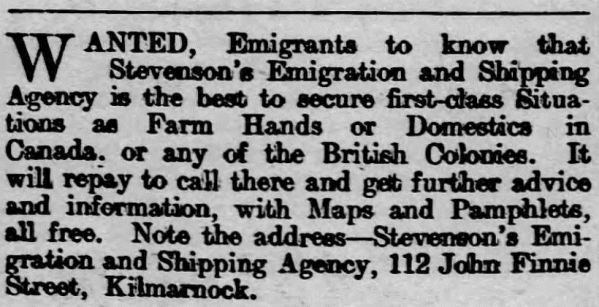
At the time, booking agents in the United Kingdom advertised and recruited potential immigrants to Canada. There was an acute need of domestic help and agricultural workers. Between 1890 and 1920, Canada experienced its third wave of immigration and its peak was between 1911 and 1913, just before World War I.1 The following type of advertisement was common in the newspapers.2

Booking agent advertisement

Maybe one of these advertisements gave the McHugh family the idea to emigrate to Canada. Or maybe Mary was ready for an adventure. She was just 21 when she disembarked from the SS Grampian that had left Glasgow on June 24, 1911 and arrived in Quebec City on July 9, 1911.  She would have had a medical exam when she arrived to ensure that she was in good health and did not have an infectious disease. Conditions for immigration to the colonies were well known in the United Kingdom. The February 11, 1911 edition of the Hamilton Observer, in its article, Canadian Notes, People Prohibited, details the reason some potential immigrants could expect to be refused by Canada. The article explains the booking agent’s liability for the immigrants that arrived in Canada for a period of three years following their arrival:

“The following classes of people are prohibited from landing … feeble minded, idiotic, insane, or who have been insane within five years, afflicted with any loathsome, contagious, or infectious disease; anyone who is a pauper, who is destitute, who is a professional beggar or vagrant.”3

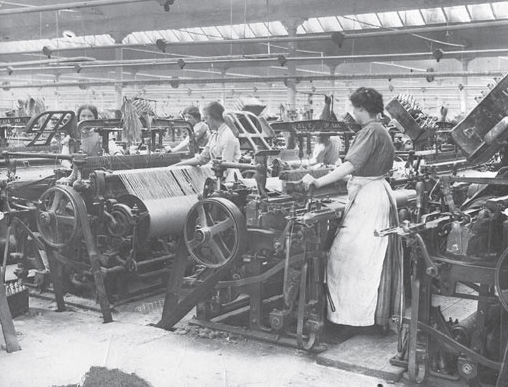
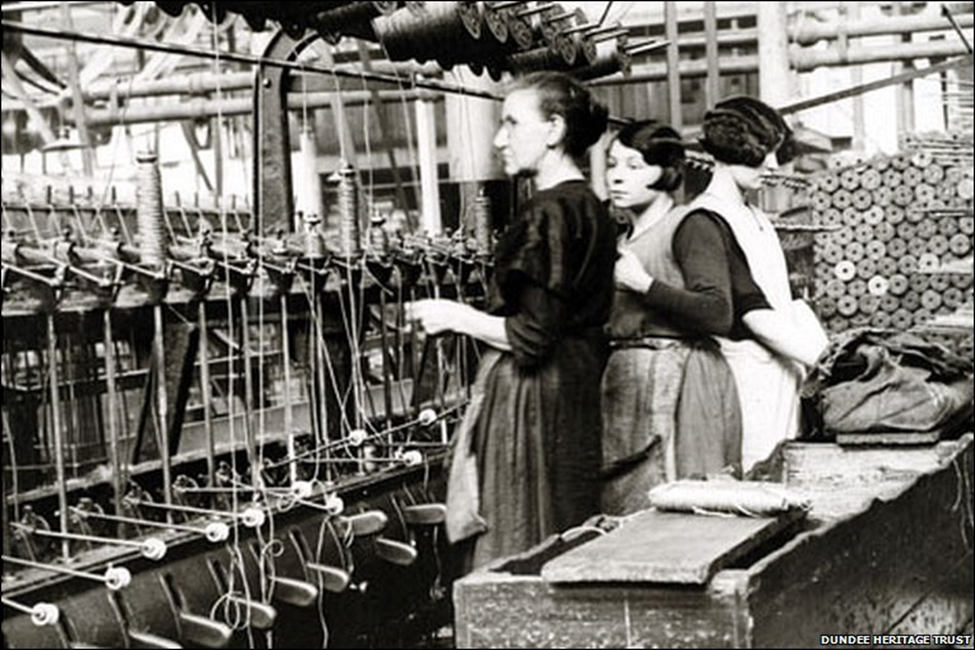
All of the members of the McHugh family worked in the jute mills in Dundee. The 1911 census indicates Mary was a jute weaver, which probably meant that she operated a jute weaving machine.4 She lived with her mother, Sarah Jane McLaughlin, and her brothers, Edward and Francis. They lived at 1 Tait Lane, Dundee. Her other brother, Thomas, my grandfather, lived with his wife and seven children at 9 Tait Lane.

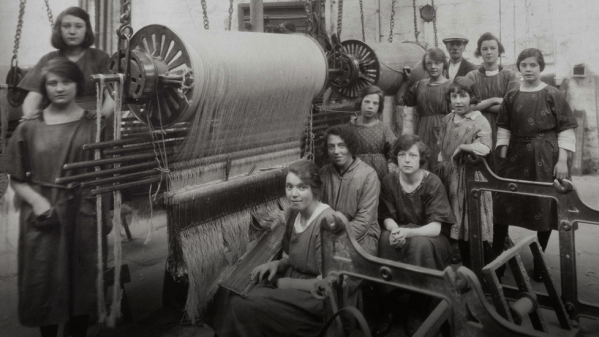
The picture below shows the jute weaving machine.5

Mary must have been satisfied with her new life in Montreal, Quebec. Within a year, her mother and her two brothers, along with my grandfather, had followed her to Canada. Six months later, my grandmother, Elsie Orrock, and her seven children joined her husband, Thomas, in Montreal.

The McHughs lived close together in Dundee and they also lived close together in Verdun, Quebec. While I will never know for sure why they decided to emigrate, I can guess that they wanted a life that was not as hard as the one working in the jute mills. There are a few clues that this was not a spur of a moment decision but a planned family decision.

Mary left first and, if it did not suit her to live in Canada, she would have been able to easily return to Dundee. Her mother and brothers were still there. By the time her mother emigrated, along with her three sons, they arrived with $150 CAD, about $4,750 in today’s dollars. Browsing through the passenger lists, I can see that they had a lot more money than many of their fellow passengers. 6 They were not a rich family, so this amount of money would have taken some time to save up.

Coincidentally my grandfather joined the Freemasons in 1910 and achieved a Master Mason diploma and a Mark Mason diploma.7 By that time, he already had six children. He worked long hours in the jute mill, including Saturdays. Why would he join the masons when he was already a very busy man providing for his family, plus taking care of his widowed mother, and his siblings who still lived at home? There is no evidence that he ever joined the masons when he arrived in Canada. I believe that it is possible that he joined the masons to in case he needed the contacts to find employment. As he quickly found work, his busy family life prevented him from pursuing his membership in the masons.

Only one of my grandfather’s siblings stayed in Scotland, Sarah Jane McHugh. She was not living with the other McHughs at the time of the 1911 census. But she remained close to the family. Surprisingly, she travelled to Montreal to be a witness at her brother’s wedding at the Notre Dame Basilica in Montreal on May 8, 1913.8 That would have been quite a trip for Sarah Jane to make.

  1. Wikipedia, Immigration to Canada, https://en.wikipedia.org/wiki/Immigration_to_Canada, accessed 27 September 2023.
  2. Irvine Herald and Ayrshire Advertiser (Irvine, Strathclyde, Scotland) · 13 Oct 1911, accessed Newspapers.com, downloaded 24 August 2023.
  3. The Hamilton Advertiser (Hamilton, Strathclyde, Scotland) · 11 Feb 1911, accessed Newspapers.com, downloaded 24 August 2023.
  4. Scotland’s People, National Records of Scotland, 1911 Census, Sarah Jane McHugh, downloaded 23 June 2019.
  5. V&A Dundee Design Museum, Women’s Day tweet, 6 March 2020.
  6. Passengers lists for S.S. Grampian arriving in Port of Quebec, May 21, 1912, Library and Archives Canada, https://www.bac-lac.gc.ca/eng/discover/immigration/immigration-records/passenger-lists/passenger-lists-1865-1922/Pages/image.aspx?Image=e003578022&URLjpg=http%3a%2f%2fcentral.bac-lac.gc.ca%2f.item%2f%3fid%3de003578022%26op%3dimg%26app%3dpassengerlist&Ecopy=e003578022, accessed February 3, 2022.
  7. Thomas McHugh, registration of the Grand Lodge of Scotland, dated 25 August 1910.
  8. Registration of marriage of Francis McHugh and Helen Smith, 8 May 1913, downloaded 6 January 2022.

Ralph Dodds, Signalman, Royal Canadian Navy

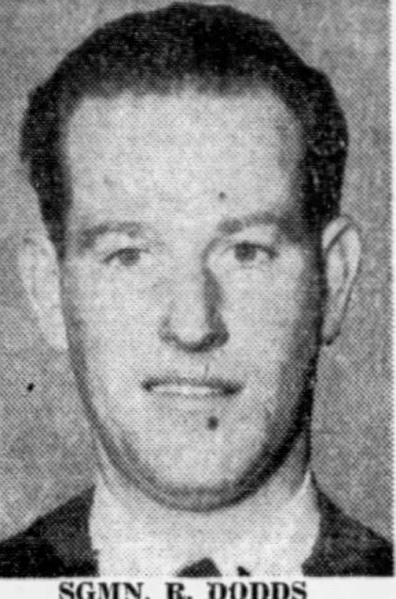
My aunt, Sarah Jane McHugh, was delighted to host the linen shower to celebrate her daughter, Dawna Day’s upcoming marriage to Ralph Dodds. The happy couple announced their engagement in October 1947. Ralph had recently been discharged after serving in the Royal Canadian Navy for over six years.  The couple’s wedding would take place in Vancouver, Ralph’s home town. Dawna was from Montreal.

Ralph was just 20 when he started his navy career in Esquimalt, British Columbia in 1939.1 With the advent of World War II, the Esquimalt Navy base became the largest naval training center in western Canada. 2 Ralph Dodds trained to become a signalman would have learned all aspects of military communications in the Canadian Navy. He would have used semaphore flags, read and transmitted morse code messages, and assured radio communications.3 During his training, Ralph would not have predicted that he would participate in the sinking of a German U-boat during the Battle of the Atlantic, that he would be on a destroyer that participated in a sea fight on D-Day, or that the destroyer he was on would be shipwrecked off the coast of Iceland.

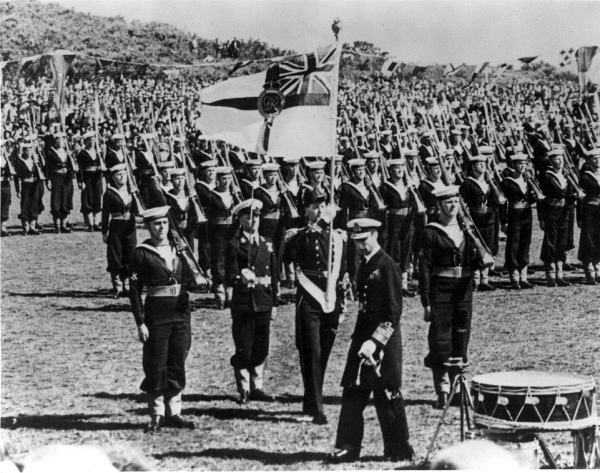
King George VI presents the King’s Colours to the Royal Canadian Navy at Beacon Hill Park, Victoria, 1939. Photo: CFB Esquimalt Naval and Military Museum collection

While Ralph was assigned to a naval station, and to a corvette (small destroyer), for most of his naval career, he was assigned to the HMCS Skeena.

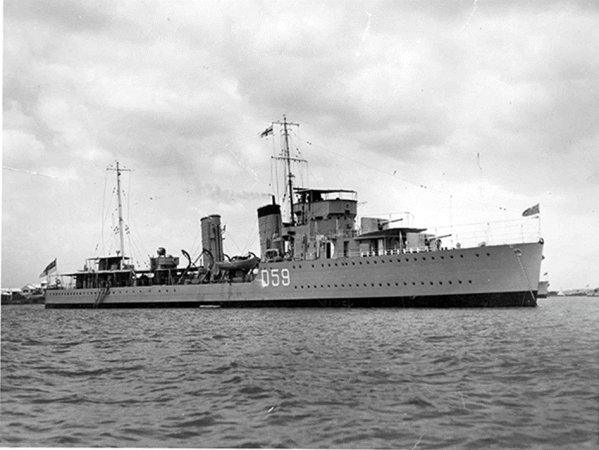
HMCS Skeena, D59, Government of Canada website, Ships’ histories

The HMCS Skeena was commissioned in 1931 in Portsmouth, U.K. and was one of the first two ships built to Canadian order. With the outbreak of the war, the Skeena initially performed domestic escort duties. In May 1940, she was sent to Plymouth, U.K. and became part of the Western Approaches Command, taking part in the evacuation of France and escorting convoys in British waters. She was later assigned to continuous convoy duty.

During one of its escort duties in the Atlantic, the Skeena destroyed U-boat U-588. This happened during ON-115 (ON means Outbound to North America).  There were twelve escort ships for a trade convoy of 43 merchant ships that left Liverpool on July 12, 1942. On July 29, seven U-boats of the Wolfpack Wolf had spotted them. This Wolfpack was quickly joined by another six U-boats of the Wolfpack Pirat. The Wolf Pack tactic, or the “Rudeltaktik,” was devised to attack the Allied convoy system by forming into position effecting a massed organized attack.4 This particular battle resulted in the loss of three of the ships in the convoy and significant damage to two of the ships in the convoy. One of the damaged ships returned to the U.K. and one was escorted to St. John’s, Newfoundland. The Skeena, on which Ralph was a signalman, and the HMCS Wetaskiwin, an escort corvette, destroyed U-boat 588 with depth charges (antisubmarine missiles) on July 31. The hostilities lasted until August 3 when the U-boats lost contact with the convoy due to misty weather. The convoy with the remaining ships reached Boston on August 8, 1942.5

The sinking of American freighters, Edward Rutledge, Tasker H. Bliss and Hugh L. Scott at Fedala Roads, November 12, 1942
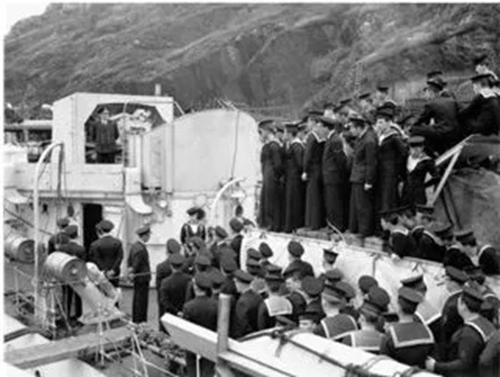
Commodore Leonard Murray congratulating the ship’s companies of HMCS Skeena and HMCS Wetaskiwin for sinking the German submarine U-588 on 31 July 1942. St. John’s, Newfoundland, Aug. 4, 1942. (NAC PA-115347)

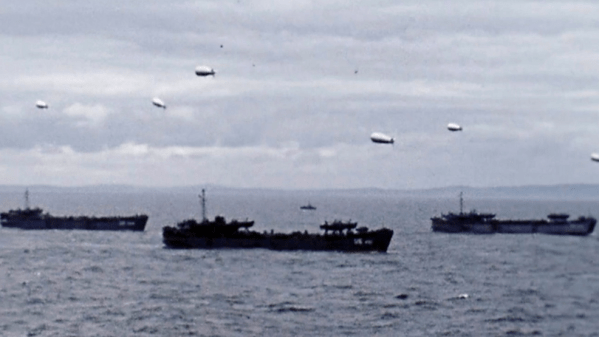
The Skeena also participated in a hot sea fight in the Channel on D-Day. The Skeena’s assignment was to prevent enemy U-boats from attacking Allied ships while the Invasion of France was being carried out.

“Torpedoes were shooting about in the Channel and missed the Skeena by only a matter of feet,” said Ralph in an interview he gave to the Vancouver Sun.

The destroyer also had to contend with German Dorniers (bombers) that were bombing the destroyers in the Channel. One of the aerial missiles fell so close to the Skeena that shrapnel was later found on the deck.6

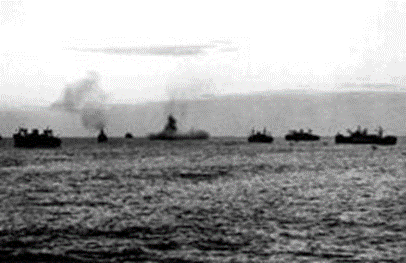
Ships and blimps sit off the coast of France on D-Day, June 6, 1944. War Footage From the George Stevens Collection at the Library of Congress

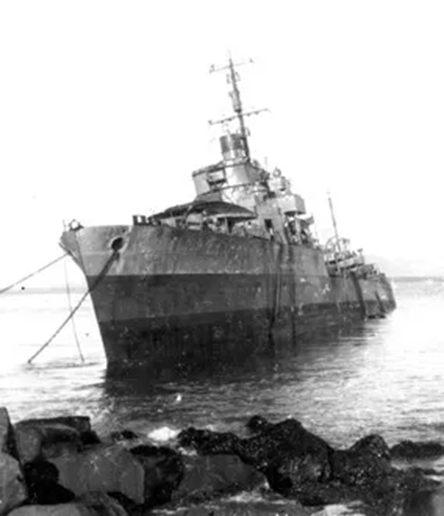
After five years of war, the HMCS Skeena met her end as she sheltered from a violent gale with 15-metre waves off the coast of Iceland, at Videy Island on October 24, 1944. Even though the crew had thrown out a second anchor to secure the ship, the Skeena smashed into the rocks. When the crew abandoned ship, the men were unable to hold the lines. Some crew members were smashed into the rocks, while others were tossed into the sea. Fifteen sailors died.7 Ralph Dodds survived.

HMCS Skeena aground on Videy Island. (Image Source: http://www.forposterityssake.ca/Navy/HMCS_SKEENA_D59.htm#Photos)
  1. Vancouver Sun, D-Day Fight in Channel Recalled by B.C. Sailor, 13 December 1944.
  2. Vance, Emily. Capital Daily, How Canada’s Pacific Fleet Shaped Greater Victoria Over Two Centuries, 1 May 2021, https://www.capitaldaily.ca/news/canadas-pacific-fleet-greater-victoria-two-centuries, accessed 24 July 2023.
  3. Wikipedia, Signaller, https://en.wikipedia.org/wiki/Signaller, accessed 24 July 2023.
  4. Uboataces, German U-Boat, U-Boat Tactics, The Wolf Pack, http://www.uboataces.com/tactics-wolfpack.shtml, accessed 31 July 2023.
  5. Wikipedia, Convoy ON115, https://en.wikipedia.org/wiki/Convoy_ON_115, accessed 26 July 2023.
  6. Vancouver Sun, D-Day Fight in Channel Recalled by B.C. Sailor, 13 December 1944.
  7. Military History Now, HMCS Skeena – Meet One of the Toughest Warships of the Battle of the Atlantic, 12 November 2020, https://militaryhistorynow.com/2020/11/12/hmcs-skeena-meet-one-of-the-toughest-warships-of-the-battle-of-the-atlantic/, accessed 2 August 2023.

They Came By Ship

The Titanic Sunk and Loss Feared of Over 1,500 Lives

The April 16, 1912 of the Guardian newspaper screamed this headline.1 Other newspapers around the world had similar headlines.

Just over three weeks later on May 11, 1912, my grandfather, Thomas McHugh, his widowed mother, Sarah McLaughlin, and his two brothers, Edward and Francis, boarded the S.S. Grampian in Glasgow, Scotland, to cross the Atlantic to start their new life in Canada.2

They would have been sad to leave their home, excited about their new lives, and definitely worried about hitting an iceberg.

There was a total of 1,638 “souls” on board the S.S. Grampian,3 33 of whom were Saloon or First-Class passengers, and 363 were 2nd cabin passengers. My family was part of the 1,244 passengers in steerage. The crossing took 20 days and the ship arrived in Quebec City on May 21, 1912. Between them, the McHughs arrived with $150 in their pockets. Browsing through the passenger lists, I can see that they had a lot more money than many of their fellow passengers. 4 A Google search tells me $150 in 1912 is about $4,300 in today’s dollars. As they were poor and lived in a tenement in Dundee, Scotland, I can only assume that this meant that they had carefully planned to emigrate.

Steerage accommodations were often divided into three compartments on the ships at that time: one compartment for single men on one side of hold of the ship as steerage passengers certainly did not have an ocean view; one for families in the middle; and a compartment for single women on the other side of the ship. I assume and hope that my family travelled together as a family. These compartments were crowded, with about 300 people in each of them.5 Nor did steerage passengers have a lot of room to move around top deck. They were restricted to a portion of the open deck and prevented from mingling with the Saloon and 2nd cabin passengers by metal gates.

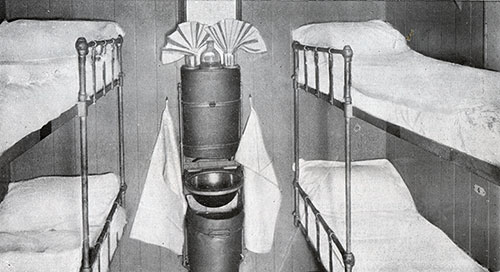
The berths were two-tiered and made of metal frames. Each bed had a mattress and a pillow that could be used as a life preserver. The passengers probably brought their own bedding. Most passengers slept fully dressed.6 The picture below is an example of a four-berth room found in a brochure for the Cunard Line, 1912,7 although many ships had no rooms in steerage and the berths were set up in an open space.

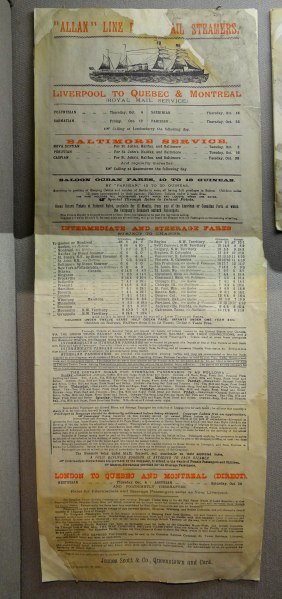
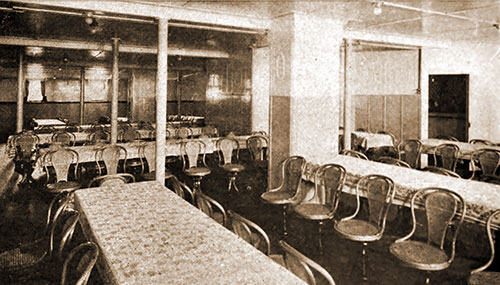
The dining room in steerage had long tables with benches. Steerage passengers were provided with a set of utensils that they used for the entire trip, normally a fork, spoon and a lunch pail. A small dish fit into the top of the pail for meat and potatoes, with an attachment on the lid as a dish for vegetables and a tin cup that fit inside for drinks. The pail also served as a wash basin. 8 The poster below indicates that steerage passengers had to pay 3s 6d per adult for their small pail and utensils (pannikin).9

An example of a dining room for the steerage passengers.10

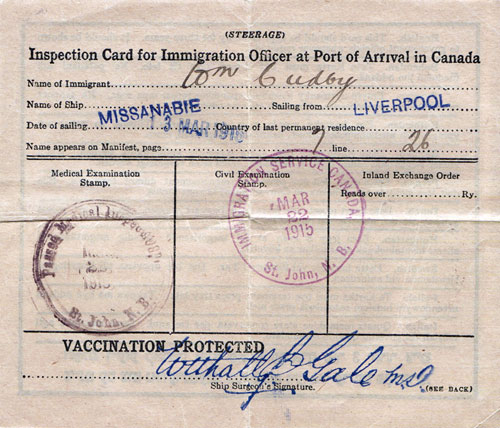
When the McHughs arrived in Quebec City, they were inspected by one of the medical examiners, either Dr. Drouin or Dr. Dupont, who were tasked with examining all the steerage passengers.11 Each immigrant would have been given an inspection card like the one illustrated below. The ship’s surgeon would have signed that they were vaccinated protected.12

My grandfather, Thomas, his brothers and his mother, were not the only McHughs to arrive on the S.S. Grampian. A year before Thomas arrived, his sister, Mary McHugh also arrived on this ocean liner.13 She came from Dundee, Scotland to work as a domestic. And Thomas’ wife, Elsie, accompanied by their seven children, arrived six months after Thomas, also on the S.S. Grampian. 14

It is no surprise that they all booked their passage on the S.S. Grampian as the Allan Shipping Line, founded in 1819 and whose main shipping line was between Scotland and Montreal, is credited with providing passage for the largest number of Scottish immigrants to Canada.15 In 1907 Sir Montagu Allan of the Allan Line Royal Mail Steamers ordered the building of the S.S. Grampian from the Stephens & Sons Ltd. shipbuilding yards in Scotland.16

When World War I broke out, the S.S. Grampian was used to transport troops of the Canadian Expeditionary Force (CEF) from Canada to Europe. After the war, during the summer of 1919, the S.S. Grampian had left Montreal on its way to Liverpool and struck an iceberg off the coast of Newfoundland. Even though the front of the ship was crushed, it managed to reach the port of St. John’s, Newfoundland. Two of the crew were killed, and two of them were injured. Even though the ship was repaired, two years later, while undergoing a refit, it was gutted by fire and sank. It was then considered a write-off.17

  1. Newspapers.com, The Guardian, April 15, 1912, retrieved December 25, 2021.
  2. “Canada Passenger Lists, 1881-1922,” database with images, FamilySearch (https://familysearch.org/ark:/61903/1:1:2HLP-31W : 23 February 2021), Thomas McHugh, May 1912; citing Immigration, Quebec City, Quebec, Canada, T-4785, Library and Archives Canada, Ottawa, Ontario, retrieved December 25, 2021.
  3. Passengers lists for S.S. Grampian arriving in Port of Quebec, May 21, 1912, Library and Archives Canada, https://www.bac-lac.gc.ca/eng/discover/immigration/immigration-records/passenger-lists/passenger-lists-1865-1922/Pages/image.aspx?Image=e003578022&URLjpg=http%3a%2f%2fcentral.bac-lac.gc.ca%2f.item%2f%3fid%3de003578022%26op%3dimg%26app%3dpassengerlist&Ecopy=e003578022, accessed February 3, 2022.
  4. Ibid.
  5. GG Archives, Steerage Conditions, https://www.gjenvick.com/Immigration/Steerage/SteerageConditions-ImmigrationCommissionReport-1911.html, retrieved February 3, 2022
  6. Ibid.
  7. GG Archives, Changes to Steerage Conditions on Steamships, 1912, Third Class / Steerage Four-Berth Room. 1912 Brochure RMS Franconia and Laconia – Cunard Line. GGA Image ID # 118805de77, https://www.gjenvick.com/Immigration/Steerage/ChangesToSteerageConditionsOnSteamships-1912.html, retrieved February 7, 2022
  8. Parillo, Vince, True Immigrant Tales: Steerage Challenges in Getting Fed, May 14, 2014, https://vinceparrillo.com/2014/05/15/true-immigrant-tales-steerage-challenges-in-getting-fed/, retrieved February 7, 2022.
  9. Image courtesy of Bjørn Christian Tørrissen, Wikipedia, S.S. Grampian, https://en.wikipedia.org/wiki/SS_Grampian, retrieved February 7, 2022.
  10. Image credit: Parillo, Vince, True Immigrant Tales: Steerage Challenges in Getting Fed, May 14, 2014, https://vinceparrillo.com/2014/05/15/true-immigrant-tales-steerage-challenges-in-getting-fed/, retrieved February 7, 2022.
  11. Passengers lists for S.S. Grampian arriving in Port of Quebec, May 21, 1912, Library and Archives Canada, https://www.bac-lac.gc.ca/eng/discover/immigration/immigration-records/passenger-lists/passenger-lists-1865-1922/Pages/image.aspx?Image=e003578022&URLjpg=http%3a%2f%2fcentral.bac-lac.gc.ca%2f.item%2f%3fid%3de003578022%26op%3dimg%26app%3dpassengerlist&Ecopy=e003578022, accessed February 3, 2022.
  12. GG Archives, Allan Line, Canadian Immigrant Inspection Card – Steerage Passenger – 1912, Wm. Cudly, jgenvik.com, “Immigration Documentation,” https://www.gjenvick.com/Immigration/ImmigrantDocumentation/1912-06-27-InspectionCard-SteerageImmigrant-Canada.html, accessed February 3, 2022.
  13. Findmypast.com Passenger Lists Leaving UK 1890-1960, Mary McHugh, S.S. Grampian leaving Glasgow June 24, 1911 and arriving in Quebec City July 8, 1911, retrieved January 23, 2022.
  14. Findmypast.com Passenger Lists Leaving UK 1890-1960, Elsie McHugh, retrieved December 13, 2017.
  15. Wikipedia, Allan Line Royal Mail Steamers, https://en.wikipedia.org/wiki/Allan_Line_Royal_Mail_Steamers, retrieved February 7, 2022.
  16. Wikipedia, S.S. Grampian, https://en.wikipedia.org/wiki/SS_Grampian, retrieved February 7, 2022.
  17. Ibid., retrieved February 7, 2022.

The Cipher

When I say that my grandfather, Thomas McHugh, worked as a cipher, Bletchley Park, MI5, and Russian spies immediately come to mind. He was neither a Russian spy nor did he work as a cipher during the war. His employer was the Bank of Montreal and it was his first job when he came to Canada in 1912.

The decision to immigrate to Canada was not easy for Thomas. He was in his mid-30s and already had seven children, between the ages of one and fifteen. For over 40 years, the jute manufacturers of Dundee, Scotland had been providing employment for his parents, aunts, uncles, siblings, wife, and for him. However, by the early 1900s, he was facing a precarious future for his children.

By the early 1900s, Dundee had suffered a serious decline in the textile industry and more significantly, the jute industry.  Jute was imported from India, however, the mill owners realized that it would significantly lower the cost of production to open mills in India to prepare the jute and import the finished product to Scotland. Once mills were established in India, the jute production in the mills in Dundee decreased substantially.1

So when Thomas arrived in Canada, a little ahead of his wife and his children, he was eager and prepared to do any job so that he could. The Bank of Montreal had its headquarters in Montreal, Quebec. In the early 1900s, the bank had significant dealings with Great Britain and there were correspondence and banking instructions back and forth between Canada and Great Britain daily. These instructions were mainly sent by telegraph overnight. There were two reasons for this. Some of these instructions were confidential and it was preferred that they remain so. Overnight instructions reduced the number of people who would have access to them. Another reason was the time difference between Montreal and the United Kingdom. The banks in London and Edinburgh were open for business while Montreal was still asleep.

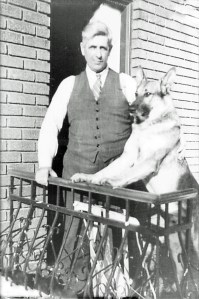
Thomas McHugh with Pal

Even in those days, the banks were concerned about security, privacy, and confidentiality. The banking instructions and transactions were submitted by telegraph and were encrypted. It was the job of the cipher clerk to decipher them so that the bank staff could then ensure that the instructions were carried out as required.

To be a cipher clerk, one had to be reliable, meticulous, and honest, and ensure the confidentiality of the bank’s business. The cipher clerk used a cipher handbook to decipher the information. Also, the cipher clerk worked overnight, so it was a difficult job for a man with a family.

So while my grandfather, the cipher, did not work in espionage, I still think that his first job in Canada was rather interesting.2

1 Wikipedia web site, The History of Dundee, https://en.wikipedia.org/wiki/History_of_Dundee, accessed February 19, 2017

2 McHugh, Edward. Personal knowledge. [Father of writer].

Love in the Jute Factory

Sarah Jane McHugh was the only member of her family who stayed behind in Scotland. I believe she must have stayed to be with her sweetheart, Thomas Adams.

In 1911, Sarah’s sister, Mary McHugh, was ready for adventure. She decided to leave Dundee, Scotland and set out for Canada on her own to work as a domestic. Mary arrived in Montreal in the summer of 1911.1 She must have liked her new home because her widowed mother, Sarah McLaughlin, and her three brothers, Thomas, Edward, and Francis, followed in May 1912.2 Thomas’ wife, Elsie Orrock and their seven children, Annie, Elsie, Sarah, Thomas, Francis, Mary and Adam also came later that year.3

But Sarah? Sarah, a young woman of 24, stayed behind in Dundee. The McHughs had been workers in the jute factories of Dundee for three generations. When the McHughs left for Canada, leaving behind Sarah, the jute mills were the biggest employer in the city. Almost half the city worked in the jute industry. 4 But the working conditions were difficult. The wages were lower for women and children than for men. The constant noise from the machines was deafening and the dust damaged the lungs. Wages in Dundee were the lowest in the country and Dundee had the highest cost of living, possibly due to the pressure on housing, caused by overcrowding. Mill workers had a bleak future ahead of them.5 Only a compelling reason could make Sarah stay and that reason must have been Thomas.

OpenLearn, Open University, Photo courtesy of University of Dundee Archive Services 6

Sarah and Thomas probably met at mill where they worked. As they lived close to each other, they would have worked at the same mill.7 Both Sarah and Thomas would have started working in the mills as soon as they finished school, at age 13. Although it was not uncommon for younger children to work alongside their mothers. Children under nine worked as pickers, cleaning the dust from beneath the machines.8

But Sarah and Thomas did not work in the mills all their lives. By the time they were in their mid twenties and Sarah’s family had left to settle in Canada, Thomas and Sarah had also moved away from Dundee to Glasgow. Glasgow is about 130 km from Dundee, so this would have been quite a move. It is probable that Thomas went first as his parents and siblings also moved to Glasgow. 9

From left to right, Thomas Adams, Sarah Jane McHugh, Ronald Maddocks (cousin)

  1. Ancestry, Canada, Arriving Passenger Lists, 1865-1935, Library and Archives Canada, Mary Ann McHugh, The Grampion, July 1911.
  2. Ancestry, Canada, Arriving Passenger Lists, 1865-1935, Library and Archives Canada, Thomas McHugh, The Grampion, May 21, 1912.
  3. Ancestry, Canada, Arriving Passenger Lists, 1865-1935, Library and Archives Canada, Elsie McHugh, The Grampion, October 1912.
  4. Dundee and the Jute Industry, Natural Bag Co. website, https://naturalbagcompany.co.uk/jute-news/dundee-and-the-jute-industry/, accessed February 23, 2021.
  5. Dundee History Archive, Workers of the mills, September 16, 2014, https://www.ddtours.co.uk/archive/workers-of-the-mills/#:~:text=Constant%20noise%20from%20the%20machines,breathing%20problems%20were%20also%20common, accessed February 23, 2021.
  6. OpenLearn, Dundee, jute, and empire, https://www.open.edu/openlearn/history-the-arts/history/dundee-jute-and-empire/content-section-5.2, accessed March 3, 2021.
  7. Scotland’s Places, Ordnance Survey Name Books, Watsons Lane, https://scotlandsplaces.gov.uk/digital-volumes/ordnance-survey-name-books/forfarshire-angus-os-name-books-1857-1861/forfar-angus-volume-34/20, accessed February 23, 2021, and Taits Lane, https://scotlandsplaces.gov.uk/digital-volumes/ordnance-survey-name-books/forfarshire-angus-os-name-books-1857-1861/forfar-angus-volume-33/8, accessed February 23, 2021.
  8. Verdant Works web site, Dundee Industrial Heritage Ltd., Working in the Mills,https://www.verdantworks.co.uk/exploration-article/working-in-the-mills/, accessed March 3, 2021.
  9. Scotland’s People, Death registers, Thomas Adam (father of Thomas), accessed February 23, 2021.
  10. Scotland’s People, Marriage registers, Sarah McHugh and Thomas Adam, January 1, 1915. Thomas is a railway engine driver and both Sarah and Thomas are living with Thomas’ widowed mother in the Possilpark District of Glasgow City, accessed August 21, 2019.
  11. Family Search, History of the Railways, https://www.familysearch.org/wiki/en/England_Occupations_Railway_Employees_(National_Institute), accessed February 23, 2021.
  12. Scotland’s People, Statutory Births, Sarah Jane McHugh, accessed August 20, 2019.
  13. Scotland’s People, Statutory Deaths, Adams, Thomas, accessed February 2, 2021.

Montreal Transit

“Eddie! Come on, Ed. Frank forgot his lunch and you have to take it to him.”

Ed’s heart sank. He had no school today but, instead of playing with his friends, he would have to make his way all the way from Verdun to Montreal West so that he could give Frank the lunch he forgot. It was sitting right there, on the kitchen table when Frank left – and he forgot it again!

My uncle, Frank McHugh, worked as a tramway driver and he drove the tram on the 63 or 64 route that went along Sherbrooke Street West in Montreal. The unlucky little boy who always had the job of taking him his lunch was my dad, Edward McHugh.

Uncle Frank’s full name was Francis Strachan McHugh. He was born in Dundee, Scotland in 1904 and emigrated to Canada with his parents and six siblings in 1912. His younger brother, Edward, was born in 1914. So, by the time Frank had found work as a tramway driver in the 1920’s, Edward was old enough to travel across the city and bring him his lunch.

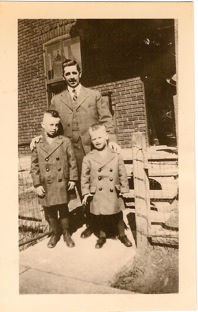
Thomas McHugh with sons, Edward (left) and James (right). Edward was about eight years old in this picture, about the time he would have carried Frank’s lunch to him.

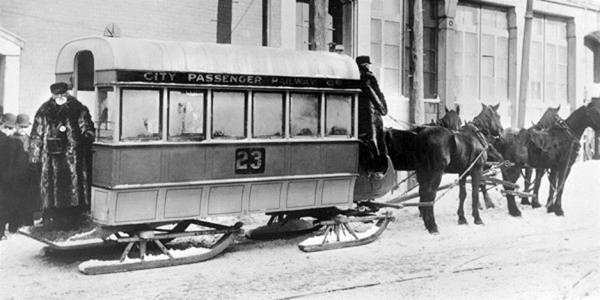
The first public transportation company in Montreal, The Montreal Passenger City Railway Company (MPCRC) was established in 1861 when the first horse-drawn tramway came into service along Notre Dame Street. The horse-drawn tramway had two employees on-board, a driver and a conductor who collected the fares. The passengers simply hailed the tram when they wanted to get on and signaled to the driver when they wanted to get off.1

Horse-drawn winter tramway on St. Catherine Street (around 1877), Société de transport de Montréal (STM) website, Tramways History

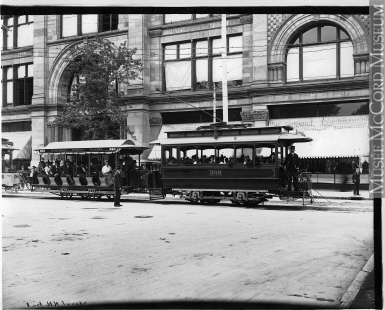
The MPCRC eventually became the Montreal Street Railway Company (MSRC). The MSRC introduced the first electric powered tramway, The Rocket, on September 21, 1892. The electric tramways immediately became very popular as they were much faster than the horse-drawn tramways. 2

By the time Uncle Frank became a tram driver, his employer was the Montreal Tramways Company (MTC). The MTC, created in 1911, acquired all the other transit companies on the island at that time. The citizens of Montreal, concerned that a private company had a monopoly over the public transit in the city, put pressure on the city, and the Montreal Transit Commission was created in 1918 to oversee the MTC. 3


Electric trams, Ste-Catherine Street, Montreal, McCord Museum, Wm Notman and Son, 1895

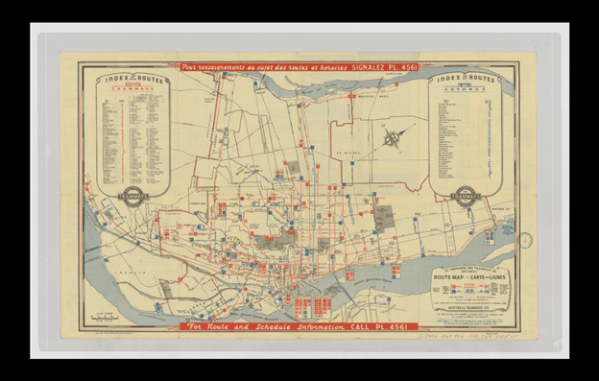
At the time that Uncle Frank worked as a tramway driver in the early 1920s, it was the peak of the operation of the tramway system in city. At that time, the MTC carried nearly 230 million passengers per year. 4 In 1924, the company published this map of the Montreal Transit system.5


Route map of bus and tramways in Montreal, Bibliothèque et Archives nationales du Québec, collection numérique

By the mid-1920s, the city began transitioning to buses, with the first major replacement of the tramway in 1936 in the city’s east end on Notre Dame Street. 6 Uncle Frank followed suit and drove the bus that went along Sherbroooke Street West. But by that time, if he forgot his lunch, he was out of luck.

When cars became popular in Montreal in the 1950s, Uncle Frank quit his job as a bus driver and became a taxi driver.


Frank McHugh and his wife, Molly Baxter
.
  1. http://www.stm.info/en/about/discover_the_stm_its_history/history/tramways-history#:~:text=Created%20in%201911%2C%20the%20Montreal,quality%20of%20the%20service%20offered, accessed October 18, 2020
  2. Ibid.
  3. Ibid.
  4. Ibid
  5. Société de transport de Montréal (STM) website, Tramways History, http://www.stm.info/en/about/discover_the_stm_its_history/history/tramways-history#:~:text=Created%20in%201911%2C%20the%20Montreal,quality%20of%20the%20service%20offered,accessed October 18, 2020
  6. http://www.stm.info/en/about/discover_the_stm_its_history/history/tramways-history#:~:text=Created%20in%201911%2C%20the%20Montreal,quality%20of%20the%20service%20offered, accessed October 18, 2020

Good wages, employment guaranteed

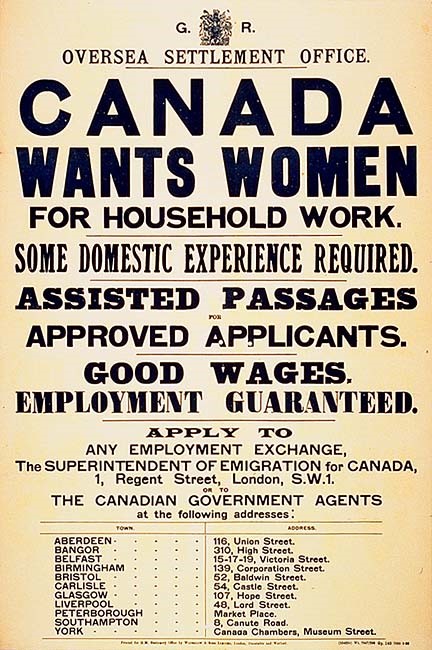
Good wages. Employment guaranteed. These words echoed over and over again in Mary McHugh’s head. And only some domestic experience required. Mary thought that she had quite enough domestic experience, thank you, as she was the only daughter still at home.

It was 1910 and Mary had turned 20 in February.1 Old enough to be married. No prospects in sight. She had been working at the jute factory since she finished school at 14.2 Like her older brother, Thomas McHugh, she immediately got a job in the jute factory as soon as she could. Mary’s mother, Sarah McLaughlin, was happy that Mary was working as Sarah was a widow and still had three children at home. Her husband, Michael McHugh, had died of tuberculosis when Mary’s brother, Francis, was just three months old.3  It had been a struggle for Sarah to make ends meet. Even though Sarah had managed to get a job as a charwoman,4 it was not easy. Sarah was exhausted when she got home, too, and it was up to Mary to help with the housework and cooking for her younger brothers. Mary’s older brother, Thomas, was already married with six children. He helped when he could but he had his own worries.

Mary thought ruefully about her job. She was a jute spinner at the flax mill.5 The mill was noisy and crowded. Mary worked twelve hours a day and it was back-breaking work. The women worked hard in the mills but made less wages than the men. The machines were dangerous. Accidents happened often.6 And then there was mill fever or brown lung. Most people who worked in the mill had a dry cough and sometimes even a fever.7

Mill Workers

Photograph from the BBC8

Mary liked the idea of being a domestic. The hours would be long and she would be on her feet all day but the air would be clean and it would be quiet. But Canada? So far away? All by herself? Could she do it?

These thoughts were the beginning of Mary’s plan to emigrate to Canada. Mary McHugh was my great aunt and she arrived on the S.S. Grampion that sailed from Glasgow and arrived in Quebec City in July 1911.9

In the early 1900s the demand for domestic servants in Canada exceeded the number of young Canadian women willing to do this type of work. Governments, employers, and women’s organizations made a special effort to encourage the immigration of household workers.8 More specifically, British immigrants were considered as desirable immigrants to Canada. As of 1888, steamship agents received a bonus for selling the passage of a female immigrant whose intent was to work as a domestic servant in Canada. This was called the British Bonus and it came into effect by an Order-in-Council on September 27, 1890. Its purpose was to offer an incentive to desirable British immigrants. Often the Canadian employer would pay the fare of the immigrant to the steamship company.10 The emigrating domestic would then have to pay it back out to her employer out of her wages. This meant that the young immigrant woman was already indebted to her employer even before she started working. If she was unhappy with her employment, it made it difficult for her to find a better employment as long as she owed money.11

It is probable that Mary’s fare to Canada was paid by her employer. Beside Mary McHugh’s name on the passenger manifest of the Grampion there is a stamp British Bonus Allowed.

Hopefully Mary enjoyed her employment. She was the first member of the McHugh family to arrive in Montreal in 1911. She was probably delighted when her mother, Sarah, and three brothers, Thomas, Edward and Francis, followed her to Montreal in May 1912. And Thomas’ wife, Elsie Orrock, and their seven children, Ann, Elsie, Sarah, Francis, Mary, Adam, and Thomas arrived in October 1912. Mary married John Mervin Porter in June 1913 and her family would have been there to celebrate with her.


Notes and sources:

This poster from the Canadian Museum of History is from a 1926 pamphlet entitled Housework in Canada: duties, wages, conditions and opportunities for household workers but there would have been similar pamphlets advertising for immigrants that may have given Mary the idea.  This pamphlet says that “Canada welcomes men and women of the right type who come to seek their fortune in this broad new land … (people) of good moral character, and in good health, mentally and physically.” You can see this on the Canadian Museum of History web site in the section Advertising in Britain in the 1920s, https://www.historymuseum.ca/cmc/exhibitions/hist/advertis/ads7-06e.html

Household work

  1. Scotland’s People, Register of Births, Mary Ann McHugh, born February 4, 1890, accessed November 18, 2017.
  2. Wikipedia web site, History of Education in Scotland, https://en.wikipedia.org/wiki/History_of_education_in_Scotland, accessed August 17, 2020.
  3. Scotland’s People, Registers of Death, Michael McHugh, died May 16, 1895, accessed November 27, 2017 and Scotland’s People, Registers of Births, Francis McHugh, born February 21, 1895, accessed November 27, 2017.
  4. Scotland’s People, 1911 Census, Sarah McHugh, 1 Tait Lane, Dundee, Scotland, accessed February 15, 2018.
  5. Scotland’s People, 1911 Census, Mary McHugh, 1 Tait Lane, Dundee, Scotland, accessed February 15, 2018.
  6. DD Tours web site, Workers of the mills, September 16, 2014, https://www.ddtours.co.uk/archive/workers-of-the-mills/, accessed August 17, 2020.
  7. com web site, Byssinosis, https://www.healthline.com/health/byssinosis, accessed August 19, 2020.
  8. BBC web site, Tayside and Central Scotland, The history of mills in Dundee, December 2, 2009, http://news.bbc.co.uk/local/taysideandcentralscotland/hi/people_and_places/history/newsid_8390000/8390747.stm, accessed August 17, 2020.
  9. Passenger list, S.S. Grampion, July 1911, Glasgow – Quebec City.
  10. British Bonus Paid, British Home Children web site, https://www.britishhomechildren.com/single-post/2014/11/09/British-Bonus-Paid, accessed August 18, 2020
  11. Barber, M.J., Immigrant Domestic Servants in Canada, Canadian Historical Association, Ottawa, 1991, p. 9

Letter to My Grandson

Dear Grandson,

You will be born tomorrow, April 2, 2020. At this time, Montreal has 2,097 cases of the Corona Virus (COVID-19). In Quebec, this flu virus has caused 33 deaths. 1

The World Health Organization declared COVID-19 a pandemic on March 11, 2020. Almost every country in the world is currently in some type of lockdown. As governments manoeuvre through this crisis, trying to maintain health care systems and the basic needs of their citizens, families face individual struggles.

Schools, daycares, and businesses that are not considered essential services are closed.  Public health messages tell people to stay at home, to practice social distancing, a new term that means we do not congregate and that if we do need to have contact, to maintain a two-metre distance from each other. Playgrounds, libraries, sports complexes, cinemas, theatres, and shopping centres are shut down.

But love is not cancelled. We already love you so much. Normally we would be preparing for tomorrow, planning on meeting you at the hospital, with balloons, flowers and other gifts. Right now, no visitors are allowed.

Just a month ago, in what now seems to be a carefree world, I would have been planning to greet you at home, waiting to cuddle you in my arms, and lovingly admire your every feature. At this time, we do not know when we will visit you.

A little over a hundred years ago, my family lived through the Spanish Flu of 1918 in Montreal. It must have been just as frightening as today’s health crisis. The McHughs were a large family. My grandfather, Thomas, and his wife, Elsie, had eight children living at home. Grandfather Thomas’ mother, his two brothers, and his sister’s family lived close by. Thomas and Elsie’s daughter, Anne, and her husband, Norman Smith, had their first son, Thomas, just a few months before the Spanish Flu outbreak reached Canada.  They must have been terrified.

It is estimated that 20,000 people in Montreal died of the Spanish Flu. This is out of a population of over half a million.2 Many years ago I asked my aunt why no one in the family died during the Spanish Flu and she answered that the family stayed home. Only those who worked went out. They left the house as little as possible to buy food. They didn’t go to church. The children stayed home from school. And they did not visit anyone. In light of today’s crisis, it seems like they did the right thing.

Montreal was hard hit by the Spanish flu as it was a port city.3 Like COVID19 that has today spread quickly throughout the world due to travel, the Spanish Flu also spread rapidly this way. 4

It is believed that the Spanish Flu first came to Canada in two separate occasions, both on September 13, 1918. Polish soldiers coming through the U.S. to a military training camp at Niagara-on-the-Lake arrived with the flu. The same day, a group of Catholic clergy and parishioners arrived, also from the U.S., to attend a Eucharistic Congress in Victoriaville that hosted over 25,000 participants. By Monday, some of the participants were dead and the students who attended the Congress and who were not yet ill, travelled back home across Canada, spreading the virus rapidly.5

So dear Grandson, always remember that, no matter what, love is never cancelled. And, while you will be born in a time of great turmoil, I am optimistic for your future. You are lucky that you will be a citizen of a country with responsible government. Already the crisis has shown that creative solutions to problems can be found. A coat manufacturer is retooling to produce hospital gowns. Manufacturers of auto parts are set to change production lines so that they can deliver ventilators. Many distillers are making hand sanitizers instead of spirits.6 The provincial government has indicated that it will help farms in Quebec to expand so that they can produce more. One drug store chain has donated over a million face masks to the government.7

We will get through this.

Love,

Gran


  1. Government of Quebec website, Information about the Corona Virus, https://www.quebec.ca/en/health/health-issues/a-z/2019-coronavirus/situation-coronavirus-in-quebec/#c47900, accessed April 1, 2020.


  1. Wikipedia website, Montreal, https://en.wikipedia.org/wiki/Montreal, accessed March 22, 2020, Population in Montreal in 1911 was 533,341.


  1. Government of Canada, Parks Canada website, The Spanish Flu in Canada 1918 -1920, https://www.pc.gc.ca/en/culture/clmhc-hsmbc/res/doc/information-backgrounder/espagnole-spanish, accessed March 22, 2020.


  1. Global News, D’Amore, Rachael, Here’s How the Spanish Flu is similar and different from the Corona Virus, March 21, 2020, https://globalnews.ca/news/6707118/coronavirus-spanish-flu-comparison/, accessed March 22, 2020.


  1. Canadian Geographic website, The Outbreak and its Aftermath, Mitchell, Alanna, August 23, 2018, https://www.canadiangeographic.ca/article/outbreak-and-its-aftermath, accessed March 22, 2020.


  1. Ipolitics website, Pinkerton, Charlie, March 19, 2020, Trudeau says wartime production law could be used to boost manufacturing of medical equipment, https://ipolitics.ca/2020/03/19/trudeau-says-wartime-production-law-could-be-used-to-boost-manufacturing-of-medical-equipment/, accessed March 22, 2020.


  1. Le Journal de Québec website, Gagnon, Marc-André, COVID-19 Pénurie de masques d’ici 3 à 7 jours, March 31, 2020, https://www.journaldequebec.com/2020/03/31/en-directfrancois-legault-fait-le-point-sur-la-pandemie-de-covid-19-au-quebec, accessed April 1, 2020

Discovery and Imagination

Historical walking tours are a great way to walk in your ancestors’ footsteps. Even if you know a lot about the place your ancestors lived, you are sure to learn a few new facts. I recently visited Drummondville, where my dad, Edward McHugh, lived for eight years during the Great Depression. He, as well as his brother, Thomas, and his sister, Sarah Jane, had gone to Drummondville in 1933 after being out of work in Montreal. They were employed by the Celanese, one of the biggest employers in Quebec during the 1930s. The Celanese was a textile plant and my dad worked in the Silk Factory as an electrician. The Celanese plant in Drummondville was one of the main reasons why Drummondville hardly felt the effects of the Great Depression.

The walking tour I went on was a free tour offered by the Société d’histoire de Drummond (historical society of Drummondville).1 The tour started at Parc Woodyatt, named after James Blain Woodyatt, Director General and member of the Board of Directors of Southern Canada Power. Southern Canada Power built, owned and operated the hydroelectric complex In Drummondville. The public park Woodyatt opened in 1930 and included sports facilities such as a pool, a skating rink and tennis courts.2

My dad, who loved to skate and swim and was an avid tennis player, would have gone to this park regularly.

My dad also loved to go to the theatre and I can easily imagine him spending his Saturday evenings at the Théâtre Capitol, built in 1937. He would have been excited when the theatre opened. This lovely art deco building is currently a multi-screen cinema complex.

Across from the town square is the impressive Roman Catholic Basilica Saint- Frédéric. When the McHugh siblings lived in Drummondville in the 1930s, this church was not yet a basilica. The first church was a chapel built in 1822 and demolished in 1879 as it became too small to accommodate the parishioners. The second church was situated where the Saint-Frédéric Park is now, just in front of the current church. The second church burnt down in 1899. The third church, built at the church’s current location, was completed in 1907 and was the victim of arson in 1921. The fourth church is the one currently standing and it was completed in 1922. It is truly magnificent. It was named a minor basilica by Pope Francis in 2015.4

Image result for eglise saint frederic drummondville

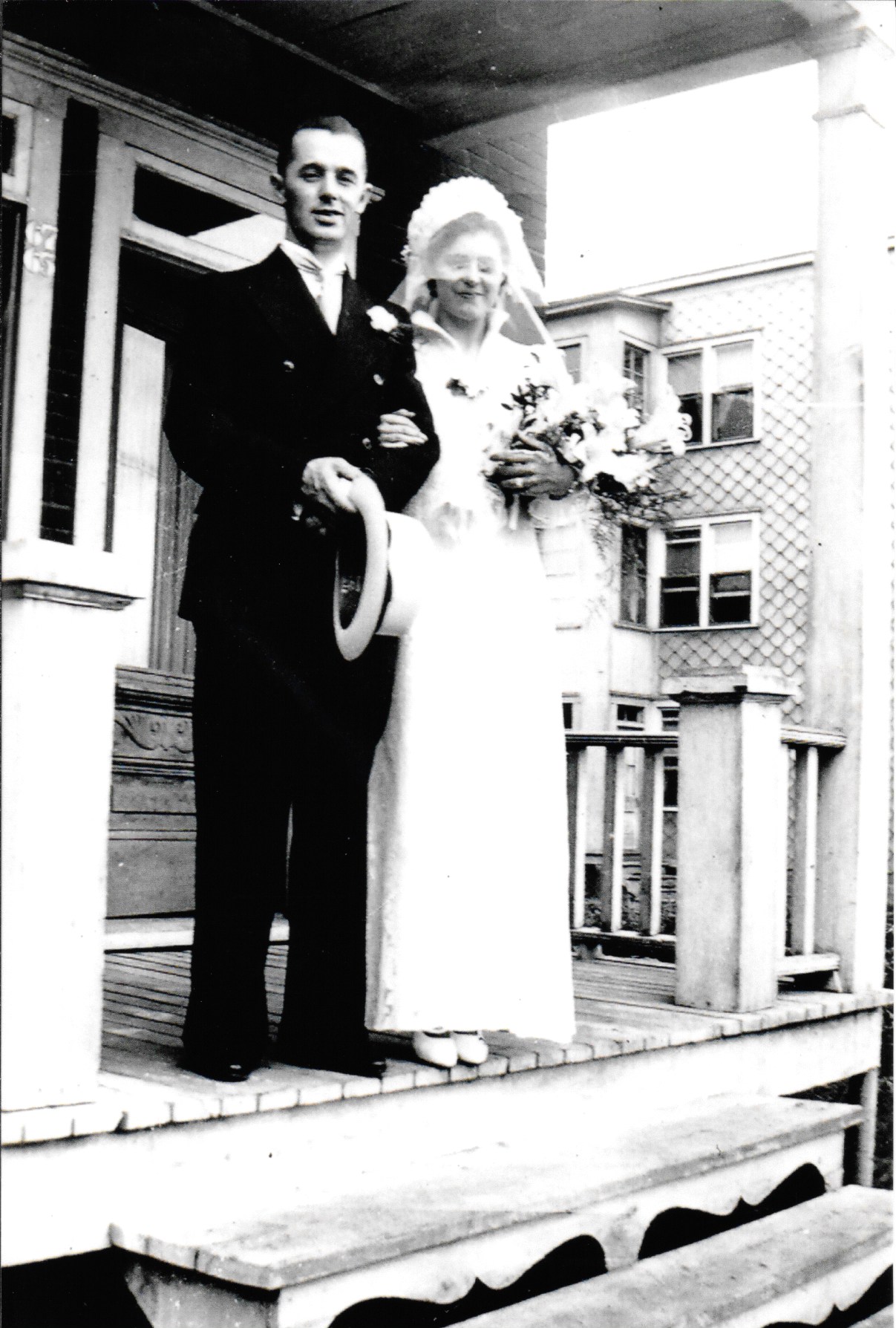
In 1937, my uncle Thomas McHugh and Simone Cloutier, a young lady from Drummondville, were married in Saint-Frédéric.5  A Casavant organ, built in 1930, would have played at their wedding. Fourteen Stations of the Cross grace the church. Stained glass windows represent the life of Saint-Frédéric, an archbishop in France.6 The McHugh family was a large one, with nine siblings. They would probably have all attended the wedding, and would have most likely travelled from Montreal by train.

McHugh, Thomas with Simone Cloutier (maybe)

Sadly, they returned to visit this magnificent church less than one year later. Thomas McHugh died of an illness in the hospital.7 My father, along with his other brothers, signed the register as pallbearers.8 Thomas McHugh is buried in the Saint-Frédéric cemetery on Saint-Joseph Boulevard, not very far from the church.

From the outside I saw the Hôpital Sainte-Croix where, sadly, my uncle would have died. The current site of this hospital was founded in 1927 and, at the time of my uncle’s death, had 18 beds and one operating room. It was run by the Soeurs de la Présentation de Marie. 9

We finished our day by driving through the working class district of Drummondville where the workers of the Celanese lived. I know my dad lived on the top floor of a duplex. He had no car so he would have lived in walking distance from work.

It was truly a day of discovery and imagination.


  1. A sincere thank you to the Société d’histoire de Drummond for this walking tour and for all of the valuable work that they do to preserve the history of Drummondville.
  2. Société d’histoire de Drummond
  3. Société d’histoire de Drummond
  4. Société d’histoire de Drummond
  5. Registration of the marriage of Thomas McHugh and Simone Cloutier, July 17, 1937, Paroisse Saint-Frédéric de Drummond, Registres photographiés au Registres de Arthabaska
  6. Church pamphlet entitled Guide – Visite et histoire de la Basilique Saint-Frédéric de Drummondville
  7. The Drummondville Statesman, “Thomas McHugh Passes Away,” May 27, 1938, accessed March 19, 2016
  8. Registration of the death of Thomas McHugh, May 25, 1938, Paroisse Saint-Frédéric de Drummond, Registres photographiés au Registres de Arthabaska
  9. Société d’histoire de Drummond