
Tag Archives: Westfield MA

Life on the Massachusetts Frontier

My six-times great-grandfather Daniel Bagg (1668-1738) was a farmer in Westfield, a small town on the western frontier of Massachusetts. It was a tightly knit community, centered around the building that doubled as the town meeting house and the Congregational church. Daniel no doubt hoped his children would be blessed by God in their lives, as he had been, but life was far from easy for his son David.

Westfield was founded in 1669, and most of its early residents had come from either Springfield, Massachusetts or Windsor, Connecticut. Daniel was no exception. He was born in Springfield, one of 10 children born to John Bagg and Hannah Burt.1 His mother died when he was 12 years old, and his father died three years later. It is not clear who raised him and his siblings after that; perhaps his mother’s family looked after them.

Daniel probably moved to Westfield around the time he married, in January 1693/94.2 His wife was Hannah Phelps (1675-1751), daughter of Isaac Phelps and Ann Gaylord. Isaac had been a founding settler of Westfield and a community leader; perhaps this connection to the Phelps family helped Daniel become a prominent citizen there.

Agricultural fields spread out around the village. The nearby hills, plains and riverside meadows had fertile soil and provided good growing conditions for a variety of crops, including corn, wheat and flax.

In land deeds and court documents, Daniel was described as a farmer and wheelwright and, in the later part of his life, as a merchant. Perhaps these activities brought him a good income, although his name appeared in several lawsuits, primarily because he either owed money or money was owed to him.3

Daniel served as a selectman (town official) of Westfield in 1718 and 1723. He represented the town in the Massachusetts legislature for a year,4 and he was involved in several committees at Westfield’s Church of Christ.5

Daniel and Hannah had 10 children: three boys, one of whom died as an infant, and seven girls. Their youngest child, David, born in February 1717, was my direct ancestor.

In 1737, Daniel prepared his will and signed it with his mark, suggesting that he could not write. He died Aug. 18, 1738, age 70.6

His will gives us a glimpse of his character, revealing his love for his wife, his trust in his sons, and his generosity to his daughters. In it, he acknowledged that God had blessed him in this life, which was a very Puritan thing to say. The Puritans of New England attributed everything that happened to them to God’s will.

He left to his “dearly beloved wife during her natural life” one end of “my dwelling house and part of the cellar with the one half of the garden, as also one quarter of the orchard by the house and one quarter of the land by the house that was called the homestead, being two acres and a half.”9

He bequeathed all his farmland in Westfield to his two sons, Daniel Jr. and David. In age, they were 20 years apart, but they were to share the land equally. Daniel Jr. was to have the new house and David the old house and barn, and Daniel was to give David 60 pounds to enable him to make improvements. David was also to have the team of oxen that ploughed the fields and pulled the farm wagons.

To each of his daughters, Daniel left “100 pounds with what she has already had.” He showed special concern for daughter Abigail, wife of Isaac Dewey, and her children, leaving them extra money. He gave Daniel and David a deadline to make sure his daughters received their bequests – and extra time to come up with the funds if there was not enough in his personal estate.

David Bagg

A year after his father’s death, on July 7, 1739, David married Elizabeth Moseley,8 (1714-1759), daughter of Westfield resident Consider Moseley and his wife Elizabeth Bancroft, and they went on to have eight children. Phineas (my four-times great-grandfather) was probably born in 1751, although there is no record of his baptism.

David farmed the fields he had inherited from his father and, in 1754, his brother sold him the 12 tracts of land in Westfield that he had inherited.9 But David’s life seems to have been turned upside down with his wife’s death on April 11, 1759.5 At the time, his children ranged in age from about 18 to eight. It is possible that Elizabeth died from a communicable disease, such as smallpox or measles, which swept through frontier towns regularly. The local parson wrote in his journal that he was “called up in ye night to visit David Bagg’s wife” on April 9; she died two days later. 

In the wake of Elizabeth’s death, David decided to leave Westfield. He bought a farm in nearby Blandford Township and, in 1761, he married Martha Cook, widow of John Dickinson.10 The marriage did not last long, however, as Martha died a year later.

Over the next few years, David made more changes. He sold the farm in Blandford in 17667 and gradually sold off his properties in Westfield, selling his last tract of land there in 1777. Meanwhile, he purchased property in Pittsfield, Massachusetts, in the beautiful but isolated Berkshire Hills, on the colony’s western frontier.

In this newly settled area, the soil was rockier and less fertile than in the Connecticut River valley, but perhaps David felt that Pittsfield would provide a fresh start for himself and affordable land for his five sons. The move was also typical of a trend in colonial New England for farmers and their growing families to leave settled areas and establish new towns, and these people became known for their independent spirits.

David bought property in Pittsfield in 176012 and probably moved there with his family not long after 1764.13 The move couldn’t have been easy: the road to Pittsfield was an old Indigenous trail that had been widened, but was often impassable. Nevertheless, David and his family must have moved essential household belongings and farming implements, cleared the land and built a log house. In 1772, David Bagg and a household of eight were listed among the 666 residents of Pittsfield.14

In 1769, David married again.15 His third wife was Ruth (Owen) Tupper, the widow of Thomas Tupper of Salisbury, Connecticut.

Meanwhile, David’s lifetime was a period of social and political change. For one thing, the people of New England were not as religious as their great-grandparents had been when they came to North America, fleeing religious persecution.

The Seven Years’ War (also known as the French and Indian War) ended in 1763 with the French ceding New France to the British. This brought to an end the raids on Massachusetts towns by the Indigenous allies of the French. It also led indirectly to the American Revolution: the war had left the British heavily in debt, and the high taxes they imposed on the Thirteen Colonies eventually led to a revolt.

Many people in the Berkshires were strongly opposed to the British, and David probably agreed with them. During the American Revolution, he served in Pittsfield militia regiments on two occasions: in January 1776, he marched to Albany for five days, and in July 1777, he served for 10 days on a march to Manchester. Each time, one of his sons (Phineas or Martin) accompanied him.16

The last mention of David Bagg of Pittsfield in Massachusetts records is a note referring to a court action, in June, 1784.17 

In the 1790 federal census, his sons Martin and Phineas Bagg and Daniel Bagg (possibly a nephew) were counted in Pittsfield, while son Joseph appeared in nearby Lanesborough.18 David might have been living with one of his children then, but he was more likely deceased.

This story has been condensed and revised from two articles about Daniel and David, written in 2018 and posted on my personal family history blog, www.writinguptheancestors.ca.

Notes:

The children of Daniel and Hannah Bagg were: Hannah, b. 1695; Daniel; Ebenezer, b. 1700, died as an infant; Rachel, bap. 1702; Ann, b. 1704; Abigail, b. 1702; Ruth, b. 1709; Margaret, b. 1712; Sarah, b. 1714; David, b. 1716/17.

The children of David and Elizabeth Bagg were: Elizabeth, bapt. Nov. 1, 1741; Joseph, born Jan 6, 1739/40 at Westfield, bapt. Nov. 1, 1741; Rachel,  bapt. Dec 19 1742 at Westfield; Martin, bapt. Jan 27, 1745 at Westfield; Eunice, bapt. June 8, 1746 at Westfield; Abner, bapt. May 15, 1748 at Westfield; Aaron, bapt. Mar 11, 1750 at Westfield; Phineas, born c. 1751.  (Phineas, my direct ancestor, moved to Canada around 1797.)

There were several individuals named David Bagg in this time period. David Bagg jr., son of David and Hannah of Springfield died in 1756 in his 19th year. David Bagg, son of Jonathon Bagg of Springfield, died in 1760 in his 50th year.  David Bagg, born Westfield to Mary Sackett, March 27, 1739.

Sources:

  1. Massachusetts: Vital Records, 1621-1850 (Online Database: AmericanAncestors.org, New England Historic Genealogical Society, 2001-2016).https://www.americanancestors.org/DB190/r/1320087835
  1. New England Marriages to 1700. (Online database. AmericanAncestors.org. New England Historic Genealogical Society, 2008.) Originally published as: New England Marriages Prior to 1700. Boston, Mass.: New England Historic Genealogical Society, 2015. https://www.americanancestors.org/DB1568/i/21174/65/426875386
  1. Debrett, “The Bagg Family of Massachusetts, America and of Montreal, Canada. Research for Mrs. J.D. Hamilton, July, 1980.”
  1. Massachusetts: Legislators of the General Court, 1691-1780 (Online database: AmericanAncestors.org, New England Historic Genealogical Society, 2002), (Orig. Pub. by Northeastern University Press , Boston, MA. John A. Schutz, Legislators of the Massachusetts General Court 1691–1780 A Biographical Dictionary, 1997.) https://www.americanancestors.org/DB142/r/5875254
  1. Rev. John H. Lockwood, Westfield and its Historic Influences 1669-1919: The Life of an Early Town (Springfield, 1922, Printed and sold by the author), p. 147, 310, https://archive.org/stream/westfieldandits00lockgoog#page/n174/mode/2up, accessed May 19, 2018
  1. Hampshire County, MA: Probate File Papers, 1660-1889. Online database. AmericanAncestors.org. New England Historic Genealogical Society, 2016, 2017. (From records supplied by the Massachusetts Supreme Judicial Court Archives and the Hampshire County Court. Digitized images provided by FamilySearch.org) https://www.americanancestors.org/DB1653/i/33925/7-17-co3/0

7.  Massachusetts: Vital Records, 1621-1850 (Online Database: AmericanAncestors.org, New England Historic Genealogical Society, 2001-2016). https://www.americanancestors.org/DB190/i/13250/3/253010247

8. Massachusetts: Vital Records, 1621-1850 (Online Database: AmericanAncestors.org, New England Historic Genealogical Society, 2001-2016). https://www.americanancestors.org/DB190/i/13251/4/253014174

9. William A. Cooper, “The James Bagg Family of Lanesborough, Mass,” unpublished, 1918.

10.  Massachusetts: Vital Records, 1621-1850 (Online Database: AmericanAncestors.org, New England Historic Genealogical Society, 2001-2016). https://www.americanancestors.org/DB190/i/13250/91/253013581

11.  Massachusetts: Vital Records, 1621-1850 (Online Database: AmericanAncestors.org, New England Historic Genealogical Society, 2001-2016). https://www.americanancestors.org/DB190/i/14507/117/264964546

12. Rollin H. Cooke, Pittsfield Families, Vol. 1 A-B, p. 73.

13.  J.E.A. Smith, The History of Pittsfield, (Berkshire County,) Massachusetts, From the Year 1734 to the Year 1800. Boston: Lee and Shepard, 1869. p. 476.

14.  “The Number of Families and Persons in the town of Pittsfield, Nov. 16, 1772” Berkshire Genealogist, fall 1993, vol. 14, no 4, p. 111.

15. Vital Records from The NEHGS Register. Online database. AmericanAncestors.org. New England Historic Genealogical Society, 2014. (Compiled from articles originally published in The New England Historical and Genealogical Register.) https://www.americanancestors.org/DB522/r/264680608

16.  Massachusetts Soldiers and Sailors in the War of the Revolution, Ancestry.com

17. Cooper, “The James Bagg Family of Lanesborough, Mass”.

18. Ancestry.com. 1790 United States Federal Census [database on-line]. Provo, UT, USA: Ancestry.com Operations, Inc., 2010. Images reproduced by FamilySearch. Original data: First Census of the United States, 1790 (NARA microfilm publication M637, 12 rolls). Records of the Bureau of the Census, Record Group 29. National Archives, Washington, D.C.  year: 1790; Census  Place: Pittsfield, Berkshire, Massachusetts; Series: M637; Roll: 4; Page: 483; Image: 526; Family History Library Film: 0568144. (accessed Jan. 14, 2013)
Consider Moseley of Westfield, MA

Consider Moseley (1675-1755), of Westfield, Massachusetts had an unusual name. In Puritan New England, where he was born, people normally named their children after close relatives1 or gave them Biblical names, but the origin of Consider’s name is a mystery. Maybe his parents had good imaginations: they called one of his brothers Comfort.

Whatever the origin of his name, my six-times great-grandfather was born in Windsor, Connecticut, the fifth child of Lieut. John Maudsley (an earlier spelling of the last name) and his wife, Mary Newberry. Consider had five younger siblings, all of them born after the family relocated to Westfield, Massachusetts2 around 1675.

John Maudsley was probably born in 1640 in Dorchester, Massachusetts.3 He and Mary married in 1664 and the couple moved to Windsor. It had been established on the banks of the Connecticut River almost 30 years earlier, and the founding settlers had received land grants but, as a relative latecomer, John purchased his land.

John sold that property in 1677 and moved to Westfield4 where he bought a house and store. According to Westfield chronicler Chester Stiles, “Mr. Moseley had already proved his valour in battles with the followers of King Philip. [King Philip’s War, 1675-1676, was fought between some of the indigenous people and the colonists.] Hence, he was warmly welcomed to the stockaded hamlet and chosen lieutenant of the little company of defenders. He was also recorded as one of the seven original members, or “foundation men,” of the [Congregational] church first organized under Rev. Edward Taylor in 1677.” 5

John still owned a mill in Windsor, and he died there in 1690. Mary then married her Westfield neighbour, widower Isaac Phelps.6 Consider was 15 at the time of his father’s death and, as one of the older boys in the family, he would likely have been responsible for many chores on the family farm.

Consider was still a young man in 1700 when he was called upon to assist the community. Officially this was peace time, but there was only a lull between two wars between England and France, King William’s War and Queen Ann’s War. Even in peace time, the people of Westfield were worried that the indigenous people who were allied with the French would come from New France (Quebec) and attack them.7

The town residents agreed that several houses should be securely fortified, and Consider’s house was one of the buildings chosen. Teams of neighbours helped with the work. Consider eventually became a lieutenant in the Westfield militia.

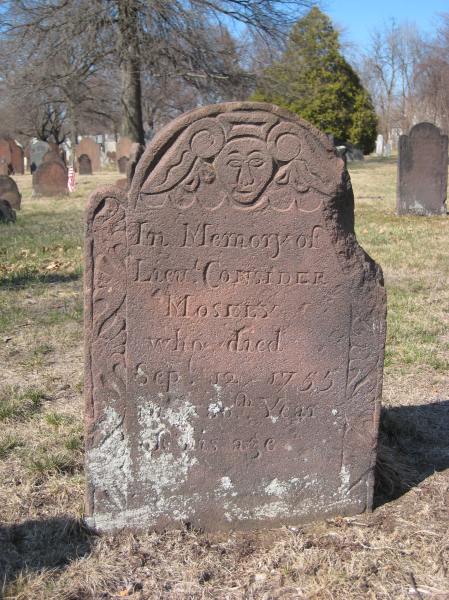
Lieut. Consider Moseley’s grave in the old burying ground, Westfield, MA. JH photo, 2014.

In 1709, at age 34, Consider married Elizabeth Bancroft.8 The couple had eight children, including twins Elizabeth and Daniel. (Elizabeth Moseley grew up to marry David Bagg, and the couple are my direct ancestors.9)  In 1731, after Elizabeth died, he married Rebecka (Williams) Dewey, the widow of Jedediah Dewey II.10 Rebecka had nine children of her own at the time, ranging in age from five to 26.  

When Consider died in September, 1755 at age 80, he was described as “one of the wealthiest and most influential men of the town.”11 He may or may not have considered wealth important. Puritans valued hard work, but wasting their money on frivolous things was frowned upon. Wealth was tied to influence, however. Wealthier residents were usually elected to their town’s most important offices and, every Sunday when the people of New England went to church, where they sat depended on their social status.12

Many Puritans believed that God ordained all that happened, so an individual’s prosperity was a sign of God’s approval for a commitment to godly living. In his will, Consider noted that, “it has pleased God to bless me in this life.”

When Consider wrote his will in January, 1754, he noted that he was “infirm and weak in body, yet of perfect mind and memory.” Indeed, this four-page document shows how well organized he was. He owned numerous tracts of pasture land and farm land around Westfield, and he identified each one according to its geographic location, neighbouring lot owners or the individual from whom he had purchased it.

He had already signed deeds of conveyance giving the titles of several properties to his sons. He split the land between his two sons, Daniel and Israel, and the sons of his late son Benjamin. Each of his five daughters, and Benjamin’s daughter, received relatively small sums of money and a share of his furniture and household goods.

As for his beloved wife Rebecka, his bequest to her was five shillings “in consideration of the articles of agreement concluded between us at our marriage.” He did not describe that agreement,13  but her children probably looked after her for the rest of her life.

This article first appeared on my personal family history blog Writing Up the Ancestors in 2018.

Notes:

Children of John Maudsley and Mary Newberry:  

Born in Windsor: Benjamin, b. 1666, m. Mary Sackett; Margaret, b. 1668/69, d. 1678; Joseph, b. 1670, m. Abigail Root; Mary, b. 1673, m. Isaac Phelps Jr.; Consider, b. 1675, m. 1, Elizabeth Bancroft, 2, widow Rebecca Dewey.

Born in Westfield: John, b. 1678, d. c. 1690; Comfort, b. 1680, d. 1711; Margaret b. 1683, m. Samuel Taylor; Elizabeth, b. 1685; Hannah, b. 1690, d. 1707.

Source: Henry R. Stiles, The History of Ancient Windsor vol. II, p. 508.

The Bancroft Family:

Immigrant John Bancroft brought his wife and children to New England in 1632 and settled in Lynn, Massachusetts. After he died in 1637, his wife may have remarried and moved to Windsor, Connecticut. 

In 1650, John Bancroft Jr. married Hanna Duper in Windsor. John Jr. and Hanna had five children, including Nathaniel, born 1653. After John Jr. died in 1662, Hanna remarried and moved to Westfield.

Nathaniel Bancroft married Hannah Williams in 1677. They had five children, with Elizabeth, born 1682, being the second-youngest. Elizabeth Bancroft married Consider Moseley in 1709.

Source: Henry R. Stiles, The History of Ancient Windsor vol. II, p. 40-41.

Children of Consider Moseley and Elizabeth Bancroft:

Rhoda, b. 1710, m. Nathaniel Weller; Israel, b. 1711, Daniel, b. 1714, m. Ann Abbott; Elizabeth, b. 1714, m. Daniel Bagg; Lydia, b. 1716, m. Israel Dewey; Ruth, b. 1717, m. Thomas Root; Mercy, b. 1722, m. Aaron King; Benjamin?, m. Hannah?                

Source: Henry R. Stiles, The History of Ancient Windsor, p. 509.

Sources:

1. David Hackett Fischer, Albion’s Seed: Four British Folkways in America, New York, Oxford University Press, 1898, p 23.

2. Henry R. Stiles. The History of Ancient Windsor, Vol. II, a facsimile of the 1892 edition, Somersworth: New Hampshire Publishing Co., 1976. p. 508, https://archive.org/stream/historygenealogi02stil#page/508/mode/2up accessed April 10, 2018.

3. Robert Charles Anderson, Great Migration Directory: Immigrants of New England, 1620-1640, a Concise Compendium. Boston: New England Historic Genealogical Society, 2015.

4. Henry R. Stiles, The History of Ancient Windsor, p. 508.

5. Chester D. Stiles, A History of the Town of Westfield, compiled for public schools from Greenough’s History of Westfield in the Annals of Hampden County and other sources, Westfield: J.D. Cadle & Company, 1919, p. 22. https://archive.org/stream/historyoftownofw00stil#page/22/mode/2up  accessed April 14, 2018.

6. The American Genealogist. New Haven, CT: D. L. Jacobus, 1937-. (Online database. AmericanAncestors.org. New England Historic Genealogical Society, 2009 – .) https://www.americanancestors.org/DB283/i/12963/239/24672606, accessed April 7, 2018.

7. Rev. John H. Lockwood. Westfield and its Historic Influences, 1669-1919: the life of an early town. Springfield, MA, printed and sold by the author, 1922, p. 295, https://archive.org/stream/westfieldandits00lockgoog#page/n324/mode/2up  accessed April 10, 2018.

8. Massachusetts: Vital Records, 1621-1850 (Online Database: AmericanAncestors.org, New England Historic Genealogical Society, 2001-2016), https://www.americanancestors.org/DB190/i/13251/47/253015607 accessed April 14, 2018.

9. Massachusetts: Vital Records, 1621-1850 (Online Database: AmericanAncestors.org, New England Historic Genealogical Society, 2001-2016). https://www.americanancestors.org/DB190/r/253018268, accessed April 10, 2018.

10. Joann River, River-Hopkins, Saemann-Nickel and Related Families (website), Jedediah Dewey II #8003, http://josfamilyhistory.com/htm/nickel/griffin/sheldon/noble/noble-dewey.htm#jed3, accessed April 15, 2018.

11. Lockwood, Westfield and its Historic Influences, p. 386.  https://archive.org/stream/westfieldandits00lockgoog#page/n414/mode/2up, accessed April 10, 2018.

12. Virginia DeJohn Anderson, New England’s Generation: The Great Migration and the Formation of Society and Culture in the Seventeenth Century, Cambridge, UK: Cambridge University Press, 1991, p.175.

13.  Westfield, Hampden, Massachusetts, Probate Record of the estate of Consider Moseley, 1755. Case Number 102-30, Hampshire Box 102, 1755, page 102-30:1.

Isaac Phelps and his Blended Families

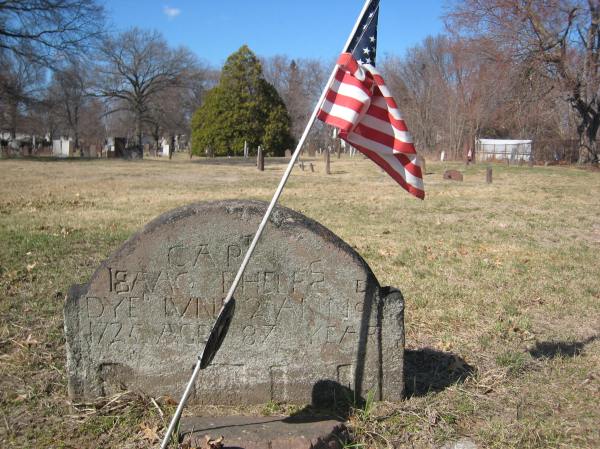
My seven-times great grandfather Isaac Phelps (1638-1725) was like the Energizer bunny: he never seemed to stop. For much of his life, he worked hard as a farmer and he held many offices in his home town in New England, but he also became a school teacher at age 64 and was named a captain in the militia at age 71. Only death seemed to slow him down, at age 87, and his tombstone is almost as legible now as the day it was carved.

Isaac was born in 1638 in Windsor, Connecticut, the eldest son of George Phelps and Philura Randall,1 both of whom were newcomers to New England, part of a wave of Puritans who fled England, hoping to follow their religious beliefs without persecution.

The Puritans wanted to be able to read the Bible themselves, so education was considered important in colonial New England. Meanwhile, everyone in the community attended church for the whole day every Sunday.

By the time he was nine years old, Isaac had four younger siblings, but that year, 1647, two of them died. The following April, his mother died.2 Families needed two parents to share the work of running the household and the farm, so his father did not wait long to remarry. George Phelps’ second wife was Frances Dewey, whose second husband, Thomas Dewey, had died two days before Philura.3

From age ten, Isaac grew up in what we would describe as a blended family. The household included his father and step-mother, his brother Joseph, Mary Clark (Frances’ daughter from her first marriage) and the five Dewey children: Thomas, Josiah, Anna, Israel and Jedediah. Eventually, there were three more half-brothers: Jacob, John and Nathaniel Phelps. Isaac’s other brother, Abraham, was adopted by Randall relatives who were childless.4

The grave of Isaac Phelps in the Old Burying Ground, Westfield, MA. JH photo, 2014

In 1662, Isaac married Ann Gaylord.5 (See note i) Isaac’s and Ann’s eldest child, Isaac Jr., was born in 1666 in Windsor. The family moved to Westfield, Massachusetts around 1670 and the rest of their 11 children were born in that frontier settlement. (See note ii)

Ann (Gaylord) Phelps died in 1689 or 1690, when the youngest child was still a toddler. Sometime before 1694, Isaac married his neighbour, widow Mary (Newberry) Maudsley,6 who had eight children of her own. (See note iii) Once again, Isaac was part of a big, blended family.

Other members of the extended Phelps/Dewey family also lived in Westfield. Perhaps they saw opportunities to acquire fertile farmland in the new settlement, which was founded by settlers from nearby Springfield and a handful of families from Windsor.

Isaac and his father were among the first settlers in Westfield, choosing prime home lots located near the Little River in 1667.7 The colonists purchased the land from the indigenous people and Westfield was incorporated in 1669.

Because Westfield was quite isolated, the residents were afraid of attacks by the indigenous people, especially during King Phillip’s War (1675-76). When colonial authorities in Boston told the residents to go to Springfield because of the danger, Isaac Phelps was one of four people to sign a letter refusing to do so. Instead, Westfield residents built a two-square-mile wooden palisade around the town and dug an underground cellar where the women and children could hide.8 Westfield was not attacked, although Springfield was, and some individuals were.

Westfield’s citizens maintained a militia for decades to counter the threat that was fueled by ongoing wars between the English and the French and their Native American allies. In 1709, Isaac became a captain in the militia.

Isaac also played a role in Westfield’s civic life. He served as town clerk, assessor, surveyor and town treasurer,10 and teacher. He was also a legislator of the Massachusetts General Court.

Westfield had about 150 residents in 1676, and the town continued to grow. The Dewey brothers built a mill on one of the many nearby creeks, there was a tavern in the town and a road that led to Springfield. Most important, the town had a minister: Reverend Edward Taylor, a graduate of Cambridge University and of Harvard University, served the people of Westfield from 1679 to 1726. Isaac was one of the founding members of the church, and a deacon.9

Isaac Phelps died in 1725 and was buried in Westfield’s Old Burying Ground.

This story was first published on my personal family history blog, Writing Up the Ancestors, in 2018.

Notes:

i. The Gaylord family. Ann Gaylord’s grandfather William Gaylord (also spelled Gayler, Gaylar, Gaylor, Gailead and Gailer) brought his family from England to Dorchester, Massachusetts aboard the Mary and John in 1630. At the time, he and his wife had six children ranging in age from about four to 15.11

William Gaylord played an important role in Dorchester, initially as one of two deacons of the Congregational church that the colonists and their pastor, John Warham, established there. William was one of four men who signed early town orders in Dorchester, he was chosen as a selectman (town official) for several terms between 1635 and 1637, and he was appointed assessor in 1636.

Two years later, the Gaylord family followed Rev. Warham and a number of other Dorchester families to Windsor, Connecticut. There, William was granted a 20-acre home lot and several tracts of agricultural land. He served as deputy for Windsor to the Connecticut General Court for many years. His wife died in Windsor in 1657; William Sr. died in 1673.

Their second child, William Jr., was baptized in Crewkerne, Somersetshire, in 1617, and married Anna Porter in Windsor in 1641.12 The Porter family had settled in Windsor in 1639. After Anna died in 1653, William married Elizabeth Drake.

William Gaylord Jr. died in 1656, leaving seven children, the oldest of whom was Ann, born 1645. Ann must have shouldered a lot of responsibility helping to raise her younger brothers and sisters. She married Isaac Phelps on March 11, 1662/63.

ii. Isaac’s and Ann’s children born in Windsor:

Isaac, b. 1666, m. Mary Moseley.

Those who were baptized in Westfield were:

daughter b. 1669, d. young.

John b. 1672, married Thankful Hitchcock;

Hannah b. 1674, m. Daniel Bagg in 1693/4 (my direct ancestors);13

Hezekiah b. 1677;

Joseph b. 1679;

Daniel b. 1681, d. 1690;

Noah, b. 1684, d. 1731 at Housatonnuc;

infant, b/d 1686;

Ebenezer, b. 1687, m. Susanna Burbank.14

iii. Some 19th-century genealogies suggest Isaac did not remarry after Ann’s death, but it would have been unusual for a widower with several young children not to look for a new wife. An article proving Isaac did remarry appeared in The American Genealogist in 1993 (TAG vol. 68, p 239-241). In such a small community, there were multiple connections between some of these blended family members. After Isaac Phelps married Mary (Newberry) Maudsley, his son Isaac Jr. married her daughter, Mary Maudsley.

iv. Windsor and Westfield kept good records and these databases are available online from the New England Historic Genealogical Society. Several books have been written about the area and its residents, mostly by amateur historians and genealogists in the 19th century, and the information in these books needs to be checked against the databases. Keep in mind that often several individuals living about the same time had the same name. For example, besides the father and son I have mentioned, there were three other men named Isaac Phelps. See The New England Historical and Genealogical Register 163 [2009]: 117.

Sources:

1. Connecticut: Vital Records (The Barbour Collection), 1630-1870 (Online Database: AmericanAncestors.org, New England Historic Genealogical Society, 2011.) From original typescripts, Lucius Barnes Barbour Collection, 1928. https://www.americanancestors.org/DB414/i/12316/224/138422806, accessed April 7, 2018

2. Ibid.

3. Ibid.

4. Oliver Seymour Phelps and Andrew T. Servin, compilers, “George Phelps the Emigrant, 1630,” The Phelps Family of America and their English Ancestors, and other interesting papers, coats of arms and valuable records, volume II (Pittsfield, MA: Eagle Publishing Company, 1899), p. 1270.

5. Burton Spear, compiler, Search for the Passengers of the Mary and John, 1630, vol. 5, Gallop – Greenway (Toledo: The Mary and John Clearing House, 1987), p 18.

6. The American Genealogist. New Haven, CT: D. L. Jacobus, 1937-. (Online database. AmericanAncestors.org. New England Historic Genealogical Society, 2009 – .) https://www.americanancestors.org/DB283/i/12963/239/24672606, accessed April 7, 2018.

7. Rev. John H. Lockwood, Westfield and its Historic Influences 1669-1919: The Life of an Early Town (Springfield, 1922, Printed and sold by the author), p. 58, https://archive.org/stream/westfieldandits00lockgoog#page/n80/mode/2up accessed April 1, 2018

8. Kay Delli Bovi, Barbara Trant, volunteers in public schools, The Westfield Story, printed in 2006, http://www.cityofwestfield.org/DocumentCenter/View/236 accessed April 7, 2018.

9. Lockwood, Westfield and its Historic Influences 1669-1919, p. 94. https://archive.org/stream/westfieldandits00lockgoog#page/n120/mode/2up, accessed April 1, 2018.

10. Phelps and Servin, The Phelps Family of America and their English Ancestors, p. 1269.

11 Robert Charles Anderson, The Great Migration Begins, Immigrants to New England, 1620-1633, 3 volumes, (Boston: New England Historic Genealogical Society), II: 742.

12.  Connecticut: Vital Records (The Barbour Collection), 1630-1870 (Online Database: AmericanAncestors.org, New England Historic Genealogical Society, 2011.) From original typescripts, Lucius Barnes Barbour Collection, 1928. https://www.americanancestors.org/DB414/r/138416737, accessed April 10, 2018.

13. New England Marriages to 1700. (Online database. AmericanAncestors.org. New England Historic Genealogical Society, 2008.) Originally published as: New England Marriages Prior to 1700. Boston, Mass.: New England Historic Genealogical Society, 2015. https://www.americanancestors.org/DB1568/r/426875386, accessed April 10, 2018.

14. The New England Historical and Genealogical Register. Boston, MA: New England Historic Genealogical Society, 1847-. (Online database: AmericanAncestors.org, New England Historic Genealogical Society, 2001-2013.) https://www.americanancestors.org/DB202/r/245392558, accessed April 10, 2018.

The Phelps Family of Windsor and Westfield

For many of the colonists who fled England to become pioneers in New England in the 1630s, rebuilding their lives once was enough. But not for George Phelps. He helped to found the town of Windsor, Connecticut and raised his family there. Thirty years later, he started over as a founding settler of Westfield, a new town on the edge of the Massachusetts wilderness.

His date and place of birth in England are unknown, but he was probably born around 1613.1 He probably came to New England on the ship Recovery in 1634.2 Most of its passengers were from southwest England, and George may have been from the same area.

He initially settled in Dorchester, Massachusetts. Some people in Dorchester complained that the leaders of the Massachusetts Bay Colony were too elitist and autocratic.3 They wanted to be part of a more democratic society. In 1635, a group of unhappy colonists left Dorchester with their minister, Reverend John Warham, determined to found a new community they called Windsor, Connecticut. George was one of them.

A trading post had been built at the spot where the Farmington River flows into the Connecticut River several years earlier, and the indigenous people in the area were friendly to the newcomers and willing to sell them land. The spot was well located for trade and its riverside meadows were fertile, so Warham’s group decided to settle there. 

Sixty men, women and children travelled overland with their farm animals, while their possessions were shipped by water. The first winter was so difficult that many of the cattle died and some of the would-be settlers fled back to Dorchester, returning to Windsor in the spring, accompanied by additional settlers.

In 1637, the Pequot Indians began attacking the New England colonists, so the settlers surrounded their houses with a protective wooden palisade. By 1639, the danger had subsided and the people of Windsor began construction of the most important building in the community: the church and meeting house.

George married Philura Randall, the daughter of Philip Randall, although there is no surviving record of their marriage. They lived in an area known as the Island, overlooking the Farmington River, but not only was that area prone to flooding, in 1640, the house burned.4

Like most of his neighbours, George supported his family as a farmer. According to a 1640 inventory of Windsor properties, he owned nine different tracts of land, including several acres in what was known as the Plimouth Meadow, as well as several properties on the other side of what people called the Great River and several narrow tracts of land that stretched three miles back from the water.5

As well as wheat and Indian corn, George may have grown tobacco, a crop that has been grown in the area since 1640, and he planted 500 apple trees. Apples had been imported to the colony from England and were a staple of the New England diet.

He signed land deeds and his will with a mark, so George probably did not know how to write, however, he did own some books.6  He served as a constable in Windsor in 1645 and was on juries a number of times between 1649 and 1667.

George and Philura had five children, including Isaac (my direct ancestor), who was born in 1638, Abraham, born 1642, and Joseph, born 1647.The years 1647 and 1648 were particularly difficult, with many deaths in the community. Two of the Phelps children died in 1647, and Philura died on April 29, 1648.7 George remarried six months later. His second wife was Frances Dewey, the widow of Thomas Dewey, who had had also died in April. Frances had a daughter from her first marriage and five young children from her marriage with Thomas. She and George went on to have three children together: Jacob, born 1649, John, born 1651, and Nathaniel, born 1654.8

In the late 1660s, the Phelps family left Windsor and helped to found Westfield, Massachusetts. Some of their Windsor neighbours made the same move, joining several families who had come from Springfield, Massachusetts to establish the new town. Life was not easy in Westfield, which was the westernmost town in Massachusetts, nevertheless, these self-reliant pioneers survived the many hardships they faced and the town grew.

When George Phelps died on May 8, 1687,9 he left his bedding, household goods, some money and the use of part of the house in Westfield to his wife. She died in Westfield three years later.

His son Jacob received a four-acre section of the home lot in Westfield that included the house, barn and orchard. To son Isaac, he left “the best coat of my wearing apparel and my mare.”10 He distributed money and his remaining land in Windsor and Westfield between all his sons.

This story was first published on my personal family history blog, Writing Up the Ancestors, in 2018

Notes

Note that some of the sources of information on this period were written in the 19th century by gentleman genealogists. Books of this type often contain errors and must be used with caution. For more background, see the website of the organization Descendants of the Founders of Ancient Windsor, https://dfaw.org. See also the website https://connecticuthistory.org/towns-page/windsor/

Sources

1. The Great Migration Begins: Immigrants to New England 1620-1633, Volumes I-III. (Online database: AmericanAncestors.org, New England Historic Genealogical Society, 2010), (Originally published as: New England Historic Genealogical Society. Robert Charles Anderson, The Great Migration Begins: Immigrants to New England 1620-1633, Volumes I-III, 3 vols. 1995), p 445. https://www.americanancestors.org/DB393/i/12107/539/1415511879, accessed March 25, 2018.

2. “The Origin of George Phelps” Phelps Family History in America, http://www.phelpsfamilyhistory.com/research/george/index.asp, accessed March 24, 2018.

3. Howard, Daniel. A New History of Old Windsor, Connecticut. Windsor Locks, CT: Journal Press, 1935. http://www.archive.org/stream/newhistoryofoldw00howa#page/n5/mode/2up, accessed March 29, 2018.

4. Stiles, Henry. The History and Genealogies of Ancient Windsor, Connecticut Including East Windsor, South Windsor, Bloomfield, Windsor Locks, and Ellington. 1635-1891, Vol. 1. Hartford, CT: Case, Lockwood & Brainard Company, 1891, p. 163. http://www.achive.org/stream/historygenealogi01stil#page/n7/mode/2up, accessed March 24, 2018.

5. Anderson, The Great Migration Begins, p 446.

6. Oliver Seymour Phelps and Andrew T. Servin, compilers. The Phelps Family of America and their English Ancestors, and other interesting papers, coats of arms and valuable records. Volume II.  Pittsfield, MA, Eagle Publishing Company, 1899. “George Phelps the Emigrant, 1630,” p. 1267.

7. Connecticut: Vital Records (The Barbour Collection), 1630-1870 (Online Database: AmericanAncestors.org, New England Historic Genealogical Society, 2011.) From original typescripts, Lucius Barnes Barbour Collection, 1928, https://www.americanancestors.org/DB414/i/12316/224/138422806, accessed April 7, 2018

8. Anderson, The Great Migration Begins, p 449.

9. Massachusetts Vital Records. 1621-1850 (online database: AmericanAncestors.org. New England Historic Genealogical Society, 2001-2016.) https://www.americanancestors.org/DB190/r/253013871, accessed March 21, 2018.

10. Anderson, The Great Migration Begins, p 447.