
Category Archives: colonial New England

John Bagg of Springfield, Massachusetts

Seventeenth-century New Englanders were wary of strangers. In Springfield, Massachusetts, newcomers had to be approved by the town residents before they could stay for more than a month, but when John Bagg moved to Springfield around 1657, he not only stayed, he married the daughter of one of the town’s leading citizens.

John’s origins are obscure, but once he settled in Springfield, town records were thorough, and the life of my seven-times great-grandfather was well documented. The first record of John Bagg’s name there was his marriage to Hannah Burt, daughter of Henry Burt and Ulalia March, on Dec. 24, 1657.1 Soon after, he opened an account at John Pynchon’s general store. He also worked for Pynchon, earning several shillings a day for fetching hay and stones, felling timber, reaping wheat and trimming the orchard.2

In 1659, he was listed in the ninth of 10 rows in the meeting house (the church), where seating was assigned according to status in the community. Three years later, he had moved up a row.

In 1662, John and several friends appeared in court, charged with the illegal act of playing cards. He pleaded guilty and paid a fine.

Another incident, involving a breach of town regulations, seems trivial today. John had been named a fence-viewer, an important responsibility since escaped livestock could damage crops. When he and his fence-viewing partner Reice Bedortha observed defects in a neighbour’s fence, town officials fined the owner. At the same time, John complained there was a defect in Bedortha’s fence, but Bedortha countered that it wasn’t his fence. Both men were fined for not carrying out their fence-viewing duties properly.3  

The inhabitants of Springfield all supported their families as subsistence farmers. No one became rich, but neither did they starve. They mainly acquired farmland as land grants from the town. John’s first grant, a six-acre parcel of land, was approved in 1660. In 1664, he purchased 20 acres on the Chicopee Plain and, in the same year, the town granted him 30 acres near the Agawam River (now the Westfield River).

In 1668, John and two friends leased another 40 acres. Cash was always in short supply, so they paid half the rent in “good merchantable wheate, and the other half in Pease and Indian corne, all good and merchantable.”4 The town later granted him several additional small pieces of land.

Springfield, the first town built in the western interior of the Massachusetts Bay Colony, was founded beside the Connecticut River in 1636. The site was chosen primarily for commercial reasons. The Great River, as people called it, provided transportation, while meadows provided grazing for livestock and the soil was fertile. The town founders purchased land on both the east and west sides of the Connecticut River from the indigenous people. The town was on the east side and most of John’s property was on the other side, in what later became West Springfield.

The destruction of much of Springfield in 1675, during King Philip’s War, must have been the most terrifying event of John’s life. Town residents had been on good terms with many of the area’s indigenous people, but a bloody conflict erupted in 1675. Moe than 30 houses and 25 barns in Springfield were burned, as well as several mills and large quantities of corn that had been stored for the coming winter.

John’s and Hannah’s wedding was another milestone. When they married, she was 16; he may have been considerably older. Hannah was the ninth of Henry and Ulalia Burt’s 13 children, and the first member of the Burt family to be born in the colony.

John’s Obscure Origins

About 40 years ago, my mother wondered, who was the first member of the Bagg family to come to North America? She turned to Debrett’s, a company that specialized in researching British aristocratic families. Meanwhile, she told her friend Carol, from Boston, about her interest in the Bagg family history. Carol replied, “I’m descended from the Baggs too!” and she sent my mother an article about the family’s roots in colonial Massachusetts.6

With that information, Debrett’s prepared a report on four generations of the Bagg family in Springfield, Westfield and Pittsfield. Carol’s ancestor was Joseph Bagg (1740-1836) and ours was his brother Phineas (c. 1751-1823), who moved to Canada around 1795.3 Their great-grandfather, John Bagg (? – 1683), was the immigrant member of the family.

When John first appeared in Springfield records, 20 years had passed since the town was founded, and it was long after the Great Migration, the period between 1620 and 1640 when thousands of people emigrated from England to New England.

A book about the Burt family written in the 1890s said that John Bagg “is supposed to have emigrated from Plymouth, England.”9 My grandparents thought that we were descended from Sir James Bagge who was mayor of Plymouth in the early 1600s and lived in a mansion called Saltram, but the Debrett’s researcher concluded there was no evidence to connect him to my family.

Their report revealed that several individuals named John Bagg came to North America in the 17th century. The Original Lists of Persons of Quality, by John Camden Hotten, which listed emigrants, religious exiles, political rebels and others who went from Great Britain to the American Plantations, 1600-1700, listed a John Bagg who owned more than 10 acres of land in Barbados in 1638, but there is no evidence to suggest he relocated to Massachusetts 20 years later. 

A better bet is the John Bagg, age 16, who was transported to Virginia aboard the ship Safety in August, 1635.10 In 1991, researcher W. Denis Hanley of the New England Historic Genealogical Society (NEHGS) replied to Mother’s query. He suggested that John Bagg may have gone to Virginia as an indentured servant, having promised to work the land for several years, but broke that promise and sailed to Barbados where he was granted land, then eventually moved to Massachusetts. Or he might have gone to Virginia as an indentured servant, stayed on the plantation for a number of years and moved to Massachusetts in the 1650s.

If John Bagg left England at age 16 in 1635, he would have been 38 when he got married. As for his motivation to leave Virginia, there were few single women on the plantations there, so perhaps he came to Massachusetts to look for a wife and picked Springfield, hoping to find employment as a day labourer until he could acquire land of his own.

I have not followed up with further research in Virginia. But even if I find John Bagg – or Bag, Bagge, Begg, Bigg or Biggs – in the records there, it would be hard to say with certainty that he was the man who settled in Springfield, and we still do not know his origins in England. I have not pursued further research to determine when or where he was born since it would be so difficult to prove.

My own theory – and again, I have no evidence – is that someone in John’s family knew members of the Burt family in England, so John made his way to Springfield, where he had connections.

What Springfield records do show is that John and Hannah had 10 children: Hannah (1658-1740) married Nathaniel Sikes; Mercy (1660-1738) m. Ebenezer Jones; Daniel (1663); John (1665-1740) m. Mercy Thomas; Daniel (1668-1738) m. Hannah Phelps (my direct ancestors); Jonathan (1670-1746) m. Mary Weller; Abigail (1675-1739) m. Benjamin Cooley; James (1675-1689), Sarah (1678-?) m. 1. Benoni Atchison, 2. Samuel Barnard; Abilene, (1680- 1750).5

Hannah died, age 39, on Aug. 1, 1680,11 several days after giving birth to Abilene. Three years later, on Sept. 5, 1683, John Bagg “was sicke and died”.12

John’s probate record shows that Samuel Marshfield became guardian of sons John and James, and of baby Abilene, but it is not clear what happened to the other children. The inventory of his estate listed the simple belongings of a farmer: a yoke of oxen, a horse, some cows and swine, a cart, plow, axe, kettle, bedding, two coats, a pair of britches, a hat and a pair of stockings. His house and adjoining land were evaluated at 16 pounds. His debts totalled 50 pounds.13   

John may have had humble origins, but in 1893, Springfield historian Henry M. Burt wrote that John Bagg “appears to have been an industrious citizen and his descendants are among the most prosperous and intelligent people of recent times.”14

This story was previously posted in 2018 as two separate articles on my personal family history website Writing Up the Ancestors.

See also: Janice Hamilton, “Henry Burt, from Devon Clothier to Springfield Farmer”, Genealogy Ensemble, March 7, 2018. https://genealogyensemble.com/2018/03/07/henry-burt-from-devon-clothier-to-colonial-farmer/

Sources:

1. Massachusetts: Vital Records, 1621-1850 (Online Database: AmericanAncestors.org, New England Historic Genealogical Society, 2001-2016), accessed Feb. 21, 2018

2. Henry M. Burt, Silas W. Burt. Early Days in New England. Life and Times of Henry Burt of Springfield and Some of His Descendants. Springfield: Clark W. Bryan, printers, 1893. Internet Archive, p. 252-253 https://archive.org/details/earlydaysinnewen00burt_0/page/252/mode/1up, accessed Oct 1, 2026.

3. Henry M. Burt, The First Century of the History of Springfield. The Official Records from 1636 to 1736, with an historical review and biographical mention of the founders. Volume 1 Springfield, Mass: Printed and Published by Henry M. Burt, 1898. Internet Archive, p. 56, accessed Sept. 26, 2026..

4. Burt, Early Days in New England, p. 251.

5. Thomas B. Warren, Springfield Families, Vol. 1 (A-E), copied by Mercy Warren Chapter, Springfield, Mass, 1934-1935, p. 22.

6. Lyman Hotchkiss Bagg “Autobiography 1846-1895. Forming a supplement to the “Obituary Notice of a Yale Graduate of ’69 written by himself in 1890.” New York: printed for private distribution by Karl Kron, publisher; reprinted from the Biographical Records of the Yale Class of 1869, vol. I, p 24-32.

7.  Debrett, “The Bagg Family of Massachusetts, America and of Montreal, Canada. Research for Mrs. J.D. Hamilton, July, 1980.”

8. William A. Cooper, “The James Bagg of Lanesborough, Massachusetts” based on research made by John McIlvene. Conshohooken, Pa, 1918.

9. Henry M. Burt, Silas W. Burt. Early Days in New England. p.249.

10. Michael Tupper, editor. Passengers to America. A Consolidation of Ship Passenger Lists from The New England Historical and Genealogical Register. Baltimore: Genealogical Publishing Co., 1977, p. 98.

11. Massachusetts: Vital Records, 1621-1850 (Online Database:  AmericanAncestors.org, New England Historic Genealogical Society, 2001-2016), accessed Feb. 21, 2018.

12. Massachusetts: Vital Records, 1621-1850 (Online Database: AmericanAncestors.org, New England Historic Genealogical Society, 2001-2016), accessed Feb. 20, 2018.

13. Hampshire County, Massachusetts probate records 1660-1916. index, 1660-1971 [microform].

14. Burt, Early Days in New England, p. 250.

Additional Reading:

Virginia DeJohn Anderson. New England’s Generation, The Great Migration and the Formation of Society and Culture in the Seventeenth Century. Cambridge, U.K.: Cambridge University Press, 1991.

Lyman Hotchkiss Bagg “Autobiography 1846-1895. Forming a supplement to the “Obituary Notice of a Yale Graduate of ’69 written by himself in 1890.” New York: printed for private distribution by Karl Kron, publisher; reprinted from the Biographical Records of the Yale Class of 1869, vol. I, p 24-32.

Patricia Law Hatcher. Researching Your Colonial New England Ancestors. Provo, Utah: Ancestry Publishing, 2006.

Nathaniel Philbrick. Mayflower. A story of courage, community and war. New York: Penguin Books, 2007.
Consider Moseley of Westfield, MA

Consider Moseley (1675-1755), of Westfield, Massachusetts had an unusual name. In Puritan New England, where he was born, people normally named their children after close relatives1 or gave them Biblical names, but the origin of Consider’s name is a mystery. Maybe his parents had good imaginations: they called one of his brothers Comfort.

Whatever the origin of his name, my six-times great-grandfather was born in Windsor, Connecticut, the fifth child of Lieut. John Maudsley (an earlier spelling of the last name) and his wife, Mary Newberry. Consider had five younger siblings, all of them born after the family relocated to Westfield, Massachusetts2 around 1675.

John Maudsley was probably born in 1640 in Dorchester, Massachusetts.3 He and Mary married in 1664 and the couple moved to Windsor. It had been established on the banks of the Connecticut River almost 30 years earlier, and the founding settlers had received land grants but, as a relative latecomer, John purchased his land.

John sold that property in 1677 and moved to Westfield4 where he bought a house and store. According to Westfield chronicler Chester Stiles, “Mr. Moseley had already proved his valour in battles with the followers of King Philip. [King Philip’s War, 1675-1676, was fought between some of the indigenous people and the colonists.] Hence, he was warmly welcomed to the stockaded hamlet and chosen lieutenant of the little company of defenders. He was also recorded as one of the seven original members, or “foundation men,” of the [Congregational] church first organized under Rev. Edward Taylor in 1677.” 5

John still owned a mill in Windsor, and he died there in 1690. Mary then married her Westfield neighbour, widower Isaac Phelps.6 Consider was 15 at the time of his father’s death and, as one of the older boys in the family, he would likely have been responsible for many chores on the family farm.

Consider was still a young man in 1700 when he was called upon to assist the community. Officially this was peace time, but there was only a lull between two wars between England and France, King William’s War and Queen Ann’s War. Even in peace time, the people of Westfield were worried that the indigenous people who were allied with the French would come from New France (Quebec) and attack them.7

The town residents agreed that several houses should be securely fortified, and Consider’s house was one of the buildings chosen. Teams of neighbours helped with the work. Consider eventually became a lieutenant in the Westfield militia.

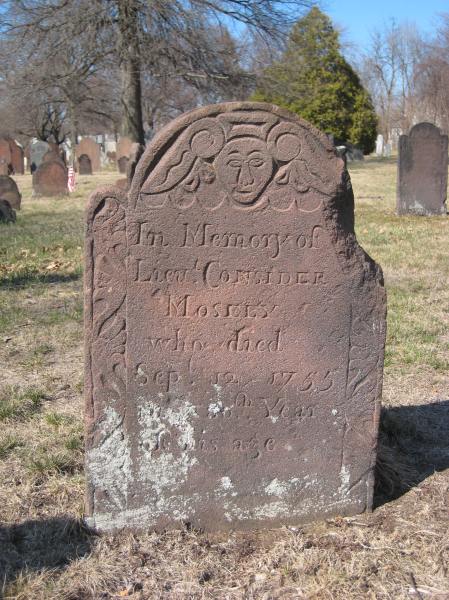
Lieut. Consider Moseley’s grave in the old burying ground, Westfield, MA. JH photo, 2014.

In 1709, at age 34, Consider married Elizabeth Bancroft.8 The couple had eight children, including twins Elizabeth and Daniel. (Elizabeth Moseley grew up to marry David Bagg, and the couple are my direct ancestors.9)  In 1731, after Elizabeth died, he married Rebecka (Williams) Dewey, the widow of Jedediah Dewey II.10 Rebecka had nine children of her own at the time, ranging in age from five to 26.  

When Consider died in September, 1755 at age 80, he was described as “one of the wealthiest and most influential men of the town.”11 He may or may not have considered wealth important. Puritans valued hard work, but wasting their money on frivolous things was frowned upon. Wealth was tied to influence, however. Wealthier residents were usually elected to their town’s most important offices and, every Sunday when the people of New England went to church, where they sat depended on their social status.12

Many Puritans believed that God ordained all that happened, so an individual’s prosperity was a sign of God’s approval for a commitment to godly living. In his will, Consider noted that, “it has pleased God to bless me in this life.”

When Consider wrote his will in January, 1754, he noted that he was “infirm and weak in body, yet of perfect mind and memory.” Indeed, this four-page document shows how well organized he was. He owned numerous tracts of pasture land and farm land around Westfield, and he identified each one according to its geographic location, neighbouring lot owners or the individual from whom he had purchased it.

He had already signed deeds of conveyance giving the titles of several properties to his sons. He split the land between his two sons, Daniel and Israel, and the sons of his late son Benjamin. Each of his five daughters, and Benjamin’s daughter, received relatively small sums of money and a share of his furniture and household goods.

As for his beloved wife Rebecka, his bequest to her was five shillings “in consideration of the articles of agreement concluded between us at our marriage.” He did not describe that agreement,13  but her children probably looked after her for the rest of her life.

This article first appeared on my personal family history blog Writing Up the Ancestors in 2018.

Notes:

Children of John Maudsley and Mary Newberry:  

Born in Windsor: Benjamin, b. 1666, m. Mary Sackett; Margaret, b. 1668/69, d. 1678; Joseph, b. 1670, m. Abigail Root; Mary, b. 1673, m. Isaac Phelps Jr.; Consider, b. 1675, m. 1, Elizabeth Bancroft, 2, widow Rebecca Dewey.

Born in Westfield: John, b. 1678, d. c. 1690; Comfort, b. 1680, d. 1711; Margaret b. 1683, m. Samuel Taylor; Elizabeth, b. 1685; Hannah, b. 1690, d. 1707.

Source: Henry R. Stiles, The History of Ancient Windsor vol. II, p. 508.

The Bancroft Family:

Immigrant John Bancroft brought his wife and children to New England in 1632 and settled in Lynn, Massachusetts. After he died in 1637, his wife may have remarried and moved to Windsor, Connecticut. 

In 1650, John Bancroft Jr. married Hanna Duper in Windsor. John Jr. and Hanna had five children, including Nathaniel, born 1653. After John Jr. died in 1662, Hanna remarried and moved to Westfield.

Nathaniel Bancroft married Hannah Williams in 1677. They had five children, with Elizabeth, born 1682, being the second-youngest. Elizabeth Bancroft married Consider Moseley in 1709.

Source: Henry R. Stiles, The History of Ancient Windsor vol. II, p. 40-41.

Children of Consider Moseley and Elizabeth Bancroft:

Rhoda, b. 1710, m. Nathaniel Weller; Israel, b. 1711, Daniel, b. 1714, m. Ann Abbott; Elizabeth, b. 1714, m. Daniel Bagg; Lydia, b. 1716, m. Israel Dewey; Ruth, b. 1717, m. Thomas Root; Mercy, b. 1722, m. Aaron King; Benjamin?, m. Hannah?                

Source: Henry R. Stiles, The History of Ancient Windsor, p. 509.

Sources:

1. David Hackett Fischer, Albion’s Seed: Four British Folkways in America, New York, Oxford University Press, 1898, p 23.

2. Henry R. Stiles. The History of Ancient Windsor, Vol. II, a facsimile of the 1892 edition, Somersworth: New Hampshire Publishing Co., 1976. p. 508, https://archive.org/stream/historygenealogi02stil#page/508/mode/2up accessed April 10, 2018.

3. Robert Charles Anderson, Great Migration Directory: Immigrants of New England, 1620-1640, a Concise Compendium. Boston: New England Historic Genealogical Society, 2015.

4. Henry R. Stiles, The History of Ancient Windsor, p. 508.

5. Chester D. Stiles, A History of the Town of Westfield, compiled for public schools from Greenough’s History of Westfield in the Annals of Hampden County and other sources, Westfield: J.D. Cadle & Company, 1919, p. 22. https://archive.org/stream/historyoftownofw00stil#page/22/mode/2up  accessed April 14, 2018.

6. The American Genealogist. New Haven, CT: D. L. Jacobus, 1937-. (Online database. AmericanAncestors.org. New England Historic Genealogical Society, 2009 – .) https://www.americanancestors.org/DB283/i/12963/239/24672606, accessed April 7, 2018.

7. Rev. John H. Lockwood. Westfield and its Historic Influences, 1669-1919: the life of an early town. Springfield, MA, printed and sold by the author, 1922, p. 295, https://archive.org/stream/westfieldandits00lockgoog#page/n324/mode/2up  accessed April 10, 2018.

8. Massachusetts: Vital Records, 1621-1850 (Online Database: AmericanAncestors.org, New England Historic Genealogical Society, 2001-2016), https://www.americanancestors.org/DB190/i/13251/47/253015607 accessed April 14, 2018.

9. Massachusetts: Vital Records, 1621-1850 (Online Database: AmericanAncestors.org, New England Historic Genealogical Society, 2001-2016). https://www.americanancestors.org/DB190/r/253018268, accessed April 10, 2018.

10. Joann River, River-Hopkins, Saemann-Nickel and Related Families (website), Jedediah Dewey II #8003, http://josfamilyhistory.com/htm/nickel/griffin/sheldon/noble/noble-dewey.htm#jed3, accessed April 15, 2018.

11. Lockwood, Westfield and its Historic Influences, p. 386.  https://archive.org/stream/westfieldandits00lockgoog#page/n414/mode/2up, accessed April 10, 2018.

12. Virginia DeJohn Anderson, New England’s Generation: The Great Migration and the Formation of Society and Culture in the Seventeenth Century, Cambridge, UK: Cambridge University Press, 1991, p.175.

13.  Westfield, Hampden, Massachusetts, Probate Record of the estate of Consider Moseley, 1755. Case Number 102-30, Hampshire Box 102, 1755, page 102-30:1.

Isaac Phelps and his Blended Families

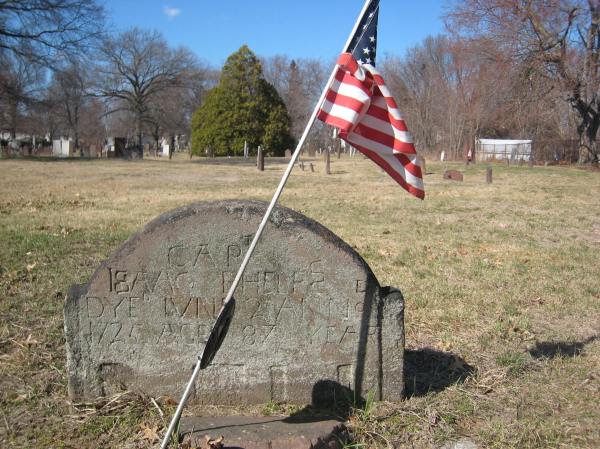
My seven-times great grandfather Isaac Phelps (1638-1725) was like the Energizer bunny: he never seemed to stop. For much of his life, he worked hard as a farmer and he held many offices in his home town in New England, but he also became a school teacher at age 64 and was named a captain in the militia at age 71. Only death seemed to slow him down, at age 87, and his tombstone is almost as legible now as the day it was carved.

Isaac was born in 1638 in Windsor, Connecticut, the eldest son of George Phelps and Philura Randall,1 both of whom were newcomers to New England, part of a wave of Puritans who fled England, hoping to follow their religious beliefs without persecution.

The Puritans wanted to be able to read the Bible themselves, so education was considered important in colonial New England. Meanwhile, everyone in the community attended church for the whole day every Sunday.

By the time he was nine years old, Isaac had four younger siblings, but that year, 1647, two of them died. The following April, his mother died.2 Families needed two parents to share the work of running the household and the farm, so his father did not wait long to remarry. George Phelps’ second wife was Frances Dewey, whose second husband, Thomas Dewey, had died two days before Philura.3

From age ten, Isaac grew up in what we would describe as a blended family. The household included his father and step-mother, his brother Joseph, Mary Clark (Frances’ daughter from her first marriage) and the five Dewey children: Thomas, Josiah, Anna, Israel and Jedediah. Eventually, there were three more half-brothers: Jacob, John and Nathaniel Phelps. Isaac’s other brother, Abraham, was adopted by Randall relatives who were childless.4

The grave of Isaac Phelps in the Old Burying Ground, Westfield, MA. JH photo, 2014

In 1662, Isaac married Ann Gaylord.5 (See note i) Isaac’s and Ann’s eldest child, Isaac Jr., was born in 1666 in Windsor. The family moved to Westfield, Massachusetts around 1670 and the rest of their 11 children were born in that frontier settlement. (See note ii)

Ann (Gaylord) Phelps died in 1689 or 1690, when the youngest child was still a toddler. Sometime before 1694, Isaac married his neighbour, widow Mary (Newberry) Maudsley,6 who had eight children of her own. (See note iii) Once again, Isaac was part of a big, blended family.

Other members of the extended Phelps/Dewey family also lived in Westfield. Perhaps they saw opportunities to acquire fertile farmland in the new settlement, which was founded by settlers from nearby Springfield and a handful of families from Windsor.

Isaac and his father were among the first settlers in Westfield, choosing prime home lots located near the Little River in 1667.7 The colonists purchased the land from the indigenous people and Westfield was incorporated in 1669.

Because Westfield was quite isolated, the residents were afraid of attacks by the indigenous people, especially during King Phillip’s War (1675-76). When colonial authorities in Boston told the residents to go to Springfield because of the danger, Isaac Phelps was one of four people to sign a letter refusing to do so. Instead, Westfield residents built a two-square-mile wooden palisade around the town and dug an underground cellar where the women and children could hide.8 Westfield was not attacked, although Springfield was, and some individuals were.

Westfield’s citizens maintained a militia for decades to counter the threat that was fueled by ongoing wars between the English and the French and their Native American allies. In 1709, Isaac became a captain in the militia.

Isaac also played a role in Westfield’s civic life. He served as town clerk, assessor, surveyor and town treasurer,10 and teacher. He was also a legislator of the Massachusetts General Court.

Westfield had about 150 residents in 1676, and the town continued to grow. The Dewey brothers built a mill on one of the many nearby creeks, there was a tavern in the town and a road that led to Springfield. Most important, the town had a minister: Reverend Edward Taylor, a graduate of Cambridge University and of Harvard University, served the people of Westfield from 1679 to 1726. Isaac was one of the founding members of the church, and a deacon.9

Isaac Phelps died in 1725 and was buried in Westfield’s Old Burying Ground.

This story was first published on my personal family history blog, Writing Up the Ancestors, in 2018.

Notes:

i. The Gaylord family. Ann Gaylord’s grandfather William Gaylord (also spelled Gayler, Gaylar, Gaylor, Gailead and Gailer) brought his family from England to Dorchester, Massachusetts aboard the Mary and John in 1630. At the time, he and his wife had six children ranging in age from about four to 15.11

William Gaylord played an important role in Dorchester, initially as one of two deacons of the Congregational church that the colonists and their pastor, John Warham, established there. William was one of four men who signed early town orders in Dorchester, he was chosen as a selectman (town official) for several terms between 1635 and 1637, and he was appointed assessor in 1636.

Two years later, the Gaylord family followed Rev. Warham and a number of other Dorchester families to Windsor, Connecticut. There, William was granted a 20-acre home lot and several tracts of agricultural land. He served as deputy for Windsor to the Connecticut General Court for many years. His wife died in Windsor in 1657; William Sr. died in 1673.

Their second child, William Jr., was baptized in Crewkerne, Somersetshire, in 1617, and married Anna Porter in Windsor in 1641.12 The Porter family had settled in Windsor in 1639. After Anna died in 1653, William married Elizabeth Drake.

William Gaylord Jr. died in 1656, leaving seven children, the oldest of whom was Ann, born 1645. Ann must have shouldered a lot of responsibility helping to raise her younger brothers and sisters. She married Isaac Phelps on March 11, 1662/63.

ii. Isaac’s and Ann’s children born in Windsor:

Isaac, b. 1666, m. Mary Moseley.

Those who were baptized in Westfield were:

daughter b. 1669, d. young.

John b. 1672, married Thankful Hitchcock;

Hannah b. 1674, m. Daniel Bagg in 1693/4 (my direct ancestors);13

Hezekiah b. 1677;

Joseph b. 1679;

Daniel b. 1681, d. 1690;

Noah, b. 1684, d. 1731 at Housatonnuc;

infant, b/d 1686;

Ebenezer, b. 1687, m. Susanna Burbank.14

iii. Some 19th-century genealogies suggest Isaac did not remarry after Ann’s death, but it would have been unusual for a widower with several young children not to look for a new wife. An article proving Isaac did remarry appeared in The American Genealogist in 1993 (TAG vol. 68, p 239-241). In such a small community, there were multiple connections between some of these blended family members. After Isaac Phelps married Mary (Newberry) Maudsley, his son Isaac Jr. married her daughter, Mary Maudsley.

iv. Windsor and Westfield kept good records and these databases are available online from the New England Historic Genealogical Society. Several books have been written about the area and its residents, mostly by amateur historians and genealogists in the 19th century, and the information in these books needs to be checked against the databases. Keep in mind that often several individuals living about the same time had the same name. For example, besides the father and son I have mentioned, there were three other men named Isaac Phelps. See The New England Historical and Genealogical Register 163 [2009]: 117.

Sources:

1. Connecticut: Vital Records (The Barbour Collection), 1630-1870 (Online Database: AmericanAncestors.org, New England Historic Genealogical Society, 2011.) From original typescripts, Lucius Barnes Barbour Collection, 1928. https://www.americanancestors.org/DB414/i/12316/224/138422806, accessed April 7, 2018

2. Ibid.

3. Ibid.

4. Oliver Seymour Phelps and Andrew T. Servin, compilers, “George Phelps the Emigrant, 1630,” The Phelps Family of America and their English Ancestors, and other interesting papers, coats of arms and valuable records, volume II (Pittsfield, MA: Eagle Publishing Company, 1899), p. 1270.

5. Burton Spear, compiler, Search for the Passengers of the Mary and John, 1630, vol. 5, Gallop – Greenway (Toledo: The Mary and John Clearing House, 1987), p 18.

6. The American Genealogist. New Haven, CT: D. L. Jacobus, 1937-. (Online database. AmericanAncestors.org. New England Historic Genealogical Society, 2009 – .) https://www.americanancestors.org/DB283/i/12963/239/24672606, accessed April 7, 2018.

7. Rev. John H. Lockwood, Westfield and its Historic Influences 1669-1919: The Life of an Early Town (Springfield, 1922, Printed and sold by the author), p. 58, https://archive.org/stream/westfieldandits00lockgoog#page/n80/mode/2up accessed April 1, 2018

8. Kay Delli Bovi, Barbara Trant, volunteers in public schools, The Westfield Story, printed in 2006, http://www.cityofwestfield.org/DocumentCenter/View/236 accessed April 7, 2018.

9. Lockwood, Westfield and its Historic Influences 1669-1919, p. 94. https://archive.org/stream/westfieldandits00lockgoog#page/n120/mode/2up, accessed April 1, 2018.

10. Phelps and Servin, The Phelps Family of America and their English Ancestors, p. 1269.

11 Robert Charles Anderson, The Great Migration Begins, Immigrants to New England, 1620-1633, 3 volumes, (Boston: New England Historic Genealogical Society), II: 742.

12.  Connecticut: Vital Records (The Barbour Collection), 1630-1870 (Online Database: AmericanAncestors.org, New England Historic Genealogical Society, 2011.) From original typescripts, Lucius Barnes Barbour Collection, 1928. https://www.americanancestors.org/DB414/r/138416737, accessed April 10, 2018.

13. New England Marriages to 1700. (Online database. AmericanAncestors.org. New England Historic Genealogical Society, 2008.) Originally published as: New England Marriages Prior to 1700. Boston, Mass.: New England Historic Genealogical Society, 2015. https://www.americanancestors.org/DB1568/r/426875386, accessed April 10, 2018.

14. The New England Historical and Genealogical Register. Boston, MA: New England Historic Genealogical Society, 1847-. (Online database: AmericanAncestors.org, New England Historic Genealogical Society, 2001-2013.) https://www.americanancestors.org/DB202/r/245392558, accessed April 10, 2018.