Tag Archives: World War I

Gunner John Hunter, World War 1

When I discovered that my Great-Uncle, John Hunter died at the age of 20 in either France or Belgium in 1917 during World War I, I assumed that he had died in battle. He was a gunner, which mean that he either served the guns, handled ammunition, or drove the horses. My first thought was that this seemed like a particularly dangerous assignment.1 With further research, I discovered that it was almost inevitable that he would die.

John was assigned to the 87th Brigade of the Royal Field Artillery (RFA). He lived in Fife, Scotland and the RFA was actively recruiting there. In World War I, the minimum age was 19 to sign up, so John would only have seen a year of active fighting before his death. 2 He either enlisted voluntarily or was forced to as the Military Service Act was passed in 1916, requiring the conscription of unmarried and widowed men without any dependents.3
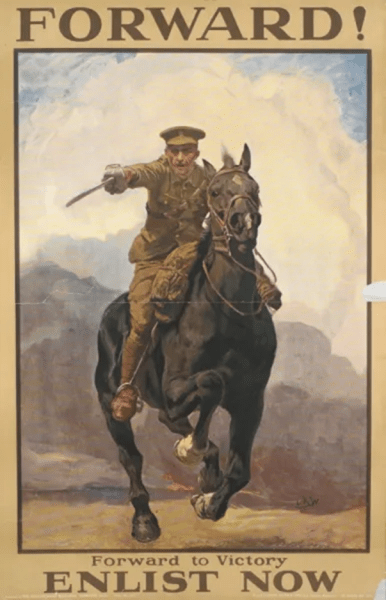
Courtesy War Museum, Recrutment Posters

The 87th Brigade was an infantry brigade formation of the British Army. By the time John would have joined the Brigade, it was serving on the Western Front.4 John would have likely participated in the Battle of the Somme and Passchendaele.

John was taken ill when he was in the theatre of war. He was sent to the Lord Derby War Hospital in Winwick, Borough of Warrington, Chesire, England. He was in a diabetic coma when he died on September 7, 1917, with my grandmother, just 16 years old at the time, at his side. Their mother had died in April 1917 and their father was also serving in World War I and was positioned in France at the time of his son’s death. My grandmother would have been summoned to his bedside and she would have had to make the journey from Lumphinnans, Scotland to Chesire, England by herself.5

Imagine the terror of being diagnosed with diabetes prior to 1921, the year insulin was discovered by a team of doctors, Charles Banting, Charles Best, and J.B. Collip and their supervisor, J.J.R. Macleod,  working at the University of Toronto.6 The symptoms would have included a terrible thirst, excessive urination, lethargy, and perhaps confusion. A urine analysis would have been done and a high glucose level would have confirmed diabetes but there was nothing to be done before the discovery of insulin except a strict dietary regime. We now know that diabetes can be triggered by trauma in someone with a genetic predisposition. There Is no doubt that the trauma of trench warfare would have had its toll on John.

When my grandson was diagnosed with diabetes when he was 16 months old, the doctors questioned whether type 1 diabetes was in the family. We could not think of any relative who had type 1 diabetes. We now know that we were wrong. My grandson will live a normal life with the help of a pump that provides insulin as he needs it. But John did not have a chance. He was living through traumatic circumstances, had a genetic predisposition, and life-saving insulin was not yet discovered. 

  1. Wikipedia, Gunner (rank), https://en.wikipedia.org/wiki/Gunner_(rank), accessed 17 June 2025
  2. War Museum, https://www.iwm.org.uk/history/voices-of-the-first-world-war-joining-up, accessed 17 June 2025
  3. War Museum, https://www.iwm.org.uk/learning/resources/first-world-war-recruitment-posters, accessed 18 June 2025.
  4. Wikipedia, 87th Brigade, https://en.wikipedia.org/wiki/87th_Brigade_(United_Kingdom)#:~:text=The%20brigade%20was%20assigned%20to,the%20rest%20of%20the%20war., accessed 17 June 2025.
  5. Death certificate, John Hynd Hunter, issued 22 April 2025, Grace Hunter, sister, was the informant.
  6. The Canadian Encyclopedia, The Discovery of Insulin, https://www.thecanadianencyclopedia.ca/en/article/the-discovery-of-insulin, accessed 18 june 2025
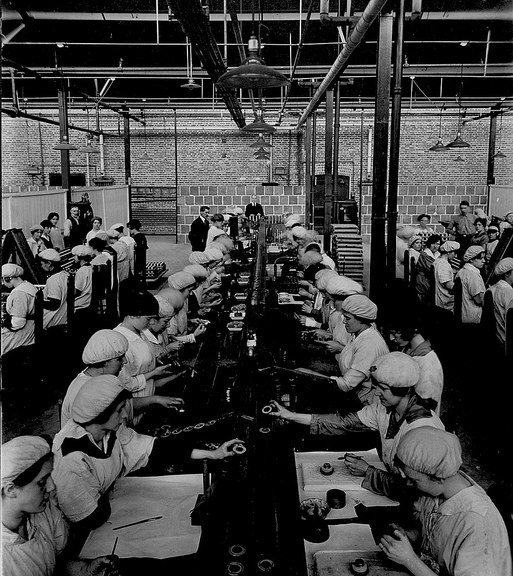
Women Heroines at La Poudrière during WWI

During World War I, 4,000 people, many of them women,  assembled eight million fuses in a building locally known as “La Poudrière.” Given that the job required mounting a detonator cap over a gunpowder relay charge and attaching a safety pin (read more about WWI fuses here), the job was risky and monotonous at the same time.

Who were these people? How can we honour their work?

Recently, while looking through the records of World War I soldiers, I realized that their records may offer us ways to discover our homefront heroines.  Several women moved to Verdun and lived within walking distance of the armament plant while their husbands or brothers served overseas.

Patrick Murray

When Ethel Henrietta Murray’s husband Patrick volunteered for the Canadian Over-Seas Expeditionary Force on Wednesday, April 12, 1916, the couple lived at 80 Anderson Street, in downtown Montreal.[1]

According to his military records, he died on October 29, 1917, driving with the 4th Brigade of the Canadian Field Artillery. She went by the first name Henrietta. Initially, she had moved to 1251 Wellington Street. Later, she lived at 956 Ethel Street.[2]

None of her addresses exist anymore, nor have I yet found any evidence explaining why she moved to Verdun. Based on her address and circumstances, however, I suspect that she—and three other women who lived nearby—worked at “la poudrière.”

La Poudrière

Locals call a building that currently houses 64 units for senior citizens “La Poudrière,” which means powder keg. The Canadien Slavowic Association (l’Association canadienne slave de Montréal) operates the space.

I haven’t yet looked into the records of the company to find out if there is a list of employees so that I can see if Ethel or Henrietta Murray appears on their rolls.

Other women I’d like to verify include Marjorie Victoria Stroude Luker, Ellen or Helen Elizabeth Winsper, and Mrs. John Sullivan. These three women also lived within walking distance of la poudrière between 1916 and 1919.

Military records include the addresses of these women because all of them received telegrams about loved ones being wounded or killed overseas.

Arthur Stroude

Marjorie’s husband Arthur was wounded in Italy on August 20, 1917, and then died of the flu in Belgium on December 2018. Although the couple lived in Point St. Charles when he signed up, her benefits were sent to her at 714 Ethel Street by the time he died.[3]

George Winsper

Ellen or Helen Elizabeth Winsper, the wife of George Winsper who died on November 7, 1917, had moved from Rosemont to 196 St. Charles Street in Pointe St. Charles by the time he died.[4]

William Wright

Two records mention the grief of Mrs. John Sullivan when Private William Wright, a steamfitter from Scotland, died in action at St. Julien on April 24, 1915. Neither have her first name. One document describes William, who was 21 when he died as the adopted child of Mr. and Mrs. John Sullivan. The one I think is correct mentions that she is his sister. Her address at the beginning of the war was 9 Farm Street, Point St. Charles, the same as his when he enlisted. His medals were sent to her at 431A Wellington St., Point St. Charles.[5]

If these women worked together, as is possible, they too risked their lives.

Employees with the British Munition Supply Company–which was created by The British Government under the auspices of The Imperial Munitions Board–faced the possibility of accidental explosions. Britain paid $175,000 in 1916 to construct a building that could contain shockwaves. It also included a saw-tooth roof to prevent sunlight from entering.[6]

British Munitions Limited

One description of their work comes from the biography of Sir Charles Gordon, who led the team that arranged for building construction.

The IMB had inherited from Sir Samuel Hughes’s Shell Committee orders for artillery shells worth more than $282 million, contracts with over 400 different factories, and supervision of the manufacture of tens of millions of shells and ancillary parts. Its most serious problem was acquiring time and graze, or percussion, fuses for the shells produced by its factories. There was no capacity to create and assemble these precision parts in Canada, and contracts with American companies had proved dismal failures.

The problem was given to Gordon to solve. He recommended that fuse manufacturing be done in Canada. The IMB set up its own factory in Verdun (Montreal) to make the delicate time fuses. Skilled workmen and supervisors were quickly brought over from Britain to train Canadian workers. British Munitions Limited, the IMB’s first “national factory,” was open for business by the spring of 1916. The last order from Britain, for 3,000,000 fuses, came in 1917 and the last fuses were shipped in May 1918. British Munitions was then converted by the IMB into a shell-manufacturing facility.[7]

Another source I read said that Dominion Textile Company purchased the site for its textile operations when the war ended in 1919. Two decades later, Defence Industries Limited revived the site for a shell factory during World War II, between 1940 and 1945. David Fennario’s book “Motherhouse” offers a good look at the women’s lives during this second wartime era.

[1] Attestation Paper, Library and Archives Canada, RG 150, #347740, Patrick Murray, a derivative copy of the original signed by Patrick.

[2] Address card, ibid.

[3] Attestation Paper and address card, Library and Archives Canada, RG 150, #1054006, Arthur Luker.

[4] Attestation Paper and address card, Library and Archives Canada, RG 150, #920146, George Winsper.

[5] Library and Archives Canada, RG 150, #26024, William Wright.

[6] “Usine à munitions pour retraités slaves” by Raphaël Dallaire Ferland,  ttps://www.ledevoir.com/societe/354100/usine-a-munitions-pour-retraites-slaves, accessed September 22, 2018.

[7] Biography – GORDON, SIR CHARLES BLAIR – Volume XVI (1931-1940) – Dictionary of Canadian Biography, http://www.biographi.ca/en/bio/gordon_charles_blair_16F.html, accessed September 22, 2018.

Letters

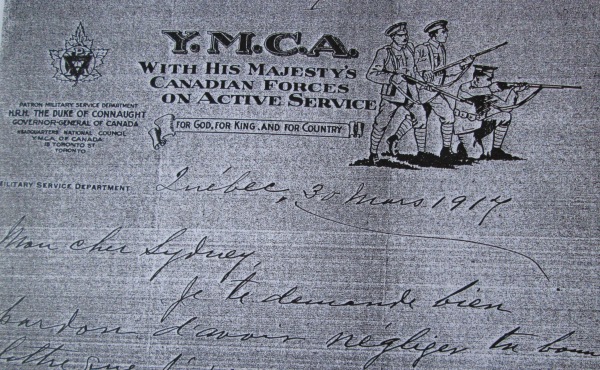
Nothing gets a genealogist’s heart beating faster than finding an old letter written by an ancestor. These are as close as we come to knowing what they really thought, gleaning a little bit of an ancestor’s character. “Thank you very much for your good wishes for my 65th birthday and it seems to me only yesterday that I was your age. Oh! Life goes fast; we should use it well so as not to have one regret on reaching the end.”¹ I am lucky as I have a number of family letters but one always wishes for more.

Many of the letters are somewhat disappointing. People seem to be just filling the page. How are you? We are all fine and the neighbours too, unless of course they aren’t and then the neighbours ailments are itemized. They often finish with please write soon as we have waited such a long time to hear back from you. Other than knowing the letter writer is still alive not much other information is given. Still the recipient was happy to receive the note.

Letter written by Ismael Bruneau

Before the telephone became ubiquitous people would just drop a note in the mail. It might just be a postcard with thanks for a visit, even to a neighbour around the corner. They used the post as a means of keeping in touch.

Some letters are heartfelt, such as a father wishing his sons wouldn’t go to war. “ I am sorry to tell you that I do not approve of your plans to go to war. Alas I certainly had greater and nobler ambitions for my boys than to make simple soldiers of them.”² If they did go he prayed that God would keep them safe. All his congregation was praying for them. My great-grandfather Ismael Bruneau wrote many letters to his son Sydney during the First World War. He signed most, “ton père affectionné I.P. Bruneau”. Sydney kept the letters and his daughter translated some. I only have photocopies which are hard to read.

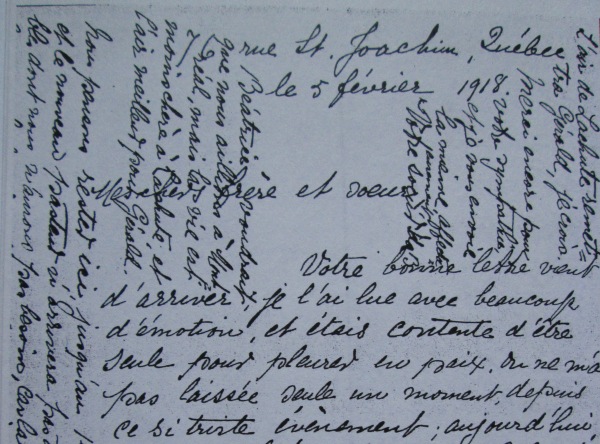
These letters have only snippets about the family as he writes, “Your mother told you about the family so I won’t.” Only one letter written by Ida Bruneau survives and that was written just after Ismael’s death.

Letter written by Ida Girod Bruneau

Handwriting can be difficult to decipher and letters written in other languages make them even harder to read. Some people had beautiful even cursive script and their letters are still a pleasure to read. They learned “real writing” in school with much practice. Other letters are covered in tiny script as they didn’t want to waste the paper. Most difficult to read are those with writing perpendicular to the first lines, again to save paper or a just remembered thought.

Unfortunately, there are also some letters you wished you had never found as they say things you didn’t want to hear. Letters from people recounting their hard times and mental struggles you never heard about and negative opinions about people you thought you knew.

Did those who saved the letters ever think someone would read them many, many years later? Most often there is just one side of the correspondence. I have a series of letters my grandfather wrote to my grandmother before they were married. He mentions often rereading her letters so he didn’t immediately discard them but they didn’t survive. Were they too personal or showed too much anger or just stupid thoughts? I imagine my grandmother found them and was embarrassed by her openness and she threw them out.

What will future generations find? Nothing? Emails and texts they can’t access, Facebook pages that have disappeared or meaningless tweets but almost no letters. There will be no papers touched by a loved one’s hand to find, tied with a ribbon or tucked into a fancy box. So after reading this, go and write someone a letter. They just might keep it!

Notes:


  1. Letter from Ismael P. Bruneau to his son Sydney Bruneau: Y.M.C.A., Quebec, 30 March 1917. Ismael died before his 66th birthday.
  2. Letter from Ismael P. Bruneau to his son Sydney Bruneau: Cornwell, ONT, 15 March 1915. Both Sydney and his brother Edgar survived the war.
  3. Letter from Ismael P. Bruneau to his son Sydney Bruneau: Cornwall, Ont, 18 July 1915.

These letters were translated by Sydney Bruneau’s daughter Ida Bruneau.

Far from Home

The news from home gave John Hunter, my great-grandfather, a jolt. Usually letters from home to the troops during WWI were full of the joys of everyday life, encouraging the soldiers that the war would end soon and that the family back home awaited their return with anticipation.

For many months now, John Hunter had been getting bad news. John knew that his wife, Mary Hynd, had become seriously ill. Then John got the news that she was in the hospital, and then that she had died.

Luckily for John, he at least received news regularly from home in Scotland.  All mail going to France, where John was stationed, first had to reach Regent’s Park in England. From Scotland, this would have taken a bit of time. Nevertheless, the government consistently delivered letters to the troops as they felt that the letters helped with the troops’ morale. Nineteen thousand mailbags crossed the Channel every day and arrived at one of three stations in France: Le Havre, Boulogne, or Calais.1

John, a sapper with the 326th Company of the Royal Engineers, worked as a miner by trade back in Scotland. Sappers, sometimes called quarrymen or tunnelers, mined the quarries and built the tunnels essential to the Allies in their battles against the Germans.

The 326th Company was formed at Buxton, England and it landed at Le Havre on May 23, 1917, consisting of four officers, 264 men, and two horses.2 They moved to Marquise on May 27, 1917.  By this time, Mary, back home in Scotland, had been diagnosed with liver and intestinal cancer. Mary died on October 14, 1917 and her death certificate states that her husband, John, was out of the country in Rinxent, France. Rinxent is about 3 km from Marquise. The significant quarrying operations in Rinxent provided the stones for the laying and maintenance of roads by the Allies.3

It was in a document on October 27, 1918 that the request was made to the war office in London to release Sapper John Hunter, 326th Company, Royal Engineers from his war duties and to transfer him to the reserve. Permission was granted:

“…. Provided he can be spared, you will issue the necessary instructions for him to be despatched to the Scottish Command Discharge Centre, East London Street Schools, Edinburgh, with a view to him being transferred to the reserve and returned to his home.”

This permission was based on “compassionate grounds” and “due to his domestic situation.” Mary had left behind two children, my grandmother, Grace, 17, and Thomas, 12.

The Deputy Adjutant General signed off on the transfer of John Hunter to his home. He was transferred to Calais and then shipped to England, and then transferred to Scotland.4

By the time he actually arrived back home in Scotland, the Armistice had been signed, essentially bringing the war to an end. Nevertheless, as part of a quarrying company, he would have still needed permission to return home as the companies continued to mine in France until late 1919.


  1. BBC, “How did 12 million letters reach WWI soldiers each week,” http://www.bbc.co.uk/guides/zqtmyrd, accessed April 21, 2019.
  2. https://www.longlongtrail.co.uk/quarry-companies-of-the-royal-engineers/, The Long, Long Trail” or “The Long, Long Trail: the British Army in the Great War” or “Chris Baker’s site The Long, Long Trail” as title in addition to the URL, accessed April 21, 2019.
  3. https://www.longlongtrail.co.uk/battlefields/gazetteer-of-the-western-front/gazetteer-of-the-western-front-rinxent/, The Long, Long Trail” or “The Long, Long Trail: the British Army in the Great War” or “Chris Baker’s site The Long, Long Trail” as title in addition to the URL, accessed April 21, 2019.
  4. Document to the Commandant, Scottish Command Discharge Centre, Edinburgh, ref. Z1/B, signed December 13, 1918 by Lieutenant R.E. for Lieutenant Corporal, Troops Base Depot.

Remembering the 9.5 Million Dead of World War I

Canadian actor and playwright R. H. Thomson has undertaken a remarkable project to commemorate the names of the more than nine million people who died in World War I, individually, and at the exact time of each person’s death, no matter what the person’s nationality or military rank.

Over the next four years, those names will appear in various ways. They will be streamed to computers, tablets and cell phones. They will be displayed on the walls of buildings or in public spaces. And they will be distributed in an app to museums, schools and universities.

Among the many nations participating are Canada, the U.K., Germany and France. Russia, where more people died than anywhere else, is considering its participation, but may have difficulty because some of the archives were destroyed. Some countries have declined to take part.

To learn more, go to http://theworldremembers.ca. You can listen to Michael Enright’s Feb. 23, 2014 interview with R. H. Thomson at www.cbc.ca/thesundayedition/.