Great Grandmother’s Quilt: Eliza Jane Eagle

I have a sampler made by Susan Dodds Bailey, my two times great-grandmother, but much more has survived made by her daughter Eliza Jane. My favourite item is a wool quilt.

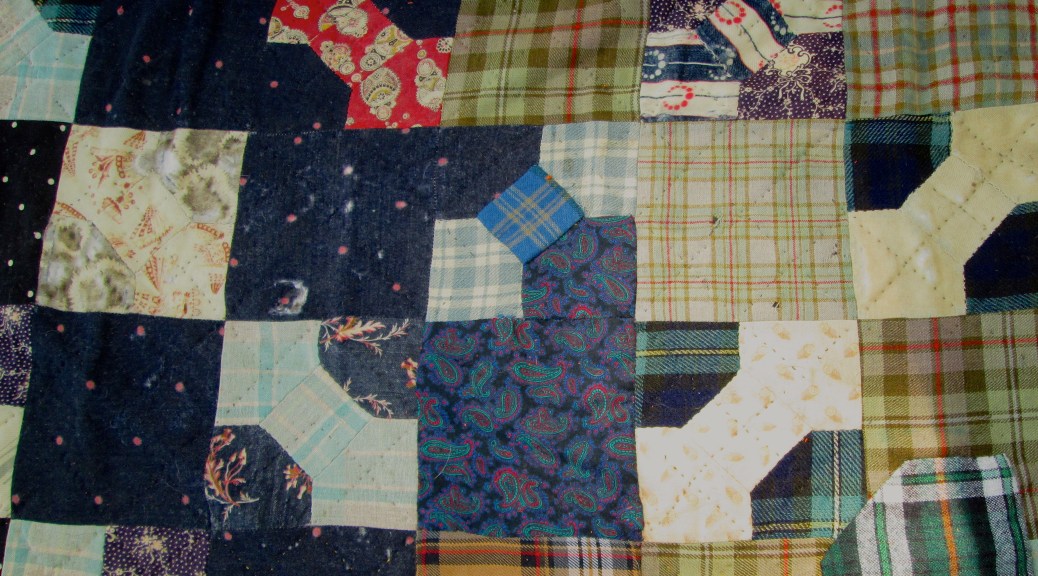
The quilt is a traditional bow tie pattern, made from scraps of suiting and other old clothes. Reds, blues and greens in plains, plaids and a few polka dots march across the front. It was all hand stitched. For many years, it was put away in a closet but now summer has it spread out on the day bed, on the verandah of our country cottage. Many an afternoon nap has been taken on it. The quilt had begun to show wear, especially the disintegration of the black dyed fabric but it was being used and loved. Last fall, before Thanksgiving, the quilt was left on the bed. Mice climbed under the tarpaulin protecting it, decided wool would make a great nest and chewed the fabric. It needed to be repaired. Great grandmother would not be happy.

Eliza Jane wasn’t just a quilter, she also knit and made a finely worked afghan. This was a work of love made from off white wool purchased especially for the project. It was given to her daughter Minnie. Elisa Jane was very upset to see that her daughter used it folded up under a mattress, to raise the head of a bed. It was the only time her granddaughter Beth remembered seeing her grandmother cry. The afghan then went to Beth and later her great-granddaughter Dorothy, who proudly displayed it on her guest bed. Great grandmother would be happy.

Eliza Jane also did a lot of fancy needlework. Needlepoint book marks, crocheted towels and lace, crossed stitched sayings on paper and tatted edging have all been preserved. She loved listening to the radio,“Wilson came over on Wed evening and looked over our machine it needs a new long battery but I heard a fine concert in Masonic Hall last night the best yet after the shaking up he gave the old battery.” I can picture her sitting listening in the evening, her hands never idle.

Eliza married William Eagle in 1881, when they were both considered “older”. He had been looking after his mother and didn’t want his wife to become a nurse. They did marry before Martha McClelland Eagle died, as they couldn’t wait forever. Eliza’s wedding dress was a burgundy silk because she thought cream or white wasn’t suitable for a woman then 36 years of age. I don’t know if she made the dress but it was kept for many years and worn for dress up by her daughters and granddaughters.

Neither her daughters nor her granddaughters were much for sewing or handiwork. My grandmother, Minnie could do some mending and darn her stockings but she was never into fine sewing. She had a dressmaker come to her house twice a year to make her clothes. Her sister Amy tried to do some sewing but for her it was a task, not something she enjoyed. So, I think Eliza Jane would be pleased to know that some of her great granddaughters do a lot of needle work and appreciate her craft.

With some old fabric saved from my mother’s hall closet, I repaired the major holes in the wool quilt. This summer it was back on the day bed. I think Great Grandmother would be happy.

Bibliography:

Personal communication with Beth Sutherland Van Loben Sels in 2000.

Notes written by Minnie Eagle Sutherland,“Mother made these fancy articles” and Amy Eagle.

Letters from Eliza Jane Eagle to Minnie Eagle Sutherland -1920’s.

Letter Feb 8 1924 from Eliza Jane to Minnie. Wilson was her daughter Minnie’s brother -in-law.

Articles in the possession of the author
Researching French Canadian Ancestors through the Drouin Institute

Institut Généalogique Drouin

 http://www.institutdrouin.com

450-448-1251

Institut.drouin@gmail.com

 If you are researching French Canadian ancestors, the best place to look is the Drouin Institute, www.drouininstitute.com. The institute can help you find a great deal of information about your ancestors, but only some pages are in English and you may become confused because there are several different ways to access the site’s information.

In addition to the subscription database at https://www.genealogiequebec.com/en/, the institute has a vast selection of publications for sale through its bookstore.

You will find the link to subscribe to the institute’s online database, Quebec Records, at the top of the page www.genealogiequebec.com/en/ or, if you are on the French-language page, click on abonnement.

The Quebec Records collection, updated as of February 2016, includes more than 42 million files and images. Take a look at the About Us page (https://www.genealogiequebec.com/en/about) to get an idea of the scope of information available. It includes the Lafrance Collection of Catholic baptisms, marriages and deaths starting from 1621, and some Protestant marriages, 1760-1849. The online Drouin Collection includes a variety of genealogical records from Quebec, Ontario and New Brunswick. Scroll down the About page to see the listing of additional databases, including notarized documents and obituaries.

The Quebec Records page has a link to the PRDH project, or Research Program in Historical Demography, http://www.genealogie.umontreal.ca/en/home. This huge undertaking by the University of Montreal put together all Catholic baptisms, marriages and burials, as well as Protestant marriages, in Quebec from 1621 to 1849.

According to the project’s website (http://www.genealogie.umontreal.ca/en/LePrdh) the result is “a computerized population register, composed of biographical files on all individuals of European ancestry who lived in the St. Lawrence Valley. The file for each individual gives the date and place of birth, marriage(s), and death, as well as family and conjugal ties with other individuals. This basic information is complemented by various socio-demographic characteristics drawn from documents: socio-professional status and occupation, ability to sign his or her name, place of residence, and, for immigrants, place of origin.” The PRDH site includes an extensive bibliography. Subscription rates depend on whether you live in Quebec, the rest of Canada or elsewhere.

The Drouin Institute sells a number of products through its online boutique. For example, you can buy family histories on CD through https://institut-drouin.myshopify.com/collections/patrimoine-familial (search for your family’s name in the naviguer box on the right), or you can purchase published family history books at https://institut-drouin.myshopify.com/collections/patrimoine-familial. Almost all of these products are in French.

The page http://www.drouininstitute.com/index.html links to the online boutique. On that page (https://institut-drouin.myshopify.com/search) you can put your family name into the search box and it will tell you what products, including CDs, books, spiral binders and PDFs, can be ordered.

Another way to search this resource is to go to www.institutdrouin.com/neufs. This page will lead you to a long list of product numbers. Click on each selection to see what titles are available.

Here are some of the spiral binders you can buy from the institute containing records that Montreal genealogist Jacques Gagné says are not available through commercial databases:

Item # N-0076 –RawdonSt. Patrick Catholic Parish – Montcalm County – Marriages, baptisms, deaths (1837-1987) – Parish later renamed Marie-Reine-du-Monde de Rawdon > Spiral binders $55. + taxes-shipping

Item # N-0278 – Iberville County – Protestant & Catholic Marriages (1823-1979) – Towns of: Henryville – Iberville – Mont-St-Grégoire – St-Alexandre – St-Athanase – Ste-Anne-de-Sabravois – Ste-Brigite-d’Iberville – St-Grégoire-le-Grand – St-Sébastien – Ste-Angèle-de-Monnoir – 802 pages – 2 volumes > Spiral binders $75. + taxes-shipping

Item # N-0327 – Trois-RivièresSt. Patrick Irish Catholic ParishMarriages (1955-1981) > Spiral binders $10. + taxes-shipping

Item # N-0504 – Terrebonne Judicial District Civil Marriages – (1969-1991) – 8,900 marriages – 684 pages > Spiral binders $69. + taxes-shipping

Item # N-0578 – St. Lawrence River’s Mid North ShoreMoyenne Côte-Nord du St-Laurent Judicial District of Sept-IlesMarriages (1846-1987) – 10,342 marriages – Towns of : Sept-Iles – Port-Cartier – Clarke City – Godbout – Gallix – Baie-Trinité – Rivière-Brochu – Franquelin – Moisie – Rivière-Pentecôte – Pointe-aux-Anglais – 607 pages > Spiral binders $43. + taxes-shipping

Item # N-0579 – St. Lawrence River’s Lower North Shore &  Southern LabradorBasse Côte-Nord du St-Laurent et du Sud du LabradorProtestant & Catholic marriages, baptisms, deaths (1847-2006) – 6,470 marriagesRegion of Minganie – Aguanish – Baie Johan Beetz – Hâvre-St-Pierre – Anticosti Island – Longue Pointe de Mingan – Mingan – Natashquan – Pointe-Parent – Rivière-au-Tonnerre – Rivière-St-Jean – Region of Lower North-Shore – Aylmer Sound – Blanc Sablon – Chevery – Harrington Harbour – Kegaska – La Romaine – La Tabatière – Lourdes de Blanc Sablon – Musquaro – Mutton Bay – Pakua-Shipi – Rivière St-Paul – St-Augustin (St. Augustine) – Tête a la Baleine – Region of Southern Labrador – Capstan Island – Clear Bay (L’Anse-au-Clair) – East St. Modest (e) – Flower’s Cove – Forteau – L’Anse-au-Loup (Woolf Cove) – L’Anse-Amour – Pinware – Red Bay – Sheldrake – West St. Modest (e) – Catholic Parishes (17) – Anglican Church (4) – United Church (2) – Methodist Church (1) – Congregationalist Church (1) – Plymouth Brethern (Gospel Hall) (3) – Pentecostal (1) – The church records of the Presbyterian Church in Harrington Harbour were destroyed by fire in 1973 – 330 pages > Spiral binders $28. + taxes-shipping

Item # N-0585 – St. Lawrence’s River Upper North Shore –  Haute-Côte-Nord du St-LaurentMarriages (1668-1992) – 17,689 marriages – Towns of: Baie-Comeau – Forestville – Les Escoumins – Tadoussac – Chutes-aux-Ouardes – Ragueneau – Pointe-Lebel – Betsiamites – Bersimis – Les Bergeronnes – Les Ilets Jéramie – 576 pages > $40. + taxes-shipping

Item # N-0613 – Gardenville Presbyterian Church & United Church of LongueilGreenfield ParkLongueilMarriages, baptisms, deaths (1905-1925 & 1926-1941) – 77 pages > $35. + taxes-shipping

Researched and compiled by Jacques Gagné gagne.jacques@sympatico.ca

The Cook at the McGill University Faculty Club

by Sandra McHugh

I particularly like the series Downton Abbey.  It portrays the upstairs and downstairs of the upper classes during the beginning of the twentieth century. I like to imagine what it would have been like to work as part of the domestic staff.  In 1922, my grandmother, Grace Graham Hunter, worked as a domestic, probably a cook, in Edinburgh for Dr. W. Kelman MacDonald, an osteopath.1 She was young and unmarried and looking for adventure.

Her experience as a cook in one of the homes of the upper class of Edinburgh surely stood her in good stead when she became head cook at the McGill University Faculty Club in Montreal.  When my grandmother was looking for adventure, Canada badly needed domestic workers.  The Canadian government favoured immigrants from Great Britain to ensure the predominance of British values.  The British Parliament passed the Empire Settlement Act, which entitled my grandmother to free third-class passage from Scotland to Canada.2

Given that the need for domestic workers was acute, government hostels, partially financed by both the Canadian government and the provinces, welcomed these immigrants to the major urban centres of Canada and referred them to Employment Services of Canada who then found them employment.3

The McGill University Faculty Club was established in 1923. I assume that my grandmother was one of the first employees as this is the year she met my grandfather and she used to tell me stories of letting him come in the back door to eat a dessert or two.

My grandmother also used to tell me many stories of the people who were members of the Faculty Club and their guests and of the pressure of preparing the food just right. I used to wonder about the famous people who dined there, who they shared their meals with, and what they discussed.

The Faculty Club was originally located on University Street.  It was only in 1935 that it was moved to its current location in the Baumgarten House on McTavish Street, the former resident of Sir Arthur Currie. 4 It was only when it moved that the Faculty Club allowed women members.  Notably, Maude Abbott became the first woman member of the Faculty Club.  She was a remarkable Montreal citizen.  She started practising medicine in 1894.  In 1910, McGill University awarded her an honorary degree and a lectureship in the Department of Pathology.5 In 1924, she founded the Federation of Medical Women of Canada. 6 Somehow, it seems fitting that such an extraordinary woman should be the first woman member of the McGill University Faculty Club.


1 This is derived from my grandmother’s address on the passenger list of the S.S. Montclare that sailed from Greenock, Scotland to Saint-John, New Brunswick on February 16, 1922.  Her address was listed as 41 Drumshegh Gardens, Edinburgh.  Dr. W. Kelman MacDonald, Osteopath, is listed as the owner linked to architectural drawings of work that was done in 1922. As my grandmother’s job was a domestic, I assume that she worked for Dr. MacDonald.

2Immigration Form 30-A of Grace Graham Hunter.

3 Crawford, Ruth, 1924, “Canada’s Program for Assimilation”, The Rotarian, May 1924, p. 16

4https://www.mcgill.ca/facultyclub/history

5https://www.mcgill.ca/about/history/features/mcgill-women

6https://en.wikipedia.org/wiki/Maude_Abbott


Surgeon and Mentalist

Shortly before graduation from medical school at Queens University in Kingston, Ontario in 1883, William G. Anglin (my great grandfather) and a few fellow medical students attended the performance of a “thought-reader”, English mentalist Stuart Cumberland[1]. So impressed with what they had seen, they went back to their place and tried one of the simpler experiments.

 The operator was blindfolded, and the Medium, placing the back of the fingers of one hand on the operator’s forehead was to think intently as to what was required to be done. For instance – pick up an article from some position and place it in another position – the operator having previously gone out of the room while the experiment was being agreed upon. Everyone singly failed, and I was the last one to try. Immediately I went across the room and picked up a small object from the mantelpiece – crossed the room and placed it on the middle of a chair. Tore off the handkerchief from my eyes and said: “That’s what you wanted done”. “By George, you’re right, Anglin, we will try you again”, and I did correctly five or six other experiments – each a little more difficult than the last. Could not account for the success, but in every experiment I was conscious that I was doing the right thing. When my fingers touched the desired object, I closed on it with a feeling of certainty.[2]

The next week William left for Halifax to sail for Liverpool to continue his medical studies in England. He met a fellow doctor and, eventually the conversation turned to “thought-reading”.

It proved to be a very entertaining voyage for the passengers, as he successfully performed time and time again. A passenger would say – “Well, Doctor, I hid a pin somewhere on the ship – an hour ago” and blindfolded, William would take the passenger’s right hand and, holding the fingers to his forehead, he would say, “Think where it is”, and they would start upstairs and downstairs, and along corridors to the spot, and he would pick up the pin from a curtain or a chair wherever it had been placed.[3]

Later in life, his son Douglas, referring to his father’s diary, lamented “End of Diary – too bad – I wish we could have heard about my father’s time studying in London and Edinburgh, where he was entertained at many high society places on account of his thought-reading.”[4]

Following his medical degree from Queen’s in 1883, William spent eighteen months as the house surgeon at the Royal Infirmary, the Sick Children’s Hospital, and the Royal Maternity Hospital in England. Then he successfully completed the M.R.C.S. exam (Member of the Royal College of Surgeons) in England.

When he returned to Kingston, in the fall of 1885, he lectured for a session in surgery at the Women’s Medical College. A year later, he became Professor of Pathology and finally head of the department of Clinical Surgery.

Around that time, William built an addition to his parents’ home at 52 Earl Street in Kingston, which provided him with both office and home. 3

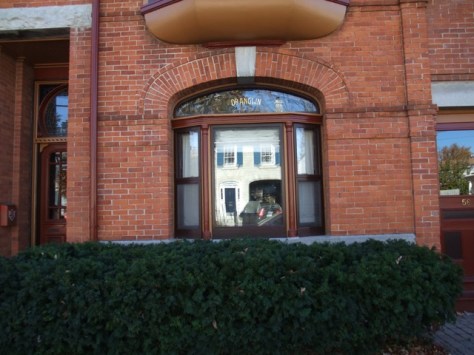
This is where he brought his childhood sweetheart and bride, Harriet (Hattie) Eva Gould, in 1886. The name ‘Dr. Anglin’ remains embossed in the upper portion of the glass of the front window to this day.[5]

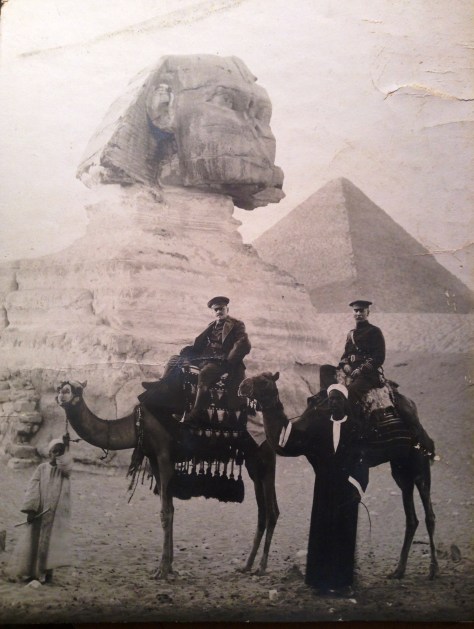
He remained a member of the Medical Staff at Queen’s until May 1915 when he departed with the Queen’s Stationary Hospital for Cairo, at age 59. Cairo, Egypt - Dec 7, 1915 - Lt Col AnglinHe served as a civil-surgeon with the rank of Lieutenant Colonel until 1916 when he became ill with Malta fever and phlebitis. He was given a medical discharge and sent back home.
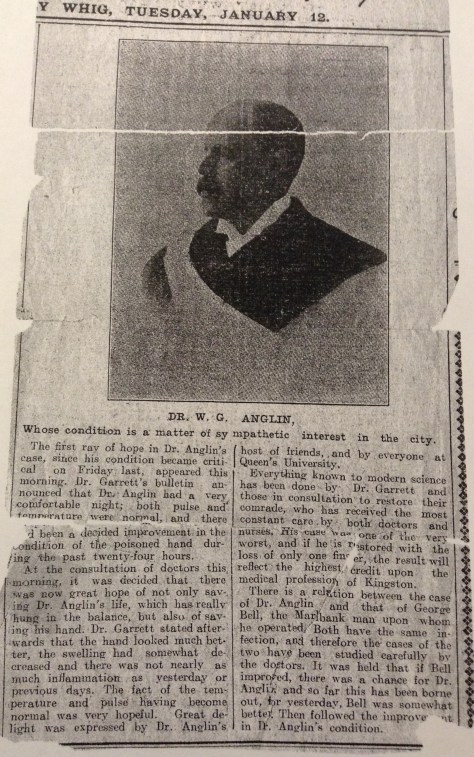
William’s attestation papers, dated May 1st 1915, declared that he was fit for duty but noted a missing middle finger on his right hand.  In 1904, it was reported that Dr. William G. Anglin was severely ill, and lost a finger due to this illness. There was much relief when it was announced that he would live.[6] Middle Finger The story told was that by using his “thought-reading” skills, he was able to physically draw down the infection in his right arm to his middle finger. The amputation of that one finger removed all traces of infection from his body probably saving his life… and enabling him to continue his work as a surgeon.[7]


[1] Wikipedia-Stuart Cumberland (1857–1922) English mentalist known for his demonstrations of “thought reading”.

[2] Personal recollections – W.G. Anglin, 52 Earl Street, Kindston, Ontario – November 14, 1927

[3] Personal recollections – W. G.Anglin, 52 Earl Street, Kingston, Ontario – November 14, 1927

[4] Written note from Douglas Anglin at the end of Personal recollections – W.G. Anglin, 52 Earl Street, Kingson, Ontario – November 14, 1927.

[5] Helen Finlay, owner-operator of  52 Earl Street Cottages, Kingston, Ontario

[6] The Kingston Whig, January 12, 1904,

Queen’s archives, Biographical History – Anglin, William Gardiner (1856-1934)

[7] As told to Lucy Anglin from Thomas Gill Anglin, grandson of W.G. Anglin, who read his grandfather’s diary


Société de Généalogie des Laurentides

Société de Généalogie des Laurentides

www.sglaurentides.org/publications

450-553-1182

info@sglaurentides.org

This short research guide addresses indexes of marriages, baptisms and deaths of English-speaking families of Lower Canada and Québec, both Protestant and Catholic, that can be purchased as spiral binders from the Société de Généalogie des Laurentides (the genealogy society of the Laurentians). These indexes refer to records from the vast Laurentian region north of Montreal, as well as Irish-Scottish Catholic parishes in Montreal.

Family lineage researchers in Québec have compiled this information at various repositories of the Archives nationales du Québec, and by visiting the vaults of Protestant churches and English-language Catholic churches. These record will help you determine precisely in which church a child was baptized, in which church young couples were married or the place of burial of a person or persons. Contrary to popular belief, indexes of people and places at various commercial online search engines in genealogy are not complete and not always precise.

Item #R 12 – District judiciaire de TerrebonneJudicial District of TerrebonneProtestant Marriages (1900-1992) – 846 pages – Indexes by names of both husband and wife – Towns and churches – Arundel : Holiness Movement – Standard American Church – Anglican Church – Methodist Church Presbyterian Church – United Church of Rouge Valley – Avoca-Rivington – Baptist Church – Presbyterian Church – United Church – Belle-Rivière – Église Évangélique Française – United Church – Boisbriand – Pentecostal Assemblies – Brownsburg – Maple Baptist Church – Second Baptist Church – Pentecostal Assemblies – United Church – Calumet – Pentecostal Assemblies – Chatham-Brownsburg – Baptist Church – Cushing – St. Mungo’s Presbyterian Church –  Dalesville – Baptist Church – Deux-Montages (Lake of Two Mountains) – All Saints Church – Christ Church Anglican – People Associated Gospel Church – Grenville – Baptist Church – Methodist Church – Pentecostal Church – Presbyterian Church – Church of England (Episcopal) – Harrington – Presbyterian Church – Lac-Marois – United Church – Lac-St-Denis – Protestant Chapel – Lachute – St. Simeon’s Anglican – T. Henry’s Presbyterian Church – Wesleyan Methodist Church – Margaret Rogers Memorial Presbyterian Chapel – Baptist Church – United Church – People’s Church & Associate Gospel – Église Évangélique Baptiste – Centre Chrétien Évangélique – Église Groupe Évangélique Chrétien – Lakefield – Holy Trinity Anglican – Methodist Church – St. Simeon’s Anglican Mission of Lachute in Lakefield – Lakefield-Dunany – St. Paul’s Anglican – Lakeview – Presbyterian Church – Lorraine – Église Évangélique Chrétienne – Lost River – Presbyterian Church – Louisa (Wentworth) – St. Aidan’s Anglican – Mille Iles – Christ Church Anglican – Presbyterian Church – Mont-Tremblant – St. Bernard’s United Church – Morin Flats – Holiness Movement – Morin Heights – Trinity Anglican Church – Methodist Church – United Church – New Glascow – Church of England – Presbyterian Church – United Church – St. John’s Anglican Church – Oka – Methodist Church – Pentecostal Church – United Church – Rosemere – St. James Anglican – United Memorial Church – Centre Évangélique Chrétien – Shawbridge – Methodist Church – United Church – Shrewsbury (West Gore) – St. John’s Anglican – St. Andrew’s East (St-André-Est) Christ Church Anglican – St-Eustache – Trinity United Church – All Saints Church – Église du Nazaréen – Église Évangélique Rive-Nord – Mennonites Church – St-Jérôme – St. Andrew’s United – Témoins de Jéhovah – Armée du Salut – Groupe Évangélique – St-Jovite – Methodist Church – Centre Évangélique Hautes-Laurentides – Apötres-de-l’Amour Infini – St-Sauveur – St. Francis of the Birds Anglican – Ste-Adèle – United Church – Assemblée Chrétienne du Nord – Ste-Agathe – United Church – Holy Trinity Anglican – House of Israel – Centre Évangélique – Église Chrétienne – Ste-Marguerite – St. Christopher’s Anglican – Ste-Thérèse – Presbyterian Church – United Church – Mennonites Church – Témoins de Jéhovah – Terrebonne – St. Michael’s Anglican – Assemblée Chrétienne La Mater – Église Baptiste Évangélique – Centre Évangélique Chrétien > Spiral binders $105. + taxes-shipping

Item #L 6 – St. Colomban’s Irish Catholic ParishCatholic Marriages (1836-1984) – 521 marriages – Please note: This research guide in the form of a spiral binder also contains the Catholic Marriages of the parish of Bellefeuille – The latter with 545 marriages (1954-1991) > Spiral binders $10. + taxes-shipping

 Item #R 33 – St. Colomban’s Irish Catholic Parish Catholic births, baptisms, deaths (1836-1939) > Spiral binders $35. + taxes-shipping

Montreal Irish–Scottish Catholic Parishes

Item #H 8 – St. Patrick’s Irish Catholic Parish MontrealMarriages (1859-1899) – 316 pages > Spiral binders $40. + taxes-shipping

Item #H 9 – St. Patrick’s Irish Catholic ParishMontrealMarriages (1900-1941) – 360 pages including indexes of brides > Spiral binders $45. + taxes-shipping

Item #H 10 – St. Patrick’s Irish Catholic ParishMontrealBirths & baptisms (1859-1899) – 1,253 pages > Spiral binders $160. + taxes-shipping

Item #H 11 – St. Anthony’s of Padua Catholic ParishMontrealMarriages (1884-1941) – 277 pages > Spiral binders $30. + taxes-shipping

Item #H 12 – St. Patrick’s Irish Catholic ParishMontrealBaptisms (1900-1945) – 659 pages > Spiral binders $85. + taxes-shipping

Item #H 13 – St. Anthony’s of Padua Catholic ParishMontrealBaptisms (1884-1941) – 649 pages > Spiral binders $85 + taxes-shipping.

Researched & compiled by: Jacques Gagnégagne.jacques@sympatico.ca

Breaking Through My Shearman Brick Wall

In 2014, I wrote about the brick wall surrounding the Irish origins of my great-great grandmother Martha Bagnall Shearman.1 Thanks to the generosity of a new-found distant cousin, I have now demolished that brick wall, moved the family tree back another six generations and discovered additional Shearman family branches in New Zealand and the United States.

I knew that Martha Shearman was born in Waterford, Ireland, married Charles Francis Smithers there in 1844 and came to Canada three years later.2 Because of Charles’ career in banking, the Smithers family lived for several years in Brooklyn, New York, and I discovered that two of Martha’s brothers and a sister had also immigrated to Brooklyn. I knew nothing, however, about the Shearman family’s roots in Ireland.

I posted the article online and eventually Lorraine Elliott, who was born in New Zealand and lives in Australia, came across my blog, Writing Up the Ancestors. She contacted me to tell me that her ancestor Robert Clarke Shearman,3 a New Zealand policeman, was another of Martha’s siblings. The clue that helped convinced her we were related was a photograph in her great-great-grandfather’s album identified as Maria Boate, Martha’s and Robert’s sister in Brooklyn.

Some years ago, Lorraine’s research had led her to a genealogy of the Shearman family written in 1853 by John Francis Shearman (I’ll refer to him as JFS). He was a cousin of Martha’s and Robert’s, an amateur archaeologist and a Catholic priest. (Some of the Shearmans were Protestants, others converted to Catholicism.) This document is in the archives of the National University of Ireland at Maynooth, near Dublin. She sent me the notes she had on that document, along with some of her own research on the extended Shearman family.

The JFS genealogy takes the Shearmans back to the mid-17th century when Thomas Shearman (c 1610-1704) came to Ireland from England with Oliver Cromwell’s invasion forces. He then settled in Burnchurch, County Kilkenny. Subsequent generations of Shearmans lived in and around Grange, not far from Kilkenny City.

P1220924
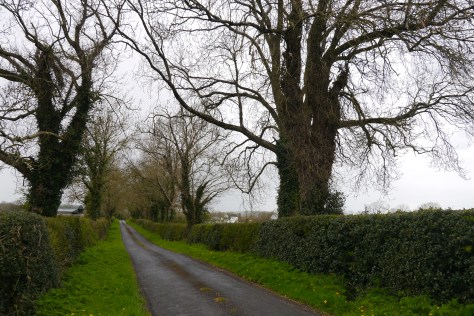
Grange House, now long gone, was once on this road in County Kilkenny.

Lorraine’s notes stated that Martha was one of 13 children, and that their parents were Thomas Shearman (c 1785-1850) and his wife, Charlotte Bennett Clarke (no dates available).4 Her research suggested that Thomas lived in Dunkitt, Kilkenny, near the city of Waterford, but other sources say that he was from the nearby city of Waterford. Perhaps he lived in Dunkitt in his early life, then moved to the city.

I recently came across another Shearman genealogy on familysearch.org.5 This 15-page manuscript was written in 1863 by a member of another branch of the family, George Shearman (1818-1908) of Penn Yan, a small town in New York State. It was clearly based on the family history written by JFS 10 years earlier, and it added more detail about George’s line and had less information about mine. It listed Thomas Shearman and named his sons, but only mentioned that he had five daughters.

All this information comes with a caveat: neither of these documents meets the requirements of genealogical proof standards. The names and dates of birth, marriage and death were probably based on family records and anecdotes and parish records that existed at the time, but today there are no official records in Ireland to back them up.

Nevertheless, records of the Shearmans can be found in various cemeteries, old Irish city directories, newspaper articles, Tithe Applotment Books and indexes of wills. Kilkenny researcher Edward Law found numerous records pertaining to Grange House, home to my Shearman ancestors, and the librarian with the Kilkenny Archaeological Society, Rothe House, Kilkenny was extremely helpful in my search for traces of the family.

This article is also posted on writinguptheancestors.blogspot.ca.

Footnotes

  1. Janice Hamilton, “My Shearman Brick Wall”, Writing Up the Ancestors, Feb. 9, 2014, http://writinguptheancestors.blogspot.ca/2014/02/my-shearman-brick-wall.html
  2. Janice Hamilton, “Waterford Cathedral: A Tale of Two Weddings”, Writing Up the Ancestors, June 8, 2016, http://writinguptheancestors.blogspot.ca/2016/06/christ-church-cathedral-waterford-tale.html
  3. Robert S. Hill, “Shearman, Robert Clarke”, from the Dictionary of New Zealand Biography, Te Ara – the Encyclopedia of New Zealand, http://TeAra.got.nz/en/biographies/1s10/shearman-robert-clarke. Note that this article says Robert’s uncle was William Hobson, first governor of New Zealand; Lorraine has been unable to confirm that.
  4. Charlotte was the daughter of Waterford pewter manufacturer Charles Clarke and his wife “Miss Bennett, late of Bath.” My maternal line has now come to another brick wall.
  5. “Genealogy of the Shearmans”, prepared by George Shearman of Penn Yan, New York, c. 1863 https://familysearch.org/ark:/61903/3:1:939K-VQH2-8?mode=g&i=113&wc=9DWX-ZNL%3A1040900401%2C1040900901%3Fcc%3D1880619&cc=1880619