Category Archives: Quebec

The Irish Catholic Churches in Quebec City

During the first half of the 19th century, thousands of immigrants from the British Isles arrived at the port city of Quebec. Most were fleeing poverty, famine, and overpopulation. Although most of the newcomers continued westward, a number, including many of the Irish Catholics, chose to remain in Quebec City.

In response to the sudden growth in population, the authorities encouraged the opening of new townships around the city. The Irish settled in Portneuf, Lotbinière, Dorchester, Lévis and Québec counties, north and south of the city.

In 1819, the Irish population of Quebec City numbered nearly 1000; by 1830, there were an estimated 6000 to 7000 Irish in the area, representing nearly a quarter of the total population. By 1861, 40 percent of Quebec City’s 10,000 inhabitants were English-speaking, largely because of the Irish families who by now made up 30 percent of the total population.

As early as 1817, Irish Catholic priests were tending to the Irish at Notre Dame Cathedral, and also probably at the Diamond Harbour Parish and the Church of the Nativity in nearby Beauport. The first annual Saint Patrick Mass was most likely celebrated in 1819 in the Congregationalist Chapel in Quebec City.

The earliest church record I was able to trace regarding the Irish of the Québec City region was in 1736 in the parish of Saint Augustin in nearby Saint Augustin de Desmaures in Portneuf County. Notre Dame in Quebec City claims to have records of Irish births, marriages and burials as early as 1728. After the Battle of the Plains of Abraham in 1759, English-speaking Catholics of Irish-Scottish-British origin were identified as such.

Please note: The use of the term Irish Catholic Churches in this research guide does not imply that parishioners were mostly of Irish descent; rather, at one point in time, a minimum of 10% of the acts of baptism, marriage, death at a church addressed Irish immigrants or their descendants.

Furthermore, especially during the early days following the arrival of the Irish in the Quebec City region, the registers showing baptism, marriage and death can only be found through the church records of Notre-Dame Cathedral, even though these acts may have occurred in another small church in the region.

At the Bibliothèque et Archives nationales du Québec (BAnQ) in Montréal and Quebec Ciity, one can find multiple index books of Catholic marriages, baptisms and deaths. I selected the parishes I felt qualified as Irish churches (10 percent or more of baptisms, marriages and deaths) from these records.

For detail on the parishes that served people of Irish descent in and around Quebec City, click on the link to access the PDF:  Irish Catholic Churches of Quebec City

For more background, see,

http://www.irishheritagequebec.net/the-celtic-cross/

https://www.ville.quebec.qc.ca/en/citoyens/patrimoine/quartiers/vieux_quebec/interet/immigration_au_port_de_quebec.aspx

https://www.ville.quebec.qc.ca/en/citoyens/patrimoine/quartiers/saint_jean_baptiste/interet/irlandais_origine_quebec.aspx

http://saintpatrickquebec.com/en/quebec-and-the-irish/

http://www.themetropolitain.ca/articles/view/494


Irish Catholic Churches in Lanaudière and Yamaska

Berthier, Champlain, Joliette, Maskinongé, Montcalm, Nicolet, St-Maurice, Terrebonne, Yamaska Counties

In May, 2014, Genealogy Ensemble posted my research guide to Irish Catholic churches in Quebec. At almost 120 pages, the PDF document is a bit unwieldy, so recently I decided to update the guide and break it into more manageable chunks.

The PDF following this introduction is the first in a series of seven research guides regarding Catholic churches across rural Quebec, Montreal and Quebec City that served the province’s large Irish population.

Irish roots go deep in Quebec. At the end of the 1600s, an estimated five percent of the 2,500 families in New France were Irish. Between 1816 and 1860, a massive number of new immigrants arrived in Canada, and 60 percent of them were Irish. Most of those who were Protestant settled in to Upper Canada or the United States, but most of those who were Catholic remained in Montreal or Quebec City, while others moved into rural areas of Quebec.

The inclusion of a church in this guide does not imply that its parishioners were mostly of Irish descent; rather, it means that, at one point in time, a minimum of 10 percent of the acts of baptism, marriage and death addressed Irish immigrants or their descendants.

This guide focuses on the area that is known today as the Lanaudière, northeast of Montreal on the north shore of the St. Lawrence River, as well as the Nicolet-Yamaska region, between the St. Lawrence and the American border. These are the rural counties of Berthier, Champlain, Joliette, Maskinongé, Montcalm, Nicolet, St-Maurice, Terrebonne and Yamaska, There are several small cities in the area including Trois-Rivières, Joliette and Shawinigan, as well as Saint-Jérôme.

At least one prominent individual who helped to develop this vast area had links with the Irish community. He was businessman Edouard Scallon (1813-1864), whose father immigrated to the Yamaska region from Ireland in 1810.

Scallon moved to L’Industrie (now Joliette) as a young man and went into partnership with the local seigneur, or landowner. He worked primarily as a lumber merchant. He was also involved in a plan to build a railroad, he built a sawmill and a flour mill, and he was a land speculator and money lender.

He died suddenly at age 51, leaving much of his fortune to fund the construction of a trade school, and to the Sisters of Providence for the expansion of the hospital built on land he had already given them.

In 18th century, James Cuthbert (c.1719-1798), a Scottish-born army officer, merchant, justice of the peace, and legislative councilor, touched the lives of many Irish settlers and others.

He first came to Quebec as an officer in the British Army, and remained after the French were defeated and Quebec became a British colony. He left the army in 1765, bought the seigneury of Berthier and had a manor-house built there.

Over the next 25 years, Cuthbert acquired several other seigneuries. Eventually, his land stretched about 50 miles along the St Lawrence River. Irish, Acadian, British, American, French Canadian and a few Germanic families were censitaires, or tenant farmers, on the seigneuries belonging to him.

Cuthbert became a very wealthy man, however, he was often difficult to get along with and had many disagreements with government officials. Because of this, he had little political influence.

Around 1787, Cuthbert, a Presbyterian, built one of the first Protestant churches in the colony, St Andrew’s Church at Berthier. His censitaires were nearly all Catholic, so in 1766, he donated land in the parish of Saint-Cuthbert for a Catholic church there. Several years later, he also supplied stone for the church building, a painting of his patron saint and two bells. In the 1780s he donated land and materials for the construction of the Catholic church of Sainte-Geneviève.

Link to PDF document: Irish Catholic Churches Lanaudiere and Yamaska

For a map of the area, see Google maps, Lanaudière

For more information, see the Dictionary of Canadian Biography online,

Edouard Scallon http://www.biographi.ca/en/bio/scallon_edouard_9F.html  

James Cuthbert   http://www.biographi.ca/en/bio/cuthbert_james_4F.html

Quebec Guardianship Records can help resolve brick walls

Tutelle et Curatelle (guardianships) of the region de Montréal 1791-1807 and of Quebec City, 1639-1930

Life was often short in our ancestors’ times. Epidemics swept through communities, tuberculosis took many, and accidental injuries killed others at a young age. Not every parent lived to see children grow to adulthood.

In Quebec, there was a system to ensure that children who had lost one or both parents, as well as people who were unable to care for themselves, had guardians to look out for them. When a parent died, male family relatives and friends would meet together with a notary and decide who that guardian was to be. The notary would write a legal document known as a tutelle et curatelle to make the guardianship official.

These documents can be very helpful to family history researchers. They can help us understand how a family got through a crisis, and they can also shed light on family networks by identifying the uncles, family friends and so on who were present.

To actually read these documents, you may have to visit the archives. Meanwhile, in this article, I will explain how to find the tutelle et curatelle records that are online.

Tutelle et curatelle records are filed separately from other notarial documents at the Bibliothèque et Archives nationales du Québec (BAnQ). The BAnQ in Montreal alone has more than 300,000 linear meters of these documents, dating from 1658 to 1974, and other branches of the Quebec archives have many more such records.

Definitions

Today, people think of a tutor as a teacher, not a guardian. In this article, we have to understand that both tutors and curators are guardians: tutors are guardians of children, and curators are guardians of young adults.

There were two types of guardianships in Québec:

Tutelle testamentaire – Guardianship governed by a will (testament) issued by a notary in which the surviving parent (father or mother) of the children would assign the guardianship of his or her young children to an adult family member or close friend.

Tutelle légitime – Guardianship governed by the judicial courts, in which full legal tutorship is accorded to the closest adult relative (uncle, aunt, older brother, older sister.) It appears that the majority of guardianships decreed in Québec were this type.

The use of guardianships dates back to the mid-1600s and the first days of the French colony of New France, where the age of majority was 25. After 1783, under British rule, the adult age was 21.

Around 1791, British Laws were implemented in Quebec. The laws governing various judicial jurisdictions were grouped under the general heading of Laws of Canada and among those was one such law governing the tutorship (guardianship) of children and incapacitated adults. The latter dealt with those who could not take care of themselves and needed supervision by others. In 1865, the Civil Code of Lower Canada basically addressed the same issues with slight variations of content.

Searching for the records

If your ancestors lived in the Quebec City region, you are in luck. Familysearch.org has placed online tutelle et curatelle records from 1639 to 1930. Take a look at the wiki page, https://www.familysearch.org/wiki/en/Quebec,_Quebec_Judicial_District,_Guardianships_(FamilySearch_Historical_Records)

You can access the actual records at

https://www.familysearch.org/search/collection/1399459

There are more than 300,000 images and they have not been indexed, so you will need to browse them. They are separated into numbered files by year.

In another, separate database, the BAnQ in Montreal has placed online tutelle et curatelle notarial records from 1791 to 1807. Even within that short time frame, this database contains 22,879 searchable links. In the future, more such records will likely be made available online.

To access this database, go to http://www.banq.qc.ca/archives/genealogie_histoire_familiale/ressources/bd/instr_archives_civiles/tutelle_montreal/index.html

This is what you will see on that page:

Tutelle et curatelle (Tutorships and guardianships)

On this page, click on the blue box on the right side of the page that says Consultation de l’instrument de recherche (Access to the searchable online database.)

The next page will indicate: Nouvelle recherche (New Search), and one line below in the colour blue, Chercher par (research by):

Nom (family name)

Prénom (first name)

Titre (title) – Enter Tutelle

Acte (Tutorship Act) – Enter Tutelle

Date – Enter the date of the date of event.

If your family name was not a common one in Quebec, you can simplify your search. Go to the page https://applications.banq.qc.ca/apex/f?p=148:2::::::  Then, next to Nom, just enter the family name you are researching.

The database includes the following information:

Pupille (First name of child)

Date tutelle (Date of Tutorship decreed (judicial order))

Défunt (Deceased person) In most cases, the name of the father or mother

Tuteur (Tutor), the person described on line 1 and line 2

Autre (Other) – In rare cases in which limited information is available in regard to a particular act of Tutorship

The Next Step in Your Research

Unfortunately, the information obtained in this online database is basic at best. By clicking on Détails on the right hand side of each name, you will access another page indicating the family, first name of the child, and the date of the tutorship.

For example, I entered the name of Smith under Nom. This search resulted in 25 results from 1796 to 1807. I picked one, Enos Smith, and the results obtained online under Détails read as follows:

Nom: Smith

Prénom: Enos

Titre: Pupille

Acte: Tutelle

Date tutelle: 1804-02-07

At the bottom of the page, a box will appear:

> Seul le contenu sécurisé s’affiche (Only the secured information will be posted) >> Afficher tout le contenu (Access to content of file)

The results obtained are precisely the same as the previous page. This most likely indicates that you can only see the full content of the original document by visiting the BAnQ.

For the closest branch of the BAnQ, see

http://www.banq.qc.ca/archives/entrez_archives/centres_archives/index.html

There are 10 branches of the BAnQ across Québec. The repository in Montréal is listed on the website under Vieux Montréal; the archives in Quebec City under BAnQ Québec, the branch in Sherbrooke in the Eastern Townships under BanQ Sherbrooke, and the branch in western Quebec near Ottawa is called BAnQ Gatineau.

Always contact by email the archives branch to confirm whether the record you wish to access is actually stored at that branch. Emails written in the English will be answered in the English language.

I recommend for the initial requests to be sent by email. Once you have obtained the name of the technician assigned to your dossier (file), telephone calls are in order. And once you reach the archives, you may need help locating the tutelle et curatelle files.

Compiled, adapted and researched by Jacques Gagnégagne.jacques@sympatico.ca

Polio in the Family

My Auntie Elsie McHugh was quite a chatterbox and so were her budgies. When we used to visit her, the budgies filled the room with the sound of their chatter, competing to be heard. Unless it was time to go to bed, or someone was coming in the door, the budgies were free to fly around the apartment. It was quite an adventure to go there.

My Uncle Jimmy Scott was usually sitting in his favourite chair, not saying a word.

Certainly when I remember Elsie, I think about her continual stream of conversation and story-telling. But I also remember that she had a distinct limp.  This didn’t stop her from being a snazzy dresser or wearing fancy shoes.

Scott, Jimmy and Elsie McHugh

Jimmy Scott and Elsie McHugh

As an adult, I learned that Auntie Elsie limped because she was stricken with paralytic polio when she was an infant living in Dundee, Scotland at the beginning of the 1900s.1 While today, polio is almost eradicated, at that time it would have been a frightening disease.

Only Elsie, out of the family of seven children, contracted poliomyelitis, the medical term for polio. Dr. Ivar Wickman of Sweden proved that polio was contagious in 1905. This was probably after Elsie was sick. And it was not until the 1930s that it was discovered that it was an intestinal infection and spread by the oral-fecal route, and not an airborne virus, as previously thought.2

During Elsie’s childhood, the family lived in a tenement in industrial Dundee, near the jute factories. There was overcrowding and poor sanitation.

In children, paralysis from polio occurs one in a thousand cases. Most children are simply sick and consequently develop an immunity to it.3 It is probable that Elsie’s siblings were also exposed to polio, but they suffered from no permanent consequences.

Because young Elsie limped and probably could not run or jump very well, she was considered disabled or “crippled.” As a result, she attended a special school to learn cooking, needlework and housekeeping. The other girls in the family resented the special education that Elsie received.

In Scotland, children had to attend school between the ages of five and thirteen. In addition, the morals and tenets of the Church of Scotland were influential. The church believed that children should be taught to be self-sufficient.4 Therefore, there was considerable pressure on educational institutions to provide for all children, including the blind, deaf and physically disabled.

Throughout the 1800s, institutions for the blind and deaf were opened in the major cities in Scotland.5 It is likely that Elsie attended one of these institutions as some of them expanded to include “cripples.”

The family immigrated to Montreal, Canada in 1912. Elsie was fourteen and would have finished her schooling by then. As far as I know she always worked in a department store as a saleslady, but like many women at the time, she quit her job when she married Jimmy Scott in 1926.6 Her daughter, Norine Scott, was born the next year. 7

Many people who have had polio in childhood experience symptoms of fatigue, weakness in the muscles, pain and breathing problems later on in their lives.8 I remember Auntie Elsie used to have difficulty breathing but she always said that it was old age.  Elsie never let anything get in the way of her enjoying life and she lived to the respectable age of 91.9

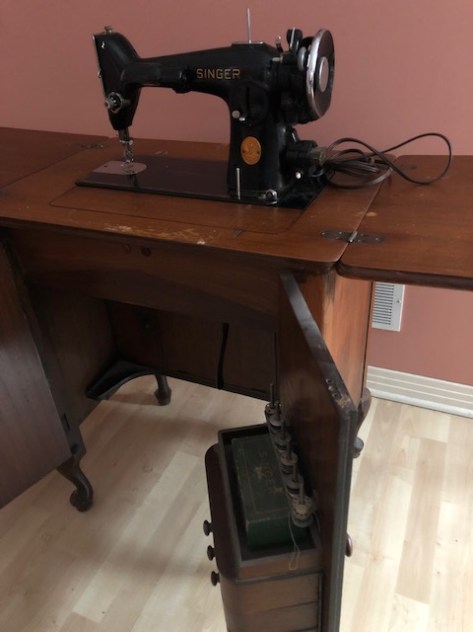
She did put her skills to good use at home, cooking for the family and sewing. I have inherited her Singer sewing machine, although I don’t sew at all. The machine works by pushing on a lever with your knee. It is a lovely piece of furniture in my home and, more importantly, a beautiful keepsake of my Auntie Elsie.

sewing machine


  1. Birth register of Elsie McHugh, November 10, 1898, District of St. Mary, Burgh of Dundee, National Records of Scotland, Scotland’s People web site, accessed December 1, 2017.
  2. Post-Polio Health International, History of Acute Polio, Tony Gould, unknown date, http://www.post-polio.org/edu/aboutpol/hist.html, accessed January 28, 2019.
  3. Wikipedia, History of Poliomyelitis, https://en.wikipedia.org/wiki/History_of_poliomyelitis, accessed January 28, 2019.
  4. The Semantic Scholar, Voices from the Past, Early Institutional Experience of Children with disabilities – The case of Scotland, Iain Hutchison, https://pdfs.semanticscholar.org/f5d8/80cd842c518f3bc8a2dd3f5fb4e359eecf7e.pdf, accessed January 28, 2019.
  5. Ibid.
  6. Personal notes of author.
  7. Personal notes of author.
  8. Post-Polio Health International, History of Acute Polio, Tony Gould, unknown date, http://www.post-polio.org/edu/aboutpol/hist.html, accessed February 6, 2019.
  9. Personal notes of author.


The Protestant Churches of Quebec City, 1629-1759

Some 15 or 20 years ago, someone asked me to research and compile a document addressing the earliest Protestant churches in Quebec and find out where the church registers are. Listed here are Quebec City region Protestant missions organized from 1629 to 1759. None of the church registers have survived.

A number of Huguenot merchants from La Rochelle, Bordeaux and Rouen, France were present in Quebec City in September, 1759 when the British army conquered the French forces at the BattIe of the Plains of Abraham. More than a century before those events, Huguenot merchants were members of a small Calvinist church in Quebec City.

1629 Lutheran Chapel – It is on record that the Kertk (Kirke) brothers, and a small group of French Protestants (Huguenots from France), who captured Québec in the name of King Charles I of England on the 20th of July, 1629, built a Lutheran Chapel in Nouvelle France at the time. David, Louis, Thomas Kertk (Kirke), their wives, plus two other women and an undisclosed number of men worshipped until 1633 in Québec.

1631 – Temple Calviniste – A small community of Huguenots (Reformed Church of France) established a Calvinist Temple in the old city of Québec in the early 1630s or shortly after. The small temple would have been located near the Couvent des Ursulines. Most of the Huguenots at the time in Québec were traders who imported goods from French ports such as Auray, Bayonne, Bordeaux, Brest, Caen, Calais, Cherbourg, Dieppe, Dunkerque, Fecamp, Le Havre, Honfleur, La Rochelle, Lorient, Nantes, Paimboeuf, Port Louis, Rochefort, Rouen, Royan, Les Sables d’Olonne, Saint Brieuc, Saint-Malo and Vannes. These same Huguenots were also merchants, mainly in the purchasing and exporting of fine furs and selected hardwoods in New France. This small but thriving Protestant community was instrumental in opening-up trade partnerships between Nouvelle France and fellow Huguenot associates in France and other European countries including Belgium, the Netherlands, Germany, Switzerland and the British Isles.

1759 – Chapel of the Ursulines  – First Anglican Church service in Québec on September 27th 1759 – Rev. Eli Dawson, presiding – Chaplain of the British Forces headed by the late General James Wolfe, Commander in Chief of the British Imperial Army – In attendance were French speaking Huguenots from the Québec region.


Tips on Researching Gaspé Ancestors

Over the centuries, Quebec’s Gaspé Peninsula has been home to a mix of residents including the Micmac First Nations people, French settlers, Acadians and Loyalists. The Gaspé is surrounded by water on three sides — the estuary of the St. Lawrence River, the Gulf of St. Lawrence and the Bay of Chaleur – so in the past, many Gaspé residents made their living by fishing, however, the fishing industry has changed and suffered in recent years. The interior of the peninsula features mountains, forests and rivers.

If you had ancestors from the Gaspé, the idea of researching their lives might seem daunting. It is a long way from central Canada, and many people in the region do not speak English today. However, there are a number of databases and other resources online, and you can contact the archives there to ask for help.

The attached PDF has links to a variety of resources, including background on the Loyalists who came from the United States after the revolution and settled in the area. The major part of this document lists the notaries who practised in the Gaspé. Their records should help you find your ancestors’ land transactions, business agreements, wills, inventories, and other records.

One of the best researchers to have studied the people of the Gaspé was Michel Émard, a medical doctor, historian and author. This research guide tells you where to find the books he wrote. It also tells you how to contact the main archives serving the area.

Here is the link to the PDF: notaries of the gaspé peninsula guide

Bulletin des Recherches Historiques

If your ancestors lived in Quebec between 1640 and 1940, you may find them mentioned in a periodical called Bulletin des Recherches Historiques, published by one of the province’s senior archivists and his sons. Searching this publication takes a little effort, and it helps if you can read some French, but your time may be well spent.

Archivist Pierre-George Roy and two of his sons did their research over several decades and published the Bulletin between about 1920 and 1943. In 1920, Roy was the first archivist at the Archives de la Province du Québec, the precursor of the Archives nationales du Québec (BAnQ), and he later became senior archivist at the Archives nationales du Québec in Quebec City. His two sons were also archivists.

Roy obtained the majority of his material from notarial documents. His father, Joseph-Edmond Roy, was a notary in Québec City from 1880 to 1911, and other Roy family members were also notaries.

The Bulletin includes a variety of articles including family genealogies, profiles of individuals, amusing anecdotes and accounts of historical interest. Some articles focus on high-profile people such as land owners and civil servants in the days of colonial New France. Others look at Catholic religious orders, laws and the courts, but there do not seem to be many women mentioned.

The articles are not exclusively about French Canadians; they also include Acadian, British, Scottish, Irish, Germanic, American, Jewish, Loyalist and Huguenot families and individuals. Ancestors of at least four members of Genealogy Ensemble are covered in the pages of the Bulletin.

When the BAnQ copied these periodicals, it named the database Le Bulletin des Recherches Historiques 1895-1968, however, it appears that the articles cover the period 1642 to 1942, not 1895 to 1968.

To find out whether any of your ancestors is mentioned in the Bulletin, start by scrolling through the 818-page PDF of the index. The volume number is underlined and the second number is the page number. Here is a link to the index: http://numerique.banq.qc.ca/patrimoine/details/52327/2656928

Once you have found your family’s name in the index, the next step is to go to the database that includes the actual volumes of the Bulletin. Open http://numerique.banq.qc.ca/ and, on the right hand side, put in your search terms: Bulletin des Recherches Historiques, as well as the volume number in roman numerals and the name of the month the issue appeared in French.

For example, according to the index, the name Bagg appeared in volume 49, page 59, so the search term is “Bulletin des Recherches Historiques XLIX Fevrier” You may have to guess the month, depending on the page number. Then scroll down to find your ancestor. You can also find hard copies of this publication at la Societé généalogique canadienne-française (https://www.sgcf.com/) in Montreal.

The language level of the magazine is not difficult, and you can use Google Translate or a similar online tool to help with the translation.

Here are links to a few samples of the Bulletin that I found interesting:

http://collections.banq.qc.ca/jrn03/dn2087/src/1935/02/164865_1935-02.pdf

http://numerique.banq.qc.ca/patrimoine/details/52327/2656928

http://numerique.banq.qc.ca/patrimoine/details/52327/2656964

http://numerique.banq.qc.ca/patrimoine/details/52327/2657360

http://numerique.banq.qc.ca/patrimoine/details/52327/2656957

http://numerique.banq.qc.ca/patrimoine/details/52327/2657519

http://numerique.banq.qc.ca/patrimoine/details/52327/2657338

http://numerique.banq.qc.ca/patrimoine/details/52327/2657158

http://numerique.banq.qc.ca/patrimoine/details/52327/2657205

http://numerique.banq.qc.ca/patrimoine/details/52327/2657158

http://numerique.banq.qc.ca/patrimoine/details/52327/2657534?docsearchtext=Braillard%20de%20la%20Madeleine

http://numerique.banq.qc.ca/patrimoine/details/52327/2657523?docsearchtext=Braillard%20de%20la%20Madeleine

Seigneuries of the Charlevoix and the Saguenay

Beginning in 1535, long before the establishment of Nouvelle France by Samuel de Champlain, Europeans traded goods for furs with the indigenous people in the region referred to as the Royaume (kingdom) du Saguenay (1535-1842).

For centuries, the fur traders had complete control of the Saguenay River and the Lac-Saint-Jean regions of Quebec. Because the fur industry was so dominant, farming was forbidden in the Lac-Saint-Jean area until the 1850s.

The Charlevoix refers to the area of boreal forest along the north shore of the St. Lawrence River, northeast of Quebec City, including present-day towns such as La Malbaie. The Saguenay River, which flows south from Lac Saint-Jean, enters the St. Lawrence near the village of Tadoussac.


Mouth of the Saguenay River at Tadoussac; Janice Hamilton photo

The attached research guide lists the fur trading companies that operated in Nouvelle-France and Québec, from the first such company established in France in 1614 to the Hudson Bay Company in 1854.

In 1835, 1,830 young farmers from the south shore of the St. Lawrence and the Charlevoix region signed a petition sent to Governor Archibald Acheson of Gosford, requesting access to lands in the Lac-Saint-Jean region. When Acheson and later governors did not react to the petition, many young Quebecers moved to the New England States and other parts of the United States in order to seek jobs.

In the late 1850s, the fur trade declined and the fur trading companies lost their political influence. Finally, the Lac-Saint-Jean and upper Saguenay areas were opened to agriculture, however, by this time, the seigneurial system had been abolished across Quebec.

This 23-page PDF includes a list of the seigneurs and business leaders who controlled the Charlevoix and Saguenay areas for almost two centuries. It lists regional cemeteries and briefly describes the counties and towns in the area. It includes a list of the fur trading companies that operated in the region and a list of the notaries who prepared documents such as business contracts and wills. At the end of the guide you will find contact information for the archives and historical societies found in these regions.

See the research guide here: seigneuries of charlevoix, chicoutimi and saguenay


Jacques Gagné’s Research Interests in 2018 and 2019

2018 was a busy year for genealogy researcher Jacques Gagné, so if you missed any of his posts, here is a recap of his work and a look ahead to 2019.

For many years, Jacques was a volunteer researcher at the Quebec Family History Society, so he has a broad knowledge of genealogical records in Quebec. He is particularly knowledgeable about resources at the Bibliothèque et Archives nationales du Québec (BAnQ), finding notarial records, searching for ancestors in France and anything to do with the Huguenots.

He is now on the far side of 80 and his eye sight is not what it used to be, so the amount of research he has accomplished for Genealogy Ensemble is all the more impressive. He is passionate about what he does and he just keeps pushing ahead. The list of projects he would like to do in the future is almost as long as the list of his past achievements.

                 Jacques Gagné

Jacques’ work is actually a collective effort. He does all the hard work of exploring the Internet and putting together the research guides, while Claire Lindell and Janice Hamilton (me) revise them, edit the introductions and post everything online. I took a year off between the spring of 2017 and April 2018, which is why there is a gap in his posts.

The major research guides posted in 2018 focused on one main theme: the seigneuries of Quebec. From the time New France was created in the 1600s until the mid-1800s, most land in Quebec was owned by a few individuals known as seigneurs. They were usually French aristocrats, wealthy merchants or military leaders. Most ordinary Quebecers were tenant farmers living on the seigneuries. Jacques identifies the seigneurs and seigneuries in each region, and the notaries who practised there. He also includes a list of cemeteries in each area and repositories for archival material and other resources.

Another post from 2018 was a list of notaries who practised in the years after Quebec came under British rule, between 1760 and 1848. He also put together research tips for finding Huguenot ancestors in France, tips for searching at the BAnQ and French municipal archives, and a heads up on a wonderful online resource, the New France Archives from Library and Archives Canada, nouvelle-france.org.

Jacques has been hard at work for several months on a new series of guides for 2019 on the merchants, ship owners and fur traders of New France. This series looks at the men who did business in New France. Many of them were born in France but married and died in North America, and some were also notaries or played other important roles in the new world. The series includes a post about their ports of departure and their trading partners back in France, as well as background on the trading companies they were associated with.

He is also working on a new series of posts updating his old research guide to the Irish Catholic churches of Quebec (https://genealogyensemble.com/2014/05/20/irish-catholic-churches-of-quebec/). Meanwhile, guides to ancestors in the Charlevoix and Gaspe regions, and more tips on searching in France are coming soon.

If you missed some of Jacques’ past compilations, or are having trouble finding something you noticed several months ago, our blog has several features that makes searching easy.

On the right hand side of the screen, under the Geneabloggers logo and before Categories, there is a Search box. Enter any terms that you might think will take you to a post you are trying to find, such as the name of a region, as well as Gagné. (It will work without the accent.) If you find an article of interest and open it up to its full length, you will find suggestions for related articles at the bottom of the page.

You can also look down that column on the right of your screen until you come to Jacques’ name (it is the fourth name in the list) and click on it. You can then scroll backwards through all his posts. When you get to the bottom of a page, click on Older Posts.

Finally, below all the authors’ names on the right is a search function called Archives. It brings up all our posts from each month.

Thank you for following us since 2014, and good luck with your research in 2019.

Townships of Pontiac, Gatineau Counties, plus the Township of Hull

Prior to the arrival of the first European settlers, the area around the Gatineau hills of Quebec, north and west of Ottawa, was the home of the Anishnabe Algonquin First Nations people. Between about 1800 and 1900, western Quebec was settled by British, American, Irish Protestant, Scottish, Irish Catholic, French Canadian and Germanic families. The Germanic settlers had a strong presence in this region. To my knowledge, there were few Loyalists or Huguenots.

Prior to 1845, people and goods were transported primarily by barge along the Ottawa River, which separates Quebec and Ontario. The steamboat that operated on the Ottawa River between Montreal and Ottawa could not manage the rapids between Carillon and Grenville, so in 1854, the Carillon and Grenville Railway, a short 12-mile-long portage railway, was organized.

Prior to 1845, when they purchased land, finalized business deals or wrote their wills, the settlers of western Quebec likely dealt with notaries from Montreal, and perhaps those in Vaudreuil and Rigaud. The section of this compilation that lists notaries begins in 1845, since the Judicial District of Hull was a late-comer among judicial districts across the province.

Today, this region is well served by two superb archives and four regional genealogical societies. Contact details for all these places can be found in the attached compilation.

BAnQ Gatineau – Bibliothèque et Archives nationales du Québec

LAC – Library and Archives Canada, Ottawa

OGS – Ottawa Branch of the Ontario Genealogical Society

SGO – Société de généalogie de l’Outaouais

Gatineau Valley Historical Society

Pontiac Archives (genealogy society, located in Shawville, QC)

See: Townships of Pontiac and Gatineau Counties plus the the township of Hull

The contents of this 23-page compilation are as follows:

Page 1  the settlers (including farmers, businessmen, militia officers, politicians)

Page 3  the counties in 1791

Page 4  the townships in chronological sequence

Page 11 regional cemeteries

Page 13 Outaouais region (a list of cities, towns, villages)

Page 14 description of notarial records

Page 15 the notaries

Page 22 area archives and genealogical resource centres