Category Archives: Quebec

Chasing the Voyageurs, part 2

The fur trade was a key part of Canada’s history and hundreds of people were involved in it from the late 1600s to the early 1800s. One way to research an ancestor who was a fur trader is to find the contracts he signed, contracts thwere generally prepared by notaries in Montreal, Quebec or Trois-Rivières.

The notaries who handled fur trade contracts in the 18th and 19th centuries were:

Louis Chaboillez – Montréal 1787-1813 – 9,346 bibliographical records

John Gerbrand Beek – Montréal 1781-1822 – 5,277 records

Jonathan Abraham Gray – Montréal 1796-1812 – 3,258 records

Jean-Baptiste Adhémar– Montréal 1714-1754 – 3,151 records

Louis-Claude Danré de Branzy – Montréal 1738-1760 – 2,784 records

François Simmonet – Montréal – 1737-1778 – 2,139 records

Joseph Desautels – Montréal 1810-1820 – 1,638 records

Antoine Foucher – Montréal – 1746-1800 – 1,056 records

Henry Griffin – Montréal 1812-1847 – 952 records

Pierre Panet de Méru – Montréal 1755-1778 – 824 records

François Leguay – Montréal 1770-1789 – 814 records

Nicolas Benjamin Doucet – Montréal 1804-1855 – 609 records

Henry Crebassa – Sorel 1795-1843 – 555 records

Joseph Cadet – Québec 1784-1800 – 276 records

Charles Claude Pratte – Trois-Rivières 1801-1817 – 236 records

Louis-Joseph Soupras – Montréal – 1762-1792 & 1809-1832 – 150 records

Pierre Ritchot – Montréal 1821-1831- 117 records

Joseph Gabrion – Montréal 1780-1804 – 54 records

Jean-Baptiste Desève – Montréal 1785-1805 – 15 records

One of the busiest of these notaries was Louis Chaboillez, who practiced in Montreal. Summaries of the more than 9000 fur trade contracts he handled can be found online on the website of the Societe historique de Saint-Boniface (SHSB) at http://archivesshsb.mb.ca/fr/list?q=Louis+Chaboillez&p=1&ps=20

The SHSB in Winnipeg has a special interest in the history of the fur trade and the people who were involved. You can learn more about the SHSB heritage center at http://shsb.mb.ca/en/about_us. This society can also help with genealogy research, especially if you have Metis ancestry. See http://shsb.mb.ca/en/Collections_and_Research.

Diane Wolford Sheppard of the French-Canadian Heritage Society of Michigan has done extensive research on the fur trade during the French Regime, especially in the Detroit region of Michigan, the Mississipi River in Illinois and the Green Bay region of Wisconsin. This includes Fort Michilimackinac (Mackinac Island & Mackinak County, Michigan) 1683-1754; Fort Pontchartrain du Détroit – Fort Détroit (Detroit, Michigan) 1701-1760; Fort de Chartres (Mississipi River in Illinois) 1718-1731; Bay of Sauks (Ouisconsin) — Fort Winnebago; (Green Bay, Wisconsin) 1640s-1763.

The notaries in New France who handled fur trade contracts for destinations in Michigan, Illinois and Wisconsin were:

Antoine Adhémar – Montréal 1668-1714 – Trois-Rivières 1668-1714

Claude Mauque – Québec 1674-1682 – Montréal 1677-1696

Hilaire Bourgine – Montréal 1685-1690

Pierre Raimbault – Montréal 1697-1727

Michel Lepailleur de Laferté – Québec 1700-1715 & Montréal 1701-1732

Jean-Baptiste Adhémar – Montréal 1714-1754

Henri Hiché – Québec – 1725-1736

François Simmonet – Montréal – 1737-1778

http://www.habitantheritage.org/french-canadian_resources/the_fur_trade This article on the website of the French-Canadian Heritage Society of Michigan links to a variety of resources about the fur trade in the 17th century.

http://habitantheritage.org/yahoo_site_admin/assets/docs/Women_and_Their_World_-_for_website.275153906.pdf This article by Diane Wolford Sheppard lists some women who were involved in the fur trade or liquor trade in the 17th century.

http://habitantheritage.org/yahoo_site_admin/assets/docs/Outdoor_Activities.27051652.pdf This article mentions the names of some of the men who were present in Detroit around 1715.

If you had an ancestor who worked for the Hudson’s Bay Company, take a look at this article from the Alberta Family History Society on researching family history at the archives of the HBC: http://afhs.ab.ca/aids/talks/notes_mar98.html. The Hudson’s Bay Company records are at the Manitoba Archives, https://www.gov.mb.ca/chc/archives/hbca/.

Library and Archives Canada has many records of people who worked in the fur trade; for example, http://www.bac-lac.gc.ca/eng/discover/genealogy/topics/employment/Pages/fur-trade.aspx

The McCord Museum in Montreal has records of the North West Company, one of the major players in the later years of the fur trade. Some of its photos and documents have been digitized; see http://collections.musee-mccord.qc.ca/scripts/search_results.php?keywords=North+West+Company&Lang=1

Notarial records including fur trade contracts from prior to 1800 can be found on the Parchemin database; see https://genealogyensemble.com/2017/01/01/finding-quebecs-early-notarial-records/

The Bibliothèque et Archives nationales du Québec (BAnQ) is slowly digitizing its collection of notarial documents, but most can be consulted on microfilm at the archives in Montreal and other branches across Quebec.

The Société de généalogie de Longueuil (http://www.sglongueuil.org/), just south of Montreal, also has an extensive collection of notarial records on microfilm; see http://www.sglongueuil.org/cadres/texte/greffes.html.


Safe Passage

img_0399

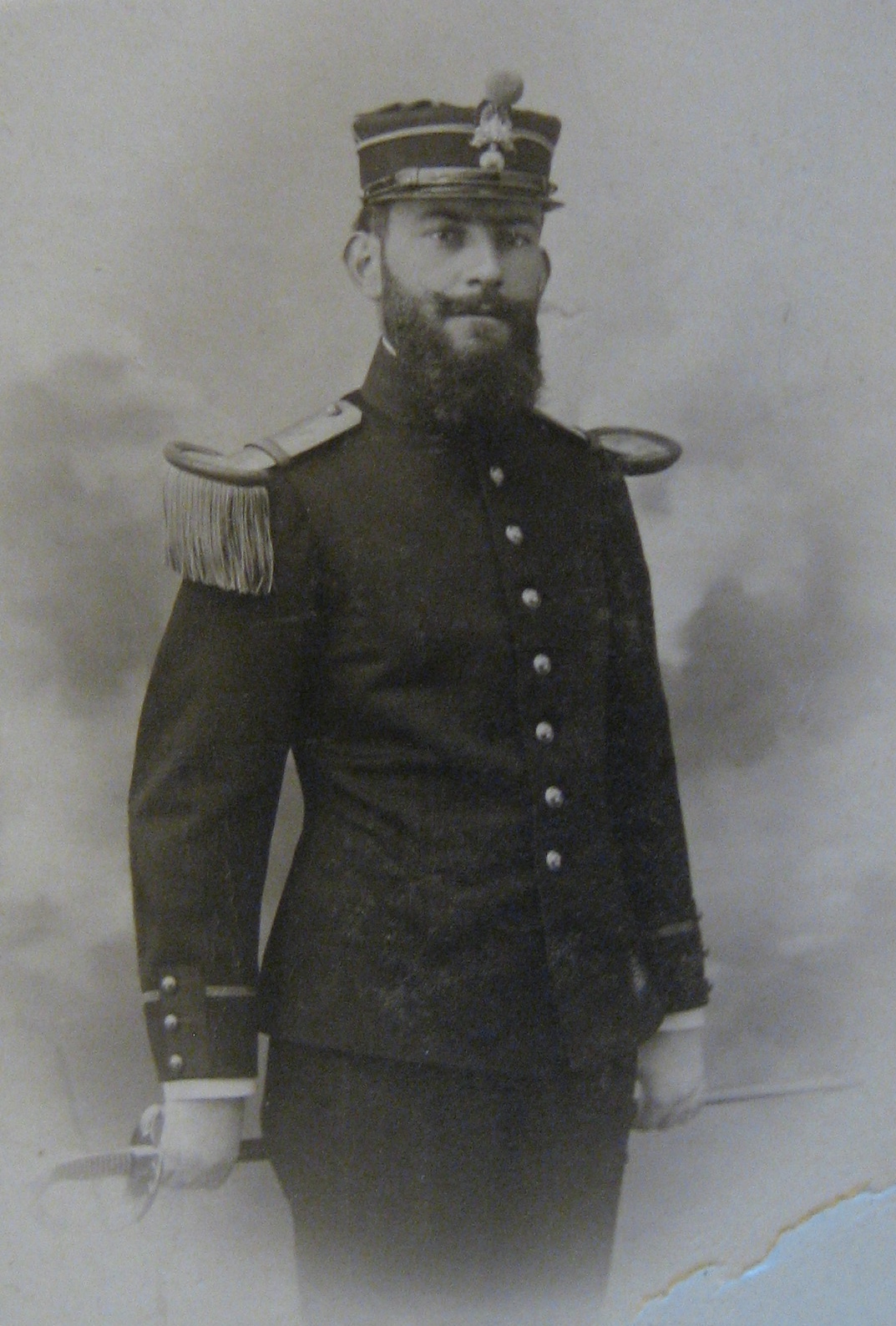
René Emile Raguin, my grandfather, was the last of my relatives to arrive in Canada. He was the only one to return home after he emigrated. His family, originally from Doubs, France, moved to Fleurier, Switzerland soon after he was born.

He arrived in Canada aboard an Allen Line steamship, the Lake Erie and so didn’t have to endure a long voyage on a sailing ship. It was 1910 and he was 23 years old. He had been a Lieutenant in the French army. His father was French and as the son, even though he lived in Switzerland, he had to do his service. He had also trained as a teacher but there were no jobs in Switzerland, so he was fortunate to find a job at the French Protestant school in Pointes aux Trembles, Quebec.

René was a dapper little man with a full beard and moustache. He was sure he was going to be a hit with Canadian girls although his landlady told him they didn’t like men with a lot of facial hair. The morning after meeting Beatrice Bruneau and her sisters, he came downstairs with only a goatee! In later years he only had a small moustache but with a completely shaved head.

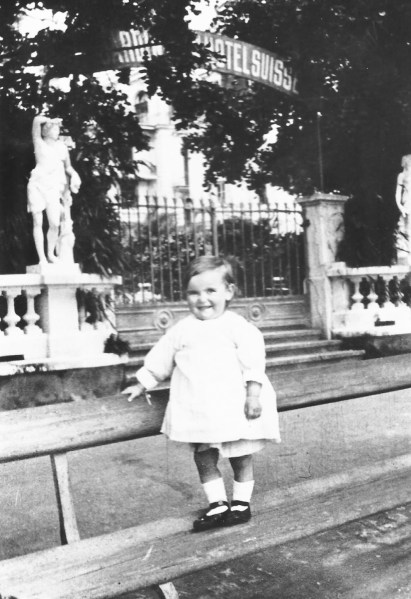
René and Beatrice were married in 1912 in Cornwall, Ontario by Beatrice’s father, Reverend Ismael P. Bruneau. Their first daughter Aline Marguerite was born in May 1913. The next summer they sailed to Europe to show off Aline to Rene’s family. Rene enjoyed the voyage, walking on deck with his little daughter, but Beatrice, pregnant with their second child Robert, suffered from seasickness and was mostly invisible. Rene was very happy chatting with all the other passengers who wondered about the little girl’s mother.

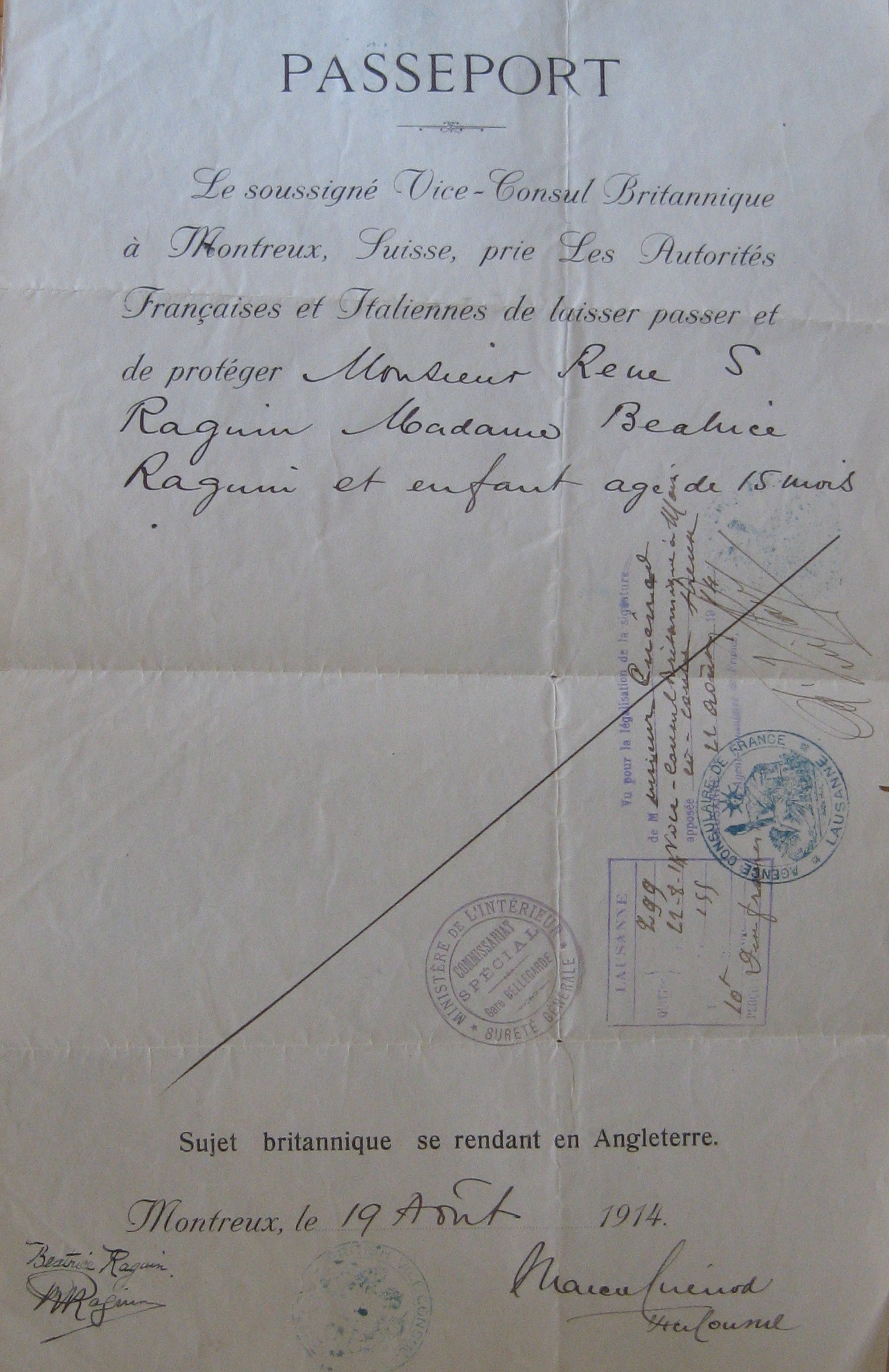
They were having a wonderful time in Fleurier, visiting Rene’s parents, Joseph Marie and Rosina Steinman Raguin and his sister Bluette, when Archduke Franz Ferdinand was assassinated and World War I began. When England declared war on Germany on August 4, 1914, returning to Canada as quickly as possible became a priority. As Rene had become a Canadian/British citizen in 1913, they appealed to the British Government and received a document of safe passage through both France and Italy to return to England. They made a quick journey by train from Switzerland to Le Havre, France taking what they could easily carry and leaving their trunk behind.

They made it safely back to Canada where René was then the principal of De La Salle Academy in Trois Rivieres, Quebec. The school administration had been worried he wouldn’t return for the beginning of the school year. He used his story to raise money during the war, for the Canadian Patriotic Fund. 

Robert was born in December followed by Arthur, Dorothy and Madeleine. René continued teaching and finished his career as a French teacher at Baron Byng High School in Montreal. They spent summers in Dunany north of Montreal where he enjoyed golf and socializing and winters in Montreal where he curled and socialized. He and Beatrice didn’t travel very much, just one train trip to Vancouver to visit their son Robert. They never returned to Europe, never again saw any of Rene’s family or their trunk.

img_0364

Notes:

Rutherdale, Robert. Hometown Horizons: Local Responses to Canada’s Great War. Vancouver: University of British Columbia, 2004. Print.

Anecdotes personally communicated to the author by Aline Raguin Allchurch in 2003.

Passeport; original document in possession of author.

Rene’s British /Canadian Naturalization Certificate was in his possession in Europe to obtain his Passport but the document was later lost as it was replaced in 1916. Libraries and Archives Canada: Citizenship Registration Records for Montreal Circuit Court 1851-1945.

Military documents in possession of the author.

Aline in Switzerland

Chasing the Voyageurs, part 1

Have you heard a family story about an ancestor who was a voyageur or coureur des bois? These were the men who canoed across the interior of North America to trade with the indigenous people for beaver pelts and other furs and bring the pelts back to Montreal.

The fur trade thrived in the 17th and 18th centuries and the early years of the 19th century. Setting out from Montreal, the voyageurs’ destinations included what is now western Canada, Ontario, Michigan and Illinois. Some had wives and children in Quebec and some fell in love with aboriginal women and were the ancestors of Canada’s Métis people.

Before they set out on their travels, the voyageurs signed contracts with fur trading companies or their agents. These contracts specified where they were to go and for how long, and how much they were to be paid. Notaries, most of whom resided in Montreal, Lachine or Ste-Anne-du-Bout-de-l’Ile (now known as Ste-Anne-de-Bellevue), prepared the contracts and kept them on file. As a result, more than 34,500 of these contracts have survived.

The notarial records themselves are stored at the Bibliothèque et Archives nationales du Québec (BAnQ) along with all the other contracts, wills, leases and other documents these notaries prepared.

In addition, the information in many of the voyageurs’ contracts is available online, thanks to La Société historique de Saint-Boniface (http://shsb.mb.ca/en). St. Boniface is a traditionally French part of Winnipeg, Manitoba, and its Centre du patrimoine (heritage center) specializes in the history of the francophone community of Manitoba, and in the heritage and genealogy of the Métis people.

http://archivesshsb.mb.ca/en/list?q=Notaires+de+Montr%C3%A9al&p=1&ps=20 This link takes you to the database of contracts. You can search in English, but the data is mostly in French. There are various ways to search the database, but if you know your ancestor’s name, you can put that into the search box. There is a small box for each result, and clicking on “more detail” opens it up. Included in the details is the date the contract was signed. For example, 18090503 indicates May 3 1809. You can use Google translate or a similar online translator if you need help understanding the text.

http://habitantheritage.org/yahoo_site_admin/assets/docs/Fur_Trade_Contracts_during_the_French_Regime.29095438.pdf This article by Diane Wolford Sheppard of Michigan is a collection of representative contracts drafted during the French Regime, including engagé (hiring) contracts, partnerships, partnership settlements, obligations and invoices for fur trade purchases. They have been translated into English.

http://www.habitantheritage.org/french-canadian_resources/the_fur_trade For more in-depth background, images and documents about the fur trade in the Great Lakes region, see this page posted by the French Canadian Heritage Society of Michigan.

See also http://www.thecanadianencyclopedia.ca/en/article/voyageur/

Finding Quebec’s Early Notarial Records

Many people living across North America today had ancestors in the colony of New France or in the British colony of Quebec prior to 1800. The legal documentation of their business transactions, property transfers, wills and marriage contracts were prepared by notaries.

Notarial acts written after 1800, plus a few from the late 18th century, are available on microfilm at the Bibliothèque et Archives nationales du Québec (BAnQ) and are in the process of being digitized. You can search the BAnQ website (http://bibnum2.banq.qc.ca/bna/notaries/), while a growing number of notarial documents can be viewed on familysearch.org (https://familysearch.org/wiki/en/Quebec_Notarial_Records) and on Ancestry.ca (http://search.ancestry.ca/search/db.aspx?dbid=61062&geo_a=r&o_iid=41015&o_lid41015&_sch=Web+Property).

But most acts of notaries prior to 1800 are only available through a database called Parchemin, and you will have to visit a branch of the BAnQ or go to Library and Archives Canada (LAC) in Ottawa to consult this database.

Parchemin is a collection of hundreds of thousands of records prepared by the notaries of early Quebec, from the first French settlement of North America until December 31, 1799. During this two-century period, more than 275 notaries practised in New France and in Quebec following the British conquest. The collection of original documents takes up hundreds of meters of shelf space, and is mainly preserved at the BAnQ.

The Parchemin database was built with software designed specifically for notarial documents. It displays like a computer directory, providing access to personal data, as well as to other information regarding the nature of the transaction.

The Parchemin database was developed by Archiv-Histo with the financial support of the Chambre des notaires du Québec, the Social Sciences and Humanities Research Council of Canada, the Ministère de la Culture et des Communications du Québec, and other government programs.

You can search the Parchemin database at the LAC archives in Ottawa, Ontario, and at various BAnQ locations across Quebec (see list below). Parchemin is also available at some municipal and university libraries in Quebec which are not listed here because they are accessible to residents and students only.

Future posts will identify many of these early notaries and describe the work they did.

https://archiv-histo.com/assets/publications/2015-Notaires-liste-Chrono-Tablo.pdf

Where to access Parchemin by Archiv-Histo

Ontario

  • Bibliothèque et Archives Canada – Library Archives Canada

395, Wellington Street. Ottawa (Ontario) K1A ON4 – email:
BAC.CCG-CGC.LAC@canada.ca

Québec

Gaspé

  • BAnQ – Archives nationales du Québec

80, boulevard de Gaspé, Gaspé (Québec) G4X 1A9
1-800-363-9028 poste 6573 – emaill : archives.gaspe@banq.qc.ca

Gatineau

  • BAnQ – Archives nationales du Québec

855, boulevard de la Gappe, Gatineau (Québec) J8T 8H9
(819) 568-8798 – email : archives.gatineau@banq.qc.ca

Montréal

  • BAnQ – Archives nationales du Québec

Édifice Gilles-Hocquart
535, avenue Viger, Est, Montréal (Qc) H2L 2P3
(514) 873-1100 – email : archives.montreal@banq.qc.ca

  • Société généalogique canadienne-française

3440, Davidson, Montréal (Qc), H1W 2Z5
(514) 527-1010 – email : info@sgcf.com

Québec

  • BAnQ – Archives nationales du Québec – Pavillon Louis-Jacques-Casault – Campus de l’Université Laval – 1055, avenue du Séminaire, Québec (Québec) G1V 4N1
    (418) 643-8904 – email : archives.quebec@banq.qc.ca

Rimouski

  • BAnQ – Archives nationales du Québec

337, rue Moreault, Rimouski (Québec) G5L 1P4
(418) 727-3500 – email : archives.rimouski@banq.qc.ca

  • Société de généalogie et d’archives de Rimouski

110, rue de l’Évêché est, Rimouski (Québec) G5L 1X9
(418) 724-3242 – sghr.ca/fr/contact

Rouyn-Noranda

  • BAnQ – Archives nationales du Québec

27, rue du Terminus Ouest, Rouyn-Noranda (Québec) J9X 2P3
(819) 763-3484 – email : archives.rouyn@banq.qc.ca

Saguenay :

  • BAnQ – Archives nationales du Québec

930, rue Jacques-Cartier Est, bureau C-103, Saguenay (Québec) G7H 7K9 – (418) 698-3516 – email. archives.saguenay@banq.qc.ca

Saint-Hyacinthe :

  • Le Centre d’histoire de St-Hyacinthe

650, rue Girouard Est, St-Hyacinthe (Québec) J2S 2Y2
(450) 774-0203 – infos@chsth.com

Salaberry-de-Valleyfield

  • Société d’histoire et de généalogie de Salaberry

16, rue Saint-Lambert, Salaberry-de-Valleyfield (Québec)  J6T 1S6
(450) 763-2398 – email : shgs2011@hotmail.fr

Sept-Îles

  • BAnQ – Archives nationales du Québec

700, boulevard Laure, bureau 190, Sept-Îles (Québec) G4R 1Y1
(418) 964-8434 – email : archives.sept-iles@banq.qc.ca

Sherbrooke

  • BAnQ – Archives nationales du Québec

225, rue Frontenac, bureau 401, Sherbrooke (Québec) J1H 1K1
(819) 820-3010 – email : archives.sherbrooke@banq.qc.ca

  • Société généalogique des Cantons de l’Est

275, rue Dufferin, Sherbrooke (Québec) J1H 4M5
(819) 821-5414 – email: sgce@abacom.com

Trois-Rivières

  • BAnQ – Archives nationales du Québec

225, rue des Forges, bureau 208, Trois-Rivières (Québec) G9A 2G7
(819) 371-6015 – email : archives.trois-rivieres@banq.qc.ca


What Could It Possibly Be?

by Claire Lindell.

In today’s world we can walk in to a grocery store and buy fruits, vegetables and all kinds of fresh produce from every country imaginable.  Grapes from Chile, shrimp from Thailand and raspberries from Mexico, to name a few. There was a time not too long ago when our choices were limited to what was available locally and in season.

In the summer of 1948 my Mom received a phone call from the Station Master in Danville telling her that a package had arrived  and would someone be available to pick it up.  Off we went on a four mile drive to the railway station. We were presented with  a large wooden handled basket with newspaper on the top to protect whatever was inside.

What could it possibly be? We were wondering and trying guess who it came from. What was inside this huge basket? It was heavy and the newspapers had protected the contents.

It didn’t take us very long to figure out what it was, once we knew where it came from and who had sent it. You see, it was blueberry season in northern Ontario and  Granny and Aunt Ted knew how much our family enjoyed blueberries. They also knew how much we missed the opportunity to pick them. They had picked a huge basket  full of this delicious little fruit and sent them by train from Sudbury, Ontario to our home in Asbestos, Quebec. We picked up the basket at the nearest railway station.

Can you imagine how this basket of blueberries must have been treated by the employees on the train? They must have known that there were folks eager to receive the package and they handled it with great care. The basket arrived safe and sound after such a long journey and several transfers from one train to another. There would have been a transfer in Montreal, then again in Sherbrooke and the last one in Richmond. We received it in perfect condition, almost as fresh as they day they were picked.

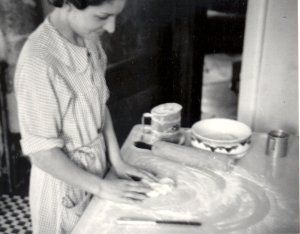
We drove home with visions of fresh blueberries and cream and of course, Mom’s famous blueberry pie dancing though our heads. Once home, Mom began baking pies. She was allergic to flour and often wore a mask, and when she didn’t wear her mask she would sneeze incessantly for  at least a dozen times. For her, that was a small inconvenience when it came to baking pies, especially blueberry pies.

scan0020

The basket contained enough fruit for at least ten pies.  Some of the pies were placed in our huge Amana freezer, while we enjoyed several of those  freshly baked. At that time we were a family of seven, one pie really wasn’t enough, especially since they were right out of the oven!

In today’s world there are many different kinds of blueberries. There are the cultivated blueberries which are quite large that  can be purchased all year round. Wild blueberries from Lac St-Jean are very tiny and are available seasonally. Their tastes differ substantially from one to  another, however, being originally from northern Ontario you can guess  what my choice is when it comes to real blueberries with great flavour.


new_basket

Notary Pierre Panet

Pierre Panet de Méru was an important notary in Montreal between 1754 and 1778, a period that included the years immediately after New France was conquered and transitioned into a British colony. If your ancestors lived in Montreal during this period, Panet may have drawn up wills for them, or helped them purchase property or make business agreements.

The son of Jean-Nicolas Panet and Madeleine Françoise Foucher, he was born in Paris in 1731. He moved to New France in 1746 and settled in the capital city of Quebec, where his brother Jean-Claude Panet served as a notary from 1744 to 1775. Panet married Marie-Anne Trefflé-Rottot in Quebec City on October 2, 1754, and he was appointed a notary in the jurisdiction of Montreal two months later.

Following the British victory in 1759 at the Battle of the Plains of Abraham in Quebec City and the surrender of Montreal to the British in 1760, many notaries, court clerks and other notables left New France and returned to Europe. Panet was not one of them. From the beginning of the British regime, he learned to live and work with the new authorities.

He was one of the first notaries in Montreal to work closely with the English-speaking merchants, civil servants, military officers and soldiers who now resided in the region, assisting them with marriage contracts, wills (testaments), after-death inventories, guardianships, property transactions and business agreements.

In addition to being a notary, Panet served as a judge and a justice of the peace. He died June 15, 1804. For more details of his life, see http://www.biographi.ca/en/bio/panet_pierre_5F.html

As of December, 2016, the fonds (collections) of notarial acts of Pierre Panet de Méru are not available in any online databases, nor are they on microfilm at the Bibliothèque et Archives nationales du Québec (BAnQ). These notarial acts are only available from Parchemin, a database of notarial acts of Québec owned by Archiv-Histo, a division of the Chambre des notaires du Québec.

The notarial acts acts written by Pierre Panet can be found in the Parchemin collection under Cote # 06010308 or under Saphir # 6009308 (1755-1778). See https://www.archiv-histo.com/EN/.

You can consult the Parchemin database at the BAnQ in Montreal and several other locations in Quebec, and at some public libraries elsewhere.

BAnQ Montréal – Bibliothèque et Archives nationales du Québec  535, avenue Viger Est, Montréal, QC H2L 2P3   – Tel : 514-873-1100 #4 or 1-800-363-9028 –   email : archives.montreal@banq.qc.ca

For more information on notarial records see the following links:

http://books.openedition.org/pur/4596?lang=en

http://www.fichierorigine.com/recherche?numero=243137

https://www.archiv-histo.com/assets/publications/1989-Parchemin-Methode_SITE.pdf

https://archiv-histo.com/assets/publications/2015-Notaires-liste-Chrono-Tablo.pdf

http://bibnum2.banq.qc.ca/bna/notaires/fichiers/portail/html/liste.html


Finding British Regiments in Quebec, 1759-1760

The 1759 Battle of the Plains of Abraham, in which General Wolfe’s British invasion force defeated General Montcalm’s defending army, is the most famous battle in Canadian history. After the British also conquered Montreal the following year, New France became history and a new British colony in Canada was born.

Thousands of people took part in these events. British historians say that the fleet that sailed up the St. Lawrence River in the spring of 1759 carried between 10,000 and 12,500 British sailors and soldiers, while the book Combattre pour la France en Amérique lists 7,450 French soldiers.

Finding out whether your ancestor fought in this campaign is not easy, but the PDF attached below, Finding British Regiments in Quebec, 1759-1760, may help you make a start. This compilation lists the British regiments that fought at Quebec City and Montreal, and it identifies the places British regiments were posted during the 1759-1760 campaign.

The Canadian government website of The National Battlefields Commission www.ccbn-nbc.gc.ca/en/ describes the historical context of the Seven Years War (also known as the French and Indian War), while the searchable page www.ccbn-nbc.gc.ca/en/history-heritage/battles-1759-1760/soldiers/ lists the names of 7,279 British soldiers and 4,079 French soldiers who took part.

Marcel Fournier and a staff of about 30 researchers in Montreal and France identified 7,450 soldiers and officers who fought for France in New France, plus the names of another 1374 soldiers. These findings were published in Combattre pour la France en Amérique by La Société généalogique canadienne-française, Montreal, 2009 (in French only).

If you are interested in the soldiers who fought in British regiments, you should consult the two-volume In Search of the “Forlorn Hope”: a Comprehensive Guide to Locating British Regiments & Their Records (1640-WWI) by John M. Kitzmiller II, published in Salt Lake City by Manuscript Publishing Foundation, 1988. You will probably find it in a large library. This book is the source of the information complied here.

These two volumes, plus a supplement, tell you which regiment was posted where from 1640 to 1914. The book does this in reverse: you need to look up the name of a place or campaign and the book identifies the regiments stationed there. The supplement can also help you with genealogical research you might want to conduct in British War Office Records. Once you find your ancestor’s name, you may need to visit the Public Record Office, Kew, near London.

Another book, My Ancestor was in the British Army, by Michael Watts and Christopher Watts, published by the Society of Genealogists in the U.K. in 2009, lists dozens of other archives in England, Wales and Scotland in which military records are kept, including the soldiers and mariners who fought during the Seven Years War in North America. You can also try searching military records on the subscription website Find My Past, www.findmypast.com.

finding-british-regiments-in-quebec-1759-1760


Louis Chaboillez, Notary of Missisquoi Bay, 1787-1813

If your Loyalist ancestors settled in the Missisquoi Bay area of Quebec, including towns such as Frelighsburg, Philipsburg, Saint-Armand and Pigeon Hill, the files of notary Louis Chaboillez might help you learn something about them.

This area, located just north of the Vermont border near Lake Champlain and the Richelieu and Pike Rivers, has a long history. The shore of Missisquoi Bay was once the site of an Abenaki village, but in the mid-1700s, the governor of New France divided the land into vast estates called seigneuries. Two of the seigneuries in this part of Quebec were the St. Armand and the Foucault Seigneuries. The first owner of the Saint-Armand seigneury was a Quebec City man who built ships for the King of France, and later, this seigneury was owned by a senior British colonial administrator.

Although New France became the British colony of Lower Canada in 1763, the seigneurial system of land ownership remained in effect until 1854. But long before 1854, many new settlers began to arrive in the area, and they wanted to own their own property.

Thousands of Loyalists who had been loyal to the British during the American Revolution left the United States for Canada in 1784. In the Missisquoi Bay area, they built homes, farms, flour mills, schools and churches. The government of Lower Canada had to find a way to sort out titles to properties in this and similar areas, and it gave this responsibility to certain notaries. The man who undertook this task in the Missisquoi Bay region was Louis Chaboillez. A notary who practiced between 1787 and 1813 in the Judicial District of Montreal, he was assigned to legalize the allotment of lands in the Eastern Townships of Quebec and in the Richelieu River Valley. He served families in the Eastern Townships until the arrival of notary Léon Lalanne in the spring of 1799.

You can find the collection of notarial acts written by Louis Chaboillez between 1787 and 1813 at the Bibliothèque et Archives nationales du Québec (BAnQ) in downtown Montreal. The acts are on microfilm under Cote (Fonds) # CN60,S74 (1787-1813). The original fonds (collection) includes 14.67 metres of documents and one map. It appears that all documents written by Chaboillez were reproduced, with the exception of the map, on microfilms # 3291, 3292, 3293, 3294, 3295, 3296, 3297, 3298, 3299, 3300, 3301, 3302, 3303, 3304, 3305, 3306, 3307, 3380, 3496, 3497 and 3733. A few additional acts were reproduced on Cote (Fonds) #ZQ601.

As of October, 2016, the notarial acts of Louis Chaboillez were not available on the BAnQ’s website (http://bibnum2.banq.qc.ca/bna/notaires/).

The main Montreal branch of the Bibliothèque et Archives nationales du Québec is located at 535 avenue Viger Est, Montréal, QC H2L 2P3; Tel : 514-873-1100 #4 or 1-800-363-9028; email: archives.montreal@banq.qc.ca. The archives is open from Tuesday through Saturday every week; please verify for actual opening hours and legal holidays. See  www.banq.qc.ca/archives/entrez_archives/centres_archives/ca_montreal.html.

Louis Chaboillez’s notarial acts can also be found in the Parchemin collection, compiled by Archiv-Histo, under cote # 06010074 (1787-1813). The Parchemin collection is available at libraries throughout Canada and the United States. Archiv-Histo is an associate society of the Chambre des notaires du Québec.

The collection of notarial acts on Parchemin is the largest and most precise in Quebec. Not all of the documents produced by Quebec notaries between 1663 and 1900 are available at BAnQ repositories across the province. Parchemin tells you where notarial acts (minutiers) are kept, and which ones were destroyed by fire. To learn more, see https://www.archiv-histo.com/EN/index.php.

Compiled by Jacques Gagné  gagne.jacques@sympatico.ca  2016-10-16


Notary Peter Lukin Sr. and the Christie Seigneuries

Notary Peter Lukin Sr. helped the people of the Upper Richelieu River Valley and Eastern Townships of Quebec sort out land ownership issues between 1790 and 1814. Among his clients were Loyalists and other American-born settlers who had moved north of the border in search of farmland, as well as British, Scottish and Irish-born families.

Although New France was ceded to Britain in 1763 and became the Lower Canada colony, the old seigneurial land-ownership system of New France persisted until 1854. The seigneurial system began in the 1600s as a tool to control the settlement of New France. The king granted large areas of land to influential people including military officers and members of the aristocracy. The seigneurs then rented out farm lots to the habitants, or tenants. The habitants paid rent in cash or grain in exchange for land management assistance and various rights from the seigneurs. This system determined the way rural society in New France developed. When the British abolished the system in 1854, the colonial government had to introduce a means for the tenants to buy their farms.

One area in which the seigneurial system existed was in the Upper Richelieu Valley, an area with very fertile soil that attracted many settlers. The valley stretches next to the Richelieu River, which flows north out of Lake Champlain in northern Vermont and  empties into the St. Lawrence River near the town of Sorel. Lieutenant-Colonel Gabriel Christie acquired five seigneuries in this region following the fall of New France. The Christie Seigneuries remained in his family’s possession long after the seigneurial system was officially abolished.

In her book The Christie Seigneuries; Estate Management and Settlement in the Upper Richelieu Valley 1760-1854 (McGill-Queen’s University Press, 1992), historian Françoise Noël wrote that seigneurial property rights were used to control access to land, timber mills and other resources in the area for many years.

On May 8, 1790, Peter Lukin Sr., a notary and Justice of the Peace in the Judicial District of Montreal, was appointed as one of several notaries assigned to legalize the allotment of lands in the Eastern Townships and the Richelieu River Valley, including the Christie Seigneuries.

The seigneurial system was never implemented in the Eastern Townships, which was settled in the late 1700s and early 1800s.

The notarial acts of Peter Lukin Sr., 1790-1814, Cote # CN601, S269, can be found on microfilm at the Bibliothèque et Archives nationales du Québec (BAnQ) in Montreal. The BAnQ Montréal is located at 535 avenue Viger Est, Montréal, QC, H2L 2P3; Tel: 514-873-1100 plus option 4, plus option 1; Toll Free: 1-800-363-9028 plus option 4 plus 1; email: archives.montreal@banq.qc.ca

http://www.banq.qc.ca/archives/entrez_archives/centres_archives/

http://bibnum2.banq.qc.ca/bna/notaires/

A database of the Christie Seigneuries, “The Upper Richelieu Valley Database by Seigneury,” prepared by Françoise Noël can be found at http://faculty.nipissingu.ca/noel/files/2013/01/Christie_Seigneuries_by_Seigneury.pdf

Noël also identified three other early notaries who served in the region of the Christie Seigneuries within the Upper Richelieu River Valley:

Pierre de Mérut Panet – Notary, Judicial District of Montréal 1755-1778

Pierre Lanctot – Notary, Judicial District of Montréal 1809-1850

Pierre Besse – Notary – Judicial District of Richelieu 1811-1813

The Notarial Acts of Pierre de Mérut Panet likely address the British officers who were granted lands in the Upper Richelieu River Valley and perhaps also in the Lower Richelieu River Valley (the Sorel area) who fought with military leaders James Wolfe, Jeffery Amherst, James Murray, Charles Saunders, Thomas Gage, George Townshend and Robert Monckton at the Battle of the Plains of Abraham in 1759 and at the Conquest of Montreal in 1760.

Loyalist Settlers and their Notaries: Leon Lalanne

If you had ancestors who were early immigrants to Quebec’s Eastern Townships, the records of notary Leon Lalamme might help you learn details about their lives, but you will have to travel to Sherbrooke to consult them.

The first Europeans to settle in the Eastern Townships region (now known as Estrie) were farmers from Vermont, New York state and New Hampshire. They were looking for free land. After the American Revolution, Loyalists who had supported the British flooded across the border. Having supported the losing side in the war, they were promised new land in Canada. Most of them came from Massachusetts, Connecticut, New York, Rhode Island, Pennsylvania and Vermont.

The trouble was that, in this part of Lower Canada, other settlers were already living on the land. The colonial government passed an act to legalize the allotment of lands in the Eastern Townships, and several notaries were appointed to settle these issues.

Among the notaries appointed to this task were two from Montreal: Louis Chaboillez, who practiced from 1787 to 1813; and Peter Lukin, who practiced from 1790 to 1814. Pierre Gamelin, who practiced in Saint-Jean-sur-Richelieu from 1815 to 1855, was a third appointee.

Leon Lalanne.was another notary who served Loyalist & non-Loyalist American families in the Eastern Townships. He practiced between 1799 and 1845. He lived in the village of St. Armand (now known as Frelighsburg) until 1842, then moved to Brome County and served families there until his retirement.

As well as acting as a notary to former American families, he also served the needs of Dutch, Scottish, British, Irish and French Canadian residents. His records at the Archives nationales du Québec are mostly in the English language, and total 8.23 linear metres (28 feet). Notarial acts cover agreements such as land sales and rentals, marriage contracts, wills, apprenticeships and protests over unpaid loans.

The microfilms of Lalanne’s notarial acts (Cote # CN 502, S26) are stored at the Bibliothèque et Archives nationales du Québec (BAnQ) in Sherbrooke, They have not been digitized. The BAnQ Sherbrooke is located at 225 rue Frontenac #401, Sherbrooke QC J1H 1K1, tel: 819-820-3010, toll free: 1-800-363-9028; email: archives.sherbrooke@banq.qc.ca

On the web: www.banq.qc.ca/archives/entrez_archives/centres_archives/

Note that the Bedford Judicial District (District judiciaire de Bedford) was a group of villages, towns and townships within Missisquoi, Brome and Shefford counties. The St. Francis Judicial District (District judiciaire Saint-François (Sherbrooke)) included villages, towns and townships in Sherbrooke, Stanstead, Compton, Richmond and Wolfe counties.

Among the other notaries who practiced in the Eastern Townships and southwestern Quebec in the early 19th century were Edouard Faribault, Farnham,1826-1832; Richard Dickinson, Bedford, 1826-1877; Henry Bondy, Sweetsburg,1829 -1869; Samuel Gale, East Farnham, 1802-1819; Louis Barbeau, Laprairie, 1804-1864 (his files were burned, but some still exist in the Ellis Papers at the Archives); Pierre Besse,1809-1810, Trois-Rivières and 1811-1854, Richelieu.

Over the next few months, I intend to post more information on the notaries who served the residents of the Eastern Townships. Some, but not all, of these notaries are included on the website of the BAnQ; see http://bibnum2.banq.qc.ca/bna/notaires/

Finally, thanks to Pennie Redmile for help with this post. She has been a family lineage researcher for 35 years and is also an expert on Quebec notarial records. She has compiled information on hundreds of Loyalist and non-Loyalist families, plus British, Scottish, Irish families who settled in Missisquoi, Brome and Shefford Counties, as well as the Upper Richelieu Valley (Missisquoi Bay) from the 1780s onward. She is now retired.

Compiled by: Jacques Gagné  gagne.jacques@sympatico.ca    2016-10-10