Category Archives: Quebec

Borderland Religion 1792-1852 by J.I. Little

Borderland Religion – 1792-1852 – The emergence of an English-Canadian identity – J.I. Little
QFHS Library #HG-100.44 L5 – 385 pages

In December 1811 ‘A Poor Farmer’ in Shipton Township wrote the following plaintive words to the editor of the Québec Gazette:
Eleven years have elapsed since I first entered these woods, with my family, and seven years since my residence in this Township … On my first arrival in these woods, with my wife, both of us about the age of Twenty, we had one child, at present we have six, and have lost three. Our first care and inquiry was, in what manner shall we have our children Baptized, Educated, and taught the true Religion of Christianity. Hope led us to believe, living under so good a Government, we shall shortly have men placed among us for these purposes. Alas, Eleven years are now gone over, and I dont see the least prospect of these blessings.
With what sorrow do I declare that in the Townships, in this District, it is estimated that near Two thousand Children live without Baptism, upward of Six hundred men and women live together without lawful marriage; and that the greatest part of these people have not, for the last Ten years, heard the Word of God on a Sabbath day; as for our dead, they are disposed of in the same manner that most people dispose of a favorite Dog who dies, by placing him quietly under a Tree.

In the 1831 census the largest cohort in the Eastern Townships declared no religious affiliation whatsoever. By this time, however, British missionary societies had been attempting to fill the religious vacuum for more than a decade. Many who declared affiliation with the Church of England were probably doing so because it was the only one available to provide the basic services of baptism, marriage, and burial.
J.I. Little

Other books by J.I. Little, on the subject of the Eastern Townships of Québec;
> Loyalties in Conflict: A Canadian Borderland in War and Rebellion, 1812-1840
> The Other Quebec: Microhistorical Essays on Nineteenth-Century Religion and Society
> State and Society in Transition: The Politics of Institutional Reform in the Eastern Townships 1838-1852
> Crofters and Habitants: Settler Society, Economy, and Culture in a Quebec Township, 1848-1881
> Nationalism, Capitalism, and Colonization in the Nineteenth Century Quebec: The Upper St Francis District

Posted by Jacques Gagné for Genealogy Ensemble

History of Compton County by L.S. Channell

History of Compton County in the Eastern Townships of Québec by L.S. Channell
QFHS Library #UEL-REF HG-153.01 C46
295 pages large format – Two copies available at the Library.

Being a U.E.L. Reference book, said books cannot be taken out of the Library.

The history of 400 pioneer families of Compton County plus those in Sherbrooke County and those within the district of St. Francis from the birth of the region in 1782.

At the close of the Revolutionary War in 1782, many thousand United Empire Loyalists were offered lands in Canada by the British Government. A few hundred families came to the townships of Eastern Canada.

There can be no doubt that United Empire Loyalists took up their residence in our Townships before 1792, but the official records of such are missing.

The first settlers are heard of on Missisquoi Bay and Lake Memphremagog. At the head of the Connecticut River in the township of Hereford, Colonel John Pope settled as early as 1792, and there is not much doubt but that settlers were there for several years previously.

In the year 1796 the first lands in Lower Canada were granted in free and common soccage.

In 1803 the courts of Montréal rendered a decision that no right of property in slaves could exist in Lower Canada, and the few slaves in this country were thus manumitted. The people in the Townships were too poor to own slaves in those days, and two only are known to have been in what is now Compton County. They belonged to Colonel John Pope, and remained with him until their death when they were sent back to the old plantation in Massachusetts for burial.

L.S. Channell

Posted by Jacques Gagné for Genealogy Ensemble

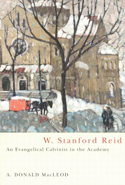
W. Stanford Reid, An Evangelical Calvinist in the Academy

ReidMy copy of this 401 page-tome by A. Donald MacLeod has a few coffee stains and a few highlighted portions but overall it’s still in good shape.

Rev. W. Stanford Reid was a leading Presbyterian Minister in Montreal after World War 2 – He was a Professor at McGill University – He was associated with the Presbyterian College at McGill University.

He was the son of another Presbyterian Minister, he was the grandson of another Presbyterian Minister, the latter born in Scotland who settled with his family  in Compton County and opened a large Church of Scotland for the Hebridean Scots of the region.

He was a Pastor at some of the leading Presbyterian Churches in Montreal and Westmount after WWII.

At one point in time at the Presbyterian College in Montreal, he was influenced by the teachings on Calvinism by Rev. Donald Harvey MacVicar,  at the time, a leading Presbyterian Minister in Montreal and also a distinguished professor at the Presbyterian College at McGill University.

Pastor W. Stanford Reid as indicated above and for the rest of his life embraced the teachings of John Calvin (Huguenots) which was taught and promoted by Rev. Donald Harvey MacVicar and others in Québec and other parts of Canada, especially Ontario at the time.

Pastor W. Stanford Reid eventually opened one of the largest Presbyterian Churches in Montréal in the Town of Mount-Royal. It’s now a United Church of Canada parish.

This book is not for your average reader but if one wants to understand fully why there were so many variations to the Church of Scotland and later the Presbyterian Church in Québec and in the rest of Canada, this explains it.

A copy of the book is available for purchase at

http://www.mqup.ca/w–stanford-reid-products-9780773528185.php.

Jacques Gagné’s book review

M Jacques Gagné est un chercheur en généalogie, bénévole depuis plus de dix ans à la Quebec Family History Society.  Il a compilé plusieurs dizaines de listes de ressources pour les chercheurs.  On en retrouve en ligne,  dans la section des membres de la QFHS, certaines de ses nombreuses compilations.  On en nretrouve en bibliothèque aussi à la société.  Il a travaillé, entre-autres, sur les actes manquants des églises protestante du territoire que couvre le Québec contemporain pour la période 1759-1899.  Il a travaillé sur maints projets, dont les églises des missions des premières nations, sur les Huguenots, tant en Europe qu’en Amérique, sur les missionnaires itinérants, sur les ressources disponibles sur les Acadiens, les Canadiens- Français et en ce moment  sur les départements français.

M Gagné a écrit une série de critiques de livre dont voici la première que nous vous présentons.

Members of QFHS know him, and in the members only section of the QFHS you find some of his compilations.  Many of his works are available at the QFHS library.  He has been working hard for years to provide tools to help us look up and find genealogical information on French, Huguenots, First Nations….

”Jacques Gagné has been a volunteer genealogical researcher at the Quebec Family History Society for the past ten years, handling a wide variety of genealogical cases. For several years, Jacques has conducted in-depth research on the missing Protestant Church Registers for what is now the province of Quebec, from 1759 to 1899. To date, more than 1,000 churches are listed. Now he has provided an extensive guide to Family Searches on the Internet.”

Here is one of a series of book reviews he has prepared for the French Research Group at QFHS.

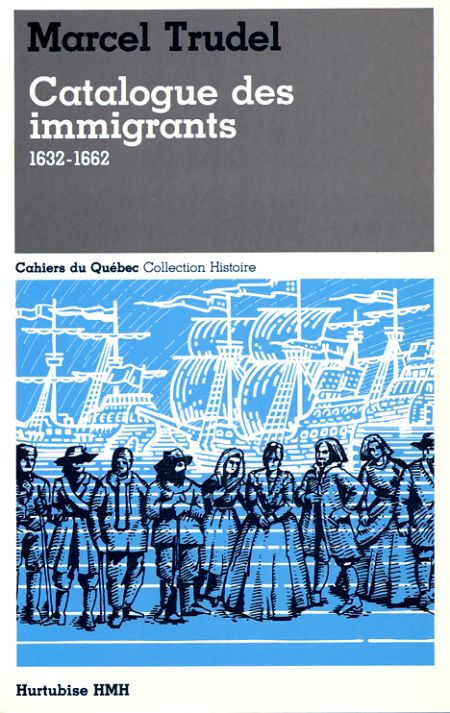
Marcel Trudel
Catalogue des immigrants 1632-1662
569 pages
QFHS #REF HG-150.99 T7

Trudel

Marcel Trudel (1917-2011) was a longtime professor at the Université Laval in Québec City and at the University of Ottawa. Recipient of many awards during his lifetime as an historian. In 1971 he was made Officer of the Order of Canada – In 2004 he was made a Grand Officer of the National Order of Québec.

Within this 569 pages detailed research guide, Marcel Trudel has addressed 3,000 immigrants from 1632 to 1662 who had settled in Nouvelle France.

Monsieur Trudel in comparison to Marcel Fournier and René Jetté has taken a different approach in his work.

All three historians in my opinion are offering a different perspective to the research process of one’s ancestor in France.

I have never taken the time to compare the results posted by Marcel Trudel or by René Jetté or by Marcel Fournier, but in my opinion, all three have researched and compiled superb material.

Marcel Trudel as part of is excellent dictionary has spent considerable time in offering his readers, precise details such as the age of an immigrant, the type of work he or she did in France, from where they came from, were these immigrants capable of signing their names to documents such as acts of baptism, marriage, death or notarial records and what type of work they did once they settled into Nouvelle France.

Jacques Gagné


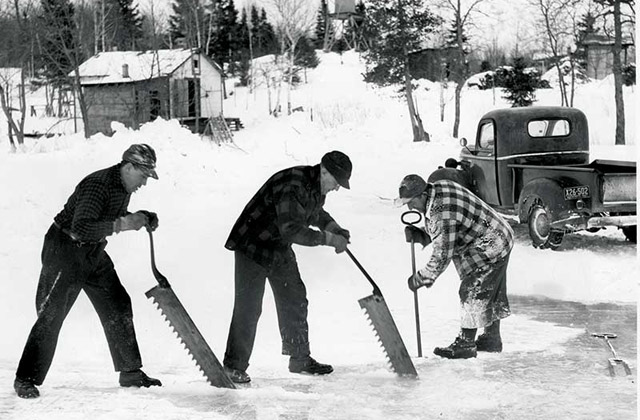
10 jobs qui ont disparu (et qui ne reviendront pas)

Fun historic information on free Metro paper.  Click at bottom to read on.
Faits historique amusant dans le journal gratuit Metro. Cliquez au bas pour lire la suite.

A Pembroke Pioneer

Many years ago while visiting the red brick house with the huge front porch at 202 Isabella Street in Pembroke, I had little idea about the people who lived in that grand home.

Francois Evariste Fortin, my great grandfather spent his early years on the banks of the Ottawa River in Montebello Quebec.

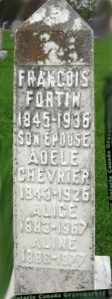
Francois was born on the 6th of July 1845. At the age of twenty he married Adele Chevrier from Rigaud. She was also twenty. The marriage took place in Bon Secours Church in Montebello in mid-May of 1866. They settled in Hull, Quebec  where he was an innkeeper.

Several years later, in 1874 after the birth of Louisa, their third child, ( my grandmother) Francois, Adele and their children  moved up the Ottawa River to Pembroke, Ontario where the family grew. They had one son, Frank, who worked for Eastman Kodak in Rochester, New York and five daughters, Emma, Julia  (Sr. St. Gabriel) who became a Grey nun, Louisa, my grandmother, Alice who taught music for the City of New York until she was seventy-five and Aline who remained a spinster caring for her parents.

Francois began a business as a merchant-tailor and according to the  1881 and 1891 Census he had thirteen employees. Later census records indicate that he became a  contractor for the railroads and an inspector. He was actively involved with the Pembroke Southern Railway  (PSR) and an original director and in time was named Vice-President. Francois invested substantially in the PSR. The railway linked Pembroke to other local communities. It was eventually  bought out by C.N.R. and at the time became a spur line.

His interest in municipal affairs and a genuine  concern for the welfare of the town led him to run for town council and eventually  for the mayoralty in 1894. He was the first Mayor to serve three years in succession, 1894 – 1896. Francois-Evariste was also interested in politics and a staunch supporter of the Liberals. He worked tirelessly for the party.

Francois and his family were devout Roman Catholics. They would gather in their home each evening to recite the Rosary. He played an active role during the construction of Saint Columbkille Cathedral just blocks from their home. Along the way he  had a falling out with the Church and refused to participate in the evening recitation of the Rosary. He would seclude himself in his office. The family made certain that he could hear their prayers.

Over the years, Francois eventually was brought back in to the fold and made peace with the Church. He died less than two weeks before his ninety-first birthday, July 17th. He had lived in that community for sixty-two years. He was mourned by his family and the citizens of Pembroke alike and remembered as a well respected pioneer in the community. A Requiem High Mass was celebrated in Saint Columbkille. He is buried in the Roman Catholic Cemetery in Pembroke, beside his wife, Adele who predeceased him by ten years.

             Francois Evariste Fortin Adele Chevrier grave_edited-aaa

Bibliography:

Obituaries: The Ottawa Journal, July 7, 1936. p.10

Census of Canada 1851, 1871, 1881, 1891 1911, 1921

Interview with Madelyn Smith (Percival) 2011 my ninety year old cousin.

Canada Voter’s List 1935

Canadian Dominion Directory for 1871. John Lovell’s Province of Quebec Directory for 1871. Volume 1 p.998  John Lovell & Son, Montreal,1871

Ontario, Canada, Deaths,1869-1938 and Deaths Overseas 1838-1847

Copyright 2013 Drouin Institute (Lafrance) dlp_32631325.jpg

Le centre de genealogie francphone d’Amerique 1997-2006 GEDCOMn155 #Individu 19607

special thanks to fellow genealogist Oskar Keller for finding the grave.

Of interest:     Excerpt from The History of Pembroke  http://www.pembrokeontario..com/city-hall/history-of-pembroke#sthash.rCHphQZD.groK4XiT.dpuf/

Pembroke was the first town in Canada in which electric power was generated for commercial use. On October 8,1884 the very first street lights in Canada cast their glow down Pembroke Street. A small building on Pembroke Street east of the Muskrat River provided electricity for street lighting as well as for the factories in the Town.

In 2003 a fully redundant fibre optic cable was installed around Pembroke, enabling local businesses to work anywhere in the world – without leaving their desks- through a telecommunications infrastructure that is vital to remaining competitive in today’s global economy.

Hiding to read that kind of newspaper?

Readers always loved those stories, but…they would rather not admit it.

Shocking News

Vicky Lapointe, graduate historian from Sherbrooke University, signs a special newspaper blog.  She combs through Quebec old newspapers to present us with crimes and catastrophies, francophones from outside Quebec and some pictures, medicine, history and patrimonial buildings.

It is suprising to see what kind of news would make the paper a century or two ago, how people responded, and yes…what strange crimes were being commited.  I also enjoy reading about events that are now part of history, as they happened.

Read Patrimoine, Histoire et Multimédia


To grow a life-size tree, you grow a family

My good friend Joel Bergeron’s grand-father moved to Temiscamingue early in the 20th century.

Their descendants still meet annually at their cousin’s farm.  The most beautiful tree grows on this farm.

It’s painted on the side of the barn; its trunk has their grand-parents’ names at the base.

arbreP

Wooden apples sit at the base of the main branches:  each pair of apples represents a couple and another branch on the tree.  Along each branch sits an apple for each child and his or her spouse. From each of these grows a smaller stem that in turn holds apples for each of their kids.

arbrdetp

Every year, the entire family comes to the farm from Ontario, Quebec, where-ever they live… to feed that tree with joy.

Un arbre généalogique pleine grandeur!  C’est celui des Bergeron qu’on retrouve sur la grange d’un cousin.  Les grand-parents se sont installés au Témiscamingue au début du 20e siècle.  Leurs noms sont à la base du tronc.  A chaque embranchement, deux pomme pour un de leurs enfants avec son conjoint.  La branche qui y pousse, contient les pommes des enfants de ceux-ci, et les petites branches, de leurs petits enfants.  Et toute cette famille se réuni chez ce cousin, quelques jours, chaque année, parce que la famille, ça se cultive!

GenWebCanada updates Quebec cemetery listings

Every morning, I read Elizabeth Lapointe’s Genealogy Canada blog, and she never disappoints. Today, she announced that GenWebCanada has updated several cemeteries in Quebec, Nova Scotia, and Prince Edward Island. Read the entire blog post here.

The cemeteries in Quebec are:

Huntingdon County

Hillside Cemetery
Labelle County
Chut-St-Philippe Cemetery
Kiamika Cemetery
Lac Saguay Cemetery
Lac St-Paul
Lac Saguay Cemetery
Lac St-Paul Cemetery
Ste-Anne-du-Lac Cemetery
Val Barrette Cemetery
Gatineau County
East Templeton Cemetery
St Raphael Cemetery
Papineau County
Notre-Dame-de-la-Salette Cemetery

LAC explains “dit” names

Perhaps one of the most asked questions about French Canadian genealogy is, “What’s a dit name?” Library and Archives Canada does a nice job on its blog, explaining it.