This month a Montreal tradition will resume after a two-year pandemic break: the annual St. Andrew’s Ball will take place at the Windsor Hotel on November 18. The event promises to be “a gala evening of dining, dancing and Scottish pageantry, celebrating Scottish heritage in Montreal,” featuring the Black Watch Pipes and Drums and highland dance performances.
My mother attended this event in 1937, the year that, despite her protests, she was a debutante. Writing under her married name, Joan Hamilton, she recalled that experience 40 years later, and her article, published in Montreal Scene magazine on November 26, 1977, described the endless social gatherings she and her teenage friends attended.
In those days “coming out” didn’t mean what it does today. Then it meant that a young woman of 18 was introduced to society, and to members of the opposite sex, which was important because my mother and most of her friends attended separate private schools for girls or boys.
She wrote, “For a tightly-knit group of Montrealers whose growing up took place in the mid-30s, life consisted of a round of parties that started with events called sub-deb dances and progressed to coming-out balls. Actually, they weren’t as grand as they sound. Life was simpler then, and one lived by a strictly prescribed social code. The sub-deb parties were given at private homes, primarily during the Christmas holidays, and the ages of the future debutantes ranged from 14 to 17.” When the girls became debutantes, the parties became balls.
Although many Canadians were suffering economically during the Depression, my mother recalled that there were dozens of debutantes each season, and there was a ball at least once, and sometimes twice a week from October until February. Many debutantes came out at their own parties, but others were presented at either the St. Andrew’s Ball or charity balls put on by the Royal Victoria Hospital Auxiliary. At that time, most of the balls were held at the Winter Club on Drummond Street, the Hunt Club on Côte Ste-Catherine Road, or the ballroom of the Ritz-Carlton Hotel. The St. Andrew’s Ball took place at the Windsor Hotel.
In Montreal the St. Andrew’s Ball was first held in 1848, but some members of the society preferred a dinner for the men only, and the next ball wasn’t held until 1871. When it next took place, it was described as “the social event of the year,” probably because Queen Victoria’s daughter Princess Louise and her husband were the guests of honour. Over the following years, Montreal’s Scots sometimes celebrated St. Andrew’s Day with a banquet or a concert, and the society did not choose a ball as its principal event until 1896.
According to the Montreal Daily Star, more than 900 people—a record—attended the 1937 edition of the St. Andrew’s Ball, including the Governor General of Canada and his wife, Lord and Lady Tweedsmuir. “Merriment reigns as sons and daughters of auld Scotia lay aside their cares,” the newspaper headline announced.
In the ‘30s, the debutantes wore long white evening dresses and white, elbow-length kid gloves, while their escorts were in white tie and tails. The evening began with dinner parties, with cocktails and wine served. On arriving at the ball, the guests went through a receiving line so the proud parents of the debutante in whose honour the party was being held could introduce her. Then the dancing began, with music provided by an orchestra. Supper was served around midnight, accompanied by champagne.
“One’s partner at dinner was supposed to, and usually did, have the first and last dance and escort you to supper, as well as take you home,” she recalled. “It was a good security blanket.” My mother was not one of those girls who was so popular with the boys that her dance card for the evening was always full. In fact, she hinted that she spent a fair amount of time in the ladies’ room, pretending to be invisible. Nevertheless, she wrote that her teen years were a lot of fun, going to movies, picnics and corn roasts in the summer and taking the train to the Laurentians to go skiing in winter, after the party season had wrapped up.
Two years later life changed for everyone, and some of the young men who had attended those parties went off to war and never came back. Nor did my mother marry one of the boys she was introduced to as a debutante; my parents met in Ottawa, where they were both working, just as the war was ending.
(little poem etched in pencil in one of Norman’s early ‘store books’)
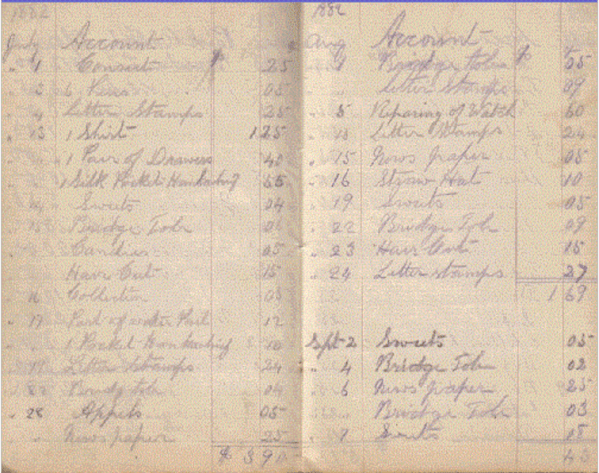
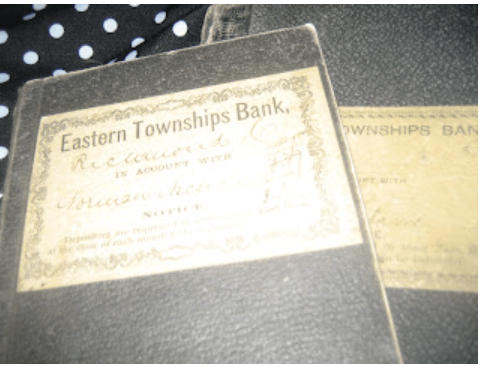
Norman Nicholson, my husband’s great grandfather liked to keep track of things: Indeed, that was his one extraordinary trait. He kept track of his every expense, business or household, over five decades (right down to 5 cents tossed to a tramp). He kept balances, inventories, invoices and lists from 1881 when he left home to live on his own to 1921 at this death at home in Richmond, Quebec.
He kept all this information in dozens of ledgers, diaries and notebooks and he kept these booklets neatly arranged in a trunk under the window in his daughter’s room. ( I know because it said so in one of the many letters he kept, which the daughter in her turn kept, and which eventually fell into my hands as the wife of his great grandson.)
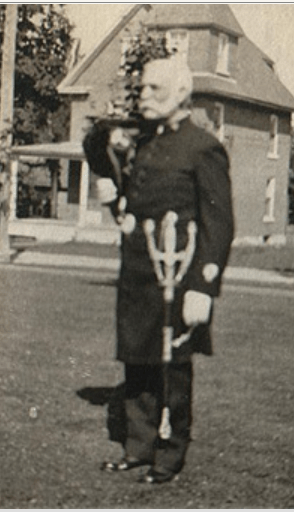
Norman in Masonic Regalia circa 1905
That’s how history-challenged I came to have a real appreciation for the life of a 1st generation Canadian living in the Eastern Townships of Quebec at the turn of the 20th century, that is Norman Nicholson, son of Malcolm Nicolson, he who came to this country in 1841 at age 26 with his parents and 8 siblings after being cleared from the family farm on the nearly treeless Isle of Lewis, Hebrides; who walked from Port St Francis to Flodden and settled on crown land, earning money by burning wood for potash and clearing trails through the forest.
That’s how I’ve come to understand that my husband’s great grandfather, Canadian-born, Canadian schooled Norman Nicholson, successful hemlock bark dealer, turkey salesman, bill collector for a local doctor, Town Public Works Clerk, Inspector for the Transcontinental Railway and The Quebec Streams Commission (I have all the documentation) was a work-a-day sort, devoted husband to the spirited feminist-minded Margaret McLeod, (also a Lewis descendant) doting father to three feisty and ambitious daughters Edith, Marion, Flora and one lost soul of a son, Herb.
He was the kind of ordinary man who lives a full life, with all its joys and sorrows and broken dreams, and dies, the memory of him quickly fading to black until, one day, (with any luck at all) a glimmer, as a great great grandson, flipping through the brittle pages of a photo album, points to one particular picture and asks. “Who’s this ‘sick-looking’ dude with the white moustache and beard?” And the boy’s middle aged father answers: “Oh, that’s Norman Nicholson, your great great grandfather, or at least, I think it is.”
“Was he a general or something, too?” the boy asks referring to the man’s mason uniform – because the boy is related to General Douglas MacArthur on another branch of his family tree.
“No, Norman Nicholson was just an ordinary man.”
Cost of setting up house 1883. 45 dollars for furniture
Now, after scanning the ledgers and reading all his diaries, that I can confirm: ordinary, in every possible way. Not a hero like Alexander Mackenzie, the Lewis born explorer, for whom a great Canadian river is named, although Norman did have a thing for bodies of water. From his 1912 diary: List of Rivers East of Cochrane, Abitibi River, Sucker Creek, Mistango River, Low Bush Creek
Not a villain like Lewis descendant Donald Morrison, the Megantic Outlaw, subject of Canada’s largest ever manhunt and at least two books and one documentary, although Norman did have a part in the man’s post capture defense.
From an 1889 press clipping: Let it be hereby resolved that Norman Nicholson be appointed by the Richmond Royal Caledonia Society to press the authorities for an interview with Donald Morrison.
Neither famous, nor infamous, neither scoundrel nor saint; ergo NOT the kind of man whose exploits are chronicled for future generations in plodding high school history texts or low budget straight to cable documentaries; just a loyal husband, protective father, dutiful citizen. An ordinary man, the kind of man who reaches a point in life where he feels the need to lay down the law to his kids: November 14, 1902 Future Regulations: All must be up and downstairs by 7:30 o’ clock in the morning, Sunday included, breakfast at 7:30. The kind of man who, lonely on the job in middle age, writes love letters to his wife: “I don’t want a concrete hall or a little birch canoe; just want a place with you by the fireside.”
Very very ordinary. No, not the stuff of history books or even good caricature, although it would be easy to characterize Norman as the quintessential penny pinching Scot (someone who believes his bank book to be the best kind of reading) but that characterization would be totally unfair.
Norman Nicholson may have been a practical man:
Price of ash for 1899: 8 cents for 12 inch;10 cents for 13 inch; 12 cents for 14 inch.
1913 Trip to Boston to see Grand Lodge: ticket to Montreal, 2.55, street car 05, ticket to Newport, 3.25. Dinner on train .60
with a petty side:
number of times Dr. Kellock was away from his congregation in year 1897: 24 January in Boston; 21 March in Spencerville; 24 October in Toronto;
October 18, 1899. Date McMorine had his water cut off in his store by M. McDonald tinsmith.
But he also was a romantic:
Nothing to do Margaret, Dar..ling, nothing to do. Let’s take a trip on memory’s ship back to the by gone days. Let’s sail to the old village, anchor outside the school door. Look in and see, that’s you and me, a couple of kids once more.
See? An ordinary man of conflicting passions, just like you and me, the kind of man who has but one chance to have something flattering written about him and that’s at the end of his life:
From the Richmond Guardian June, 1922:
The death occurred suddenly last Friday morning in Montreal of Mr. Norman Nicholson, one of the most respected citizens of this place…
And then that’s it, finito, no more, except, perhaps, for an epitaph on a tombstone in a far-flung country cemetery no one ever visits.
RIP Norman Nicholson, my husband’s great grandfather. An oh-so ordinary man, except for this one extraordinary trait, this compulsion to keep track of things, to leave a paper trail for posterity – if mostly in list form.
END
LIST Cost of LIving 1900 Richmond Quebec.
1900 accounts, family of six, children in teens. Wife Margaret got a hefty allowance with her purchases going unnoted, but I see no mention of material or sewing notions in the list and Margaret sewed her daughter’s clothes for the most part. In 1900 the Nicholsons were comfortably middle class with a fine house, but their fortunes would soon fail with the end of the hemlock bark industry.
If you drive into Montreal from the Laurentians on a sunny day, you’ll see a wonderful skyline, complete with a church spire as the tallest building for miles around. Such views are still typical throughout Quebec, although that’s likely to change as the iconic buildings get torn down to be replaced with skyscrapers, auditoriums and other modern structures.
These are remnants of the period from 1621 until 1964, when the Catholic Church operated as Church and State in this province. As genealogists, it’s important to remember this history as we look for traces of our ancestors. Traces of anyone in North American, even Protestant, Jewish and secular ancestors, might be found within documents held by religious organizations in Quebec.
In 1996, David Seljak described the Catholic Church’s influence in Quebec in an article. He wrote:
“Before 1960, the Church exercised a virtual monopoly over education, health care, and the social services offered to French Quebeckers who formed the majority of the population. During his years as premier from 1944 to 1959, Maurice Duplessis had declared Quebec a Catholic province and actively promoted the Church’s welfare. In 1958, more than eighty-five percent of the population identified themselves as Catholic and more than eighty-eight percent of those Catholics attended mass every Sunday. A virtual army of nuns, priests, and brothers, which by 1962 numbered more than 50,000, oversaw the Church’s massive bureaucracy.”
(Seljak, David. “Why the Quiet Revolution Was ‘Quiet’: The Catholic Church’s Reaction to the Secularization of Nationalism in Quebec after 1960,” CCHA, Historical Studies, 62 (1996), 109-124, n.d., 16.)
He argues that the Church took its loss of status with relative serenity because Quebec had so many Catholic residents at the time. The influence of Vatican II meant that most activists in favour of a secular reform in Quebec came from within the Church itself. If he’s right, the Church in Quebec decided itself to remove itself from a position as an instrument of the State to ensure that secularism spread throughout the Province.
Whether that’s true or not, given that many North Americans passed through Quebec during at least one generation, almost everyone has an ancestor whose experience may be highlighted within the records of the Catholic Church in Quebec. If you’re looking for traces of your ancestors, it’s worth exploring these documents.
Records that exist include:
baptisms
private and public engagement contracts (especially with Marriageable and King’s daughters’ contracts)
banns
marriages
parish records (black cross)
migration records
death records
burial records
orphan records
land records
construction records
fundraising records
directories
newsletters
Glossary
Abjuration: Recantation of faith, often associated with Huguenots (Protestant people from France)
Acquet: Goods inherited or otherwise obtained prior to marriage
cimetière: Cemetery
Communauté de biens: commonly-held goods
Déclaration de fiançailles: oral promise to marry
def, defunt or feu: deceased
Douaire: dower or widow rights to be paid by a future husband to his future bride in the case of his death; this amount could not be taken by creditors in the case of bankruptcy
Fiançialles: marriage bonds, oral promise of marriage, engagement
Mandements: clergical administrative orders
Propres: Items legally owned by a man and women when they married that would not be jointly owned after marriage
Sépulture: burial
Société Notre-Dame de Montréal: a religious organization founded in 1639 in Paris. It recruited people to go to New France, including Jeanne Mance, who wanted to found a hospital, and Marguerite Bourgeoys, who wanted to found a school. The company was dissolved in 1663 and the Seigneurie de l’Ile de Montreal was turned over to the Compagnie des prêtres de Saint-Sulpice. Members started supporting the public program, with Bourgeoys founding the Maison Saint Gabriel farm house in 1668 to house the King’s wards.
Note: The Archdiocese Archives operate on Monday to Friday, from 9 to 11:45 am and from 1 to 3:45 pm, by appointment only.
Appointments are made via email in which the researcher must provide the archivists with the following information: research subject and context, period and dates, places, people (first and last names, titles and dates) concerned, a summary statement of existing research, and the researcher’s personal information: first and last name, title, institution, and city.
Collections include:
Adjurations Index
Certificates of freedom of marriage, 1757-
Confirmation registers
Parish, Mission and Centre Archives
Archives from the first missions and the Native American missions (manuscripts in Native American languages)
Archives from the apostolic vicariate of New France (1658-1674)
Archives from the archdiocese of Quebec (1674), with collections pertaining to the government of the diocese, the cathedral chapter, diocesan councils and committees, the chancellery, church authorities, pastoral work, human resources, communications and communications.
Archives from the provincial councils of Quebec (1851-1886) and from the Plenary Council of Québec (1909)
Archives from the Québec Interdiocesan Tribunal (1946)
Archives from parishes and communities
Archives from diocesan seminaries and colleges
Archives from institutes of consecrated life
Archives from ecclesiastic organizations, associations and movements
Archives from religious events at the diocesan, provincial, national and international levels
Personal and familial archives, including personal archives of bishops and archbishops of Québec
The historical archives of the Missionary Oblates of Mary Immaculate (OMI) in Canada (documents going back to 1841); manuscripts; volumes; microfilms; photographs (going back to 1816); collections pertaining to Oblate Missions, Aboriginal and Western history.
Bibliothèque et Archives nationales du Québec (BanQ)
Canada, Québec, registres paroissiaux catholiques, 1621-1979.” Database with images. FamilySearch. https://FamilySearch.org : 14 June 2021. Archives Nationales du Quebec (National Archives of Quebec), Montreal
Canada, Québec Index de copie civil de registres paroissiaux, 1642-1902.” Images. FamilySearch. http://FamilySearch.org : 14 June 2021. Bibliothèque et Archives Nationales Du Québec (National Library and Archives of Quebec).
Marriage Contracts of Quebec: Contrats de mariage des districts judiciaires de Québec, de Beauce, de Charlevoix, de Montmagny et de Thetford Mines, 1636-1953
Superior court records: Fonds Cour supérieure. District judiciaire de Québec. Insinuations, registres des insinuations de la Prévôté de Québec, vol. 1 (Anciennement registres 1, 2 et 3) (1er mars 1667 – 25 septembre 1696), folios 109-109v.
Parish Records:Fonds Paroisse Notre-Dame-de-Foy, 1662-1976, Cote : P48, Id 298582
Parish Records: Paroisse Sainte-Famille, Ile d’Orléans – registres d’état civil, 1666-1790, ZQ1,S28 #184 : 12 avril 1666 au 7 octobre 1727.
Parish Records: Paroisse Notre-Dame-de-Montréal, 1657-[vers 1850], Cote : P1000,D1277 Id 696688 et Registres d’état civil, 1642-1948, Cote : ZQ106, Id 420864 et Index alphabétique des confirmés de Notre-Dame-de-Montréal, de 1676 et 1678 – s.d. 11 pages Numéro : 301330
Notarial records: Montréal (Québec : district judiciaire). Notariat, 008127867_003_M99W-KP4, Jan 1, 1657–May 14, 1669; notary Claude Aubert, 1652-1692; notary Bénigne Basset, 1658-1672; notary Pierre Raimbault, 1698-1727; notary Antoine Adhémar, 1673-1712.
Collection Jacques Henri Fabien (MG 25 G231), La collection sur microfilm se compose de renseignements généalogiques pour la période de 1657 à 1974.
Cases of indentured servants who left their masters (extraits d’arrêts du Conseil supérieur concernant les engagés qui quittent le service de leurs maîtres) 00003916294, fol. 56-57v sur microfilm Centre des archives MG1-C11A, 1663-1702 Microfilm reel number: F-2.
Rules, arrests and declarations made in Paris (Recueils de réglements, édits, déclarations, et arrêts : concernant le commerce, l’administration de la justice, & la police des colonies françaises de l’Amérique, & les engagés : avec le Code noir, et l’addition audit code, France, Chez les Libraires associés, Paris), 1765, MG1-C11A. Microfilm reel number: F-2.
English translation of The Jesuit Relations and Allied Documents, 1610-1791, http://moses.creighton.edu/kripke/jesuitrelations/, edited by Reuben Gold Thwaites, secretary of the State Historical Society of Wisconsin, computerized transcription by Thom Mentrak, historical interpreter at Ste. Marie among the Iroquois living history museum, Liverpool, New York, 1898-1901.
The Internet Archive operates as a free catalogue of everything on the Internet since 1996. It also operates as a public library.
Secondary Sources
Academic papers
Boivin Sommerville, Suzanne. “Marriage Contract in New France according to La Coutume de Paris / The Custom of Paris,” French-Canadian Heritage Society of Michigan, https://habitantheritage.org/cpage.php?pt=14, May 12, 2018, originally published in Michigan’s Habitant Heritage, Vol. 26, no. 3 (July 2005): 135-137.
Gauvreau, Michael. “From Rechristianization to Contestation: Catholic Values and Quebec Society, 1931–1970.” Church History 69, no. 4 (December 2000): 803–33. https://doi.org/10.2307/3169332.
Seljak, David. “Why the Quiet Revolution Was ‘Quiet’: The Catholic Church’s Reaction to the Secularization of Nationalism in Quebec after 1960,” CCHA, Historical Studies, 62 (1996), 109-124, n.d., 16.
Books
Baum, G. (1991). The Church in Quebec. Canada: Novalis.
Grand’Maison, Jacques. Nationalisme et religion. Tome 2. Religion et 58 idéologies politiques, (Montréal: Beauchemin, 1970)
Jetté, René. Dictionnaire généalogique des familes du Québec. Montréal: Les Presses de l’Université de Montréal, 1983.
Lindsey, Charles. Rome in Canada: The Ultramontane Struggle for Supremacy Over the Civil Authority. Lovell brothers, 1877.
Sulte, Benjamin. Histoire des Canadiens-Français. Wilson & Cie, Editeurs, Montréal, 1882, ISBN 0885450183; Editions Elysse, 1977.
Trudel, Marcel. La population du Canada en 1666. Recensement reconstitué. Québec: Septentrion, 1995.
Valynseele, Joseph et al., La Généalogie, histoire et pratique, Paris, éditions Larousse, 1991.
Vincent, Rodolphe, Notre costume civil et religieux, Montréal, Centre de psychologie et de pédagogie, 1963, B004QP56OA
New France, New Horizons, http://www.archivescanadafrance.org/, a bilingual site set up by the Direction des Archives de France (Paris) et les Bibliothèque et Archives Canada (Ottawa) to commemorate the 400th anniversary of New France in 2004. The search function still works.
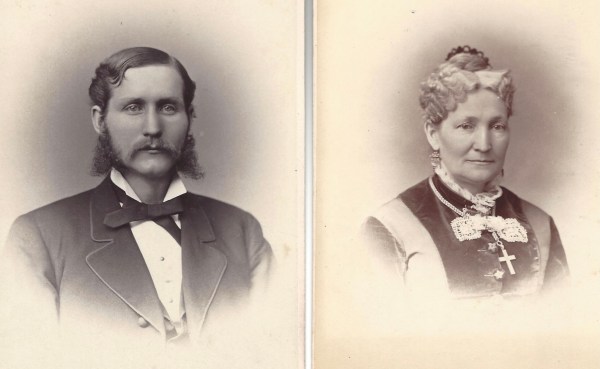
The Fall River Daily Evening News reported in Our Folks and Other Folks Column, “ He sustained an accident and narrowly escaped serious injury in Brookline on Saturday, by jumping from an electric without signalling for a stop. A sliver in the platform step caught in his shoe heel and threw him, as he jumped, and he was dragged some distance. He sustained severe bruises, his clothes were badly torn and his shoe, one of a new pair, was ripped from his foot.” This is one of the more interesting things written about my two times great uncle, Aimé B. Bruneau.
Aimé was a jeweller and studying to be an optometrist in 1897 when the accident happened. He must have been attending the Klein School of Optics in Boston’s South End. The school, founded three years earlier by ophthalmologist Dr. August Klein, was one of America’s first formal training programs in optics and refraction. After one year of study, Aimé could make glasses as well as jewellery.
He had travelled far from his roots. Aimé Benjamin Bruneau was born in Saint Constant, Quebec to Barnabé Bruneau and Sophie Marie Prud’Homme. He grew up on the family farm but as the seventh of 13 children, he had to find employment elsewhere. He left home as a teenager and went with his brother Dolphis to Adams, South Berkshire, Massachusetts where they were probably attracted by jobs in a mill.
I am not sure where he met Mary Floretta Mann. She lived in Rutland Vermont. Her husband, Steven Mann had died in 1869 and the widow was living with her three children. Four other children had died in early childhood. Mary couldn’t have been looking for financial support as she had real estate worth $16,000 and a personal estate of $5,000. When they married in 1871 Aimé was 26 and Mary 43.
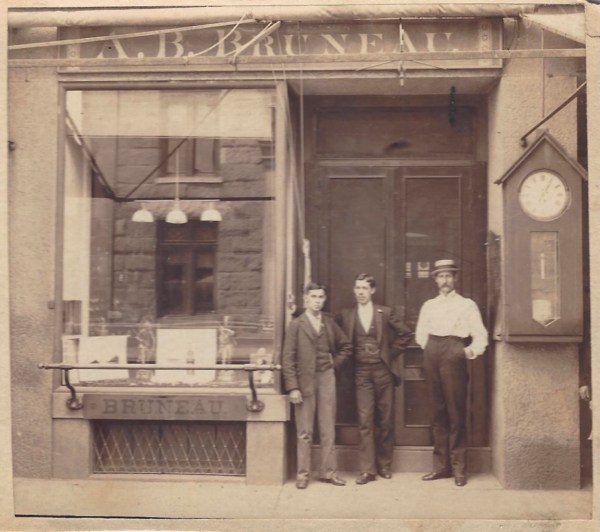
The couple soon moved to Fall River, Massachusetts, which after the Civil War was the leading textile city in America. Aimé didn’t work in a mill but as a clerk in Fred Macomber’s jewellery store and eventually bought him out. It was a prosperous business in the Granite Block, a block-long commercial building in downtown Fall River and one of the leading jewellery stores in the area for almost twenty years.
Aime Bruneau on right in front of his jewellery store, Fall River MA.
“Mr. Bruneau was of a very social nature and made many friends here (Fall River). He greatly lived out of door life and was noted as a walker, covering all the country about this city in his tramps. A walk to Newport or Providence, (almost 20 miles away) on a pleasant Sunday was an ordinary thing with him.”
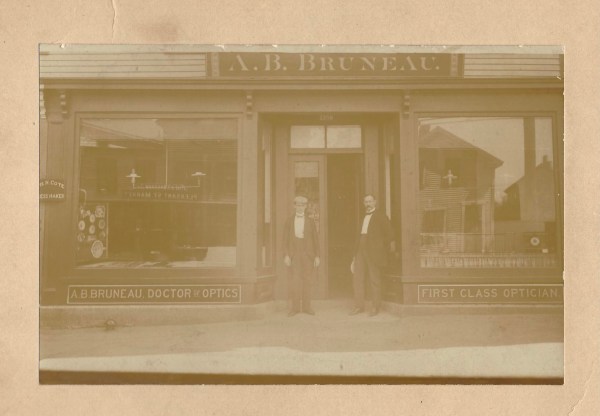
Then in 1897, his business fell off, he closed his store, sold his stock at auction and studied to be an optometrist. A year later he re-established in a smaller way as an oculist. In the next few years, he can be found in Leominster, Massachusetts, Dover New Hampshire and finally in Auburn, Maine with Aime’s occupation listed as a jeweller but also as an Insurance Agent working for the Manhattan Company Federal Street, Boston. During this time Mary appeared to be living in Fall River.
Aimé died unexpectedly of an internal hemorrhage in January 1910. He was 65 and still living in Auburn, Maine. His wife continued to live in Fall River, Massachusetts with her daughter Ida. Mary died there, just six months later at the age of 82. I can speculate about why he wasn’t living with his wife but the long and painful illness noted in her obituary might be the story.
Notes:
Aime B. Bruneau Obituary, The Evening Herald, Fall River Massachusetts. Tuesday 18 January 1910 pg 4. Newspapers.com December 25, 2021. The only Bruneau family member mentioned in his obituary was his brother Ismael as a Congregationalist minister in Montreal.
Our Folks and Other Folks column. Fall River Daily Evening News, Fall River Massachusetts. Tuesday, August 24, 1897. Page 1. Newspapers.com Dec 23, 2021.
Death of Mrs. Mary F. Bruneau: Fall River Daily Evening News, Fall River Massachusetts. Tuesday Aug 23, 1910. Page 8. Newspapers.com Dec 23, 2021.
The New England College of Optometry, NECO was founded as the Klein School of Optics by Dr. August Klein in 1894. Located at 2 Rutland Street in Boston’s South End, the Klein School offered a one-year program that centred on optics, anatomy, and refraction. As optometry quickly became a more established profession, the school’s name changed in 1901 to the Massachusetts School of Optometry. The school began offering a two-year program in 1909, and that same year the National Board of State Examiners in Optometry was established as other new optometry schools sprang up around the country.
The Mass School of Optometry also began requiring incoming students to have completed four years of high school and to possess “good moral character.”
(Jccques et Gilles: McGarrigles from Matapaedia Album)
Sulloway Mill, Franklin, NH
Lydia Morrisette, my granddaughter’s 2nd great grandmother on her mom’s side, was a real Americanophile, or so Lydia’s daughter, Irene, told me just the other day. Lydia always raved to Irene about life the US despite the fact she had lived and worked there for a mere seven years in her youth, in Franklin, New Hampshire from 1903 to 1910.
Why do you think your mother loved the United States so much, I asked Irene. After all, work in New England textile mills by most accounts was no picnic, not even at the best of times, what with the long hours, the lack of respect, the bad ventilation and lint and dust flying everywhere, the dangerous machines that could ‘jump’ at any time and the NOISE. Oh, the noise! Let’s not forget the institutionalized racism against French Canadians, often referred to as pea-soupers, or the paternalistic behavior of the French Canadian overseers.
“She liked the independence,” said Irene. “She liked the money.”
So, it seems that Marie-Leonie Ledia Morrisette, like so many other Edwardian women out in the workforce in the big cities of the Western World, valued her independence and enjoyed having an occupation in which she took some pride. After all, the Sulloway Mill up on the hill produced top-of-the-line men and women’s hosiery.
Irene agrees. “They made nice socks,” she says.
Maria-Leonie Lydia (Ledia) Morissette was born in 1889 (with the help of Dr. Harel1) in Ste Gertrude, Becancour, Quebec, a short ferry ride across the St Lawrence to Three Rivers, to farmer Eugene Morrisette and his wife, Clarisse Heon.
In 19032 The Morrisettes and their children, four five girls and two boys, set out to work in Franklin Mills, a smaller, happier sort of industrial town of around 6,000 people on the Miramack River.
Lydia and her sisters on the 1910 US Census. Few French workers made the Census for some reason (including Lydia’s parents) but the 1906 Franklin Annual Report reveals there were many French Canadians in the town. They just weren’t enumerated, perhaps seen as temporary workers. The Morrisette family is on the 1911 Canada census but Eugene and Clarisse and a son and daughter returned to the US.
With four girls and two boys (including a newborn with “muscular atrophy” ) moving to a mill town where the older children could help support the family was a logical step for a Quebec subsistence farmer.
The 1910 United States Federal census has Lydia and her two sisters, Antonia and Elivina (Alvina) working in a “hosiery mill” (almost certainly the Sulloway Mill) as helpers/top hand and boarding in Ward 2, up from the river and the mill, with teamster M. Poirier and his family.
Lydia, as young “Canadiennes” were instructed to do by the community patriarchs (wherever they happened to be living) ceased work in 1910 to marry handsome Quebecker Henry Hamel. Of course, biology likely had its part in this 🙂 The couple moved back to Drummondville, Quebec and raised a large family. Irene, born in 1918 (and the last surviving child, needless to say) is the among the youngest of their brood.
Lydia was the only female member of the strong-willed Morrisette girls to marry. A sister Alvina remained a mill worker in Franklin and two of her sisters became nuns.3
Perhaps because Franklin was a smaller, kinder New England textile town with fewer workers; perhaps because Franklin is where Daniel Webster of dictionary fame was born; perhaps because the Morrisettes lived in Franklin during an era of exponential change, Lydia and her sisters were different from many New England mill workers from Quebec – who usually kept to themselves. The women took pride in integrating and learning English.
Indeed, their one healthy brother, Horace, was of a similar stamp. He stayed in New Hampshire with his parents, Eugene and Clarisse, and his sister Alvina and married an English girl, Mary Murray.
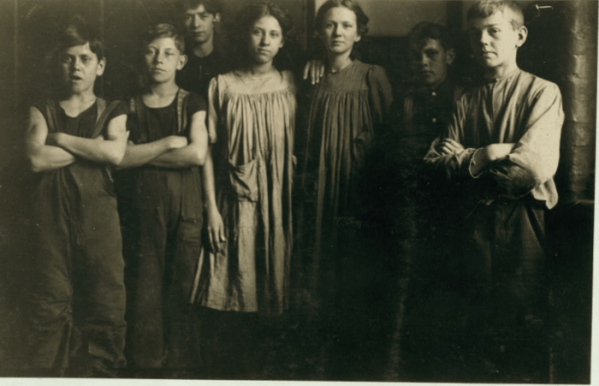
French Canadian child workers at the enormous oppressive Amoskeag Mill in Manchester New Hampshire 1909. LIbrary of Congress. in Franklin NH, at least in boom times, there were Company picnics and baseball games and parades to compensate for the gruelling work in the mills.
1. This is the first time I have seen something like this on the Drouin records. Was the birth difficult?
2. This 1903 date is given on the US Federal Census, shown above and on Eugene Morrisette’s death certificate in 1937.
3, Alvina is listed in the 1930’s as a working as a finisher, which might mean sewing toes and heels into socks or applying chemicals and pressing the socks. Another sister, Antonia, joined a Catholic order back home, but moved to Ontario as she spoke good English. Another sister, Aurore, became a nun in Africa, much to her parents’ displeasure.
325,000 Quebecers left between 1860 and 1900. Just 100,000 between 1900 and 1910 with 40,000 returning. This 2020 YouTube Video from Rhode Island Genealogy Society explains: https://www.youtube.com/watch?v=LyWu46jbauk Country life was very hard for Quebeckers in the Victorian Age. The burgeoning New England textile industry proved most alluring to many farm families. As industry competition increased over the decades, some New England Textile Corporations actively sought out French Canadian workers who, because of their large families who could pool their income, could toil for less money and were less inclined to agitate. French Canadians were also valued for their excellent work ethic.
The Notaries who began their careers from 1760 to 1791
The Notaries who began their careers during the French regime of Nouvelle-France (New France) and were reappointed by the British governors and administrators after 1759.
Note that BAnQ keeps adding new online search engines which did not exist about two years back, such as :
BAnQ Advitam-Numérique
BAnQ Archives
BAnQ Advitam-Numérique in regard to notaries and their dossiers is a regrouping of Notarial Acts which previously were only available within the 10 repositories of the Archives nationales du Québec across the province in the form of :
Microfilms
Original Minutiers (Notarial books)
Or as in-house digitized dossiers which could only be accessed within the 10 libraries of BAnQ across the province on dedicated computers
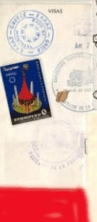
My mother-in-law’s Expo passport. My husband’s family didn’t go to Expo often; there was a summer marriage.
I remember 1967 as the best of year of my childhood. In the US, 1967 was the Summer of Love (flower-in-your-hair hippies) and of war (Vietnam draft dodgers) and of civil unrest (inner city riots) but in Canada it was our Centennial Year, the 100th anniversary of Confederation. For children across the nation it was an especially giddy year: educators from coast-to-coast were teaching their charges how to sing Bobby Gimby’s exuberant CA-NA-DA song, “one little, two little, three Canadians. We love you. Now we are twenty million.”
For Montrealers like me, it was the summer of Expo67, our fabulous world’s fair, situated just a short bus and metro ride away on two man-made islands in the Saint Lawrence River.
I visited Expo 50 times, if memory serves. I sometimes went by myself and I was only 12 years old!
I could go whenever I pleased because I was in possession of a shiny red passport that cost a whole 17 dollars. With his passport you could go from pavilion to pavilion and get it stamped, just like travelling the world.
I no longer have the passport, but it was not lost. My passport was given away by my mother to a beautiful young African woman – and this is how it came about.
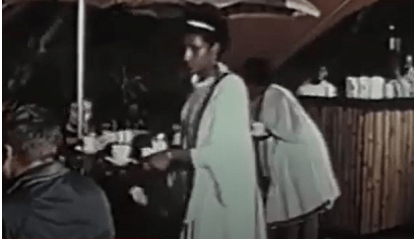
Mentewab (probably) at the coffee bar from a Youtube Video (See notes 1)
A friend of my mother’s had gone through official channels offering to chaperone Expo hostesses from foreign countries. Two Ethiopian hostesses, Hanim and Mentewab, were suggested to her. My mother got into the act and the two girls soon regularly visited our Snowdon home.
Hanim was shy and wore a caftan and hijab. Mentewab was ‘wild’ and wore a halter top, micro-miniskirt and white go-go boots when not in her official costume.
I do not recall having any specific conversations with these young ladies, but I can still see in my mind’s eye their pretty faces as they sat so graceful and ‘grown-up’ on our brown corduroy living room couch, Mentewab so animated, Hanim so quiet.
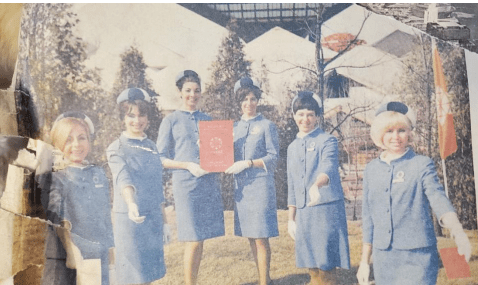
These women seemed to exotic to me: the reporter in the Gazette had called them ‘goddesses’ after all.
Hostesses from Montreal Star Insert. The media focused a great deal on the attractive and accomplished hostesses of Expo, from Canada and beyond.
I doubt that they were as impressed with us and our dingy upper duplex apartment. These girls must have been from the elite classes to have been chosen to host at Expo.
As it happens, on May 2, I caught a glimpse of their leader, Haille Selassie, as he passed through the Expo crowd to polite applause, a small, very proud-looking man followed by a tiny little dog, Lulu the Chihuahua, whose short legs were working very hard to keep up with her master. My mother, who admired powerful men, was very excited. “The Lion of Judah” she sang out as he passed.
On cold rainy days at Expo I spent a great deal of time in the coffee bar at the Ethiopian Pavilion, a shiny red tent with lion cubs on guard, probably pestering Hanim and Mentewab big time.
And then, in mid-October, Expo was over. I guess the women visited us one more time because that is when my mother gave MY Expo passport away to one of the girls. Upon learning that Mentewab or Hanim didn’t have a passport of her own, she merely grabbed mine and said, “Take this one.” (At least, that is how I remember it.)
Sometimes I wonder if Mentewab and Hanim are still alive (why wouldn’t they be, they were hardly older than me) and whether one of them, living in Addis Ababa or Paris or New York City, occasionally opens a drawer crammed with Expo67 memorabilia and shows to her many grandchildren a shiny red passport belonging to a pimply, brown-haired Canadian girl called Dorothy Nixon – and wonders, in turn, where I am today. I’d like to think so.
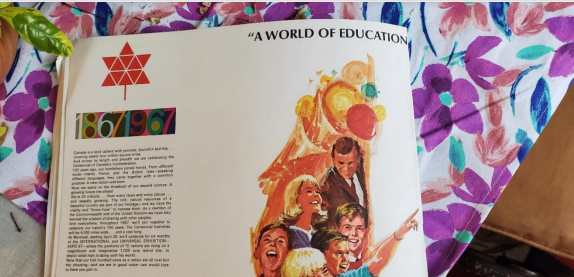
A World of Education. No kidding. The copy here acknowledges that Canada is multi-cultural the visuals not so much.
Ethiopian Stamp that was really a stamp.
My husband may not have visited Expo much, but he did keep the newspapers from the opening.
Many French Canadians left the farms of Quebec and migrated to the mills of New England in the mid 1800s. Some worked and then returned home while other like Dolphis Bruneau settled in the United States.
Dolphis was the eldest son of Barnabé Bruneau (1807-1880) and Sophie Marie Prud’homme (1812-1892) my great great grandparents. One would think he would inherit the family farm in Saint Constant, Quebec but he had moved to North Adams, Massachusetts, long before his father’s death.
North Adams, a mill town in Berkshire County, grew at the convergence of two branches of the Hoosic River, which gave the town excellent water power for the developing industries. Dolphis arrived there 1864, at the end of the Civil War. He first lived in a rooming house and worked as an operative, presumably in a mill. At the same time, his younger brothers, Aimé and possibly Napoleon also lived and worked there.
He married Nellie Saunders the daughter of an Irish immigrant Thomas Saunders. She worked in a shoe factory. They started a family with Maude born in 1871 and another daughter Nellie three years later. Tragically, his wife died during that childbirth so Dolphis was left to raise his two daughters alone. He must have had help from Nellie’s family, as he didn’t move back to Quebec like his brother Napoleon and applied for his United States Naturalization Petition in 1895.
Dolphis’ wife Nellie Saunders
Dolphis continued his quiet life in North Adams. He worked as a carpenter possibly not at a mill but for for a cabinet maker. He kept in contact with his family in Quebec. Some pictures of his growing girls were taken in Montreal so they certainly went north to visit. He didn’t move much as his address, a rental property, is listed as 15 N Holden St for most of his life. His daughters continued to live with him. Maud seems to have kept house and Nellie worked as a bookkeeper.
Nellie BureauMaude Bruneau
Dolphis remarried eleven years after his wife died to a widow, Ester Mary Halse Tingue. Information about his second wife is scant and rather confusing. Ester received a Civil War pension from her first husband and so had some income. The census and city directories show them living apart although listed as married. He lived with his daughters and she lived with her daughter Emma Tingue. Dolphis died in 1909 and Ester in 1924. In her obituary she is refered to as Mrs. Ester T. Bruneau, living at 108 Quincey Street and survived only by Emma. “Her death will bring deep sorrow to her many acquaintances,” it said. Dolphis and Ester were buried in different cemeteries.
The year after her father’s death, Nellie married Arthur Henwood. They moved in with her sister Maud at 15 N Holdon Street. Nellie and Arthur never had any children. Arthur kept a steady job working for James Hunter Machinery as a machinist. His draft registration cards for both WWI and WWII showed him working at the same company. Nellie continued to work as a bookkeeper and Maude continued to keep house. Both sisters had a close involvement with the First Baptist Church.
Maude never married and after her sister’s death in 1939, she and her brother-in-law continued to live together for the next twenty plus years, still at 15 N Holden Street. Arthur died in 1960 and Maude then moved to the Sweet Brook Nursing Home in Williamstown, Massachusetts where she died two years later. Maude’s death ended the Bruneau line in North Adams although most of the family are buried in Maple Street Cemetery.
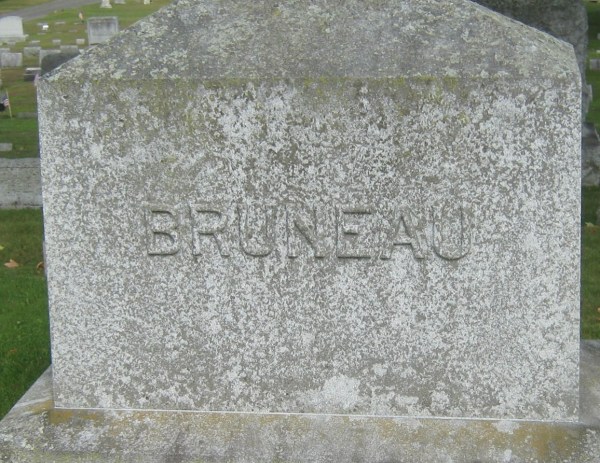
Bruneau Family Tombstone North Adams, MA
Notes:
Dolphis BruneauMassachusetts, U.S., Death Records, 1841-1915 [database on-line]. Provo, UT, USA: Ancestry.com Operations, Inc., 2013. Original data:Massachusetts Vital Records, 1840–1911. New England Historic Genealogical Society, Boston, Massachusetts.Massachusetts Vital Records, 1911–1915. New England Historic Genealogical Society, Boston, Massachusetts. Accesses March 15, 2022.
Dolphis Bruneau – Massachusetts, U.S., State and Federal Naturalization Records, 1798-1950 [database on-line] NAI Number: 4752894; Record Group Title: Records of the Immigration and Naturalization Service, 1787-2004; Record Group Number: R G 85. Provo, UT, USA: Ancestry.com Operations, Inc., 2011. Accessed Mar 12, 2022.
Nellie Bruneau Henwood Obituary.The North Adams Transcript (North Adams, Massachusetts) December 27,1939, Page 3. Accessed on Newspapers.com Mar 27, 2022.
Maude L Bruneau Obituary. North Adams Transcript (North Adams, Massachusetts) March 17, 1962, Page 3. Accessed on Newspapers.com Mar 23, 2022.
Mrs Ester T Bruneau Obituary. North Adams Transcript (North Adams, Massachusetts) Dec 19, 1924, page 14. Accessed on Newspapers.com Mar 30, 2022.
1900 Census: North Adams Ward 3, Berkshire, Massachusetts;Roll:632;Page:7;Enumeration District:0051;FHL microfilm:1240632Ancestry.com.1900 United States Federal Census[database on-line]. Provo, UT, USA: Ancestry.com Operations Inc, 2004. Original data: United States of America, Bureau of the Census. Twelfth Census of the United States, 1900. Washington, D.C.: National Archives and Records Administration, 1900. T623, 1854 rolls. Accessed Mar 2, 2022.
Arthur Henwood: Draft Card H. Registration State:Massachusetts; Registration County: Berkshire Source Information Ancestry.com. U.S., World War I Draft Registration Cards, 1917-1918.Imaged from Family History Library microfilm M1509, 4,582 rolls. Provo, UT, USA: Ancestry.com Operations Inc, 2005. Accessed April 5, 2022.
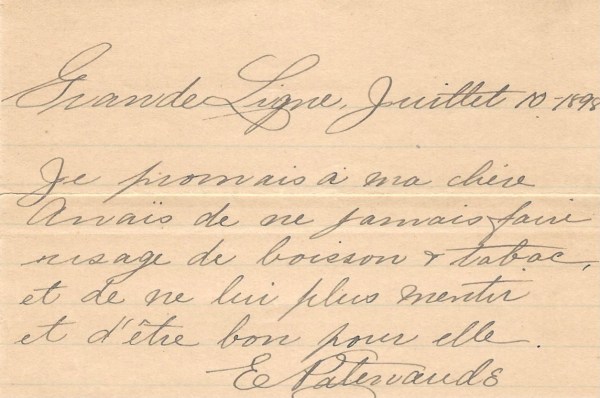
I promise to my dear Anais never to use alcohol or tobacco
and not to lie to her anymore and to be good to her.
E Patenaude”
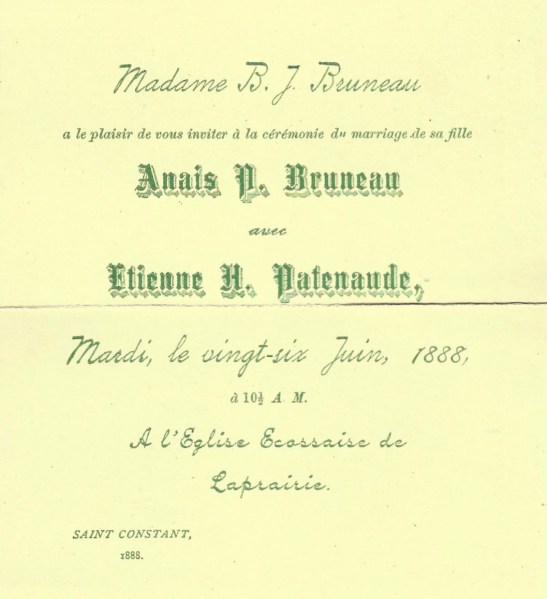
This note found in a box of Bruneau family pictures, along with an invitation to Anais Bruneau and Etienne Patenaude’s wedding made me wonder. At first I thought it was a promise made before they married but then realized the date was ten years later. What had Etienne done?
Anais, the sister of my great grandfather Ismael Bruneau was the youngest of 13 children of my two times great grandparents, Barnabé Bruneau and Sophie Marie Prud’homme. She appeared to be my great grandfather Ismael’s favourite and only three years his junior. He wrote many letters to Anais and some survived but none of her replies. He traveled for his studies and his ministry while she remained close to home in Saint Constant helping their parents. When Ismael was ministering in Kankakee, Illinois, he wrote that he wanted her to meet his beautiful soon-to-be wife. He asked her to come and visit and said that he would find her a tall strong farmer for a husband. As far as I know, Anais never visited and she found her own husband.
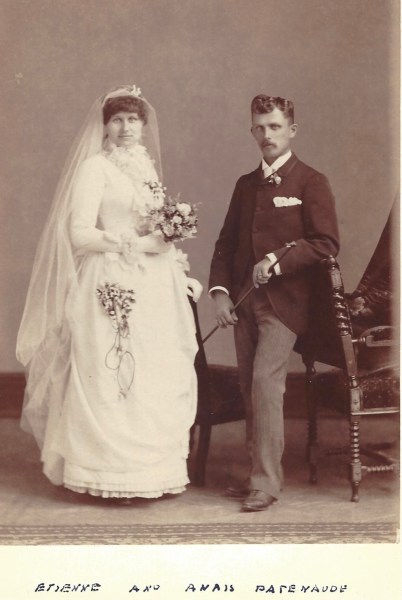
Anais married Etienne Hilaire Patenaude on a Thursday at ten and a half in the morning in L’Eglise Ecossaise in Laprarie, Quebec. I thought it was a strange day and time for a wedding but Anais dressed the part of a bride in a fancy white dress and veil with a bouquet of flowers as their wedding photograph shows. She was 33 and Etienne only 27.
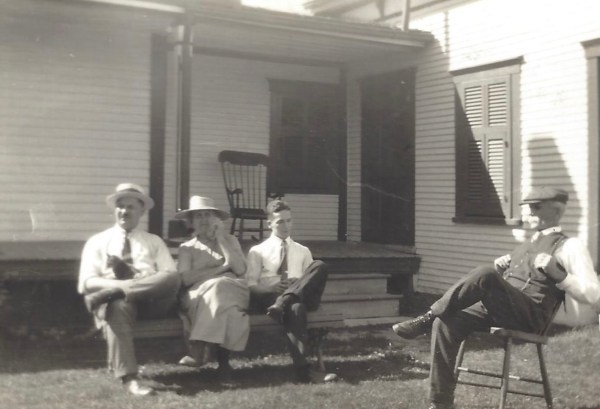
They seemed to live a quiet life on a farm south of Montreal. They had no children. Her mother lived with them for a time after their marriage and most likely until her death. Anais was the good daughter and following her brother’s instructions, continued to look after her mother after her father died. Although Anais had seven sisters only she remained near St-Constant.
Nephews Edgar & Gerald Bruneau with Anais & Etienne in Grande Ligne
Etienne died in 1931 and Anais a year later at 77 years old. They are both buried in the cemetery at St Blaise Baptist Church in Grande Ligne showing they led a religious life. This church was associated with the Feller Institute, founded by Henrietta Feller a Swiss missionary who came to convert the native population but had greater success with the French Catholics. Madame Feller and her partner Louis Roussy were responsible for the conversion of Anais’ parents. Etienne’s parents were also Baptists.
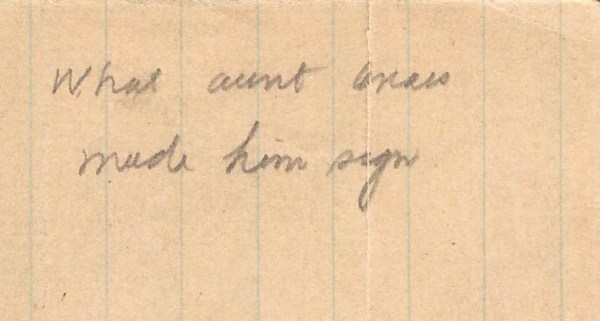
What did Etienne do to have him write this promise? They were both French Baptists and involved in the Mission at Grande Ligne where sobriety would be expected. Did he go off and drink, smoke and lie about it? Who saved this paper and how did it come to me? On the back is written, “What Aunt Anais made him sign.” So, according to family lore, it wasn’t his choice to make this declaration.
Notes:
Note by Etienne Patenaude translated by author.
Ancestry.com. 1921 Census of Canada[database on-line]. Provo, UT, USA: Ancestry.com Operations Inc, 2013. Original data:Library and Archives Canada. Sixth Census of Canada, 1921. Ottawa, Ontario, Canada: Library and Archives Canada, 2013. Series RG31. Statistics Canada Fonds.Images are reproduced with the permission of Library and Archives Canada.
Ancestry.com. 1901 Census of Canada[database on-line]. Lehi, UT, USA: Ancestry.com Operations Inc, 2006. Original data:Library and Archives Canada. Census of Canada, 1901. Ottawa, Ontario, Canada: Library and Archives Canada, 2004. http://www.bac-lac.gc.ca/eng/census/1901/Pages/about-census.aspxl. Series RG31-C-1. Statistics Canada Fonds. Microfilm reels: T-6428 to T-6556.Images are reproduced with the permission of Library and Archives Canada.
Ancestry.com. 1891 Census of Canada[database on-line]. Provo, UT, USA: Ancestry.com Operations Inc, 2008. Original data:Library and Archives Canada. Census of Canada, 1891. Ottawa, Ontario, Canada: Library and Archives Canada, 2009. http://www.bac-lac.gc.ca/eng/census/1891/Pages/about-census.aspx. Series RG31-C-1. Statistics Canada Fonds. Microfilm reels: T-6290 to T-6427.
Ancestry.com. Quebec, Canada, Vital and Church Records (Drouin Collection), 1621-1968 [database on-line]. Lehi, UT, USA: Ancestry.com Operations, Inc., 2008. Original data:Gabriel Drouin, comp. Drouin Collection. Montreal, Quebec, Canada: Institut Généalogique Drouin.
We all know time flies but have you ever thought of your life in chunks of five or ten years at a time?
Census records are a vital resource for family historians researching their ancestors. They provide a snapshot of each household on a particular day over the years. Here is the snapshot of my life on census years.
1961
POP: 18,238,247-Prime Minister: John Diefenbaker(Conservative)
In the News: CUSO was formed and the CFCF (Canada’s First Canada’s Finest) Television Network began broadcasting.
Favourite song : Ben E. King’s “Stand by Me”.
Travels included the family summer cottage in Knowlton (Eastern Townships).
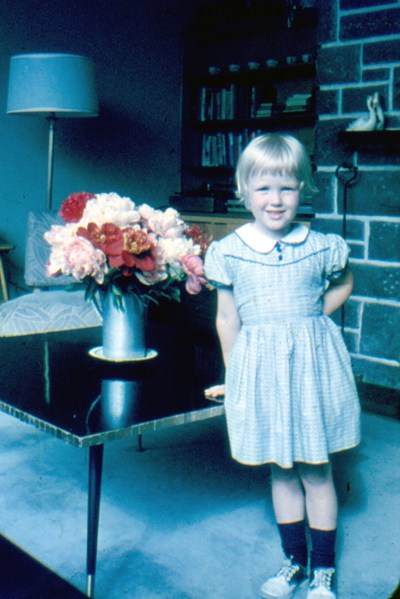
My mother died of cancer leaving my father with four children under the age of 12. I was only four years old. We all lived in the house my father built ten years earlier in Montreal (Quebec). My father ran his own engineering company.
Four-year old me – 1961
1971
POP: 21,568,311-Prime Minister: Pierre Trudeau (Liberal)
In the News: FLQ terrorized Montreal. Pierre Laporte and James Cross are kidnapped. Trudeau invoked the War Measures Act. Frankie Vallie and the Four Seasons are a hit.
Favourite song: Led Zeppelin’s “Stairway to Heaven”.
Travels included winning a trip for two to Paris accompanied by my father and meeting up with my older sister living in England at the time and the Knowlton summer cottage.
I still lived in the same house…blessed with a stepmother (1964) and three more sisters. My youngest half- sister was born in June which gave me a focus to my 14 year-old angst-filled life. As a high school student in 1971, classes were regularly interrupted by bomb scares and evacuations to a shelter across the street. I regularly ran by mailboxes on my way to school “just in case”. I played badminton in the winter and, in the summer, tennis as well as horseback riding just like my older sister… never admitting that the beasts actually terrified me!
(Note: After 1971, the Canadian Census was taken every five years instead of ten.)
Riding “Sugarfoot” at the Knowlton Pony Club – 1971
1976
POP: 22,922,604 – Prime Minister: Pierre Trudeau (Liberal)
In the News: The Parti Quebecois won a provincial majority and Bill 101 (the french language law) was being finalized. Montreal hosted the Summer Olympics.
Favourite song: ABBA’s “Dancing Queen”.
Travels included a family trip to Kennebunk (Maine) beach and the Knowlton summer cottage.
All grown up at 19 years old, I worked at my first real job as a bank teller and moved out of the family home into my first apartment. By the end of the year, I had changed my mind and quit my job, moved back to the family home (with a cat) and signed up for courses at CEGEP (a Quebec college). Maybe I wasn’t quite finished growing up after all!
L to R – Me, my father, my three half-sisters, my Stepmother and my brother – 1976
1981
POP: 24,343,181 -Prime Minister: Pierre Trudeau (Liberal)
In the News: All-time high prime interest rate of 22.75% and Rene Levesque’s Parti-Quebecois was re-elected after the failed Referendum.
Favourite song: The Pointer Sisters’ “Slow Hand”.
Travels included Barbados and weekends of golf in Magog (Eastern Townships).
My fourth attempt of moving out of my father’s house finally succeeded. As an adult of 24 years, my legal secretarial training in Ottawa landed me a job in NDG (west end of Montreal) near my new apartment. However, my interest in investments prompted me to take the Canadian Securities Course where I met a boy and, by the end of the year, I was engaged to be married.
1986
POP: 25,309,331 – Prime Minister: Brian Mulroney (Conservative)
In the News: The Canadian dollar hit an all-time low of USD70.2 and Jean Drapeau (responsible for the Metro, Expo 67 and Place des Arts) resigned as Mayor of Montreal.
Favourite song: Chris deBurgh’s “Lady in Red”.
Travels included Vancouver (British Columbia) and weekends in Magog (Eastern Townships).
My husband, our one-year daughter and I moved back to Quebec from Morrisburg (Ontario), where we operated a ten unit motel for a year until we quickly realized we were losing money. Real estate prices had increased so much in the one year since we left Dorval that we had to buy in a suburb further west of Montreal (Ile Perrot). Moving “home” was no longer an option once married and 29 years old!
Mother and daughter – 1986
1991
POP: 27,296,859 – Prime Minister: Brian Mulroney (Conservative)
In the News: The GST tax came into effect and Canadian forces participated in the Persian Gulf War.
Favourite song: Cher’s “It’s in his kiss”.
Travels included Vancouver and Victoria (British Columbia).
Now divorced and living with my six-year daughter in Magog (Eastern Townships) after closing our used bookstore since we were losing money…again. True to my flip-flop nature, I enrolled to study business at Bishop’s University as a 34-year old mature student. My daughter and I attended our respective schools and enjoyed a less expensive country life filled with seasonal sports and blessed with a group of supportive friends.
1996
POP: 28,846,761 – Prime Minister: Jean Chretien (Liberal)
In the News: Mr. Dressup’s last children’s show. Lucien Bouchard replaced Jacques Parizeau after the second lost Quebec referendum. Severe flooding of the Saguenay River (east of Montreal).
Favourite song: Sarah McLachlan’s “I will remember you”.
Travels included Glacier Park (Montana), San Francisco and Carmel (California), Los Cabos (Mexico) as well as cottage time at the lake.
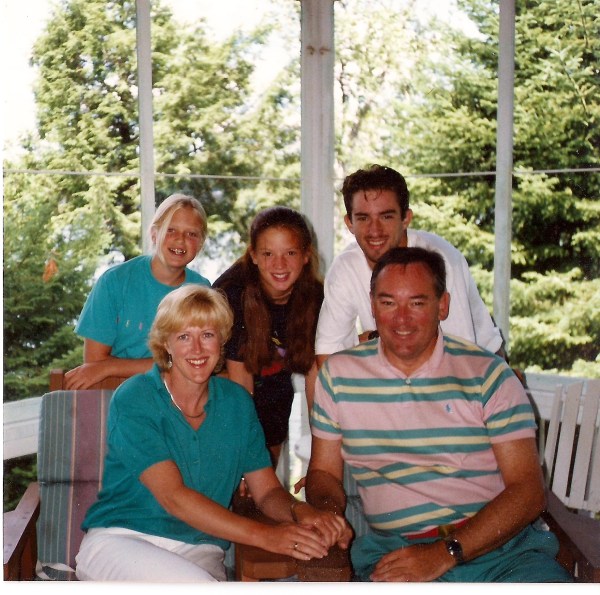
My father died (1995). After five years of study, I graduated from university at 39 years old. My daughter and I moved back to Montreal (Quebec) to start my new career but mostly to crowd into an apartment with my boyfriend of three years and his two teenage children. We married two years later.
Cottage time at the lake as a family – 1996
2001
POP: 30,007,094 – Prime Minister: Jean Chretien (Liberal)
In the News: 9/11 terrorist attacks on the US and Canadian Astronaut Chris Hadfield’s space walk.
Favourite song: Westlife’s “Uptown Girl”.
Travels included Porto (Portugal) and an Alaskan cruise as well as cottage time at the lake.
My business degree enabled me to work full time while juggling my busy new family life but we still found time to travel. The events of 9/11 shook up the world, affecting the travel industry especially, so my husband took the early retirement package “offered” by Air Canada. So at the age of 44, I found myself with my new husband retired, my daughter finishing high school and a roomier apartment as the other two children were away at school in the United States.
2006
POP: 31,612,897-Prime Minister: Stephen Harper (Conservative)
In the News: Dawson College shooting, the fatal collapse of a Laval overpass (a suburb north of Montreal), the Québécois ethnic group officially recognized as a nation within Canada.
Favourite song: John Mayer’s “Waiting on the world to change”.
Travels included Lisbon (Portugal) and a Hawaiian cruise as well as cottage time at the lake.
The only one left in our “nest” was my daughter who attended McGill locally. We continued to enjoy travelling (on Air Canada passes) while I was still working at age 49 and my husband enjoyed his early retirement.
One of several cruises enjoyed with my husband
2011
POP: 33,476,688-Prime Minister: Stephen Harper (Conservative)
In the News: Extreme weather conditions with a winter storm in the Maritimes, a cold snap in Quebec, the Richelieu River overflowing its banks and Wild Fires in the West.
Favourite song: Adele’s “Someone like you”.
Travels included a Hawaiian cruise, England to meet our second grandchild, Halifax (Nova Scotia), Los Angeles (California) and Seattle (Washington) as well as cottage time at the lake.
My husband and I are very comfortable in our new house (2007) that we bought after all the children left home! The unfinished basement made a fabulous art studio that I enjoyed now that I was semi-retired. As a 54- year old grandmother of two, I had the time, love and energy to share with them…but sadly they lived in England.
Cottage time at the lake with the grandkids – 2012
2016
POP: 35,151,728 – Prime Minister: Justin Trudeau (Liberal)
In the News: Final concert of Canadian band Tragically Hip, Wild Fires evacuate Fort McMurray (Alberta).
Favourite song: Ed Sheeran’s “Photograph”.
Travels included a Carribean cruise, a visit with the grandkids in England, a trip down my husband’s memory lane in Winnipeg (Manitoba) and cottage time at the lake.
My daughter married and lives only ten minutes away. Fully retired from office life at the age of 59, I enjoyed an active membership in two art associations. And, as one of nine writers in my genealogy group, my monthly creative writings were due regularly. I volunteered any spare time with the “stitch and bitch” group at my church.
Trip to England to visit the grandkids and the Disraeli House – 2016
2021
POP: 38,246,108 – Prime Minister: Justin Trudeau (Liberal)
In the News: Covid, Vaccinations, Closed Canada-US border and Canadian Indian residential schools gravesites.
Favourite song: All the Golden Oldies!
Travels were restricted to cottage time at the lake… which helped keep me sane.
The strange year flew by with very little in the way of normalcy. We kept safe in our house, wore masks in public, washed our hands frequently, only shopped when necessary and maintained our distance from others. At 64 years, staying fit and healthy had never been more important. The deck at the back of our house provided numerous opportunities for outdoor entertaining of family, friends and neighbours between May and September.
I wonder what my life will look like for the 2026 Census?
Perhaps someday my “great-greats” will find this story helpful and some of their research on my life will already be done!












 Genealogy Ensemble