While rummaging through the Dusty Old Boxes containing family memorabilia, I came upon letters written by you to your only brother, my father, Tom. There were also letters written to your sweetheart during WWII while you were stationed in England serving with the RCAF. So I thought the best way to remember you would be in the form of a letter.
Please allow me to introduce myself. My name is Lucy and I am one of your nieces.
Our paths never crossed. I was only born in 1957 and you died in 1943. Your brother had seven children. I was his fourth. His eldest son, born in 1949, was named after you – William Sherron Anglin II.
While staying with my family in England in 2016, I visited you in person at your last known address: Runnymede Memorial[1], Panel 179, Surrey, UK. My grandchildren, who always enjoy a challenge, accompanied me in my search to find you. It didn’t take them long to find your panel and you – or your name, that is – inscribed on one of several stone walls, along with 20,000 other airmen, at this dedicated memorial building on Cooper’s Hill overlooking the Thames River.
Your name was too high up for the children to touch but I brushed my fingers lovingly over your name and told you we were there. I am quite sure you knew it. You had an interest in mental telepathy, as did your grandfather, and his story was documented in the family boxes as well. (Surgeon and Mentalist)
Throughout your letters to Tom, along with childhood memories, you shared and referred to an interest in The Rosicrucian Order which “is a community of mystics who study and practice the metaphysical laws governing the universe”.[2]
You maintained the belief in an ability to “project” yourself and to send mental messages. I can only guess that a feeling of closeness to your brother by any means must have consoled you greatly while away at war in England.
In your letters to your sweetheart, you described England in general (with the usual complaints about the rainy weather), your life with the RCAF, weekend leaves to Scotland and dances in the mess hall “wishing you were there”. Although I don’t have her letters in response, I am sure you took great comfort in hearing from her.
You were sent on a training course at the end of May 1943 and, while away, your crew went on a mission without you – never to return. In the last letter to your girl, you confided that you were feeling “depressed” at their loss. On the very next mission, you went missing as well.
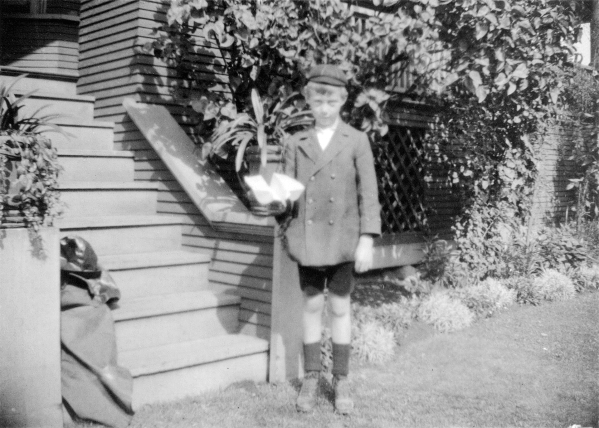
Last picture of Uncle Bill (far left) – 1943
Not long afterwards, your sweetheart sent a bundle of your cherished letters, wrapped in a bow, to your mother and wrote “I know I want to forget as soon as I am able, everything – and so I am sending you the few letters I had saved from those Bill sent me from England. I hope that you would rather have them, than not … perhaps they will make you glad to have something more – to know something else of Bill’s life in England … rather than rake up memories you are trying to forget. For while I want to forget, I feel so sure that you will want to remember.”
Your mother never gave up hope that you would return one day.
The abundant number of photos found with the letters in these boxes show your 27 years filled with family times – gatherings, annual trips, formal portraits, a few pets and a full life.
William Sherron Anglin was an Air/Gunner and Warrants Officer II with the 429 Squadron flying in a Wellington X bomber, Serial no. HZ471.
Reason for Loss:
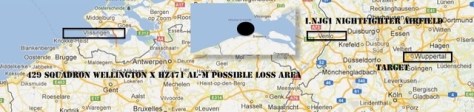
Took off from R.A.F. East Moor, North Yorkshire at 22.36 hrs joining 719 aircraft attacking the town of Wuppertal, the home of the Goldchmitt firm which produced Tego-Film, a wood adhesive used in the production of the HE162 and TA154 (aircraft). Around 1000 acres was destroyed in the firestorm that followed – 211 industrial buildings and nearly 4,000 houses were totally destroyed. A figure of 3,400 fatalities on the ground has been recorded. Bomber command did not escape lightly on this operation losing some 36 aircraft.
It is thought “probable” that HZ471 was shot down by Lt. Rolf Bussmann, flying out of Venlo airfield, and attacking this Wellington at 3,700 meters with the aircraft falling into the sea off Vlissingen.
Who would have thought that finding the immigration records of my grandparents would have led to me to learn about two British government initiatives designed to promote emigration to Canada in the 1920s? I was browsing the Library and Archives Canada web site and found digitized records of Form 30 that recorded the entry of every immigrant between July 1921 and December 1924.1 I was thrilled to find the form that my grandfather, George Thomas Deakin, signed in August 1923, and the one that my grandmother, Grace Graham Hunter, signed in February 1924.
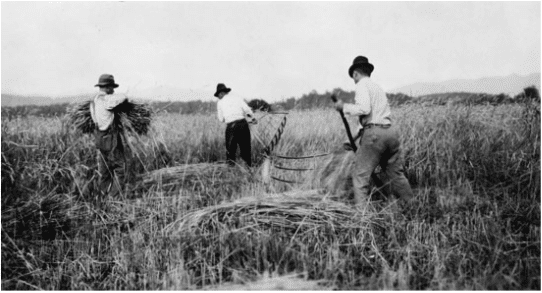
My grandfather’s form indicated that he came to Canada as part of the Harvester Scheme. In 1923, Canada had a bumper wheat crop and North America could not provide the labour needed to harvest the crop. Under the Harvester Scheme, the two major Canadian railway companies entered into an agreement with the British government to transport 12,000 workers out west where they would earn $4.00 per day plus board. This was considered a successful scheme as 11,871 migrants came to Canada to work on the farms in Western Canada. The harvest was successfully completed and 80% of the harvesters stayed and were considered “successfully assimilated.”2
Source: The Farm Collector
Like the Harvester Scheme, The Empire Settlement Act was also an initiave to provide Canada with badly needed labour. It was passed by the British Parliament in 1922 and its purpose was to provide an incentive for migrants to settle in the colonies. Canada badly needed farm labourers and domestic workers. At that time, the Canadian government favoured immigrants from Great Britain as a means of ensuring the predominance of British values. In the early 1920s, it was difficult for Canada to attract immigrants from Great Britain as Britain was enjoying a period of prosperity right after World War I. Another reason was the prohibitive cost of transatlantic transportation. Even passage in third class would have been expensive for a farm labourer or a domestic worker.3
My grandmother came to Canada to enter into domestic service as a cook and her destination in Montreal was the government hostel. Hostels were located in major urban areas across Canada. These hostels were partially funded by the provinces and immigrants from Great Britain were allowed free dormitory accommodation for 24 hours after their arrival. Young ladies were looked after by the Superintendent of the hostel and referred to a church worker. They were also referred to Employment Services of Canada who would find them employment.4
In 1916, William sailed for India. He was to take up garrison duties in Multan, India (now Pakistan) to release regular troops to fight in the War.
William Clegg lived in Liverpool during the early 1900s. He was married to Louisa and together they had eight children; one child was stillborn, one child died at age two and another at six years of age, leaving five living children.
At that time and for many years afterwards, life in Liverpool was hard. Living conditions were crowded, poor and unhealthy. There was not much work, and only a few could hope for a fulfilling life. William earned his living as a paint grinder a dirty, noisy and unhealthy job.
In April 1914, one of the children named Evelyn aged six died. This must have been a very hard year for the family. When WW1 was declared on August 1, 1914, William joined the Territorial Army. He probably wanted to get away from the death and poor living conditions and maybe hope to get a better level of pay to support his family. He was 32 years of age, and he left Louisa eight months pregnant!
The Territorial Army is an army of volunteers which supports the British Army. Volunteer units have existed for centuries, but in 1908 they were merged to form the Territorial Force. Members of the Territorial Force were mobilised in the First World War and served alongside the regular army. [1]
One of the units was The Fifth Battalion King’s (Liverpool) Regiment, which had its HQ at 65 St Anne Street Liverpool.
William was supposed to be part of the Home Guard and serve in England but at some point, he agreed to transfer to the Rifle Brigade. He was immediately sent to the Curragh in Ireland, and then to Douglas on the Isle of Man for training.
By 1916, he and other troops were on their way to India as part of the “The Indian Trooping Season.”
Normally, troop ships left England in September and returned on another ship, with the last ships leaving India in March. This pattern was probably established once troop ships no longer sailed around the Cape of Good Hope and started using the “Overland Route’ and then the Suez Canal after its opening in 1869.[2]
Travel was restricted to the cooler months so that acclimatised troops from Britain were not travelling from the ports of Bombay or Karachi to their cantonments during the heat of an Indian summer.
William travelled on the troop ship “Ballarat,” which was mistakenly diverted to Karachi by senior officers.
It was against regulations to cross the Sind Desert from Karachi to Multan because of abnormally hot temperatures, but William and the other troops with him did so anyway. They were exposed to terrible conditions. More than 200 men suffered from heat stroke and 20 of them died.
During an inquiry, three senior officers were blamed for not looking after the men. Questions were raised in India and England.
The governments of India sent the following telegram to the British House of Commons:
We can now give a considered opinion, having received a report of the committee. The responsibility for diverting the ship from Bombay to Karachi rests with Brigadier-General Roe who was acting as Quartermaster-General at the time. He knew acclimatised troops had never before been sent in large numbers by rail in the middle of Summer through the Sind Desert. He knew, or should have known that the Commander-in-Chief in December 1915, had decided that Karachi should not be used as a port at which wounded and sick British troops should be landed and distributed to other stations, on account of danger of sending in the hot season through Sind.
It follows, that before (the ship) Ballarat was diverted to Karachi, the Acting Quarter-Master-General should have consulted the Commander-in-Chief but did not do this. Having taken on himself the responsibility, he should certainly have warned Karachi military authorities to take special precautions for the safety of troops during the journey by rail. He did not do this.
We, therefore, must hold him responsible, and propose to remove him from his appointment as Deputy Quarter-master-general. It is clear from evidence, that the mischief began before disembarkation, many men having been seen on deck bareheaded in the sun, a thing no officer with Indian experience would have allowed. All the officers on board were quite inexperienced, and we cannot hold them blameworthy.” [3]
The lengthy telegram went on to add that the troop train left Karachi with 13 officers and 1013 men and was insufficiently equipped, overcrowded and without experienced officers.
The three British officers named in the inquiry were “cashiered,” which means they were dismissed from their positions for a breach of discipline.
William Clegg and 19 others died in the Multan Military Hospital, which is now in Pakistan. He left behind his wife and 5 children.
He was originally buried in Multan but the Commonwealth War Graves Commission has found it impossible to maintain War Graves in Pakistan so his name also appears on the large British War Graves Cenotaph in Karachi.
William was the grandfather of my husband John Clegg.
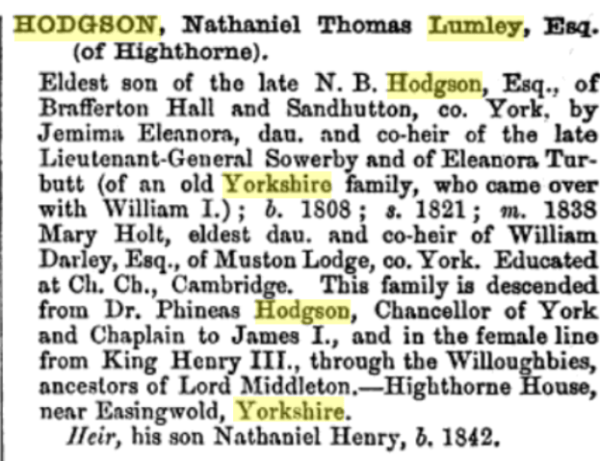
Antonia Willoughby, ancestor of Mr. Lumley Hodgson on his mom’s side.1
As is typical, I know little about the life of my great great grandmother, Ann Nesfield, a cook from North Yorkshire, UK except the basics: birth (1838), death (1912) marriage (1861) and children (10) but thanks to the Internet I know a great deal about her employer, Nathaniel Thomas Lumley Hodgson, a member of the landed gentry. So, just for fun, I have strung together this little fiction about my great great grandmother from some intriguing facts about Mr. Lumley Hodgson found online.
August 23, 1861. “Happiness in marriage in entirely a matter of chance.” I read that in a book by Miss Austen.
As it happens, I am getting married in less than a week to a tailor from the tiny village of Rievaulx, a man I hardly know, a Mr. Thomas Richardson. He visits my place of employ twice a year in the spring to make up my Master’s riding clothes.
Although most of my Master’s clothing is bought in London, he prefers Mr. Richardson, who lives only 12 miles away, for his country apparel.
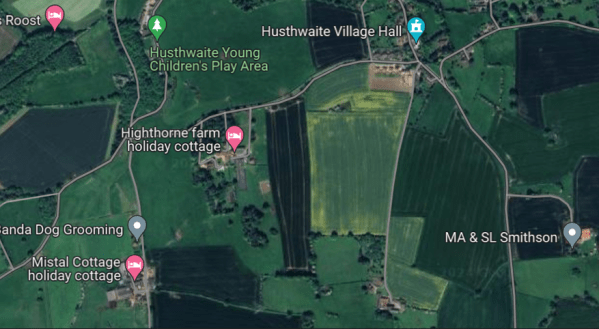
My name is Ann Nesfield. For many years now, I have been engaged as a cook at Mr. Nathaniel Thomas Lumley Hodgsons’ farm estate, Highthorne, near Husthwaite. It is a leisurely employment. I feed his small family, the household staff and the three farmhands. It is rare that important visitors come to stay, and if they do they come on business and sup at the local inn where they can haggle in manly fashion.
You see, Mr. Lumley Hodgson is a breeder of fine horses, of field hunters and of race horses. He trades mostly in the strong reliable Cleveland Bay, a local breed of which he is reet fond.
The Cleveland Bay, he informs everyone, was originally bred centuries ago by the local Cisterian Monks as a pack horse. Later, after the dissolution, the Cleveland was bred with some fleet and graceful Turkman stallions.
Today the Cleveland Bay is used in the field, both to hunt and to plow.
Mr. Hodgson seldom fails to tell his customers how 30 years ago he rode his own Cleveland Bay the one hundred and seventy five miles to and from Cambridge where he attended university.
If that doesn’t impress, he then relates the story of how another local man rode his Cleveland mare 70 miles a day for a week for jury duty in Leeds. Or how another man once burdened his beast with 700 pounds and rode 45 miles to Ilkley and back.
“The breed is being ruined,” Mr. L.H. likes to say, “by the London fashion for flashy carriage horses of 16.5 or 17 hands. Leggy useless brutes they are. All action and no go.”
Leggy Cleveland Bay Carriage Horses.
Mr. L.H. calls himself a farmer but he is a gentleman-farmer with a pedigree as impressive as his osses’. At Cambridge he shared lodgings with the great scientist Charles Darwin. This is also summat he usually tells a prospective client, for Mr. L.H. is a canny businessman and this association can only help him, considering his occupation.
There are rows and rows of stables on his 107 acre farm near Husthwaite that sits on one of the seven hills in the area. The main house, they say, was given as a reward many years ago to one of William the Conqueror’s faithful knights.
As I said, my Master’s household is small, made up of his wife Mary Darley (whose family owns many yackers of land in Yorkshire) two daughters, Julia, 22 and Emma, 8, as well as a nurse, a housemaid and a cook, yours truly.
At 23, I have been summat of a sister to Julia, who is sharp-witted but shy in company. She is destined never to marry. At least, there is never any talk of it, not since 1857 and the bachelor’s ball at the Yorkshire Union Hunt Club. So, on fine evenings, I am the one to accompany Julia out riding. We take two bay mares who she says are descended from the Darley Arabian, the daddy of all Thoroughbreds.
I am told I have a better seat than she does, but only by the groom, a Mr. Jack Bell. At breakfast time he likes to call out to me “Mornin’ Milady, grand day i’n’it”- a bit of a jape – and then he laughs showing a great gap where his front teeth should be.
A signed copy of the Voyage of the Beagle lies in a place of honour in Mr. Lumley Hodgson’s private library and has for decades. You can be sure I have never read it, but Julia has and told me all about it. She is the one who had me read Pride and Prejudice. She likes to lend me her favourite novels so she can explain them to me.
Over the years, I have heard (mostly overheard) so much about this Beagle book I feel as if I have read it and even been on the great sea voyage myself to the GA-LA-PA- GOS Islands and seen with my own eyes the strange and colourful creatures there.
Mr. Darwin has lately published another book called, I think, the Origin of Species. A copy arrived by messenger to Highthorne late last year.
This new book of Mr. Darwin’s has caused quite a stir locally. At a Methodist church service a month ago the minister bellowed that Darwin’s theory of evolution is blasphemous. Flippin’ ‘eck! The theory says we all come from monkeys! Mr. Lumley Hodgson – not in attendance – later told the minister that the theories in the book apply only to animals not to humans, but the minister was not satisfied. He said the question of the origin of all species was decided long ago and by an infallible source. He meant the Bible, of course. “God made the animals of the earth after their species as explained by Noah’s Ark.”
So, my Master, who can’t escape this connection with Mr. Darwin now, has decided to quit the farm for a while.
A few days ago he assembled the staff in the south hall and told us he is selling off his best hunters and other stock (including Emma’s comely Cobb pony and his prize Nag stallion) and moving his family to town for the winter. His excuse is that some of his horses have the equine flu (two have already been put down) and he thinks it might be catchin’ to humans.
No matter what the real reason for his takin’ his family to town, the result is that I am left in the lurch with no employment and no place to stay.
But just yesterday, Mrs. L. H. called me into her sitting room, the one with all the paintings of Julia’s frightsome-lookin’ ancestors, and pronounced, “Ann, you must marry Mr. Richardson, the tailor from Rievaulx. He is a respectable man who needs a wife. His sister, who has been housekeeping for him, has suddenly left for abroad. He says he is comfortably settled now in his own cottage and ready to marry and raise a family.”
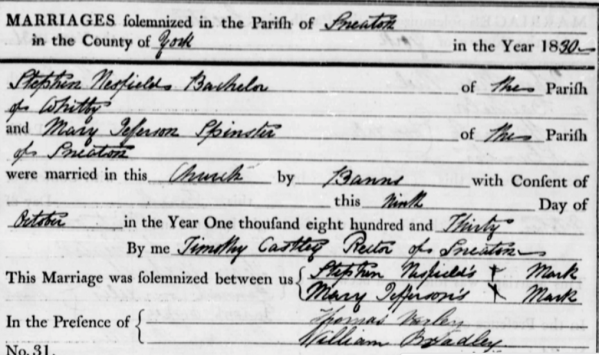
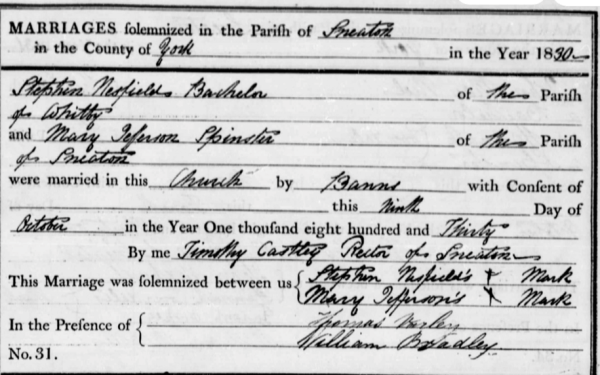
X marks the spot where my illiterate ancestors Mary Jeferson (Jefferson)of Sneaton and Stephen Nesfield of Whitby, Ann Nesfield’s parents, signed their marriage certificate in 1830.)
I must have looked very confused because she continued: “You remember Mr. Richardson from the spring? He waxed ecstatic over your Lamb’s Tail Pie and Tipsy Trifle.” (I did. Seems to me he had eyes for Julia back then.) “He says he needs a wife schooled in numbers to help him keep the accounts. And as Rievaulx is an isolated place, he requires a strong healthy girl who can walk the trails back and forth to Helmsley herself on market day. He is often on the road, so you will not have the use of his carriage as you do here to go to market in Easingwold. Yes, you must marry Mr. Richardson and very soon, too. We can have the ceremony right here in Husthwaite. But first you must visit him in Rievaulx. You can stay at our cousins the Lumleys who have a big farm there.”
So, it is set. My days of making simple Yorkshire meals for a small, ‘appy family in a reet bonnie setting near Husthwaite- and cantering over the dales at darkening with my almost sister Julia – are over.
Highthorne Farm is now a holiday destination, as is Birdsall rectory Manor, near Malton, North Yorkshire where Emma and Julia Hodgson, both unmarried, spent their old age with their brother, Captain Lumley Hodgson, according to 1911 UK Census. Lumley Hodgson’s mother’s relations, the Middletons (Willoughby) owned that place. On that census, Ann Nesfield Richardson was a widow living with her youngest daughter at New Cottage, Rievaulx, running a grocery. She died a year later.
I am off to Rievaulx to marry and make childer with a stranger. Otherwise, all that is left for me is to flit home to Whitby and that I cannot do. My mother is long dead and my father is in line to finish off his days at the workhouse should none of my half-siblings take him in.
Mr. Lumley Hodgson, his ‘ead filled with other worries, has no objections and no opinions on the subject either, although he jokes, “It’s either Mr. Richardson or Mr. Bell for you, I fear.”
But, I ‘ave watched Mr. Bell as he slips the belly-band around the more skittish horses in his care with a firm but gentle hand, keepin’ his voice soft and melodious all the while and I ‘ave noticed how his muscular shoulders glisten after an honest day’s work and I do not think the joke to be as funny as that.
But Jack is a lowly farmhand and Mr. Richardson is a country tailor with a ready clientele and a sweet sunny cottage of his own, Abbot’s Well, with a fine prospect of the Rievaulx Monastery ruins. As I trot along on foot to Helmsley, my poke brimmin’ with dragonwort balm, tansy oil and other home-made potions to sell at market, I can watch from a distance as the Earl of Feversham’s family and friends go a-huntin’ o’er the heathery moors outfitted in all their finery on their own spirited Cleveland Bay/Thoroughbred crosses.
That is the selling point, according to Mrs. Hodgson: The cottage (complete with a little garden for growing my special herbs) and the mannerly profession.
But as Mrs. L. H. was quick to explain, this alliance is a major step up for me. I am but the daughter of a day labourer.
So, I hope Miss Austen is right, that it is ‘best to know as little as possible about the defects of your marriage partner,’ because I know almost nowt about this Mr. Thomas Richardson, except that he enjoys my tipsy trifle. (The trick is to use a lot of high quality whiskey). Still, that is as good a start as any, I reckon.
END
childer: children
Summat: something
Poke: bag
darkening: dusk
reet: very
nowt: nothing
Almost all of the entries for the Lumley-Hodgson’s in the press, mostly Yorkshire press, were related to Mr. L. H.’s businesses, horse and cattle breeding. By the 1870’s he was considered an expert ‘from the old school’ so his curmudgeonly opinions on the ‘horse question’ were much in demand and have left a long paper trail.
Yes, a notice in the paper in August 1861 said Mr. Lumley Hodgson was leaving Highthorne for ‘the health of his daughters.” (The girls were likely not frail, since Julia lived to a ripe old age and Emma was playing competitive doubles tennis in her thirties, I think.) And, yes, a week later, my great great grandmother, Ann Nesfield got married at Husthwaite.
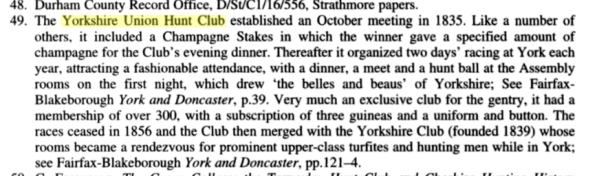
There aren’t many entries in the ‘social notes’ for the ladies of the family despite their good breeding; In 1857, Julia Lumley-Hodgson attended the last? hunt and supper at the Yorkshire Union Hunt Club, (a horse-racing club) where the fashionable young could mingle.
A hunt ball was given in 1867 at Highthorne. And in 1875, Mrs. Lumley Hodgson and Miss Hodgson (likely the much younger Emma) attended a bachelor’s ball in York.
Mr. Lumley-H died in 1886. A notice to creditors was put in the paper, his farm stock, ‘valuable hunters’, and effects put up for auction and his farm “in excellent condition” advertised for let… perfect “for a gentleman fond of rural pursuits.” In 1891 his wife (and girls?) were at Birdsall Manor near Malton (owned by Lord Middleton, a L.H. relation) and Mrs. L.H. was seeking a groom of good character, who must be single to work there. In 1911, her son Captain Hodgson, a widower, was at Birdsall Manor with Julia and Emma, both still single ladies with “private income’ listed where occupation should be.
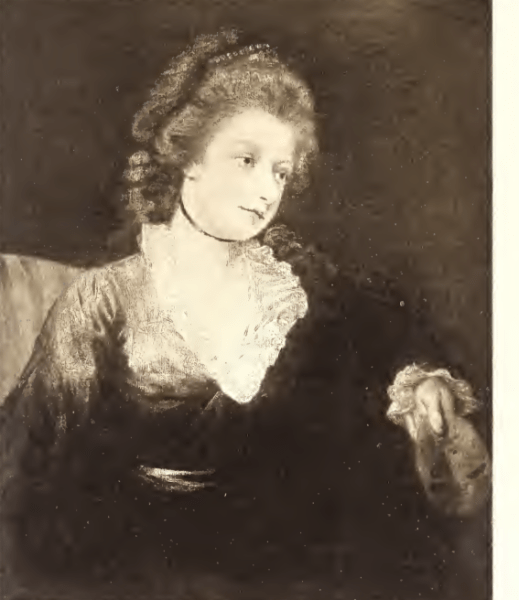
A few reports suggest Mrs. Lumley Hodgson dealt in fine art. The portait above was owned by her, found on Archive.org in A History of the Works of Sir Joshua Reynolds, Getty Museum publication. The weirdest entry about Lumley-Hodgson was that as an infant he sued his mother, Jemima, for land. Another online entry about Highthorne says he leased it in 1815. He would have been seven!
The Darley Arabian was brought to England from the East by the Alton, Yorkshire branch of Darley’s. Mary was from the Muston Lodge branch. They come from the same family originally.
In April, 2008 I received an unsolicited email from a Mrs. Joan Hague of Montreal with just one word in the subject line: Changi.
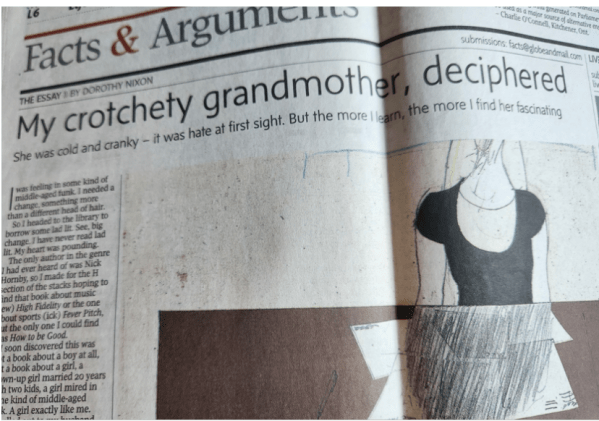
She had seen an article I had written about my grandmother in the Facts and Arguments1section of the Globe and Mail. She wanted to tell me about her father, Thomas Kitching, who had been interned at Changi Internment Camp in Singapore during WWII, just like my grandmother Dorothy Nixon.
I visited the gracious Mrs. Hague (recently deceased at the ripe old age of 99) only to discover something extraordinary: Mrs. H. and my own father, Dorothy’s first son, Peter, had led parallel lives!
My father, Peter, was born on October 24, 1922 in Kuala Lumpur, to a Selangor planter, Robert Nixon of North Yorkshire and his wife, Dorothy Forster of Teesdale, County Durham. Mrs. H. was born in Batu Gajah, Malaya in early November, 1922, to Thomas Kitching, the Surveyor of Singapore and his wife Nora.
As was the custom for British Colonials in the era, Mrs. H. was sent away at age six to go to school in England. She attended Harrogate Ladies’ College in North Yorkshire. My father was sent away at age five to go to a school in Maryport, Cumberland and then he went on to St. Bees prep school on the coast of Cumberland.
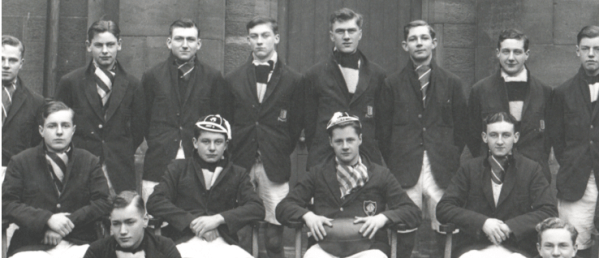
Senior Rugby St Bees School, Cumberland. My father at top, fourth from left. Courtesy St. Bees School Website.
Mrs. Hague told me she spent her holidays with a loving grandmother in Lancashire. My father and his even younger sister, Denise, were shuttled on vacations between random relatives who resented having to care for them.
Mrs. Hague’s mother, Nora, a nurse by profession, filled the void in her life with sports, golf mostly. She also scored cricket for Singapore. My grandmother, Dorothy, became the librarian at the Kuala Lumpur Book Club and she was Selangor’s official cricket scorer.
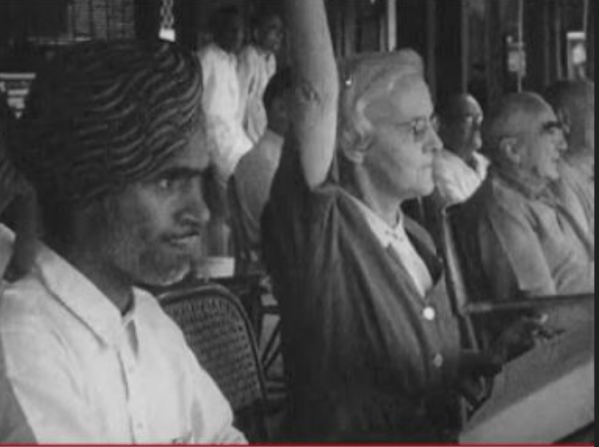
My grandmother, scoring cricket at Royal Selanor Club in K.L in 1952. Courtesy of a March of Time Newsreel. She was the ‘grand dame’ of Malayan cricket apparently. She told a reporter that she got into cricket because her husband, my grandfather, was one of the finest players in Malaya in the 1920’s and 30’s.
In 1939, when the phony war broke out in England, my father was about to go to Oxford. Mrs. H. was in her last year at her ladies’ college. The Harrogate students were evacuated to another town. Mrs. H’s parents, in England for a time, brought her back to Singapore because they thought she would be safer. After two years at Oxford’s St Edmund Hall (where he was awarded ‘colours’ for rugby) my father signed up with the RAF and went to train in Saskatchewan, Canada.
The Japanese invaded Malaya on Boxing Day, 1942.The Japanese planes bombed “the green” at the center of KL, the site of many government buildings. My grandmother’s library building, adjacent the legendary Royal Selangor Club, was hit. During the bombing my grandmother hid under a desk. Later, she helped dig four dead bodies from out of the rubble.
On that ominous day, Mrs. H and her mom were safely in “fortress” Singapore. They joined up as VADs, tending to the severely burned survivors of two navy ships that had been blown up by the Japanese in Singapore Harbour. Mrs. H. had a vivid memory of unfolding the hospital cots that were all covered in a sticky goo to prevent rusting.
Kuala Lumpur soon fell. My grandmother was commanded to take a noisy, unlit night train to Singapore. Upon arriving, she immediately joined the ‘resistance’ at the Malaya Broadcasting Corporation.2
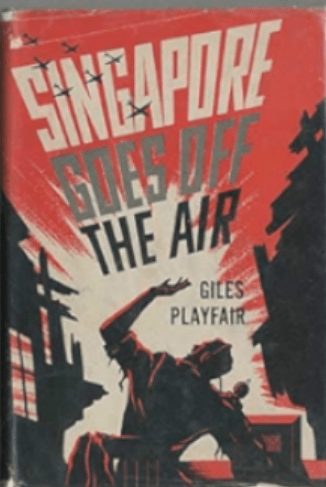
Giles Playfair, a reporter, wrote Singapore Goes off the Air in 1943, so it was likely a bit of wartime propaganda. He oft mentions my grandmother and seems to like her, but he disparages Colonial Wives as lazy and living above their station.
To everyone’s surprise and to Winston Churchill’s embarrassment Singapore soon fell as well. Mrs. H. escaped to Batavia and made it back to England but tragically Nora, her mother, took another boat, the Kuala, with 500 others including 250 women and children, and was lost at sea when her ship was bombed by the enemy.
Mrs. H. trained as a physiotherapist at St Thomas Hospital, London and volunteered at the Canadian Camp.
Mrs. H’s father, Thomas Kitching, was interned at Changi Internment Camp, as were my grandmother and grandfather, Dorothy and Robert Nixon. (Upon the fall of Singapore, Dorothy had stubbornly refused to escape to Batavia, staying instead to support wounded soldiers. A good thing, perhaps.)
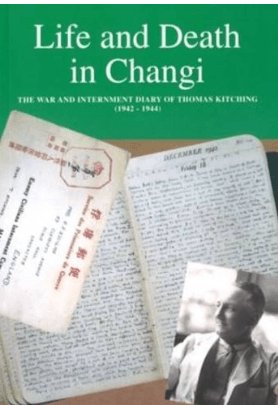
Thomas Kitching’s diary was published posthumously. Mrs. H. lent me a copy.
Kitching died of throat cancer in the men’s section of Changi prison in 1944 but he kept a diary of his time there that was later published. For a six month period my grandmother was Commandant of the Women’s Camp and according to her own unpublished memoirs she liked sneaking into the men’s camp, which was strictly against the rules, to gather information. The men had secret radio sets, you see, and she was an amateur radio enthusiast.
Malaya Straits Times 1936. The only woman among men. From what I have learned, that’s how “Granny,” educated at a co-eductional quaker school, liked it. This is why she just had to sneak into the men’s camp, a very dangerous act, I think. it certainly got her into trouble! Here she is described as Mrs. Dorothy Nixon. In those days and well into the 1960’s in newspapers in North America women were referred to as Mrs. John Smith.” They had no first names.
On October 10, 1944 many of these men and a few women were accused of spying in the infamous Double Tenth incident and taken by the Japanese Gestapo to a room in the basement of the local YMCA to be harshly interrogated, some men horribly tortured. My grandmother stayed in that stifling, bug-infested room with the crazed, half-starved men for a month, enduring a kick in the ribs on occasion, and then she was put in solitary confinement for another five months.
She survived her ordeal, but barely.
My father, meanwhile, was posted to the Ferry Command based in Dorval, Quebec, a suburb of Montreal. A member of both the RAF and RCAF, he flew planes around the world, mostly mosquitos he told me.
A range of Mosquitos were manufactured to do everything from reconnaissance to bombing. Some were made in Downsview, Ontario. Ferrying planes from Canada to Europe was dangerous and many planes didn’t make it, but, hey, it was war.
In Montreal he met my mother, a French Canadian stenographer at RKO Radio Pictures probably at a party at the Mount Royal Hotel. They married after the war in 1949 once my father had finished his war-shortened math degree at Oxford.
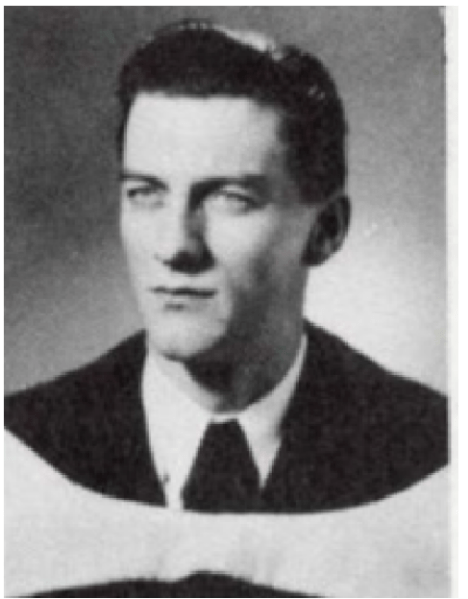
My father’s Sir George Williams grad pic, 1952, that I recently found online. Sir George Williams University night school was designed for returning soldiers, many of whom already had families.
In Montreal, my father added on a night time Commerce Degree from Sir George Williams University and a CA from McGill while working full time and raising a family.
Mrs. H. met her future husband, Mr H., the son of a prominent Westmount banker, during the war in London at a party for Canadian soldiers. The invitees brought with them a big juicy turkey apparently. The couple married in Morecambe Parish Church and moved to Montreal on the war bride scheme.
It is too bad I never got the chance to introduce Mrs. H. to my father as he succumbed to Alzheimer’s in the St. Anne de Bellevue Veteran’s Hospital in 2005. They certainly would have had a great deal to talk about!
Indeed, they may have already met. They both sent their sons to Lower Canada College on Royal Avenue in NDG in the 1960’s.
2. Chronicled in a 1945 book Singapore Goes off the Air by Giles Playfair. The author wrote fondly of my grandmother, although he held the common belief (from back then) that Colonial women were indolent parvenues, ‘who would be sweeping out a four bedroom cottage back home’ were they not in Malaya attending fancy liquor-oiled soirees and waited on at home by a slew of servants.
3. Joan Hague obituary, chronicling her ‘interesting’ life with portrait young and old. I wrote this piece years ago and posted it on my personal blog after passing it by Joan Hague but also added two tidbits from her online obituary: Her marriage details and her work details.LINK HERE
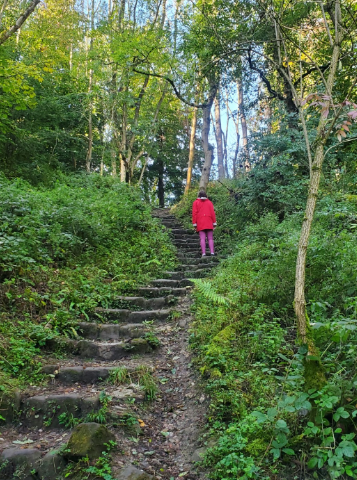
The path my 2 times great grandmother Anne Nesfield took to work and marry in 1860 era. People in Sleights tended to stay put until the opening of the railroad in 1840.
My father, Peter, born Kuala Lumpur, Malaya in 1922 of hardscrabble North of England stock, always signed his name Peter N.F. Nixon Esq., something I found a wee bit pretentious. He was just a chartered accountant, after all. The F stood for Forster, the N for Nesfield.
I knew Forster was his mother’s surname. I didn’t know until very recently upon doing his genealogy that Nesfield was his father’s paternal grandmother’s name.
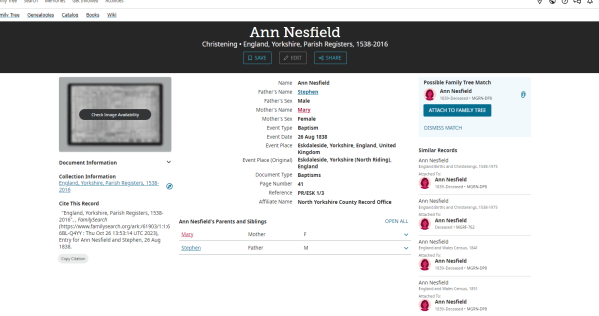
Ann Nesfield, my 2x GG was born in 1838A in Sleights near the lovely coastal town of Whitby at the North East corner of the North Yorkshire Moors to Stephen Nesfield of that place and Mary Jeferson of nearby Sneaton.
Stephen was a labourer. He and Mary were both illiterate as they signed their 1830 marriage certificate with an X.
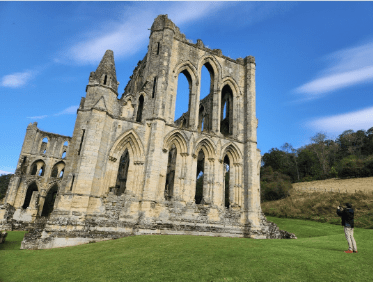
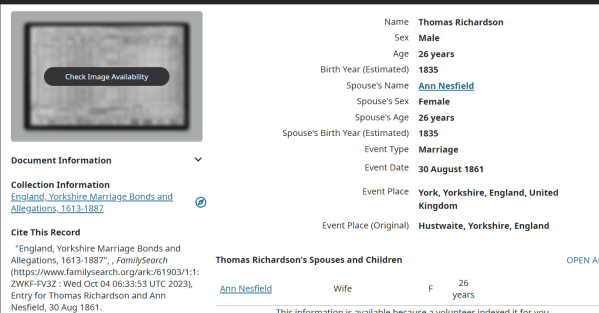
The August 30, 1861B marriage record for Thomas Richardson and Ann Nesfield has them wed in Husthwaite, 40 miles to the south west but still on the Moors. Thomas was from nearby Rievaulx, a small town of 229 people (10 farms and 26 cottages, one school house and no pub) famous then as now for its monastery ruins.
According to the 1861 UK Census, Ann had been working in Husthwaite as a cook at an estate/farm, Highthorne, belonging to one Nathaniel Thomas Lumley Hodgson, Esquire (sic) gentleman horse-breeder who had been a crony of Charles Darwin’s at Cambridge! 3Thomas according to the same Census is living in Rievaulx with an older sister.
Ann and Thomas Richardson go on to have ten children over twenty years with my father’s grandmother Mary-Ellen, 2nd born in 1862, destined to marry one Robert Nixon, a quarryman from the adjacent market town of Helmsley.1
Now, I imagine Ann Nesfield’s existence in rural England post-Industrial Revolution wasn’t that easy despite her initial skilled position as a cook for a small family at a Yorkshire Dales farm/estate. And who can know about her 1861 marriage to Thomas Richardson. Tailors and drapers, especially in small towns, were still solidly working class.
It is also possible Ann married right then out of necessity. It was announced in the 24th of August 1861 Yorkshire Gazette (just one week before Ann’s marriage) that Lumley-Hodgson Esq. was selling off some fine animals and leaving his farm for the winter ‘due to the health of his daughters.’
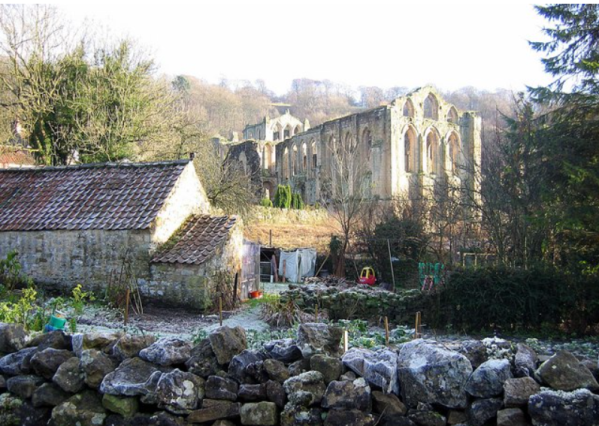
Abbot’s Well cottage on Google Earth with ruins behind. The oldest standing non-monastery building in Rievaulx, designated by the National Trust as Medieval, a period that ended in 1450.
The view from the garden. Roger Smith. Geograph Project Creative Commons
In the beginning, Thomas and Ann Richardson lived at the Richardson family abode, Abbot’s Well, a cozy-looking medieval cottage in Rievaulx, a town that started out as the inner court of one of the richest Cistercian Monasteries in England founded in 1132. The Monastery was destroyed by Henry VIII in 1532 at the very beginning of the infamous dissolution. New homes were then built with stone from the monastery, homes that were used to house various workers from the nearby Duncombe Park Estate of Lord Feversham.
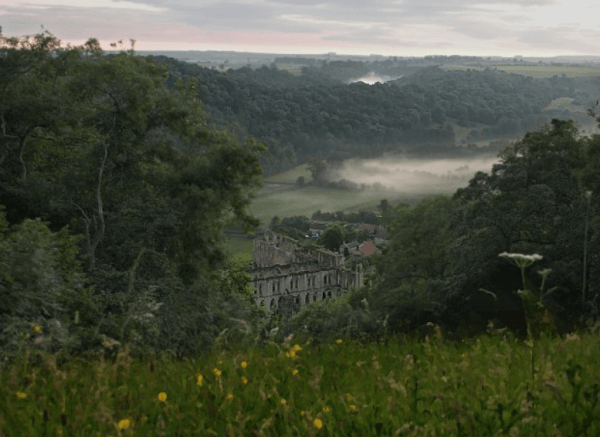
The view from the little garden of Ann’s heritage house, by all accounts, was simply stupendous.
I discovered a 1830’s travelogue online that already describes the town of Rievaulx as ‘quaint’ and ‘picturesque’ and ‘historic,’ claiming the view from the ridge of the vale and ruins “offers a combination of beauties that must be seen to be enjoyed and once seen can never be forgotten.”2
A century later, in the 1930’s, a nephew of the 1st Lord Feversham of Duncombe Park in Helmsley was living at Abbot’s Well House (built 1906 and 30 meters away from the cottage) and Lady Beckett, the widow of the 2nd Lord Feversham, was offering tours of the cottage in benefit of local nurses “with the small garden providing an excellent prospect overlooking the monastery ruins.” Her tours continued well into the 1950’s.
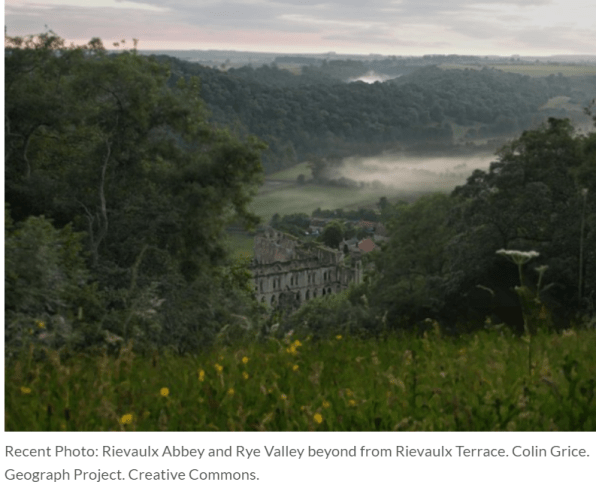
And in May, 1984, the London Times remarked upon a recent sale of the modern Abbot’s Well House. “That a view is worth something is proved by the recent million pound plus sale of the modern Abbot’s Well with a two acre garden that has a view of the 12th century abbey and the Rye Valley beyond.”
I have to wonder, in the 1860’s, did Ann’s heart sing out every time she went out to hang the laundry with my great-grandmother, Mary-Ellen, at her feet? Or did she lament the leaky roof, drafty windows or the lack of bedrooms for her growing family? Was living beside these majestic monastery ruins a comfort to her or merely a haunting reminder of how things can fall apart?
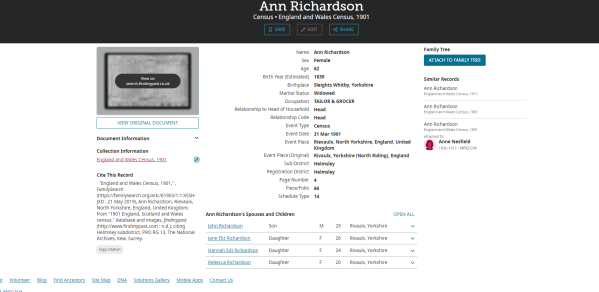
As it happens, the Richardsons did move out of Abbot’s Well sometimes after 1881 and before 1891, but they did stay in town. The 1891 UK Census has the family living at New Cottage in Rievaulx, with Thomas still a tailor and draper but also, now, a grocer. The 1901 CensusC has Ann a widow with four grown children still at home, one son working as a general labourer but three girls in their twenties performing “home duties.” Ann is now the tailor/grocer in the family. In 1911, one year before her death at 74, Ann is still at New Cottage, working as a grocer and living with her youngest daughter who is 30 and married.
Recent Photo: Rievaulx Abbey and Rye Valley beyond from Rievaulx Terrace. Colin Grice. Geograph Project. Creative Commons.
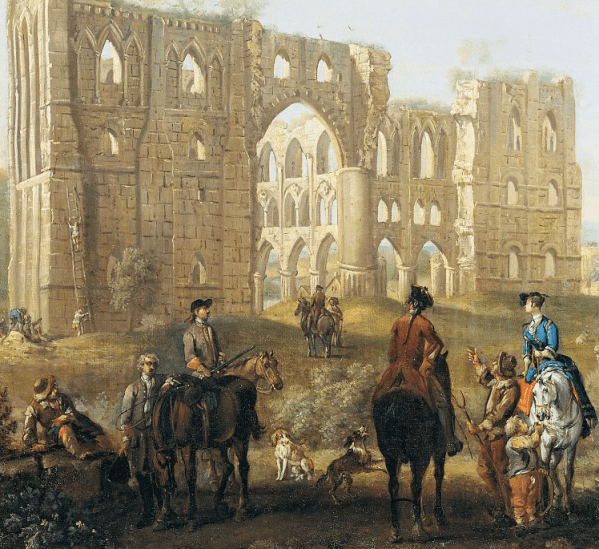
Duncombe Hunting Party. 1728. John Wooten. Yale Collection of British Art. Creative Commons . My ancestors would be the labourers in the background or the scruffy attendants:)
My father’s working-class ancestors lived in picturesque towns all along the route from Whitby to Helmsley; pretty places with colourful names like Goathland, Kirbymoorside and Ugglebarnby. Whitby, where Ann Nesfield lived her early years, is also a North of England beauty spot from what I see on YouTube with surrounding coastal villages as lovely as anything in Italy’s Cinque Terre.
So, although little of consequence about Ann Nesfield’s life can be gleaned from the genealogical record, one thing about the woman cannot be denied. She spent her entire existence surrounded by the breath-taking beauty of the North Yorkshire Moors. That, I think, has to have taken the edge off her own hard-scrabble existence.
Notes:
Thank you to the Ryedale Family History Group for all their kind and expert help and especially to Valerie Slater for helping me sort out the many Ann Nesfields in the Whitby area born circa 1838.
(Apparently, there’s a lot of mix up over these Anns in online family trees. I have to redo part of my tree, now! And it doesn’t help birth dates on the UK Census are only guesstimates 🙂
Robert Nixon Sr, my great grandfather, 1863-1937, who married Nesfield’s daughter, Mary Ellen Richardson, was a delver in the quarry in 1911 according to the UK Census, but he had other occupations. I know because I found his short obit from 1937 from the Yorkshire Post on the British Newspaper Archive database:
“Mr. Nixon was for man years foreman timber leader with messrs William Frank and Sons and with Mr Bentham King. Later worked for the Duncombe Park Estate, and during the war was put in charge of the felling of timber at Waterloo. He was a Sunday school superintendent and a local preacher in the Methodist circuit for over half a century.”
The 1921 census says Robert is working as head quarryman at Duncombe for the Trustees of the Earl of Feversham who was under age. The former Earl had died in 1915 in the war.*I wonder if the Nixons had an IN with the Earl? A Nixon and a Richardson were pallbearers at the Dowager Feversham’s 1889 funeral.
2. Ross, Stephanie. The Picturesque, an eighteenth century debate. Journal of Aesthetics and Art Criticism. 1967
Esquire: Modern British. Polite term as appendix to a surname of someone without any other title implying genteel birth. Earlier, for English gentry rank below a Knight.
3. Both Darwin and Lumley Hodgson were ‘admitted pensioners under Mr. Shaw 1827. at Christ’s College a Divinity School.” Apparently, nature studies and divinity studies were considered compatible back then, as in ‘all God’s creatures.” Both graduated in 1832, although Darwin completed his exams in 1831. The Darwin Archives of Cambridge contains a January 1831 letter where a friend is asking Darwin if Lumley Hodgson has passed. “I don’t see his name anywhere, I am almost afraid to ask.”
Nesfield Rugby genes. My father’s nephew 1973, Rugby for Cambridge and England. My father, co-captain, 1939 Rugby for St Bees School Cumberland. My grandfather, 1912 Rugby for Duncombe Park where he was a footman. Through DNA I discovered other Ann Nesfield descendants played rugby for Scotland.
CITATIONS
A: Ann Nesfield Baptism 1838 Family Search2. Ann’s marriage to Thomas Richardson 1861 Family SearchC: 1901 Census. Ann at Home running the family business with her girls.
… and now his church celebrates its 200th Anniversary in 2023
(upcoming celebration details below)
The deed described the property as “a commodious estate upon the outskirts of the thriving town of Halifax, in the Colony of Nova Scotia, Canada”. Imagine William’s surprise to arrive in Halifax in February to discover that “outskirts” meant a 200-mile hike through thick forest and deep snow!
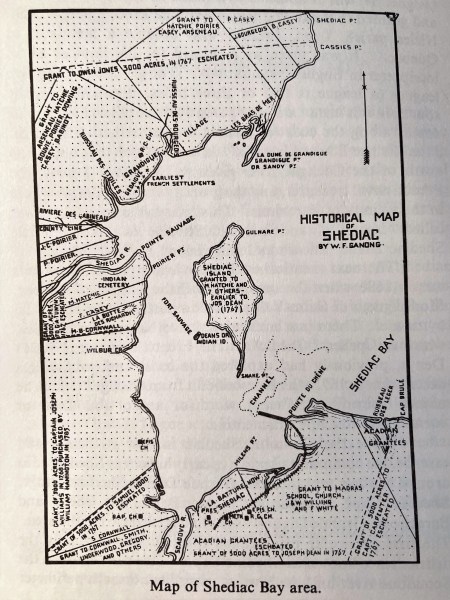
My great-great-great grandfather, William Hanington, was born in London, England, in 1759. As the son of a fish dealer, he trained as an apprentice to the Fishmonger’s Company but became a freeman in 1782. Two years later, at the age of 25, this adventurous young man paid £500 sterling for 5,000 acres of land “near” Halifax, Nova Scotia, from Captain Joseph Williams.
After the initial shock upon their arrival, William and his companion found an Indian guide, loaded all their worldly belongings onto a hand sled, trudged through the snow, slept in the open and finally arrived in bitterly cold Shediac in March 1785. His discouraged companion quickly returned to Halifax and sailed back to England on the first available ship!
Large Lower left piece of land belonged to William Hanington 1785
William, however, was obviously made of sturdier stuff and delighted by what he found! A good size stream flowed into the bay and he had never seen such giant trees! He must have pictured the lucrative possibilities for trade in lumber, fish, furs and more.
Seven years after his arrival in Shediac, at the age of 33, he hired a couple of Indian guides to paddle a canoe over to Ile St. Jean (now known as Prince Edward Island) where there were other English settlers. The Darbys were Loyalist sympathizers who escaped from the rebels in New York. While riding along in an oxcart through St. Eleanor’s (now known as Summerside), he spotted a young lady (age 18) named Mary Darby, drawing water in her father’s yard. After a brief stay with her family, William and Mary married and paddled back to Shediac where they eventually raised a large family of 13 children.
After the first three years together, they persuaded Mary’s sister Elizabeth and her husband John Welling to come over from Ile St. Jean and settle on their land – becoming the second English family in Shediac.
And in the next five years, William boasted eight families on his property of about one hundred acres of cleared land. He opened a general store and dealt in fish, fur and lumber. The furs and timber were shipped to England and the fish to Halifax and the West Indies! He imported English goods from Halifax and West Indies products – mainly sugar, molasses and rum from St. Pierre. He also bartered with the friendly Indians for furs and helped them clear land.
Before long, a considerable village clustered about the Hanington Store – including a post office and a tavern. William remained the leading figure of the community and acted as the Collector of Customs of the Port, Supervisor of Roads and Magistrate enabling him to officiate over the marriages of many couples. To top it all off, in 1800, just 15 years after his arrival from England, this remarkable young man built a shipyard 10 miles north of Shediac in Cocagne.
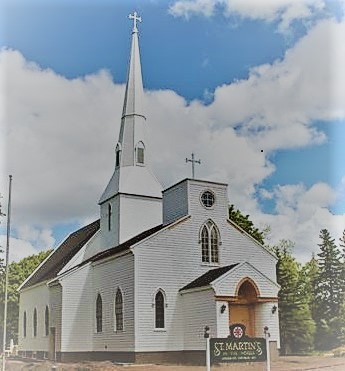
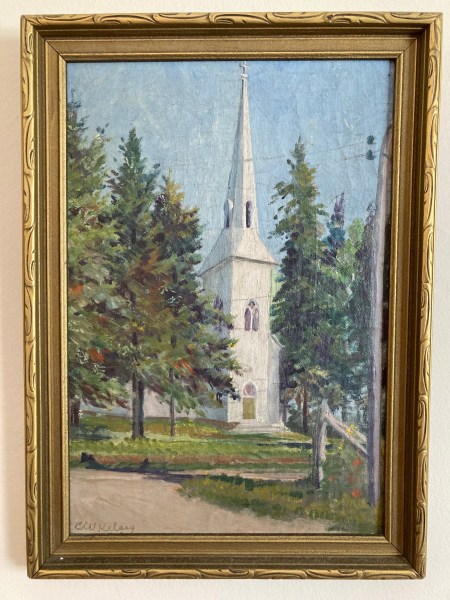
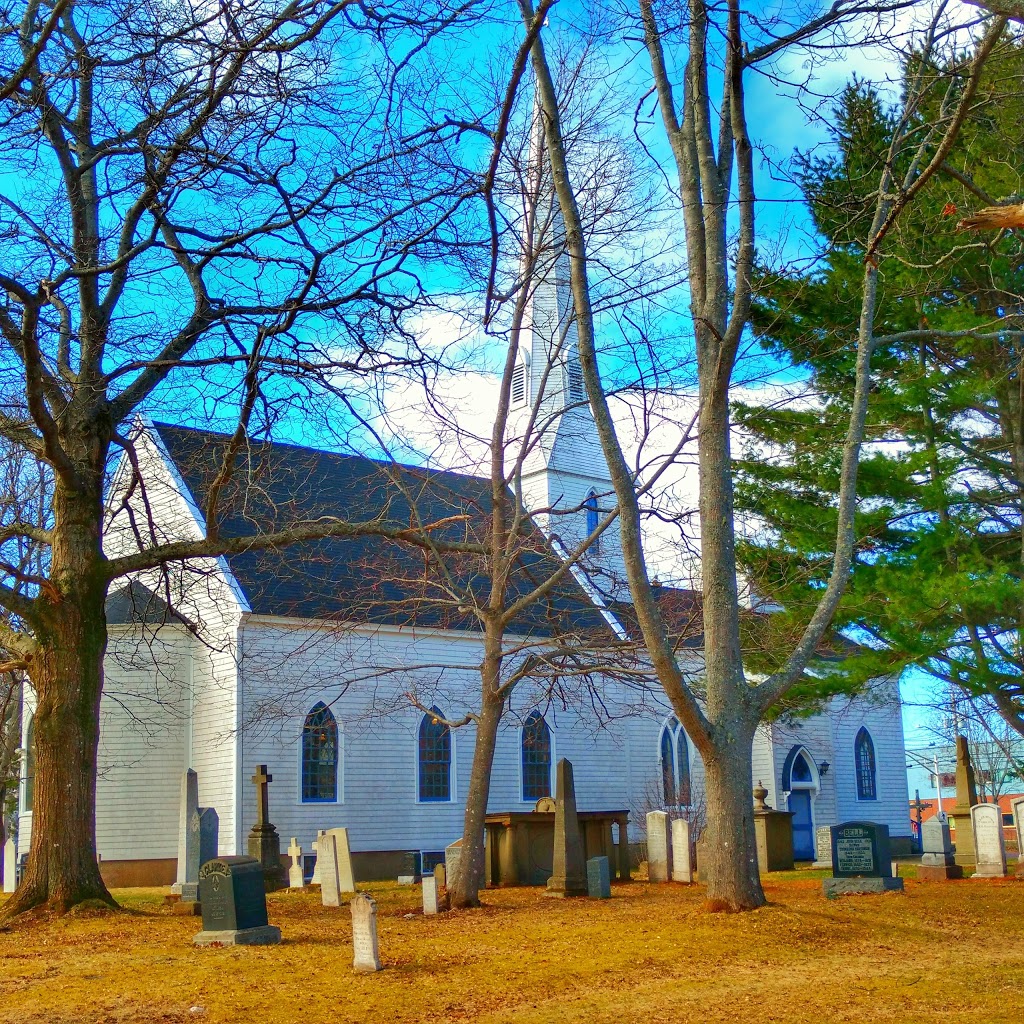
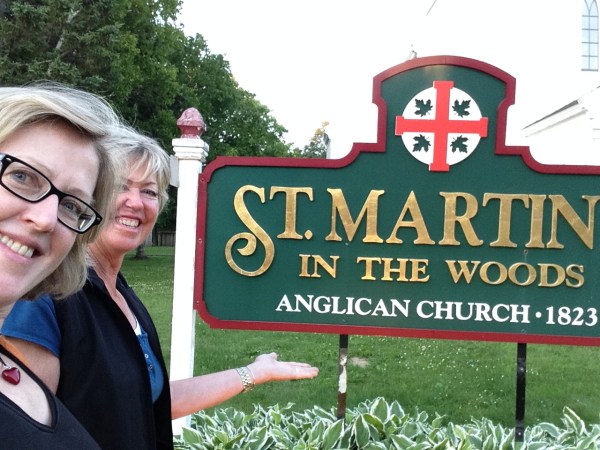
The only thing lacking in this delightful little community was a church. Until then, William being a religious man, conducted service in his home every Sunday and welcomed all to attend. Then in 1823, William donated the necessary land and lumber and oversaw the completion of St. Martin-in-the-Woods, the first Protestant church. He named it after his church in England; the famous St. Martin-in-the-Fields overlooking Trafalgar Square in London.
Painting of
St Martin-in-the-Woods Church
by Charles Kelsey
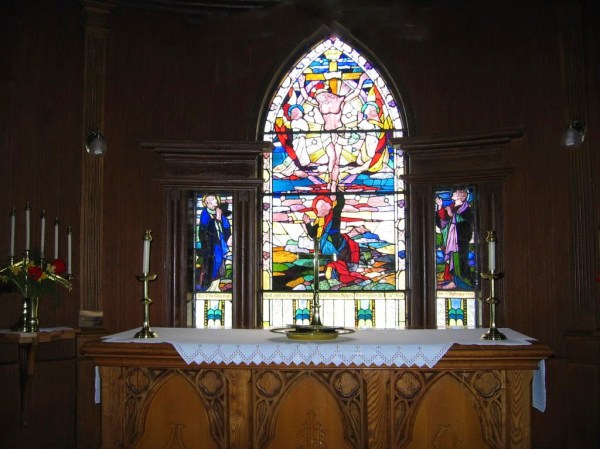
In 1934, my grandfather Canon Sydenham Lindsay (Shediac summer resident at Iona Cottage – She Owned A Cottage – with his wife Millicent Hanington and sometimes stand-in priest at the church) dedicated a large memorial stain glass window in the sanctuary to his father-in-law, Dr. James Peters Hanington (1846-1927) who was my great-grandfather and William’s grandson. The window was designed and installed by Charles W. Kelsey of Montreal and described as follows:
“The centre light of the window represents the Crucifixion, with Mary Magdalene at the foot of the cross, while the two side windows represent the Blessed Virgin Mary and Saint John the Evangelist.” (1934 – The Montreal Gazette)
Stain Glass Window in St Martin-in-the-Woods (photo credit Paul Almond)
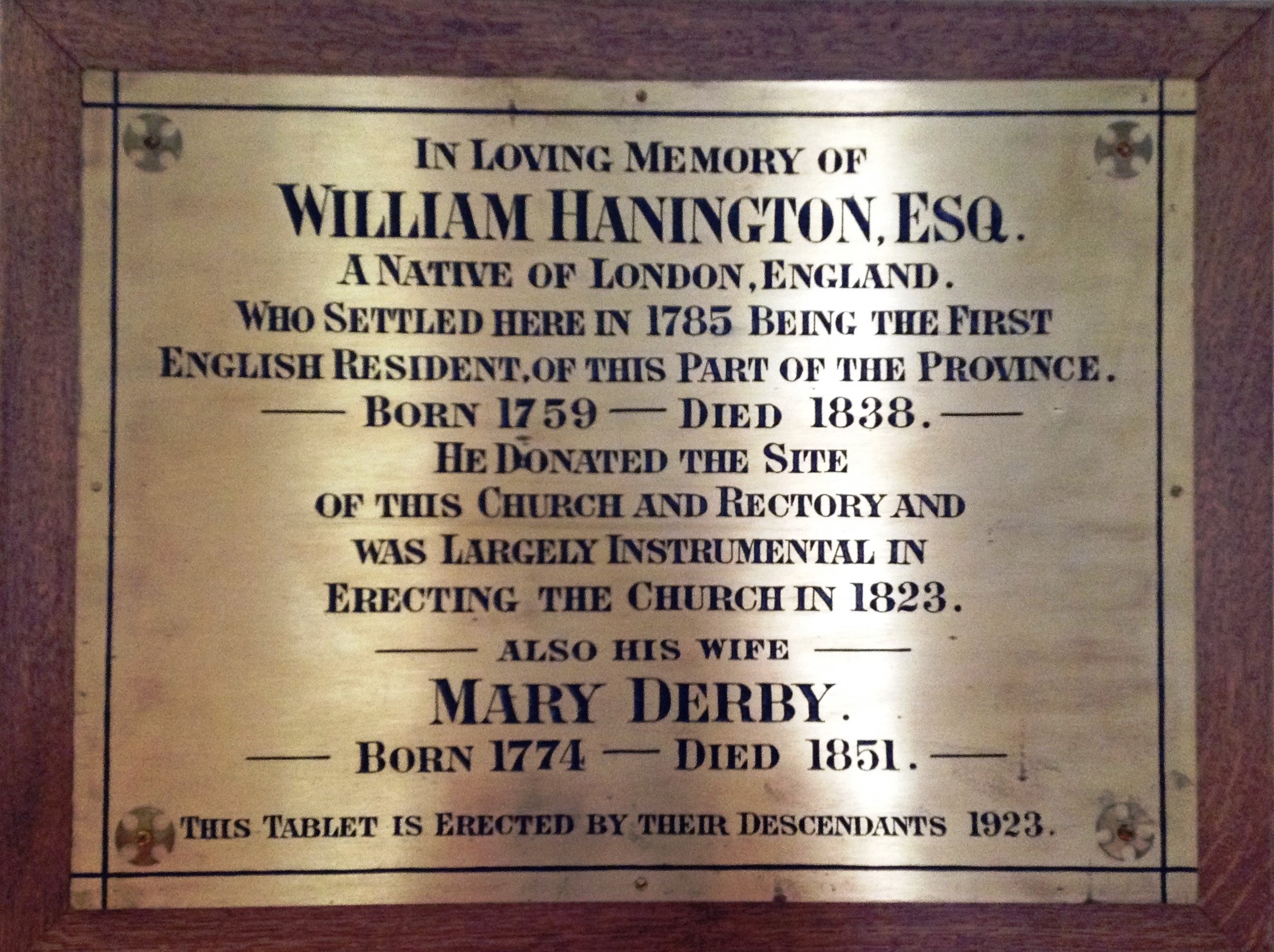
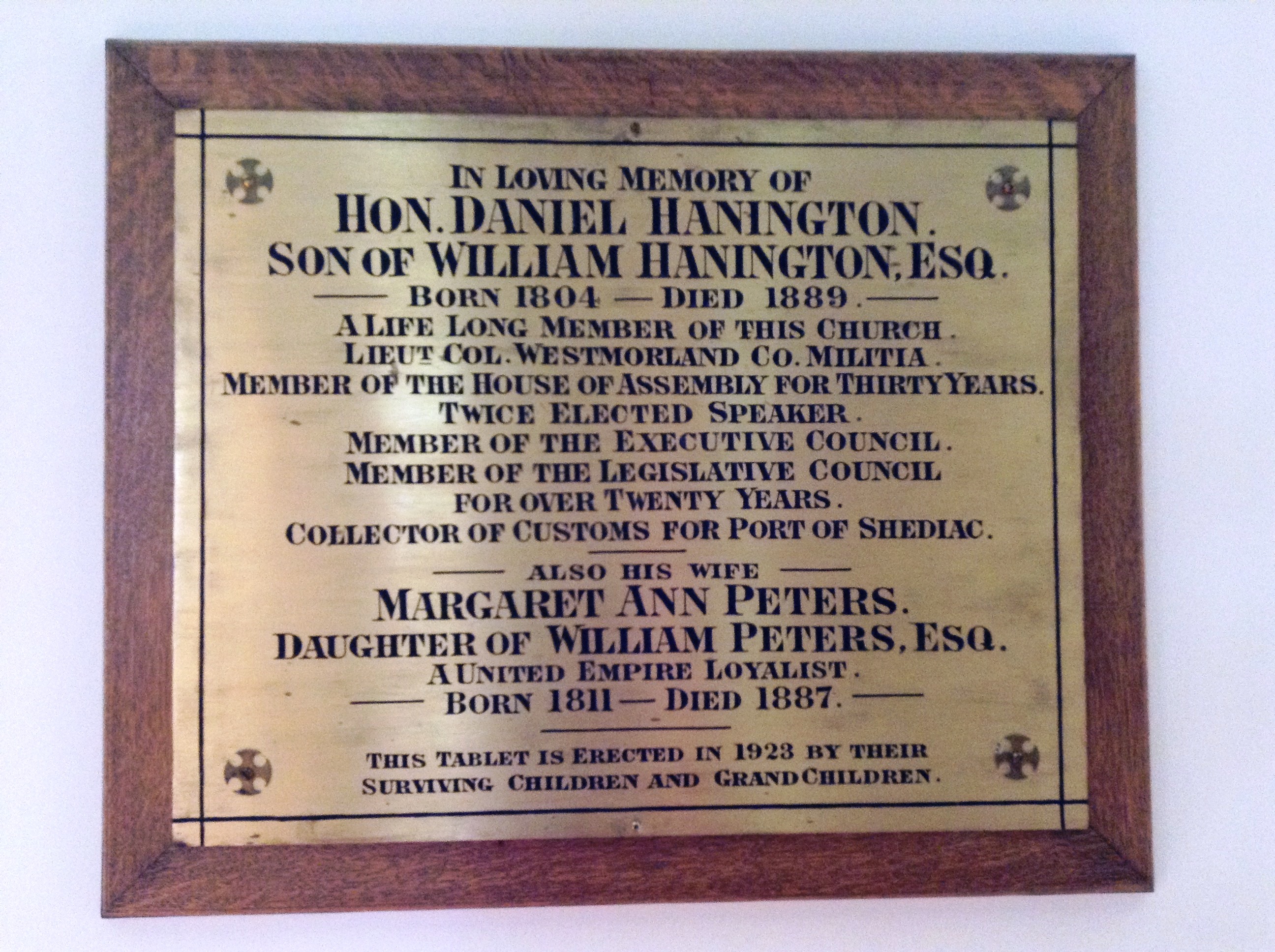
Also mounted inside on the church’s side walls are two honourary brass plaques. One in memory of William and his wife and one in memory of his son Hon. Daniel Hanington (1804-1889) and his wife Margaret Ann Peters – my great great grandparents.
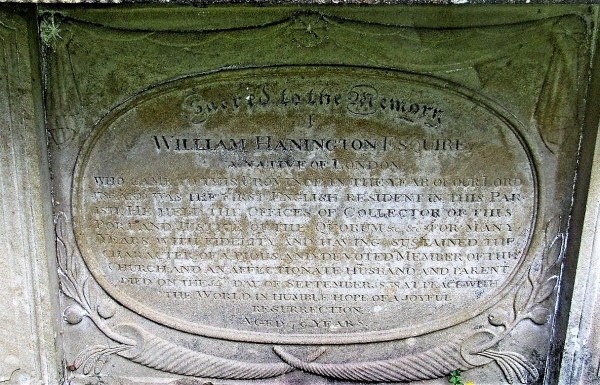
William died in 1838 at age 79. A huge memorial of native freestone marked his grave, in the cemetery beside his beloved church nestled in the community of Shediac, where he spent a lifetime building a “commodious estate” from a forest of giant trees.
Two hundred years later on this anniversary of the St. Martin-in-the-Woods church, William and Mary are lovingly encircled by the graves of several generations of their descendants.
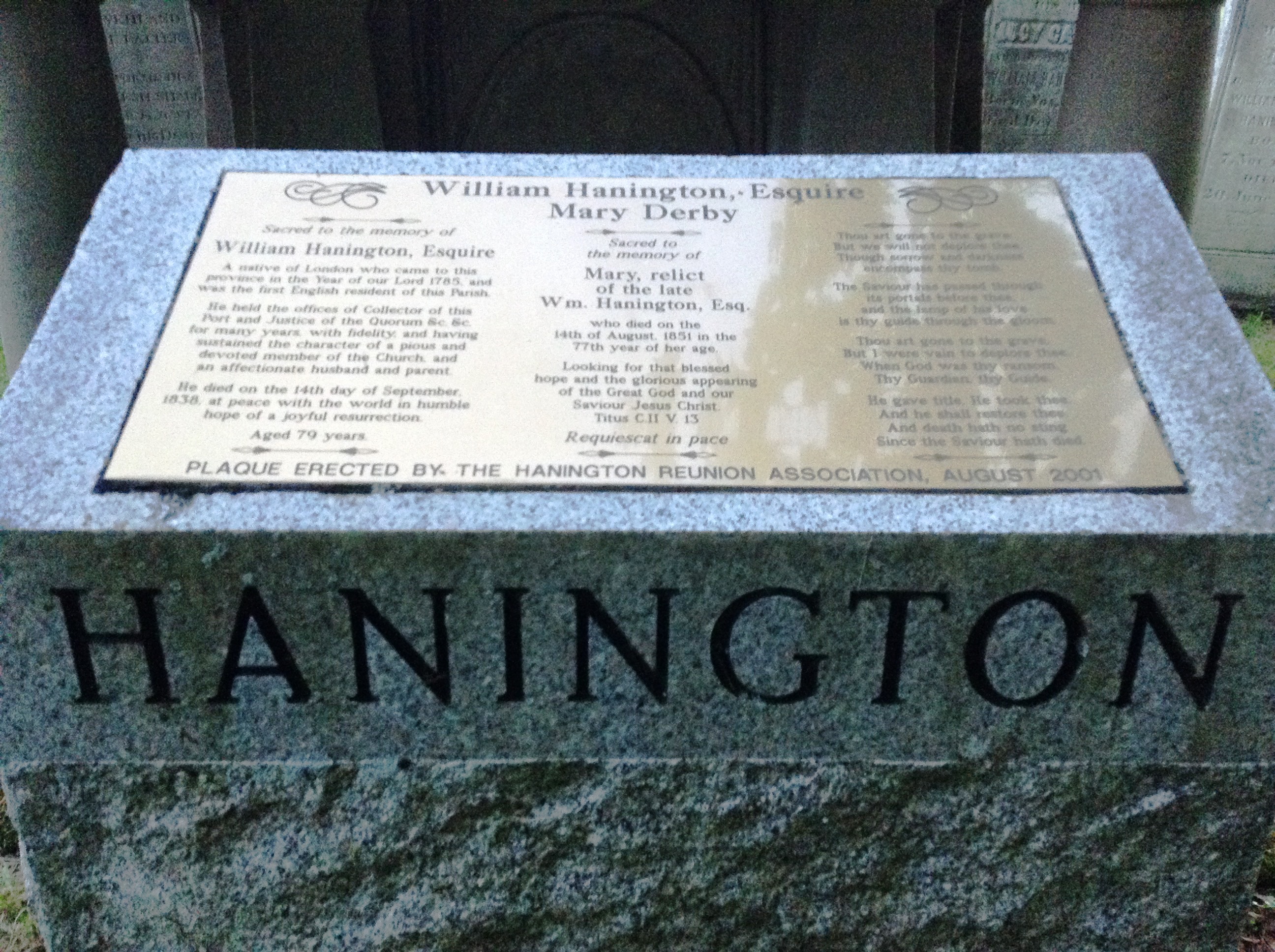
A memorial plaque to William and his wife Mary, was erected in 2001 by the Hanington Reunion Association. This year the Association will be adding a bench in the cemetery in celebration of the 200 years.
Close-up of theHeadstone of William Hanington (1759-1838)
(L)Hanington Reunion Association Plaque (2001) honouring William Hanington and his wife Mary Darby and (R) photo by Scotty Horsman showing William’s large headstone at the side of the church.
In 2015, my sister and I visited the church and our ancestors in the graveyard and also enjoyed meeting some Hanington cousins as well!
ANNIVERSARY CELEBRATION DETAILS FOR SEPT 16-17, 2023:
The main events for the 200th Anniversary will be Sept. 16th and 17th with a corn boil, hotdog/hamburger barbecue and cake on Saturday, Sept. 16th. There will also be games, a bonfire, fireworks and music at the church shore.
The Anglican Bishop, David Edwards, of Fredericton will be attending this celebration. He will also be at the 10:30 AM church service on Sunday, Sept. 17th. After the church service there will be a pot luck lunch and a skit in the hall. There will also be items on display in thechurch basement and in the hall. There will be items for sale – glasses, mugs and lapel pins, with the Hanington crest as well as lapel pins. ornaments and trivets with the church on them.
“Here men and women were working side by side, the women subordinate to the men. All were preoccupied, wrapped up in their respective operations, and there was the sound of irregular whirring movements from every part of the big room. The air was laden with whitish dust, and clay was omnipresent—on the floor, the walls, the benches, the windows, on clothes, hands and faces. It was in this shop, where both hollow-ware pressers and flat pressers were busy as only craftsmen on piecework can be busy, that more than anywhere else clay was to be seen in the hand of the potter.” Anna of the Five Towns by Arnold Bennett.
Family heirlooms are loaded both with history and with sentiment. While an heirloom’s historical significance often grows over time, the sentimental side of it inevitably diminishes down the generations.
A once-cherished heirloom very often becomes something a baffled descendant holds up in the air while wondering “Is this teacup pretty enough to keep?” “Does this glass lamp match my decor?” Or more likely. “I wonder if this hideous silver ladle is worth something.”
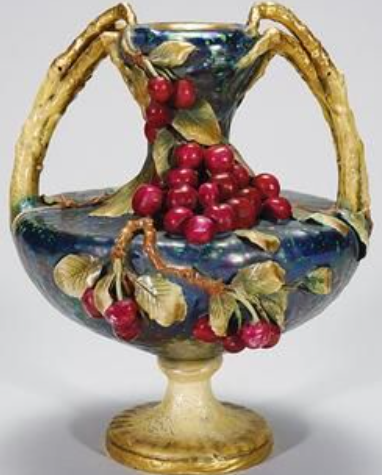
In my house, I have many heirlooms from my husband’s side –and have disposed of even more – and only a few from my mother’s side. My mother’s much older sisters got all the delightful bourgeois bric-a-brac from the family, my mother ended up with only a few turn-of-the-last-century vases.
I gave my sister-in law this Austrian Amphora with a cascade of cherries. She has more baroque decorating tastes than I do.
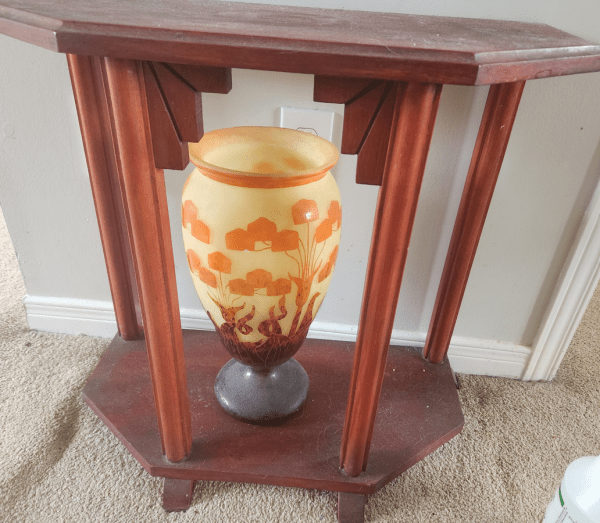
This classic Schneider Verre Francaise I keep in an Art Deco place of honour – on the floor – so my kamikaze cat won’t knock it over.
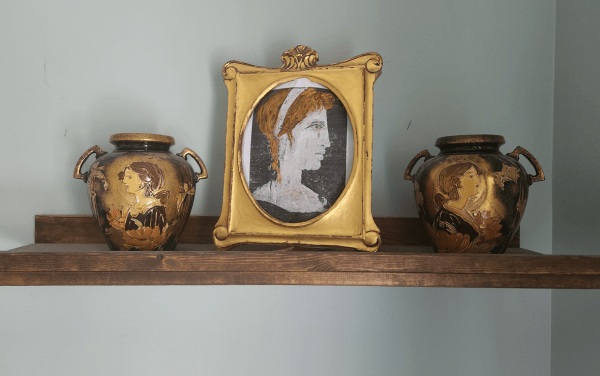
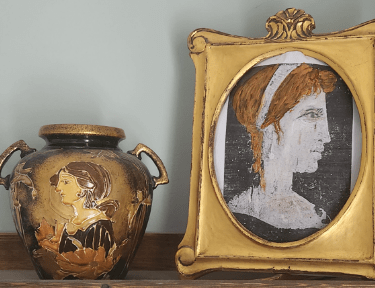
And the two rather ugly portrait vases once belonging to my chere Grandmaman Crepeau, I keep up on a shelf in the spare bedroom
for one reason and one reason only: I was practically born under them.
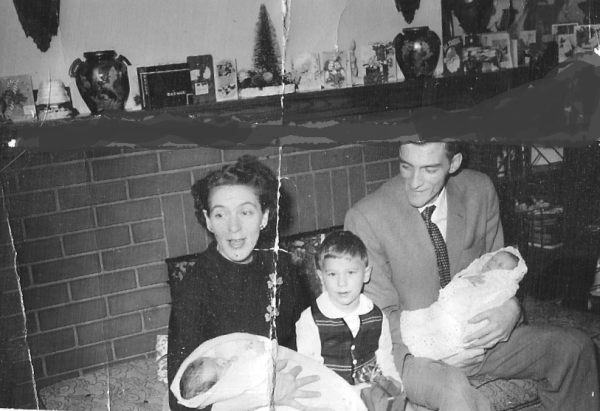
December 1954. That’s me in father’s arms. We are at my Aunt’s home in NDG
Twenty years ago, I investigated the provenance of the ugly vases for my Mom. She had just inherited them from my Aunt. They had a certain Pre-Raphaelite feel, I told her. Maybe they were worth something.
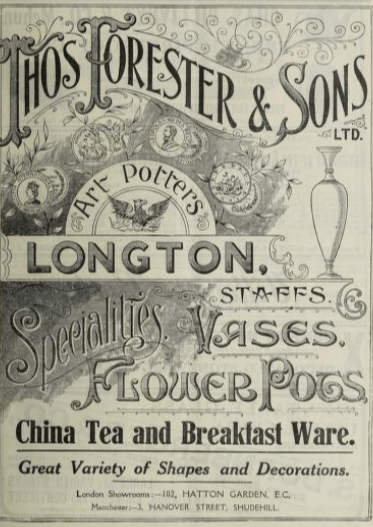
It didn’t take too long to figure out. These vases were English “art nouveau’1 Rembrandt vases out of the Thomas Forester factory in Longton, Stoke-on-Trent, a business supplying “useful and decorative” pottery to the masses.
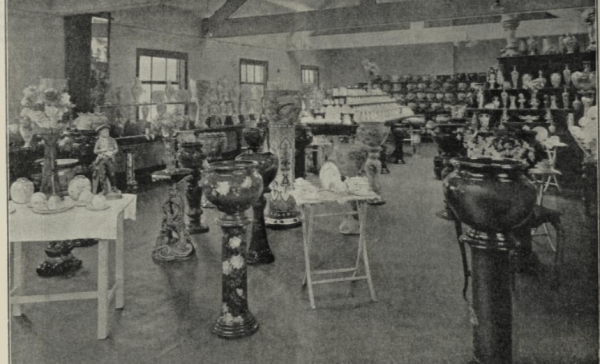
1912 Thomas Forester Showroom, Glasgow. The company specialized in Phoenix ware, a bright blue kind of pottery.
Later, I brought the ugly vases to a woman who was holding a “road show” event locally and she seemed impressed that I knew of their provenance. She said my Rembrandt vases were worth 400 dollars. Well, OK. Today, I can see a nearly identical pair on auction in Yorkshire for a mere 30 British pounds.
These days, I display the vases beside a print-out of a painting of the Pompeii Cleopatra. (I am a classical history enthusiast which, let’s face it, is largely about pottery – or pottery shards.) There’s a similarity in style, I think, especially with the girl on the left. I’ve always called her the Egyptian girl.
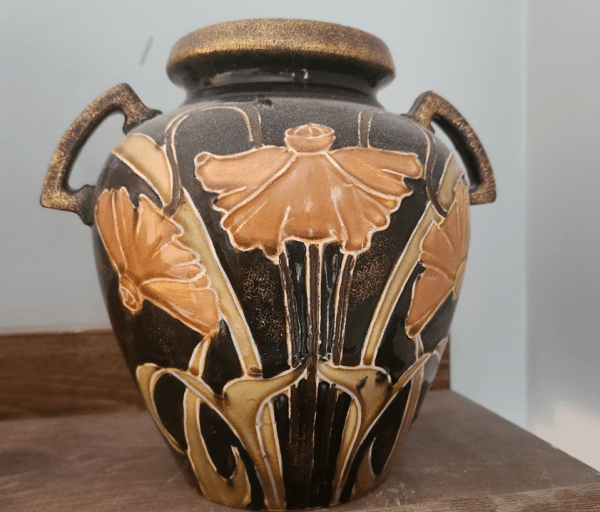
The back of the vases. Poppies? The Road Show lady said all the ugly bleeding is a mark of multiple firings and a good thing.
The designer of the vases is likely one Thomas Deans 2. I wonder if Mr. Deans ever visited Pompeii. Still, I don’t find these vases very appealing. Too chiaroscuro3 for my tastes. Too rough around the edges. The auction sites agree 🙂
Now, wouldn’t you know, Mary, the Queen of England, expressed a fondness for Rembrandt vases in 1913, the very year my vases were thrown. I know because Their Majesties made a tour of the Potteries (five towns in Staffordshire) in April . The tour was recounted in detail in the May 1913 issue of The Pottery Gazette.
The pottery industry was so important in England in 1913 that it warranted a Royal tour.
The King and Queen were also there, I suspect, to help calm down the natives who were upset over muscly new workplace laws threatening their businesses.5
This Royal visit was a PR masterclass, skilfully curated in support of the English pottery industry: The Royal Couple was on a tight schedule but they always seemed to linger longer than permitted, “so interested they were in the orchid paintings of Mr. Dewsbury; such pleasure they took in the engravings of Mr. Wyze; how attentively they watched the Wedgewood throwers at their work.”
And at every turn, Her Majesty revealed a vast knowledge of all things moulded, pressed and thrown.
Their Majesties did not stop at the two Thomas Forester factories in Longton but they did visit another factory-of-the-masses in that town signifying that they were not pottery snobs and very much interested in the ‘utilitarian’ aspect of the products.
They also went upscale. It was at the Doulton Factory toward the end of their tour where Queen Mary expressed a keen interest in my vases, ah, well, similar ones. “The Rembrandtware was singled out by the Queen for special inspection.” I guess, she really liked those gloomy vases gilded with gold.
So, my ugly art nouveau vases do contain a bit of history, even if it can’t be proved that Thomas Dean the designer ever visited Pompeii; even if Queen Mary of Teck, King Charles’ great-grandmother, never set eyes on them. 4
The vases certainly contain loads of sentiment: that photo is the only one I have of me as a baby and I’m in my Dad’s arms. For all I know, I first learned to focus my eyes on one of those gilded West Midlands maidens as my father moved toward the couch for this first-ever family photo-op.
Reminder to self: Put a copy of this story in one of the vases for when my my kids are deciding whether to give it to the VON. Also. Reread Anna of the Five Towns.
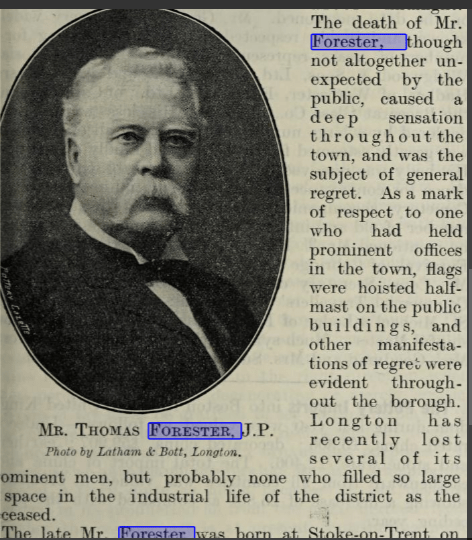
Thomas Forester: A local self-made man with good business sense. He would have two factories on Longton, his home town.
1. Art Nouveau. I love Art Nouveau. But where are the Mucha-like flowers in the hair? Forester produced prettier vases with women adorned like that. Just not here. My vases are a mishmash (miss match) of Dutch Golden Age, Art Nouveau and Classical Antiquity, I think anyway.
2. My vases have no Forester stamp, just a squiggly line, but online at auction an identical vase was designated Deans.
3. Rembrandt style as in clear/dark. I remember the term from an art history lecture in college. Funny what sticks in your head. Doulton Rembrandt vases are worth a fair bit on the auction sites. They have traditional portraits of hoary old men.
4. Maybe she did, after all. To put a stamp on the Royal visit, the Potteries mounted a huge exhibit for the benefit of all citizens.
5. Children under fourteen were banned from the workplace. The glass industry said this would ruin them. Boys needed to start work at 10 or so in order to become apprentices at 14. Not to worry, the children would only work 44 hours a week! There were new laws regarding the unbearable heat in the buildings, too, and lead-poisoning (of women and children) was also a topical issue.
JULIUS GRIFFITH – RCA, OSA, CSPWC, CSGA (1912-1997)
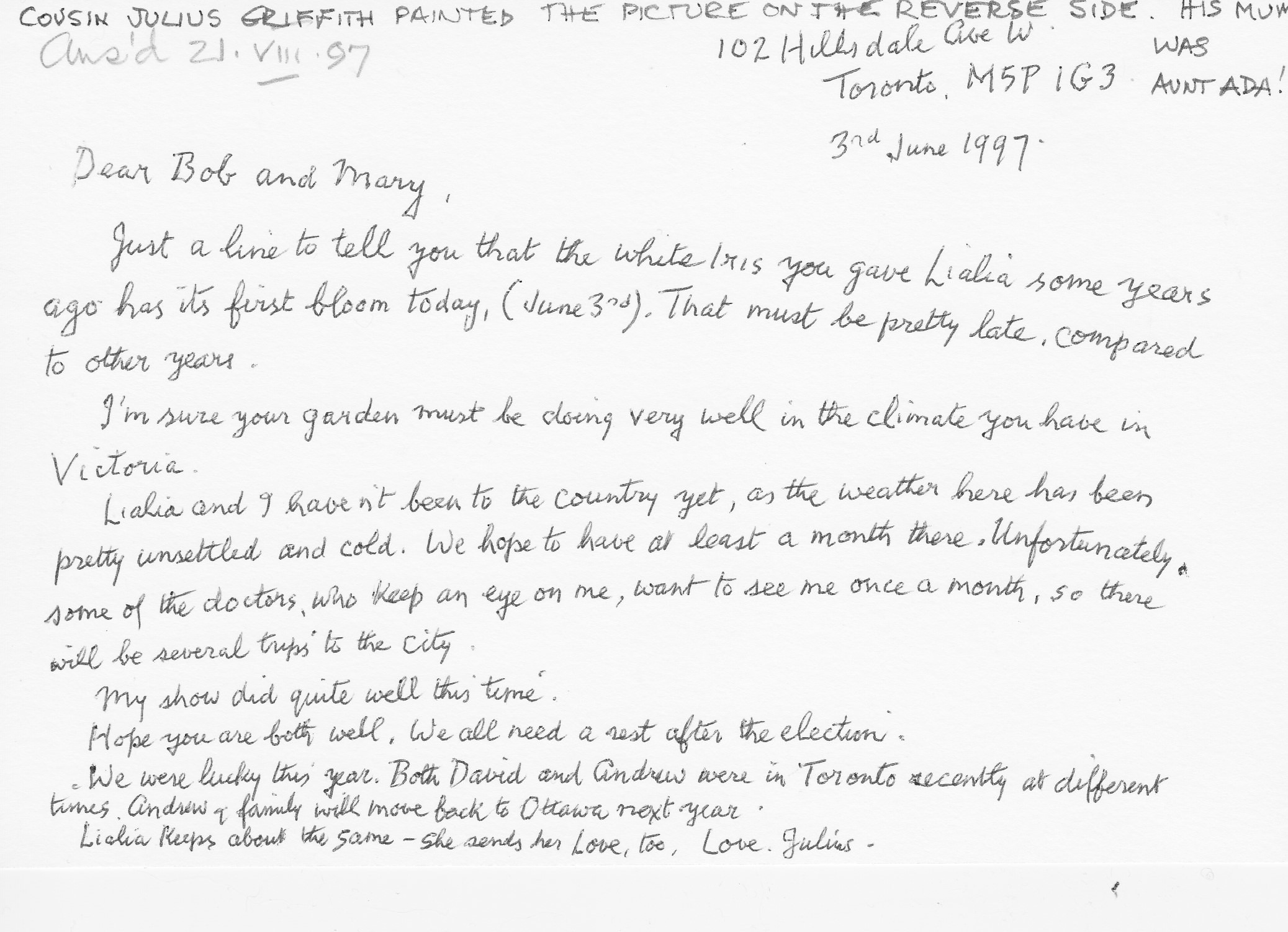
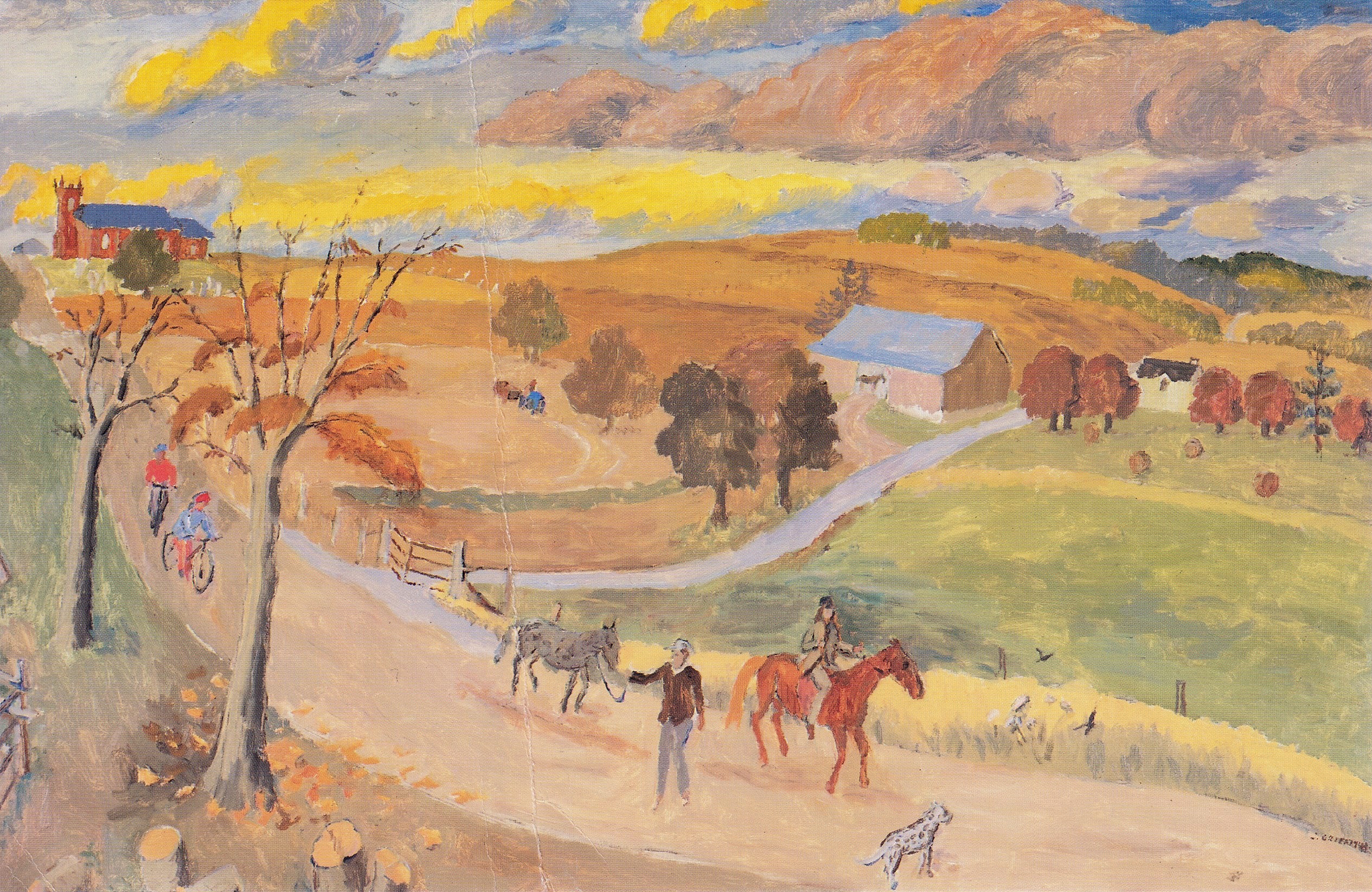
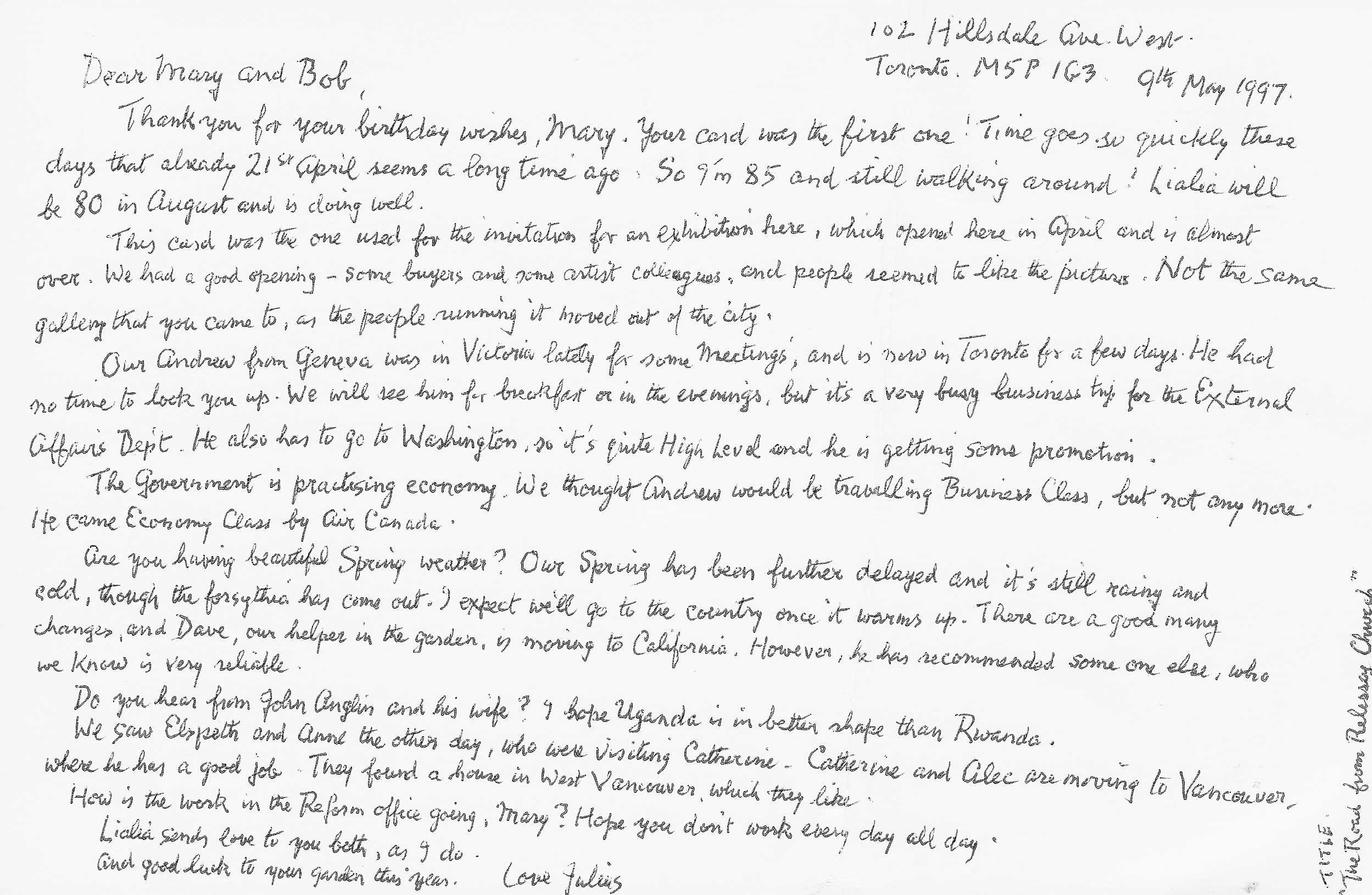
My collection of genealogy treasures includes two picture postcards sent to my Aunt Mary by her talented artist cousin, Julius Griffith, prior to his death in November 1997.
His meticulous handwriting described that day’s garden blooms, commented on the recent election, provided a short health update, news of a son moving back to Ottawa with his family and Lialia sending her love. At the very end, he writes “my show did quite well this time.”
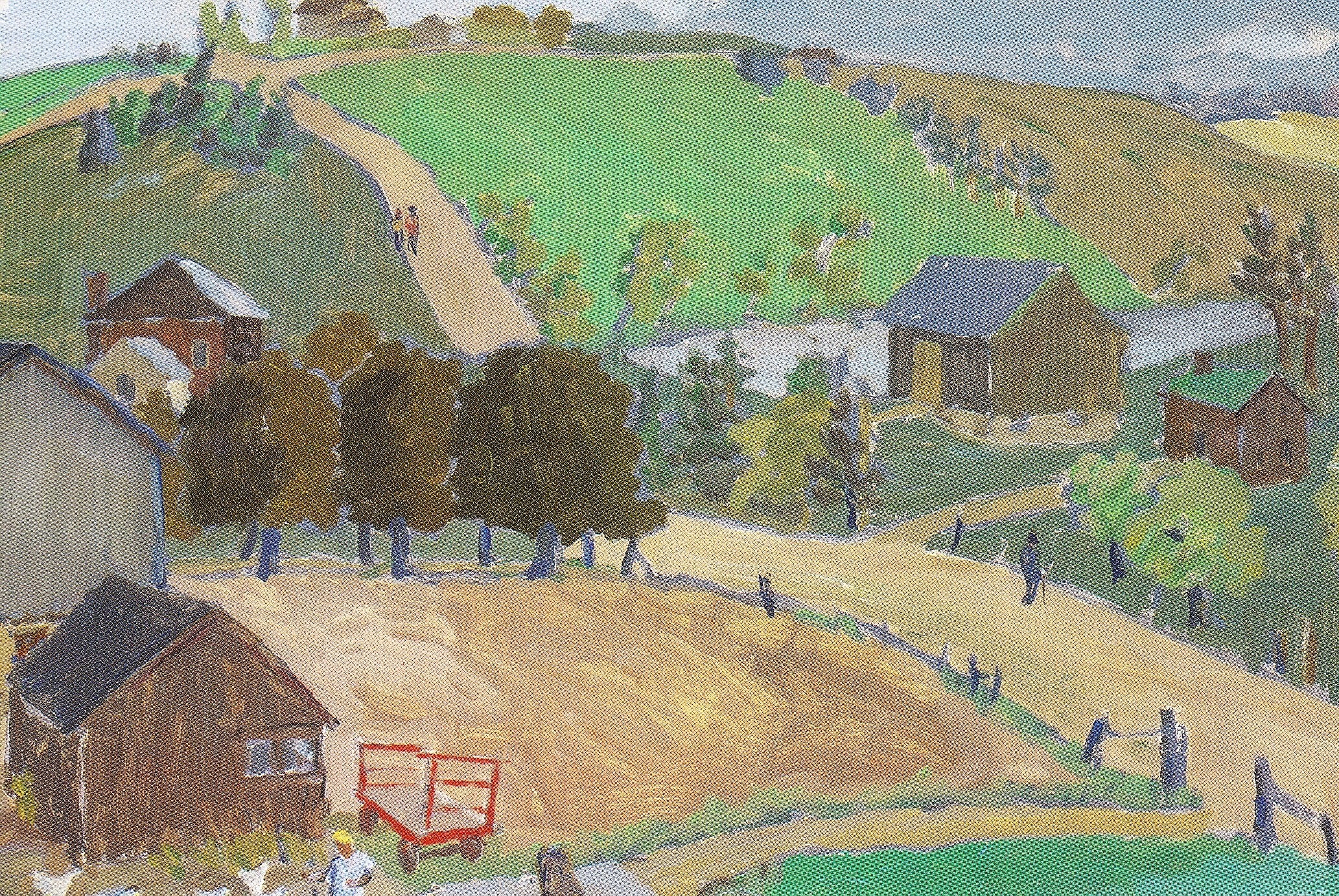
“The Road between Allen’s Farms”
And so it should have. Her cousin, Julius Edward Griffith (1912-1997) was a successful enough painter in watercolour that the members of the Canadian Society of Painters in Water Colours (CSPW), voted for him to be included as a member. Co-founded by a group of prestigious painters including Group of Seven artists A.J. Casson and Franklin Carmichael in 1925, the association continues to exist and has a storied history. For their Diamond Jubilee in 1985, they selected 60 paintings, including one from cousin Julius, and gave them to Her Majesty Queen Elizabeth II. The Queen formally exhibited the collection in Windsor Castle’s Drawing Gallery in 19861.
One of my two postcards could be a replica of his circa 1982 painting presented to the Queen, which was called “The Empty Farmhouse.” The official description describes it as a “watercolour view across fields of a square farmhouse with four windows, surrounded by trees.”
Julius Edward Griffith (1912-1997) was a successful painter in watercolour and oils, a graphic artist, an illustrator, a fine print maker and an art teacher.
As the only child of Katharine Ada Lindsay and Julius Henry Griffith, and born in Vancouver, British Columbia, Julius relished his grandfather Lindsay’s extensive art collection when he visited with him in Montreal, Quebec. Thus began his art education.
Julius Griffith – 1920
When Julius finished High School at 16, he was too young to attend the Royal Military College, as was his father’s family tradition. Instead, he studied at the Vancouver School of Art (Now Emily Carr University of Art + Design)under Charles H. Scott, F.H. Varley and J.W.G. MacDonald (two of which were Canada’s famous Group of Seven artists2). What a fantastic start to his artistic career! At the same time, he also learned block printing techniques from American artist Bruce Inverarity3 who lived in Vancouver at that time. Julius was immediately drawn to block printing because he enjoyed black and white contrast.
A few years later, he moved to England with his parents and studied at the Slade School of Art4 in London and continued his studies at the Central School of Arts & Crafts with Noel Rooke5 learning the technique of wood carving.
At age 21, Julius returned to Vancouver during the Depression hoping to get any kind of work as an artist. And he did! The owner of the Vancouver Sun newspaper commissioned him to paint two murals on the walls of his building and different groups of people were invited to watch his progress. Among these groups were his previous art teachers, Fred Varley and Jock Macdonald and their students at the time. He must have been so pleased at this role reversal!
In 1938, near the end of his fourth year back in England at the Royal College of Art6, he returned to Vancouver to see his father just before he died. After his father’s death, WWII interrupted Julius’ studies but he returned to England with his mother at that time as he wanted to serve.
During the war he worked with the “Air-raid Precautions” for a time and eventually joined the Red Cross. He worked in a country-house hospital in Sussex and, with so little to do, Julius taught art and learned to speak Russian.
What a serendipitous decision! He fell in love with his teacher – nurse Lialia Oralevs originally from Latvia – and they married quietly a couple of years later before the end of the war.
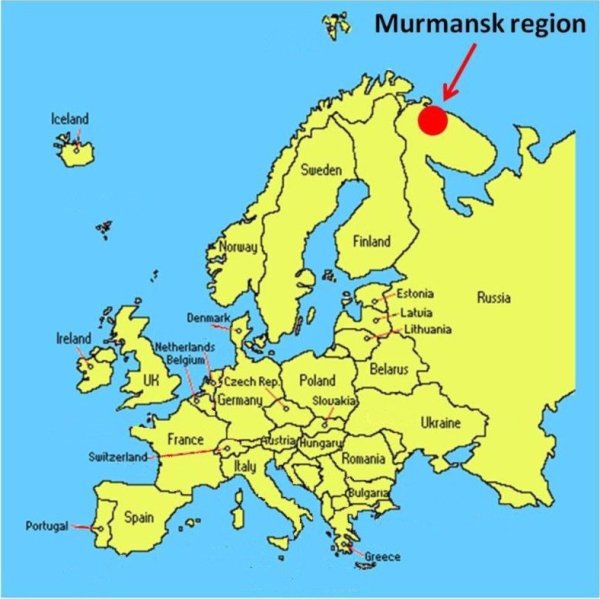
After learning to speak Russian, Julius presented himself in London to the Royal British Navy, passed an oral Russian test and worked as an interpreter under the rank of Sub-Lieutenant stationed in Murmansk7 and Archangel until the end of the war.
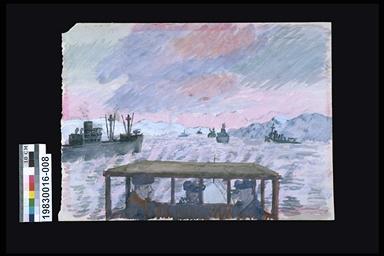
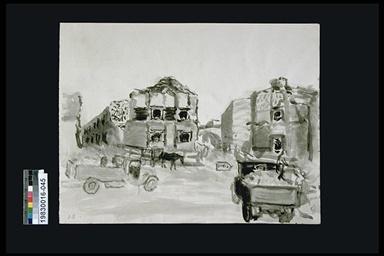
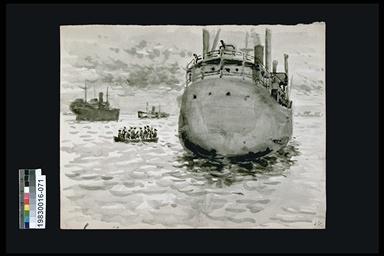
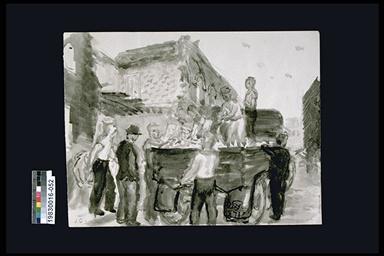
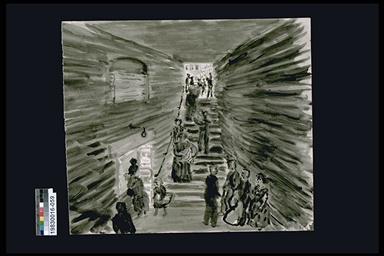
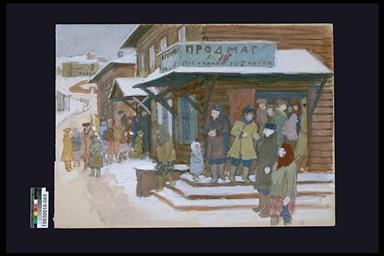
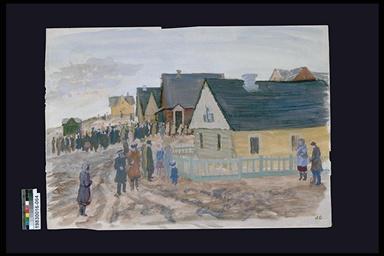
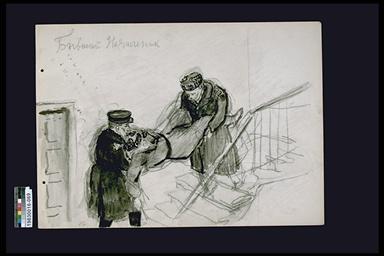
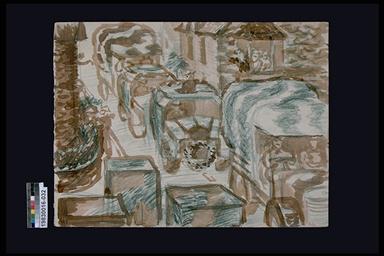
While in Russia, Julius would sketch scenes from memory in the privacy of his room at night and only after his 30-year oath of secrecy expired did he show them to the Canadian War Museum8. They purchased 90 of these drawings and The British War Artists Collection acquired several as well.
After the war, Julius and Lialia returned permanently to Canada. Julius quickly earned a degree at age 34 which enabled him to teach art and support his wife and four sons while continuing to pursue his passion as a graphic artist and wood engraver. Julius taught art in many of the top schools in Toronto – the Western Technical School, Artists’ Workshop, Ryerson Polytechnic Institute, Ontario College of Art, and at Central Technical School.
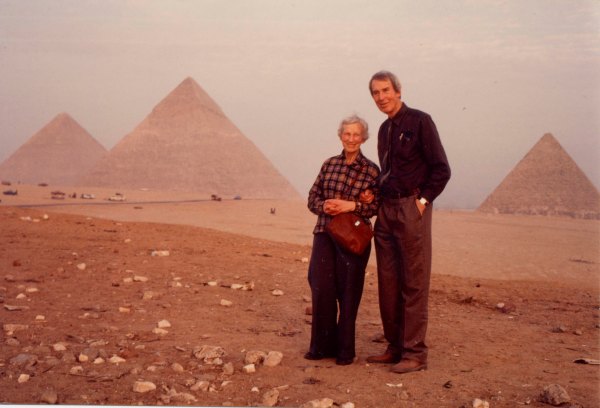
Although I never met Julius, I understand that they made quite the impressive pair with Julius at 6 feet 4 inches towering over five foot Lialia. Not surprisingly, “Julius seemed to develop a slight lilt to the left in later years, probably because he would put is left hand on Lialia’s shoulder and lean to hear or speak to her.” This 1985 photo taken during a trip to Egypt illustrates this charming pose.
Julius and Lialia – 1985 (courtesy of Lorne Griffith)
On the other postcard that he sent to my Aunt Mary in 1997, he wrote “This card was the one used for the invitation for an exhibition here, which opened in April and is almost over. We had a good opening – some buyers and some artist colleagues, and other people seemed to like the pictures.”
” The Road from Relessey Church”
Although I don’t have any of Julius’ original paintings, his two picture postcards with his personal handwritten messages are real treasures to me.
NOTE:
Julius’ work is displayed in the collections of the National Gallery of Canada, Canadian War Museum, Imperial War Museum (London), Art Gallery of Ontario, Toronto City Archives, Toronto Public Library, Art Gallery of Hamilton, McMaster University (Hamilton), Carleton University (Ottawa), Glenbow Museum (Calgary), Art Gallery of Greater Victoria (British Columbia), and numerous corporate and private collections.










 Genealogy Ensemble