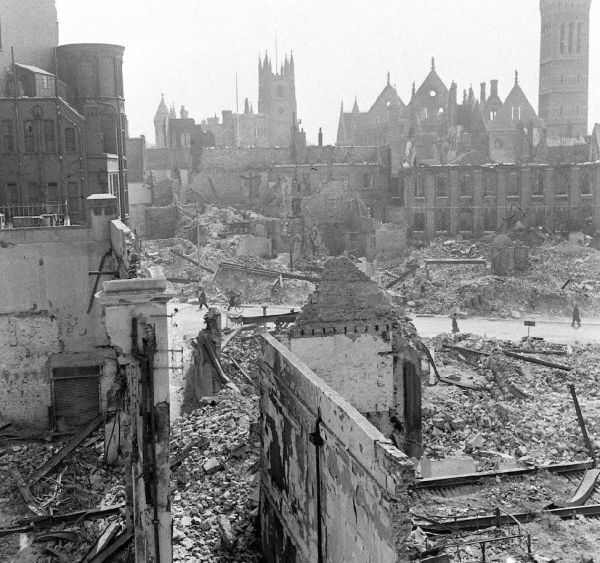
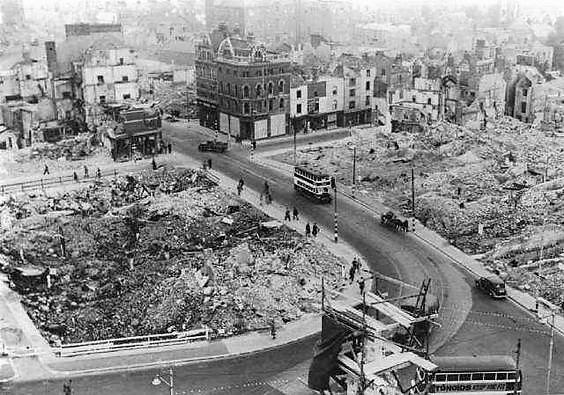
I was reminded of the city I grew up in when images of the tornado that shattered the towns in Kentucky were shown on TV and online recently. Our city after the blitz looked exactly like that…. and it was not until I was a teen that the city workers had finally cleared away the last of the debris and rebuilt our city completely.
Plymouth, England, After A Raid – 1941
Plymouth Reduced to Rubble after A Raid – 1949
This was bad, but after London, the worst bombed city in England was Liverpool.
Christmas 1950 was still bleak, I was five years old and Christmas that year was to be austere, to say the least, but I was not aware of that at the time. It is only with age that I remember and think wow! That was hard.
WW2 had finally ended in November 1945 the year and month I was born. Our city of Plymouth was battered and bombed, and by the time I was born, rationing and shortages were still all over the country which lasted until I was nine years old!
I often think, as so-called ‘victors’ in the War, shouldn’t we have been better off and not ‘on the rations’ until I was nine years old?
One person’s ration for a week.
There were few Christmas trees or decorations, At our primary school, we cut up strips of newspaper, glued them together to make paper chains to hang in the classroom.
We did the same at home. Occasionally, if you were lucky we could buy coloured strips of paper but mostly it was the newspaper chains. Dad would go out and find some Mistletoe and Holly to put around the mantlepiece.
We did not have a tree at home, but we all had fun at school, making the ‘decorations’ we sang Christmas carols and exchanged homemade cards coloured with old, worn down crayons. We always had a Carol Service at school before we finished for the year.
We had no books or school library but our teacher read out loud to us each Friday and she finished the book the last Friday before we broke up for the Christmas holidays. I remember the book, it was called ‘ Pygmalion’ by George Bernard Shaw. (1)
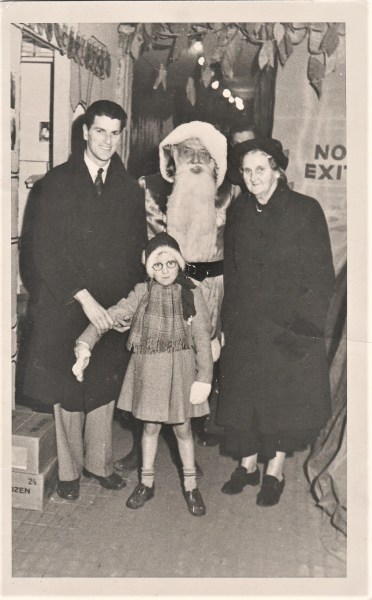
Back to Christmas 1950. Below, is a photo of me, Dad and his mother, Emily Marion. It always makes me laugh as I am wearing my ** National Health Service** free glasses- hence the gawky look! (I hated those glasses with a passion and once buried them in the garden!) (2)
In this photo, we were shopping in the Nissan huts, temporary metal huts set up for various bombed-out shops until re-building could commence in our blitz-wrecked city. and I was meeting Santa.
Looking at this photo now, I see that I was not exactly dressed appropriately” for the weather. Severe shortages were still in effect, and although I was warm I do remember my legs always being cold, after the fashion of those days!
The photo below was taken in 1943, The Nissan huts were still in use in my photo above.
A view of the busy Market Hall in Plymouth, showing that Woolworth’s has opened a large stand in the market. The main F W Woolworth & Co. Ltd. store had been severely damaged during an air raid.
There was not much available for Christmas foods, but my Dad would go late in the evening, as the stalls were closing, to get the cheap ‘end of the day goods’ like apples that were slightly bruised, or some pieces of holly or mistletoe or a few small oranges which only appeared at Christmastime.
Nuts were popular but we would see them only at Christmas and they were very expensive, so it was traditional to put a few nuts in childrens’ pillowcases along with a small orange. We usually had two or three big walnuts, still in their shells in our pillowcases. There were no ‘stockings’ to hang up. We put pillowcases hung over the bedknob at the end of the bed for our gifts and I carried on that tradition with my children.
Most of the gifts were either homemade or knitted and always wrapped in newspaper. We did not care what it was wrapped in, we had presents! I do not remember feeling deprived of anything.
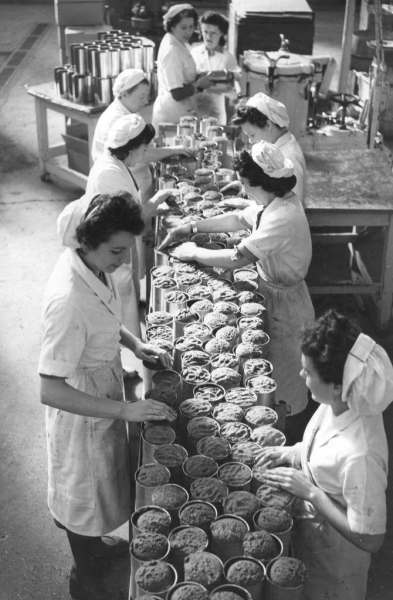
That year, 1950, only certain meats were off ration such as reindeer, horse, rabbit and whale meat was also on offer. If I ate them, I cannot claim to have a memory of it! If we had a chicken or duck we were very lucky or rich. Usually, it was lamb or pork.
1949: Workers rolling out the whalemeat roll from a conveyor belt at a Slough factory. Whalemeat will soon make its bow to the public and it will be unrationed and off points. It can be served as luncheon meat, warmed in a frying pan as a breakfast food or served cold with a salad…..Yum!!
Three years after the War ended, restrictions on food were gradually being lifted. Petrol rationing, imposed in 1939, ended in May 1950. . Flour was ‘off ration’ on 25th July, followed by clothes on 15th March 1949. Although on the 19th of May 1950, rationing ended for canned and dried fruits chocolate biscuits treacle, syrup, jellies and mincemeat. In September 1950 soap was off ration and became a very popular Christmas gift!
We were still having to queue for food, and often it was sold out, by the time we reached the head of the queue, so our Christmas pudding and cakes had carrots added to them, to sweeten and bulk it up. Even when I was older in the early 1960s, and learning to bake and cook at school, we still added carrots to our Christmas cakes and puddings. (3)
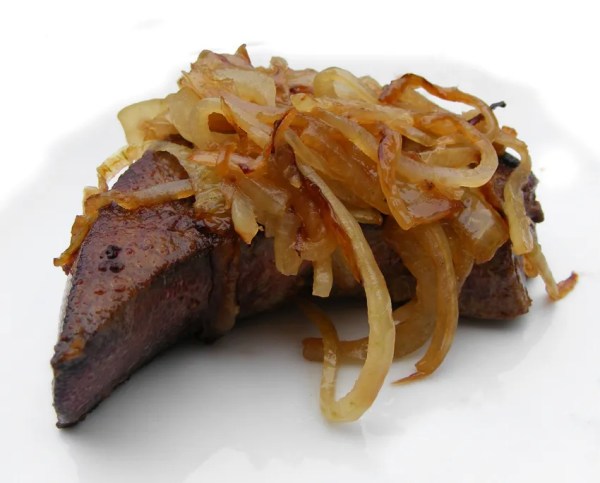
We all ate a lot of ‘organ meats’ such as liver and onions and occasionally, when they could be picked in the fields, with mushrooms too. Today, we would add bacon to the liver and onions. Steak and kidney pies were and still are, a favourite in England. I do remember eating calves’ brains – on toast!
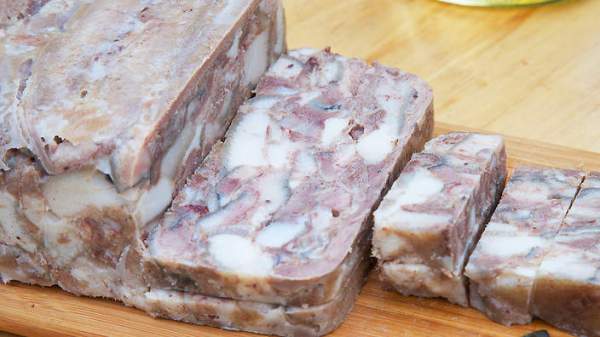
Oh, and ‘Brawn’ or ‘Braun’ made with a whole pigs head, when you could get one. Tongue, ears, brain, eyes. Boiled for hours with various herbs and spices cooled, and then everything was removed from the head then pressed in a mold overnight.
Sliced and served cold in a salad, on a Summer day it really was delicious. I believe it is known here, in Quebec, as ‘headcheese’?
Brawn
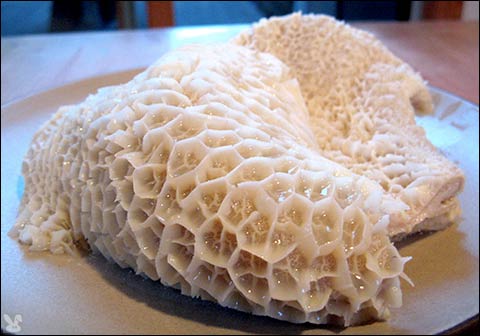
Tripe and onions were very popular too. Tripe comes from the stomach lining of farm animals and, I remember Granny telling me, it was a wonderful source of protein and would make my hair and nails grow. Still served in many countries around the world, I think in the UK it originated in the county of Yorkshire.
Tripe Before Cooking in Milk, Herbs And Onions
I ate it all. What did I know or care, what I was eating?? I had a full tummy. Today, I do not take Christmas for granted even with all the goodies available because, although austere bleak and not much around in Christmas, 1950 I do not remember ever being hungry. Plus our dietary restrictions were not a bad thing for our health. As a five-year-old, I was frequently cold, yes, but hungry? Never! I was a lucky one.
SOURCES
(1) Many years later on 25th December 1964 when I was 19, the movie ‘My Fair Lady’ came out. I remember sitting in the theatre watching it and thinking “I know this story”….of course, it was based on the book Pygmalion by George Bernard Shaw that teacher used to read to us every Friday.
(2) Before the National Health Service was created in 1948, patients were generally required to pay for their health care. Free treatment was sometimes available from charitable voluntary hospitals. Some local authorities operated hospitals for local ratepayers (under a system originating with the Poor Laws). History of the National Health Service – Wikipedia
The first items to go on points rationing were tinned meats, tinned fish and tinned beans; later, points rationing was applied to most tinned goods, dried fruits, cereals, legumes, biscuits, etc. When points rationing was first introduced, everyone had 16 points per person every four weeks. British Wartime Food – CooksInfohttps://www.cooksinfo.com › Cuisines
My great aunt Marguerite Lindsay, aged 22 in 1918, was well trained in mothering long before she might have had a child of her own. She “mothered” grown men while volunteering with the Information Bureau of the Canadian Red Cross Society in London during the Great War.
Lady Julia Drummond1, a Montreal philanthropist, established the Information Bureau within the Canadian Red Cross in 1915, when the first of the Canadian contingents landed in France.
“It was her absorbing wish to bring to the fighting men of Canada, when they returned from the battle line, sick or wounded, some sense of personal interest and sympathy, of individual thought and care.”2 Thereby, given the nickname “The Mothering Bureau.”
As soon as the wounded Canadians arrived in London, they were informed of the Information Bureau as sort of the fairy godmother of childhood dreams. Then they completed an index card (white for the enlisted men, blue for the officers), stamped and addressed to Lady Drummond, with their name, number, battalion, the name of the hospital and next of kin. Within days, not only would they receive a note from Lady Drummond herself, but each soldier met with their assigned “visitor” who learned more about him as she kept in touch with all Canadians admitted to her specific hospital.3
The Visitor reported weekly to the Bureau of the soldier’s wound or illness, his physical and mental condition, his needs and general well being. These reports, completed with initials and dates, were kept on his index card and eventually held a complete record of the soldier’s case.
The various departments would then immediately become active:
Letters of comfort or condolence based on these reports were quickly sent to the man’s family.
The parcels department would dispatch tobacco, cigarettes, and other comforts as requested by the visitor.
The newspaper department would send Canadian newspapers (often from their hometown).
The drives and entertainment department brought some diversion.
The hospitality department might arrange for leave in some kindly English home.
Efficient correspondence was the most important and valuable work of the Bureau.
Marguerite might have volunteered in one or several of the previously mentioned departments. However, I wonder if she worked along side Princess Mary3 (daughter of King George V and Queen Mary) as she too began her nurse’s training around the same time as Marguerite? Apparently Princess Mary told a friend: “they were some of the happiest days in my life.” Probably because she was not treated any differently from the others and the patients and her fellow nurses loved her.
Princess Mary wearing the same Red Cross uniform as Marguerite Lindsay – 1918Miss Marguerite Lindsay – 1918
During that time, most of Marguerite’s family were also involved in the war efforts in different ways. Marguerite’s mother and sister-in-law (wife of her brother Lionel a doctor in the Canadian Army Medical Corps) were also volunteers with Lady Drummond’s Information Bureau. Her brother Stanley, a Captain, fought in Ypres in 1915. And her father, Robert Lindsay, co-founded along with Lady Drummond and Lady Perley (wife of Canada’s High Commissioner) the first of The King George and Queen Mary Maple Leaf Clubs3. (A Montreal Stockbroker…and much more) Several large London homes were donated and refurbished to provide for the welfare of Canadian Expeditionary Force (CEF) soldiers on leave from the front.
Robert Lindsay kept a family residence in London for several years at 8 Radnor Place, Hyde Park, just over a mile from Coulter Hospital4 (another refurbished home) at 5 Grosvenor Square, Mayfair, where Marguerite volunteered her time with the Bureau. A 20-minute walk home to the shelter of family life might have provided a bit of normalcy to her hectic days.
Sometime in 1919, after the end of the war, Marguerite continued her volunteer work as one the much needed VADs (Voluntary Aid Detachments)5 at the Canadian Red Cross Hospital in Sidmouth, Devon. She must have lodged with the other nurses since the family home in Hyde Park was now 160 miles away.
What did Marguerite and the other volunteer “mothers” accomplish in the Great War?
To some of the men, they provided kit bags, tobacco and chewing gum and such, but to others – a renewed interest in a changed life and some hope for the future. All the soldiers were cared for as individuals and that’s what really mattered. A much needed human and personal touch during the time of war.
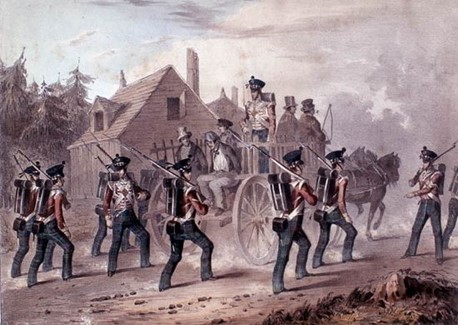
In 1837 and 1838, insurgents in Upper and Lower Canada led rebellions against the Crown and the political status quo. … It led to the Act of Union, which merged the two colonies into the Province of Canada. It also resulted in the introduction of responsible government.
The following database consists of a list of authors who have written books, theses and articles on the subject of Intolerance in Quebec.
Kindly click on the link below and open in a new window.
I have no doubt that the real cause of my great-grandmother’s death was a broken heart. She had experienced one grief too many and after the death of her daughter, she gave up and her heart gave out.
Alice Mary Knight, my great-grandmother, was born in the small village of West Bromwich, Staffordshire in 1875.1 Mary’s love story started in Birmingham, about six miles away. She went to Birmingham to work and met John Deakin at the rooming house where they were living.2 John also came from a nearby village. They were single, away from their families, and most certainly lonely. They married in 1900 and almost immediately moved to Sheffield, 90 miles away.3
The move to Sheffield would have been difficult. While Mary and John had each other, they would certainly have been homesick. Especially as their son, my grandfather, George Deakin, was born soon after they moved. In a strange city with a newborn, far from her mother and sisters, Mary would certainly have missed living in the village.
John found a mining job in Sheffield and he possibly worked for the Tinsley Park Collieries, situated very close to where John and Mary lived.Mary would have been alone most of the day as miners often worked 12-hour shifts. This young couple could have no inkling that the mine would unravel their lives.
In 1905, their little family was complete with the birth of George’s sister, Alice Gertrude Deakin.4
When George finished school, he went on to apprentice as a fitter, also at a mine, and possibly the one his father worked at.5 Fitters repaired and maintained machinery. George always worked at the surface of the mine. But he knew that it would not be long before he would be asked to work below ground. He was a short man and therefore an ideal size for moving around in the close spaces below ground. “I did not want to work below ground in the mine,” Gramps would say every time someone asked him why he came to Canada.
When George came to Canada in 1922, he had not yet decided whether he would stay.6 As soon as he arrived, he went out west by train to work on the wheat farms, to bring in the harvest. When the work dried up on the farms, he returned east to Montreal and met my grandmother, Grace Hunter. He was content living in Montreal. He married my grandmother and they had two children, Jack and Patricia. He had a job he enjoyed and worked there all his life, even during the Great Depression. George went on with his life but I cannot help but think that his mother must have been sorry he was so far away. Mary must have regretted George’s job at the mine, the catalyst for his emigration to Canada. It is unlikely that George ever went back to England for a visit, possibly because he may have felt that he could not take the time off work. A week to get there, a day’s journey by train to get to his parents’ house, and then the return. My grandparents were not rich, so money would have also been a consideration.
In 1935, John and Mary received more bad news. John had laryngeal cancer. At the time they did not know it, but mining is now considered a risk factor for laryngeal cancer. John underwent surgery to address the cancer, but he had heart failure from the shock of the operation and died on the operating table.7
After the death of her husband, Mary and her daughter, Alice, decided to move back to the village of Smethwick, John’s birthplace. Both John and Mary’s family were in the area. At least Mary would be close to some family members. Mary purchased a house and Alice found a job as a timekeeper at W&T Avery, a spring balance manufacturer.8
Tragedy struck again about ten years later when Alice was diagnosed with a brain tumour. Alice Gertrude died in the Queen Elizabeth Hospital in Birmingham on November 1, 1951. Alice’s friend and neighbour, Marie Evans, was the informant on the death certificate.9
Within a week of Alice’s death, Mary changed her will.10 She must have already been seriously ill and, although we don’t know for sure, the urgency would have been to dispose of the house. Mary died of a heart attack less than two months after the death of her daughter. She was a widow, her son lived far away, and her daughter had died. The sorrow would have been overwhelming. Mary died at home on New Year’s Eve in 1951, in the company of her younger brother, Benjamin.10
Mary’s new will left 20£ to her brother, Benjamin, for being the executor of her estate. She left a few bequests of 5£ to some of her friends and to the Firth Alms House in Sheffield, Yorkshire. Mary required that all of her other possessions, including her house, be sold and bequeathed to her son, George, in Canada.11
Mary must have felt that she lost her son to Canada and that when her daughter died in 1951, that the future was bleak. When death gently came to claim her just two months after her daughter’s death, Mary did not fight back.
Certified copy of an entry of birth, Alice Mary Knight, born April 17, 1875, extract dated May 4, 2021.
Certified copy of an entry of marriage, John Thomas Deakin and Alice Mary Knight, November 25, 1900, St. Paul’s Church, Aston, Harwick, extract dated May 25, 2021.
1901 census, Tinsley, Yorkshire, John Deakin and Mary Deakin, referenced January 1, 2016.
Copy of an entry of birth, Alice Gertrude Deakin, born July 19, 1905, referenced July 27, 2021.
Declaration of passage, George Thomas Deakin, Form 30A, referenced October 2, 2009.
Idem.
Copy of an entry of death, John Thomas Deakin, died July 8, 1935, referenced October 29, 2021.
1939 Register, Findmypast, Deakin, Alice G. and Deakin, Alice M., Alice is registered as a timekeeper at a balance manufacturer. Mary is registered as unpaid domestic help, referenced June 24, 2017.
Copy of an entry of death, Alice Gertrude Deakin, died November 1, 1951, referenced August 29, 2021. The informant was Marie Evans, neighbour and friend. The law is specific about who can register a death in England: a relative, someone who was present at the death, an employee of a public house where the death occurred, or the person making the funeral arrangements. As Marie Evans was not a relative, she was allowed to register the death if she made the funeral arrangements. As such, the death certificate states that Marie Evans was “causing the body to be buried.” This way Marie Evans was able to allow her to register the death.
The Last Will and Testament of Alice Mary Deakin, dated November 1, 1951 and probate, dated February 6, 1952, referenced August 12, 2021.
Copy of an entry of death, Alice Mary Knight, died December 31, 1951, referenced August 8, 2021.
Whether you live in North America, in German-speaking Europe, or almost anywhere else in the western world, the way Christmas is celebrated has been influenced in large measure by Austria and Germany. The Christmas tree comes from Germany. “Silent Night” (“Stille Nacht”), the world’s best known Christmas carol, originated in Austria.
The German religious reformer Martin Luther (1483-1546) is often credited with starting the Christmas tree custom, but the first appearance of a Tannenbaum was recorded in Germany many years after Luther’s death. It was in 1605 in Strasbourg in Alsace, then in Germany, that a chronicler wrote (in old German): “Auff Weihenachten richtett man Dahnnenbäum zu Strasburg in den Stuben auff…” (“At Christmas they set up Christmas trees in Strasbourg in their rooms…”).
But it is likely that the custom dates back to at least around 1550, since the first of several “Tannenbaum” ballads was circulating in print at that time. By the 19th century this custom had spread across most of Germany and beyond. Several royal Germans are credited with helping extend the tree decorating custom beyond Germany’s borders. The Duchess of Orleans (from Mecklenburg) brought it to Paris, while other Germanic royals brought the Christmas tree to England and other European countries. But it was commoners—emigrants from Germany—who brought the Weihnachtsbaum to America.
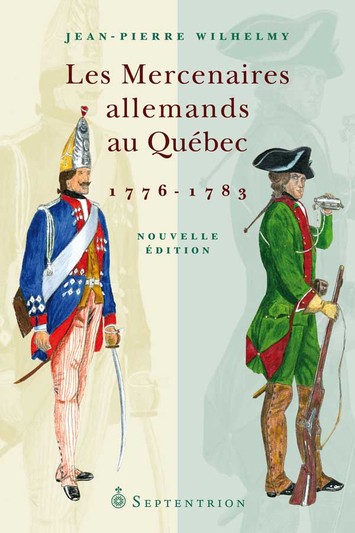
Hessians were German soldiers who served as auxiliaries to the British Army during the American Revolutionary War. The term is an American synecdoche for all Germans who fought on the British side, since 65% came from the German states of Hesse-Kassel and Hesse-Hanau. Known for their discipline and martial prowess, around 30,000 Germans fought for the British during war, comprising a quarter of British land forces. While known both contemporaneously and historiographically as mercenaries, Hessians were legally distinguished as auxiliaries: whereas mercenaries served a foreign government on their own accord, auxiliaries were soldiers hired out to a foreign party by their own government, to which they remained in service. Auxiliaries were a major source of income for many small and poor German states, typically serving in wars in which their governments were neutral.
Today, roughly 10,000 French-Canadians have a German soldier as an ancestor. If your surname follows, you may have a German soldier as an ancestor: Arnoldi, Bauer, Berger, Besner, Besré, Black, Brown, Carpenter, Caux/Claude, Eberts, Frédéric, Grothe, Hamel, Heynemand, Hinse, Hoffman, Hunter, Inkel, Jordan, Koenig, Laître/Lettre, Lange, Lieppé, Maheu, Matte, Nieding, Olivier, Pave, Piuze, Pétri, Plasse, Pratte, Rose, Rouche, Schenaille, Schmidt, Schneider, Steinberg, Stone, Trestler, Wagner, Wolfe. Some of these surnames were simply translated from German into French or English, while others went through a more complex transformation
The database below consists of authors who wrote about the immigration of Germans to Quebec beginning with Hessian auxiliary soldier who fought along side the British.
Philidelphia physician Robert S.J. Mitcheson (1862-1931) is said to have been a kind, thoughtful person and a good doctor, but his true passion focused on another realm entirely: art. Thanks to his widow’s generosity, it is as an art collector, rather than as a physician, that his legacy endures.
Several years after R.S.J.’s death, Lucie Washington Mitcheson donated some of the best paintings from his collection to the Philadelphia Museum of Art. She didn’t know much about art, but did know that the paintings would serve as a memorial to her beloved husband.
I came across Robert’s name long before I started to research my ancestors in a serious way. I knew my Mitcheson ancestors lived in Philadelphia in the 19th century, so I asked a researcher at the Historical Society of Pennsylvania (HSP) to look up the family. But Philadelphia, which had been founded in 1682, was home to many well-respected colonial and revolutionary families. The Mitchesons came to Philadelphia from England around 1817, so they were not included in any American genealogies. Thanks to Lucie Washington’s ancestry, however, the researcher did find Robert S.J. Mitcheson mentioned in a book about colonial families,1 and it mentioned both his medical career and interest in art.
Dr. Robert S.J. Mitcheson, photo courtesy University of Pennsylvania Alumni Relations.
Robert S.J. Mitcheson was the only son of Episcopal clergyman Robert MacGregor Mitcheson, (1818-1877) and Sarah Johnson (1823-1907). He had two older sisters: Fanny Mary Mitcheson (1851-1937), who married Uselma Clarke Smith and had five children, and Helen Patience Mitcheson (1854-1885), who died unmarried.
His father died when R.S.J. was 15. In his will,2 Reverend Mitcheson expressed the wish that his son study for a profession rather than go into business. R.S.J. attended the Philadelphia College of Pharmacy, graduating in 1885, and worked in the wholesale and retail drug business for several years.He then studied medicine at the University of Pennsylvania, graduating in 1891, and opened a medical practice, specializing in the ear, nose and throat. He also taught at the university.
He married Lucie May Washington (1867-1952) in Philadelphia in 1894 with Lucie’s father, Reverend Shadrach Washington, officiating at the wedding. The couple had no children and lived for many years in a row house on North 15th Street, first with Robert’s mother, then with Lucie’s.
Even as a medical student, Robert was interested in art, and he purchased a large number of paintings over the years. When he died suddenly at age 69, he left the collection in Lucie’s hands.
At first she was not sure what to do with the paintings, but with the help of Robert’s nephew, Chicago architect William Jones Smith, Lucie arranged to donate ten oil paintings to the Philadelphia Museum of Art. William was a friend of the museum’s director, Fiske Kimball. Kimball chose the paintings he wanted — primarily landscapes done by 19th-century American artists — and they arrived at their new home in October, 1938. At the time, the museum’s vast neoclassical building (familiar to many from a scene on the front steps in the movie Rocky)was only ten years old, and many of its walls were still bare.
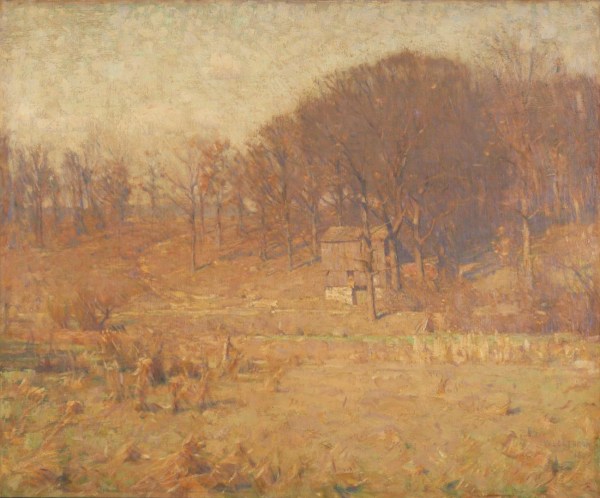
Landscape, by William Langson Lathrop, American Artist (1859-1938); Philadelphia Museum of Art: Gift of Lucie Washington Mitcheson in memory of Robert Stockton Johnson Mitcheson for the Robert Stockton Johnson Mitcheson Collection, 1938-22-5.
A flurry of correspondence between Lucie and museum staff reveals that everyone was happy about the gift. The paintings were hung together for a month in the newly furnished board room before being put on public display. Lucie was invited to come to see them, and to become a patron of the museum. Thrilled, she admitted she had once thought of museums as impersonal places, but “now I shall feel I am really one with you, and anticipate many visits to our Museum.”3
Several years later, she sold a number of paintings and water colours from the collection at auction. By 1946, Lucie must have also sold the house as she had moved into a hotel in the Mount Airy neighbourhood of the city. Her health was declining, nevertheless, she continued to correspond with museum director Kimball. That year she wrote, “It nearly breaks my heart not to be able to accept the many kind invitations that come to me from the museum, and now of all things to miss the Xmas party is the last straw.”4
The final entry in the museum’s file of correspondence with Lucie W. Mitcheson is a note to the museum director, informing him of her death on May 24, 1952.
Notes and Sources
1. Wilfred Jordan, editor. Colonial and Revolutionary Families of Pennsylvania; Genealogical and Personal Memoirs. New series. New York: Lewis Historical Publishing Company, Inc., 1942, p. 507. The author noted that, “according to family history,” Robert S.J. Mitcheson was a descendant of Richard Stockton, signer for New Jersey of the Declaration of Independence. That would have greatly improved Robert’s social status in Philadelphia, however, I have been unable find evidence of a connection.
2. Robert McGregor Mitcheson, Nov. 30, 1877, City of Philadelphia Register of Wills Office, #895. Familysearch.org, Wills, 1682-1916, Index to Wills, 1682-1924, film #07726523; Wills, V. 90-91, 1877-1878, image #390.
3. Lucie W. Mitcheson, Dec. 16, 1938, General Correspondence and related material, 1938-1939, Philadelphia Museum of Art, Library and Archives.
4 Lucie W. Mitcheson, Nov. 30, 1946, General Correspondence and related material, 1945-1946, Philadelphia Museum of Art, Library and Archives.
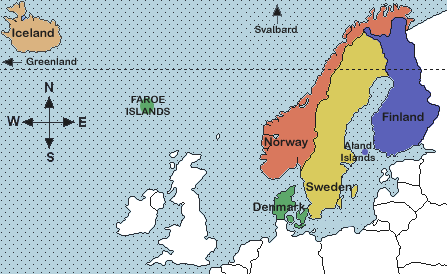
Scandinavia consists of three countries, Norway, Sweden and Denmark, where Scandinavian languages dominate.
The Nordic countries consist of Scandinavia plusIceland (that used to be a part of first Norway then Denmark) and Finland (that used to be the eastern third of Sweden, with a strikingly similar culture, although a totally different language).
The Nordic countries includes two autonomous parts of Denmark, namely Greenland and the Faroe Islands, plus one similarly autonomous archipelago of Finland, the Åland Islands, where the language is Swedish and almost no Finnish speakers live.
The Scandinavian languages are, unsurprisingly, Danish, Swedish and Norwegian.
The most used term is the Nordic countries, which is:
Sweden
Denmark
Norway
Finland
Iceland
Åland (?)
The term the Scandinavian countries is only a physical regional designation:
Sweden
Denmark
Norway
The database below consists of documents, books, articles and theses written by authors from Scandiavian countries, Canada, the U.S.A. and Nordic countries.
Several complete books, documents and articles may be downloaded and they are noted in several different colors.
Click the link bewlow to access the database and open in a new window.
The internet and social media have changed our lives, allowing us to connect to new friends and reconnect to old ones to celebrate our victories and lives. I recently experienced this first-hand.
Last September, I received, out of the blue, an email message from a complete stranger because he read a few of my stories on Genealogyensemble.com about my time in the Women’s Royal Air Force (WRAF).
George Cook, an archivist for the Trenchard Museum, which is based at RAF Halton was gathering information on the MTE – Medical Training Establishment – and happened upon the story of my time there. He recognised the man in one of my photos that went with the story.
“Purely bychance, I had the opportunity to read “Dear Miss Bulford” and I was compelled to follow up on Marian’s story of life in the RAF in the 1960s,” he said in his email.
‘You will appreciate my surprise when on reading part 4, I recognised the young gentleman who became her husband. John and I joined the RAF in September 1964 as admin apprentices at RAF Hereford. Not only did we do our square bashing together for 12 months but we were both posted to RAF North Luffenham in Rutland in 1965”
So, of course, I had to find out more. Let’s begin at the beginning of this intriguing tale, as told to me by George in his letter and by my very surprised husband.
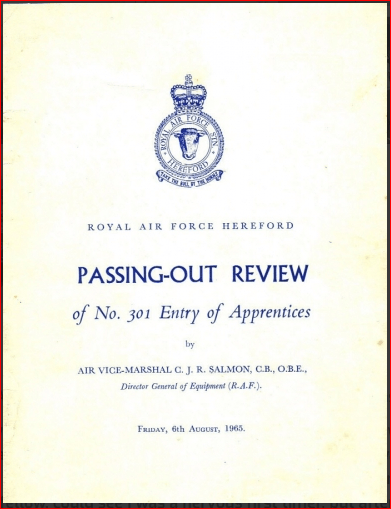
At the end of August 1964, my husband John Clegg was only 16 years old. He says he remembers standing on Liverpool Station on Lime Street England, waiting for a train to Herefordshire. He had left school in July 1964 and was headed off to join the Royal Air Force at RAF Hereford to enter a one-year Administrative Apprentice training course as part of the 301st cohort known as an ‘entry’ (1)
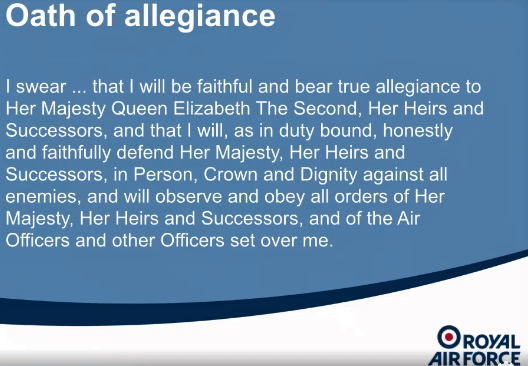
A week later, on the 2nd of September 1964, he took the Oath of Allegiance to Her Majesty the Queen.
The Oath of Allegiance
This committed him to serve 12 years in the RAF. One small point not clearly explained to an eager 16-year-old was that his 12 years of service wouldn’t start until his 18th birthday, meaning that the RAF had him for two extra years (14 in total)!
The boys in the administrative programme numbered approximately 40 per entry and were divided up into two dormitories of 20 per room. The training period consisted of daily classes for administrative procedures which would, on successful completion, quality John as an Administrative Secretarial Clerk. In addition, he learned personal discipline and stories about life in the RAF, including its history.
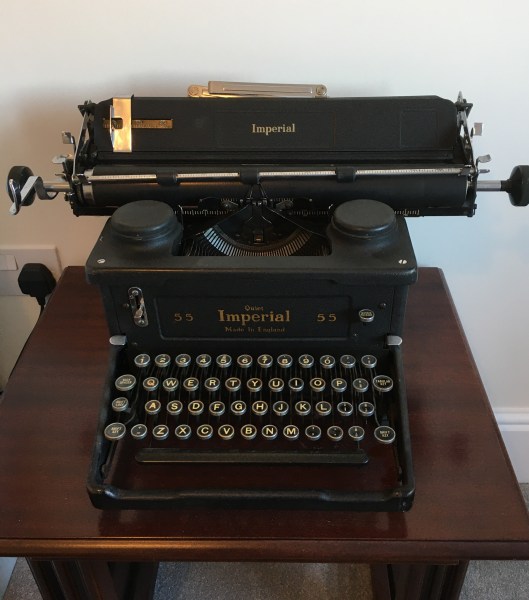
At that time, students were also taught to type on mechanical typewriters. John says that that training prepared him for the future introduction of computers John can still type 55 words a minute, the speed the boys were trained to do. George sent us this photograph of the typewriter they learned on.
The Typewriter the Apprentices Trained On
George Cook also apprenticed at RAF Hereford and he and my husband were alphabetical order billeting, which meant they ended up in the same room. They became friends.
John remembers George as a wonderful artist. He told me, that one drawing, in particular, stood out. It was a haze of charcoal until you stepped back and there appeared the face of Dusty Springfield a very popular singer in the England of the 1960s. John always remembered that drawing and the quiet talent that was often on display from George.
Whilst there, John and George made many friends with boys from different parts of the UK and from different backgrounds. After a year of close contact and demanding discipline, they forged friendships and operated as a group. At the end of the year-long course, trainees graduated as Senior Aircraftmen and had their passing out parade then they were posted to their stations where they became part of an administration team. Afterwards, they were to be posted to different parts of the country. Many never saw each other again, but that’s not what happened with John and George.
Invitation To The Passing Out Review.
Instead, they got their first posting together to RAF North Luffenham in Rutland. This area is very ancient and first mentioned as a separate county in 1159, but as late as the 14th century referred to as the “Soke’ of Rutland’, and in the Domesday Book as “A detached landlocked part of Nottinghamshire” (2) George was in the Station Sick Quarters teaching the Nursing Attendants to type, whilst John’s first assignment at North Luffenham was as a clerk in the Motor Transport section and later to the Ground Radio Servicing Centre. They were responsible for the reparation of Radar and Radio facilities in the UK. At a later point, he worked in the General Office and helped prepare airmen for overseas posting.
After a few years at RAF North Luffenham, John applied for a position on VIP duties, as a clerk on the staff of the Air Officer Commander in Chief at RAF Upavon in Wiltshire England where, shortly after his arrival, he met…….me!
**(Read my adventures and how I later met my husband of 53 years at RAF Upavon below)
Fast forward 60+ years and George read my story about my time in the RAF. Here’s what he told me about his experience
“During the 2 years there, I also worked in the Station Sick Quarters as the admin support to help the Nursing Attendants learn how to type at the mind-boggling speed of 15 wpm! We went our separate ways when I was posted to Singapore in 1968 but I do recall being told that John had re-mustered in the trade of air cartographer and was serving at AIDU RAF Northolt.
So, how did I come to read Marian’s stories? I work as a volunteer at the Trenchard Museum RAF Halton as an archivist and one of my tasks is to look into the history of the station.
Most people associate the station as the home of Number 1 School of Technical Training and the Trenchard Brats, young engineering apprentices who entered into a 3-year apprentice scheme set up by Lord Trenchard in 1922. What many people seem to overlook is the amazing medical history of the unit particularly the hospital, Institute of Pathology and Tropical Medicine and of course the Medical Training Establishment (MTE) Marian refers to. Marian, I loved your stories and you have made an old man very happy learning of my old pal John. I hope that you are both well particularly in these troubled times”
I read his email with great excitement. I called my husband to come and read THIS!!!
When he read it he could not believe it was from the same George whom he knew all those years ago when they served together as Administrative Apprentices.
George Cook is now a volunteer Archivist at the Trenchard Museum at RAF Halton and also assists with the guided tours of the Halton House Officers’ Mess. (3) (4)
An exchange of emails reveals that George has led a full and varied career in various positions of leadership in the RAF. John served 12 years and then served many years in the airline industry in Genéva, Switzerland and Montréal, Canada where we now reside.
How amazing is the speed of technology the internet and social media? I will always be grateful that it allowed George to read my stories, and John to reconnect with his friend after so many years.









 Genealogy Ensemble