Category Archives: Genealogy

Getting Quotes from Attestation Papers

Attestation papers include declarations or oaths military recruits said out loud

Fourteen days after Canada declared War on Italy and the same day France signed an armistice with the country, my grandfather Richard Charles Himphen left his job as a baker’s helper to enlist in The Irish Regiment of Canada.

He said a declaration out loud, in front of someone whose name looks like Mr. Armstrong Cafo, although it might also be Captain M. Armstrong.

…I hereby engage to serve in the Canadian Active Service Force so long as an emergency, ie, war, invasion, riot or insurrection, real or apprehended, exists, and for the period of demobilization after said emergency ceases to exist, and in any event for a period of not less than one year, provided His Majesty should so require my services.”

Then he said:

I Richard Charles Himphen do solemnly promise and swear (or solemnly declare) that I will be faithful and bear true allegiance to His Majesty.”[1]

I know he said those words because they’re on his attestation papers. Although since no one crossed out one or the other I don’t know whether he “solemnly promised and swore” or “solemnly declared.” I suspect he did both because he was reading from the paper and it says both, but I don’t know.

(Note: If you want to read more about Richard Himphen, I have stories about his life here and here.)

Good Stories Need Quotes

Unless you have an ancestor who participated in a court case or worked as an actor, singer or writer, it can be difficult to obtain quotes from his or her life.

Military recruits, however, usually had to say declarations and oaths out loud in front of a witness and both had to sign to make enlistment legal. If that happened, the declarations and oaths will be on their attestation papers.

You also have the name of the witness if you can read his or her signature.

World War II

Most attestation papers include declarations and/or oaths, but not all. The attestation paper of Harry Denis Davy who enlisted in the Royal Canadian Air Force on February 14, 1919 doesn’t include either an attestation or an oath. Then again, it’s possible that there was a third page missing from his service record.[2]

James Fredrick Devitt served with the same unit and his attestation papers included a declaration and oath.

I James Patrick Devitt do solemnly declare that the foregoing particulars are true, and I hereby engage to serve on active service anywhere in Canada, and also beyond Canada and overseas, in the Royal Canadian Air Force for the duration of the present war, and for the period of demobilization thereafter, and in any event for a period of not less than one year, provided His Majesty should so long require my services.”[3]

Soldiers in other wars said different things.

World War I

During WWI, on October 29, 1915, bank clerk John Glass said:

I hereby engage and agree to serve in the Canadian Over-Seas Expeditionary Force, and to be attached to any arm of the service therein, for the term of one year, or during the war now existing between Great Britain and Germany should that war last longer than one year, and for six months after the termination of that war provided His Majesty should so long require my services, or until legally discharged.”

Boilermaker Arthur Luker said the exact same thing on June 24, 1916.

Steamfitter William Wright said the same thing on September 21, 1914.

Henry Hadley Jr.’s file doesn’t include an oath or declaration. He signed a Officers’ Declaration Paper on December 9, 1915 instead.

South African War

South African war recruits swore at least two declarations and two oaths. Farmer Henry Smith Munro, for example, swore on October 6, 1899 that he would:

…well and truly serve our Sovereign Lady The Queen in the Canadian Contingent for Active Service, until lawfully discharged, and that I will resist Her Majesty’s enemies, and cause Her Majesty’s peace to be kept on land and at sea, and that I will in all matters appertaining to my service faithfully discharge my duty, according to law. So help me God.[4]

Then, on December 24, 1901, he said:

I Henry Smith Munro, do sincerely promise and swear (or solemnly declare) that I will be faithful and bear true allegiance to His Majesty, King Edward VII, His Heirs and Successors and that I will faithfully defend Him and them in Person, Crown and Dignity, against all enemies and will obey all orders of the Officers set over me.[5]

Abbreviations Can be Tricky

As you go through the form, you definitely want to refer to a Canadian Archives’ abbreviations page to understand everything on the form.

Pay careful attention to marital status. Often, wives or husbands had to send letters to the recruiting office giving permission for someone to enlist. These letters are wonderful sources of direct information about your ancestor.

Also, look carefully for typical fields that remain blank. This might indicate that your ancestor intentionally left the field blank to make sure they would not be rejected. Eliza Richardson describes why nurses left several blanks on their attestation forms during World War I.

The Nursing Sisters who did not fit the camc requirements of age, education, and marital status bypassed regulations by deliberately abstaining from marking down pertinent information on their attestation forms. It is only through pairing Toman’s statistics with the personal accounts of Nursing Sisters in the form of letters, memoirs and photographs that these inconsistencies become clear and a more accurate picture of the composition of the Nursing Sisters becomes possible.”[6]

Look for Historical Context

After collecting information from the attestation papers of your relatives, you may want to do a search of academic papers on Google scholar to figure out how the information you learn fits within common assumptions about historical trends.

Now that attestation papers have been more widely digitized, historians have been examining them for health and sociological information. New interesting papers are constantly appearing.

A simple search informed me about a decades-long discussion questioning why statistics show soldiers at the beginning of World War I being shorter than those who served in the Anglo-Boer War even though there were only 14 years between the beginning of one war and the end of the second.

Last February, Martine Mariotti,  Johan Fourie and Kris Inwood from the Australian National University and the universities of Stellenbosch and Guelph came up with a theory to explain the discrepancy in their article Military Technology and Sample Selection Bias.

We posit that new technologies, and the changes in military strategy entailed by those technologies, explain the difference. The Anglo-Boer War, also termed ‘the last gentleman’s war’, was the last war to use cavalry lancers, a military strategy where height is a particular advantage. In contrast, the mechanization of weapons during WWI  meant that soldiers’ heights were no longer so important. In this case, improvements to military technology help to explain the apparent decline in stature between the two wars.[7]

If you have an ancestor who served as a soldier in WWI or the Anglo-Boer War, you might want to mark down his height and compare it to the average height of soldiers at that time. Then you can comment on whether he fits the general trend or not. You might also try to figure out whether his task was height-dependent.

Next Steps

If you want help writing stories about your ancestors using attestation papers, I’m offering a course that begins at the end of the month. You can find more information on my Teachable page. There’s also a free course about my four-step system for writing profiles on that same page.

In the meantime, I’d love to hear what you discover about Canadian military attestation papers in the comments.


Sources

[1] Himphen, Richard Charles; Library and Archives Canada, R112, volume 30826.

[2] Davy, Harry; Library and Archives Canada, RG-24, volume 25178.

[3] Devitt, James Frederick; Library and Archives Canada, RG-24, volume 25203.

[4] Munro, Henry Smith; Department of Veterans Affairs fonds, RG38, volume 11170, T-2079, p1.

[5] Munro, Henry Smith; Department of Veterans Affairs fonds, RG38, volume 11170, T-2079, p10.

[6] Richardson, Eliza. “Sister Soldiers of the Great War: The Nurses of the Canadian Army Medical Corps (Book Review)” by Cynthia Toman,” Canadian Military History: Vol. 27 : Iss. 1, Article 9. Available at: http://scholars.wlu.ca/cmh/vol27/iss1/9, accessed January 5, 2019.

[7] Fourie, Johan, Martine Mariotti and Kris Inwood. “Military Technology and Sample Selection Bias,” Stellenbosch Working Paper Series No. WP03/2018, February 2018, https://www.ekon.sun.ac.za/wpapers/2018/wp032018

 

Thirteen Children

When I first became interested in genealogy I knew very little, especially on my Sutherland side. A query I posted on Roots Web and a reply from Carol McIntosh Small opened the door to a flood of information, pictures and a number of third and fourth cousins. The cousins all wanted to know, “Who was your William Sutherland’s father?”

One cousin had heard stories that William Sutherland, born about 1750 in Scotland, had 13 children. They had only been able to find seven children from William and his wife Catherine Mackay. My William appeared to be his grandson, with his parents being another William Sutherland and Christina McLeod. He was thought to be one of six children. Then, we all received an email saying, “Guess what?” There was only one William Sutherland and he had two wives, hence the possible 13 children.

If one just looked at birth dates, William wouldn’t be expected to have fathered these 13 children. The first was born about 1779 and the last around 1827. In fact, William was around sixty when he married Christina McLeod and started his second family. He was almost eighty when his last child was born!

Unfortunately, before his second family was grown, William, old and frail was unable to work. His mind went and he couldn’t manage his affairs. He had been a stone mason and had worked the land in Inchverry as a tenant for more than 50 years. He was behind on his rent and was to be expelled from his land and removed from his cottage.

In April of 1833, his wife Christina, with the help of Rev H. McKenzie sent a petition for the consideration of the Duchess of Sutherland, pleading for time to catch up on the arrears. It stated, that if they were removed from their home, she and her young children would be forced to beg to survive.

William had always been an industrious and honest man who had never been in debt. Not only had he raised the seven children from his previous marriage, who were all educated and in various trades, but he had also raised many of his brothers and sisters after their parents died. They were now in other parts of the world and either could not help or were “forgetful of their duty”. Christina had expected to receive help from William’s brothers in Aberdeen and his son by his first marriage in England but no help arrived.

There was another petition, August 14, 1834, stating that their oldest son William, now 17, was finishing his apprenticeship as a shoemaker in Inverness. He would begin working in Tongue in the summer of 1836. As everyone needed shoes and he was a sober and hard working fellow, he would probably do well and would be able to support the family, manage the lot and pay the rent. In the meantime, they hoped the Duchess would allow them to remain on the land and to keep a little summer meal.

The Duchess responded August 20, 1834, “The petitioner’s arrears will be given up upon condition of the petitioner’s son assisting him in the future.” Their son William did looked after the family until he left for Canada in 1845. His younger brother Donald, then also a shoemaker was left in charge.

Further research by the cousins turned up two more children born to William and Christina. Although a William wasn’t a child of William and Catherine there was a John so the 13 children have become 15.

Notes:

National Library of Scotland, Edinburgh: Sutherland Estate Papers, Dep. 313/2461    Papers found by Margaret Walker and passed on to the cousins..

Small, Carol A. The McIntoshes of Inchverry. Denfield, Ont.: Maple Hurst, 2008. Print.

Personal communications from Karen Sutherland Pahia, Nancy Sutherland Grieg, Carol McIntosh Small and Paul Worth.

WILLIAM SUTHERLAND was born abt. 1750 in Tongue, Sutherlandshire, Scotland. He married CATHERINE MACKAY. She was born abt. 1755. He then married CHRISTINA MCLEOD. She was born in Tongue, Sutherland, Scotland.

Children of WILLIAM SUTHERLAND and CATHERINE MACKAY are:

 JOHN SUTHERLAND, b 1779

 MARGARET SUTHERLAND, b. Abt. 1783; d. April 06, 1873, Tongue Sutherland Scotland.

ELIZABETH SUTHERLAND, b. Abt. 1789.

GEORGE SUTHERLAND, b. Abt. 1790; d. Bef. 1851.

HELEN SUTHERLAND, b. Abt. 1794; d. June 04, 1846, Mt. Thom, Pictou Co., Nova Scotia, Canada.

BARBARA SUTHERLAND, b. July 04, 1794.

GRACE ANN SUTHERLAND, b. January 05, 1800; d. September 12, 1889, Strangeways, Australia

Children of WILLIAM SUTHERLAND and CHRISTINA MCLEOD are:

CATHERINE SUTHERLAND, b. Abt. 1810, Tongue Sutherland Scotland: d. January 23, 1858, Rhitongue, Tongue, Sutherland, Scotland.

ISABELLA SUTHERLAND, b. Abt. 1814, Tongue Sutherland Scotland; d. June 22, 1897, Heddon Bush District, Southland, New Zealand.

WILLIAM SUTHERLAND, b. 1816, Sutherlandshire, Scotland; d. August 12, 1887, Toronto, Ontario, Canada.

JOHAN SUTHERLAND, b. Abt. 1818; d. November 12, 1901.

HUGHINA SUTHERLAND, b. Abt. 1820; d. August 09, 1909, Inverpolly, Ross and Cromarty, Scotland.

JANET “JESSIE” SUTHERLAND, b. Abt. 1825, Tongue, Sutherland, Scotland: d. March 20, 1924, Ullapool, Lochbroom, Ross and Cromarty, Scotland.

DONALD SUTHERLAND, b. Abt. 1826, Brae Tongue Sutherland Scotland; d. May 04, 1895, Brae Tongue Sutherland Scotland.

ROBERTINA SUTHERLAND, b. Aft. 1827, Tongue Sutherland Scotland: d. June 25, 1917, Coldbackie, Tongue, Sutherland, Scotland.

His son William was my great great grandfather. A story about William’s wife Elizabeth Mowat, can be found at https://wordpress.com/post/genealogyensemble.com/3293


Jacques Gagné’s Research Interests in 2018 and 2019

2018 was a busy year for genealogy researcher Jacques Gagné, so if you missed any of his posts, here is a recap of his work and a look ahead to 2019.

For many years, Jacques was a volunteer researcher at the Quebec Family History Society, so he has a broad knowledge of genealogical records in Quebec. He is particularly knowledgeable about resources at the Bibliothèque et Archives nationales du Québec (BAnQ), finding notarial records, searching for ancestors in France and anything to do with the Huguenots.

He is now on the far side of 80 and his eye sight is not what it used to be, so the amount of research he has accomplished for Genealogy Ensemble is all the more impressive. He is passionate about what he does and he just keeps pushing ahead. The list of projects he would like to do in the future is almost as long as the list of his past achievements.

                 Jacques Gagné

Jacques’ work is actually a collective effort. He does all the hard work of exploring the Internet and putting together the research guides, while Claire Lindell and Janice Hamilton (me) revise them, edit the introductions and post everything online. I took a year off between the spring of 2017 and April 2018, which is why there is a gap in his posts.

The major research guides posted in 2018 focused on one main theme: the seigneuries of Quebec. From the time New France was created in the 1600s until the mid-1800s, most land in Quebec was owned by a few individuals known as seigneurs. They were usually French aristocrats, wealthy merchants or military leaders. Most ordinary Quebecers were tenant farmers living on the seigneuries. Jacques identifies the seigneurs and seigneuries in each region, and the notaries who practised there. He also includes a list of cemeteries in each area and repositories for archival material and other resources.

Another post from 2018 was a list of notaries who practised in the years after Quebec came under British rule, between 1760 and 1848. He also put together research tips for finding Huguenot ancestors in France, tips for searching at the BAnQ and French municipal archives, and a heads up on a wonderful online resource, the New France Archives from Library and Archives Canada, nouvelle-france.org.

Jacques has been hard at work for several months on a new series of guides for 2019 on the merchants, ship owners and fur traders of New France. This series looks at the men who did business in New France. Many of them were born in France but married and died in North America, and some were also notaries or played other important roles in the new world. The series includes a post about their ports of departure and their trading partners back in France, as well as background on the trading companies they were associated with.

He is also working on a new series of posts updating his old research guide to the Irish Catholic churches of Quebec (https://genealogyensemble.com/2014/05/20/irish-catholic-churches-of-quebec/). Meanwhile, guides to ancestors in the Charlevoix and Gaspe regions, and more tips on searching in France are coming soon.

If you missed some of Jacques’ past compilations, or are having trouble finding something you noticed several months ago, our blog has several features that makes searching easy.

On the right hand side of the screen, under the Geneabloggers logo and before Categories, there is a Search box. Enter any terms that you might think will take you to a post you are trying to find, such as the name of a region, as well as Gagné. (It will work without the accent.) If you find an article of interest and open it up to its full length, you will find suggestions for related articles at the bottom of the page.

You can also look down that column on the right of your screen until you come to Jacques’ name (it is the fourth name in the list) and click on it. You can then scroll backwards through all his posts. When you get to the bottom of a page, click on Older Posts.

Finally, below all the authors’ names on the right is a search function called Archives. It brings up all our posts from each month.

Thank you for following us since 2014, and good luck with your research in 2019.

François Eugene Jodouin


1895-1969

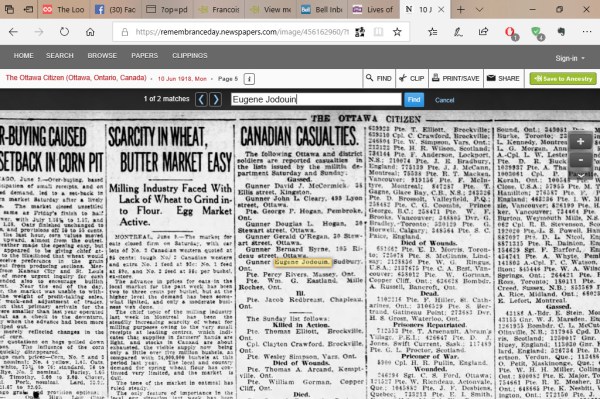
During the war years Canadian citizens were kept informed by newspapers. The Ottawa Citizen had a column CANADIAN CASUALTIES.  In the 10th of June, Monday Edition 1918. It listed under the Title Gassed, Gunner Eugene Jodouin from Sudbury, Ontario.1.

Ottawa Citizen June 19, 1918

Many young Canadian men and women made patriotic decisions to serve their country during the years 1914-1918. Some may have been reluctant, not really knowing what lay ahead, while others perceived it as a great adventure. One thing that was most likely uppermost on their minds, was a deep obligation to serve their country. They went to recruiting offices across the country and signed Attestation papers.

One of those young men was my Uncle Eugene. He was nineteen years old, a month short of his next birthday. He signed his attestation papers on September 15th,1916 in Sudbury, Ontario and took the oath to bear true allegiance to His Majesty King George the Fifth.

Joseph François Eugene Jodouin was the second child, the first son of Louis Joseph Jodouin and Louise Fortin. He was born on the  17th of October 1885 in Sudbury.2 As a young man he began working as a miner. From the mid-1880’s and onward Sudbury was a major hub of activity. Surveyors were busy, and  prospectors had found precious metals, such as copper. However, predominantly nickel ore was most sought after. The village was growing by leaps and bounds with the building of the railroad, the center of activity. Young men with families were settling in the area. Jobs were plentiful. Nevertheless, Eugene enlisted and joined the Canadian Expeditionary Forces.

Uncle Eugene signed his attestation papers and underwent the standard medical exam. It was noted that he was a short man, only 5’2”and his medical report stated that he did not meet the regulations for artillery, nevertheless, it was not a drawback. He served willingly.

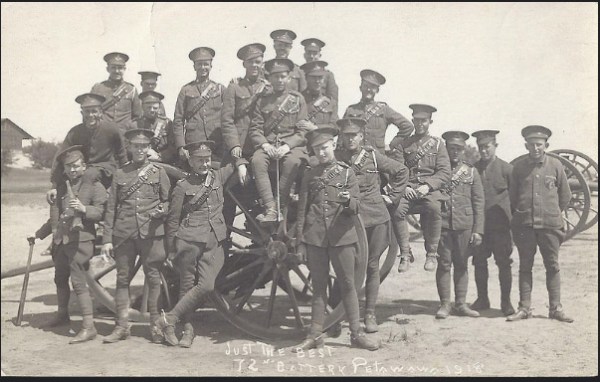
He was assigned to the 72nd ‘Queen’s’ C.F.A. Battery C.E.F.

Is that Uncle Eugene on the far left? Maybe.

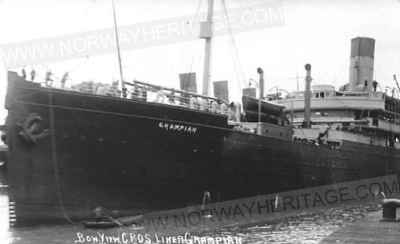
A large contingent of young soldiers gathered aboard the S.S. Grampian in Halifax on October 24th, 1916 bound for duty in France. After a lengthy journey they arrived in Liverpool, England on November 5th. They were transferred to “Shorncliffe a staging post for troops destined for the Western Front during the First World War”.3. Shorncliffe is located in Kent, England. 

S.S. Grampian

Records received do not indicate where Eugene was stationed in France, in which battles he saw action, although one might surmise the Battle of Verdun and the Battle of the Somme. His documents indicated he saw action in both France and Belgium.

On the 10th of March 1918, 1 Brigade C.G.A, Eugene’s unit was granted a short leave. They rejoined the unit in France on the 31st of March ready for continued active duty.”To break the deadlock of trench warfare on the Western Front, both sides tried  new military technology, including poison gasaircraft and tanks.”4 … “The skin of victims of mustard gas blistered, their eyes became very sore and they began to vomit. Mustard gas caused internal and external bleeding, attacked the bronchial tubes, stripping off the mucous membrane. This was extremely painful. Fatally injured victims sometimes took four or five weeks to die of mustard gas exposure” 

Effects of mustard gas

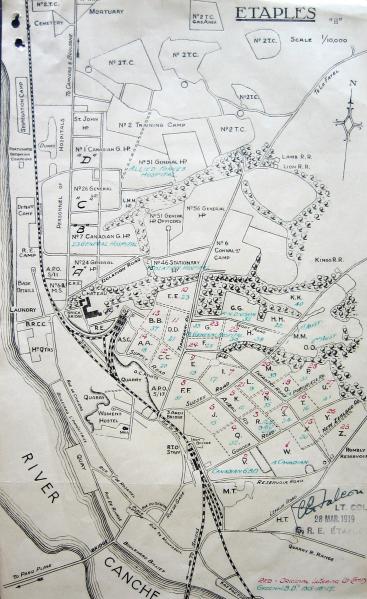
Many soldiers suffered from shell gas and mustard gas. Eugene was no exception. His first experience was on May 29th, 1918. He was sent to Camiers and on the 5th of June, 1918 he was admitted to the 73 Gen. Trouville Hospital and again on June 13th. On the 16th of August 1918 he was hospitalized at Base Dep Étaples the largest British Military base in the world and… “the Étaples base hospital complex hosted as many as 20 hospitals by 1917”,this time the diagnosis was mustard gas. 4. Later that year he was again hospitalized several times for scabies.

Etaples

On the 25th of January 1919 Eugene was granted a seven day leave in Paris. No doubt, he and his comrades were cheered by the people of Paris. War was over. Armistice had been declared. France was finally liberated.

On April 5th, 1919 Eugene proceeded to England and on the 3rd of May 1919 he embarked on the S.S. Mauretania in Southampton, England. They were heading for Halifax where he and many other young men and women whose lives had been changed forever finally landed on Canadian soil, the 6th of May 1919.

On May 11th, 1919 Joseph François Eugene Jodouin was officially(Discharged from. H.M.S.) No. 2 Depot PART II D.D.136, Toronto,March 23, 1921

Eugene married a young widow, Della Sinnett. In two years he was to lose her. She died of septicemia on the March 5th, 1923 while giving birth to their second child. She was only 25 years of age leaving him with his young son, Frankie. Della is buried in Sudbury in the Jodouin gravesite. At 61 years of age, Frankie was also laid to rest beside his mother and grandparents in Lasalle Cemetery in Sudbury, Ontario.

Eugene and Della’s Wedding Certificate

Uncle Eugene moved to the Kirkland Lake where Voter’s Lists indicate he worked as a shift boss in a mine. In 1940 he remarried. He died in 1969 and is buried in the Kirkland Lake Cemetery.

Sources:

1.  https://remembranceday.newspapers.com

2.  Ontario, Canada, Catholic Church Records (Drouin Collection), 1802-1987 Ancestry.ca

3.  https:/en.wikipedia.org/wiki/Western_Front_(World_War_I)

4. https://en.wikipedia.org/wiki/Chemical_weapons_in_World_War_I

Notes:

Staggering statistics “a war which would last 1,566 days, cost 8,528,831 lives and 28,938,073 casualties or missing on both sides.” https://www.forces-war-records.co.uk/units/230/seaforth-highlanders/

Read:

You might wish to read Dad’s Favourite Christmas Story about young Frankie’s Christmas caper at https://genealogyensemble.com/?s=Dad%27s+Favourite+Christmas+Story

The Courtship of Ann and Tommy – Part 2

My father Tom was already a McGill Engineering graduate and employed in his field when he met my mother Ann, who had just begun her college studies. This meant he got to enjoy the McGill “scene” and social life for a second time around! He happily escorted Ann to all the school’s social functions. According to Dad, he was a really good dancer and they made a handsome pair dressed in their evening finery.

Ann’s 1946 diary describes these dances, parties and charity balls in detail with most entries closing with a rather ecstatic declaration of affection for her “Tommy”: What a man, what a love, what a darling! I love him so! What a passion I have for him! Tommy is more wonderful every day. The more I see you, the more I love you, Tommy. What a darling you are-Tommy-the loveliest things are part of you. The happiest days are always with Tommy.

Whew!

The diary entry for May 12, 1946, refers to “the best letter ever!” from her Tommy. They wrote each other almost daily during her summer breaks from college when her parents kept her “busy” and out-of-town visiting family and friends. What a thrill it was to find this very letter in my “dusty old boxes” of family memorabilia! And, yes, it is pretty special. It is a profound and lengthy letter analyzing love in different relationships such as a mother’s love, Christian love and love between a man and a woman. Tom wrote to Ann “…but all these things seemed outside forces and not within myself”. He continued to describe himself as “naturally a little cold emotionally and that his character and training encouraged reason.” The letter closes with “but since I’ve known you my darling, I’ve experienced love from my own heart responding to yours.” Good for you, Dad!

Clearly, their letter writing was not all romantic fluff!

At one time, they discussed buying a piece of property together – “Would you like a lake shore place rather than a place at the bay?” wrote Tom and included some rough number crunching for her opinion. Another lengthy letter summarized his fundamental thoughts on the universe: “…we can conceive of the universe finite in mass and energy yet with no boundaries and no centre.”

But what speaks volumes is that he consulted Ann in the planning stages of his own engineering company – the company name, his percent interest, his monthly salary and other essential decisions. Shortly before their wedding in May 1947, there was a letter to Ann written on the company letterhead – T. G. Anglin Engineering Company Limited.

I can only imagine Tom’s emotional state when he began dating Ann in the summer of 1943. In May of that year, his only brother went missing in action with his RCAF crew during WWII. I like to think his brother was watching over them and paving their way to a life together.

Ann always seemed so positive, happy and full of life. Her diary was filled with daily exclamations of Fun Galore! Swell! Wonderful! Simply Perfect! What a garden/view/weekend! It wasn’t long before my father, mesmerized by her optimism, gaily signed a letter with his initials made up of x’s and o’s.

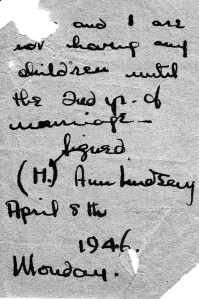
It was not all that surprising to find Ann’s hand-scrawled note on a scrap of paper, hidden amongst their numerous letters and photos, promising not to have children for the first two years of marriage thus protecting their time alone after a passionate four-year courtship.

1946-04-08

BnF Gallica

As one of Europe’s most important countries, it is not surprising that France has a wonderful national library, and that this institution has a growing online presence. The website of the Bibliothèque nationale de France found at www.bnf.fr (or www.bnf.fr/en for the English version) leads you to the catalogue and tells you how to access the library’s many collections, including antiquities and works published in Paris in the 16th century.

Gallica https://gallica.bnf.fr is the BNF’s vast digital library, free to all through the Internet. Intended for use by all readers, including the casually curious, students and academics, this site includes medieval manuscripts, illustrations from the natural sciences, maps and photographs.

It might not seem obvious how Gallica could assist with your family history research, but you just need to stretch your imagination. The Patrimoine équestre collection, for example, focuses on horses, which were part of our ancestors’ everyday lives. (See https://gallica.bnf.fr/html/und/sciences/patrimoine-equestre)  And as France was once a colonial power with a presence from the Caribbean to Polynesia and Africa, the maps on this site could prove helpful if your ancestors were sailors or merchants. (See https://gallica.bnf.fr/html/und/cartes/les-ameriques-en-cartes)

Another aspect of Gallica is a bilingual site called la France en Amerique, or France in America, created in collaboration with the Library of Congress. (See https://gallica.bnf.fr/dossiers/html/dossiers/FranceAmerique/fr/default.htm) In addition, if you are looking for a biography of a French ancestor dating back to the 12th century, BNF Gallica is the place to go. I discovered this by chance.

I was searching online for Jean Allaire, a Quebec City merchant who arrived in New France in 1658. He was associated with François Perron (Péron), a leading merchant in La Rochelle and Québec City. Google took me to the Dictionnaire Allard, also known as the Dictionnaire de Dauphiné, on BnF Gallica. (See https://gallica.bnf.fr/ark:/12148/bpt6k39393d/f12.item.zoom)

A dictionnaire in France can be a source of biographies, at least in the more expensive versions. For most of the 44 ancient provinces of France prior to 1789-1799, Bnf Gallica has posted dictionaries of important residents.

This particular dictionary addresses the ancient province of the Dauphiné. At the time of the French Revolution, Dauphiné was divided into three modern-day Départements: Drôme, Hautes-Alpes and Isère. According to Fichier Origine (/www.fichierorigine.com), 26 pioneers from Drôme, 27 settlers from the Hautes-Alpes  and 70 pioneers from the Isère settled in Nouvelle-France.

Similar regional dictionaries covering other parts of France can be found on Gallica, and in them you may find information about your very distant French ancestors in France. For example, I discovered that my family name, which was Gagné in New France, was Gasnier in France in the 16th and 17th centuries, and it appears to have been Garnier in the 14th and 15th centuries. This is information I obtained through BnF Gallica and other free online research tools.

Plucky Police Constable

On the 26th December 1912, the SS Tripolitania, a steam cargo ship from Italy on its voyage from Genoa to Barry Wales for coal, had beached on the Loe Bar, near Porthleven in Cornwall England. The weather had been and was still a vicious South Westerly gale with 100 mph winds, rain, huge churning waves and blowing sand which made it difficult to see anything.

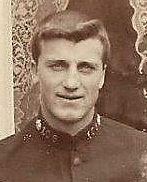
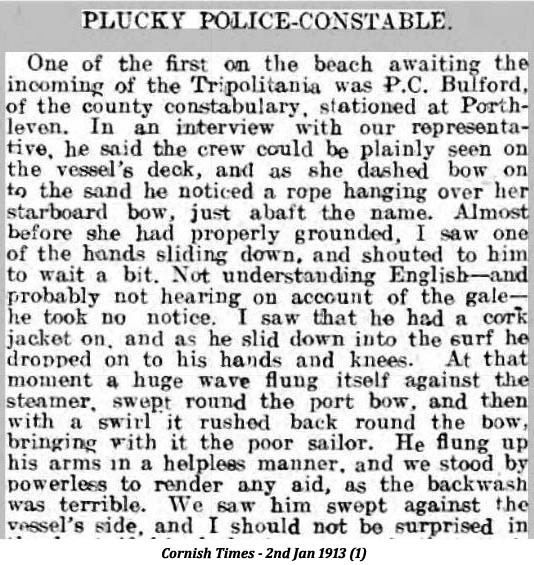
One of the first men on that beach, waiting for the RNLI (Royal National Lifeboat Institution) to arrive and assist, was the local Police Constable, (PC) Francis Bulford – my future grandfather. He could clearly see the crew on the vessel’s deck as the bow dashed onto the sand and heaved up and crashed down again and again.

Police Constable Number 106, Francis Bulford

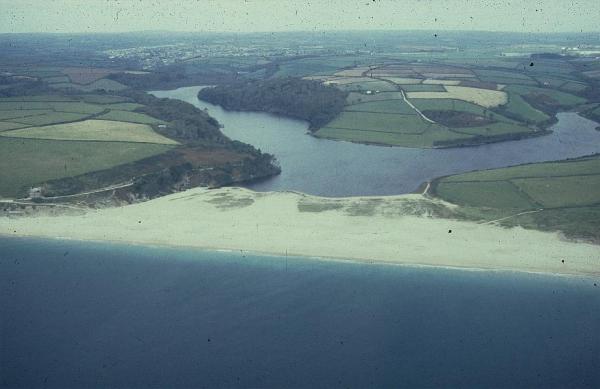
The wreck had the sea on one side of her, and Loe Bar on the other side. The Loe bar is a half mile wide shingle bank – also referred to as a rocky beach or pebble beach – which separates the Loe, the largest natural fresh water lake in Cornwall, from the sea.  Loe Bar was originally the mouth of the River Cober which led to a harbour in Helston. However, by the 13th century, the bar had cut Helston off from the sea and formed the pool.

Loe Bar 1993 Aerial View Helston Museum.org

Loe Bar has a well-earned reputation for being treacherous and over the years several lives have been lost. The combination of powerful waves, a steep slippery shingle bank and vicious currents make it a very dangerous stretch of beach, and there is a local rumour that a freak wave here claims a life every seven years. At the end of the day, the best advice is to heed the signs and don’t even think about swimming here. [1]

On that day after Christmas, 1912, the steamship SS. Tripolitania was still rising and trying to ground in the violent weather. PC Bulford could just make out a  rope hanging over her starboard bow. Then, to his horror, he saw a deck hand start to slide down the rope.

He shouted to him ‘Wait a bit’! intending to let the boat properly ground before attempting a rescue, but the crew member either not hearing in the loud gale winds, or not understanding English, slid down the rope and dropped onto his hands and knees, into the surf.  At that very moment, an enormous wave lifted the steamer, swept around the port bow and rushed back, bringing with it the sailor who was swept against the ships’ side and disappeared. “I should not be surprised in the least if his body is recovered, that it is found he was killed by being caught under the steamer’s bilges” said PC Bulford when interviewed later. [2]

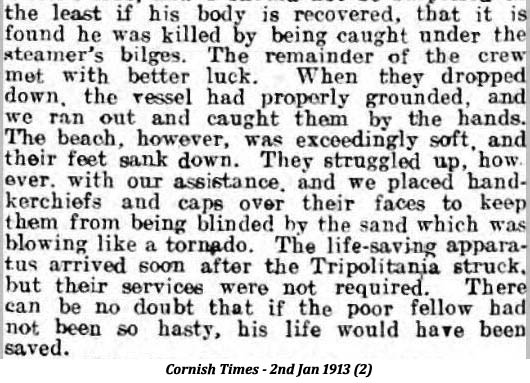
The rest of the crew remained aboard until the steamer was properly grounded. By that time villagers and the RNLI crew from the Penlee Lifeboat had joined the PC. Together, they all ran out and grabbed the crew by the hands, to lead them to safety.

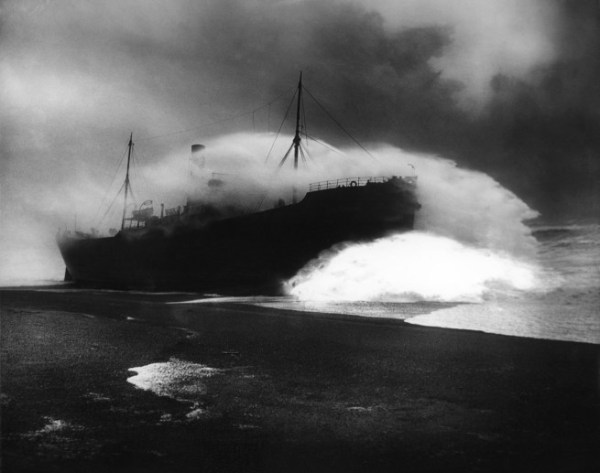
The Steamship SS Tripolitania grounding on Loe Bar 26 December 1912

Photo © Of the late W.F. Ivey and Graham Matthews (Grandson of W.F. Ivey) [3]

By this time, the beach sand was saturated with sea water and the rescuers’ feet were sucked down.  Meanwhile, the wind was blowing and tossing so much sand into eyes and mouths they could barely see. The rescuers placed handkerchiefs over their own mouths and the crewmembers’ mouths and dragged and pushed and pulled everyone to safety.

The Cornish Times – below – stated, that “Life-saving apparatus arrived soon after the SS Tripolitania struck, but their services were not required”

That day, the 28 members of the crew were saved but one, and his body was never recovered. In addition, two of the crew of the brave Penlee Penzance Royal National Lifeboat Institution, Janet Hoyle, died of pneumonia the following Thursday. [6] All these men were volunteers.  See notes below.

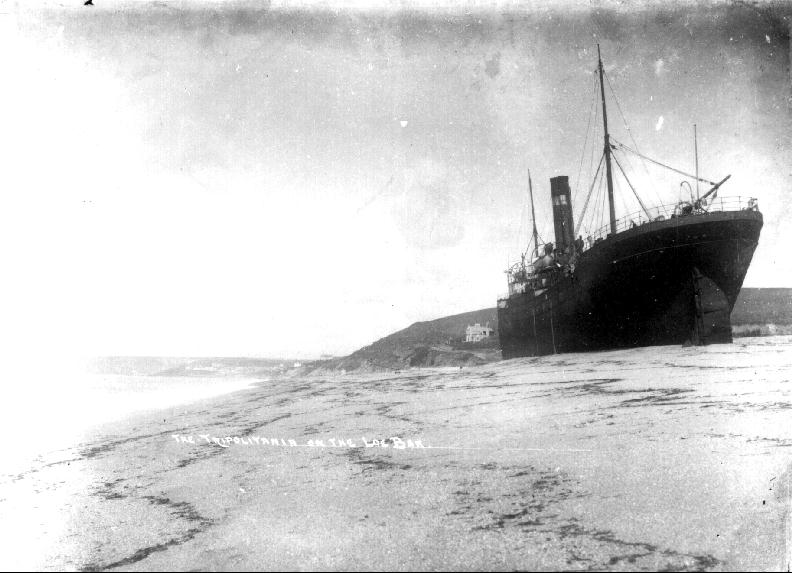
SS. Tripolitania The Calm After The Storm [4]

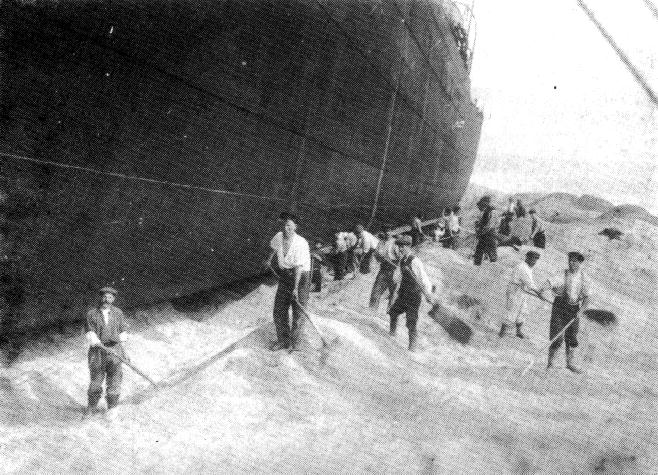
Once the storm was over, attempts were made to refloat the ship, by removing much of the shingle from the seaward side, but they failed. She was eventually scrapped in situ.

Digging out the SS Tripolitania PHOTO

Photo © Of the late W.F. Ivey and Graham Matthews (Grandson of W.F. Ivey) [5]

By the way, the meaning of the word ‘Abaft’ above, which I took to be a typing error means according to the Oxford Dictionary, “In or behind the stern of a ship” It is a nautical adverb. Plucky’ is an adjective meaning “Having or showing determined courage in the face of difficulties” Francis Bulford born 28 October 1884 died 25 March 1963 was my plucky Grandfather. RIP.

Follow this link to read another story of my Grandfather here:

/https://genealogyensemble.com/2018/10/10/all-in-a-days-work/

SOURCES:

[1] https://www.visitcornwall.com/beaches/west-cornwall/helston/loe-bar-beach

[2] Cornish Times Newspaper Clipping. In Possession Of The Bulford Family Archives

[3, 4, 5 ] http://www.helstonhistory.co.uk/w-f-iveys-shipwrecks/tripolitania/

[6] http://www.rnli-penleelifeboat.org.uk/About%20us/PastCoxswains

NOTES:

William Nicholls – Coxswain 1912-1915

Mr William Nicholls was appointed Coxswain on 3rd July 1912 and was the Coxswain of 2 reserve Penzance lifeboats. William was instrumental in the choice of the Janet Hoyle from the shipyard.

During his time on the Janet Hoyle, she launched twice in service, the first being an extremely dangerous mission to the SS TRIPOLITANIA on boxing day 1912.

In a letter, dated September 1959, Coxswain William NICHOLLS recalls the launch to S.S.TRIPOLITANIA as follows:

“My most arduous lifeboat service took place in 1912. On Boxing Day, at 8.00 am, the Coastguard called at my house in Penzance. He brought a message that a steamer was drifting disabled across the Bay. Neither the Sennen or Newlyn boats could go out, and so the message was passed to me. A strong gale (100 m.p.h) was raging; shop fronts at Penzance were blown in and boats overturned in the harbour, Penzance Pier Head being under water. At 8.30 the boat was in the water, all reefs taken in, and away. I have often thought of the appearance of the Bay when I rounded the pier head. The seas were pitiless, and the first one aboard completely filled the boat. I remember thinking that this was my last trip! I thrashed about 8 miles, opening up all the Western land, and then, seeing nothing of the ship, came about, and edged towards Porthleven, where the broken sea was worse. I was, from there, signalled by green rocket to ‘recall’  The vessel, S.S. TRIPOLITANIA, had gone ashore on Loe Bar, near Porthleven; and to judge the height of the seas, she was thrown at dead low water to twenty feet above high water. She remained there for years until broken up for scrap. There were only two lifeboats afloat on that day, my own, and the Plymouth boat, which was blown ashore in Jennycliff Bay inside the breakwater. The stemhead of my boat split from the planking, and the lovely paintwork smashed in spots into the drab first coat. She looked like a spotted leopard. Two of my men died on the following Thursday from pneumonia, which shows the terrible conditions we had to face on that service.”

Townships of Pontiac, Gatineau Counties, plus the Township of Hull

Prior to the arrival of the first European settlers, the area around the Gatineau hills of Quebec, north and west of Ottawa, was the home of the Anishnabe Algonquin First Nations people. Between about 1800 and 1900, western Quebec was settled by British, American, Irish Protestant, Scottish, Irish Catholic, French Canadian and Germanic families. The Germanic settlers had a strong presence in this region. To my knowledge, there were few Loyalists or Huguenots.

Prior to 1845, people and goods were transported primarily by barge along the Ottawa River, which separates Quebec and Ontario. The steamboat that operated on the Ottawa River between Montreal and Ottawa could not manage the rapids between Carillon and Grenville, so in 1854, the Carillon and Grenville Railway, a short 12-mile-long portage railway, was organized.

Prior to 1845, when they purchased land, finalized business deals or wrote their wills, the settlers of western Quebec likely dealt with notaries from Montreal, and perhaps those in Vaudreuil and Rigaud. The section of this compilation that lists notaries begins in 1845, since the Judicial District of Hull was a late-comer among judicial districts across the province.

Today, this region is well served by two superb archives and four regional genealogical societies. Contact details for all these places can be found in the attached compilation.

BAnQ Gatineau – Bibliothèque et Archives nationales du Québec

LAC – Library and Archives Canada, Ottawa

OGS – Ottawa Branch of the Ontario Genealogical Society

SGO – Société de généalogie de l’Outaouais

Gatineau Valley Historical Society

Pontiac Archives (genealogy society, located in Shawville, QC)

See: Townships of Pontiac and Gatineau Counties plus the the township of Hull

The contents of this 23-page compilation are as follows:

Page 1  the settlers (including farmers, businessmen, militia officers, politicians)

Page 3  the counties in 1791

Page 4  the townships in chronological sequence

Page 11 regional cemeteries

Page 13 Outaouais region (a list of cities, towns, villages)

Page 14 description of notarial records

Page 15 the notaries

Page 22 area archives and genealogical resource centres


Auntie Ann’s Second Sight

Second sight has a long tradition in Scotland, more particularly in the Highlands and among Irish Scots.  Scots are a superstitious people and many believe even today in the gift or curse of the second sight. 1 My family was Irish Scots and maybe this is why they believed that they had family members with this gift. The reason it is called the second sight is because the first sight is our normal vision that everyone has. Only some people are fortunate to have inherited the second sight. There are many Gaelic words for the second sight, the most common being An Da Sheallad, meaning two sights.2

My Auntie Ann always said that she had inherited the gift of premonition. She knew things before they were going to happen. She also claimed that she could ‘feel’ things about people.

“Such nonsense!” my mother would snort when we got back in the car after visiting Auntie Ann. Her sister-in-law always had a story or two about the times she could foresee the future or just knew something. I listened in open-mouthed wonder while my father squirmed uncomfortably. My mother held her tongue but I could feel her bristling with indignation.

One time Auntie Ann told a story that scared me for years. She was in her kitchen and she felt a cold shadow pass over her. She knew something terrible had happened and she learned later that a toddler had fallen to his death in the neighbourhood.

Another story that struck me was about Auntie Ann’s son, Tommy Smith, when he was overseas during World War II. He was injured in battle and she claims to have sat right up in bed because she knew he was going to be injured in the leg.  When I was little as I could easily imagine Auntie Ann sitting up in bed, terrified and unable to reach her son.

McHugh, Anne

There are detailed written accounts of incidents involving the second sight since the 17th century in Scotland. They have been collected by modern day folklorists and ethnographers. There are also many detailed descriptions about how the prophecy appeared to the person with the second sight. Sometimes they were able to see exactly what was going to happen. At other times, they saw symbols and interpreted them. Sometimes these visions were accompanied by smells and sounds.3

When I would ask my dad about Auntie Ann’s second sight, he would answer that Scots believe that this ability runs in families and that Auntie Ann was convinced that she had this gift. But I wanted to know whether my father believed it. I realize today that my father didn’t want to hurt his sister so he never really said one way or the other.

Ethnographers are sure that the second sight is an inherited ability.4 However, no one in our family has this ability now. And what would my mother say? “Hogwash!”


  1. McCain’s Corner, Barry McCain, blogger, The Second Sight Amongst the Scots Irish, July 17, 2015, https://barryrmccain.blogspot.com/2015/07/the-second-sight-among-scots-irish.html, accessed November 26, 2018
  2. Scotclans website, Prophecy, Scottish Second Sight, David McNicoll, February 2, 2012, https://www.scotclans.com/prophecy-scottish-second-sight/, accessed November 26, 2018
  3. Cohen, Shari Ann, Doctoral thesis abstract, Scottish tradition of second sight and other psychic experiences in families, University of Edinburg Research Archive, 1996, https://www.era.lib.ed.ac.uk/handle/1842/9674, accessed November 26, 2018

Research Help for French Louisiana Sources

There were strong ties between Quebec and Louisiana in the 18th century. Louisiana was then part of New France, having been established by the French to block the British from expanding their influence westward in North America.

Many settlers who went to the southern part of the United States originated from the same regions in France as the French Canadians and the Acadians. But few Quebec historians or genealogists have focused on the links between the families of New France and those who settled in Louisiana.

An example of someone with personal links to both places was Pierre de Rigaud de Vaudreuil de Cavagnial, Marquis de Vaudreuil (1698-1778). His father was of noble descent, from the Languedoc region of France, and Pierre was born at Quebec, where his father served as governor-general of New France. Pierre served as governor of Louisiana from 1742 to 1753, and he was the last governor-general of New France, between 1755 and 1760.

Historian Mélanie Lamotte wrote an article about primary sources in North America and France for the early modern history of Louisiana when she was studying at the Cambridge University in the U.K. She currently teaches at Stanford University, and her  Stanford website describes this article, “A Guide to Early Modern French Louisiana Sources” as providing “much-needed guidance on identifying and using French Louisiana sources. It lists the sources available and investigates their nature, details of access, state of preservation, as well as their state of digitization. It also suggests potential uses and interpretations that might be gleaned from such source material.”

You can download Lamotte’s 26-page guide from either of these two sites:

http://stanford.academia.edu/M%C3%A9lanieLamotte

https://www.repository.cam.ac.uk/bitstream/handle/1810/260104/Lamotte-2016-Collections_A_Journal_for_Museum_and_Archives_Professionals-VoR.pdf?sequence=1