Category Archives: Genealogy

Boy Soldier of the Great War

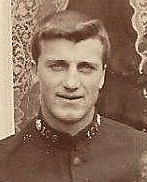
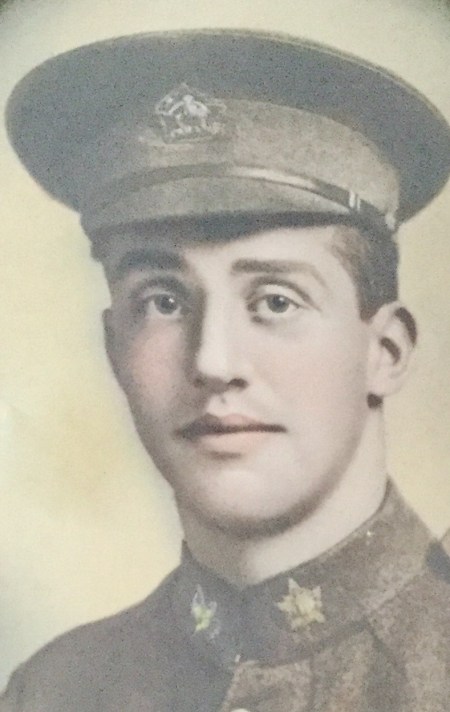
Every year in Ottawa two weeks before Remembrance Day, virtual poppies rain down the Peace Tower nightly to remember those who gave their life for Canada. This year, the 100th anniversary of World War I, the poppies are especially significant. One poppy falls for Private Lloyd William Tarrant, a soldier of that war and my son’s great uncle.

IMG_3336Private Tarrant was born on January 9, 1896 according to the Attestation papers he signed in Magog, Quebec before joining the Canadian Overseas Expeditionary Force. 1 That made him nineteen years old, the legal age for enlistment. Family legend claims he lied about his age and was actually eighteen. A medical record found in his file supports an 1897 birth date, as does an old scrapbook of family records. No birth certificate was required in order to enlist. 2

Lloyd’s parents were James Tarrant and Mabel Hawley from the farming community of Bury in Quebec’s Eastern Townships. He had a sister Edith and three brothers, Laurence, Kenneth and Nelson. Their father ran a construction company made famous for its dams and bridges. 2 Lloyd listed himself as being employed as a clerk but did not state where. 1

Whether eighteen or nineteen, Lloyd was still a boy, a boy soldier sent off to do the work of a man. Between 15,000 and 20,000 underage youths signed up to fight in Canada’s armed forces in WW I. They served in the trenches alongside their elders and fought in all the major battles: Ypres, the Somme, Vimy Ridge, and Passchendaele. Many were injured; many, many more died. 3

Why did they enlist? Patriotism perhaps, but also adventure, pressure from friends or recruiters, escape from an unrewarding job or a steady paycheque of $7/day. In August 1914, when the fighting started, it was widely thought that the war would be over by Christmas. A short trip overseas might be a lark. 3

Lloyd joined the 5th Canadian Mounted Rifles out of Sherbrooke. He trained briefly at Camp Val Cartier before his unit sailed for England on July 18, 1915. His service file states that Lloyd landed in France three months later on October 24th, 1915 but records nothing in-between. The Mounted Rifles joined the 8th infantry brigade of the 3rd Canadian Division. From October 1915 to the beginning of June 1916, it would seem Lloyd fought in the trenches of France and Belgium. 1

June 2nd, 9016 found the 3rd Canadian Division at Mount Sorrell, a strategic 30 metre high hill in Belgium’s Ypres Salient. The hill overlooked an important road between the city of Ypres and the town of Menin. Heavy rain and constant shelling left the ground a soggy mess of craters with horses and men blasted apart by artillery and the injured drowning in mud. The Germans also attacked from below, detonating mines they had dug beneath Canadians positions.

The men were nothing but fodder for the enemy. One can hardly imagine the horror and terror Lloyd experienced as he pushed forward through the explosions, flying shrapnel and falling bodies.

German forces soon captured Mount Sorrel and the nearby peaks of Hill 61 and Hill 62. They were then well positioned to attack the city of Ypres itself.

It was not until June 13th that Canadian and British soldiers were able to recapture Mount Sorrel. It came at great cost. Between June 2nd and June 14th, one thousand Canadian soldiers were killed with more than two thousand men missing. Thousands more were injured. Still others were taken prisoners of war and sent to Germany where they endured years of abuse. 4

Lloyd’s story ends here, at Mount Sorrel.

His file, covering less than a year of service, describes his death as “killed in action between June 2nd and June 3rd, 1916, aged 19”. 1 Was he killed instantly or did he suffer while holding unto hope that a medic would reach him before he bled out?

Unlike so many others, his body was eventually found and identified. He was buried, and later reburied, at Bedford House Cemetery (enclosure 4) in Belgium where he lies today. The last few pages of his scant 34 page service file cover the back-pay sent to his mother along with the Mons Star medal for early volunteer enlistment and the star awarded to every dead soldier, man or boy. 1


  1. Tarrant, Lloyd William Digitized service file – PDF format: B9504-SO52. Library and Archives Canada
  2. Family scrapbook compiled by Kim Tarrant Galley, great niece of Lloyd William Tarrant
  3. Black, Dan and John Boileau. Old Enough to Fight: Canada’s Boy Soldiers in the First World War. John Lorimer Company Ltd., Publishers. Toronto, 2013.
  4. Greenhous, Brereton and Jon Tattrie. “​Battle of Mount Sorrel”. The Canadian Encyclopedia, 12 September 2014, Historica Canada. https://www.thecanadianencyclopedia.ca/en/article/mont-sorrel. Accessed 24 November 2018.

Seigneuries of Lanaudière, including Regional Notaries and Cemeteries

This region, on the north shore of the St. Lawrence River between Trois-Rivières and Montreal, is unknown to most North Americans except for those who had ancestors there.

The Elliotts were one well-known Lanaudière family. Through Grace Elliott Trudeau (1880-1973), Robert Elliot was an ancestor of former Prime Minister Pierre Elliott Trudeau and of current Prime Minister Justin Trudeau. Robert Elliott was born in Scotland in 1762 and settled in the Lanaudière area. His funeral service was held on April 17, 1810 at the Anglican Church in Trois-Rivières, and he was buried two days later in Maskinongé County, in the Protestant Cemetery of Saint-Gabriel-de-Brandon.

The Lanaudière region was settled by French Canadian, Acadian, British, Irish Catholic, Irish Protestant, Germanic, American and Eastern Europe families, including a few Loyalists in the Saint-Gabriel-de-Brandon, Louiseville and Yamachiche regions.

The Acadian families who came here had originally been deported to Massachusetts. In August 1766, they accepted the offer of Governor James Murray to come to Quebec. A large number of these Acadians were assigned pristine lands in the Lanaudière region.

One has only to review the list of seigneurs at the beginning of this research guide to realize the importance of the military in this region. Senior and junior officers, non-commissioned officers and soldiers of the Régiment Carignan-Salières (1665-1669), as well as officers and soldiers of the 28 Compagnies Franches de la Marine en Nouvelle-France (1622-1761) were granted lands in Lanaudière. During the 17th and 18th centuries, it was common for officers and soldiers to request land in New France after their tour of duty was completed. In 1665 about one third of the 1,200 soldiers and officers of the Régiment Carignan-Salières requested lands in various regions of New France.

Here is a link to the PFD research guide: Seigneuries of Lanaudière

In this compilation, you will find:

  1.  p. 1 Seigneurs and military regiments
  2. p. 11 Seigneuries in the current counties of Berthier, Joliette, L’Achigan, L’Assomption, Maskinongé, Montcalm
  3. p. 39 Cemeteries
  4. p. 40 Notaries practising in the area, 1712-1916
  5. p. 76 Articles and resources on the Acadians, Irish, Germans and Loyalists.
  6. p. 77 Repositories in Quebec and France

(corrected and updated Nov. 26, 2018)

The Kings’ Daughters: They came to populate New France*

As she boarded the great ship Phoénix de Flessingue in May 1663, Catherine Barré knew she would never return to her hometown of La Rochelle, France.

Did she worry about the ship sinking? Would pirates attack during the six-week journey overseas? What kind of life did she imagine might be waiting for her in New France? How could she agree to marry a man, Maurice Rivet, sight unseen? Did she wonder what their life raising a family together might be like?

I am among Catherine’s 12th generation descendants from my father’s side. Thinking about her courage and resiliency gives me strength, even as I notice myself sharing her impulsive faith-led need to act, sometimes with less information than is desirable.

Despite that flaw, Catherine’s life seems to have worked out, with a few major hiccups.

Escape to New France

Her first hiccup made her choose to be a pawn in King Louis X1V’s scheme to populate New France. In exchange for her agreement to marry and raise a family, she received 10 pounds for her own use, 30 pounds for clothing and grooming paraphernalia and free passage overseas at a cost of 60 pounds.[1]

Today, she’s known as a “King’s Daughter.” More than 800 women travelled to New France during the decade beginning in 1663.

Catherine was among the first women who chose to travel to New France under the sponsorship of her king, but 262 other women made similar choices in the previous three decades. The private “Company of 100 Associates” sponsored them.

Why did these women choose to leave everything they knew in France? We don’t know.

In Catherine’s case, however, it seems likely that she faced persecution due to her religion. Abjuration records place her among thirteen Protestants sent to New France from La Rochelle.[2]

Huguenot Persecution

During this period, the practice of Protestantism by people called the Huguenots was discouraged in France, although not yet illegal. The peace set up by King Henry IV’s Edict of Nantes became eroded over time until his grandson King Louis XIV revoked it in 1685, removing religious freedom entirely. Bishops in New France begged French Finance Minister Jean-Baptiste Colbert to expel the Protestants from the colony as well, but he wouldn’t do it. Many Huguenots were literate craftsmen and business owners who were needed in New France. Also, sending Huguenots overseas eliminated their influence in France. There were no regulations against Huguenot worship in New France until 1676.

Whatever the reason for her departure from France, the daughter of Jean Barré and Marie Epy arrived in Quebec City on June 30, 1663, aboard the Phoénix.

How to Select a Suitor?

She may have had to take a boat ride down the St. Lawrence, stopping from town to town to meet eligible bachelors,[3] although since she was already betrothed, that may not have been necessary. It sounds like a bizarre 15th-century version of speed-dating.

In addition to eventually renouncing her religion, Catherine also renounced the initial man she chose to wed. Or perhaps he renounced her, although that is less likely. Whichever the case, Duquet annulled the contract between Catherine and Maurice Rivet on November 17, 1664.[4]

Vachon wrote a contract between Catherine and Mathurin Chaillé on December 30, 1664.[5]

Marriage Contracts Prior to the Wedding

During this period, all couples signed marriage contracts prior to their church weddings, as Suzanne Boivin Sommerville pointed out in her comment about this story here. She wrote:

“A marriage contract is a legal _promise_ to marry as soon as possible in the Holy, Roman, and Apostolic Catholic Church. It was not the sacrament and legal act of marriage. It could be, and often was, annulled before any religious rite took place. Some women annulled more than one contract before settling on a husband…prospective spouses were the ones to cancel the contract, even at the advice of witnesses or family, not the Church.”[6]

Catherin married Mathurin Chaillé on January 11, 1665 “as soon as could be allowed after the Seasons of Advent and Christmas” wrote Boivin Sommerville.

Boivin Sommerville has prepared a wonderful PowerPoint presentation and several blog posts about the culture and norms in early New France on the French Canadian Heritage Society of Michigan website. Her work is well-worth-reading.

Catherine and Mathurin had their first child, a son nine months after their wedding.

Jean Barré Chaillé

My direct relative was their fourth child, Jean Barré Chaillé. He came along nine years later in 1674. By then the family lived in Sillery after being evicted from their farm on the seigneurie of Beauport.[7]

The couple had six children in total. One son died at 10 years old, but the rest married and had families of their own.

Three of the families lived in Portneuf near their parents, but my ancestor Jean and his brother Henri moved to Montreal. I like to imagine Catherine and her husband Mathurin visiting them on occasion, but haven’t yet found evidence of that.

Summer Deaths

Both Catherine and her husband Mathurin died within a week of each other in the summer of 1707. She was 63 years old. There were record-breaking heatwaves in England and France in July[8], when the couple died, so I wonder if something similar happened in Quebec to cause their deaths?

NOTE:

*I have updated this story based on comments by Suzanne Boivin Sommerville, who has prepared a wonderful PowerPoint presentation and several blog posts about the culture and norms in early New France on the French Canadian Heritage Society of Michigan website. Boivin Sommerville made several points about my errors in her wonderfully-detailed comment about my story here. Yes, Suzanne, you’re right, the initial version of this story didn’t make the difference between a marriage contract and a legal marriage clear, even though I do understand that there was a difference and that women had the right to cancel contracts they made prior to meeting their intended betrothed. Also, there is no indication of why she chose not to marry Rivet. I apologize that it’s taken me so long to update the piece as you so rightly suggested.

Footnotes

[1] Gousse, S., & Wien, T. (n.d.). Filles du Roi. Retrieved from https://www.thecanadianencyclopedia.ca/en/article/filles-du-roi/ on July 18, 2018.

[2] Dawson, Nelson-M. “The “Filles Du Roy” Sent to New France: Protestant, Prostitute or Both?” Historical Reflections / Réflexions Historiques 16, no. 1 (1989): 55-77. http://www.jstor.org/stable/41298906, p64.

[3] Most French Canadians are descended from these 800 women | CBC Canada 2017. (2017, March 30). Retrieved from https://www.cbc.ca/2017/canadathestoryofus/most-french-canadians-are-descended-from-these-800-women-1.4029699 on July 18, 2018.

[4] Inventaire des contrats de mariage du Régime français conservés aux Archives judiciaires de Québec, Volume 1, Roy, Pierre-Georges, 1870-1953 Québec, 1937-1938, p85.

[5]Dee, E. (n.d.). The Families of Beauport – The Chailles. Retrieved from http://www.oocities.org/weallcamefromsomewhere/Beauport/chaille_family.html on July 18, 2018.

[6] Boivin Sommerville, Suzanne, comments about this story here. Boivin Sommerville has prepared a wonderful PowerPoint presentation and several blog posts about the culture and norms in early New France on the French Canadian Heritage Society of Michigan website.

[7] Dee, ibid.

[8] Maruske, James. A Chronological Listing of Early Weather Events retrieved from https://wattsupwiththat.files.wordpress.com/2011/09/weather1.pdf, on 2018.


Patrimoine Québec — a Genealogical Library

If you are interested in learning more about the history and people of New France, Acadia and Québec, a collection of more than 300 digitized books on these subjects might be of interest to you. There are two problems with this collection: all the books are in French, and it is not easy to navigate the site. Nevertheless, it is worth persisting, especially if you are a genealogist or have a background in history or archives.

This free virtual library is continually growing. The books, available as PDFs, can be found at www.patrimoinequebec.ca/bibliotheque/propos.php

The online collection focuses on genealogy. It includes family biographies, dictionaries in alphabetical order by various authors addressing families of Nouvelle-France and Québec, genealogical dictionaries, historical men and women from the 16th century onward of Nouvelle-France and Québec, family lineages, and descriptions of online collections, historical villages, towns and cities of Quebec.

A collection on the site that is of special interest to genealogists is called Registre Cadastrale (cadastral registry). These volumes list the seigneuries and their owners, the rangs (roads) in each seigneurie, the names of the censitaires (tenants), the amount of land each tenant held and the annual rent.

Two unique online dossiers address the content of the various fonds (collections) at BAnQ (Bibliothèque et Archives nationales du Québec) and their 12 repositories, namely: Rapport de l’Archiviste du Québec and Collectif des Archives de Québec.

To explore the collection and search the Patrimoine Québec (heritage Quebec) website, go to http://www.patrimoinequebec.ca/

You can use free online translation tools such as Google Translate, or the DeepL Translator (https://www.deepl.com/en/translator) to translate the texts. The site’s home page is available in English translation at http://www.patrimoinequebec.ca/library/.


Timothy Stanley and Hartford’s Ancient Burying Ground

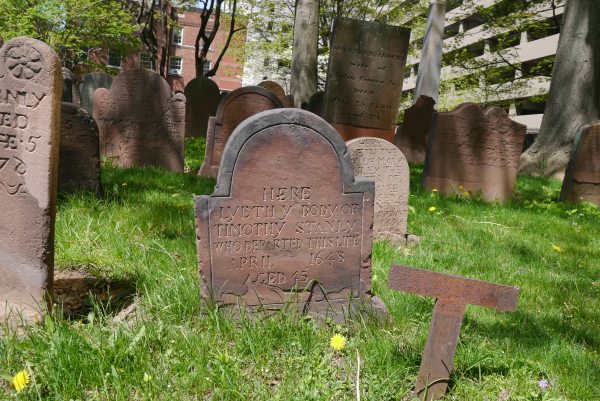
The Ancient Burying Ground of Hartford, Connecticut,1 one of America’s oldest cemeteries, is tucked  beside a historic downtown church2 and surrounded by insurance company office towers and state government buildings. This is the final resting place of many of the city’s founding settlers, and a tall monument lists their names.3 Several, including Bull, Bunce and Mygatt, are on my family tree, but it is the name Stanley that interests me most. Hartford settlers Timothy Stanley (c. 1603-1648) and his wife Elizabeth (c 1602-1678) were my direct immigrant ancestors.

Three brothers, John, Thomas, and Timothy Stanley, with their wives and children, set sail for the new world from England in 1634. They were part of a wave of strongly religious Puritan settlers who came to New England because they disagreed with the Church of England.

Their father, Robert Standly (c 1570-1605), was a whitesmith (meaning he made things out of metal) in Tenterden, Kent, in the southeast of England.4 Their mother’s name was probably Ruth. It could not have been an easy voyage for this extended family because John, the eldest of the brothers, died at sea, leaving his young children to be raised by Thomas and Timothy.

The Stanley family spent about two years in Cambridge, Massachusetts where Timothy was granted six acres of land and was named a freeman and admitted as a member of the Congregational church.5

Timothy Stanley’s grave. (photo by Janice Hamilton)

Some Cambridge residents complained that there wasn’t enough land for all the new settlers. Then, after Pastor Thomas Hooker had a dispute with Massachusetts Bay Colony governor John Winthrop, Hooker and about 100 parishioners followed the old Indian trails south to the spot on the Connecticut River (also known as the Great River) that became Hartford.6

Timothy Stanley quickly established himself as a farmer, and when a land inventory was taken in 1639, he held nine parcels of land of varying sizes. His house lot, including outhouses and gardens, was about two acres, on the west side of Front Street and with a view of the river. Later, he also bought property in Farmington, CT, about 10 miles away.

The Stanley house was described in 1670 as follows: “It is a small, two-storey building, having on the first floor only the hall and “kitchinn”, the latter serving alike for a cook-room, living-room and parlor. Meager enough is the furniture: a deal table with a “form” or bench for sitting upon at meals, and standing in winter before the great open fireplace….. Such a luxury as a carpet is unknown.”7

Timothy and his wife Elizabeth (whose maiden name is unknown) had seven children. The two eldest, Joseph and Timothy, were born in England; both died very young. Elizabeth, Abigail, Caleb (my direct ancestor), Lois and Isaac were all born in Hartford.8 Timothy also raised his niece Ruth.

Timothy was active in the community. He served on several juries, he served as a Hartford selectman (town official) and was on a committee to distribute land.

As Puritans, their religious beliefs were central to their lives. Puritans believed that man was inherently sinful. Even though they were unworthy, God chose to save some people and to send others to hell, and there was nothing anyone could do to change this. They believed everything happened for a reason. Meanwhile, the Puritans believed in hard work, and in the importance of education.9

Timothy died in April, 1648, at age 45. The inventory of his estate, taken on Oct 16, 1648, totalled £332, of which £167 represented the value of his real estate. The inventory counted household goods such as a bedstead and pillows, a hall chest, kettles and dishes, several books, a warming pan and two muskets. The farm animals included six oxen, several cows, a horse, sheep, pigs and bees.10  The court ordered that all his children be awarded something from his estate, while the house and lands in Hartford went to son Caleb.

In 1661, the widowed Elizabeth married Andrew Bacon and she inherited Andrew’s land in Hadley, MA when he died eight years later. By 1671, when she made out her will, she had returned to Hartford to stay with son Caleb’s family. Elizabeth Bacon died in 1678, around age 76.

While many of Hartford’s early settlers moved to other Connecticut towns, my ancestors stayed in Hartford for several generations. Eventually, great-grandson Timothy Stanley moved to Harwinton, CT and then to Wethersfield, and his son, Timothy Jr., settled in Litchfield, CT. Perhaps there are more family graves waiting to be found in Connecticut.

This article is also published on my family history blog Writing Up the Ancestors, http://writinguptheancestors.blogspot.com. 

See also:

“The Elusive Pamela Stanley,” Writing Up the Ancestors, Sept. 28, 2018, http://writinguptheancestors.blogspot.com/2018/09/the-elusive-pamela-stanley.html

“Timothy Stanley Jr., Revolutionary Martyr,” Writing Up the Ancestors, Nov. 15, 2013, http://writinguptheancestors.blogspot.com/2013/11/timothy-stanley-jr-revolutionary-martyr.html

“My Line in the Stanley Family,” Writing Up the Ancestors, Oct. 30, 2018, http://writinguptheancestors.blogspot.com/2018/10/my-line-in-stanley-family.html

Sources:

  1. Ancient Burying Ground http://theancientburyingground.org/
  2. First Church of Christ in Hartford, established 1632 www.centerchurchhartford.org/about.history.asp
  3. Society of the Descendants of the Founders of Hartford, www.foundersofhartford.org
  4. Leslie Mahler, “Re-Examining the English Origin of the Stanley Brothers of Hartford, Connecticut: A Case of Invented Records,” The American Genealogist, vol. 80, July, 2005, p. 218. http://www.Americanancestors.org, accessed July 24, 2013.
  5. Robert Charles Anderson, The Great Migration: Immigrants to New England, series 2, vol. VI, Boston: New England Historic Genealogical Society, 2009.  463.
  6. David M. Roth, Connecticut: A History. American Association for State and Local History, New York: W. W. Norton & Co., 1979, 39.
  7. Israel P. Warren, compiler. The Stanley Families of America as descended from John, Timothy and Thomas Stanley of Hartford, CT, 1636. Portland, Maine: printed by B. Thurston & Co., 1887, 228.
  8. Anderson, 465.
  9. Francis J. Bremer, Puritanism: A Very Short Introduction, New York: Oxford University Press, 2009, 43.
  10. Warren, 226.

Seigneuries of the Richelieu River Valley

The PDF research guide linked below explores the seigneuries of the Richelieu River Valley, south-east of Montreal. This compilation includes the seigneuries, cemeteries and notaries of the area, including present-day Chambly, Iberville, Napierville, Longueuil, Lacolle, St. Hyacinthe, Yamaska, La Prairie and Sorel.

This region was established by officers and soldiers of the Carignan-Salières regiment. French Canadian, Acadian, Loyalist, British, non-Loyalist American, Scottish, Irish, Germanic and Dutch families were present in the Richelieu River Valley from about 1636 to 1899.

After the British Conquest of New France and the American Revolution, large numbers of Loyalists sailed north in Lake Champlain and along the Richelieu River to settle in Missisquoi Bay, the Upper Richelieu near the Vermont-New York State border, St. Johns (St-Jean-sur-Richelieu), Chambly, Sorel and Saint-Ours. They also crossed the St. Lawrence River from Sorel and put down roots in Machiche (Yamachiche), Louiseville, Saint-Cuthbert, Maskinongé and Trois-Rivières.

Between 1669 and 1899, many notaries established careers in the Richelieu River Valley. They recorded land transactions and rental agreements, wills, marriage contracts, protests and other legal documents for the residents. As of 2018, about 70 percent of the notarial records made in this region can be found online, either on the Bibliotheque et Archives nationales du Quebec site (BAnQ.qc.ca), Ancestry.com with two online databases (1647-1942 & 1637-1935), Genealogy Quebec (Drouin Institute), or FamilySearch.org.

On the last page of the attached research guide, I have listed research assistance services offered by BAnQ Montréal under the heading BAnQ Ask a question. If you fill out the detailed questionnaire in English, you should receive a reply in English within 48 hours. Downloads of Notarial Acts at the BAnQ are free.

Here is the link to this PDF: Seigneuries of the Richelieu River Valley

This research guide includes:

p. 1 Introduction to the area and the Carignan-Salières regiment

p. 1. Seigneurs of the area

p. 3. The seigneuries including Beloeil, Carignan, Chambly, Lacolle, Longueil, St. Hyacinthe, Yamaska, La Prairie, Sorel.

p. 23 Regional cemeteries in Chambly, Iberville, Napierville, Monteregie, St. Hyacinthe, St. Jean-sur-Richelieu, Yamaska

p. 24. The notaries: the locations and years they practiced, from 1669 to 1957.

p. 80. Links to archives.

Thinking about my Filles du Roi Ancestors


mapancestry

Filles du Roi: Mothers of Millions. According to a map on my Ancestry DNA page, these orange dots are where French Settlers of the St. Lawrence ended up by 1900. 1


“Women’s work consists of household work and feeding and caring for the cattle; for there are few female servants; so that wives are obliged to do their own housework; nevertheless, those who have the means employ valets who do the work of maidservants.”


So, begins and ends the one paragraph devoted to women’s work in Pierre Boucher’s seminal book Canada in the 17th Century. 2 In fact,  Boucher spends more time in his book describing native women and their unusual ways than he does describing these pioneering French women. He either thought women’s work too obvious to detail or he didn’t actually know much about it.

This is a problem for writers like me who desire to write a story about their filles du roi ancestors. There’s little information out there about them that is not statistical, transactional, or speculative.3 In my case, I wanted to write about Francoise Boivin, whom I have at least twice in my mother’s tree. According to Nos Origines, Francoise, who gave birth to eight children, has around 700,000 to one million descendants.

Boivin is especially interesting because there appears to be some question as to whether she was, indeed, a genuine fille du roi; whether she married her husband Louis Lamoureux twice, once in France and once in Quebec, and whether she was an orphan, like so many of these women, or she came to New France with both her parents.

So, fun stuff.

Suzanne Desrochers, a York University scholar, used her 2007 Master’s thesis to explore the challenges involved in researching background about the filles du roi.  Desrochers, too, wanted to write an historical fiction piece about such an ancestor, but was stymied by the lack of evidence.

“In Quebec,” she writes, “ the 17th century belongs to religious figures or saintly women such as Marie de l’Incarnation, Marguerite Bourgeoys and Jeanne Mance while virtually no biographies of lay women exist.”4

Also, no records were kept in France  side with regard to filles du roi emigrations, and the story of women in France in that era is undocumented, too.

Historian James B. Collins*5 investigated this issue in an article he wrote in 1989. By digging through wills and notarial records he uncovered a paradox of sorts: French women had fewer public rights in the 17th century compared to before and afterwards but some of them had economic clout in the private sphere.

This is because wives’ sidelines were often what kept a poorer family afloat. These sidelines often involved the producing of alcoholic beverages like cider and wine, activities Boucher doesn’t describe in his book. One wonders, did some of these women transfer these lucrative skills to New France?

In her thesis, Desrochers suggests that women in New France, by virtue of their rarity, probably enjoyed higher status than their equivalents back home where women outnumbered men, but nothing can be proved. It would be nice to think it was so, wouldn’t it? This would be a perk, perhaps, to make up for the fact that Canadian women back then gave birth on the cold floor, even in the dead of the  winter, so as not to soil the family bed.

Whatever the humble origins of most filles du roi in France, 6 these female pioneers produced more progeny and were longer lived than their sisters back in Normandy and the Ile de Paris. This fact alone suggests that life in the New World was better than in France. Or at least the food was better.7

And, it is unlikely that these filles du roi had been prostitutes prior to emigration, despite all the longstanding rumours to the effect. Prostitutes were afflicted with venereal disease that leads to infertility – and these filles du roi, mothers of millions of North Americans, were anything but infertile.8

_

Notes and Resources

(Thanks to Claire Lindell for lending me her books on Les Filles du Roi)


  • 1. According to Peter J. Gagné in King’s Daughters and Founding Mothers, a true fille du roi is one of the ‘girls, women, or widows who went to Canada at the expense of the King in convoys recruited and conducted by French authorities, who were established in Canada by the Intendant and who received at marriage a King’s gift of 50 livres for commoners and 100 livres for demoiselles and sometimes, (but rarely) even more.’ P. 42.  Gagné’s meaty two volume set contains extensive bios about each fille du roi, and a lengthy introduction revealing, for instance, the clothing in the ‘trousseau’ given each King’s Daughter and the conditions of the ocean voyage they had to endure. (All information is gleaned from bits and pieces of evidence out of New France.) It is said that while waiting for husbands in New France, these fille du roi were taught cooking, needlework, knitting and how to make home remedies. Still, there is only speculation as to the truth of these women’s  lives: their particular origins, circumstances, hopes, fears and motivations.  These females are spoken of, for the most part, as commodities. An example: the introduction contains an anecdote claiming that the future husbands preferred, for practical reason, fatter girls over the thin pretty ones, rural girls over city girls. At the same time, it is assumed any fille du roi was in the driver’s seat with respect to courtship, because, by contract, she could turn down any marriage proposal.  One line in Gagné’s book is especially irksome. An observer who has met two young filles du roi claims that their personal stories are such, they would fill novels, but he gives no further details. What a missed opportunity! This is exactly what everyone today is looking for!


  • 2. Boucher, Pierre, Canada in the 17th Century. Translated by Edward Louis Montizambert. Archive.org.


  • 3. Nos Origines at nosorigines.qc.ca has Francoise (born 1646) marrying Louis Lamoureux, Quebec born, in New France, although it is indicated that no record of their marriage can be found. Other sources claim that the couple married in France. Could the Boivins have been Protestants from Rouen? Protestants hid among the emigrants to New France and converted to Catholicism upon arrival. (Leslie Choquette)


  • 4. Desrochers, Suzanne. Women of their Time: Writing Historical Fiction on the Filles du Roi of 17th Century New France. York University, 2007. Electronic thesis available at the Theses Portal, Library and Archives Canada.


  • 5. Collins, James, B. The Economic Role of Women in 17th Century France. French Historical Studies. Volume 16. No. 2 Autumn. 1989.


  • 6. According to Desrochers, it is estimated that 1/3 of the filles du roi came from La Salpêtrière, a Jesuit-run Paris hospital/workhouse for orphans and widows and other unfortunates including young and older women ‘of good moral character’ who  were trained in the household arts and likely forced to emigrate to New France and other French colonies like Martinique. Desrochers wonders whether the fille du roi immigration was voluntary. Records indicate that many French men of similar backgrounds who emigrated to New France in the 1600s did not stay, but the filles du roi mostly stayed. Gagné claims that around 50 filles du roi returned to France.


  • 7. Choquette, Leslie. Frenchman into Peasants: Modernity and Tradition in the Peopling of French North America. (Copyright American Antiquarian Society) includes a 1684 quote from army officer La Hontan. “The peasants here are very comfortable and I would wish such a good cuisine on the whole petty nobility of France…They hunt and fish freely. In a word, they are rich.”


  • 8. Landry, Yves. Les Filles du roi au XVIIe siècle. Bibliotheque Quebecois. This is a topic of great debate among historians, whether these ladies were filles du roi or filles de joie. Desrochers says there is no way to tell. The VD theory is postulated by Yves Landry in his book, where he cites statistics about fille du roi fertility and longevity. It is important to note that families in New France were offered financial bonuses for having a slew of children.


Census Results for New France Online

If you think the census is a modern invention, think again. The Nouvelle-France.org collection of archival treasures includes a number of censuses taken in New France. They can be found on the New France Archives site http://nouvelle-france.org by searching for recensements (censuses). The search brings you to this page: http://nouvelle-france.org/eng/Pages/list.aspx?k=Recensements&

This database includes 265 population census returns of New France (Nouvelle-France) and Acadia (Acadie). All are digitized versions of the original documents. Beyond 1760, the census results include pockets of former French citizens in small regions of Quebec or in the Maritime Provinces. The 1756-09-27 census (database item 12496) addresses the Acadian refugees on Ïle-St-Jean, which is present-day Prince Edward Island.

These documents have not been indexed so you will have to browse through them to find your own ancestors, but they are fun to look at. It helps if you have at least a rudimentary French vocabulary, and the beautiful old handwriting is an additional challenge, or bonus, depending on how you look at it. If you have difficulty reading it, try this website on paleography, the study of handwriting: https://paleography.library.utoronto.ca/

For example, database item number 30692, is a census of Canada, including the Quebec City area, Montreal and Trois-Rivières, taken in 1666, and stored today at the Archives nationales d’outre-mer (the Overseas National Archives) in France.


On the first page of this document, you will see an entry for a habitant family. The heading reads Quallitez et Mestiers, or quality (meaning discerning) and trade or occupation. The first family is that of Estienne Racine (Estienne or Etienne means Steven) habitant (tenant farmer), age 59, his wife (sa femme), his sons (fils) and daughters (fille.) and a hired domestic. Many of the other people counted in this census were members of religious orders.

The New France Archives project brings together digitized results from four archives in France and Canada: Library Archives Canada/Bibliothèque et Archives Canada, A.N.O.N Archives nationales d’outre-mer (France), Archives nationales (France) and BAnQ Bibliothèque et Archives nationales du Québec.


Further Information is Being Withheld

Davison Sutherland, my grandfather’s cousin’s life was entwined with the city of Toronto. He was born there, went to Jarvis Collegiate, obtained an engineering degree from the University of Toronto and then worked for the city his whole career.

“Dave Sutherland – born A.D. 1887 and still existent. Owing to the fact that a complete biography is being compiled against the day of his demise, further information is being withheld.”

This, his biography in the Torontoensis 1913, the University of Toronto Yearbook showed a quirky sense of humour.

Davison served in the military during World War One. He signed up in 1916 as a Lieutenant in the 208th Canadian Irish Battalion but later that year resigned his commission and sailed to England to join the Royal Flying Corps (RFC). He served in battle from Nieuport to Dixmude in Belgium and Arras to St Quentin in France with the 24th Squadron of the RFC, 14th wing. He was also an instructor in aerial fighting until 1918 and was discharged February 1919 with the rank of Captain.

He was the youngest surviving son of William Sutherland and Jessie Johnston. His father died in 1914 and his mother in 1916. He was then the man of the house, 21 Rose Street, Toronto. He lived there with his maiden sisters except during his service in WWI. Agnes died in 1920, Isabel in 1924 and Jessie left when she married Howard Reive in 1925. A fourth sister Annie, had moved to the United States as had his older brother William. Mowat, the youngest died as a baby.

Davison was 40 and finally free of family obligations when he married Edna Michel and soon had two children, Barbara and William Davison.

He worked for the city of Toronto as a roadway engineer, a city manager and from 1946 as deputy city engineer. His expertise was called upon when the rivers flooded and the roads and bridges were at risk or when water mains burst. He was known as a conscientious, faithful employee and one of the most reliable and respected civil servants. He would often get out of bed in the middle of the night to turn on the water for a pensioner or to help other people in distress.

In 1957 he was acting chief engineer. The Mayor, Nathan Phillips, did not want him promoted to Chief Engineer as he was due to retire in October, only six month away. The Mayor thought that an increase in salary and the resulting pension increase ( $15 per year) for a 40-year employee was unjustified. It would be a needless spending of taxpayers money. The board initially voted down the promotion and the Toronto Star said it was because of a vendetta between Mayor Nathan Phillips and Controller Jean Newman, with Davison, a pawn. He did though get promoted. Then in May 1957, all department chiefs got a 10% raise and it was recorded that Davison Sutherland’s salary went from $12,400 to $13,600. Concern about the extra cost of his pension to the city taxpayers became a moot point as he died before his retirement date.

His obituary in the paper July 7, 1957, was not very long and so, much information about Davison and his life is still being withheld.

Notes:

“Eastern Ave. Crossings Called Most Dangerous.” Toronto Daily Star 12 Mar. 1957: 21. Print.

“Needless Spending of Taxpayer Money.” Toronto Daily Star 1 May 1957: 4. Print.

“Charge Philips Brand Vendetta against Jean Making Goat of Worker.” Toronto Daily Star 2 May 1957: 1. Print.

“Dave Sutherland City Engineer Dies.” Toronto Daily Star 8 July 1957: 8. Print.

Davison Sutherland.” Roll of Service, University of Toronto Archives January 14, 1920.

Torontonensis 1913 Yearbook pg. 161 https://archive.org/details/torontonensis13univ

Seigneuries, Notaries and Cemeteries of the Montreal Region

This post is an update from an earlier version. In the attached 161-page research guide to the seigneuries, notaries and cemeteries of Montreal, I have enlarged the content of the notaries.

Here is the link to the updated compilation (as a PDF): Seigneuries Region of Montréal rev

If you had ancestors in Quebec before 1854, chances are they lived on a seigneury. The seigneur (the owner of the seigneury) granted the land to tenants, who were usually called habitants or censitaires. The seigneurs and the habitants owed certain obligations to each other. The system, based on a feudal one, dates back to the mid-1600s when the government of France was trying to ensure its colony of New France would be settled in a systematic manner.

Seigneurs were usually people of noble backgrounds, military leaders or civil administrators, or they were religious institutions. Some seigneuries were well run, other seigneurs were absentee landlords or excessively demanding. In 1854, the seigneurial system was abolished and the tenants were allowed to acquire the land they farmed. The seigneuries had a lasting impact on Quebec society and geography and the names of many seigneuries and seigneurs live on in the names of towns and streets.

In the days of New France, Montreal was a small city on the shores of the St. Lawrence and the rest of the Island of Montreal was rural farmland. For many years, the priests of Saint Sulpice were the seigneurs of most of the island. The seigneurial system began to disappear from the Montreal region before it did elsewhere because it held back development of the growing city.

The compilation in the attached PDF includes links to a variety of articles related to seigneuries and seigneurs who lived in the Montreal region, both on and off the island. Some articles are in English, others are in French. If you cannot understand the French, copy and paste the text into a translation app such as Google Translate. Included in the compilation are links to articles from the Dictionary of Canadian Biography about some of the leading figures in the history of Montreal, as well as background information about the seigneuries, Catholic parish churches and cemeteries in the region.

This compilation provides links to information on the many seigneuries, fiefs, arrière-fiefs on the island of Montreal and in nearby areas. Various historians work have described these fiefs under different names. For example, from various sources in the City of Saint-Laurent in 1720, the following seigneuries and fiefs were named: Seigneurie Saint-Laurent, Côte Saint-Laurent, Côte Notre-Dame-des-Vertus , Notre-Dame-de-Liesse and Côte-du-Bois-Franc.

In 1854, the Assemblée nationale in Québec issued a decree which halted new seigneuries from being created in the province. However, in order to satisfy the concerns of many of the existing seigneurs, the censitaires, or tenants, continued to pay rents on an annual basis. Finally, in 1935, the Assemblée nationale du Québec issued a new law. The first URL address on the attached research guide links to the rent abolition act which facilitated the freeing of all lands from constituted rents. From 1854 to 1901, the government of Québec issued payments to large land owners (seigneurs). These payments were referred to as Créanciers de rentes.

Up to 1935, notaries were involved in the creation of new documents addressing lands. This is the main reason I have extended the content of this compilation: to include notaries during this late period of time.

The largest portion of this revised research guide refers to notaries. In this update, I verify the notaries whose dossiers were digitized and are available on the Bibliothèque et Archives nationales du Québec (BAnQ) database of notaries http://binnum2.banq.qc.ca/bna/notaires/. Additional notarial acts can be found online on Ancestry.com, FamilySearch.org and Généalogie Québec (Drouin Institute).

In the regions served by the BAnQ Gaspé, BAnQ Gatineau, BAnQ Rimouski, BAnQ Rouyn-Noranda, BAnQ Saguenay, BAnQ Sept-Îles, BAnQ Sherbrooke, BAnQ Trois-Rivières, about 70% to 80% of the acts written by local and regional notaries can be accessed online at BAnQ, Ancestry, FamilySearch and/or Drouin online.

The BAnQ Montréal and BAnQ Québec (City) are the two largest repositories of the Archives nationales du Québec, and they get the most visitors. With regard to notarial acts being accessible through the BAnQ online database, probably only 40 percent of the notaries who served within the judicial districts of these two cities have had their files digitized as of 2018.

Furthermore, I have noticed over the years that the BAnQ Montréal and BAnQ Québec have not included many of the Royal Notaries (Notaires royaux), either under the French Regime of Nouvelle-France or under British military rule prior to the Lower Canada period of 1791, in the BAnQ database. However, some of the acts of Royal Notaries in the Montreal and Quebec City Judicial Districts, can be found on Ancestry.com and FamilySearch.org. Other notaries can simply not be found online at all.

Here is an overview of the contents of this research guide:

p. 1 Seigneurs, governors, religious and civic leaders of Montreal

p. 7 Seigneuries of the Montreal region, including those owned by religious orders. The seigneuries include Lachine, Riviere des Prairies, St. Anne de Bellevue, Ahuntsic, St. Leonard, Chateauguay, Boucherville, St. Rose, Longueuil, Ste. Therese, Mille-Iles, Vaudeuil.

p. 7 Regional cemeteries

p. 45 Notaries who worked in the area from the beginning of settlement until 1954, and where to locate their acts.

p. 157 Repositories for archival material and other resources, such as books and databases.

p. 159 Authors and online historical resources.