Category Archives: United States

The Loyalists of Stanstead, Sherbrooke and West Compton 2014

images (1)

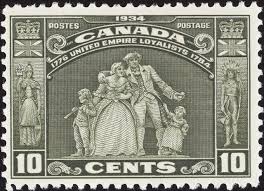
The American Revolution  was time of flux for many citizens who were loyal to the British. These Loyalists sought refuge in towns north of the border in an area known as the Eastern Townships. They settled and formed communities and built their churches

.uel2

In this database you will find the locations of  births, marriages and deaths of these early settlers.

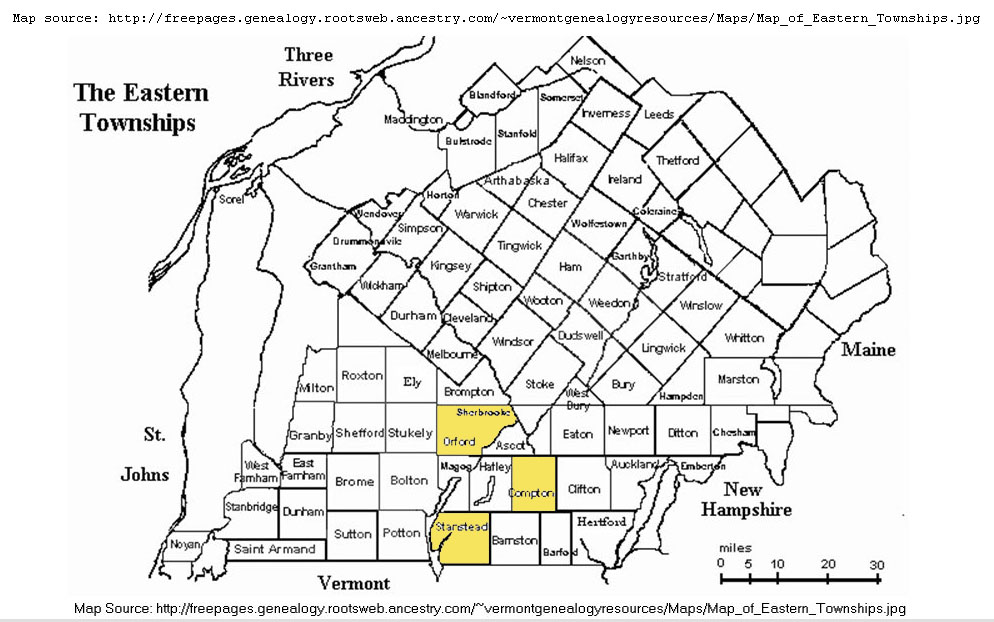
Townships Map

Right Click the title below to open the database in a new window: 

The Loyalist Churches of Stanstead, Sherbrooke and West compton 2014

The French Canadians in the U.S.A 1840-1930

French Canadian Emigration to the U.S. 1840-1930

compiled by Jacques Gagné

“The Archives nationales du Québec in Montréal on Viger Avenue are the repository of a wonderful and unique collection of books of marriages, baptisms, deaths of French Canadian families who left the Province of Québec between 1840 to 1930 for destinations south of the border. For it is estimated that during that 90 year period, 900,000 French Canadians left the regions along the shores of the  St. Lawrence River, the Richelieu River, the Chaudière River for the U.S. ”

As part of this research guide, Jacques Gagné has also included the exodus of Acadians to the same New England States, New York State and other points within the United States of America including the Acadian families who were deported to Louisiana.


Click here to open the pdf file : French Canadians in the U.S.A. 2014

Loyalist Churches in Brome-Missisquoi – Upper Richelieu Valley – South Shefford

Missisquoi 2_edited-1

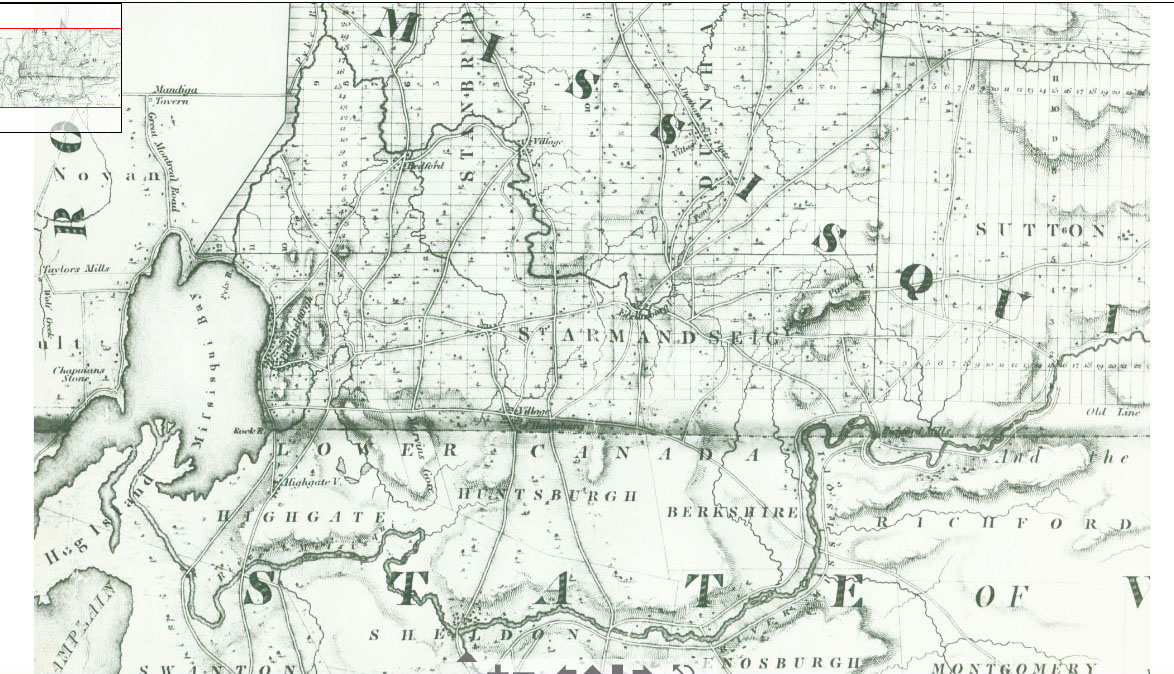
The American Revolution left  profound marks on the development of the areas of Brome-Missisquoi, the Upper Richelieu Valley and South Shefford. The Americans who wished to remain loyal to the British Crown fled the United States. These Loyalists  came from the northern states and settled very close to the border. Within a short period of time they began to develop many small communities, from Abercorn , near what is now the Vermont border to St. Armand near Missisquoi Bay..

This compilation describes the many towns and villages that emerged from the late 1780s to this day. Their churches contained documents of birth, marriages and deaths that have  been preserved and are available in various archives.

The contributions of these Loyalist can be found   throughout the area.  Many of the churches are still standing and are a tribute to their perseverance.

Click on the link: Loyalist Churches in Brome Missiquoi

Upper Richelieu Valley and South Shefford

images (1)

Who Was Phineas Bagg?


Introduction

I wrote this article as a self-assigned exercise in applying genealogical proof standards (GPS) to a brick wall.

Following GPS procedures, I did a reasonably exhaustive search of the evidence. For each statement I made, I included a source citation. I tried to resolve conflicts and write a conclusion. I also evaluated the weight of each piece of evidence, depending on whether it was direct or indirect, original or derivative, or primary or secondary. (See an explanation of GPS by Christine Rose, https://familysearch.org/learningcenter/lesson/genealogical-proof-standard/350)

The problem is that there is no birth or baptismal record for my four-times great-grandfather Phineas Bagg (c.1750-1823). I wanted to prove that he was the son of David Bagg and Elizabeth Moseley. In addition, there were several men named David Bagg in western Massachusetts at the time, so I wanted to show which David Bagg was Phineas’ father. It was possible to undertake a research project like this because the Baggs of colonial Massachusetts were limited in numbers and in geographical area. There is a great deal of information about this population, although record-keeping in Pittsfield was poor.

In the end, I decided that I could not make a conclusive statement about Phineas’ parents, but I found nothing to indicate that he was not the son of David and Elizabeth. In fact, circumstantial evidence suggests that he was their son.

As for the GPS exercise, it was a great deal of work. Citing all those sources took almost as long as writing the article. I’m not sure that I would go to such lengths to tackle another brick wall, but evaluating each piece of evidence was extremely helpful.

This article is also posted on my own blog, http://writinguptheancestors.blogspot.ca

Questions: There is no record of the birth or baptism of my 4x great-grandfather Phineas Bagg. When and where was he born? Was he the son of David Bagg and Elizabeth Moseley?

The Baggs were a large extended family in western Massachusetts during the colonial period, approximately 1650 to 1790. The first immigrant, John Bagg, married in Springfield in 16571 and each subsequent generation produced many children. Phineas (c 1751-1823) was part of the fourth generation. By 1790, there were 19 different families headed by a male Bagg in Massachusetts, primarily in the towns of West Springfield, Westfield and Pittsfield.2 Fortunately, there was only one Phineas Bagg3, which makes him easier to track.

There are several possibilities for his identity: he could have been the son of David Bagg of Westfield and later Pittsfield as most researchers suggest; he could have been the son of a related Bagg; or he could have been adopted.

David Bagg was born in Westfield, MA on 19 Feb. 1717, the tenth and youngest child of Daniel Bagg and Hannah Phelps.4 On 12 May 1739, David Bagg and Elizabeth Moseley announced their intention to marry in Westfield.5

Although both West Springfield and Westfield generally kept good birth and baptismal records, there is a minimal possibility that Phineas was born to another Bagg family and slipped under the radar. David’s brother Daniel Bagg and his wife Abigail, of Westfield, had six children: Daniel, 1735, Moses 1737, Abigail 1738, Roger 1740, Ann 1746 and Naomi 1750.6

There were at least five other young Bagg families in the area between 1740 and 1755. In Springfield, David Bagg and his wife Hannah Stockwell had three children: Noah, born in 1740, who died at age six, Mercy born 1746 and Mary in 1748.7

In West Springfield, Ebenezer Bagg and his wife Lois produced five children: Thankfull in 1749, Frederick in 1750, Warham in 1752, Walter in 1754, Ebenezer in 1756 and Judah 1758.8

West Springfield residents Thomas and Margaret Bagg had Thomas in 1749, Israel in 1752 and Oliver in 1754. In addition, their son Ezekiel was born 1755 died at age three and they had another son they called Ezekiel in 1761.9

James and Bathsheba Bagg of West Springfield, had Bathsheba in 1745, James in 1746 and Jonathon in 1748.10

There was another young David Bagg family in West Springfield, however, I have not found a marriage and mother’s name did not appear in the children’s baptism records; they are simply listed as son or daughter of David Bagg. These children were: David bap. Sept 18 1737, Hannah bap. July 15 1739, Aaron bap. Oct 28 1740, Mercy bap. Jan 19 1746 and Mary bap. Jan 19 1748.11

It is unlikely that Phineas was orphaned or given up for adoption and raised by David and Elizabeth. I have so far been unable to find any references to adoption practices in colonial Massachusetts, but there would likely have been a paper trail and I have not run across any legal guardianship documents concerned with Phineas.

Assuming that he was the son of David and Elizabeth, when was Phineas born? Most sources say he was born around 1750 or 1751. The best evidence for his date of birth comes from the record of his burial at Montreal’s Anglican Christ Church. Dated Nov. 3, 1823, it says, “Phineas Bagg esq of Montreal, merchant, died on the 31 day of November [sic] 1823, aged 72 years, and was buried on the 3rd day of November following by me. John Bethune, rector.” 12 (The minister made a mistake on the date of death: it was actually 31 October.) Neither of his sons signed as witnesses, so it is not clear whether any family members were present. Thus, although the source is original, the information is secondary.

David and Elizabeth had seven children baptized in Westfield: Elizabeth baptized 1741, Joseph 1741, Rachel 1742, Martin 1745, Eunice 1746, Abner 1748 and Aaron baptized 11 March 1750.13 If Phineas was born in 1751, this would have fit the pattern of Elizabeth having a baby every year or two.

Where was Phineas born? Probably Westfield, since David Bagg is not listed among the early landowners of Pittsfield.14 Pittsfield was a newly settled town in the Berkshire Hills, on the western frontier of the colony, about 50 miles from Westfield. David Bagg is thought to have moved there not long after 176415 but more research needs to be done on David Bagg’s land records in Westfield and Pittsfield to try to establish a time-line.


Another question arises here: there were several men named David Bagg in this time period. Was Elizabeth Moseley’s husband the same David Bagg who moved to Pittsfield after her death? The answer is probably yes. David Bagg jr., son of David and Hannah of Springfield died in 1756 in his 19th year.16 David Bagg, son of Jonathon Bagg of Springfield, died in 1760 in his 50th year.17 (Perhaps he was the David Bagg who had five children born in West Springfield.)

There was one more David Bagg: David Bagg, born Westfield to Mary Sacket, March 27, 1739.18 I have found no other records concerning him.

Following Elizabeth’s death, David Bagg of Westfield moved to Blandford, Mass,19 where he married Martha Cook, the widow of John Dickinson, on June 25, 1761.20 She died a year later. After he moved to Pittsfield, David married a third time, to Ruth Tupper.21 There is no record of his death.

Because David and his sons seem to be the main Bagg family in the Berkshires, the presence of Phineas in Pittsfield is a circumstantial argument that supports his being one of David’s sons. In the 1790 federal census (the first such census taken), Daniel Bagg, Martin Bagg and Phineas Bagg were counted in Pittsfield while David’s other known son Joseph appeared in nearby Lanesborough.22 However, there two other Baggs for whom there are no baptismal records, but who lived in Pittsfield in the 1770s through 1790s. Elijah Bagg turned up in tax23 and marriage records and Daniel Bagg was listed as a soldier during the Revolution24 and in other records.

During the War of the American Revolution, Phineas, David, Martin and Daniel Bagg all fought with Pittsfield regiments, while Aaron marched from nearby Lanesborough and Joseph was a Lieutenant in a Berkshire company.25 A paper titled “The James Bagg Family of Lanesborough”, written in 1918 by William A. Cooper, husband of Mary Bagg, noted that, in 1776, David Bagg marched to Albany in Capt. William Francis’ company, “and his son Phineas went with him”.26 However, given that this was written more than 100 years later, this statement carries little weight.

The next record of Phineas was his intention to marry Pamela Stanley, dated 21 March 1780 in the vital records of Pittsfield.27 If he was born in 1751 he would have been 29 at the time. I did not find records of the baptisms of their children, nor did I find a mention of Pamela’s death in the church records.28

Times were tough in post-revolutionary Western Massachusetts, and Phineas was caught in a credit crunch. Because of his debts, he lost much of his property to pay off his creditors.29 He headed north with his four children and a new woman. By 1798, Phineas was an innkeeper in La Prairie, Lower Canada, where he and Ruth Langworthy had two children baptized in the local Catholic church.30

Finally, how are the dots between Phineas Bagg of Pittsfield connected to the man who was an innkeeper in La Prairie and died in Montreal? First, a search of databases available on ancestry.com and americanancestors.org indicates there was only one man named Phineas Bagg. Second, there is a record of Ruth Langworthy and her parents in Pittsfield.31 Third, when sons Stanley and Abner Bagg were baptized as Anglicans in Christ Church, Montreal in 1831, they both gave their birthplace as Pittsfield.32 In addition, in her 1856 will, Sophia Bagg Roy mentioned that Abner and Stanley were her brothers and Lucie Bagg was the “natural daughter of my father Phineas Bagg.”33

In conclusion, there is considerable evidence to suggest that Phineas Bagg was born in 1751 in Westfield, the son of David Bagg and Elizabeth Moseley, however, most of this evidence is indirect, from derivative sources and secondary information, so it is inconclusive. I found no evidence that conflicts with this hypothesis. The next step is to do more research on Pittsfield deeds to see whether David transferred any of his property to Phineas, and to see whether there are any other resources I have missed.


Sources

  1. Henry M. Burt, The First Century of the History of Springfield. The Official Records from 1636 to 1736, with an Historical Review and Biographical Mention of the Founders. Volume II. Springfield, Mass: printed and published by Henry M. Burt, 1899. p. 524.
  2. Ancestry.com. 1790 United States Federal Census [database on-line]. Provo, UT, USA: Ancestry.com Operations, Inc., 2010. Images reproduced by FamilySearch. Original data: First Census of the United States, 1790 (NARA microfilm publication M637, 12 rolls). Records of the Bureau of the Census, Record Group 29. National Archives, Washington, D.C. (accessed Jan. 14, 2013)
  3. Ancestry.com. 1790 United States Federal Census [database on-line]. Provo, UT, USA: Ancestry.com Operations, Inc., 2010. Images reproduced by FamilySearch.

Original data: First Census of the United States, 1790 (NARA microfilm publication M637, 12 rolls). Records of the Bureau of the Census, Record Group 29. National Archives, Washington, D.C.

Year: 1790; Census     Place: Pittsfield, Berkshire, Massachusetts; Series: M637; Roll: 4; Page: 483; Image: 526; Family History Library Film: 0568144. (accessed Jan. 14, 2013)


  1. Westfield, MA: Birth and Death Records. (Online database: AmericanAncestors.org New England Historic Genealogical Society, 2003), (Abstraction of original records, donated to NEHGS by Harold T. Dougherty. “Westfield Birth and Death Records as Obtained From the Files at City Hall, Westfield,” donated 1937) (accessed Jan. 13, 2013)
  2. Ancestry.com. Massachusetts, Town and Vital Records, 1620-1988 [database on-line]. Provo, UT, USA: Ancestry.com Operations, Inc., 2011. Original data: Town and City Clerks of Massachusetts. Massachusetts Vital and Town Records. Provo, UT: Holbrook Research Institute (Jay and Delene Holbrook). (accessed Jan 14, 2013)
  3. Ibid.
  4. Springfield births: Vital Records of Springfield, Massachusetts to 1850. Boston, Mass.: New England Historic Genealogical Society, 2002. (Online database. AmericanAncestors.org. New England Historic Genealogical Society, 2008.) (accessed Jan. 19, 2013)
  5. West Springfield:     Massachusetts Vital Records to 1850 (Online Database: AmericanAncestors.org, New England Historic Genealogical Society, 2001-2010). (accessed Jan. 19, 2013)
  6. Ibid
  7. Ibid
  8. Ibid
  9. Ancestry.com. Quebec, Vital and Church Records (Drouin Collection), 1621-1967 [database on-line]. Provo, UT, USA: Ancestry.com Operations Inc, 2008. Original data: Gabriel Drouin, comp. Drouin Collection. Montreal, Quebec, Canada: Institut Généalogique Drouin. (accessed Jan. 12, 2013)
  10. Westfield, MA: Baptisms Performed in the Church of Christ, 1679–1836 (Online database. AmericanAncestors.org, 2003.) (accessed Jan. 12, 2013)
  11. J.E.A. Smith, The History of Pittsfield, (Berkshire County,) Massachusetts, From the Year 1734 to the Year 1800. Boston: Lee and Shepard, 1869. p. 125-128. http://books.google.ca/books?id=xKkaqbyW8ZwC&printsec=frontcover&dq=History+of+Pittsfield++Smith&hl=en&sa=X&ei=syD0UNmGFuri0QHY14CQBQ&ved=0CDEQ6AEwAA (accessed Jan. 13, 2013)
  12. Smith. Ibid. p. 476
  13. West Springfield Deaths. Massachusetts Vital Records to 1850 (Online Database: AmericanAncestors.org, New England Historic Genealogical Society, 2001-2010). (accessed Jan. 19, 2013)
  14. Ibid.
  15. Westfield, MA: Birth and Death Records. (Online database: AmericanAncestors.org New England Historic Genealogical Society, 2003), (Abstraction of original records, donated to NEHGS by Harold T. Dougherty. “Westfield Birth and Death Records as Obtained from the Files at City Hall, Westfield,” donated 1937) (accessed Jan. 19, 2013)
  16. 19. William A. Cooper, “The James Bagg Family of Lanesborough, Mass” Conshohooken, Pa.: unpublished, 1918. p. 10
  17. Ibid.
  18. Ancestry.com. Massachusetts, Town and Vital Records, 1620-1988 [database on-line]. Provo, UT, USA: Ancestry.com Operations, Inc., 2011. Original data: Town and City Clerks of Massachusetts. Massachusetts Vital and Town Records. Provo, UT: Holbrook Research Institute (Jay and Delene Holbrook). (accessed Jan. 20, 2013)
  19. Ancestry.com. 1790 United States Federal Census [database on-line]. Provo, UT, USA: Ancestry.com Operations, Inc., 2010. Images reproduced by FamilySearch.Original data: First Census of the United States, 1790 (NARA microfilm publication M637, 12 rolls). Records of the Bureau of the Census, Record Group 29. National Archives, Washington, D.C.Year: 1790; Census Place: Pittsfield, Berkshire, Massachusetts; Series: M637; Roll: 4; Page: 483; Image: 526; Family History Library Film: 0568144. (accessed Jan. 14, 2013)

23. Massachusetts and Maine 1798 Direct Tax. (Online database. AmericanAncestors.org, New England Historic Genealogical Society, 2003.) Original manuscript: Direct tax list of 1798 for Massachusetts and Maine, 1798. R. Stanton Avery Special Collections, New England Historic Genealogical Society, Boston, MA. (accessed Jan 14, 2013)

24. Ancestry.com. Massachusetts Soldiers and Sailors in the War of the Revolution, 17 Vols. [database on-line]. Provo, UT, USA: Ancestry.com Operations Inc, 1998. Original data: Secretary of the Commonwealth. Massachusetts Soldiers and Sailors in the War of the Revolution. Vol. I-XVII. Boston, MA, USA: Wright and Potter Printing Co., 1896. (accessed Jan. 12, 2013)

25. Ibid. (accessed Jan. 12, 2013)

26. William A. Cooper, “The James Bagg Family of Lanesborough, Mass” Conshohooken, Pa.: unpublished, 1918.

27. Jay Mack Holbrook, Massachusetts vital records to 1850: Pittsfield, 1761-1899 [microform]. Oxford, Mass: Holbrook Research Institute, 1983.

28. Records of the First Church, Pittsfield, Mass. Rollin H. Cooke Collection. Berkshire County, Mass. Reel #2, vols 26 and 27.

29. Land records, Middle District, 1761-1925 Berkshire County [microform] Salt Lake City, Utah: Genealogical Society of Utah, 1771, 1991.

30. Ancestry.com. Quebec, Vital and Church Records (Drouin Collection), 1621-1967 [database on-line]. Provo, UT, USA: Ancestry.com Operations Inc, 2008. Original data: Gabriel Drouin, comp. Drouin Collection. Montreal, Quebec, Canada: Institut Généalogique Drouin. (accessed Jan. 14 2013)

31. William Franklin Langworthy, compiler, The Langworthy Family. Some descendants of Andrew and Rachel (Hubbard) Langworthy, who were married at Newport, Rhode Island November 3, 1658. Published by William F. and Orthello S. Langworthy, Charles St. Hamilton, N.Y.

32. Ancestry.com. Quebec, Vital and Church Records (Drouin Collection), 1621-1967 [database on-line]. Provo, UT, USA: Ancestry.com Operations Inc, 2008. Original data: Gabriel Drouin, comp. Drouin Collection. Montreal, Quebec, Canada: Institut Généalogique Drouin. (accessed Jan. 14, 2013)

33. Labadie, Joseph-Augustin. 14278. 18 Mai 1856. Testament de Dame Sophia Bagg veuve de l’Honorable Gabriel Roy.



My Family History


Handcart Pioneers Postcard pg. 1 - 1939_thumb[1]

Handcart Pioneers Postcard pg. 2 - 1939_thumb[2]

by Marian Bulford

My family history includes, like most peoples’ history, twists and turns and coincidences that sometimes defy belief. In the 1970s, my family and I were living in Geneva, Switzerland, when we had a visit from the ‘Mormons’ doing their proselytizing door to door. Because we were in a non-English speaking environment and they were from the USA, we invited them in. Over the course of a few months, we became great friends and we decided to explore the church’s history with them.

One day, whilst talking to them, they mentioned Salt Lake City as the ‘Zion’ of the church, and how the early Pioneers who had left their homes and families to trek across the US to get to Salt Lake City, Utah. That name Salt Lake City brought back a memory. When I was 11 years old, I lived with my Grandparents for a few years and my Grandfather used to ask me to go to the post office to post his letter to a Salt Lake City address. I remember it so well because in the 1950s Air Mail letters were treated differently from normal mail, and I had to have this important missive weighed and stamped before it could be posted, so it made quite an impression. I remember thinking ‘where was Salt Lake City, and why and who was my Grandfather writing too? Of course, by the time I arrived home again, the questions were forgotten.

Now, years later in the 1970’s the question arose again, so I called my Grandfather Percival Victor O’Bray (The English branch spell it with an apostrophe unlike the USA branch who spell it without) and asked him about the letters and to whom he had been writing.

He replied that ‘Well, you know the Americans, they are always doing their genealogy and one day, I received this letter from a lady, telling me I was related to her, I was a distant third cousin’ I questioned him further and he said they had corresponded for a number of years, and at one point, she had sent him a ‘Family Tree’ all handwritten then, of course and started in 1717 to my grandfather’s day. I was very excited by this and asked him, if, when we next came home could I see the ‘Family Tree and read the letters. He replied that I could have the letters and the Family Tree, he had no further use for them, and he would post them to me.


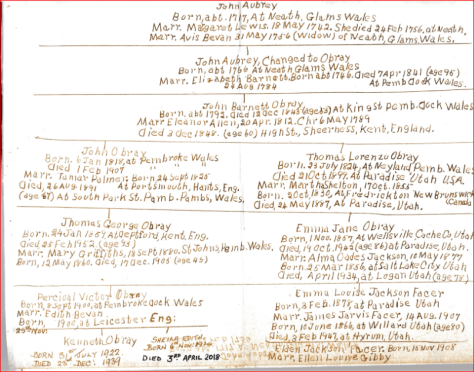
The Family Tree sent to my Gramps by his third cousin Ellen Louise Gibby Facer in Utah in the early 1950s.

Starting Family Genealogy

I think that started my interest in genealogy and research. The next time I went ‘home’ I questioned my grandparents and family at length, recorded their voices and wrote out the names and birth dates of the family. My Grandparents – who threw nothing out – gave me some marvellous 1800’s photos of family members. On the back, I wrote who these people were, most important because shortly after that, we moved to Canada, and genealogy was put on the back burner in a box, for a number of years.

32 years later a renewed interest came when we met some UK friends again, and members of the Church of Latter- Day-Saint or Mormons. We talked about genealogy, but with young families and busy lives, that was all we did, talked about it, but, never really did any more research.  About 8 years ago, we decided the time had come, and we met and researched together. Our friends invited us to their church’s’ “Centre of Family History” in LaSalle, Quebec, Canada to do some real research with them.

Finding Family Skeletons

I found the Family History Centre a wonderful place. Free to anyone at certain times it has most of the current genealogy web sites online open for free. Books, microfiche and copies of records can be researched, with help from church members if needed. It was a quiet peaceful place and we got to spend some time with friends, have lunch and do some family history together. Our friends were a great help, as the Church recommends that its members do family history so they are very experienced. I recalled all the information I had amassed in the 1970s and had no idea how to put it all together. Now I had a chance to do that. I was pleased with how I had named all the photos as it was a wonderful tool to enable me to search online for family members.

I decided to start with the mysterious ‘Family Tree’ from the USA. It was so exciting to be able to put in full names, birth dates and areas to search. I was grateful to the previous Missionaries that advised us to label and date all information as we received it. A really great tip!

My Grandfather was born in Pembroke Dock, Wales and his Great-Grandfather had, as was usual, a large family. Two of those sons, my Grandfathers’ Uncles, Thomas and Samuel OBray became Mormons and left Wales for ‘Zion’ Salt Lake City in 1854.

This photo, which appears all over FamilySearch.org, was included in letters to my Gramps from his third cousin in Utah.

Samuel William OBray

(Portrait found on Familysearch.org)

That was a surprise for me, considering the friends and interest I have had in the church over the years, a case of my Great Uncles having “been there, done that’ so I was able to trace their long and arduous journey across the plains to Utah through Mormon church records.  Our friends were very excited for us, as this was a great honour in the history of the church, to have family that had made the arduous and terrible trip to reach their ‘Zion’.

Further Research

Through the Welsh Mormon History page, on FamilySearch.org I found that Thomas, was born in Wales in 1824 and he joined the Mormon church when he was 13 years old. Eight years later, he began to preach the gospel in England then Italy, France and Germany. Later, he went to Norway and Denmark. In Malta, he raised up a church branch. In 1854 Thomas emigrated to the US. The ship stopped in New Brunswick, Canada and picked up another family. Thomas joined that family and met Louisa. They continued the journey on their way to St. Louis Missouri to pick up supplies, wagons, food, and animals for the three-month journey across the plains of the United States.

In June at Fort Leavenworth, Kansas Thomas and Louisa were married. During that journey, with her brother Albert and her sister Martha, Louisa died of cholera and was buried en route to Salt Lake City on the plains, in an unmarked grave, a bride of three weeks. Thomas continued on with the family and arrived in Salt Lake City in September 1854.

A Few Surprises

In October 1854, Thomas married Louisa’s sister, Martha. Five children were born to Thomas and Martha. In 1857 Thomas married Carolyn and had 9 children with her. In 1864 Thomas married Ruth and they had 14 children together. The women and children, according to Censuses of the time, lived together in separate houses and were called ‘Housekeepers” Thomas lived with Martha and their children.

Altogether Thomas had 28 children and yes, my Great Grand Uncle had ‘plural marriages’! At that time, it was a tenet of the Church. Martha died in 1887 and a year after her death Thomas was sentenced to the Utah penitentiary for 11 months for ‘Unlawful cohabitation. He was sentenced a second time a year later, and served from April to August 1890.

 Following a revelation to the church Prophet, the practice of plural marriage was instituted among Church members in the early 1840s however; from the 1860s to the 1880s, the United States government passed laws to make this religious practice illegal. These laws were eventually upheld by the U.S. Supreme Court. At that time, the President of the church, Wilford Woodruff issued a Manifesto, which was accepted by the Church as authoritative and binding on October 6, 1890. This led to the end of the practice of plural marriage in the Church.

Decedents Of The Family

My Great Grand Uncle was asked by the church to explore further land outside of Salt Lake City and to build other settlements, and so he moved his families to ‘Cache’ (secret) County and founded a small place called “Paradise’ just outside of Salt Lake City. Thomas homesteaded the site where the church farm is now located.

In 2014, I visited this small town. It was full of my ancestors. Even the local cafe knew the name of my Grandfather and his Uncles. The Paradise Cemetery was a beautiful place, calm and serene and I found my Uncles and their families. It may sound strange, but I ‘introduced’ myself to them, and told them of their ancestor who wrote to my Grandfather, all those years ago, and how I now ended up here, in Paradise. I hope to go back again one day.

The cemetery contained all of the family who were ‘Pioneers’ and had crossed the plains to get to ‘Zion’ It was very moving to see my two Grand Uncles with special plates affixed to their memorial stones to indicate that they were original Pioneers. Great Grand Uncle Thomas died in Paradise, Utah on 21st October 1899 and Great Grand Uncle Samuel died in Paradise, Utah on 5th June 1910.

Meanwhile, I continue my researching and find surprises every day. I would love to contact any members of Ellen Louise Gibby Facer’s family. She, who wrote to my Gramps, all those years ago!  I still have her letters and Christmas cards.

How ever did we manage without the internet and more importantly, https://www.familysearch.org?


Mapping the Mitchesons of Philadelphia

This 1875 map from the HSP.org website shows the Mitcheson property in Spring Garden.

I’ve been researching the Mitchesons, my 19th century Philadelphia ancestors, on and off for a couple of years.  One of the things that most intrigues me is to find out where they lived. Was it rural, or in the heart of the old town? At the top of a hill, or in an unhealthy swampy area? And how did the area change over time?

The best way to find out is to look at old maps. The modern ones help you to get your bearings, but studying historical maps of the areas where our ancestors lived and worked is crucial. They show transportation corridors and distances and indicate population density and land use.

The Greater Philadelphia GeoHistory Network (http://www.philageohistory.org/geohistory/) has an excellent collection of old maps of Philadelphia.

My three-times great-grandfather Robert Mitcheson bought a large piece of property facing Coates Street (later renamed Fairmount), between 11th and 12th, in the Spring Garden district, north of the city. Looking at it on this 1831 survey plan, it is clear that this was a rural area and that new roads were being laid out: http://www.philageohistory.org/rdic-images/view-image.cfm/083-1_HP

Zoom in on Spring Garden (the long, narrow pink section) on the1843 survey map at http://www.philageohistory.org/rdic-images/view-image.cfm/ellet and you’ll find the street grid is in place and the State Penitentiary is located nearby, as is the city’s famous Fairmount waterworks. The Mitchesons were becoming urban residents, and Robert took advantage of it. He built boarding houses on his property that he hoped would provide an ongoing source of income for his children.

The Historical Society of Pennsylvania (http://hsp.org.) is another good source for maps. Its digital project PhilaPlace (http://www.philaplace.org) invites users to write about the histories of their favorite spots in the city. (As I write this, the site seems to be having technical problems.)

To read about Robert Mitcheson’s wife, Fanny MacGregor, see my blog post, writinguptheancestors.blogspot.ca/2014/03/fanny-in-philly.html

The Trail of the Huguenots in Europe, the U.S.A and Canada

The Trail of the Huguenots in Europe, the United States, South Africa and Canada
Author: G. Elmore Reaman
QFHS #UEL-REF HG 010.01 R4 1972
Total pages: 318
From page 137 to page 205, this section of the book address the Protestant families in Nouvelle France (New France)
Being a book owned by the United Empire Loyalist’ Association of Canada, it cannot be taken out of the library.

The following is an excerpt from this superb book by G. Elmore Reaman.

It is a generally accepted point of view in Canada that Frenchmen have always been Roman Catholics and that Protestantism has had little or no reliationship with France. It has been further accepted that there was no connection between Protestant French and the exploration of Canada by the French. A careful study of both of these points of view will show that they are untenable. It may come as a surprise to learn that historians of this period state on good authority that, if it hadn’t been for the business enterprise of Huguenots in France and their desire to found a colony where they could remain loyal to the King of France and yet enjoy freedom of worship, it is doubtful if there would be many French in Canada today. Furthermore, it is quite possible that had the French allowed Huguenots to migrate to Canada in the seventeenth century, England would have stood a slim chance of conquering Canada.

Such information does exist in authentic sources, but few persons in Europe or America—and that includes Canada—have any knowledge of it. French Roman Catholics have naturally advanced their point of view and Protestants have never thought it worth while to investigate it. Huguenot Societies in France, England, and the United States are not aware that from 1534 until 1633 Canada was practically Huguenot controlled nor do they know that many of the earliest settlers in Upper Canada (Ontario) were descendants of émigrés from France, some of whom first went to the British Isles, then to the United States, and finally to Ontario.
G. Elmore Reaman

G. Elmore Reaman (1889-1969) was born in Concord, Ontario, he received his education at the University of Toronto, McMaster University, Queen’s University, Cornell University.

Dr. Reaman’s materials are found at the University of Waterloo Archives.

Posted by Jacques Gagné for Genealogy Ensemble

Facebook to connect on and on and on.

Yes, we are all connected with our trees, and the web makes it so you can get lost as one page connects to the next and to the next…  We genealogists are so curious, we can lose entire days brousing.  But sometimes at the end of a treck, you hit what you didn’t know you were looking for but needed anyways.

Fumbling around Facebook today, I found lots I wasn’t looking for. On the French-Canadian Heritage Society of Michigan Facebook Page, I discovered Katherine R Willson’s social media genealogy page  as I was following a lead historical and genealogical Facebook pages.  YES!  Browse throught the list and you may mingle with the right crowd gen-buffs on Facebook: the ones that can help you, the ones where cousins may be hiding, and the ones to keep on getting lost through genealogical maze on the web.  You may download the Facebook list but please keep the credits on each page.

Want to know more about genealogy, art and military family support?  Those are KATHERINE R. WILLSON’s favorite topics and she is writing a book about the use of Facebook as a genealogical research tool.  Member of many historical and genealogical societies, she is also a mixed media artist.  To know more about talks she gives, go to her social media genealogy page .

The French-Canadian Heritage Society of Michigan page helps us take walls (brick or other) down between Canada and USA to help our searches, and yes, there is a brickwall Facebook page

Facebook nous permet de rejoindre bien des gens, mais Katherine R. Willson nous aide a trouver ceux qu’on cherche: ceux qui peuvent nous aider ou des cousin.  Vous pouvez rencontrer cette conférencière sur sa page social media genealogy page .  La généalogie, le support de familles militaires et les arts sont ses sujets préférés.

Pour rendre Facebook encore plus utile, elle a compilé une liste de sites Facebook historique et généalogique que vous pouvez télécharger.  Elle nous prie de garder les crédits sur chaque page si nous diffusons cette liste.

C’est justement en me promenant sur Facebook, sur la page French-Canadian Heritage Society of Michigan que j’ai été référée a sa page.  Un autre lien Canada-Usa qui fait tomber des murs, de brique ou autres, page de Brickwall Facebook

Hiding to read that kind of newspaper?

Readers always loved those stories, but…they would rather not admit it.

Shocking News

Vicky Lapointe, graduate historian from Sherbrooke University, signs a special newspaper blog.  She combs through Quebec old newspapers to present us with crimes and catastrophies, francophones from outside Quebec and some pictures, medicine, history and patrimonial buildings.

It is suprising to see what kind of news would make the paper a century or two ago, how people responded, and yes…what strange crimes were being commited.  I also enjoy reading about events that are now part of history, as they happened.

Read Patrimoine, Histoire et Multimédia