In the Jodouin family of 9 children, six girls, and three boys the names were:
Alice, Aline, Arthur, Eugene, Adele, Lucille, Emile, Estelle and Louise.
A number of them were named after relatives
Three of those names began with the same sounding A! Sometimes Mom would go through the entire list of her children before finding the one she wanted to address! Perhaps Granny had the same situation. In any case, my Aunt Adele became known as “Ted” even though she was very feminine and truly a fashion plate, always dressed ”to the nines”.
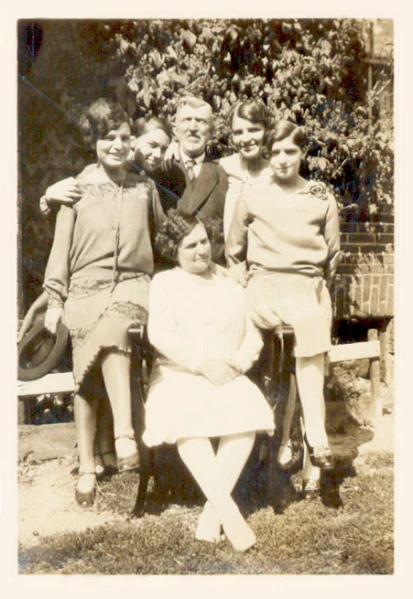
Aunt Ted, ?, Granpa, Luce, Mom, and Granny Jodouin
For many years I wondered how she received the nickname. It seems that she looked like a little teddy bear with her big brown eyes and thus she became affectionately known as Ted. The name stayed with her all her life. She was “Aunt Ted!”
Marie Adele Jodouin was born in Sudbury, Ontario, during the Holiday season, on December 28, 1901. She was the fifth child of Louis and Louisa Jodouin.
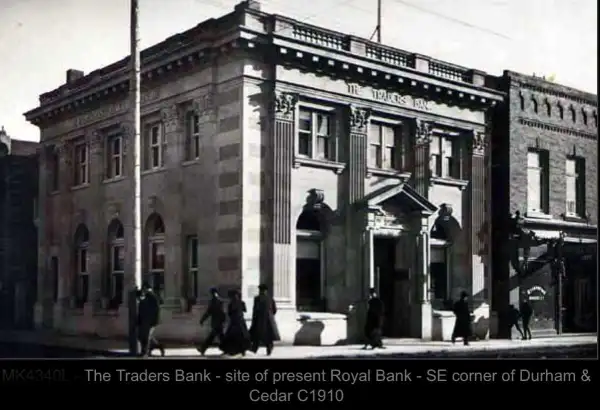
The Royal Bank on Durham Street in downtown Sudbury
She worked as a Secretary to the Manager at the Royal Bank in Sudbury.
To this day, fond memories of bygone visits either to Sudbury or Asbestos still come to mind.
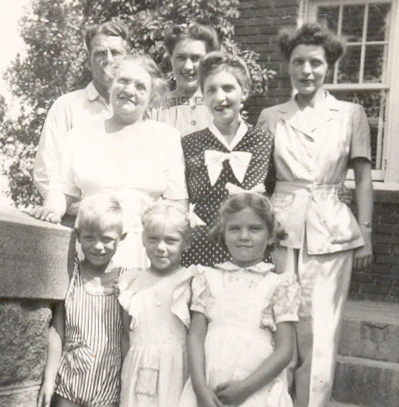
Back row: Uncle Leo and Aunt Dickie-Middle Row: Granny Jodouin, Mom, Aunt Ted – Front: Paul, Claire, and Denise – Dad took the photograph.
One of those visits occurred in the summer of 1946. Our family had moved from Sudbury to Asbestos, Quebec in the fall of 1945. We all missed our northern relatives, especially Mom. Granny, Aunt Ted, Aunt Dickie (Louise), Uncle Leo, and Cousin Denise arrived in the Packard driven by Aunt Ted. They were welcomed with open arms. Mom was in seventh heaven seeing her family. Their visit was the highlight of that summer.
When Grandpa Jodouin passed away in 1943 they sold the family home on Elm Street and built a small bungalow on John Street just around the corner from Aunt Dickie and Uncle Leo. In their new home, Granny had her Baby Grand piano as the centerpiece in their living room. The last memory of Granny etched in my mind was in 1948 when we were heading home to Asbestos. She sat down and played “Say Aurevoir But Not Goodbye”. She died in May of 1950.
Over the years there have been many visits back and forth to Sudbury. One of them happened in the summer of 1951 while spending several weeks with Aunt Ted in her home on John Street. During that time, she trotted me off to the dentist. He decided that the tooth growing off-kilter in my lower palette needed to be removed! That is something one does not forget. It is often a reminder of my caring aunt.
“Do you have a special aunt among your relatives?”
Years later, around 1955, Aunt Ted made another trip to our home in Asbestos. It would be the last time she visited us. Each one of her visits over the years has become more meaningful, and I realize just how much she was an influence in my life, and for that, I am truly grateful.
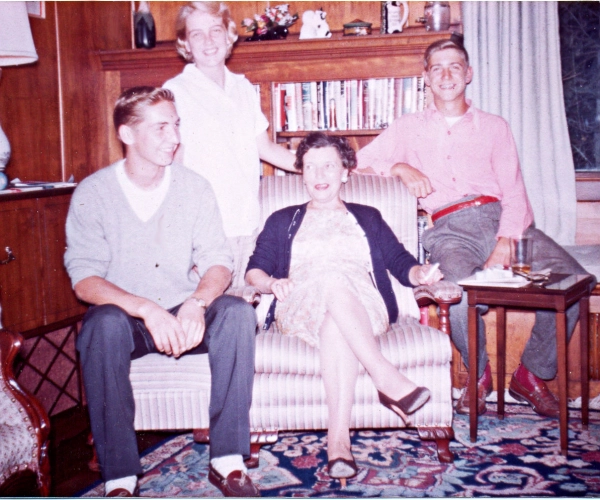
John, Claire, Aunt Ted, and Paul – Dad most likely took the photograph.
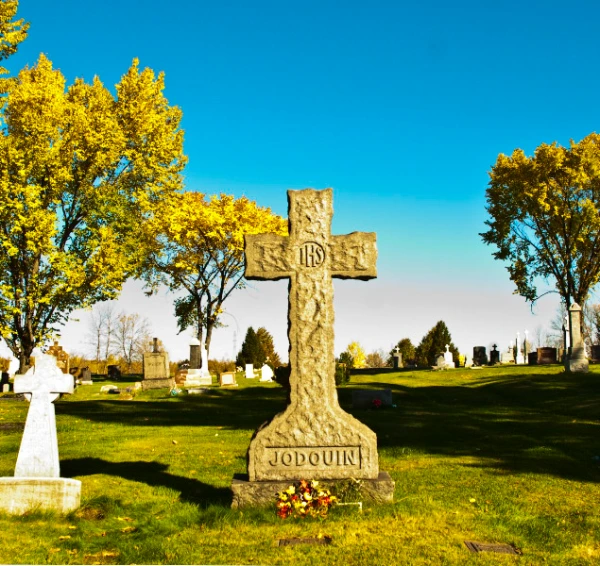
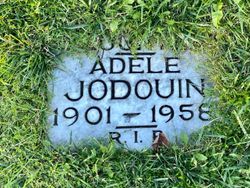
Aunt Ted passed away quietly at the age of fifty-five during the summer of 1958. I was deeply saddened and, for reasons unknown to me, did not attend her funeral. She is buried in LaSalle cemetery next to Granny, Grandpa Jodouin, and my parents.
Alas! Over time the ground around the tombstone had shifted and unfortunately, it became necessary to lower the impressive towering granite tombstone. It is no longer the marker it once was.
I was a journalist and magazine writer for many years, and I have written dozens of articles about my ancestors, but none of these projects has been as well received as the small book I recently co-edited about the small coastal community where I spend my summers.
Biddeford Pool, Maine has been welcoming summer residents for several generations. My mother came here as a child, and I have summered here since I was four. Now, only a few long-lived members of my mother’s generation are still with us, and stories from the past are disappearing.
So in 2019, inspired by the success of my family history blog, I started a blog about the Pool’s summer community. I wrote some of the articles, but the main goal was for people to write their own stories. My friend Dabney described the Sunday mornings of her childhood when everyone went to church wearing their Sunday best, then returned home to enjoy roast beef or fried chicken for lunch. Jesse told readers what he learned about life while racing his sailboat in the mid-1960s. Lisa recalled the 1950s when Mr. Anderson, dressed in a summer suit and straw hat, delighted the neighbourhood children by taking out his false teeth and giving them a toothless smile.
These were great stories, but the blog was a failure. Nobody noticed the publicity flyers I made up, and the posts were not frequent enough to land on people’s radar. When one friend asked, “what is a blog?” I knew the project was doomed.
Upon our return to Maine in 2022, after a two-year absence due to Covid, I asked some friends what they thought I should do with the blog: delete it as a failed experiment, try to revive it, or turn it into a book? We decided on a book. We included all the articles from the blog and added many new stories.
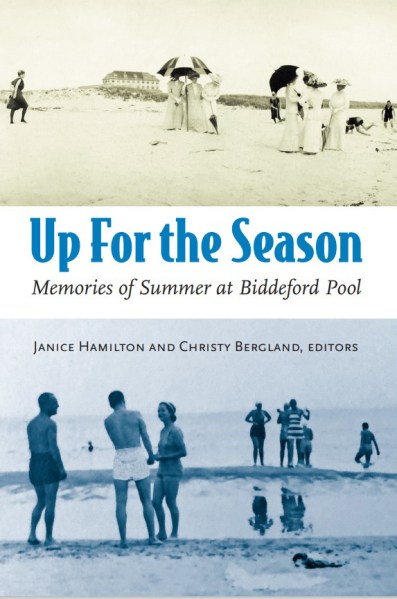
The book is called, Up for the Season: Memories of Summer at Biddeford Pool, edited by myself and Christy Bergland, an artist from Baltimore whose grandfather first came to the Pool as the summer doctor in 1907. The title is a quote attributed to a local lobster fisherman who knew many of the summer residents in the 1950s. When he saw a cottager for the first time each summer, he would ask, “Up for the season?”
co-editors Janice Hamilton, left, and Christy Bergland, right. photo by Richard Levy
The theme of the book is, when and why did your family first start coming to Biddeford Pool? It turns out that many of the men who started coming to the Pool in the late 1800s and early 1900s lived and worked together in mid-western cities such as Cincinnati and St. Louis, and they recommended it to their friends as a good place to bring their families.
The book is probably a hit for several reasons. First, people love to hear these stories about the days when men wore tuxedos to the annual Labour Day dance at the golf club and children got their first taste of freedom as they explored this safe little peninsula. unsupervised by parents.
The quality of the writing is another reason. While most of the contributors are not professional writers, they are nevertheless gifted storytellers. Eagles Nest, a turreted house overlooking the rocky shore, came to life when LeeLee mentioned the seagull who arrives for cocktails on the porch. This was a perfect example of “show, don’t tell.”
For me, putting this project together was a lot of fun because it was a group effort. Christy and several other friends helped with all the important decisions, such as the title choice.
A fun book launch. photo by Harold Rosenberg.
We hired a copy editor to catch the typos and a book designer to do the layout. The printing was done by Rapido Books, a Montreal printing company that I had previously used for a family history book. They shipped two boxes of 50 books seamlessly across the border, and they have an online bookstore for print-on-demand copies. Over the course of this summer, Christy and Mary handled the book sales and accounting with Jo’s assistance. As of the end of August, we have sold more than 100 copies and accumulated a profit of several hundred dollars that we donated to the Biddeford Pool Community Center.
Marketing in a small community where everyone knows everyone is not complicated. We put up posters in key locations advertising an early July book launch, and an announcement appeared in the Community Center newsletter. The launch, held at Lisa’s old shingled family cottage by the bay, was an overwhelming success. We also held a smaller event at the end of the summer where several of the authors read their stories aloud.
Today, many family historians are taking the next step beyond researching their ancestors’ BMDs , and they are writing about their families. Writing about the individuals, families and businesses in a community is not very different from writing about ancestors, and the sources of information — interviews, newspaper articles, city directories, census data and so on – are also the same.
Now that Up for the Season has been so well received, we are hoping that people will be inspired to start writing volume two. Many stories are waiting to be told.
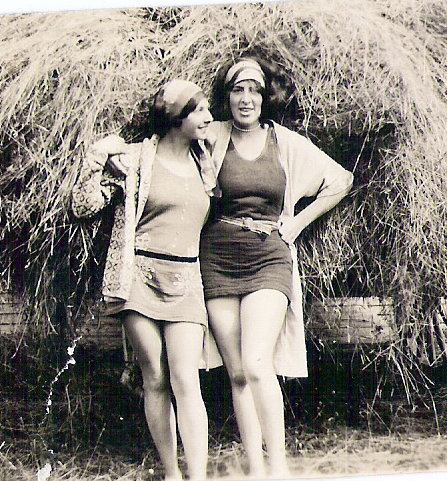
My Aunts Flo and Cecile, circa 1930, in what I assume are bathing suits maybe at Old Orchard Beach Maine where the family vacationed.
It was 1962 or so and my mom, twin brother and I had taken a bus from Old Orchard Beach to Ogunquit, Maine to visit my Aunt Cecile, who was on vacation at the same time as us.
As my brother and I crawled over the jagged and slippery shoreline in front of her hotel we openly wondered why anyone in their right mind would want to vacation in this spot. It was all rocks!
Well, much time has passed and my husband and I love to spend time at picturesque Perkin’s Cove on our short trips to Maine in the spring or fall.
On one such weekend visit, I recall the owners of our b-n-b telling us about pre-WWII Ogunquit: it had once been a bohemian artist’s colony with open air classes and nude models posing on the Marginal Way.
An artist’s colony! Now that explains it. My Aunt Cecile was an artist and a good one at that – but a bohemian, never! I remember her only as sober and serious – and seriously pious. Children were a foreign country to her and her main ambition with regards to me was to convert me to Roman Catholicism.
Marie-Catherine Cecile Crepeau was born in Montreal 1909 to Jules Crepeau and Maria Roy, my grandparents. She had an older brother and sister, Louis and Alice and in 1914 or so another girl her age, Florida, was plucked off the scruffy streets of south central Montreal and brought into the family fold. My mother would appear much later in 1921.
Cecile contracted scarlet fever as a child and suffered severe heart damage. According to her sisters, she was ‘babied’ for most of her childhood, not asked to do very much.
So, it seems she learned to paint.
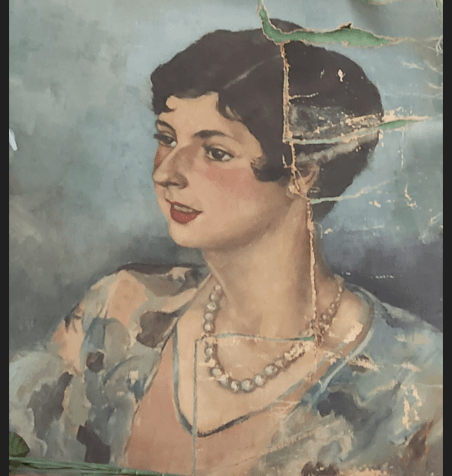
This battered canvas of young Flo is the only one of Cecile’s that I own. It was painted in 1927 when both Cecile and Flo were 18. It is pretty accomplished for so young an artist, I think.
Indeed, in a few years later Cecile would be accepted into the Beaux-Arts in Montreal (perhaps using this portrait in a portfolio) and she would win the first prize for oil painting (considered very much a male domain) in 1937.
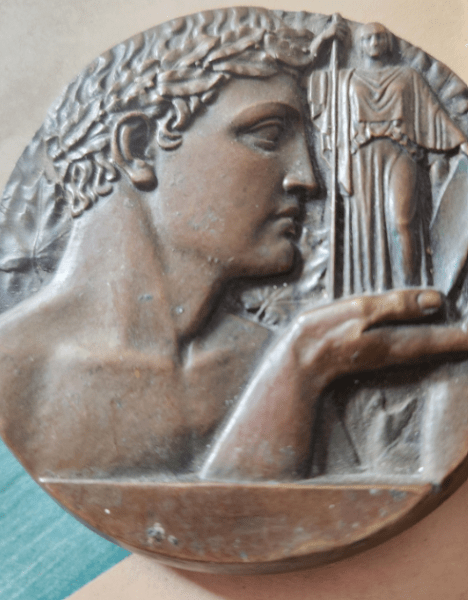
I have the medal somewhere and I found this tidbit from a tabloid called “L’illustre” describing the 1937 Beaux-Art exhibition: “Although the Hall of Paintings has little that is very striking, Therese Boucher’s “Reclining Man’ is vigorously treated. Among the angels, Cecile Crepeau’s is most alluring, in large part because of the curious golden tonality of the ensemble. Her study of a face, placed to the right of the entrance, has life and sincerity, despite some weaknesses. Her blue vase beside a pewter bowl also merits a mention. The female nudes are unimpressive.”
The angel picture I remember well. It loomed over Cecile’s living room and, yes, it was very golden. Another tall tall wall hanging I remember was an oil painting of a statue of St John the Baptist holding his own very hairy head.
I don’t recall the still life mentioned in the newspaper article, but I wish she had put some pretty vases behind Aunt Flo in my painting. It seems unfinished somehow.
The gorgeous and heavy ‘gold’ medal. I wish
My aunt was ‘a perfectionist’ (who suffered migraines for it) said my mother, which might account for why she created so few completed canvases..
Again, according to my mother, a teacher at the Beaux-Arts told her she had the technique but to be a superior artist but she had to ‘live a little.” (I wonder if the teacher was hitting on her.)
In the 1940’s, Cecile is listed in Lovell’s Directory as “housekeeper’ at my widowed grandmother’s Oxford Avenue flat. My mother is working as a stenographer at RKO Motion Pictures just down the street and my Aunt Flo as a greeter at Henry Morgan’s department store downtown. They are providing the financial support. My grandfather, former Director of City Services, had died under mysterious circumstances in 1938.
My brother and aunts in Cecile’s garden on Beaconsfield Avenue. It was lined with statuesque poplars and showcased an ornate wrought iron and marble birdbath! 1956 or so.
In 1951 my grandmother passed away. My mother had already married and moved a short distance way. Flo, too, would soon marry, leaving Cecile to figure out what to do with the rest of her life.
The story goes Cecile tried to became a nun but was turned down ‘due to her bad heart.’ Instead, she married a friend’s father, Amedee Buteau, a retired professor almost 30 years her senior. 1They would take a lower duplex apartment in NDG, filling it with my grandparents’ elegant furnishings. It was a marriage of convenience, no doubt, but it worked.
In the 1960’s, I just loved visiting Cecile’s home. Unlike our dingy and unadorned upper duplex apartment not far away, Cecile’s home was spic-n-span, every surface polished to a high sheen. There was no TV blaring Bonanza or Star Trek, just a giant grandfather clock solemnly marking each quarter hour with a click and a ping. The place felt like a museum with all the curio cabinets filled with so many intriguing things.
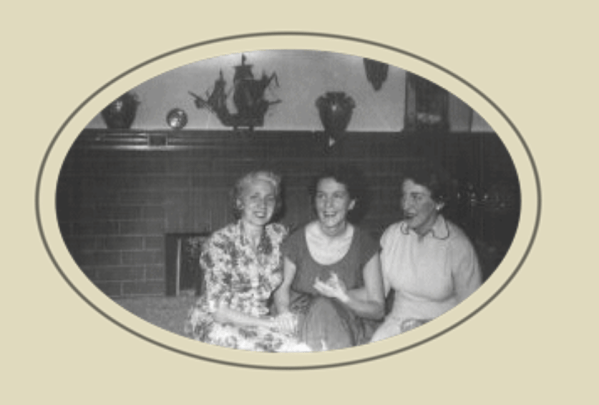
1955, My mom with her sisters.
And mixed in with the fin-de-siecle family treasures were her many multi-media artworks: sculptures, ceramics, watercolours. There were quite a few confusing (to me) religious subjects like bleeding hearts but also some adorable cherubim and many nature studies especially of flowers, birds and butterflies. Indeed, Cecile painted an immense peacock in full display on a wooden blind on the wall behind her bed. The tension between Eros and Thanatos in her beautiful Beaconsfield Avenue abode was quite evident to me, even as a child.
My mother had a very choppy relationship with her sister Cecile so even though we lived but a short bus ride away we didn’t visit her that often. – and I don’t recall her ever visiting us. Cecile’s hair went from red to grey between 1960’s visits I recall.
On at least one occasion I was sent on a sleepover. My aunt was awkward with me and I was determined not to like her, probably picking up on my mom’s vibes. It didn’t help that Cecile brought me to a scary Latin mass at Notre Dame Cathedral, pinning a silly handkerchief to the top of my head. Unfortunately, she did no art with me. Too messy I guess. Too bad as she was a wizard with pastels.
Cecile passed away in 1974 a year or two before her aged spouse. She was 65. My mother sobbed with grief at her passing. “You were always fighting with her,” I recall saying to my mom. “So why are you crying so much?” How naive of me.
All of the family heirlooms fell into the hands of ‘strangers’ upsetting my mother, but one lost canvas pained her in particular. “It was Cecile’s best painting,” she said, “of Alice putting a flower in Florida’s hair before a dance.”
Classic! I can hardly blame my mother for coveting that particular oil painting, one that involved all of her sisters: I wonder who owns it now.
Mon Oncle Amedee was so comically vague in his dotage, seated in his armchair snoozing away with an upside down Le Devoir newspaper folded onto his lap, we children assumed he was expert in some airy-fairy field like ancient philosophy. But, no, quite the opposite. A short search on the Web reveals that in the 1920’s Amadee was a civil engineer, Dean of a Technical College and expert in technical education giving lectures, meeting with policy makers, even writing a book.
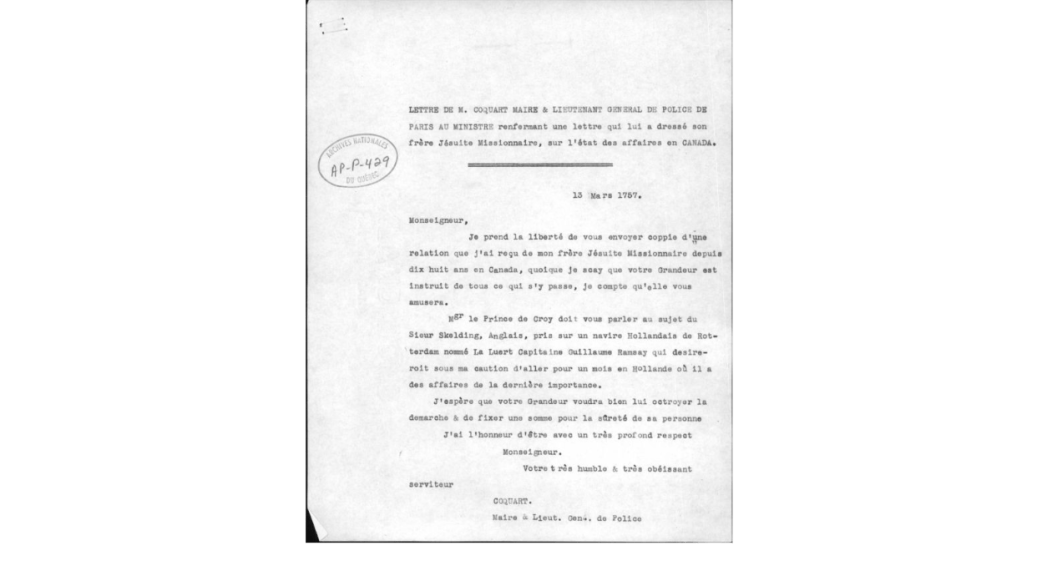
In the winter of 1749-1750, Jesuit Father Claude-Godefroi Coquart travelled through the Malbaie area of New France (now the province of Quebec) inspecting the lands owned by the King of France.
One of two farmers looking after this land was one of my ancestors, Joseph Dufour. Dufour’s farm was called “La Malbaie.”
Coquart’s written report to France describes the farm run by Dufour and his neighbours’ operation in great detail.
Author George McKinnon Wrong describes Coquart’s report on pages 17 and 18 of his 2005 book entitled “A Canadian Manor and Its Seigneurs The Story of a Hundred Years, 1761-1861”:
Father Coquart’s census is as rigorous and unsparing of detail as the Doomsday Book of William the Conqueror. He tells exactly what the Malbaie farm can produce in a year; the record for the year of grace 1750 is “4 or 6 oxen; 25 sheep, 2 or 3 cows, 1200 pounds of pork, 1400 to 1500 pounds of butter, one barrel of lard,”—certainly not much to help a paternal government. The salmon fishery should be developed, says Coquart. Now the farmers get their own supply and nothing more. Nets should be used and great quantities of salmon might be salted down in good seasons. Happily, conditions are mending. The previous farmer had let things go to rack and ruin but now one sees neither thistles nor black wheat; all the fences are in place. Joseph Dufour has a special talent for making things profitable. If he can be induced to continue his services, it will be a benefit to his employer. But he is not contented. Last year he could not make it pay and wished to leave. Nearly all his wages are used in the support of his family. He has three grown-up daughters who help in carrying on the establishment, and a boy for the stables. The best paid of these gets only 50 livres (about $10) a year; she should get at least 80 livres, M. Coquart thinks. Dufour has on the farm eight sheep of his own but even of these the King takes the wool, and actually the farmer has had to pay for what wool his family used. Surely he should be allowed to keep at least half the wool of his own sheep! If it was the policy of the Crown to grant lands along the river of Malbaie there are many people who would like those fertile areas, but there is danger that they would trade with the Indians which should be strictly forbidden.”
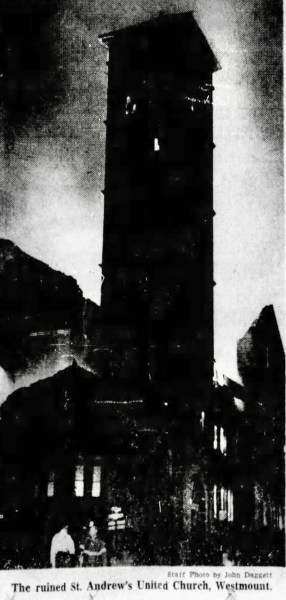
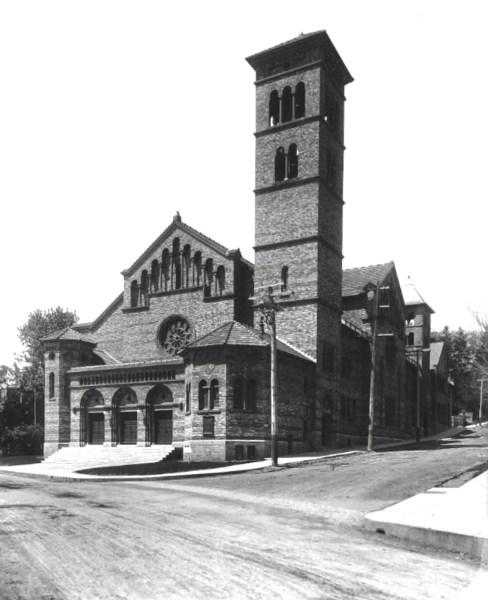
The night St. Andrews United Church, Westmount was razed by fire in 1965, I was thirteen. The whole sanctuary gone. Stained glass windows, memorials to many, melted, the organ burned and the small tower toppled. Charred red bricks littered Staunton Street. Only the tall tower and walls remained of the 57-year-old church.
Montreal Star Aug 4, 1965
This devastating fire occurred, even though the church sat just across the street from the Westmount fire station. The caretaker lived in the back of the building and when he smelled smoke in the afternoon, he went across the street to the fire station. The firemen looked through the whole church without finding anything amiss. They closed the fire doors to the Sunday School and left. Around midnight the church was engulfed in flames and all the firemen in the city couldn’t save the building. It was determined that the fire started in the basement under the sanctuary and hidden there, smouldered for hours. The minister, Reverend D.M. Grant holidaying in Nova Scotia was awakened with a telegram saying his church was burning.
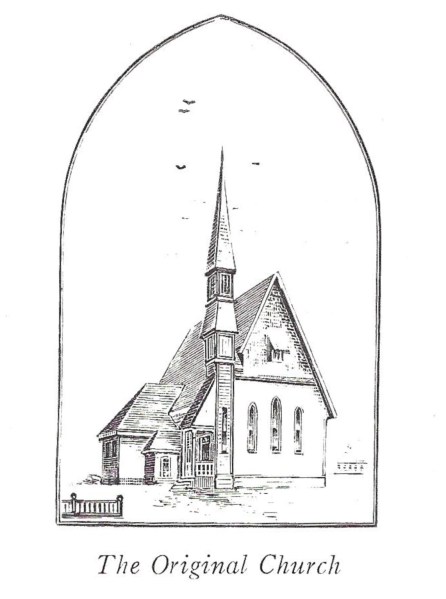
My family was not some of the early Westmount Presbyterians who worshiped in the Mission School from 1869 until 1886. They weren’t even members when a small frame church, Melville Presbyterian, was built on the corner of Cote St Antoine and Stanton St.
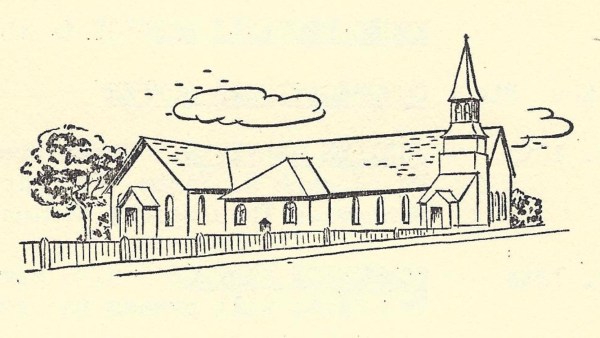
Church with an addition
According to the booklets written for the Church’s golden and diamond Jubilees, St Andrew’s Church in Westmount was formally founded in 1900. “A difference of opinion caused the division of the members. One group retained the name of Melville Presbyterian Church and moved to Melville Ave where they built a new church. The other group, retained the present church site and became St Andrew’s Church.” In the newspapers of the day I found the reason for the split, alcohol consumption! When Rev. T. W. Winfield was hired, “a promise was extracted from the Reverend gentleman that he would refrain from intoxicating liquors while pastor of Melville Church.” Some members accused him of breaking that promise. The minority moved with the Minister and took the Melville name while the majority stayed in the building and chose the new name St Andrews Presbyterian.
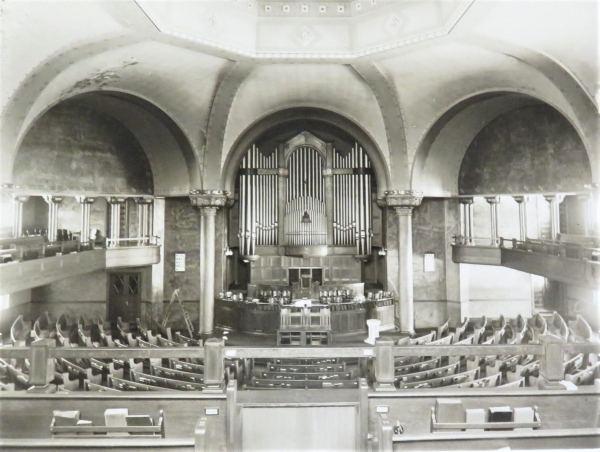
This congregation continued to grow, so in 1908 the red brick church was built. The large sanctuary, surrounded on three sides with balconies held 1100 worshipers. There was a rose window over the front doors and many other stained glass windows on the side walls. It was one of the Presbyterian churches that united with the Methodists and the Congregationalists in 1925 and became St. Andrews United Church.
St Andrew’s Church 1908-1965
I spent many hours in St Andrews Church growing up, as did my father. My grandparents joined the church when they moved from Chomedy Street to Grosvenor Ave in 1912. My grandfather, William Sutherland was a church elder and later so were both my parents. My grandmother Minnie Eagle Sutherland was very involved in church life being president of the Women’s Missionary Society and the Women’s Christian Temperance Union. My mother taught Sunday School and was the head of the Primary department for many years.
Church Interior photo by Alfred Peter Jorbes
We went to Church and Sunday School every week and won prizes for attendance. It was a church of many staircases. The hall behind the church had three sets and before and after church children would run around, up and down the stairs and through the halls. A back staircase off the kindergarten room led down to the basement. It was dark and gloomy and we would only venture down a few stairs before running somewhere else.
I remember Christmas pageants with Roman soldiers in costumes, clanking down the aisle with swords, helmets and leather skirts. I so admired the angels in their light blue satin dresses with wings that I wished I could be one. I was promised I could be an angel the next time they had a pageant but before that happened, the church burned including all the costumes stored in the basement.
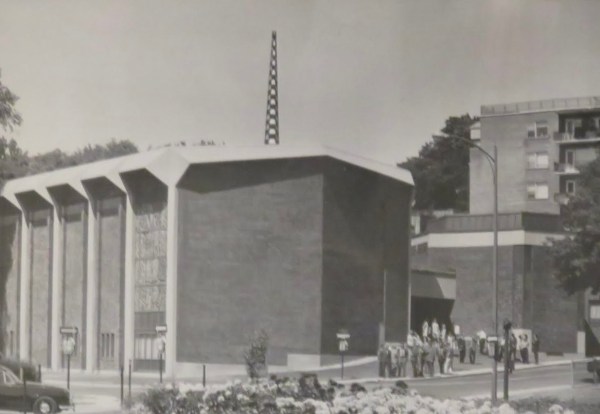
After the fire, the Church was rebuilt although with some controversy and another split. Some of the congregation left because they thought the million-dollar insurance money should be put to better use than having three underused United Churches in Westmount. They were out-voted and the new modern church opened in October 1967. It only held 500 people.
The rebuilt Church 1967
The congregation continued to age, fewer young families joined and people such as myself attended irregularly. St Andrews and Dominion Douglas United, amalgamated in 1985. The committee discussed which church to keep. Dominion Douglas, an old stone church on The Boulevard became the new home with the St Andrew’s congregation moving up the hill. Selwyn House School, across the street, bought St. Andrews. for their expansion. The chapel, including stain glass windows was deconstructed and rebuilt in the Dominion Douglas basement. In 2004 Erskine American United Church, on Sherbrooke Street joined St. Andrews-Dominion Douglas and another name was needed. The congregation became Mountainside United Church.
In less than twenty years Mountainside United Church became impossible to maintain and heat with a diminishing congregation. That building was sold to a developer and the congregation moved to the Birks Chapel on the McGill Campus. I have not attended a service there.
References:
Church Fire: The Montreal Star; Aug 4, 1965 page 3. Downloaded from newspapers.com Dec 29, 2022.
Westmount Mayor Praises Firemen: Montreal Star; August 10, 1965 page 6. Accessed from Newspapers.comDecember 29, 2022
Rising from its Ashes: Montreal Star; June 3, 1967 page 58 Accessed from Newspapers.com December 29, 2022.
Melville Church Difficulty: Montreal Gazette; 28, March 1900 page 10. Accesses from Newspaper.com January 25, 2023.
Date of Separation: Montreal Star; 12 May 1900 page 10. Accessed from Newspapers.com January 26, 2023.
St Andrew,s Church Golden Jubilee Celebration Bulletin November 5th to 12th 1950. IN the hands of the author.
Our Heritage St Andrew’s Church Diamond Jubilee 1900-1960 booklet. In the hands of the author.
Notes:
The back annex which housed the Sunday school was saved by the fire doors. Books and papers recovered from the Sunday school were stored in our basement for a time but they continued to smell of smoke and were later discarded. The manse next door was also saved but torn down for the new church.
After the church fire may local churches and synagogues offered the congregation space to worship including Melville Presbyterian Church. I went to confirmation classes at Melville but we had Sunday services in the auditorium of Westmount High School.
Melville Presbyterian Church was built on Elgin Avenue later changed to Melville Avenue, facing Westmount Park. It is now Holy Trinity Serbian Orthodox Church. After the founding of the United Church in 1925, Melville Presbyterian Church amalgamated with Westmount Methodist to form Westmount Park-Melville United Church. The combined congregation worshipped in the Melville Church building for two years, until it was sold [back] to former members who remained with the Presbyterian Church. Victoria Hall served as a temporary site while the new Westmount Park-Melville Church, which is now known as the Westmount Park United Church was built on the western edge of Westmount Park.
Relating this to my husband, John, he mentioned a memory of his maternal Uncle Ben and his Uncles’ time as a POW in Japan.
It was all second-hand because Benjamin Ronald Hughes died the year my husband was born, in 1948. However, John did have stories from his Mum, about her brother. According to her Uncle Ben suffered terribly during his 3 years as a prisoner.
Ben was born on the 27th of March 1910 the only boy in the family of six in the Toxteth area of Liverpool, Lancashire. His occupation was a messenger. That could have been for the Post Office delivering telegrams or perhaps riding a bicycle delivering groceries and goods.
When Uncle Ben was 15 years old, he joined the Royal Navy as a second-class boy entrant. When he reached 18 years old, in 1929 he was by then a Boy First Class and volunteered again, as an adult Able Seaman, and was posted to HMS Egmont II on 25 September 1931.
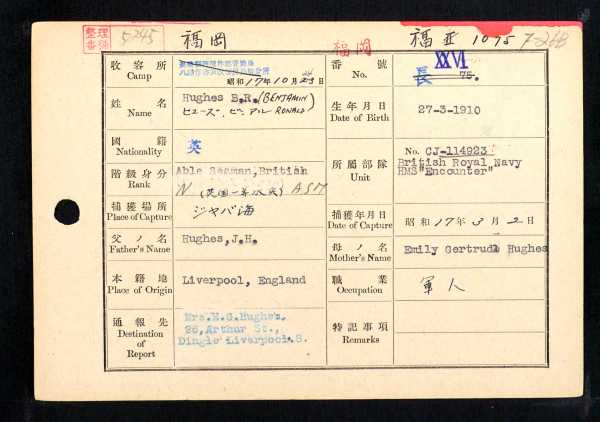
During his service, Uncle Ben served on 15 various Royal Navy ships. War was declared on the 1st of September 1939. On the 1st of March 1942, after three years of fighting, Uncle Ben was reported missing to his family. He was listed as a prisoner of war, by the Japanese. When captured and according to his Japanese POW file below, he was on HMS Encounter which had picked up allies from Malaysia and was scuttled (sunk) by her own crew, after being damaged by gunfire from heavy Japanese heavy cruisers in the Java Sea.(1)
Whilst researching I managed to find Ben’s Japanese POW information. There was not much on it, and I don’t read Japanese. I wanted to find the name of his camp and what he would have laboured at.
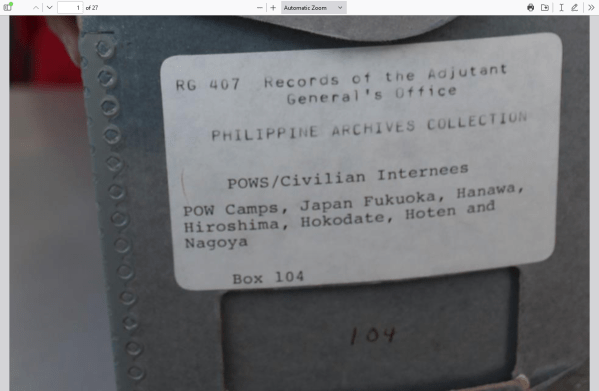
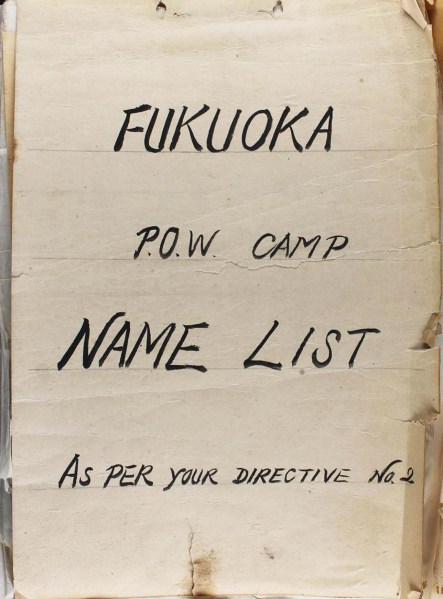
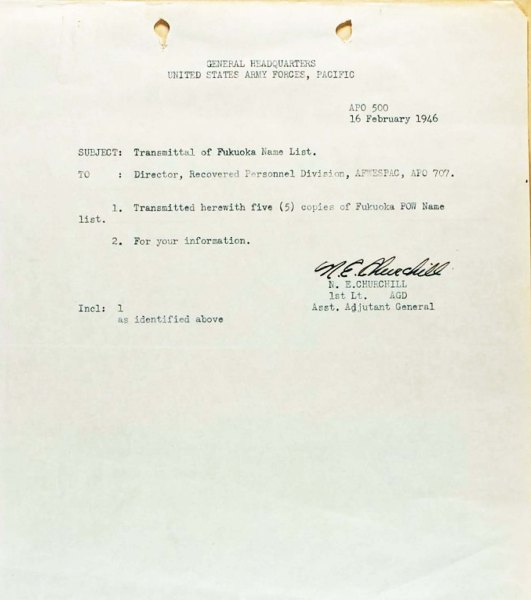
Eventually, I found that he was a POW in Fukuoka- Camp 26 prisoner number 51. The link(2) lists all the prisoners with information on nationality, name, age, and home address. it does make for interesting reading. There were British, Australian and two Dutch prisoners. The servicemen listed were Royal Navy and Army. ALL the men apart from eleven who had obvious illnesses, were listed as ‘Healthy’. The camp prisoners were used for labour in mines in this particular area of Japan.
The first pages of prisoners’ information.
At the war’s end, in 945, Uncle Ben was in the Royal Naval Hospital Chatham, in Kent. It states on his Service Record that he was Invalided out of the Royal Navy from RN Hospital Chatham on the 7th of August 1946. He would have spent time recovering from his terrible experiences.
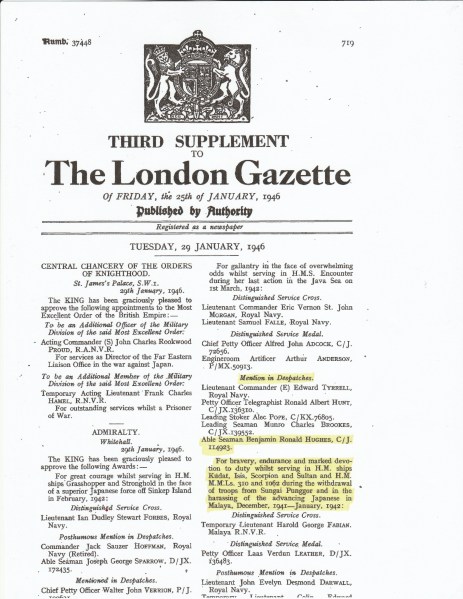
He was granted a war gratuity and a medal. Later, on the 25th of January 1946. Benjamin Ronald Hughes is ‘Mentioned in Dispatches in the London Gazette. It reads as follows.
“Able Seaman. Benjamin Ronald HUGHES, C/J. 114923. For bravery, endurance and marked devotion to duty whilst serving in H.M> ships Kuda, Isis, Scorpion and Sultan and H.M. M. MXS, 310 and 1062 during the withdrawal of troops from Sungai Punggor and in the harassing of the advancing Japanese in Malay, December 1941 – January 1942“.
My mother-in-law told her son John, that when Uncle Ben returned to his home in Liverpool he was a wreck. Emaciated, haunted, ill and looking twice his age. He was 36 years old. Uncle Ben did not live long to enjoy life and died in 1948 at the age of 38. Because of his young age, a Post Mortem was performed and he was found to have died of bacterial endocarditis. RIP Uncle Ben.
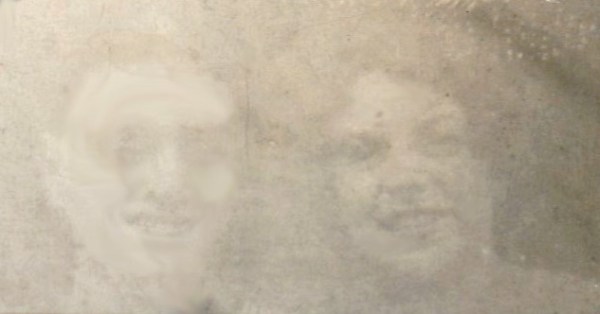
This ‘Ghost’ photo of Ben with his wife, Jessie, is the only photo we have.
Keisen Yoshikuma Coal Mine Branch Camp (Fukuoka 26-B) Established as Fukuoka No.26 Branch Camp at Yoshikuma Coal Mine in Keisen-cho, Kaho-gun, Fukuoka Prefecture on May 10, 1945.
The POWs were used for mine labour by Aso Mining Company. The son and heir Taro Aso was a past President of Japan in 2008 and the controversy surrounding his family’s use of Korean and Allied POW labour clouded his term of office.
During the “White Rice Period”, lasting from January to October 1942, Allied prisoners were granted a maximum of ten ounces of rice per day, in addition to two ounces of rancid pork and four ounces of fish monthly. This official figure was often larger than that provided, with theft by Japanese soldiers, themselves suffering from starvation towards the latter days of the war, commonplace within the camps. Red Cross parcels, containing necessary essentials, were accepted by the Japanese authorities, but rather than being redistributed among the prisoners were kept by the Japanese soldiers themselves.
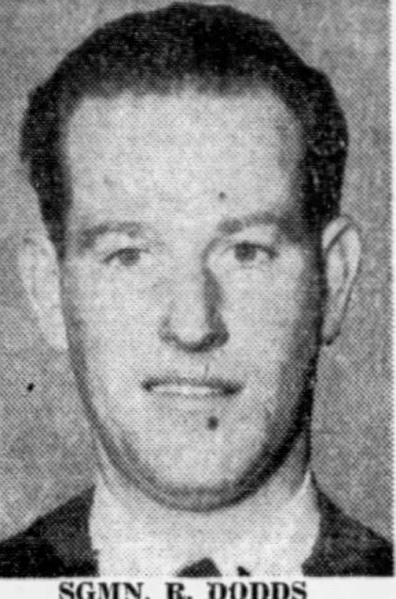
My aunt, Sarah Jane McHugh, was delighted to host the linen shower to celebrate her daughter, Dawna Day’s upcoming marriage to Ralph Dodds. The happy couple announced their engagement in October 1947. Ralph had recently been discharged after serving in the Royal Canadian Navy for over six years. The couple’s wedding would take place in Vancouver, Ralph’s home town. Dawna was from Montreal.
Ralph was just 20 when he started his navy career in Esquimalt, British Columbia in 1939.1 With the advent of World War II, the Esquimalt Navy base became the largest naval training center in western Canada. 2 Ralph Dodds trained to become a signalman would have learned all aspects of military communications in the Canadian Navy. He would have used semaphore flags, read and transmitted morse code messages, and assured radio communications.3 During his training, Ralph would not have predicted that he would participate in the sinking of a German U-boat during the Battle of the Atlantic, that he would be on a destroyer that participated in a sea fight on D-Day, or that the destroyer he was on would be shipwrecked off the coast of Iceland.
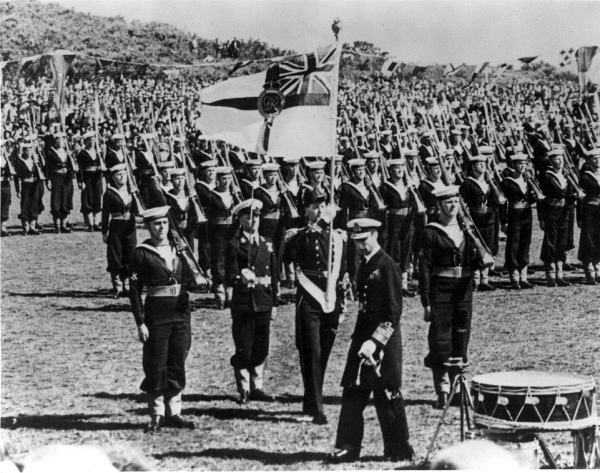
King George VI presents the King’s Colours to the Royal Canadian Navy at Beacon Hill Park, Victoria, 1939. Photo: CFB Esquimalt Naval and Military Museum collection
While Ralph was assigned to a naval station, and to a corvette (small destroyer), for most of his naval career, he was assigned to the HMCS Skeena.
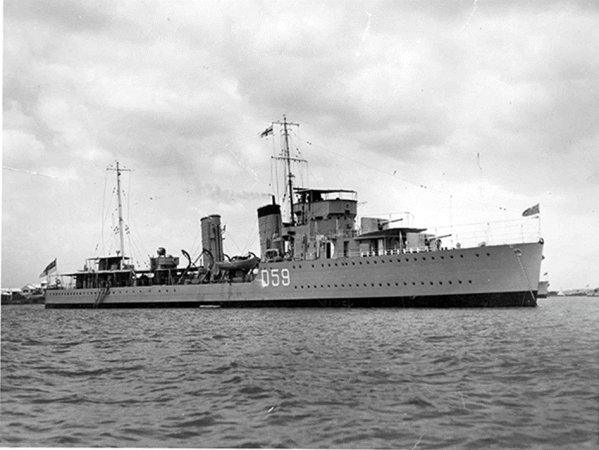
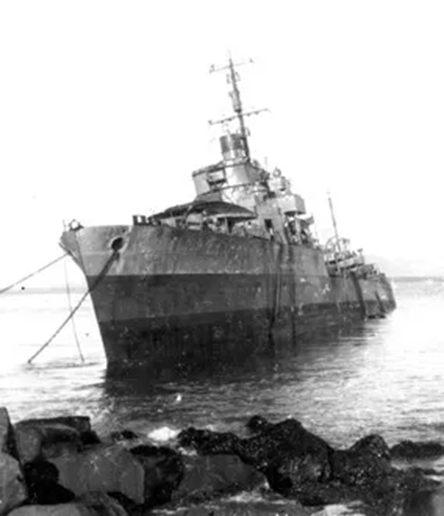
HMCS Skeena, D59, Government of Canada website, Ships’ histories
The HMCS Skeena was commissioned in 1931 in Portsmouth, U.K. and was one of the first two ships built to Canadian order. With the outbreak of the war, the Skeena initially performed domestic escort duties. In May 1940, she was sent to Plymouth, U.K. and became part of the Western Approaches Command, taking part in the evacuation of France and escorting convoys in British waters. She was later assigned to continuous convoy duty.
During one of its escort duties in the Atlantic, the Skeena destroyed U-boat U-588. This happened during ON-115 (ON means Outbound to North America). There were twelve escort ships for a trade convoy of 43 merchant ships that left Liverpool on July 12, 1942. On July 29, seven U-boats of the Wolfpack Wolf had spotted them. This Wolfpack was quickly joined by another six U-boats of the Wolfpack Pirat. The Wolf Pack tactic, or the “Rudeltaktik,” was devised to attack the Allied convoy system by forming into position effecting a massed organized attack.4 This particular battle resulted in the loss of three of the ships in the convoy and significant damage to two of the ships in the convoy. One of the damaged ships returned to the U.K. and one was escorted to St. John’s, Newfoundland. The Skeena, on which Ralph was a signalman, and the HMCS Wetaskiwin, an escort corvette, destroyed U-boat 588 with depth charges (antisubmarine missiles) on July 31. The hostilities lasted until August 3 when the U-boats lost contact with the convoy due to misty weather. The convoy with the remaining ships reached Boston on August 8, 1942.5
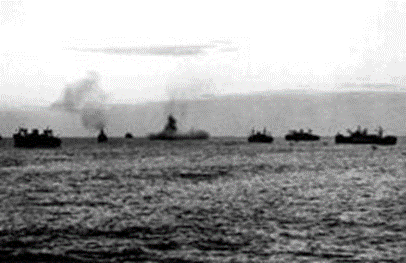
The sinking of American freighters, Edward Rutledge, Tasker H. Bliss and Hugh L. Scott at Fedala Roads, November 12, 1942
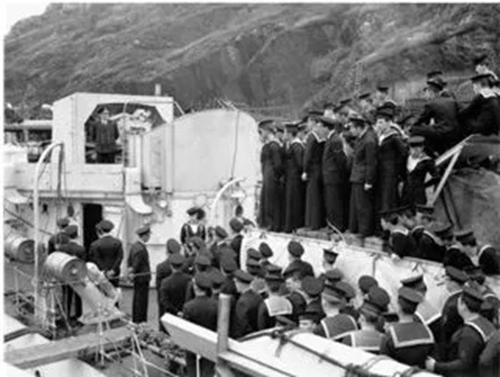
Commodore Leonard Murray congratulating the ship’s companies of HMCS Skeena and HMCS Wetaskiwin for sinking the German submarine U-588 on 31 July 1942. St. John’s, Newfoundland, Aug. 4, 1942. (NAC PA-115347)
The Skeena also participated in a hot sea fight in the Channel on D-Day. The Skeena’s assignment was to prevent enemy U-boats from attacking Allied ships while the Invasion of France was being carried out.
“Torpedoes were shooting about in the Channel and missed the Skeena by only a matter of feet,” said Ralph in an interview he gave to the Vancouver Sun.
The destroyer also had to contend with German Dorniers (bombers) that were bombing the destroyers in the Channel. One of the aerial missiles fell so close to the Skeena that shrapnel was later found on the deck.6
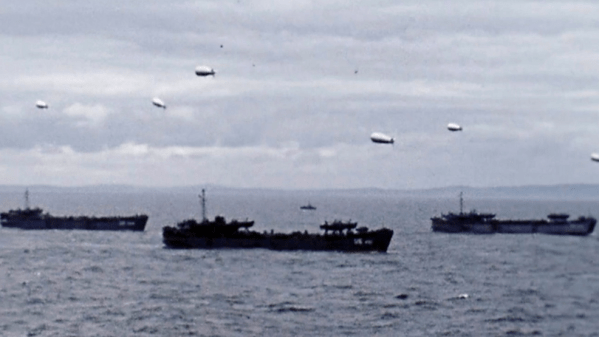
Ships and blimps sit off the coast of France on D-Day, June 6, 1944. War Footage From the George Stevens Collection at the Library of Congress
After five years of war, the HMCS Skeena met her end as she sheltered from a violent gale with 15-metre waves off the coast of Iceland, at Videy Island on October 24, 1944. Even though the crew had thrown out a second anchor to secure the ship, the Skeena smashed into the rocks. When the crew abandoned ship, the men were unable to hold the lines. Some crew members were smashed into the rocks, while others were tossed into the sea. Fifteen sailors died.7 Ralph Dodds survived.
… and now his church celebrates its 200th Anniversary in 2023
(upcoming celebration details below)
The deed described the property as “a commodious estate upon the outskirts of the thriving town of Halifax, in the Colony of Nova Scotia, Canada”. Imagine William’s surprise to arrive in Halifax in February to discover that “outskirts” meant a 200-mile hike through thick forest and deep snow!
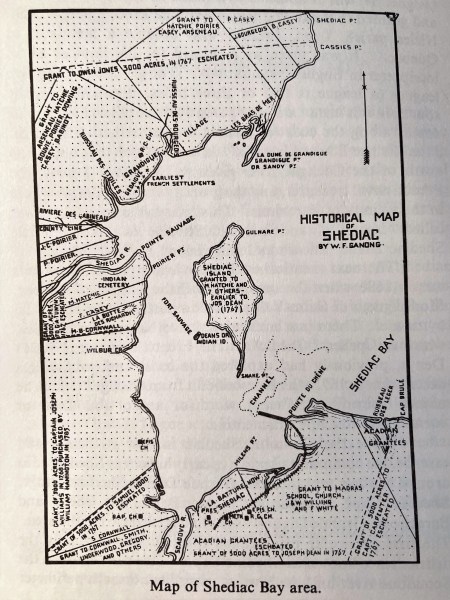
My great-great-great grandfather, William Hanington, was born in London, England, in 1759. As the son of a fish dealer, he trained as an apprentice to the Fishmonger’s Company but became a freeman in 1782. Two years later, at the age of 25, this adventurous young man paid £500 sterling for 5,000 acres of land “near” Halifax, Nova Scotia, from Captain Joseph Williams.
After the initial shock upon their arrival, William and his companion found an Indian guide, loaded all their worldly belongings onto a hand sled, trudged through the snow, slept in the open and finally arrived in bitterly cold Shediac in March 1785. His discouraged companion quickly returned to Halifax and sailed back to England on the first available ship!
Large Lower left piece of land belonged to William Hanington 1785
William, however, was obviously made of sturdier stuff and delighted by what he found! A good size stream flowed into the bay and he had never seen such giant trees! He must have pictured the lucrative possibilities for trade in lumber, fish, furs and more.
Seven years after his arrival in Shediac, at the age of 33, he hired a couple of Indian guides to paddle a canoe over to Ile St. Jean (now known as Prince Edward Island) where there were other English settlers. The Darbys were Loyalist sympathizers who escaped from the rebels in New York. While riding along in an oxcart through St. Eleanor’s (now known as Summerside), he spotted a young lady (age 18) named Mary Darby, drawing water in her father’s yard. After a brief stay with her family, William and Mary married and paddled back to Shediac where they eventually raised a large family of 13 children.
After the first three years together, they persuaded Mary’s sister Elizabeth and her husband John Welling to come over from Ile St. Jean and settle on their land – becoming the second English family in Shediac.
And in the next five years, William boasted eight families on his property of about one hundred acres of cleared land. He opened a general store and dealt in fish, fur and lumber. The furs and timber were shipped to England and the fish to Halifax and the West Indies! He imported English goods from Halifax and West Indies products – mainly sugar, molasses and rum from St. Pierre. He also bartered with the friendly Indians for furs and helped them clear land.
Before long, a considerable village clustered about the Hanington Store – including a post office and a tavern. William remained the leading figure of the community and acted as the Collector of Customs of the Port, Supervisor of Roads and Magistrate enabling him to officiate over the marriages of many couples. To top it all off, in 1800, just 15 years after his arrival from England, this remarkable young man built a shipyard 10 miles north of Shediac in Cocagne.
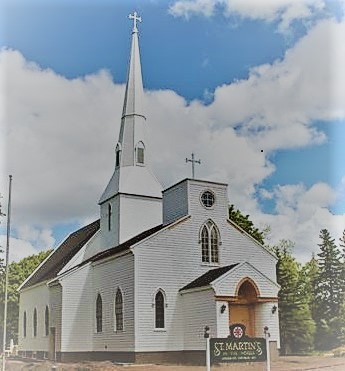
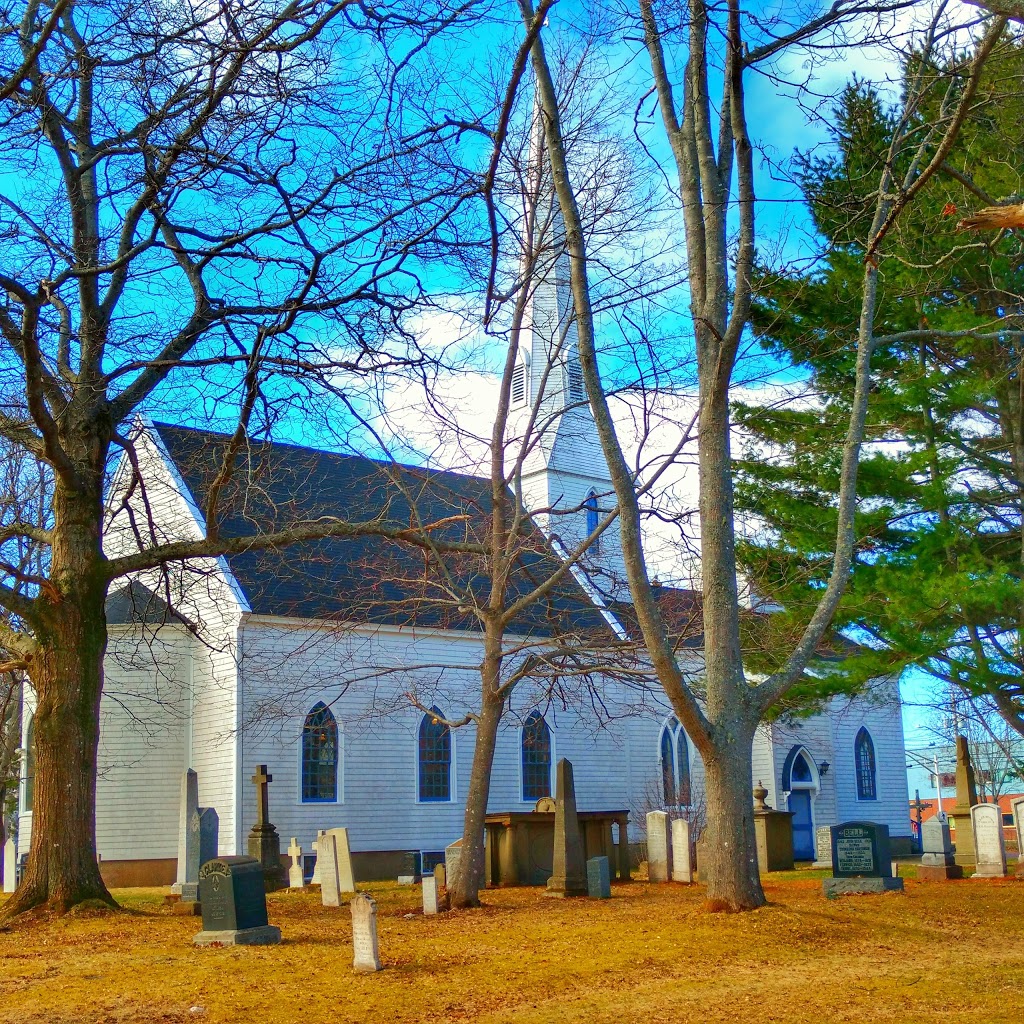
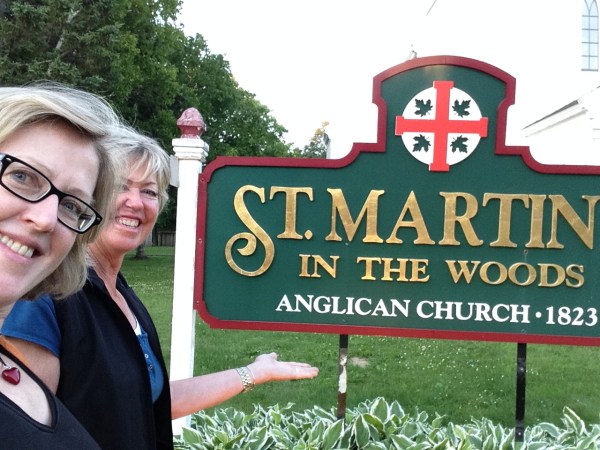
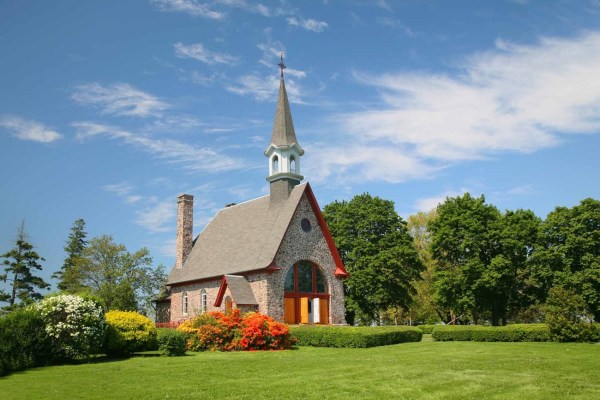
The only thing lacking in this delightful little community was a church. Until then, William being a religious man, conducted service in his home every Sunday and welcomed all to attend. Then in 1823, William donated the necessary land and lumber and oversaw the completion of St. Martin-in-the-Woods, the first Protestant church. He named it after his church in England; the famous St. Martin-in-the-Fields overlooking Trafalgar Square in London.
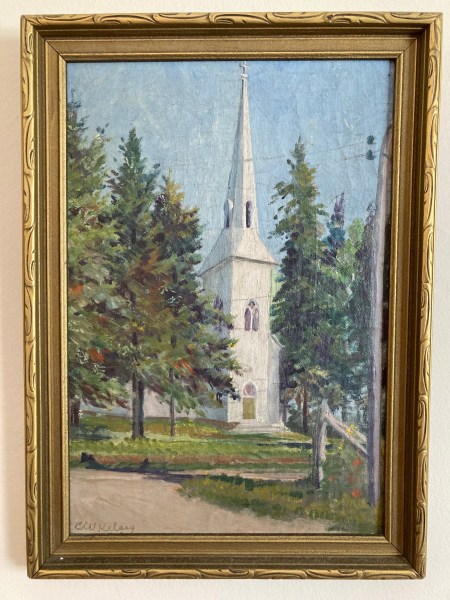
Painting of
St Martin-in-the-Woods Church
by Charles Kelsey
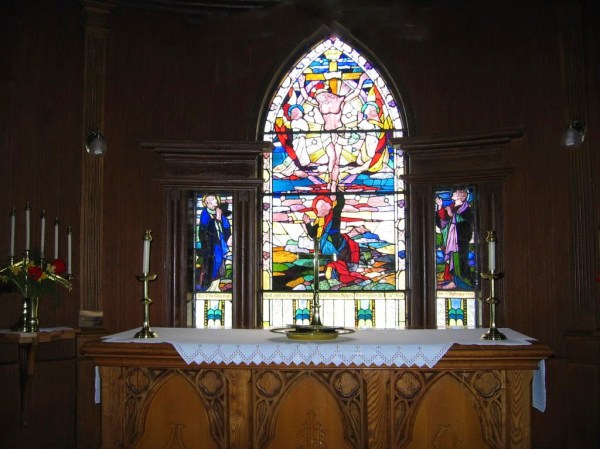
In 1934, my grandfather Canon Sydenham Lindsay (Shediac summer resident at Iona Cottage – She Owned A Cottage – with his wife Millicent Hanington and sometimes stand-in priest at the church) dedicated a large memorial stain glass window in the sanctuary to his father-in-law, Dr. James Peters Hanington (1846-1927) who was my great-grandfather and William’s grandson. The window was designed and installed by Charles W. Kelsey of Montreal and described as follows:
“The centre light of the window represents the Crucifixion, with Mary Magdalene at the foot of the cross, while the two side windows represent the Blessed Virgin Mary and Saint John the Evangelist.” (1934 – The Montreal Gazette)
Stain Glass Window in St Martin-in-the-Woods (photo credit Paul Almond)
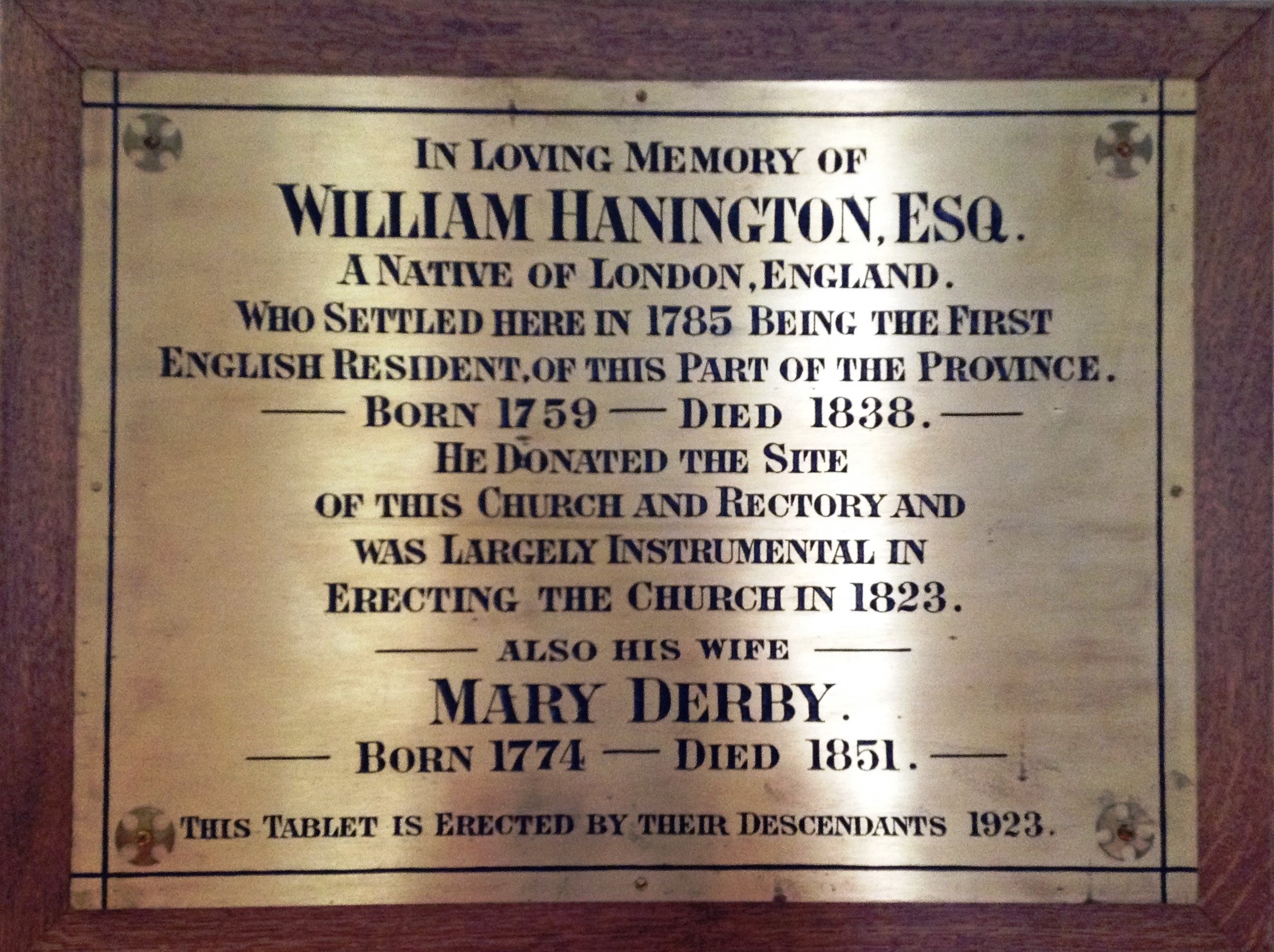
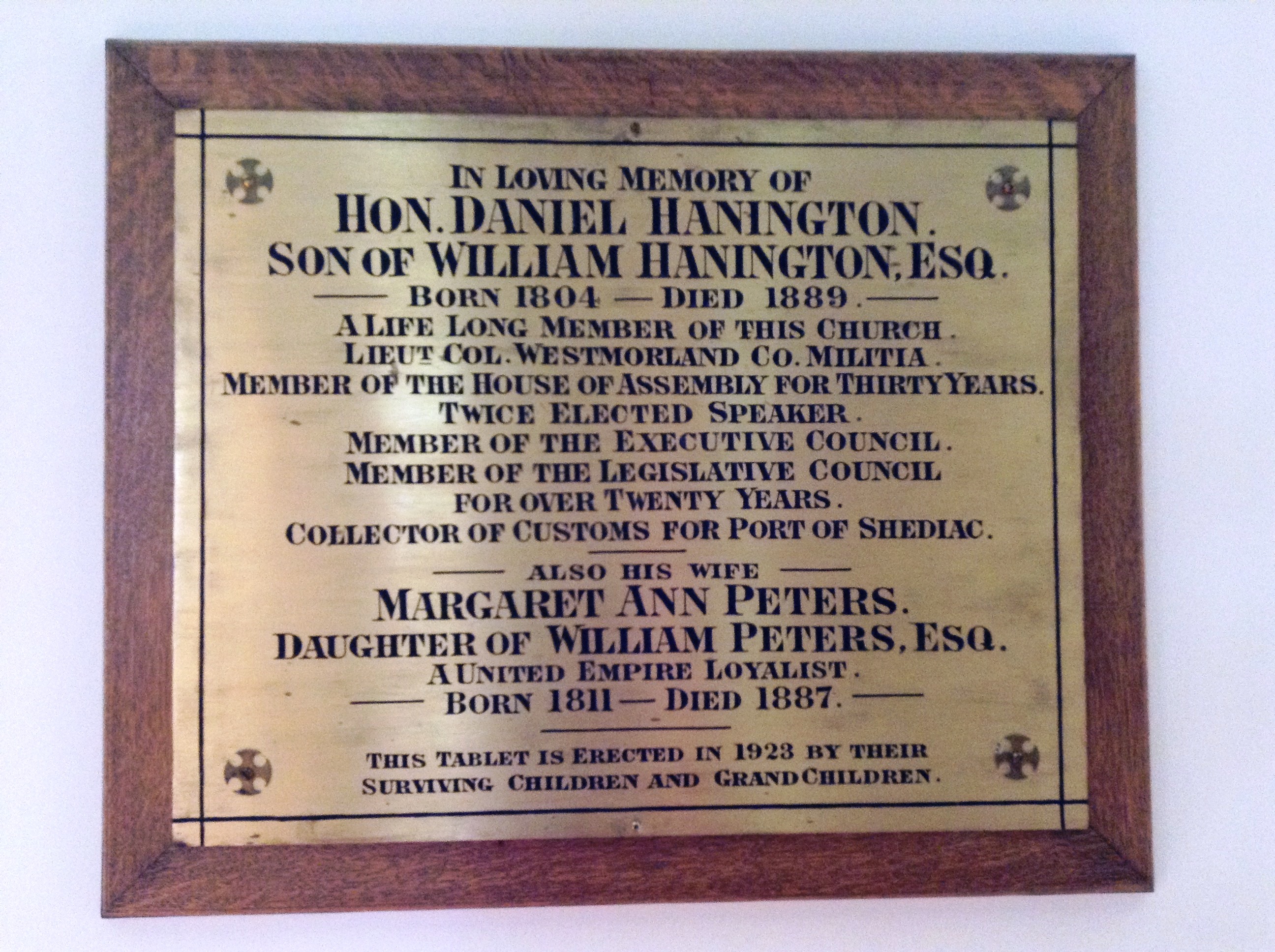
Also mounted inside on the church’s side walls are two honourary brass plaques. One in memory of William and his wife and one in memory of his son Hon. Daniel Hanington (1804-1889) and his wife Margaret Ann Peters – my great great grandparents.
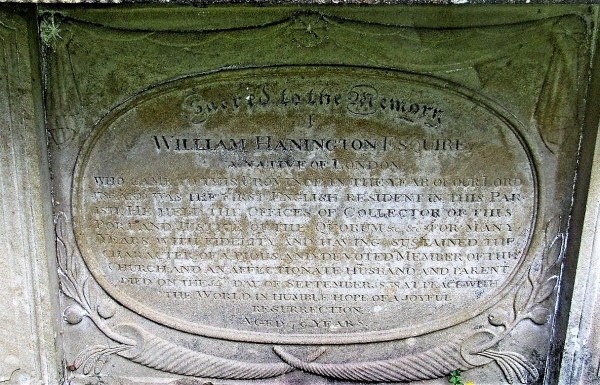
William died in 1838 at age 79. A huge memorial of native freestone marked his grave, in the cemetery beside his beloved church nestled in the community of Shediac, where he spent a lifetime building a “commodious estate” from a forest of giant trees.
Two hundred years later on this anniversary of the St. Martin-in-the-Woods church, William and Mary are lovingly encircled by the graves of several generations of their descendants.
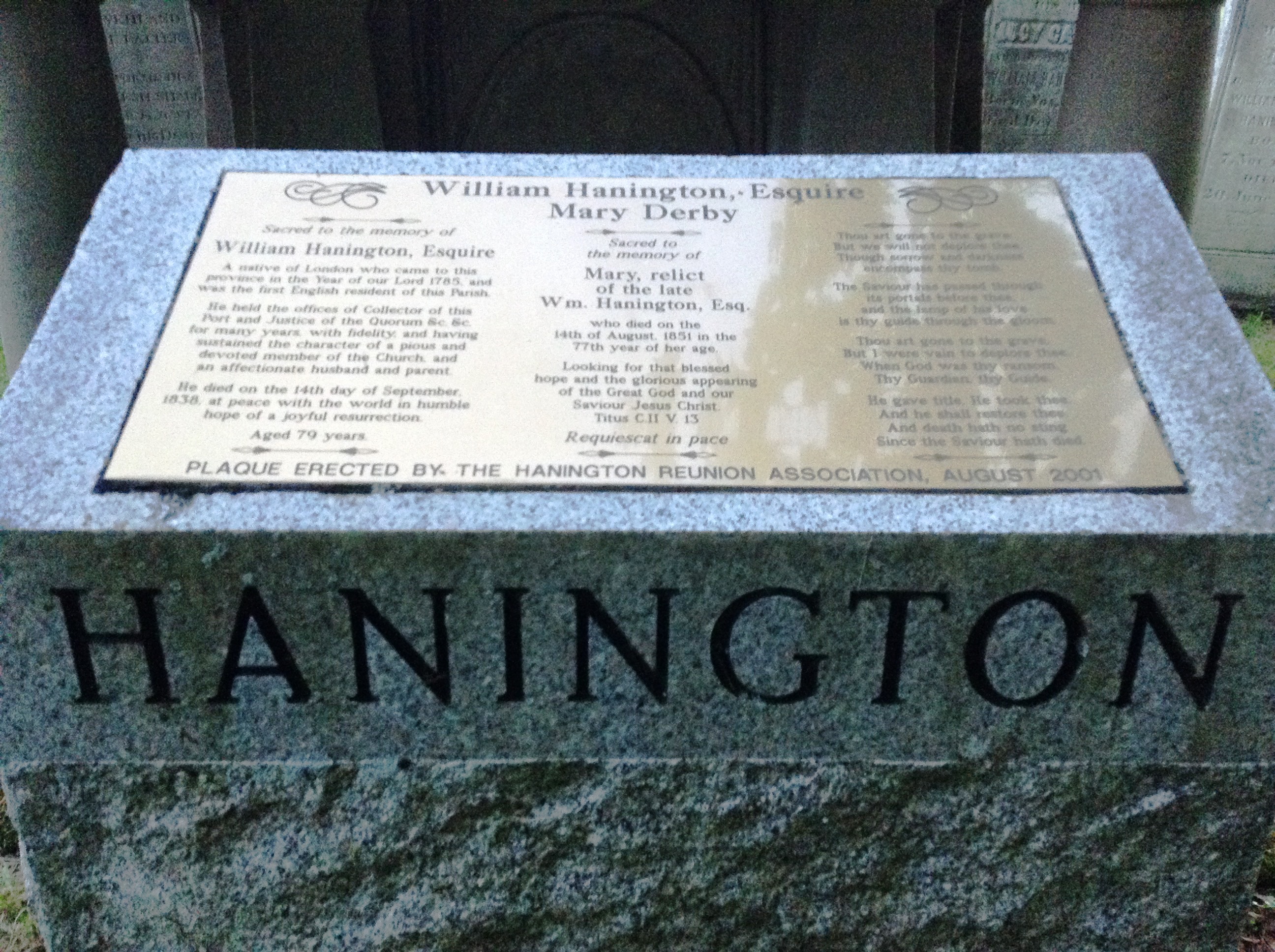
A memorial plaque to William and his wife Mary, was erected in 2001 by the Hanington Reunion Association. This year the Association will be adding a bench in the cemetery in celebration of the 200 years.
Close-up of theHeadstone of William Hanington (1759-1838)
(L)Hanington Reunion Association Plaque (2001) honouring William Hanington and his wife Mary Darby and (R) photo by Scotty Horsman showing William’s large headstone at the side of the church.
In 2015, my sister and I visited the church and our ancestors in the graveyard and also enjoyed meeting some Hanington cousins as well!
ANNIVERSARY CELEBRATION DETAILS FOR SEPT 16-17, 2023:
The main events for the 200th Anniversary will be Sept. 16th and 17th with a corn boil, hotdog/hamburger barbecue and cake on Saturday, Sept. 16th. There will also be games, a bonfire, fireworks and music at the church shore.
The Anglican Bishop, David Edwards, of Fredericton will be attending this celebration. He will also be at the 10:30 AM church service on Sunday, Sept. 17th. After the church service there will be a pot luck lunch and a skit in the hall. There will also be items on display in thechurch basement and in the hall. There will be items for sale – glasses, mugs and lapel pins, with the Hanington crest as well as lapel pins. ornaments and trivets with the church on them.
“Renowned historian Marcel Trudel in one of his many books described the above time period as; TheFailed Attempts of the French Colonies of Canada prior to New France.
Among the many authors, historians, archivists selected, few agree that the period of time prior to Samuel de Champlain in both Acadia and Quebec, the administrators, governors appointed by the kings of France in comparison to those appointed by various kings of England who administered the New England British Colonies were no match to those residing in Boston, Massachusetts.
Many historians are also in agreement that New France needed more individuals of the high calibre of Jean Talon who served as intendant (administrator) of the French colony from 1665 to 1668 and 1670 to 1672.
Still the colony survived until September of 1759 at the Plains of Abraham.”
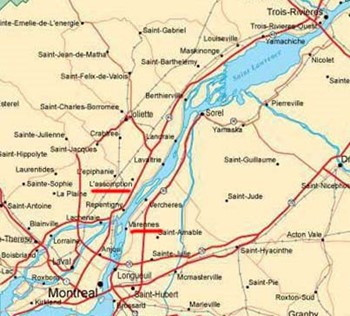
No one knows how their lives will take shape over the years. Little did my fourth great-grandfather, Joseph Antoine Gauthier dit Landreville know the path that lay before him. Joseph Antoine was one of 9 children, born in the midst of winter, February 20, 1731 to Jean Gauthier dit Landreville and Therese Moreau dite Latopine in Varennes, a village west of Ville Marie ( Montreal) on the banks of the St. Lawrence River
Baptism of Joseph Antoine Gauthier
Map of the area including Varennes and L’Assomption
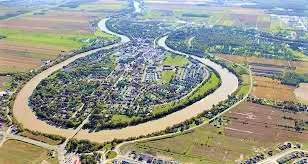
“In 1647, the L’Assomption Seignory was granted to Pierre Legardeur de Repentigny, named after the river, already named such since the seventeenth century. Between 1640 and 1700, a settlement formed inside a large horseshoe-shaped meander of the L’Assomption River. Amerindians had already been visiting this site since ancient times and called it Outaragasipi meaning widening river, in reference to the river’s course. They would drag their canoes across the peninsula as a short-cut for the meander, and therefore the settlement was first called Le Portage.
In 1717, the parish was formed, known thereafter as Saint-Pierre-du-Portage-de-l’Assomption and also as Saint-Pierre-et-Saint-Paul-du-Portage. In 1766, the village saw an influx of Acadian settlers. Between 1774 and 1888, L’Assomption was the most prosperous and important town between Montreal and Trois-Rivieres. 3.”
When Joseph Antoine was almost 25 years old on the 12th of January 1756, in L’Assomption he married a young 23-year-old widow, Agathe Laperche dit Saint Jean, along with her young daughter, Marie. The young couple had 2 sons, Joseph, and Pierre.
Almost 4 years into their marriage tragedy struck with no mention as to the cause, Agathe died leaving Joseph Antoine with three young children. Guardianship was arranged for the children.
Below is a translation of the first several lines of the above burial record for Agathe Laperche dite St Jean 4.
In the year seventeen hundred and fifty-nine, the 25th of November by the undersigned priest Vicar of this parish inhumed in this cemetery the body of Agathe Laperche dit St Jean spouse of Joseph Gautier Landreville at the age of twenty three who died yesterday…..
Three long years passed.
In February of 1762 Joseph Antoine married his second wife, 19-year-old, Louise Gregoire. Within three months tragedy struck and she, along with 9 other young women perished while crossing the Assomption River.
Marriage record of Louise Gregoire and Joseph Antoine Gauthier dit Landreville 5.
Below are the first two and half lines translated from the above Marriage record of Joseph Antoine to Louise Gregoire.
Joseph Gauthier dit Landreville widower of Agathe Laperche from this parish on one part and Louise Gregoire daughter of defunct Basil Gregoire and Marie Clemence Proulx, mother from this same parish declare no impeachment to this marriage.
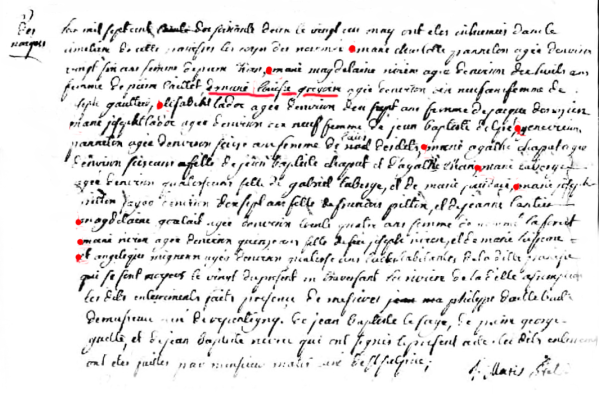
Three months after their wedding tragedy struck and Louise, along with 9 other young women perished while crossing the Assomption River on the 20th of May 1762. They ranged in age from single girls 16 -17 years old and young wives who were around 19 or 20. Were they returning home to their farms across the river from the village?
The Assomption River meanders forming a peninsula around the village.6.
The above is the burial record of Louise and the other young ladies who drowned in the Assomption River. 7.
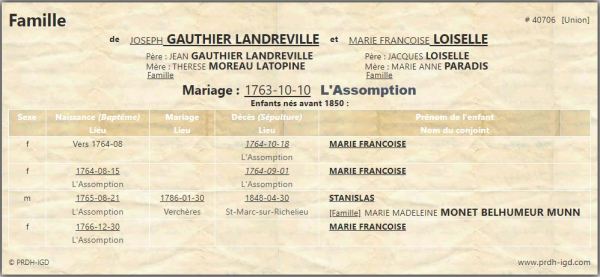
A year and half after Louise’s drowning Joseph Antoine married for the third time in October 1763. Both he and his new bride, Francoise Loiselle, were born in the same year, 1731, and were now 32 years old.
Marriage of Francoise Loiselle and Joseph Antoine 8.
On August 15, 1764, Francoise gave birth to a daughter Marie Francoise, however, the baby’s stay on earth was very brief and she died two weeks later. Another year went by and on August 31, 1765, Louis Stanislas was born. He had a long life and died at the age of eighty-three. Francoise on the other hand was not as fortunate. Her life was cut short. After less than three years of marriage to Joseph Antoine, she died in January 1767.
At this point in his life, Joseph Antoine at age thirty-six had been married three times, lost a daughter, buried three wives, and now had five children between 2 and 14 years of age in his care, no doubt a daunting task. How would he cope? Where would he find the courage and strength to continue? His life thus far adhered to the saying “Things come in 3s” or “Jamais deux sans trois”.
When were the tragedies going to end? He had experienced more upheavals in his short life than the average person. Would there be a brighter future in store for him?
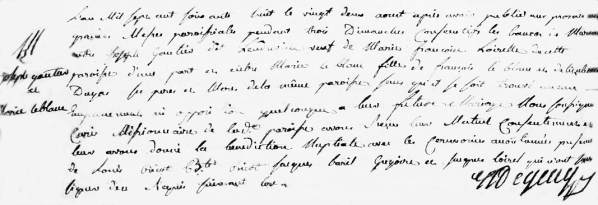
Not letting the grass grow under his feet and with firm determination, within a year and a half on August 22, 1768, he married an Acadian, Marie Leblanc. He was thirty-seven and she was in her mid-twenties. She too had endured hardships in her life. Her family had been deported along with many other Acadians who made their way to Massachusetts, then eventually settled in L’Assomption, Quebec and surrounding area.
The marriage record for Joseph Antoine and Marie Leblanc 9.
Translation of the first few lines:
In the year seventeen hundred and sixty-eight on the 22 of August, after publishing the bans at Mass for three consecutive Sundays……. Joseph Gauthier dit Landreville widower of Marie Francoise Loiselle from this parish on the one hand between Marie Leblanc, daughter of Francois Leblanc and Elizabeth Dugas the father and mother from the same parish….
“In Québec, the Acadians settled in every corner of the province starting in the late 1760s. Mostly concentrated along the St. Lawrence River, they progressively settled in other areas where agriculture was predominant. The province of Québec is where the largest Acadian population was living by the end of the 18th century. Because of the similarities in religion, language, and social status with the Canadiens (French Canadians, today’s Québecois), the Acadians easily integrated into mainstream society. The Acadians who lived in the province embraced the struggle for the rights of French speakers that drove politics and social discourse in Québec throughout the 19th and 20th centuries. Despite their integration, these communities maintained an awareness of their ancestry and contact with the Acadian communities of eastern Canada. In the late 19th century. 10.
In May of 1769 Marie gave birth to Marie Josephe. Alas, their joys were dashed. The little girl did not survive her first winter and died the following February. One more heartache.
Their lives took a positive turn and in March of 1771 Alexis was born. Between 1771 and 1778 three more sons and a daughter rounded out the family. At long last stability had become a part of their lives. There was joy in the Gauthier household.
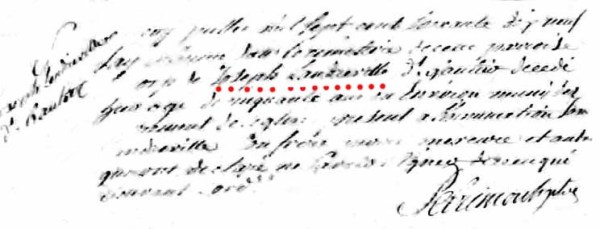
Alas! At the age of forty-eight and in the prime of life Joseph Antoine’s life abruptly came to an end. He had experienced more than his fair share of trials and tribulations during his short life. He had endured many heartaches and misery beyond belief. Despite all all the turbulence in his life, in the end he finally found companionship, joy, and happiness. Joseph Antoine died of unknown causes on the 8th of July 1779. He was buried in L’ Assomption the following day.
Burial Record of Joseph Antoine Gauthier dit Landreville
Translation of the burial record for Joseph Antoine Gauthier dit Landreville
In the year seventeen hundred and seventy-nine…….in the cemetery of this parish the body of Joseph Landreville…..
Marie Leblanc married a second time in the fall of 1780 and had several more children. She lived to the age of 82 and died in 1824 in the neighbouring community of St. Joseph de l’Achigan.
Note:
In the scope of this research there was no mention of Joseph Antoine’s occupation, however, given the fertile land around the Assomption River one could surmise that he was a farmer…. un “cultivateur’…
In this research I have maintained the French spelling that is used in the province of Quebec for the name of the town and river. The spelling in English is ‘Assumption’.











 Genealogy Ensemble