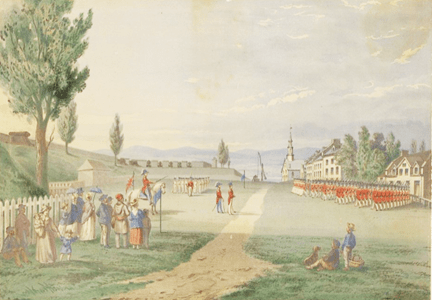
View of the Esplanade and Fortification of Quebec 1832 shows the British garrison on Parade Robert A. Sproule, BanQ
The following link below lists books, theses, and magazine articles written by numerous authors on the subject of British garrisons in Quebec.
Books that are available to buy are indicated by $$$, while numerous articles and books are available to read online or download for free and are indicated at the end of their links.
To access the file below click the link and open in a new window.
With great sadness, we recently learned of the death of Joan Benoit of Pointe Claire, Quebec in late 2022. Joan was a devoted genealogist and volunteered and helped run the Quebec Family History Society (QFHS) for over thirty years. Ever patient, she helped both the experienced and novice genealogist in their research. She was the “go to” person when anyone had a question. In the words of Claire Lindell:
“It was spring of 2012 when I walked in to the QFHS. Joan greeted me with a smile and made me feel welcome. She offered to help me with my quest for ancestors. She took Rene Jetté’s big blue dictionnaire from the shelf and asked me the names of those I was searching. Within minutes I found my mother’s ancestral family … Claude Jodouin who arrived in Ville Marie in the mid 1600s. I was off to the races and have never looked back, thanks to Joan.”
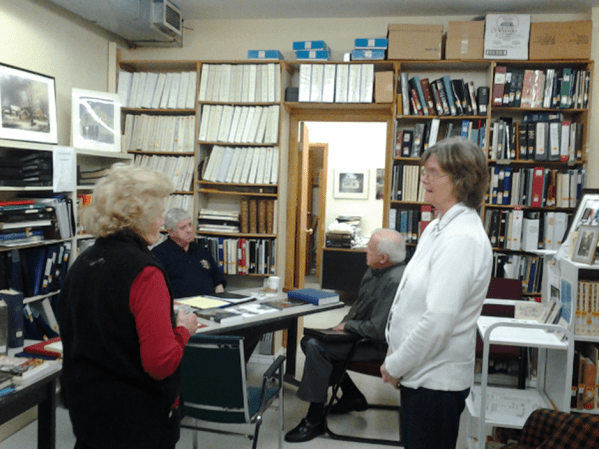
Ruth Dougherty (left) and Joan Benoit (right) chat in front of Earl John Chapman who is seated at the table speaking with Oskar Keller during Military Roots Day, 2012, at the QFHS.
Joan’s extensive knowledge, accompanied by a warm smile, has helped numerous researchers over the years. Many of her fellow genealogists became her friends. As well as being an avid researcher, she also had a vision of what was needed to promote genealogical research and always accepted the challenge to do what was needed. For approximately twenty years Joan was a well-known visitor to the Archives nationales du Québec on Mullins Street in Pointe-Saint-Charles and later the Archives nationales on Viger Square in Old Montreal. She researched hundreds of family lineages.
Jacques Gagné and Joan Benoit enjoyed a friendship of many years, which Jacques says can best be described in Proverbs 27:17, “As iron sharpens iron, so one person sharpens another.” In other words, good friends bring out the best in one another and enhance each other’s strengths.
Joan’s quiet presence, always supportive, will be sorely missed.
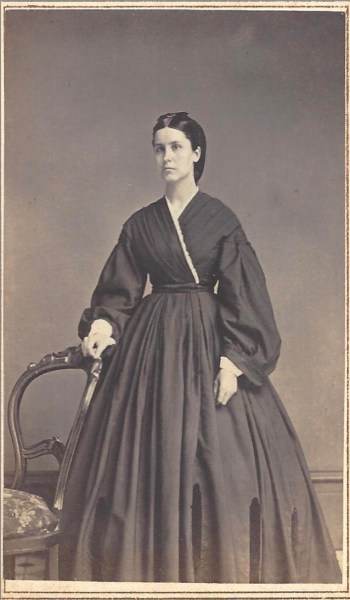
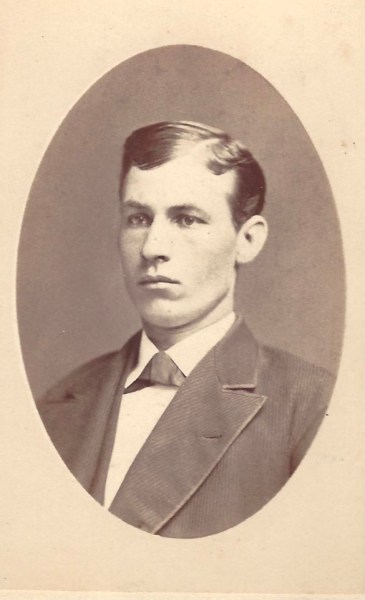
Virginie Bruneau, born in St. Constant, Quebec in 1840, became a teacher. “She enjoyed the distinction of being one of the group of teachers to receive the first French Canadian diplomas from the McGill Normal School.”
The school was established in 1857 by John William Dawson, McGill’s first Principal with an agreement between the university, the government and the Colonial Church and School Society to educate Quebec’s protestant public elementary and secondary school teachers and produce teachers who could turn young minds into university material. The Colonial Church and School Society had been dedicated to the maintenance and financing of Anglican schools.
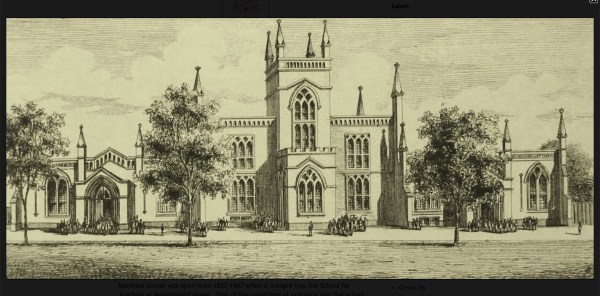
McGill Normal School 30 Belmont Street, Montreal
Applicants to McGill’s Normal School were examined in reading, writing, the elements of grammar and arithmetic and “needed to produce certificates of good moral character from their clergyman or minister of religion under whose charge they have last been.” The earlier schools judged teachers qualifications only on their common sense and reputation. The one-year course earned an elementary diploma and students attended for two years for a Model School diploma required to teach higher grades. Students had to be at least 16 years old and teach at least three years after graduating. The first class contained 35 women and five men. So Virginie, born in 1840 could have been in the first class.
The school opened at 30 Belmont Street in downtown Montreal. In 1907 it moved to the west of the island and became part of MacDonald College.
After graduating, Virginie first taught in Montreal and then later, of all places, New York City. She was my great grandfather Ismael’s sister, the third child and second daughter of Barnabé Bruneau and Sophie Marie Prudhomme. Like many of her siblings, she looked for a life beyond the farm in St Constant.
I don’t know how or where she met her husband Francois Dutaud. He was from the same region of Quebec, born in Napierville, to Joseph Dutaud and Isabelle Cyr but he also spent time in the United States. He lived in Boston for several years. There, he worked for the Tuft Brick Company. He returned to Canada in 1875, where he farmed and had a successful grain business in Grande-Ligne, Quebec.
Francois Dutauld
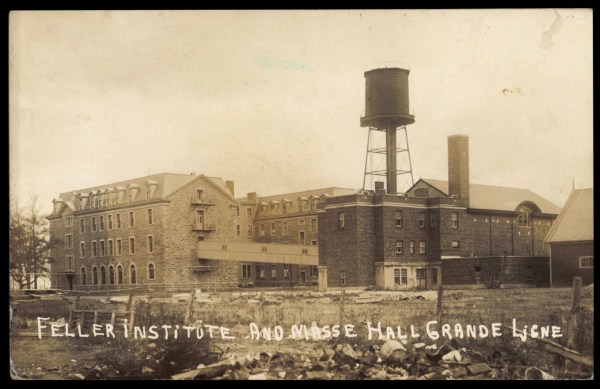
Did Virginie give up the bright lights of New York City to teach at the Feller Institute in Grand-Ligne? Is that where she met Francois? Henriette Feller was a Baptist missionary from Switzerland who came to Quebec to convert Catholics to Protestantism. The hostility of Catholics in Montreal forced her to move south. Madame Feller’s first school was in the attic of her log cabin but eventually a large stone building was constructed. She and Charles Roussy her colleague, were responsible for the conversion of Virginie’s parents in the 1850s.
Virginie was 38 when she married and she and Francois had only one child, Gustave Dutaud, born in Grand Ligne in 1879.
The couple moved to Montreal to live with their son when Francois became ill. He died a year later. Virginie continued to live with Gustave until her death in 1926 from arteriole sclerosis. Her obituary said she was of proud Huguenot stock but I don’t think this was necessarily true. Yes, she was a French Protestant but her Bruneau line had been practising Catholics for centuries.
Notes:
Picture of Virginie by S.A. Thomas 717 Sixth Ave New York. He was a photographer from 1853 to 1894 when he died at 71.
“Three years ago, Wabush was bush: a rough, scraggly, nearly lifeless wilderness. The hills in summer echoed only with the whir of the black fly. The only way for a man foolish enough to want to go there was to do so by seaplane. The bush, like so many of the parts of Canada that have yet to be opened, had to be broken and tamed, and the men who broke it — the last frontiersmen — are a breed apart.” Macleans Magazine
In November, 1963, Peter Gzowski, the young managing editor of Macleans, wrote an article for his magazine entitled “The New Soft Life on the Last Frontier.”
The journalist – now legendary – had worked ‘like a serf’ as a student on the Labrador railway that was needed before they could start work at the iron ore mines at the Quebec/Labrador border.
Apparently, he was amazed at the advances made in just a few years in the embryonic mining town of Wabush, 1248 kilometers from Montreal.
A rough, scraggly nearly lifeless wilderness is how Gzowski described Wabush back in 1960, and, yes, that is certainly how I remember it – if only from photographs we took on our little Brownie camera.
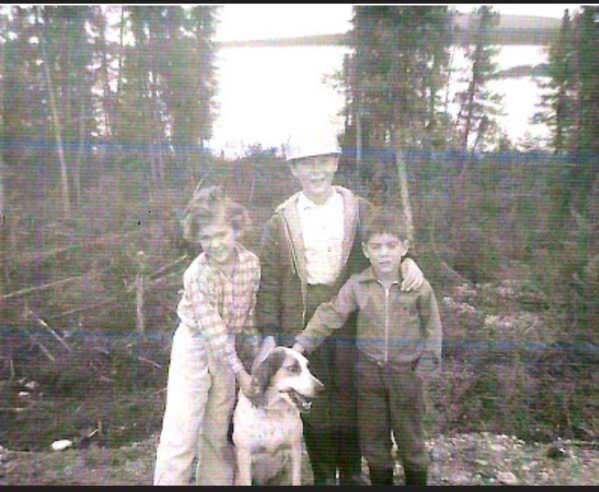
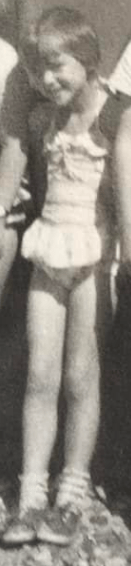
My brothers, Mark and Phil, and me in front of Little Wabush Lake, 1960, my ridiculous hairdo courtesy of my mother who was trying to make me look less of a tomboy.
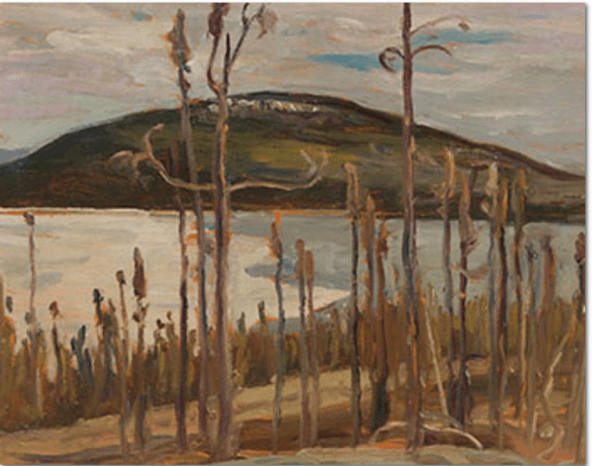
A Y Jackson Wabush Lake. If my memory is correct he visited Wabush while we were there and told my mom he would have liked to have painted my twin brother (not me!)
My family moved to Wabush in the spring of 1960 when the only family quarters there were a log cabin owned by the American Foreman and, just up the hill, a few well-equipped house trailers for the families of other supervisors.
The other mostly young unmarried male workers lived in crude canvas tents. They included an athletic young prospector who would go on to share Canada’s only gold medal – in the four man bobsled – at the 1964 Innsbruck Olympics.
Our long, green trailer was state-of-the-art with its own washer-dryer, but it was still a trailer and during the short black-fly infested summers of 1960 and 61 all five of us packed into it. I think my parents slept in a Murphy bed that made room for the kitchenette table when not in use. My twin brother, Phil, and I slept in bunk beds.
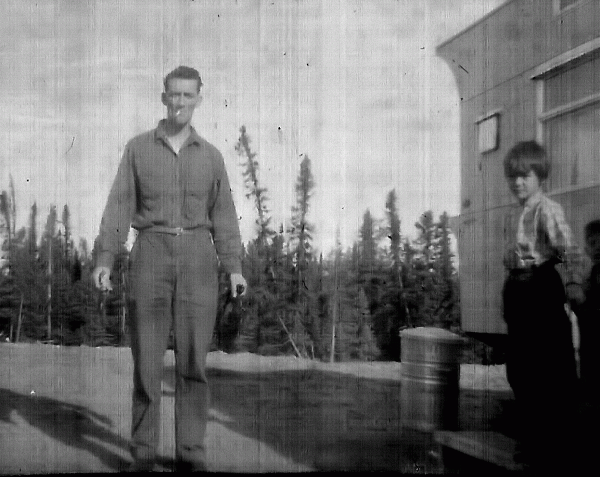
I don’t remember feeling crowded but my father, Peter Nixon, certainly did. He spent most of his time at work or outside fly-fishing in summer and taking me and my twin brother for walks ‘across the lake’ in winter.
My father and me with his fly fishing catch which I always ate because no one else liked trout.
It helped that outside the summer months my older brother, Mark, attended prep school in England. He missed out on the Wabush winters where the annual snowfall is twice that of Montreal, the days one hour shorter, and the average daily temperature what a Montrealer would consider part of a mercifully short-term deep freeze.
I do remember visiting the Foreman’s log cabin as a friend of his daughter who was a few years older and a full head taller. (Well, I remember the memory of the memory of the memory.)
She confidently made a pie, plopping peaches out of a can onto a pre-prepared pastry impressing me no end. Apparently, we played together a lot because I am in a few of the family pictures she still has in a box at her home in the U.S.
I may remember the Foreman’s daughter, but she doesn’t remember me. She attended school in Sept Iles and had other older, more intriguing friends to play with.
There were 21 children living in Wabush in summer. The many boys contented themselves with mischief, such as chasing behind the D D T truck! I mostly pushed my beige doll carriage around the small trailer camp, sometimes talking to the lonely mothers there. One of these women made me a beautiful doll’s quilt, the highlight of my entire Wabush adventure!
Generally, I lived a rather feral life with no TV and no colourful picture books to keep me amused.
My most vivid memories are not of other children but of animals: a frightened snarling fox in a cage that men were poking with a stick; a dead baby bear shot while trying to get at someone’s larder; oh, and the owl that flew down and lit upon Mark’s shoulder.
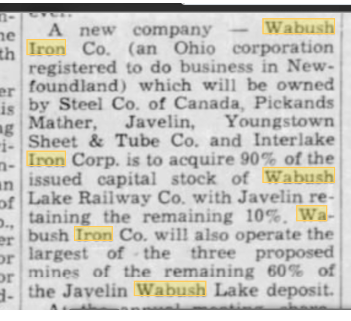
A newsclipping from 1960: “Wabush presently has crude wooden buildings, tent bunkhouses and a few housetrailers and about 125 workmen. But it boasts a fine 4,600 foot airstrip, and a daily schedule air service to Sept Isles, plus a twice weekly shuttle service to Shefferville operated by Quebecair. The Foreman says it will take five years to build a town site, a grinding and concentrating plant and a loading facility.”
My mother Marthe’s catch. They were spawning, she said.
We arrived at Wabush in April or May of 1960, taking a very noisy and cold DC 3? plane, I remember, with our young dog, Spotty, the coonhound wailing in a cage at the back of the plane.
A brilliant 1990 history of Wabush using first-person testimony, written by Dana Hines and available at their Town Hall has a telling quote:
“Some of these early residents recall stepping off the plane or train and sinking up to their knees in mud. This was to be their first taste of what initially appears to be a very barren place indeed, for Wabush at that time was nothing but wilderness. “(Page 12)
So, I am not imagining things: my family arrived in the Labrador bush at the very beginning. My father’s job was to oversee the money being used to create this model family mining community, for two years on-site (1960-61) and for another four years (1961-1965) out of the Canadian offices of the Wabush Mines Company on Dominion Square in Montreal.
In late 1961, he moved my Mom, my twin brother and me back to the big city, into a relatively spacious upper duplex apartment in Snowdon. I started the first grade, an over-due November arrival who still couldn’t read. How embarrassing!
The change of work locale for my dad, from a crude wooden structure in the deep bush to a storied edifice at the ‘cross-roads of Canada,’ also must have been truly head-spinning.
Mark returned to live with us a year later, a British schoolboy in every respect. So pudgy, polite and bookish he was, I hardly recognized him.
The town of Wabush was designed by the same architects who created the Expo 67 islands. ( It is no surprise, then, that my father went on to work in 1965 as an auditor for the Fair Commission instead of taking a transfer to Cleveland, Ohio, the seat of the US head office of Wabush Mines.)
And those architects did a very good job designing the mining town judging from the many happy, nostalgic postings on the Memories of Wabush Facebook page.
There were 293 families in Wabush by 1967 and the many children living there had lots of things to do. By then the town had a school, a library, a recreation centre with television and movies and a bowling alley, as well as a swimming pool with sauna and sundeck – and even a small shopping mall.1.
(Of course, in Montreal I had Expo 67 with its endless wonders to keep me amused, so it was no contest.)
My older brother summed things up upon reading the town’s history: “We left before things got good.”
1. Hynes, Dana. Untitled History of Wabush. 1990. Available at the Wabush City Hall.
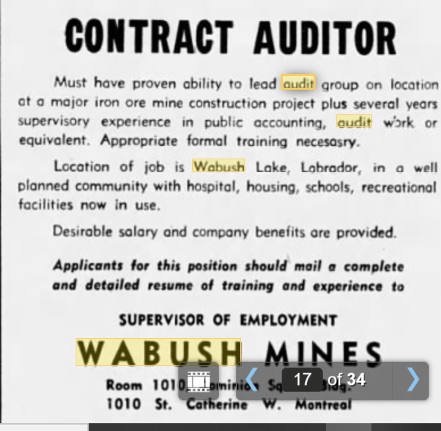
A call for an auditor for Wabush a few years after we left. My father still worked for the company at their head office at 1010 Ste Catherine Street, the Dominion Square Building.
Grandiose 16MM film promoting Wabush in 1960. Big money is being spent: I guess my dad had to keep track of it.
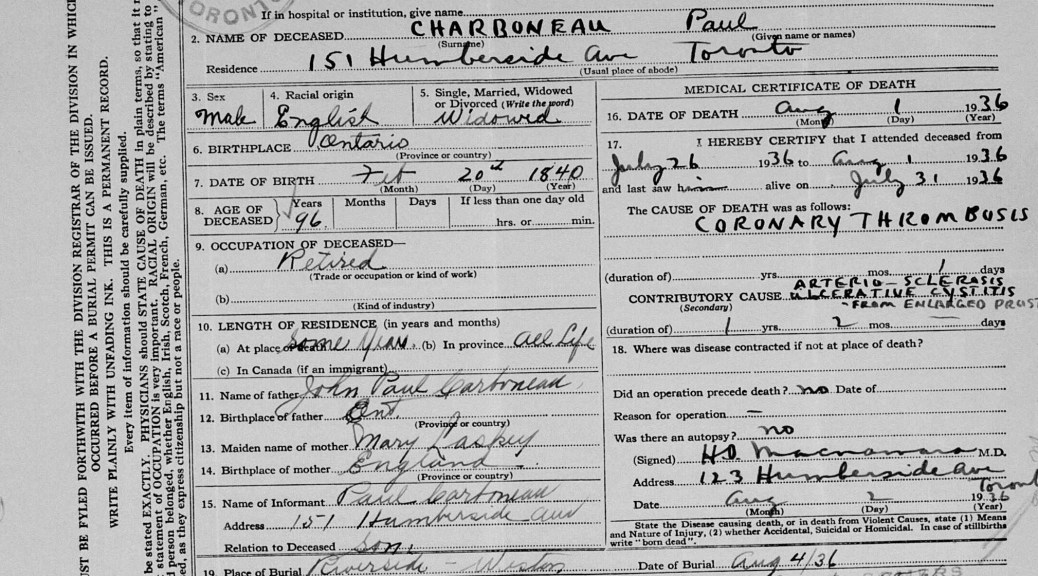
An eight-day heat wave that remains the hottest on record may have shortened the life of my great great granddad, who was 96 years old that year.
Paul Charboneau died in Toronto, Ontario on August 1, 1936. His death took place four years to the day after his beloved wife Keziah passed away, despite her being 16 years younger than he.1
The couple met and married in Orangeville, Ontario, where their families lived when they were born. The community was then known as Grigg’s Mill before the town itself was officially incorporated in 1863.2 Her family were immigrants—her dad hailed from Scotland, her mom from Ireland. They lived in a mixed farm, like many common in those days. His mom, Mary Laskey. also was an immigrant from England. His dad, another Paul Charboneau, was born in Ontario and may have been the man of the same name who got a land grant from serving in the War of 1812, although I haven’t confirmed that yet. It’s not clear whether they too owned a mixed farm or if they lived in the village while he worked felling timber or taking care of the water mills.
Either way, Paul and Keziah probably knew each other growing up, perhaps at church, since both families worshipped in the Church of England. They married in 1878 and stayed in Orangeville for almost a decade. A census three years after their marriage describes Paul as a cooper, someone who builds barrels for a living.
Orangeville’s heyday diminished by the turn of the 20th Century (although it revived to attract my parents in the 1970s; I grew up in the town).
Sometime prior to 1901, Paul and Kezia moved with nine of their ten children to Weston, Ontario, a then town that now forms part of the greater Toronto area. (My mom’s side of the family lived in Weston for another four generations after Paul and Kezia moved there, including most of her life and the first seven years of mine.)
By then, Paul worked as a labourer. Their first son had married and moved to Toronto with his wife several years earlier.
In the summer of 1936, Grandad Paul was living in a cottage-style home at 151 Humberside Ave. in Weston. Late in July, he went into the Humberside hospital where he died with coronary thrombosis due to arteriolar sclerosis and ulcerative cystitis from an enlarged prostrate.
The poor 96-year-old man must have been very uncomfortable dealing with bladder issues during that record hot summer. Multiple heat waves took place, including the biggest one prior to his death.
Temperatures in Toronto reached 105°F (40.6°C) during three of the eight days that made up with heat wave. Heat-related issues directly killed 275 Torontonians that week, in addition to harming people like my great great grandfather who suffered other ailments.
Hot temperatures remained in place well into August, long after my great great granddad died. The heat wave that summer killed 1,693 people in North America, which puts it sixth on the list of the worlds ten deadliest heat waves ever.3
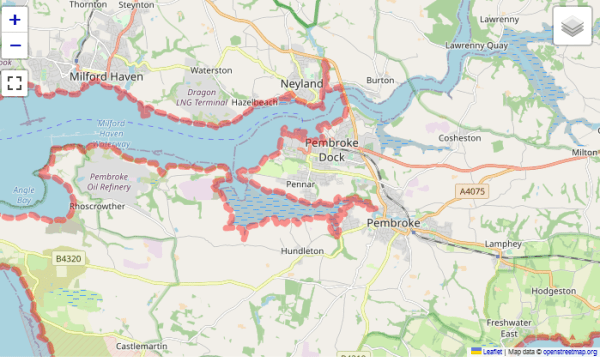
Pembroke Dock (Welsh name Doc Penfro) is a town and community in Pembrokeshire, South West Wales on the River Cleddau.
Originally named “Paterchurch”, a small fishing village, Pembroke Dock town expanded rapidly following the construction of the Royal Navy Dockyard in 1814. The Cleddau Bridge links Pembroke Dock with Nyland. (1)
John Barnett OBrey or Obray my 3rd Great -Grandfather was born in Rhosmarket. in 1792. Rhosmarket or now Rosemarket is a parish in the county of Pembroke South Wales. In 1833 the parish contained 456 inhabitants; in the 1841 Welsh Census, John Barnett was a shipwright.
The spelling of the O’Bray name over the centuries has changed numerous times and because of this, trying to trace very early family members has been a headache. There is a landed gentry branch of the Aubrey family, and I have seen our tree added to them, more times than I care to remember. It seems that everyone would like to be associated with royalty or the lords and ladies – unfortunately, or maybe fortunately, we are not.
Awbrey is the earliest family name I have traced. That would be Jenkin Awbrey, born in 1410 in Abercynrig, Breconshire Wales. He was my 13th Great Grandfather.
The next generation was Hopkin born in 1448, William born in 1480 and Thomas born in 1588 but they spelt their name, Aubrey.
But William, my ninth Great Grandfather born in 1607, who, just to be difficult, reverted back to spelling it Awbrey.
John, born in 1678 spelt it Aubrey and by the time my fourth Great Grandfather arrived in 1760 once again, another name change to Obray. Which has lasted right up to the present day for our English relatives – with one small change, my Grandfather spelt it with an apostrophe O’Bray.
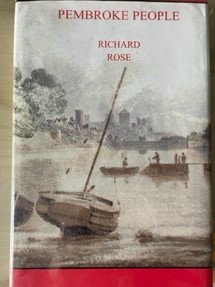
However, another mystery about John Barnett Obray cropped up. In Richard Rose’s magnificent book ‘Pembroke People‘ he states
“I assume that William Aubrey, buried at St. Mary’s church on 27th September 1817 aged four years was probably another child of this family”
In addition to this, he also states that
“An Elizabeth Oberry was buried, according to St. Mary’s register on the 11th of April 1841 aged 93”
This was my fourth Great Grandmother, Elizabeth Barnett whom John Barnett Obray is named after. Another different spelling and name.
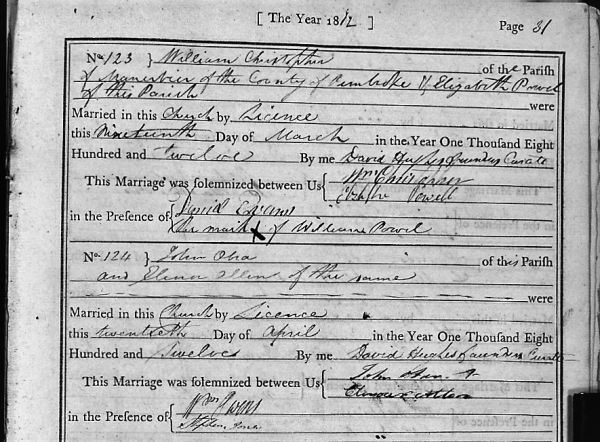
When John Barnett Obray, my 3rd Great grandfather and his wife, Elinor Allen married in 1812 his Marriage Lines recorded him as ‘John Obra’ yet, he was born Obray and died Obray.
I recently wrote to “Find My Past” to point out the error in their 1812 Marriage Lines, and they adjusted it to spell Obray. A small victory!
When I visited Salt Lake City, Utah, I went to the cemetery in the town of Paradise, located in the southern part of Cache County, Utah. I had researched and found that quite a few of the American O’Brays were buried, there. Once again, I noticed another change to the name they spelt it “OBray” no apostrophe, as my Grandfather O’Bray and his family spell it.
I can only surmise that over the centuries, the name became corrupted once spoken. I tried saying the name out loud…Awbrey, Aubrey, and O’Bray DO sound similar, especially if spoken in Welsh and with the addition of a Welsh accent.
To further add to the confusion, once I looked up the names I find that Obrey is an altered form of the French Aubry which in turn comes from the ancient Germanic personal name Alberic composed of the elements alb meaning elf and – ric powerful.
When compared to Aubrey it stated it is English from Middle English meaning a male personal name such as Albry Audry or Ayubrey. That in turn is a borrowing of Old French which in turn is a Middle English female personal name such as Albrey, Aubrey which in turn is from ancient Germanic!
French Canadian is also in there somewhere, but it all became so confusing…I gave up! Suffice it to say, the name contains some of the most ancient Old English, French and Germanic languages. No wonder there has been so much corruption and confusion spelling the name over the centuries! (2)
In part two, I shall be sharing the life of Elinor and John Barnett Obray.
As a child, I never imagined what life was like before my parents had my brother and me. But once in a while they would talk about their courtship and what it was like to meet right after World War 2.
When war broke out in 1939, my dad, Edward McHugh, signed up right away. He was stationed in Yorkshire, England and only returned home when the war ended in September 1945. He was already 31 and normally would have been considered a confirmed bachelor.
My mom, Patricia Deakin, would often speak about the day the war ended. She worked for the Sunlife Insurance Company of Montreal. The Sunlife Building was located on Dominion Square in downtown Montreal. When word got out that Germany had surrendered, all of the office workers in downtown Montreal just left their offices and walked out into the streets to express their joy. My mom described it as an amazing outburst of pure joy and celebration of the end of a long and painful war.1
Celebrations in the streets of Montreal at the end of WW2
When Edward went to war, he intended to return to work for his employer, the Canadian Celanese located in Drummondville and his employer had guaranteed his employment. However, my dad decided to stay in Montreal.
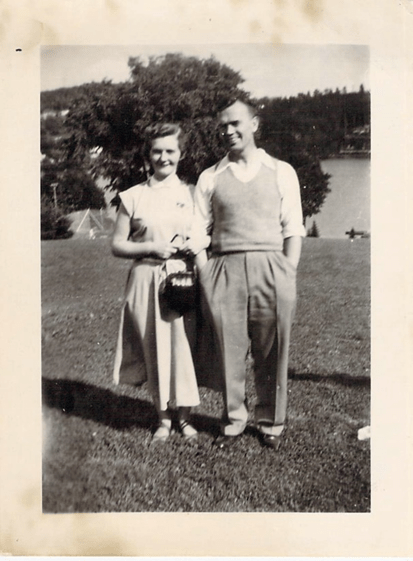
At that time, my mom’s brother, Jack Deakin, was dating Norine Scott. Norine and Patricia became great friends. The picture below shows them in the Laurentians for a day of skiing.
Norine Scott (left) and Patricia Deakin at the ski hill
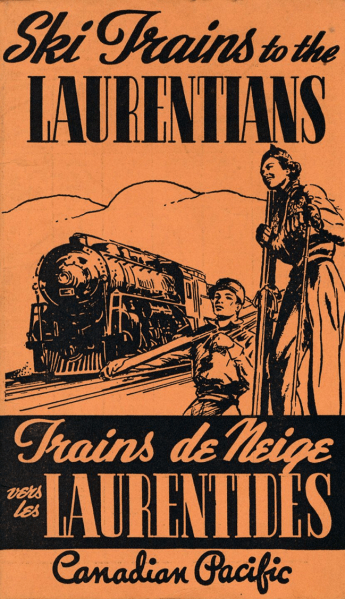
Both the Canadian National and the Canadian Pacific operated trains from Montreal to the Laurentians, known as the “snow trains,” otherwise known as the P’tit train du Nord.2 Below is one of the Canadian Pacific posters.3
Promotional poster for snow trains
It wasn’t long before Norine introduced her young and eligible Uncle Eddie to my mom and that was the beginning of their courtship.
Both Ed and Patricia loved going to the movies and their Saturday night dates were often a meal at Bens Delicatessen, followed by a show. Bens was a well known delicatessen in Montreal that was famous for its Montreal-style smoked meat. In 1908, Benjamin Kravitz and his wife Fanny Schwartz opened a sweet shop on Saint-Laurent Boulevard and then added sandwiches, using Benjamin’s mother’s recipe. In 1929, they moved to 1001 Burnside (now de Maisonneuve), in the theatre and night club district of the city, and then to their final location in 1949.4
Bens Store Front5
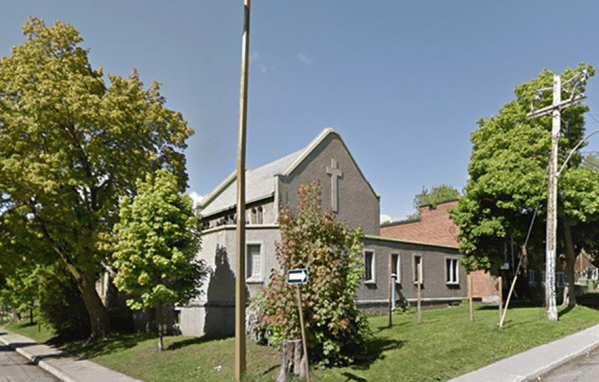
My parents were married on May 21, 1949 at St. Columba Anglican Church in Notre-Dame-de-Grace. This church was built in 1920 but has now been sold to a developer.6 My grandparents would have been parishioners of the church as they lived just 10 minutes away.7 The post WW2 period was marked by a housing shortage. Pressure on the housing shortage was due to demobilized soldiers returning home, and the increase in newly created families. My parents, like many post WW2 newlyweds, lived with my grandparents after the wedding.
St. Columba Anglican Church, Notre-Dame-de-Grace, Montreal
The wedding announcement in the Montreal Star on May 30 1949, describes the bride as wearing:
“A gown of white slipper satin made with nylon yoke on Grecian lines and with train. Her veil was of tulle illusion, was finger tip length, held with a bandeau of lilies of the valley and orange blossoms. She carried a cascade bouquet of white carnations and bavardia.”8
The wedding announcement goes on to say that the reception was held at the Montreal West City Hall, in the music room. This photograph of the wedding party is probably taken outside the Montreal West Town Hall.
From left to right: Alistair Lamb, Mary McHugh, Ronald Lamb, John Deakin, James Meikle, Edward McHugh, Patricia Deakin, Melba Jones, Norine Scott, Dorothy Newcombe, Grace Hunter, George Deakin
The wedding announcement continues:
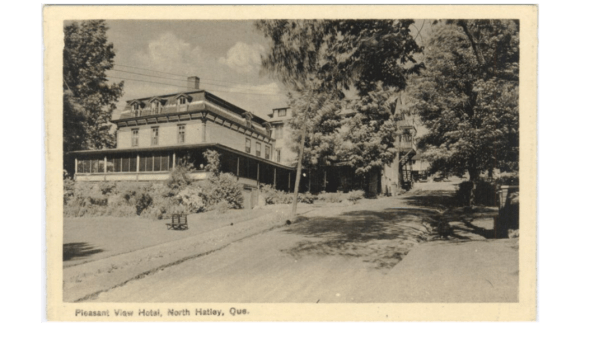
“Mr. and Mrs. McHugh went to Pleasant View Hotel, North Hatley, for their honeymoon, the bride wearing for travelling a three-piece suit of beige Scotch mist, with white straw hat and green accessories and a corsage of white carnations.”9
Founded in 1897 and located on Lake Massawippi, North Hatley is one of the prettiest villages in Quebec.10 Below is a post card of the Pleasant View Hotel:11
Pleasant View Hotel, North Hatley, Quebec, Photogelatine Engraving Co. Limited, 19?, Bibliothèque et Archives nationales du Québec, 0002643996, accessed 28 December 2022.
*Note: This seemed like the perfect time to publish this story again. If you’re lucky, you may inherit a box of family papers someday…and if you’re smart, you will take the opportunity to ask for them when you see everyone over the holidays!
The latest de-cluttering expert tells us to keep only things that give us “joy”1. All other items should be thanked for their purpose or memories and then given away. At the end of this challenge all that should remain are the things that spark joy in us!
We are told to start with clothes, then books, kitchen cupboards and desktops. Only then, after all that practise detecting feelings of joy over an item, will we be ready to tackle family photos and personal memorabilia.
On the highest shelf of my largest cupboard were three dusty old boxes that I inherited many years ago. They were to be the last step of my de-cluttering project!
I slowly opened the lid of the first box finding lots of old photographs, mostly black and white, some labelled and others not. The first handful of photos was mostly of loving couples and family reunions at the dinner table. Others showed groups of people standing proudly on the front step of a house (a new home perhaps?). The next scoopful were of children at play – sometimes holding family pets in their arms. Another handful produced proud young adults smartly dressed in various uniforms – perhaps starting a new job or ready to go to war. The last bunch showed lazy days on sandy beach holidays, numerous birthday party celebrations and Christmas gatherings.
Frozen moments captured in time from so long ago for me to enjoy now. It all felt so precious. I very gently placed the photographs back, undisturbed, into that first box.
Nothing to be given away.
The second box was filled to the brim with letters and cards. Some still neatly tucked into their envelopes, others held together with yellowing scotch tape and looking well fingered. Most of them had handwritten messages in big loopy writing that was difficult to read. The stamps alone told another story postmarked from places and dates from years ago. Among the letters were also children’s drawings, thank you notes, lists of party guests, festive menus and various well loved recipes.
But my very favourite find in this box were the love letters, written with such passion and lovingly folded into perfect little rectangles and decorated with doodled hearts.
Nothing to be given away.
The last box contained newspaper clippings announcing family births, deaths, weddings and other special events from all my ancestors over the years. And then, underneath all that newspaper, I discovered more treasures!
First, my grandmother’s monogrammed lace handkerchief with a tiny baby’s christening dress complete with a lock of hair tied in a ribbon and stored in a small envelope. Then I picked up the old school primer (book) and several dried flowers fell to the floor. Neatly stored in the bottom were numerous diaries filled with daily messages with the writing continuing up the sides of each page. Finally, carefully folded in tissue paper was an old sampler stitched by my ancestor, as a young girl two hundred years ago. Several of my family’s treasures (and perhaps a little piece of them?) had been lovingly preserved in this last box.
Nothing to be given away.
As I closed the lid on the last box, it dawned on me that someone had already sorted the family memorabilia into those three separate boxes, leaving me to find…three dusty old boxes of pure joy.
“Have you in the past ever shopped at Morgan’s Department store in downtown Montreal or at a major department store in downtown Toronto? Maybe you ventured to New York City and made a purchase at Saks Fifth Avenue or Lord and Taylor? “
“Did you know that all these stores have a distinct connection? One company that has been in existence for many years owns these stores. Have you any idea what company that might be?”
“If you ventured a guess and came up with The Hudson Bay Company, you would be right-on.”
The famous fur traders, Medard Chouart Des Groseilliers and Pierre Esprit Radisson, my eighth great uncle, were both born in France and arrived in New France in the mid- 1600’s. Fate brought them together and their explorations were instrumental in developing the fur trade in the young colony. Through their efforts they were the driving force leading to the creation of the Hudson Bay Company more than 350 years ago.
The Early Beginnings of the Company
In 1660, Prince Rupert introduced Pierre-Esprit Radisson and Médard Chouart Des Groseilliers to his cousin, King Charles II of England who eventually received them in his court. They informed him of the “great store of beaver” in an area far north of the St. Lawrence River 2.
The explorers proposed a trading company where they would be able to access the northern interior of the continent by sailing into the waters of Hudson Bay and James Bay. Prince Rupert financed a trip for Des Groseilliers and Radisson to sail to Hudson Bay. Radisson’s ship was forced to turn back off the coast of Ireland. He managed to return to London,3 while Des Groseilliers continued to Hudson Bay and into James Bay where he traded furs with Cree hunters. He returned with a boatload filled with beaver pelts and noted that “Beaver is plenty”.3.
A map of Hudson Bay
The Charter:
Desgroseilliers’ successful voyage led Prince Rupert to urge the King to grant a royal charter to the Hudson’s Bay Company. (HBC)4.
The Royal Charter of the Hudson’s Bay Company
granted by King Charles II of England – May 2, 1670
To this day HBC is the oldest merchandising company in the English-speaking world.
“Under the charter establishing The Hudson’s Bay Company, the company was required to give two elk skins and two black beaver pelts to the English king, then Charles II, or his heirs, whenever the monarch visited Rupert’s Land.
The exact text from the 1670 Charter reads:5. 6.
“Yielding and paying yearly to us and our heirs and successors for the same two Elks and two Black beavers whensoever and as often as We, our heirs and successors shall happen to enter into the said Countries, Territories and Regions hereby granted.”
With the royal charter a legal commercial monopoly was established, prohibiting others from availing themselves of the eight million square kilometres including the 1.5 million square kilometres, lands of the Inuit and First Nations.
Today, the original Royal Charter is preserved in HBC’s Corporate Head Office in Toronto and is both the premier artifact and primary record of the Company.7
The land granted in the charter became known as Rupert’s Land, the name given to an exclusive HBC trapping area, a large expanse of northern wilderness roughly a third of today’s Canada. From 1670 to 1870, it became the exclusive commercial domain of HBC.
For 250 years from the 17th century to the 19th century the demand for beaver pelts was most profitable for HBC. The pelts were used to make felt hats. European elite sought these hats. 8.
The Hudson Bay company established trading posts staffed predominately by British and Scottish personnel, while traders bartered with Indigenous trappers for manufactured goods, such as knives, tools, guns, blankets and foodstuffs. 9.
“The English-made wool point blanket — cream, with thick coloured stripes — harkens back to the 18th century, when it was the company’s most popular traded good”.10.
Hudson’s Bay Company hired labourers, voyageurs, tradespeople, and professionals such as accountants, clerks and surgeons who were under contract to HBC. These people were called “servants” of the company. They were mostly men from England, Scotland and also French-Canadian voyageurs from New France who were skilled in the fur trade, along with contracts for a few women who served as cooks.11.
The contracts were usually between I and 5 years beginning June 1 and ending May 31. Free return passage was often in the contract. Those who chose to remain in the north were given 25 acres of land from the Hudson’s Bay Company.
The company rules banned men from marrying indigenous women, until it became apparent that local officers and governors of the company had taken indigenous women as their wives. The company revoked the ban while noting that these marriage ties with indigenous communities were beneficial. The indigenous people played a distinct role teaching the employees how to adapt to life in the north. 11.
The marriage of an employee with an indigenous woman was known as the “custom of the country” rather than the traditional European marriage custom.12.
“Until the early 19th century and the founding of Manitoba’s Red River Colony, HBC had strict policies for employees. They prevented employees from remaining in Rupert’s Land once they were no longer working for HBC.
When the employee’s contract was over many of the men returned to their homelands. The indigenous family members remained behind in their communities.
Notes:
In a recent blog for Genealogy Ensemble, (https://genealogyensemble.com/2020/03/11/allegiancesI wrote a biographical sketch “Allegiances”. It describes the exploits of my eighth great uncle Pierre Esprit Radisson. He was an explorer involved in the fur trade in New France. His accounts are a main source of the explorations he undertook in partnership with his brother-in-law, Medard Chouart des Groseilliers who was married to Pierre’s half sister Marguerite.
In the process of researching his story my curiosity was piqued by the partnership of these explorers and their contributions which influenced King Charles II of England’s decision to grant a royal charter creating The Hudson’s Bay Company.
“Fur Trading in Northern Canada”, is the result of the research that has answered the questions arising from “Allegiances”.









 Genealogy Ensemble