Whether you live in North America, in German-speaking Europe, or almost anywhere else in the western world, the way Christmas is celebrated has been influenced in large measure by Austria and Germany. The Christmas tree comes from Germany. “Silent Night” (“Stille Nacht”), the world’s best known Christmas carol, originated in Austria.
The German religious reformer Martin Luther (1483-1546) is often credited with starting the Christmas tree custom, but the first appearance of a Tannenbaum was recorded in Germany many years after Luther’s death. It was in 1605 in Strasbourg in Alsace, then in Germany, that a chronicler wrote (in old German): “Auff Weihenachten richtett man Dahnnenbäum zu Strasburg in den Stuben auff…” (“At Christmas they set up Christmas trees in Strasbourg in their rooms…”).
But it is likely that the custom dates back to at least around 1550, since the first of several “Tannenbaum” ballads was circulating in print at that time. By the 19th century this custom had spread across most of Germany and beyond. Several royal Germans are credited with helping extend the tree decorating custom beyond Germany’s borders. The Duchess of Orleans (from Mecklenburg) brought it to Paris, while other Germanic royals brought the Christmas tree to England and other European countries. But it was commoners—emigrants from Germany—who brought the Weihnachtsbaum to America.
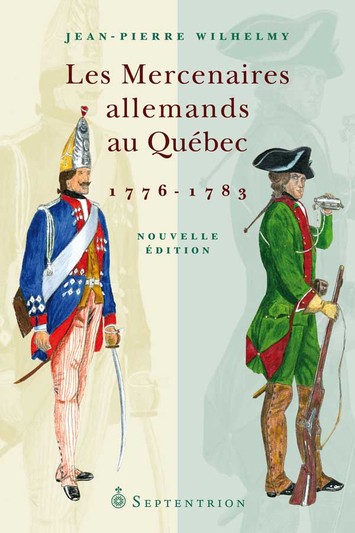
Hessians were German soldiers who served as auxiliaries to the British Army during the American Revolutionary War. The term is an American synecdoche for all Germans who fought on the British side, since 65% came from the German states of Hesse-Kassel and Hesse-Hanau. Known for their discipline and martial prowess, around 30,000 Germans fought for the British during war, comprising a quarter of British land forces. While known both contemporaneously and historiographically as mercenaries, Hessians were legally distinguished as auxiliaries: whereas mercenaries served a foreign government on their own accord, auxiliaries were soldiers hired out to a foreign party by their own government, to which they remained in service. Auxiliaries were a major source of income for many small and poor German states, typically serving in wars in which their governments were neutral.
Today, roughly 10,000 French-Canadians have a German soldier as an ancestor. If your surname follows, you may have a German soldier as an ancestor: Arnoldi, Bauer, Berger, Besner, Besré, Black, Brown, Carpenter, Caux/Claude, Eberts, Frédéric, Grothe, Hamel, Heynemand, Hinse, Hoffman, Hunter, Inkel, Jordan, Koenig, Laître/Lettre, Lange, Lieppé, Maheu, Matte, Nieding, Olivier, Pave, Piuze, Pétri, Plasse, Pratte, Rose, Rouche, Schenaille, Schmidt, Schneider, Steinberg, Stone, Trestler, Wagner, Wolfe. Some of these surnames were simply translated from German into French or English, while others went through a more complex transformation
The database below consists of authors who wrote about the immigration of Germans to Quebec beginning with Hessian auxiliary soldier who fought along side the British.
Philidelphia physician Robert S.J. Mitcheson (1862-1931) is said to have been a kind, thoughtful person and a good doctor, but his true passion focused on another realm entirely: art. Thanks to his widow’s generosity, it is as an art collector, rather than as a physician, that his legacy endures.
Several years after R.S.J.’s death, Lucie Washington Mitcheson donated some of the best paintings from his collection to the Philadelphia Museum of Art. She didn’t know much about art, but did know that the paintings would serve as a memorial to her beloved husband.
I came across Robert’s name long before I started to research my ancestors in a serious way. I knew my Mitcheson ancestors lived in Philadelphia in the 19th century, so I asked a researcher at the Historical Society of Pennsylvania (HSP) to look up the family. But Philadelphia, which had been founded in 1682, was home to many well-respected colonial and revolutionary families. The Mitchesons came to Philadelphia from England around 1817, so they were not included in any American genealogies. Thanks to Lucie Washington’s ancestry, however, the researcher did find Robert S.J. Mitcheson mentioned in a book about colonial families,1 and it mentioned both his medical career and interest in art.
Dr. Robert S.J. Mitcheson, photo courtesy University of Pennsylvania Alumni Relations.
Robert S.J. Mitcheson was the only son of Episcopal clergyman Robert MacGregor Mitcheson, (1818-1877) and Sarah Johnson (1823-1907). He had two older sisters: Fanny Mary Mitcheson (1851-1937), who married Uselma Clarke Smith and had five children, and Helen Patience Mitcheson (1854-1885), who died unmarried.
His father died when R.S.J. was 15. In his will,2 Reverend Mitcheson expressed the wish that his son study for a profession rather than go into business. R.S.J. attended the Philadelphia College of Pharmacy, graduating in 1885, and worked in the wholesale and retail drug business for several years.He then studied medicine at the University of Pennsylvania, graduating in 1891, and opened a medical practice, specializing in the ear, nose and throat. He also taught at the university.
He married Lucie May Washington (1867-1952) in Philadelphia in 1894 with Lucie’s father, Reverend Shadrach Washington, officiating at the wedding. The couple had no children and lived for many years in a row house on North 15th Street, first with Robert’s mother, then with Lucie’s.
Even as a medical student, Robert was interested in art, and he purchased a large number of paintings over the years. When he died suddenly at age 69, he left the collection in Lucie’s hands.
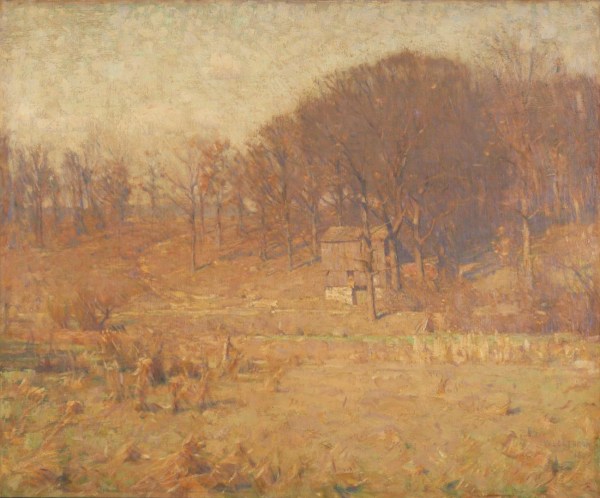
At first she was not sure what to do with the paintings, but with the help of Robert’s nephew, Chicago architect William Jones Smith, Lucie arranged to donate ten oil paintings to the Philadelphia Museum of Art. William was a friend of the museum’s director, Fiske Kimball. Kimball chose the paintings he wanted — primarily landscapes done by 19th-century American artists — and they arrived at their new home in October, 1938. At the time, the museum’s vast neoclassical building (familiar to many from a scene on the front steps in the movie Rocky)was only ten years old, and many of its walls were still bare.
Landscape, by William Langson Lathrop, American Artist (1859-1938); Philadelphia Museum of Art: Gift of Lucie Washington Mitcheson in memory of Robert Stockton Johnson Mitcheson for the Robert Stockton Johnson Mitcheson Collection, 1938-22-5.
A flurry of correspondence between Lucie and museum staff reveals that everyone was happy about the gift. The paintings were hung together for a month in the newly furnished board room before being put on public display. Lucie was invited to come to see them, and to become a patron of the museum. Thrilled, she admitted she had once thought of museums as impersonal places, but “now I shall feel I am really one with you, and anticipate many visits to our Museum.”3
Several years later, she sold a number of paintings and water colours from the collection at auction. By 1946, Lucie must have also sold the house as she had moved into a hotel in the Mount Airy neighbourhood of the city. Her health was declining, nevertheless, she continued to correspond with museum director Kimball. That year she wrote, “It nearly breaks my heart not to be able to accept the many kind invitations that come to me from the museum, and now of all things to miss the Xmas party is the last straw.”4
The final entry in the museum’s file of correspondence with Lucie W. Mitcheson is a note to the museum director, informing him of her death on May 24, 1952.
Notes and Sources
1. Wilfred Jordan, editor. Colonial and Revolutionary Families of Pennsylvania; Genealogical and Personal Memoirs. New series. New York: Lewis Historical Publishing Company, Inc., 1942, p. 507. The author noted that, “according to family history,” Robert S.J. Mitcheson was a descendant of Richard Stockton, signer for New Jersey of the Declaration of Independence. That would have greatly improved Robert’s social status in Philadelphia, however, I have been unable find evidence of a connection.
2. Robert McGregor Mitcheson, Nov. 30, 1877, City of Philadelphia Register of Wills Office, #895. Familysearch.org, Wills, 1682-1916, Index to Wills, 1682-1924, film #07726523; Wills, V. 90-91, 1877-1878, image #390.
3. Lucie W. Mitcheson, Dec. 16, 1938, General Correspondence and related material, 1938-1939, Philadelphia Museum of Art, Library and Archives.
4 Lucie W. Mitcheson, Nov. 30, 1946, General Correspondence and related material, 1945-1946, Philadelphia Museum of Art, Library and Archives.
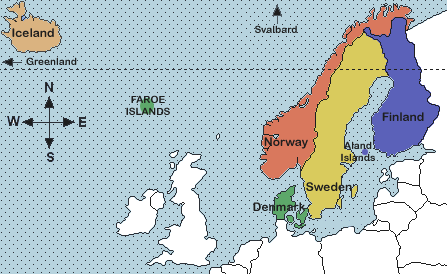
Scandinavia consists of three countries, Norway, Sweden and Denmark, where Scandinavian languages dominate.
The Nordic countries consist of Scandinavia plusIceland (that used to be a part of first Norway then Denmark) and Finland (that used to be the eastern third of Sweden, with a strikingly similar culture, although a totally different language).
The Nordic countries includes two autonomous parts of Denmark, namely Greenland and the Faroe Islands, plus one similarly autonomous archipelago of Finland, the Åland Islands, where the language is Swedish and almost no Finnish speakers live.
The Scandinavian languages are, unsurprisingly, Danish, Swedish and Norwegian.
The most used term is the Nordic countries, which is:
Sweden
Denmark
Norway
Finland
Iceland
Åland (?)
The term the Scandinavian countries is only a physical regional designation:
Sweden
Denmark
Norway
The database below consists of documents, books, articles and theses written by authors from Scandiavian countries, Canada, the U.S.A. and Nordic countries.
Several complete books, documents and articles may be downloaded and they are noted in several different colors.
Click the link bewlow to access the database and open in a new window.
The internet and social media have changed our lives, allowing us to connect to new friends and reconnect to old ones to celebrate our victories and lives. I recently experienced this first-hand.
Last September, I received, out of the blue, an email message from a complete stranger because he read a few of my stories on Genealogyensemble.com about my time in the Women’s Royal Air Force (WRAF).
George Cook, an archivist for the Trenchard Museum, which is based at RAF Halton was gathering information on the MTE – Medical Training Establishment – and happened upon the story of my time there. He recognised the man in one of my photos that went with the story.
“Purely bychance, I had the opportunity to read “Dear Miss Bulford” and I was compelled to follow up on Marian’s story of life in the RAF in the 1960s,” he said in his email.
‘You will appreciate my surprise when on reading part 4, I recognised the young gentleman who became her husband. John and I joined the RAF in September 1964 as admin apprentices at RAF Hereford. Not only did we do our square bashing together for 12 months but we were both posted to RAF North Luffenham in Rutland in 1965”
So, of course, I had to find out more. Let’s begin at the beginning of this intriguing tale, as told to me by George in his letter and by my very surprised husband.
At the end of August 1964, my husband John Clegg was only 16 years old. He says he remembers standing on Liverpool Station on Lime Street England, waiting for a train to Herefordshire. He had left school in July 1964 and was headed off to join the Royal Air Force at RAF Hereford to enter a one-year Administrative Apprentice training course as part of the 301st cohort known as an ‘entry’ (1)
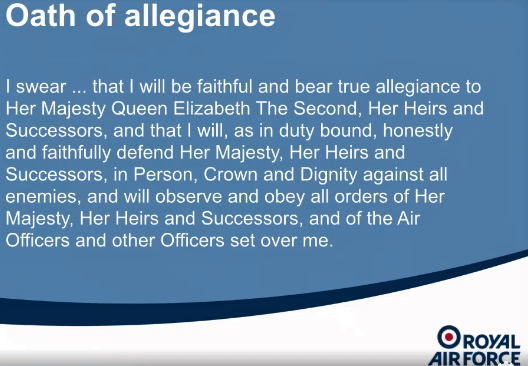
A week later, on the 2nd of September 1964, he took the Oath of Allegiance to Her Majesty the Queen.
The Oath of Allegiance
This committed him to serve 12 years in the RAF. One small point not clearly explained to an eager 16-year-old was that his 12 years of service wouldn’t start until his 18th birthday, meaning that the RAF had him for two extra years (14 in total)!
The boys in the administrative programme numbered approximately 40 per entry and were divided up into two dormitories of 20 per room. The training period consisted of daily classes for administrative procedures which would, on successful completion, quality John as an Administrative Secretarial Clerk. In addition, he learned personal discipline and stories about life in the RAF, including its history.
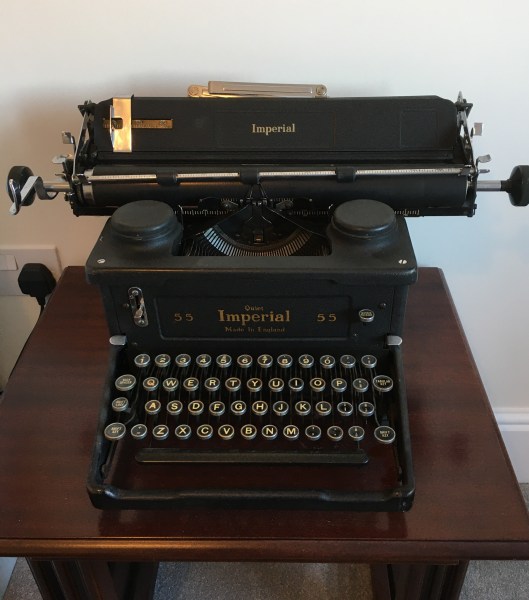
At that time, students were also taught to type on mechanical typewriters. John says that that training prepared him for the future introduction of computers John can still type 55 words a minute, the speed the boys were trained to do. George sent us this photograph of the typewriter they learned on.
The Typewriter the Apprentices Trained On
George Cook also apprenticed at RAF Hereford and he and my husband were alphabetical order billeting, which meant they ended up in the same room. They became friends.
John remembers George as a wonderful artist. He told me, that one drawing, in particular, stood out. It was a haze of charcoal until you stepped back and there appeared the face of Dusty Springfield a very popular singer in the England of the 1960s. John always remembered that drawing and the quiet talent that was often on display from George.
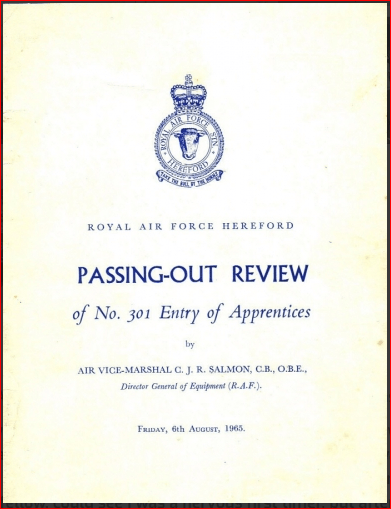
Whilst there, John and George made many friends with boys from different parts of the UK and from different backgrounds. After a year of close contact and demanding discipline, they forged friendships and operated as a group. At the end of the year-long course, trainees graduated as Senior Aircraftmen and had their passing out parade then they were posted to their stations where they became part of an administration team. Afterwards, they were to be posted to different parts of the country. Many never saw each other again, but that’s not what happened with John and George.
Invitation To The Passing Out Review.
Instead, they got their first posting together to RAF North Luffenham in Rutland. This area is very ancient and first mentioned as a separate county in 1159, but as late as the 14th century referred to as the “Soke’ of Rutland’, and in the Domesday Book as “A detached landlocked part of Nottinghamshire” (2) George was in the Station Sick Quarters teaching the Nursing Attendants to type, whilst John’s first assignment at North Luffenham was as a clerk in the Motor Transport section and later to the Ground Radio Servicing Centre. They were responsible for the reparation of Radar and Radio facilities in the UK. At a later point, he worked in the General Office and helped prepare airmen for overseas posting.
After a few years at RAF North Luffenham, John applied for a position on VIP duties, as a clerk on the staff of the Air Officer Commander in Chief at RAF Upavon in Wiltshire England where, shortly after his arrival, he met…….me!
**(Read my adventures and how I later met my husband of 53 years at RAF Upavon below)
Fast forward 60+ years and George read my story about my time in the RAF. Here’s what he told me about his experience
“During the 2 years there, I also worked in the Station Sick Quarters as the admin support to help the Nursing Attendants learn how to type at the mind-boggling speed of 15 wpm! We went our separate ways when I was posted to Singapore in 1968 but I do recall being told that John had re-mustered in the trade of air cartographer and was serving at AIDU RAF Northolt.
So, how did I come to read Marian’s stories? I work as a volunteer at the Trenchard Museum RAF Halton as an archivist and one of my tasks is to look into the history of the station.
Most people associate the station as the home of Number 1 School of Technical Training and the Trenchard Brats, young engineering apprentices who entered into a 3-year apprentice scheme set up by Lord Trenchard in 1922. What many people seem to overlook is the amazing medical history of the unit particularly the hospital, Institute of Pathology and Tropical Medicine and of course the Medical Training Establishment (MTE) Marian refers to. Marian, I loved your stories and you have made an old man very happy learning of my old pal John. I hope that you are both well particularly in these troubled times”
I read his email with great excitement. I called my husband to come and read THIS!!!
When he read it he could not believe it was from the same George whom he knew all those years ago when they served together as Administrative Apprentices.
George Cook is now a volunteer Archivist at the Trenchard Museum at RAF Halton and also assists with the guided tours of the Halton House Officers’ Mess. (3) (4)
An exchange of emails reveals that George has led a full and varied career in various positions of leadership in the RAF. John served 12 years and then served many years in the airline industry in Genéva, Switzerland and Montréal, Canada where we now reside.
How amazing is the speed of technology the internet and social media? I will always be grateful that it allowed George to read my stories, and John to reconnect with his friend after so many years.
The following database consists of books, documents, abstracts, and short articles that were written by numerous Authors whose works are available at BAnQ and numerous other links.
There are also links pertaining to books available at book stores within the list.
There is a History list of sites used in this document.
To view the database click the link below and open in a new window.
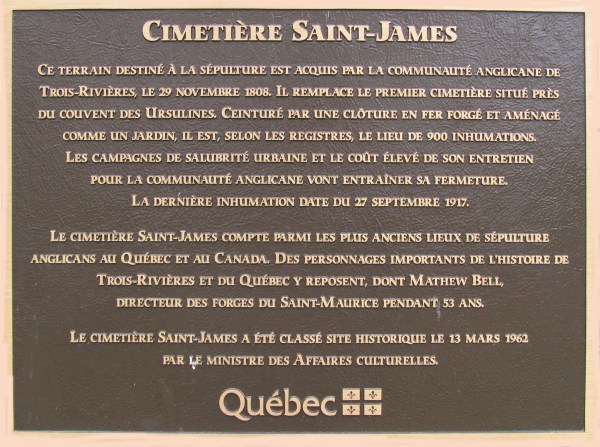
Located at the corner of Saint Francois Xavier and de Tonnancour Streets in the old part of Trois Rivieres. It was classified as a Quebec Historic Site in 1962 and is one of the oldest Anglican cemeteries in Canada. The land was acquired by the Three Rivers Anglican Community in 1808 and the cemetery was used until 1917. (It is also known as Cimetiere Saint-James) https://www.findagrave.com/cemetery/2517306/saint-james-cemetery
The database presented below consists of two extensive lists of names of Protestant Families that resided in Quebec during those years.
Genealogy is usually of little interest to children probably because their parents already seem from the Dark Ages and their grandparents from the times when Tyrannosaurus Rex tramped the planet.
It was the same thing for me way back in the 1960’s – except for the one day when I was about twelve years old. My mother came home all excited with some important news passed on to her by a cousin who had researched the Crepeau family tree.
My mom’s father, Jules Crepeau of Montreal, was descended from one Abraham Martin dit L’Ecossais, a pioneering (boat) pilot and land-owner in New France. My French Canadian mom found this fact highly entertaining. “I am descended from a Scotsman,” she told me, laughing. “What a joke.”
I remember this episode only because of another part of the story. Apparently, this Abraham Martin fellow owned the Plains of Abraham. THOSE Plains of Abraham. Now that I could sink my tweenage incisors into.
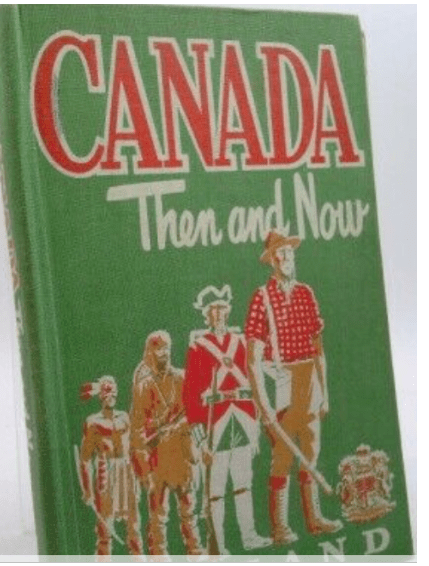
You see, I was learning about Canadian history in school. Our text was Canada Then and Now, a bright green text with a very iconographic cover pic.
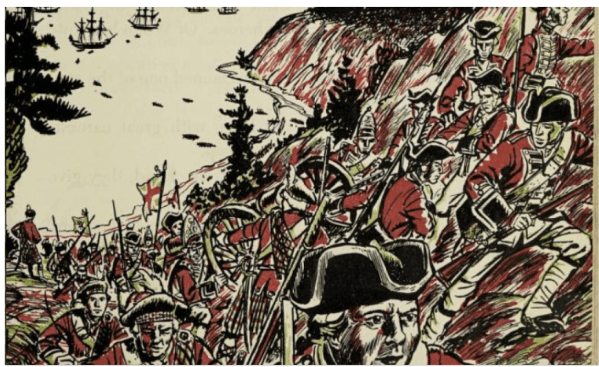
From this textbook, I was learning for the first time how the French and British were always at war with each other, way back then, in Europe and in North America. In North America, the fought over control of the lucrative fur trade and, apparently, it all came to a head one morning on the 1th of September, 1759 when a British general named Samuel Wolfe, after being rebuffed a few times by the superior French forces, led a cagey attack on the French General named Louis Joseph Marquis de Montcalm on the cliffs of Quebec City, cutting off his supplies and defeating his superior forces. This was all part of something called The Seven Years War.
All night long kept quietly landing the men on Wolfe’s cove. By morning, 5000 British soldiers were drawn up ready on the Plains of Abraham. The French had avoided battle, believing they were safe because they had more men than the British and plenty of supplies. They knew the British wold have to withdraw before freeze up. But now tht the British had landed above the town and cut off supplies from Quebec. The time had come for battle.
The textbook instructed us Canadian children, in subtle terms, to take no especial pride in this seminal event:
Wolfe and Montcalm were great generals and gallant men. Today, on the Plains outside of Quebec, a monument stands to honor them both. Wolfe’s name is on one side, Montcalm’s on the other. There is a Latin inscription that says, “Valour gave them a common death. History a common fame and posterity a common memorial.”
Illustration from Canada Then and Now. Storming the Plains of Abraham
Today, I am much older and predictably I am into genealogy. I have written many many family stories from both sides of my tree.
My mother’s French Canadian side was easy-peasy to patch together thanks to all those fabulous Catholic church records on Drouin available. And yes, if the Mons Origins website information is correct, my mom was indeed descended from this Abraham Martin.
Should I write about this pioneer ancestor? I have long wondered.
Truth be told, I would very much like to puzzle out the story of my earlier French Canadian ancestors, as Tracey Arial and Claire Lindle have done so brilliantly on this blog. I’d like to discover exciting new tidbits of information about my ancestors to add to the historical record (perhaps using some of the stellar resources catalogued on Genealogy Ensemble by Jacques Gagne) but it all seems so difficult, so labour intensive and so hard on the eyes.
In the past, I have explored the lives of Les Filles de Roi – because I am particularly interested in the lives of women ancestors – only to find there doesn’t exist much detailed information about these pioneering females from Normandy and Ile de Paris. It seems no one bothered to document the day-to-day lives or unique personal stories of these ‘mothers of millions’ back then– either in Europe or New France.
When it comes to this Abraham Martin dit L’Ecossais character, it would be a real waste of time to try to find a new angle or to write something fresh about him. There are already reams and reams (or pixels and pixels) of information written about him. It appears that Abraham Martin dit L’Ecossais is one of the most famous French Canadian pioneers and a father to millions of North Americans, including Madonna and Justin Bieber – and, ah, little ole me.
Long story short: He married Marguerite Langlois. Had 14 children. I am descended through Vitaline Forget-Despatie, my mother’s father’s mother.
The kicker to this non-story of mine: Abraham wasn’t necessarily Scottish. He could have invented the epithet to avoid criminal prosecution or he was a war deserter. His name might have generated from the fact that he had visited Scotland many times in his youth.*1
Now, lately I have dug out one very interesting fact about my mom’s French Canadian ancestors on her dad’s side, one she didn’t know about. My mother always told me that the name Crepeau meant “curly haired one.” She had very very curly hair herself, as did her father. I have no idea how long she had known this fact or who originally informed her.
If that same cousin, back in 1967, had provided her with a paper genealogy, my mother would have noticed that the original Crepeaus, going back six to eight generations, were Crespeaus, from Poitou Charent. I have recently learned that the name Crespeau almost certainly came from Crespo, a very Spanish name – and not only that a Sephardic Jewish name.
I found this tidbit on sephardim.com:
“The name Crespo has been identified by the Holy Office of the Church of Spain as a Sephardic Jewish surname.”
How fascinating.
So, it seems, even genealogically-timid I can dig out an interesting fact or two about a distant French Canadian ancestor. Maybe I should keep trying.
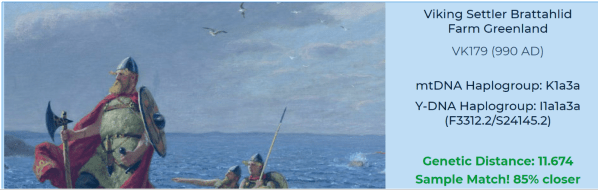
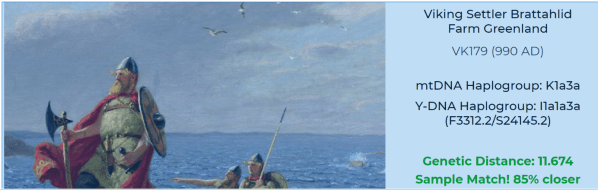
1. Even if Abraham Martin wasn’t born to the Tartan, he likely had English, Scottish and even Viking dna. Normandy, Normans, North men, Norsemen. Ancestry gives most of my many many French Canadian cousins a little bit of Norwegian ethnicity. I have a very vague 0-8 percent.
Wouldn’t it be funny if my mom were related to Eric the Red, chronicled in the second chapter of Canadian Then and Now, after the first chapter on “Indians” and “Eskimos.”
If you believe mytrueancestry.com, my husband, whose Mom comes from Isle of Lewis Scots, apparently is connected genetically to Eric’s clan. How very romantic! If I didn’t love him before, I’d have to love him now!
2. I checked the Y dna lists online at Family Tree and someone is trying to see if French Canadians have Semitic genes. There are very few members. On a regular French from France Y dna site I can see that some French Canadians have J M172, an Anatolian line, often thought of as the Greek Diaspora. Cote and Leger are the names that crop up. There are no Crespos, Crespeau’s or Crepeaus.
Montreal’s Italian community is one of the largest in Canada, second only to Toronto. With 279,795 residents of Italian ancestry as of the 2016 census in Greater Montreal,[2] Montreal has many Italian districts, such as La Petite-Italie, Saint-Leonard (Città Italiana), Rivière-des-Prairies, and LaSalle. Italian is the third most spoken language in Montreal and in the province of Quebec.
The Italian Immigrant Presence in Canada, 1840-1990 John E. Zucchi McGill University.
In the last one-hundred years, more than 650,000 Italians have immigrated to Canada, almost three-quarters of them in the period following World War I1 (Rosoli, 1978:35%5). They have settled primarily in Toronto and Montreal, and to a lesser degree in Vancouver, but also in significant numbers in scores of small and large mining and industrial towns in British Columbia, Alberta, Ontario and Nova Scotia….. The literature on Italian immigration to Canada is extensive and is represented by a number of fields, primarily history, sociology, anthropology, geography, political science and literature.1.
In the early 20th century, a new wave of European immigrants made its way to Québec and to Montréal. Among them were thousands of Italians who brought with them their traditions, their values, and their customs, going on to form one of the oldest and largest immigrant cultural communities in Montréal.2.
Of all the immigrants Montreal has welcomed since its founding, the Italians have had the greatest impact on the city. From the arts to politics, agriculture, real estate, gastronomy and sports, the Italian community has influenced every sector of life in Montreal.
The Italian presence on Quebec soil goes back to the founding of Montreal. Italian settlers served in the French regiment of Carignan-Salières (1670) to help fight the Iroquois. In return, the King of France gave them land. More Italian migrants arrived, and in 1860, 60 Italian families called Montreal home. From 1900 to 1915, more than eight million Italians left their country. Many headed for Europe, while others ended up in North America, especially the United States, and a few settled in Quebec, primarily in Montreal.
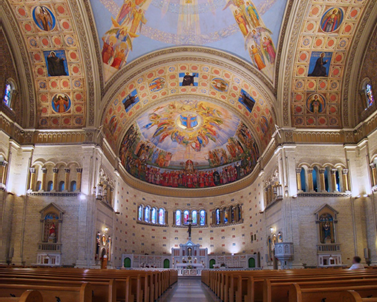
Notre-Dame-de-la-Défense parish, also known by its Italian name, Madonna della Difesa, is the first Italian parish in Canada. It is located along Saint-Laurent Boulevard, with Saint-Zotique and Jean-Talon streets marking its limits. Educational, assistance, recreational and sports establishments quickly sprung up in the community. It was here that, in 1927, the grand Notre-Dame-de-la-Défense Church was inaugurated. In 2002, the Government of Canada designated this church a national historic site.3.
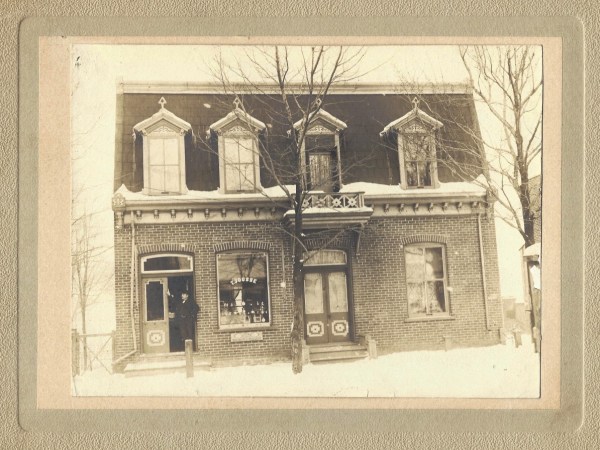
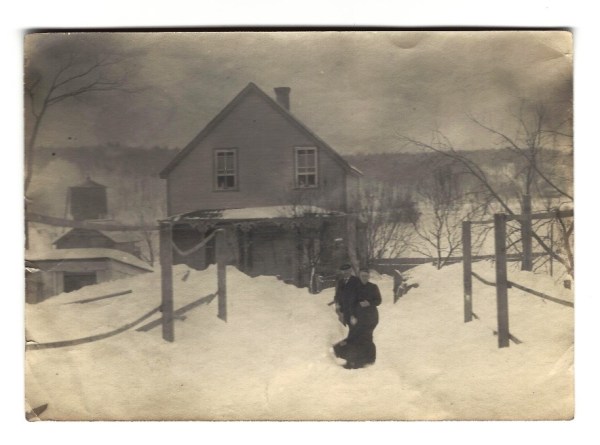
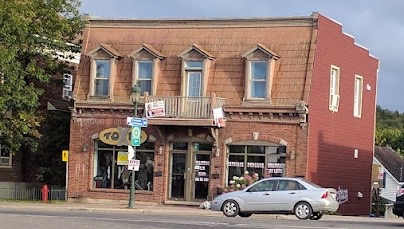
There is a house on Main Street (now Rue Principale), in Lachute, Quebec that my mother said had ties to our family. We would drive by it on most shopping trips to Lachute from our summer cottage. Mom said her Aunt Helvetia and Uncle Eugene Jousse had lived there and for a short time her grandmother Ida Bruneau. I thought it was a different house but old pictures clearly show which was the house. It now looks out on a Canadian Tire gas station and a Tim Horton’s.
Eugene’s father Theophile Jousse, had the house built in 1887, as a copy of his family home outside of Paris destroyed by a fire during the Paris Commune of 1870-71.
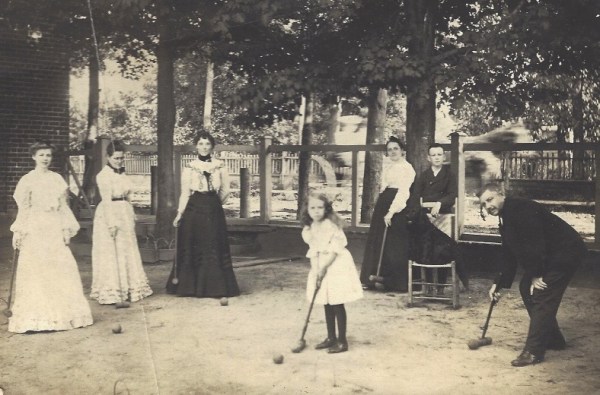
The house, built in the French style, right on the street with a small overhead balcony and dormer windows stands out. To the west of the house was a croquet lawn. A small cottage was built behind for his parents.
Theophile Jousse was born in 1855 in Vincennes, a commune in the Val-de-Maren department in the eastern suburbs of Paris. His father the Reverend Jean Felix Jousse, his mother Gorgette Haerrig and the family lived through the Prussian War, only to be caught up in the Paris Commune of 1870-71. Soldiers of the National Guard had seized control of Paris, refusing to accept the authority of the French government and tried to establish an independent state.
Felix and Theophile immigrated to Canada around 1874 with the rest of the family coming soon after. When Theophile first saw Ephyse Piché at L’Oratoire, the French Baptist Church in Montreal he knew right away that she was the woman he would going to marry and they did in 1876.
Theophile, an apprentice watchmaker moved from Montreal to Waterloo, Quebec and opened a jewellery store. When his business failed he moved his family to Lachute as his wife Ephyse was originally from nearby Saint Scholastic. There he opened another jewellery store and his parents moved into the cottage behind. Felix Jousse died in 1890 while his wife Georgette lived in the cottage for almost 20 years.
Theophile and Ephyse had three sons, Paul, Albin who died as a child and Eugene 13 years younger than Paul. Both sons apprenticed as watchmakers and jewellers under their father. Paul moved to Vankleek Hill, Ontario, just west of Lachute and opened his jewellery shop while Eugene inherited the Lachute house and business from his father. This caused some family problems.
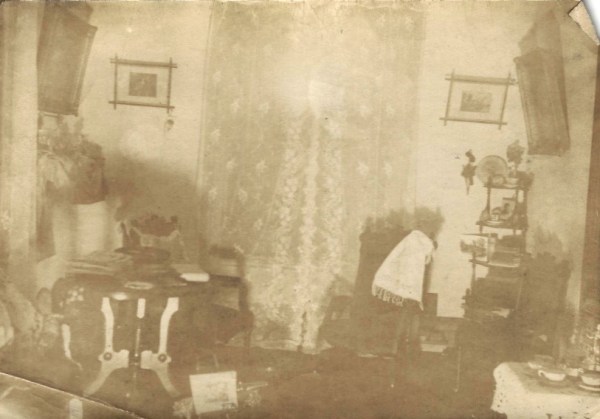
When Eugene Jousse married Helvetia Bruneau they moved into the small house behind the store as both Theophile’s parents had died. They lived there until Eugene’s mother Ephyse died and then moved into the big house to look after Theophile. While Helvetia had furnished and redecorated the cottage she wasn’t allowed to move or change anything in the big house. It had to remain as Ephyse had left it.
Helvetia and Eugene had two children, Eugene Theophile and Ephyse Marie. Theophile insisted his granddaughter be called Ephyse after his wife. When Helvetia’s father died in 1918 her mother Ida Bruneau and two younger brothers Herbert and Gerald came to live with them. They had the space as Theophile died in 1916 and they still had the two houses. Herbert finished high school in Lachute and Gerald was still living there in 1921.
In the twenties the jewellery business in Lachute couldn’t support the family so in 1927 they moved to Montreal and Eugene went to work at Birks.
The house is still there. It must have had many owners as the businesses have changed over the years. It has recently been renovated and a tattoo parlour and a clothing shop called Toxic have been replaced by a children’s clothing boutique. The grandmother’s cottage still sits behind but the croquet lawn is long gone.
Notes:
Letter from Ephyse Jousse Hawks to Donald Walcot October 10, 1986. Copy in author’s possession.
The Walcots of Montreal West by Donald T. Walcot. Toronto 1984.
Lachute Chapter IV The Period of Expansion. 1876- 1900.
The house was built in 1887 by a local builder Riddell and Sutherland but designed by Theophile Jousse.
In 1921 the house was number 57 and now it is number 601, 603 and 603A Rue Principale
In 1986 Ephyse Jousse Hawkes said the house housed a delicatessen. She looked through the window and didn’t recognize her old home.
The Jousses:
Jean Felix Jousse: 1825 -1890 He was a Limonadier and an evangelist
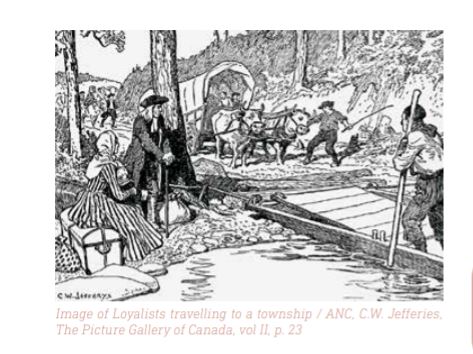
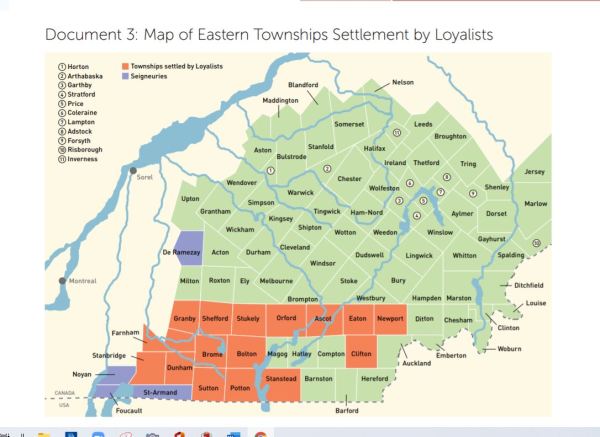
Following the American War of Independence, the Thirteen Colonies became the United States. Those who wished to remain faithful to the British Crown were obliged to leave their home to reach British territory. Consequently, following the 1783 Treaty that ended the War of Independence, Loyalists moved to British-occupied territories. Fifty thousand Loyalists reached British territories. Today, these territories make up Ontario, Quebec and New Brunswick. Of these 50 000 Loyalists, 500 fled to the Upper Richelieu Valley, to Noyan, Focault and St. Armand, unoccupied seigneuries of the Province of Quebec. These lands were ideal for clearing and their geographical location facilitated trade with the United States.
Various online databases at BAnQ (Bibliothèque et Archives nationales du Québec) list books, papers, original documents, government decrees, proclamations by the British authorities during the British Military period and during the Lower Canada time frame about who the Loyalist people of Québec were.
Click the link below to access the database. Open link in a new window.





 Genealogy Ensemble