Pages 5-36 Authors who have contributed to newspapers from 1764 onward
Pages 36-40 Lists of Quebec Newspapers and BanQ Numerique
Pages 40-48 History of Newspapers
Pages 48-52 Repositories
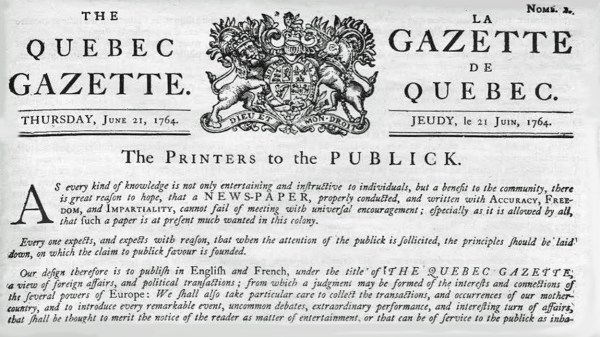
“But along came the likes of Fleury Mesplet, Pierre du Calvet, John Neilson, James Brown, William Brown, Jocelyn Weller, Daniel Tracey, Henry-Antoine Mézière, Samuel Neilson, Ludger Duvernay, François-Xavier Garneau and many others who were the prime movers, the instigators who educated the people and also they were the ones who through their printed pages influenced the people and politicians of Lower Canada and Québec during the formative years of Confederation.”
When my great-great Aunt Helen and her husband travelled to Korea in 1899, the country was almost unknown to tourists. Helen was an intrepid traveller, but in the end, the scarcity of clean accommodations got the better of her.
At the time, Helen Frances Bagg (1861-1935) and her first husband, Albert Edward Lewis (1861-1908), were living in Shanghai, where there was a large European community and they enjoyed a busy social life. However, Shanghai was very hot in the summer and Helen read that Korea was cooler, so that June, the couple left for Korea aboard an uncomfortable Russian mail ship.
In a neatly hand-written journal penned 25 years later, Helen noted that the day after they arrived in Chemulpo (now known as Incheon), Prince Henry of Prussia also landed there. A delegation of Korean nobles had been waiting for six hours for him near the landing area, dressed in gowns of spotless white, surmounted by sleeveless blue garments and small crowned hats fastened under the chin with ribbons and strings of amber beads. The prince took no notice of this welcoming committee, but immediately mounted a pony and left for the consulate.
Helen noted that the white garments so many Koreans wore were a curse to the women of the country. Poor people only owned only one such robe, and to ensure that their clothing was clean, women often stayed up all night to do the laundry, beating the garments with wooden clubs until they were dry and glossy while their husbands slept soundly.
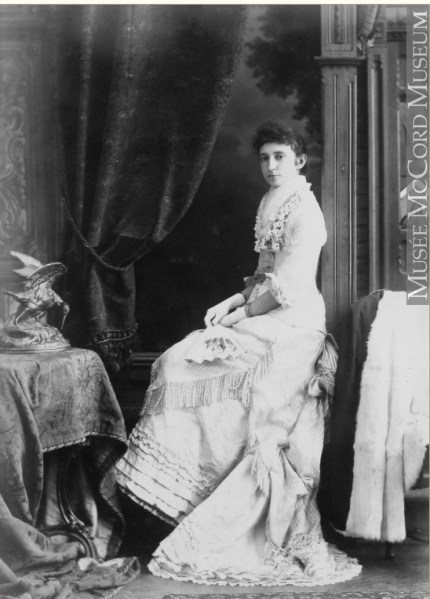
Helen Frances Bagg, Montreal, 1882
After a week in Chemulpo, Helen and Edward travelled by boat to Seoul, the capital city, along with several other foreign passengers and their interpreters. They expected to stay at the British Consulate, but the consul was away so they had to find other accommodations. By the time they settled into the house of an English missionary, it was evening, so they went straight to bed by the light of a single candle. Later, Helen awakened “with the feeling that I was being devoured alive!” In the morning, they discovered insects hiding behind the numerous Bible pictures hanging on the walls, so they went out and bought soap, scrubbing brushes and several packages of Keatings Insect Powder, guaranteed to get rid of fleas, cockroaches and flies.
Despite the discomfort of their accommodations and the unstable political situation (the empress of Korea had been assassinated four years earlier and the emperor apparently feared a similar fate), Helen and Edward found Seoul to be interesting, and they met a historian who related many local legends and took them to see the city’s palaces and other landmarks. They both took many photos with their Kodak cameras, and later sold some of their images to newspapers and magazines.
After several weeks, Helen and Edward moved to a seaside town where they hoped to find some cool breezes. They rented a Japanese bungalow near the water, but it included only what Helen described as “the barest necessities of life.” They tried sleeping on the floor, but that was so uncomfortable, they ordered bedding from Shanghai and hired a carpenter to build a bedstead.
“Our only cooking was done on a tiny Japanese hibachi, which was, however, quite sufficient for our purposes,” Helen remarked. Meat and decent vegetables were scarce, so they usually ate canned food. They hired a servant recommended by another missionary acquaintance to do the housework.
The highlight of their stay was a three-day trip to a mountain Buddhist monastery, organized by a Scottish missionary named McRae. They set out on a suffocatingly hot day with three ponies, a stout ox, two palanquins (sedan chairs) borne by six men, a Korean guide and Mr. McCrae. At the entrance of the picturesque old monastery, a group of monks in white attire greeted them, and “their 90-year-old abbot stood at the top of a long flight of steps to greet us with offerings of cake and wild honey.”
Exhausted by the long trip, the visitors were escorted to a dimly lit corner of one of the temples, and they immediately fell asleep on the smooth clay floor. Helen awoke in the middle of the night, parched and drenched in sweat. They discovered that, in an effort to be hospitable, the abbot had ordered that an extra-hot fire be lit under the clay floor! Helen, Edward and Mr. McCrae gathered their belongings and tiptoed to a cooler temple. In the dark, they thought they spotted sleeping figures on some nearby tables, but when the sun began to rise, they realized these figures were not sleeping monks but dead ones, laid out on funeral biers! Soon, a bell began to ring and a group of chanting monks carried the corpses off to their funeral.
Hot and tired, Helen and Edward got another shock when they finally arrived home at their seaside villa: the servant’s wife and two dirty children were lying on their precious bed. Helen chased them down the road, the children shrieking at the tops of their voices, and the couple burned the mattress and pillows.
They spent the following week with an unpleasant European family while they waited for a ship bound for Vladivostok. “It was without an atom of regret that we watched the shores of the ‘island of the interrupted shadow’ fade out of our sight into the distance beyond,” she wrote.
Photo credit: Notman & Sandham 11-4197.1 copyright McCord Museum
Note: The widow of a distant cousin recently found this journal among many photo albums and other family documents stashed in a locker in her condo building. She did not know what it was or who wrote it, but I did! See Janice Hamilton, “Helen Frances Bagg; A Happy Exile”, Writing Up the Ancestors, Jan. 6, 2016, http://writinguptheancestors.blogspot.com/2016/01/helen-frances-bagg-happy-exile.html
If my sisters and I have strength, persistence and a refusal to be victimized, we get it from our ancestor Marie-Madelaine Michel Gasnier DeRainville.
Over her 72-year lifetime, Marie left her family and friends three times, married twice, bore nine children, and raised eight of them to adulthood, marriage and their own children. She also lost her first husband to the Beaver Wars that lasted throughout her lifetime.
Jacques and Claire from Genealogy Ensemble also share Marie as an ancestor. If you have roots in North America, chances are, she’s one of your ancestors too.
Like many women, most of the records in which Marie appears focus on the men she accompanied. Many contain estimates about her data. The circumstances they show, however, hint at both suffering and forbearance. She never learned to write, but the strong ‘x’ she used as a signature indicates a woman who knew her worth.
My favourite resource for Marie’s life is a website created by Reverend John F. Gasnier in 2012.1 Gasnier excels at research. His detailed work provided me Marie’s parents’ names, the birth of her children and many of the dates in their lives.
I have begun to collect the original sources he used to compile this data, but so far, his work seems accurate except possibly her birth date. He estimates her birth date at 1620; another good site estimates 1619. Fichier Origine puts her birth at 1615, the date I’m using. Two of the three sites indicate that her birth took place in the village of St-Martin du Vieux Bellême, which Jacques tells me now sits within the modern-day Département de l’Orne. Both her birth town and Igé, the birthplace of her husband Louis, still exist in the now township of Bellême.
From the rest of the data, Marie’s life looks so sad. How did she live through so much suffering?
Her trauma began with the death of her first child sometime between his birth in 1639 and the family voyage from Igé, France to New France in 1644.
Two years before they left, the couple’s daughter Louise was born. By that time, Marie had reached her 27th year; her husband Louis his 30th. Perhaps her birth was the family’s chance for a new life.
It’s not clear why Marie and her husband decided to leave France, but emigration from the region started 10 years earlier, due to the recruitment by apothecary Robert Giffard and the Company of New France.
Giffard recruited many Percherons to New France until his death in 1669, except during the years when the Kirk Brothers occupied Quebec on behalf of England (1629-1631). By then, the colony of New France had 3,000 settlers, including Marie, her husband and their daughter.
In about forty years, 194 adults who had various jobs, often related to construction (mason, carpenter, brick-maker, etc), undertook the great voyage. Some returned to live and work in their native country but the great majority, despite the Iroquois threat, chose to settle on the banks of the Saint Lawrence River in order to clear and thrive the new territories. Their descendants are estimated today at 1.500.000 people in Canada and much more if we include the United States.2
When they undertook the voyage with their two-year-old daughter in July 1644, Marie was pregnant with their second daughter. Her namesake Marie became their first child born in the colony the following September.
Life couldn’t have been easy for the couple once they arrived in New France. It took them more than two years to lease a farm for their fast-growing family from the Saint-Joachim Seminary.
At that period of time, colonists to New France integrated into one of many manors set up under the seigneurial land management system brought to New France in 1627. New France then extended from the Arctic to Florida.
Under the manor system, the Compagnie de Cent Associés (Company of 100 associates) granted important people and groups, including religious ones like the Seminaire de St. Joachim, one by three league (5 by 15 km) land masses along major rivers, including the Saint Lawrence. The land was divided into 3 x 30 arpent sections perpendicular to the river so that everyone had access to boat transportation. (Note that each arpent measured 190 feet (58m).
Marie and her family rented La Ferme Saint-Charles in Cap Tourmente near the town of Saint Joachim for four years. They had two sons—Pierre and Olivier—during this period.
The family then moved back to Quebec while Marie’s husband built a new house in what is now St. Anne de Beaupré. While they waited, Marie had two more children, Louis and Anne.
Just after Anne’s birth, the family moved into a new house on a lot in the Seignerie de Beaupré (Beaupré Manor).
Part of the Beaupré Manor still exists today. Now run jointly by the l’organisme de bassins versants charlevoix-montmorency (obv-cm) and the séminaire de québec – seigneurie de beaupré, the territory covers a 20 by 95 km band north of the Saint Lawrence River. The territory spans 1,600 square kilometres west of Stoneham and east of St-Urbain in Charlevoix. Hunting, fishing and outdoors clubs share the space with loggers, Boralex and Gaz Métro/Valener.3
Back when my ancestors moved in, however, most of the action took place right next to the St. Lawrence River, where the village of Sainte Anne de Beaupré now stands. Marie’s husband Louis built a solid 22 by 20-foot home with 2-foot-thick walls on a cliff overlooking the river. There’s still a house built on the original foundations at 432 Cote Ste. Anne.
Things were good that year. Marie’s oldest daughter Louise got married and she and her husband established their home three lots away. Louis’s older brother Pierre arrived in New France from France with his pregnant wife and three sons. By 1655, he had established a property and house six lots away from his brother.
A year later, Marie gave birth to my six times great grandfather Ignace. The records indicate that Marie worried he wouldn’t live long. Jesuit Father Ragueneau rushed to the house on March 12, 1656 to baptize him. That could have been the first of three major tragedies, but he survived and married. (See my story What legacy stems from our Quebec pioneers?)
In May that same year, the second tragedy occurred. Louis’ older brother Pierre died of recurring fever.
The next three years went quickly, with all three families living in a small neighbourhood along the river. Marie’s namesake child married Andre Berthelot on January 26, 1659. Marie had her last child, son Joachim, a year later.
It would be the family’s last happy year.
In June the following year, 1660, the third tragedy occurred. Louis and seven other neighbourhood men got caught up in the politics of the era. They ended up being scapegoats in the Beaver War.
The Beaver War took place because the fur trade encouraged by British, French and Dutch colonialism pitted Algonquian and Wendat, who sided with the French, against the Haudenosaunee (called the Iroquois in Jesuit papers), who sided with the British and Dutch. Things became even worse after the British and Dutch decided to arm their First Nations allies with rifles. The French refused to supply weapons to theirs.
The weapons imbalance combined with over-hunting led to Haudenosaunee raids of the colonies. Marie’s husband became one of the victims. He probably died in Auriesville.
“Louis disappeared from the records, and it’s believed he was among a group of 8 people who were captured in a raid by some Iroquois on the morning of June 18, 1661. The settlers were forcibly taken to the tribe’s village near Lake Champlain in what is now New York. There the victims were tortured, then killed; one of them was known to have been beaten with “clubs and iron rods” before being scalped....4
Marie didn’t know for sure that her husband was dead until a notary arrived at her home a month later. At the time, she had two dairy cows, two heifers, an ox, two veal calves, nine pigs, a plow, a boat, two rifles, a pistol, an axe and household goods that included only three beds for Marie and six children.
Her son in law Claude guaranteed that she would take care of these goods for her children, her now dead husband’s heirs.
Yet still, Marie stayed strong. Five years after the tragic death of her husband, she remarried Paul DeRainville at 51 years old. Together, they raised my direct ancestor Ignace and his brothers, all of whom married and had Marie’s grandchildren.
By the time Marie died on November 12, 1687, peace still hadn’t arrived in New France. That wouldn’t occur until the Great Peace of Montreal in 1701.
Flying Dentures and the Terrible Typhus: The Montreal Water and Power Scandal of 1927
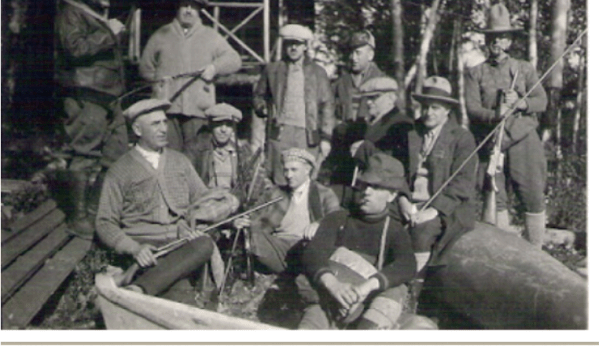
Jules Crepeau, second from right seated on a fishing trip with Aldermen and Mayor Mederic Martin. He looks deadly bored doesn’t he? Jules Crepeau lived to work.
On September 29, 1930, in a memorable public meeting of the Montreal City Council filled with oratorical fireworks, twenty-nine aldermen debated whether my grandfather, Jules Crepeau, should be allowed to ‘resign’ from his lofty post of Director of City Services at City Hall. It was an especially loud and rowdy session of Council, with observers in the gallery booing Mayor Houde, but, apparently, ‘a religious hush’ came over the hall when Etienne Gauthier, Chief City Clerk, read out my grandpapa’s coerced letter of resignation.
This was the most important debate ever held at City Hall, cried out the left wing Liberal newspaper Le Canada the next day. The City Hall reporter from the Montreal Gazette had unusual fun with the story: “It was a hot session. A dozen usually placid aldermen lost their tempers and their ruddy complexions paled in anger. The mayor lost the main span of this false teeth in the middle of a sentence, caught them on the fly and pocketed them nonchalantly. But nobody lost his voice. His Worship and Ald. Schubert of St. Louis ward put on the main bout, and the alderman asked Ald. Bruno Charbonneau, the pro-mayor in the chair, to have the mayor expelled from the Council Chamber for bad behavior.”1
Jules Crepeau’s third and fourth scandals overlap in the late 1920’s, so I am starting with the least unsettling of the two: The Montreal Water and Power controversy where the City purchased a much-needed privately-owned water utility based in a separate city, Westmount, for 14 million dollars.
Gazette headline
This purchase in 1927 was fairly benign business-as-usual except in the eyes of those Anglo businessmen who despised monopolies. Indeed, with the support of Hugh Graham (Lord Althostan) Camillien Houde used this non-scandal in 1928 to propel himself right onto the Montreal Mayor’s throne where he would remain, on and off, for decades – famously opposing the draft in WWII and even going to jail for it.
In 1930, Mayor Houde invoked this same Water and Power ‘scandal’ to force my grandfather Jules Crepeau, a 42 year veteran of City Hall, to resign his all-seeing post of Director of City Services, just two years after Council had praised him to the hilt on the occasion of the 40th anniversary of his tenure at City Hall.
Like my grandfather’s other scandals that I am writing about in this series, The Montreal Water and Power Purchase is a bit difficult to unpack, but let me try.
The Purchase was all about contagion, especially typhoid epidemics in 1904, 1909 and 1927 respectively. A key ethical question loomed over the purchase: whether municipal utilities existed to promote big business and speculation or to serve the better interests of the citizens of urban areas, rich and poor, or both.
In 1904, the typhus bug had likely originated in the pipes of Westmount’s deceptively named Montreal Water and Power Company, tainting the unfiltered water in this tony suburb and killing 30. But s**t famously flows downstream and three times the number of citizens were killed in the working class town of St. Henri.
Assess to potable water had long been a problem in St Henri, a low-lying ‘burb that flooded every spring. That town also housed a number of abattoirs and tanneries mucking up the natural water supply. In 1910, the infant mortality rate in St. Henri was world class.
The beleaguered citizens of St Henri had to pay two water taxes, one to the Company and one to the municipality. Most people couldn’t afford it.
Thus St Henri was forced to pay the water tax for many of its poorer citizens. At the turn of the 20th century, this burden proved too much and, in 1906, St Henri was absorbed into the City of Montreal.*2.
From then on it was understood that the City of Montreal would have to purchase the waterworks from its private owners– it was just a matter of time. Between 1917 and 1926, a succession of bills were passed in the Quebec Legislature making way for the City to purchase Montreal Water and Power. Meanwhile, Montreal Water and Power continued to be ‘a thorn in the side of the city.’ 9
And when the purchase was finally approved by Council on February 14, 1927, the timing was most suspicious – or auspicious, depending on the point of view.
It seems the City Council signed off on the purchase shortly after Senator Lorne Webster purchased the company stock in parcels between the spring and autumn of 1926 from the Hanson Brothers, through a family trust located in New York State. Webster paid only nine million, five hundred thousand dollars for the company. The city taxpayers were out four and a half million.
Apparently, the Montreal Star and Standard (owned by Hugh Graham until 1925) were the only English newspapers that condemned the purchase outright. The Council either acted too hastily, they said, or there were corrupt motives involved.
Surprisingly, no one mentioned the typhoid epidemic, taking hold right then in February, 1927, as a very good reason for Council to rush to purchase Montreal Water and Power, considering the events of 1904. I guess no one wanted to frighten away those monied American tourists who were flocking to Montreal for a boozy good time. 4
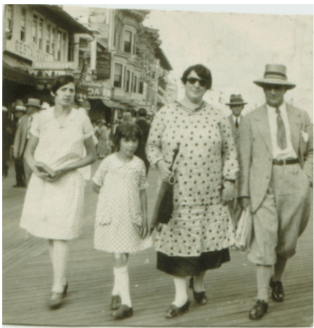
The Crepeaus visiting Atlantic City in 1927 or 28 judging from my mother’s size. Hmm…Working vacation? Atlantic City had no prohibition. You could probably cut the tension at home with a knife, considering what Jules was going through back then. My grandmaman had her own altar at home and kept a house full of priests. Was she super religious or was she afraid of something?
Alderman Mercure soon mounted a libel suit against the Montreal Standard on behalf of Council, so all people in question had to publicly testify.
On the stand Lorne Webster was positively cocky. Yes, he owned most of the shares in the family trust. Maybe he had been at the Quebec legislature in early 1926 when the bill was passed giving Montreal the go-ahead to purchase Montreal Water and Power, but he knew nothing about it. He was there on other business, Presbyterian Church Union. No, he hadn’t ever intended to quickly flip the company to the City, at least not until the City Council approached him.
The Court ruled that the controversial purchase was legal and above-board: that’s what businessmen do, speculate. Montreal Water and Power was created for no other reason than to be purchased for a profit, in the future, said the Court. It was the responsibility of the City’s Executive Committee of aldermen, led by “Montreal’s Napoleon” JAA Brodeur to have stopped the Webster purchase were it, indeed, such a bad deal for citizens. Brodeur (who died but a few months later) had testified that he knew about Webster’s prior purchase but he still thought the deal a good one.
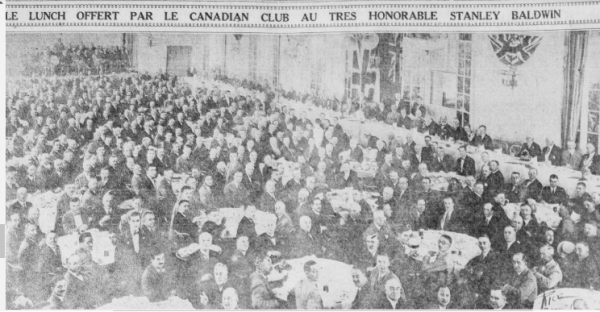
La Presse pic of huge reception for UK PM Baldwin August 2, 1927. My grandfather, along with Alderman Mercure and Mayor Mederic Martin were among the copious head table guests, which included Lorne Webster and Sir Hugh Graham. The Royal Princes were also in town to celebrate the 60th anniversary of Confederation. David and his brother were out golfing at a public event this lunch hour but they had attended a ceremony at City Hall that morning, an event organized by my grandfather’s office.
How does my poor grandpapa fit into all this? Well, Houde claimed that as Director of City Services it was his job to warn all the aldermen against the deal.
My grandfather defended himself in the papers by saying that he did not even attend the council meeting at City Hall where the aldermen voted to seal the purchase, so how could he have warned anyone? He only learned about the purchase the next day, he claimed.
It is a bit weird that he did not attend that Council meeting, since that was one of his many, many tasks. Was it a shady session? Maybe. Did my grandfather know about it? Probably.8
During the 1928 election campaign, Camillien Houde called out as corrupt the late Mr. Brodeur and a certain name-left-unspoken “everybody knows who he is” Minister at Quebec.
Houde won the April 2 election handily, winning over voters in English wards specifically on the W and P issue, or so said the Montreal Gazette, and the very next day a report was commissioned on all aspects of the Montreal Water and Power purchase. A board of arbitration put the price at fourteen million and Mayor Houde would go on to ratify the purchase. All in all, the Montreal Water and Power purchase was a very good thing for the city.
Still, Houde used the Water and Power purchase to bounce my grandfather two years later, saying the electorate had given him the mandate to do so back in 1928.
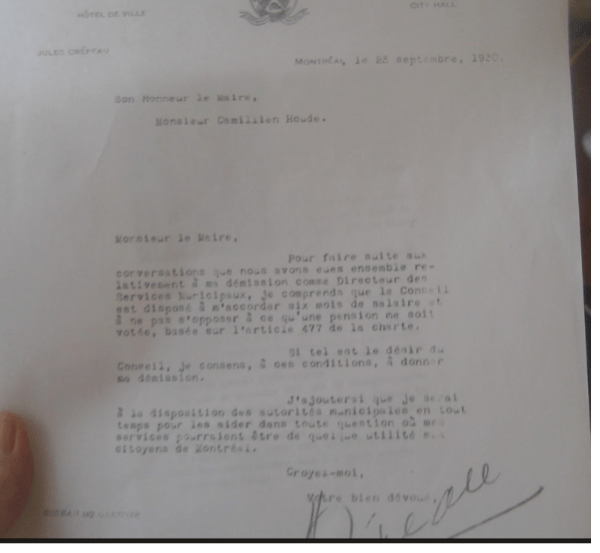
My grandfather wrote up a short letter of resignation on September 22, 1930 but he said in the newspapers that it was up to Council whether or not to accept it. Thus came about that rowdy debate at City Hall on September 29th, recounted almost word-for-word in most of the Montreal newspapers, except in the Montreal Star, where the news report was kept short and simple.1
Le Canada suggested that my grandfather had become ‘an embarrassment’ to Houde because he knew too much about the new administration. This was highly probable. Before acquiescing to Houde’s demand, my grandfather negotiated an enormous severance payout and life pension which one might guess was in return for his future silence. And the circumstances surrounding my grandfather’s untimely death in 1938 suggests the same thing.*7
In the end, on that cool autumn evening in late September, twenty-two aldermen – all Houdists – voted to accept my grandfather’s resignation and seven voted not to. My grandfather would retire and still be the second highest paid person at City Hall.
During that fateful council session Alderman Trepanier, my grandfather’s long-time ally, argued passionately on his behalf – claiming that Mayor Houde had his aldermen ‘by the throat.’ He was forced to retract that statement, replacing it with something less aggressive, “The aldermen are pirouetting to Houde’s every demand,” he said.
Houde was undeterred. “The people want revenge for the Montreal Water and Power Scandal and they want revenge for the Laurier Palace Fire,” he boomed, spitting out his lower plate.
And so we get to my grandfather’s fourth, most meandering – and most murky – career scandal at Montreal City Hall in the 1920’s, the Laurier Palace Fire/Coderre Police Corruption Scandal. This is where my grandfather’s story starts to look like the convoluted plot for a season of Line of Fire. To be continued in Part 3.
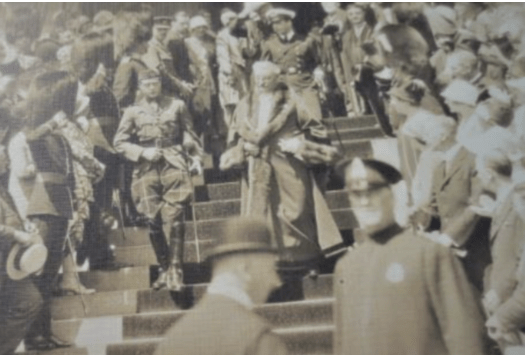
David, the Royal Prince, with Mayor Mederic Martin on the morning of their visit. The charismatic prince sorely disappointed his female fans a few hours later by rushing to the golf game in Laval des Rapides incognito instead of taking an open car on a parade route. Still, many privileged guests got to follow the princes on their round.
Le Canada, published in league with the Liberal Party of Canada, called the debate at the council session, the most important ever held at City Hall. They also said ‘there was a religious silence in the room” as my grandfather’s resignation letter was read out..
The Montreal Star story, of which I have a paper clipping, was much more restrained, featuring classic reporting that summarized the situation and said ‘lot’s more happened.’ It mentioned the flying teeth, though.
2.Lord, Kathleen. “Days and Nights: Class, gender and on Notre Dame Street in St. Henri, 1875-1905. McGill Thesis 2000.
4.The epidemic was taking hold probably right around then. By March the numbers were making the newspapers. There would eventually be 5,000 cases and 533 deaths. Americans sent up their health experts to locate the cause – eventually found to be milk not water. With no prohibition in Montreal in 1927, the city was a tourist haven for Americans looking for a good time. That’s probably why Council didn’t bring up the epidemic in their defence. (My opinion only.) Brodeur later denied there was any typhoid epidemic at all. “Just a few cases.”
5. In 1927, L’Autorite Magazine, among other revues, called my grandfather an innocent pawn of Chairman Brodeur, during the inquiry into the Laurier Palace Fire in 1927. In this particular case, I suspect they got it wrong. See my next post. They also claimed Houde kept Jules on at first because he needed his knowledge.
6. Le Canada was a very modern-looking newspaper with lots of ads and a ladies and sports page. (See BANQ for more info.) It was a newspaper published in league with the Liberal Party of Canada, and contained many scathing articles and editorials about the ‘firing’. They refused to call it a resignation. Basically, they said the new Houde administration was corrupt, already breaking laws at all levels of government, putting hardworking fathers out of their city jobs and replacing them with their own. (The Depression was starting and unemployment was rampant in Montreal. Le Canada contested Houde’s claim that the people wanted Jules out over the Montreal Water and Power deal, since these same people, they said, had re-elected most of the alderman who voted for the deal in 1928. (I’m not sure if this is true.) They said my grandfather was gotten rid of cause ‘he knew too much and maybe he had become….embarrassing.’ Probably true. When City Hall contested the Pension in 1930 /1931, there were snippets in newspapers here and there that my grandfather might run for municipal office, even as Mayor. Did he really want to run for Mayor? Not quite his style. The average Joe on the street didn’t know his name, *unless they read the tabloids in 1914. I think these postings were little threats. “Make sure I get the pension, or…” Le Devoir did not think it right that my grandfather was turfed out, “ He will be a hard man to replace: no one knows like he does how to keep the wheels of municipal government running smoothly,” but they laughed at the idea that the Houde administration was more corrupt than the previous administration ‘which was well known to be run by liberals.’ They also claimed at the time that my grandfather managed to keep the scandal over the Water and Power sale at arm’s length – at the time, anyway. They suggested that all his scandals, including the one in 1914 over the bribery, only served to enhance his reputation at City Hall.
To get his pension the city charter had to be amended at Quebec..
7. My grandfather finally won the court case and got his pension (and retroactive payments) in 1931. In 1937, under financial pressure during the Great Depression, the city rescinded my grandfather’s pension. (Thank you Christian Gravenor for digging out that info.) .Just two weeks later, Jules would be hit by a car near his home in NDG, a car driven by an off-duty policemen, get a broken leg among other serious injuries, spend two months in the hospital, and die a year later of bone cancer (from the x-rays, my mother always said.). All very suspicious, wouldn’t you say? My mother who was only 16 at the time of the incident thought it was an accident, but my cousins were told he was murdered.
8. My grandfather’s job, as defined clearly by the City Charter, was to be the liaison between top employees, like the city engineer (a Mr. Terrault) and the powerful Executive Committee of aldermen, although this worked only in theory. 8 As the unelected top civil servant he was expected to be neutral on all issues but the very nature of this position made that next to impossible. No doubt my grandpapa Jules was a pawn of the powerful JAA Brodeur, among others even higher up in the political pecking order. I suspect he was ordered to stay out of it – or he chose not to participate out of reservations of his own. During testimony into the Laurier Palace Fire taking place simultaneously an alderman said as much.
9. At the court hearing it was described as such by another alderman.
A copy of my grandfather’s coerced letter of resignation from his City Hall File that I retrieved. For all of his scandals, and all the work his office did, the file was pretty thin. I suspect it has been heavily redacted long ago.
In November 2022 I found a description of the position of Assistant City Clerk. It said the position called for delicacy as the Assistant City Clerk was in charge of all municipal receptions, an arduous task requiring a knowledge of people and social tact. The Royal Princes came to Montreal when my grandfather was in office. That must have been fun!
It is always interesting when my husband shows his American passport as we go through customs. He was born in Biloxi, Mississippi and that always gets comments.
His parents, Arline Raebeck and William Baker were northerners from Belle Harbor, Long Island and Dedham, Massachusetts, so to have their son born in the deep south was unusual but it was wartime and they were both in the US Army.
Arline graduated from Brooklyn Friends School and Centenary College. She decided against a job at the Stock Exchange as typing with a dictaphone jack in her ear wasn’t for her. Wearing her white gloves and hat, as she learned at college, she got a job at the Personnel Finance Company on Long Island, then later at the Head Office of J.P. Penney’s in New York. All the young men around her were joining the military. She was getting restless and none of these jobs, “were the real me,” so one day she went to the recruiting office and signed up. She needed her birth certificate and had to ask her father, for it. William Raebeck thought she wanted to get married but she joined the Women’s Army Auxiliary Corps (WAAC).
She traveled down to Daytona, Florida by train to attend basic training and Administration School. The Army wasn’t ready for the women. They had no uniforms, no barracks and so slept eight to a room in little nothing hotels. They were right on the ocean but, “it just wasn’t perfect!”
After their training, Arline and over a hundred other WAACs boarded a train to Keesler Field, an Army Flight Corp base in Biloxi, Mississippi. The base already had some women, nurses and civilian secretaries but the Base Commander sent a letter to all officers saying, “these WAACs were not going to ruin our field’s reputation.” He expected these 100 or so women to lead the 40,000 – 60,000 men down the road to ruin. They initially had guards around them everywhere they went. There was to be no fraternization and special permits were required to meet with individual soldiers.
Arline was posted to the Classification office where the recruits received their postings. Here she had her first contact with William Perry Baker. Bill Baker had graduated from Harvard and worked in several jobs including administering aptitude tests before signing up as a conscientious objector. He refused an officer’s commission and was a Master Sargent. It was only a three-person office and Arline had more in common with the office Sargent than with Bill.
All the squadrons had parties to keep up morale. At one event in a small hotel on the gulf, Arline couldn’t reach the refreshments on the table and asked the man in front of her for a piece of celery. It was Bill. Later, while she was dancing with her date he came and tapped him on the shoulder. He offered Arline stalks of celery and had the salt and pepper shakers in his back pocket. That was the beginning but according to Arline, “It was a little more complicated. It didn’t happen as easily as all that!”
While she dated Bill a few times she also visited two soldiers she knew from home, one in Florida and one in Dallas but, “The whole thing was a mess.” After her Dallas visit, Bill came by and while leaning against a tree outside her barracks said to Arline, “Consider yourself engaged!” She wasn’t sure of this proposal and asked one of her friends, “What kind of a husband do you think Sargent Baker would make?” The answer must have been good as two months later they were married. Only Mildred Raebeck, Arline’s mother came down from Belle Harbor for the wedding. She liked Bill the first moment she saw him. Her husband didn’t come. He didn’t like travel or the hot humid weather in Mississippi so Major Harrison in his white dress uniform, gave Arline away.
They only took a weekend for their honeymoon. They drove a few miles west in a borrowed car to Pass Christian and stayed at a closed golf course. Her mother wanted to get home but most seats were reserved for servicemen. She did manage to board a train and then the soldiers were nice to her and made sure she had a room.
Arline, then a corporal, continued to work after their marriage but had to resign when she became pregnant. William Perry Baker Junior was born September 20, 1945, in Biloxi Mississippi. Bill hadn’t yet been discharged although the war had ended.
The one item my husband wished he got when his mother downsized was her celery dish. His father won the little oval glass dish at a penny arcade.
Notes:
Women’s Army Auxiliary Corps (WAAC) began May 15, 1942, as an auxiliary Army unit and on July 1, 1943, became an active unit, Women’s Army Corp (WAC). Everyone had to sign up again. Arline said it was like being asked after six months of camp, do you want to go home or do you want to stay. She took a long time to sign again because she was worried about her parents being home alone and what if something happened.
Arline Baker Wahn interviewed by her son Jonathan W Baker, March 19, 2010, in Wellesley, Massachusetts.
Video of Arline Wahn at Thanksgiving dinner by William Baker, November 24, 2011, in Sudbury Massachusetts.
Arline Raebeck Baker Wahn 1921- 2016. William Perry Baker 1914 – 1963.
In the early days of New France Robert Giffard, a doctor and a seigneur living in the new colony of Beauport was recognized for his determination to fulfill a specific role. The Company of One Hundred Associates was instrumental in requesting him to establish the new colony. At the time there were approximately one hundred people living there. For it to become a viable settlement they needed to attract new immigrants. Giffard was up to the task. He set out to recruit the most skilled and talented craftsmen in Perche, Basse Normandie. Men signed contracts with Giffard and emigrated to New France in the first wave of settlers.
Zacharie Cloutier, my ninth great grandfather, a master carpenter, in his mid-forties, along with an ever-growing family were eager to participate. He and his great friend, Jean Guyon, a master mason both signed three-year contracts with Robert Giffard on March 14th, 1634.
There were several stipulations in the contract:1. Robert Giffard
would pay passage from France to Canada for Zacharie and Jean
plus one family member each.
promised them 1,000 arpents of land on which they could hunt, fish, and build a home
also promised to foot the bill for all their living expenses for the duration of the contract.
After two years, Seigneur Giffard would pay passage for the rest of the mens’ families to join them.
There was also a clause indicating that the men would be required to render fealty and homage to Giffard.
Although Zacharie did not know how to read or write, his signature was not the regular X, that was used by many, but, rather a unique, distinctive, creative drawing of an axe.
The marks of Martin Grouvel (left) and Zacharie Cloutier (right)2
The ship carrying the men arrived in New France on June 4,1634 after a two-month journey at sea.3.Historians did not appear to agree on the time the men’s families arrived. Some indicated that they brought their families–in their entirety on the initial voyage, whereas, others noted that a passenger list for ships arriving in1636 contained the names of Zacharie’s wife and children. We do know that his family is among the first to settle in Beauport along with the Guyons.
Zacharie was born at the close of the 16th century about 1590 in Mortagne-au-Perch (Orne)and married a widow, Xainte Dupont July 18, 1616 in Saint Jean in the same village.4. Together they had six children, 3 girls and 3 boys. A young daughter, Sainte, sometimes spelt like her mother Xainte, died in France. She was only ten years old.
Within a short period after their arrival in Quebec City, June 4th,1634 our master carpenter set to work. He began building Robert Giffard’s manor home in Beauport.5.
Once his contract was terminated, he continued building the parish church in Quebec City, and the Saint Louis Fort. Meanwhile he worked for the nuns and others at their request and in his free time began clearing and cultivating his land that was granted February 3rd, 1637. La Clouterie, the arriére fief measured 322 metres in width and 7.4 kilometres in length.6.
An arriéve-fief is a subdivision of a seigneurie.6.
Zacharie was not from a noble family. These titles were given by the King, however, as a seigneur he became known as a ‘bourgeois seigneur’ with the same duties and titles of noble seigneurs.7
The issue of fealty and homage rose to the forefront between Giffard, Cloutier and Guyon., There was a parting of the ways caused by a dispute over the clause in their contract that requested fealty and homage to Giffard. Zacharie Cloutier and Jean Guyon resisted for several years and were adamant. They refused to pay tribute to Giffard. Court actions ensued. Zacharie chose to sell his land in Beauport to Nicholas Dupont and moved to Chateau Richer where Governor Jean de Lauzon had granted him land.8.
On the 12th of May 1669, Zacharie and Xainte, his wife, made their will and placed themselves in the hands of their son Zacharie.
In 1670 Zacharie and Xainte were now about 76 and 70 years of age. They chose to prepare an “Actes de Donation”.9 Their sons and families had settled in Chateau Richer. The act consisted of a donation of all their possessions. Land and goods were given to their son and his family. In return, they were to provide the parents a home, food, clothing, and all that comes with caring for their parents for the remainder of their days.
Zacharie died on September 17th, 1677 at the age of 87 or 88 and was buried the following day in Chateau Richer Cemetery.10 Xainte succumbed on the 13th of July 1680. 341 years ago today, as I put the finishing touches on this story. She too is buried in the same cemetery.
The Cloutiers are one of the foremost families of Quebec, noting that over the years there have been between 5 and 6 million descendants.11. I’m in good company, Prime Minister Louis St Laurent is also a direct descendant.
The name ‘Cloutier’, itself, supports the contention that Zacharie was a skilled person. It appears the name is a contraction of the French word “clou” meaning nail and “métier” meaning to make; thus, a Cloutier being a ‘maker of nails’
Zacharie and Xainte were the first couple in Canada to celebrate their diamond and golden wedding anniversaries in New France.
The Fur Traders and Coureurs de bois of Quebec, Northern Ontario and Labrador
This is the first part of a two part series The first part of this database consists of an extensive list of authors who have written on the subject of the fur trade in the specific areas of Quebec, Northern Ontario and Labrador.
The second section consist of historical documents on the fur trading industry. While the third section lists the many repositories containing information on the fur traders.
Part two will follow in the next session.
Please note that this database contains numerous books, documents, articles and reports that are free to either read online or download. These are highlighted in green text for easy recognition.
Have you ever heard of Star Gazey Pie?Me, neither, but soon after their marriage, my Dad, from Cornwall, asked my Mum, from Devon, to make him a Star Gazey pie. I think it was a sneaky request as she had absolutely no idea what he was talking aboutand I think he knew that!
The main ingredients are Pilchard – or Sardines – a small, tasty fish high in omega 3 oils. Today we buy them in tins, submerged in water, tomato sauce or mustard. In England, we usually serve them on hot buttered toast.
Star Gazey Piewas created in Mousehole, Cornwall UK, where ‘Mousehole’ is pronounced as ‘Mow-Zul’
A legendary character by the name Tom Bawcock appears to have been a local fisherman in the 16th century, and according to the legend one winter was extremely stormy and the fishermen could not leave the harbour to fish.
Christmas was approaching and fish was the main source of food. The villagers were facing starvation but Tom Bawcock decided to brave the storm.
He safely returned with enough fish to feed the entire village and the whole catch was baked into a pie, which was named ‘Star Gazey Pie’ in his honour, and is now a festival called “Tom Bawcock’s Eve” held on the 23rd of December. (1)
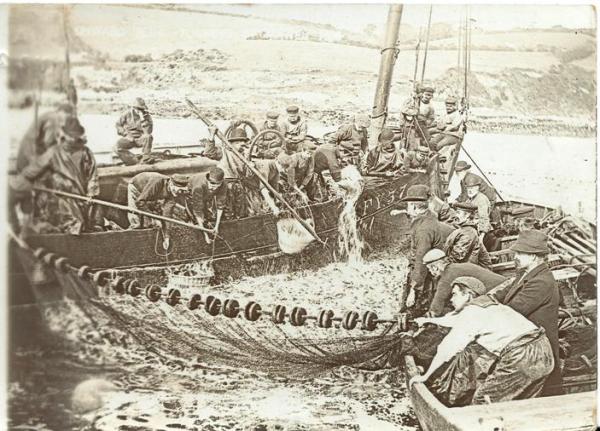
Pilchard, or sardines were fished using ‘seine nets’ all around the coastline of Cornwall and in the early days of fishing the seine nets used were large and very expensive, so they were owned only by the wealthy noblemen.
The shoals appeared in late summer and autumn in North Cornwall following warm currents and planktonic food. The shoals were so huge, the fish could be seen from the cliff tops. ‘Huers’ were employed to keep watch and when the enormous shoals were spotted the Huers would shout ‘HEVVA!’ and alert the village into action.
On Newquay’s Towan Headland, thought to have been built in the 14th century,there stands a huers hut.
Huers Hut Towan Headland, Newquay, Cornwall
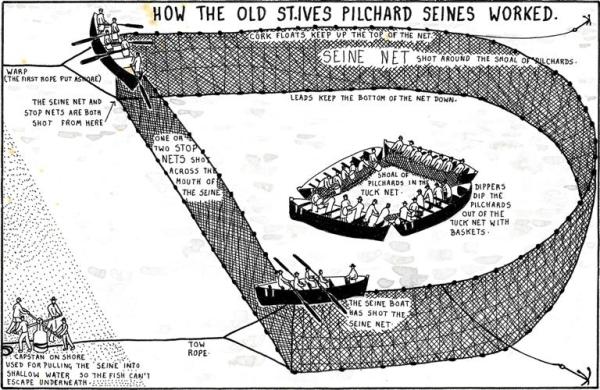
Pilchard seines nets were huge cotton nets with small mesh, in a horseshoe shape and were used in shallow waters. A cox and four oarsmen in 40 foot length rowboats, were used to set up the nets.
Then, the ‘stop net’ was set, this was a smaller wall of net, which trapped the fish in shallow water. This net would be hauled until the fish were now in a smaller, concentrated area. The fish were then scooped out of the shallow water into baskets. (See the drawing below).
This way of fishing was used for hundreds of years until the late 1890’s when the fishing industry begun to decline. The seine nets were hugely expensive, and if a fisherman wanted to be his own boss, he used the smaller drift nets, which became the mainstay of pilchard fishing. During the First World War motors began to be installed which was safer and much more practical.
However, by the 1970’s pilchard fishing ceased in Cornwall, until the 1990’s when an enterprising skipper began experimenting with ring netting for pilchards. Others followed and once again there is a thriving industry in pilchards or, as they are now known, Cornish Sardines.(2)
And now for the most interesting bit , a photo of an unbaked a Star Gazey Pie.….
Here is the recipe and how you make it; go on, have a go!
STAR GAZEY PIE
454 grams (1 pound) of shortcrust pastry.
6 pilchards – or 8 large sardines gutted and filleted BUT with their heads left on and tail fins removed.
171 grams (6 ounces) of brown breadcrumbs
1 teaspoon ground cloves
1 teaspoon allspice
Freshly ground black pepper
One small onion
1 egg
3 hard boiled eggs, chopped
4 teaspoons single cream, and 4 table spoons chopped parsley.
METHOD
Set the oven to 220 C or 425 F
Wash the fish and pat dry then open them out.
Make the stuffing with bread crumbs, cloves spice and pepper mixed with finely chopped onions bound together with beaten egg.
Fill the opened fish with stuffing. Close up, reshape and leave in a cool place.
Grease a flat pie-dish about 25.4 Cm. (10 inches) in diameter. Line with 113 grams (1/4 pound ) pastry.
Arrange the stuffed fish like the spokes of a wheel with their heads on the fin and tails in the centre. Cover with hard boiled eggs, cream parsley and pepper; finish with the rest of the pastry and pinch the two layers firmly together between the heads but roll back the pastry round the heads to reveal their eyes gazing starwards. Brush with beaten egg.
Bake for 15 minutes reduce heat to 180 C (350 F) and continue for a further 20 minutes until the pie is golden brown. (3)
The baked Star Gazey Pie.
And, no, I have not baked one myself, however, I think I may now have to try. However, when I asked the family, their response was not the most enthusiastic! I wonder why??









 Genealogy Ensemble