Good wages, employment guaranteed

Good wages. Employment guaranteed. These words echoed over and over again in Mary McHugh’s head. And only some domestic experience required. Mary thought that she had quite enough domestic experience, thank you, as she was the only daughter still at home.

It was 1910 and Mary had turned 20 in February.1 Old enough to be married. No prospects in sight. She had been working at the jute factory since she finished school at 14.2 Like her older brother, Thomas McHugh, she immediately got a job in the jute factory as soon as she could. Mary’s mother, Sarah McLaughlin, was happy that Mary was working as Sarah was a widow and still had three children at home. Her husband, Michael McHugh, had died of tuberculosis when Mary’s brother, Francis, was just three months old.3  It had been a struggle for Sarah to make ends meet. Even though Sarah had managed to get a job as a charwoman,4 it was not easy. Sarah was exhausted when she got home, too, and it was up to Mary to help with the housework and cooking for her younger brothers. Mary’s older brother, Thomas, was already married with six children. He helped when he could but he had his own worries.

Mary thought ruefully about her job. She was a jute spinner at the flax mill.5 The mill was noisy and crowded. Mary worked twelve hours a day and it was back-breaking work. The women worked hard in the mills but made less wages than the men. The machines were dangerous. Accidents happened often.6 And then there was mill fever or brown lung. Most people who worked in the mill had a dry cough and sometimes even a fever.7

Mill Workers

Photograph from the BBC8

Mary liked the idea of being a domestic. The hours would be long and she would be on her feet all day but the air would be clean and it would be quiet. But Canada? So far away? All by herself? Could she do it?

These thoughts were the beginning of Mary’s plan to emigrate to Canada. Mary McHugh was my great aunt and she arrived on the S.S. Grampion that sailed from Glasgow and arrived in Quebec City in July 1911.9

In the early 1900s the demand for domestic servants in Canada exceeded the number of young Canadian women willing to do this type of work. Governments, employers, and women’s organizations made a special effort to encourage the immigration of household workers.8 More specifically, British immigrants were considered as desirable immigrants to Canada. As of 1888, steamship agents received a bonus for selling the passage of a female immigrant whose intent was to work as a domestic servant in Canada. This was called the British Bonus and it came into effect by an Order-in-Council on September 27, 1890. Its purpose was to offer an incentive to desirable British immigrants. Often the Canadian employer would pay the fare of the immigrant to the steamship company.10 The emigrating domestic would then have to pay it back out to her employer out of her wages. This meant that the young immigrant woman was already indebted to her employer even before she started working. If she was unhappy with her employment, it made it difficult for her to find a better employment as long as she owed money.11

It is probable that Mary’s fare to Canada was paid by her employer. Beside Mary McHugh’s name on the passenger manifest of the Grampion there is a stamp British Bonus Allowed.

Hopefully Mary enjoyed her employment. She was the first member of the McHugh family to arrive in Montreal in 1911. She was probably delighted when her mother, Sarah, and three brothers, Thomas, Edward and Francis, followed her to Montreal in May 1912. And Thomas’ wife, Elsie Orrock, and their seven children, Ann, Elsie, Sarah, Francis, Mary, Adam, and Thomas arrived in October 1912. Mary married John Mervin Porter in June 1913 and her family would have been there to celebrate with her.


Notes and sources:

This poster from the Canadian Museum of History is from a 1926 pamphlet entitled Housework in Canada: duties, wages, conditions and opportunities for household workers but there would have been similar pamphlets advertising for immigrants that may have given Mary the idea.  This pamphlet says that “Canada welcomes men and women of the right type who come to seek their fortune in this broad new land … (people) of good moral character, and in good health, mentally and physically.” You can see this on the Canadian Museum of History web site in the section Advertising in Britain in the 1920s, https://www.historymuseum.ca/cmc/exhibitions/hist/advertis/ads7-06e.html
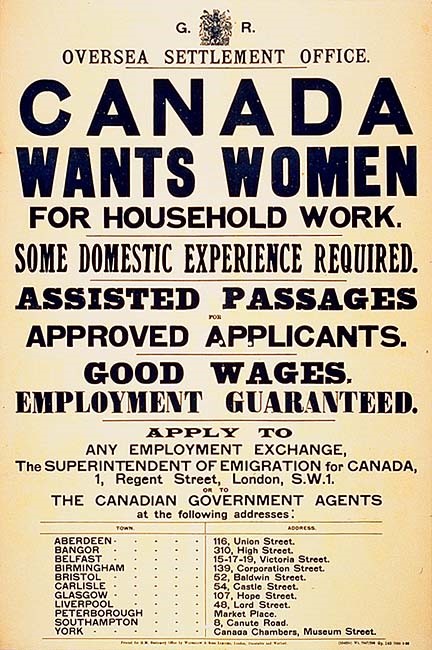
Household work

  1. Scotland’s People, Register of Births, Mary Ann McHugh, born February 4, 1890, accessed November 18, 2017.
  2. Wikipedia web site, History of Education in Scotland, https://en.wikipedia.org/wiki/History_of_education_in_Scotland, accessed August 17, 2020.
  3. Scotland’s People, Registers of Death, Michael McHugh, died May 16, 1895, accessed November 27, 2017 and Scotland’s People, Registers of Births, Francis McHugh, born February 21, 1895, accessed November 27, 2017.
  4. Scotland’s People, 1911 Census, Sarah McHugh, 1 Tait Lane, Dundee, Scotland, accessed February 15, 2018.
  5. Scotland’s People, 1911 Census, Mary McHugh, 1 Tait Lane, Dundee, Scotland, accessed February 15, 2018.
  6. DD Tours web site, Workers of the mills, September 16, 2014, https://www.ddtours.co.uk/archive/workers-of-the-mills/, accessed August 17, 2020.
  7. com web site, Byssinosis, https://www.healthline.com/health/byssinosis, accessed August 19, 2020.
  8. BBC web site, Tayside and Central Scotland, The history of mills in Dundee, December 2, 2009, http://news.bbc.co.uk/local/taysideandcentralscotland/hi/people_and_places/history/newsid_8390000/8390747.stm, accessed August 17, 2020.
  9. Passenger list, S.S. Grampion, July 1911, Glasgow – Quebec City.
  10. British Bonus Paid, British Home Children web site, https://www.britishhomechildren.com/single-post/2014/11/09/British-Bonus-Paid, accessed August 18, 2020
  11. Barber, M.J., Immigrant Domestic Servants in Canada, Canadian Historical Association, Ottawa, 1991, p. 9
Phineas Rixon and His Three Wives

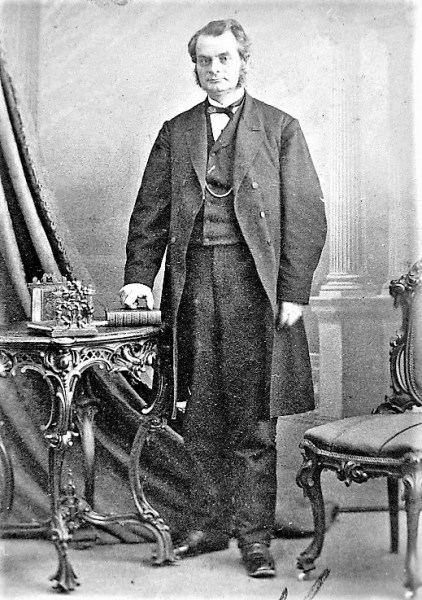
Do you have a photo of Phineas? I am writing a family history book, and would love to include his picture, but I’ve never come across one. If you can help, please contact me at janhamilton66@gmail.com.

Farmer Phineas Rixon and his wife Barbara had been out doing errands in town. After they returned home, he was getting ready to do chores when he was stricken by a heart attack. The doctor came, but Phineas never regained consciousness. He died two days later, age 78, on Friday, September 9, 1938, on the farm he had operated for almost 40 years.

The local newspaper, The Colborne Express, reported, “the large number floral tributes and friends present [at the funeral] showed the high esteem in which he was held.”1

These few facts about his last days are the most detail I found about my great-great uncle’s long life. Phineas seldom moved far from his birthplace in rural Northumberland County, Ontario, a few miles from the shores of Lake Ontario. However, considering that his first two wives and his daughter predeceased him, and that he married a third time at age 76, his home life must have had its ups and downs.

Phineas (also spelled Phinehas, Phenas, and other variations) was born on May 8, 1859,2 the son of Martha Rixon and probably of her cousin Thomas Rixon.3 His unmarried mother moved to the United States when he was about nine, leaving him and his sister Samantha (my great-grandmother) to be brought up by their grandparents, Thomas and Betsey Rixon, on their farm in Cramahe Township.

It is not clear where Samantha and Phineas lived after their grandparent’s deaths; by then they were teenagers, and they likely stayed with relatives.

In 1878, Phineas joined the militia and was listed as a private in the 40th Regiment Northumberland. He next appeared in the 1880 U.S. Census (as “Fenis Rickson,”) working as a labourer in Michigan. He must have stayed in the United States for at least a year as he was not counted in the 1881 Census of Canada.

At age 24, he married 18-year-old Almeda Warner, daughter of John Warner and Harriet Morden. Phineas’s and Almeda’s daughter, Samantha Almeda Rixon (usually known as Mattie or Medie,) was born in June, 1884. Almeda died of typhoid fever in December, 1897, aged 32, leaving Phineas with a 13-year-old to raise and a farm to run on his own.

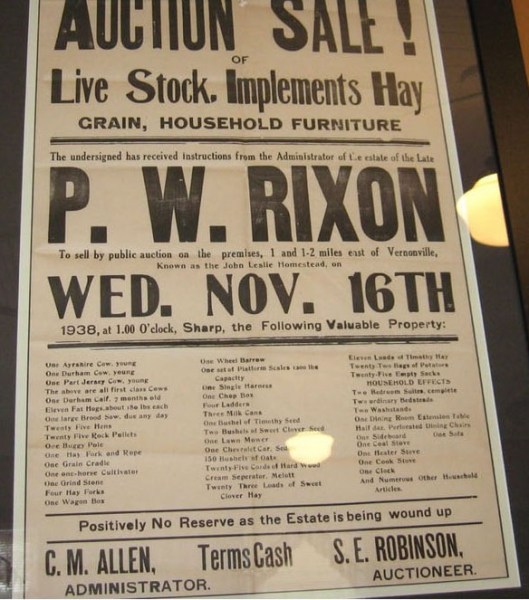
Within four years, Phineas had remarried. The 1901 census showed Phineas, 41, married to Mary Leslie, 34. With them were his daughter, Mattie, 16, and Mary’s mother and her two sisters, both in their twenties. He had also moved from Cramahe Township to lot 6, Concession 4, Haldimand Township.4 An advertisement for an estate auction held soon after Phineas’s death said the auction would be held on the John Leslie Homestead, about a mile east of the village of Vernonville, so Phineas and Mary must have lived on what had been her parents’ farm. 

Phineas and Mary were married for about 30 years. After she died in January, 1931, he remained single for the next five years. In May, 1936, he remarried. His third wife was a widow, Barbara Jemima (Haynes) Cowey.5

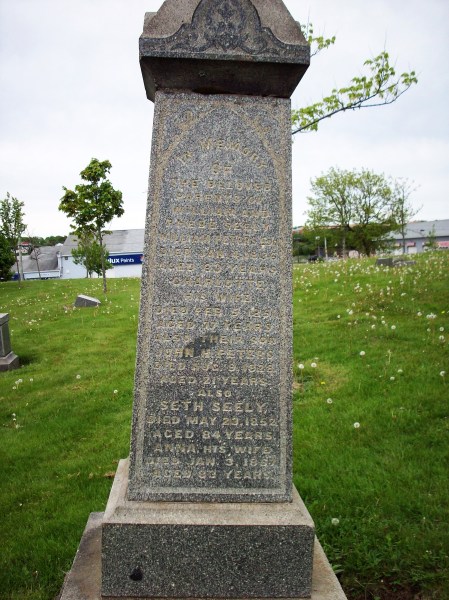
Phineas was buried in Castleton Cemetery, Cramahe, Northumberland County, with his first wife and his daughter. Medie, who was married in 1906 to farmer Claude Tweed and had six children, died in 1915.  Barbara, died in 1939, age 73.

Photos: courtesy Gabrielle Blaschuk

Sources:

1. The Colborne Express, Thursday Sept. 15, 1938, p. 1.

2. Year: 1901; Census Place: Haldimand, Northumberland (West/Ouest), Ontario; Page: 3; Family No: 26. Ancestry.ca, 1901 Census of Canada (database on-line, entry for Phineas Rixon, accessed Aug. 9, 2020,) citing Library and Archives Canada. Census of Canada, 1901. Ottawa, Ontario, 2004, Series RG31-C-1, Statistics Canada Fonds, Microfilm reels: T-6428 to T-6556.

3. This complex story is recounted in the following two posts:

“The Ancestor Who Did Not Exist,” Writing Up the Ancestors, April 11, 2017, http://writinguptheancestors.blogspot.com/2017/04/the-ancestor-who-did-not-exist.html

“Martha J. Rixon’s Short and Difficult Life,” Writing Up the Ancestors, May 14, 2017, http://writinguptheancestors.blogspot.com/2017/05/martha-j-rixons-short-and-difficult-life.html

4. Reference Number: RG 31; Folder Number: 74; Census Place: 74, Northumberland, Ontario; Page Number: 7, Ancestry.com. 1921 Census of Canada (database on-line, entry for Phineas Rixon, accessed Aug. 9, 2020,) citing Library and Archives Canada. Sixth Census of Canada, 1921. Library and Archives Canada, 2013, Ottawa, Ontario. Series RG31. Statistics Canada Fonds.

5. Archives of Ontario; Registration of Marriages 1936; Ontario, Canada, Marriages, 1826-1938, online database, Ancestry.ca and Genealogical Research Library (http://ancestry.ca, accessed Aug. 4, 2020,) entry for Barbara Cowey, citing Ontario, Canada, Select Marriages, Archives of Ontario, Toronto.

Petunias and Brown Betty

A singular memory of my childhood is the summer I spent with my Angus grandparents in Quebec City. I was nine years old.

My family had moved to La Tuque several months before my sister’s birth. The move, a difficult pregnancy, and a three-day labour left my mother exhausted. Caring for a new- born and two school age children set free for the summer was overwhelming. In an effort to help out, my grandmother invited me to come to Quebec.

My grandparents lived in a third-floor walk-up apartment on St. Cyrille Blvd. (now Rene Levesque) at the corner of Maple Ave. During the Depression, they moved from an elegant home on Fraser Avenue while my grandfather fought to save his book store. The store eventually failed but my grandparents remained in the apartment until my grandfather’s death.

A large porch extended the full length of the apartment overlooking the street below. The sun shone down on it all morning so Grandpa planted petunias in boxes that grew into a beautiful profusion of pinks, lavenders and burgundies. My job that summer was to water and deadhead, a responsibility I took very seriously. “A new blossom will not grow until the dead one is removed”, Grandpa explained. “We want lots and lots of blooms.”

The various rooms of the apartment were strung out along a narrow hallway stretching from the front door to the back bedroom: an elegant parlour with life size china dogs standing sentinel on either side of an artificial fireplace; a very large dining room with several china cabinets and a table for twelve; and a sitting room with three walls lined with books salvaged from the store that were the core of my grandmother’s lending library. There was a bathroom and two bedrooms, the largest of which looked out on the city stables. How I loved to watch the caliche horses going and coming each morning and evening. I imagined them to be my very own and gave each one a name.

Then there was the kitchen tucked into the middle of the flat. It was a very tiny room, only big enough for a stove, a fridge, an ironing board that dropped from the wall, and the food prep table where my grandmother sat to work her daily cross word puzzle. The sink was folded into a back corner beneath a set of cupboards. The dark, cramped room had but one window in the door leading to the back porch and another in the walk-in pantry. How different from my Willett grandparents’ large, sunny farm kitchen in the Gaspe that housed not one but two stoves and a pair of day beds.

Yet it was in this tiny kitchen that my grandmother cooked daily meals for two (three that summer) as well as large family meals for various holiday occasions: Christmas, Easter and Thanksgiving. She carried dishes of food through the swinging door into the dining room in what I now recognise as priceless Spode and Limoges bowls and platters. Nothing was served onto plates in the kitchen and brought to the table. Glasses and desert dishes were cut crystal. I even ate my morning boiled egg from a silver cup. Such a little princess.

Lazy summer afternoons were spent in the park. A friend and I would meet there, walking by ourselves from our homes, carrying our dolls and their accessories along with several umbrellas. The umbrellas served to demarcate the various rooms of our “doll house”. Who today would allow two young girls to spend an afternoon alone in a park? The caliche drivers came to know us and would wave, pointing us out to their tourist passengers as a quaint part of the old city.

I walked a lot that summer – my grandparents didn’t own a car. I walked with my grandmother to buy groceries on Cartier Avenue or dolls’ clothes at Woolworths on St. John’s Street. I walked with grandpa to Earl Grey Terrace to watch ships sailing the St. Lawrence to and from exotic ports. On Sundays I walked to church with both of them. The Sundays that babies were baptised were the best. As a church elder, Grampa would walk the family to the font and stand, straight and proud, while the minister performed the ceremony.

Evenings were spent reading, doing puzzles, or completing paint-by-number kits. My grandparents didn’t have a television – televisions were still too new and expensive. Sometimes on our walks Grampa and I would stop and watch the news on a TV in a store window. I don’t think Grampa would ever stoop to that if he were alone. I was the excuse for him to take a peek.

I learned to cook that summer in the tiny kitchen. My grandmother must have had the patience of Job. How much faster and easier it would have been to do it herself. Apple Brown Betty became my speciality. Eventually I could peel and slice the apples myself, measure and mix the flour, oats and brown sugar, and work in the butter with my fingers. The final touch was the nutmeg grated by hand over the top before the desert went into the oven. So delicious served with a slice of ice cream!  Remember, Ice cream was purchased in a brick-shape wrapped in cardboard.

The days passed slowly with a pleasant and predictable sameness. I was loved and indulged. Before I knew it, it was time for me to return home.

I would be sixteen when next I lived with my grandparents for my final year of high school. Although I loved being back with them, life was never again as simple as the summer when I was nine.


Slavery in New France in the 17th & 18th Centuries

August 1, 2020, Emancipation Day in Canada

In 1734, a huge fire destroyed part of Montreal. Marie-Joseph Angélique, a black slave, was accused on setting the fire deliberately as she tried to escape from her owner. She was arrested and found guilty, then she was tortured and hanged and her body was burned.

Angélique was one of many slaves, some black, others Indigenous, in New France.  Slavery was legal in Canada for more than 200 years. The Slavery Abolition Act brought an end to chattel slavery throughout the British Empire, coming into effect on August 1, 1834 in Britain, Canada, and several other colonies.

The attached PDF  Slavery in New France   is a 23-page research guide to the topic of slavery in New France in the 17th and 18th centuries. It contains the following contents:

Page 2     A link to a complete online copy of the book L’Esclavage au Canada français – 17e et 18e siècles” (in French) Author: Marcel Trudel – 474 pages Publisher- Les Presses Universitaires Laval, Quebec, Canada 1960

Pages 3-17    A List of authors who have written about slavery in Canada

Page 17- 20       Repositories in Quebec

Pages 21-22     Various online sites

Pages 22-23     Publishers


Brush with a (Messy) Icon

Marion1FIXED

Marion Blair, my mother-in-law, 1990s

There were no teenagers back in the old days, my mother-in-law, Marion Blair, used to say. You were a girl one day and a woman the next – at least when it came to the way you dressed and the way you arranged your hair.

Somewhere, I have a black and white studio photo of Marion looking rather glamorous wearing what appears to be bright red lipstick, (it’s hard to tell for certain) taken in 1929.

I find the photo a bit freaky, because Marion was born in 1917! At a mere 12 years of age she certainly had achieved that polished ‘movie-star’ look and she maintained that impeccably groomed image right up until her death in 2002.

So it was no surprise to me when my husband came into the room a while back as I was watching an old Bette Davis movie on TCM and said, “That woman looks just like my mother.”

“Your mom didn’t look at all like Bette Davis,” I replied. “But, I can see your point. The movies, back then as now, instructed girls – and boys – on how to be grown up.”

Now, this was doubly ironic as here in Quebec in the 1930’s children under 16 were banned from the cinema because of the 1927 Laurier Palace Theatre Fire where 72 children had died in a crush to the exit.

So what did these deprived Depression Era English Quebec children do to bend the rules and partake of some healthy Hollywood escapism? According to my mother-in-law, they sneaked into the movie theatres and comported themselves like adults. That meant no shouting and no jostling. Girls often applied make-up to enhance the illusion.

Marion Blair was the middle of three sisters, so it is no surprise, really, that her appearance meant a lot to her, especially since her sisters were, let’s face it, much better looking. Think Rita Hayworth and Merle Oberon.

She was the skinny sister with the slightly wonky left eye and a wild boy-crazy “biker chick” personality that had to be tamed with two years at Trafalgar all-girls school. (Hmm. Maybe, there were ‘teenagers’ in the 1930’s after all.)

The 1930’s Hollywood Dream Factory inspired more than Marion’s hair and makeup. She was a wannabe thespian. At McGill in the late 30’s she got to play comedic parts in the famed Red and White Revue.

Somewhere, I have some clippings from the early WWII McGill Daily. In one of them Marion is flying in the air attached to cables with a giant wand in her hand and an enormous toothy grin on her face.

Marion Blair was a natural for the theatre, but in 1941, with war raging, she chose a domestic existence and married Thomas Wells, a Westmount boy who had played semi-pro  hockey with her brother and who had recently enlisted in the RCAF.

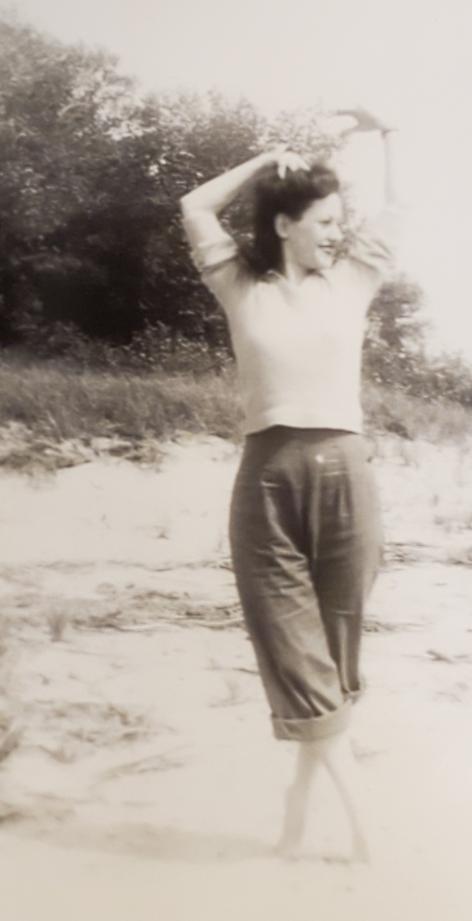
mariaondancefixe

Marion, ballerina, 1942, Dunville, Ontario RCAF training base.

As a young mother in the 1950’s, Marion continued to act in local amateur theatre out in the suburbs with the Hudson Players Club. (I guess the stage was the only place she felt safe ‘letting her hair down.’)

Her own mother, Marion Nicholson Blair, had been widowed in 1927, when Marion Jr. was just 10 years old. Mother Marion had been cut out of her husband’s family lumber fortune, but instead of remarrying one of her many suitors she went back to work as a teacher at the Montreal Board and also got involved with the Protestant Teachers Union, rising to President during WWII.

The Nicholson/Blair female-run family had little money to spare but being a natural wheeler-dealer, mother Marion found patrons to send her children to university which is why daughter Marion could swing from the rafters at McGill’s Morris Hall.

Which brings me to another related story – about another photograph, one I actually have on hand to show you.

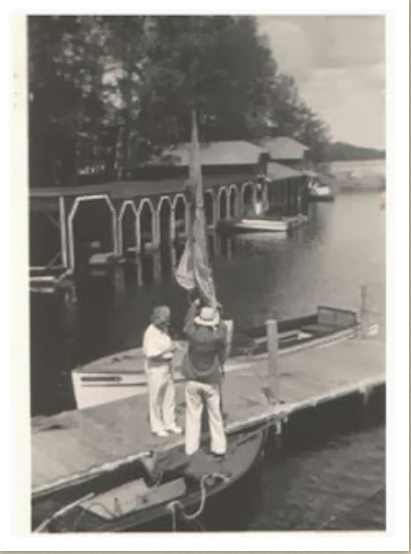
My mother-in-law’s patron was a friend of her mother’s, a Mr. Dean from the local Westmount Church. One summer in 1936 he took them to Saranac Lake, New York on a vacation.

One morning,  as they walked on the waterfront, at the marina, Marion spotted a portly older man with very disheveled hair on the pier beside a small sailboat. “What messy hair that man has,” said Marion to her companions. “Disgraceful.”

Mr. Dean would have no part of it. “That, my dear,” he told her, in a hushed and reverent tone, “is Professor Einstein.”

So my mother in law snapped a photograph – and here it is.

Saranac Lake

This picture is more than mere family memorabilia.

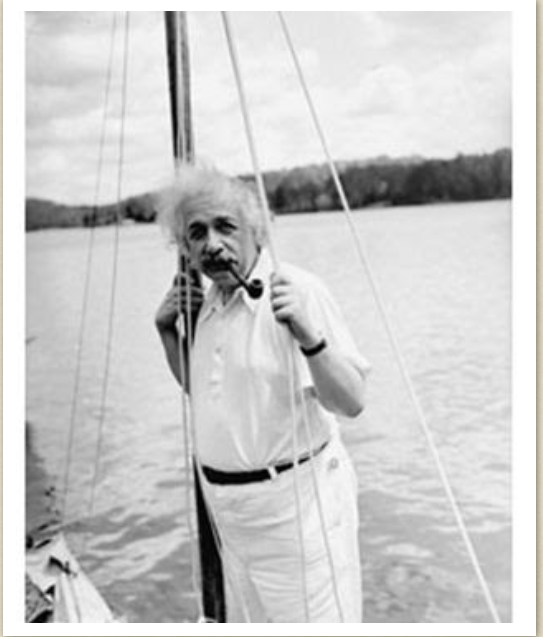
With a little online research I soon figured out that my mother in law caught the Man of the Century setting up for a famous AP photo shoot. (Or perhaps shutting down from it.)

Here’s that photo “Einstein at Play” taken a few minutes before or after my mother-in- law snapped the photo of the physicist icon with the famously messy head of white hair.

EinsteinatPLAY


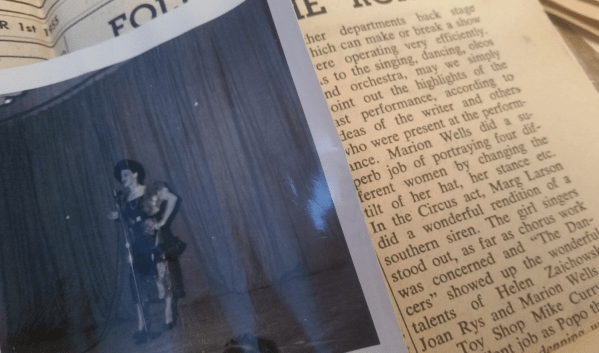
A pic of Marion on on stage and a clip from the December 1955 Lake of Two Mountains Gazette.

My Prudhommes

How do you get to be you? First you must have your parents, then your grandparents and as you trace back through your family trees you find all the coincidences needed for people to come together at a time and place for you to be who you are.

When Louis Prudhomme arrived in New France around 1640 I am sure that he never thought his seven times great-granddaughter would live there almost four hundred years later. He was an early settler in Ville-Marie (Montreal), a brewer, churchwarden and a member of the Montreal Militia. I descend from Louis and his wife Roberte Gadois. This marriage almost didn’t take place. Roberte came to New France as a child with her parents Pierre Gadois and Louise Mauger. Then when just 15, a marriage contract was drawn up between Roberte and Cesar Leger with the ceremony happening four days later. After six years, the marriage was annulled, most likely because there were no children. The survival of the colony depended on couples having children. On the same day her first marriage was annulled, Roberte married Louis Prudhomme. This wasn’t a quick decision as their marriage contract had been drawn up a year earlier. Roberte proved her fertility by soon giving birth. Their first child, son Francois-Xavier Prudhomme (1651 – 1741) is my ancestor.

Finally, well into his thirties, Francois Xavier married Cecile Gervais, only 13 at the time. This marriage too might not have taken place. Cecile’s parents were Jean Gervais and Anne Archambault. Her mother Anne had previously been married to Michel Chauvin. Michel had owned the property next to Louis Prudhomme. Louis, on a trip back to France, learned that Michel had a wife and children still living there. On his return to New France, he accused Michel of bigamy and reported him to the Governor Paul Chomedey de Maisonneuve. Michel, expelled from the colony, went back to France leaving Anne free to marry again and give birth to Cecile. Francois Xavier Prudhomme and Cecile eventually had nine children.

Their first child Francois Prudhomme (1685 – 1748) married Marie-Anne Courault. This couple appeared to have lead uneventful lives except for having eight children.

One of their children, Nicolas Prudhomme (1722 – 1810 ) married Francine Roy. This couple had at least five children before Francine died at age 34. Their youngest child Eustache was just two at the time so not surprisingly Nicholas soon married again.

It was the marriage with his second wife Helene Simone Delorme that produced Jeramie Marie Prudhomme (1766 – 1846) my three times great grandfather. Seven years had past before this child entered the world. Helene must have been busy raising her step children. In 1818 Jeramie is listed by the Sulpicians as one of the twenty family heads living and farming in Côte Saint-Luc, west of the original settlement but still on the Island of Montreal. He married Marie Louise Décarie (1769-1855), from another important farming family. Jérémie and Marie Louise had seven children. Their last child Sophie Marie Louise married Barnabé Bruneau. The Prudhommes had lived on the island of Montreal since the 1640s. Sophie left her ancestral home and moved south across the St Lawrence River to St. Constant.

It is with Sophie Marie Prudhomme that my direct Prudhomme line ended. Other branches of the Prudhomme family continued to flourish. My Great Grandfather Ismael Bruneau chose the middle name Prudhomme in honour of his mother.

Notes:

7th Great Grandfather Louis Prudhomme (1611- 1671) married Roberte Gadois (1628- 1716)

6th Great grandfather Francois Xavier Prudhomme (1651-1741) married Cecile Gervais (1671-1760)

5th Great Grandfather Francois Prudhomme (1685-1748) married Marie Anne Courault (1689-

4th Great grandfather Nicolas Prudhomme (1722-1810) married Helene Simone Delorme (1730-

3rd Great Grandfather Jeramie Marie Prudhomme (1766-1846) married Marie Louise Decarie (1769- 1855)

Two times Great Grandmother Sophie Marie Prudhomme married Barnabé Bruneau

Jean-Jacques Lefebvre http://www.biographi.ca/en/bio/prud_homme_louis_1E.html accessed May 13, 2020.

https://www.geni.com/people/Fran%C3%A7ois-Xavier-Prud-homme/6000000002352538874 accessed May 13, 2020.

Making Lime: http://www.minervaconservation.com/articles/abriefhistoryoflime.html accessed May 24, 2020.

https://csllibrary.org/the-prudhomme-family/ accesses May 12, 2020.

The Antoine Pilon Home Part 2

Antoine Pilon arrived in Ville Marie in 1668 and by 1707 he was a land owner in the growing village of Pointe-Claire, on the shores of Lake St. Louis.

In a recent blog there is a biographical sketch of Antoine, my 7th great grandfather. He sailed from Normandy, France to New France. His family were among the first residents of Pointe-Claire. When he died at the age of fifty, the home he built in 1707 remained in the family for 120 years.

The Antoine Pilon Home Part 1, https://genealogyensemble.com/2020/05/06/the-antoine-pilon-home/

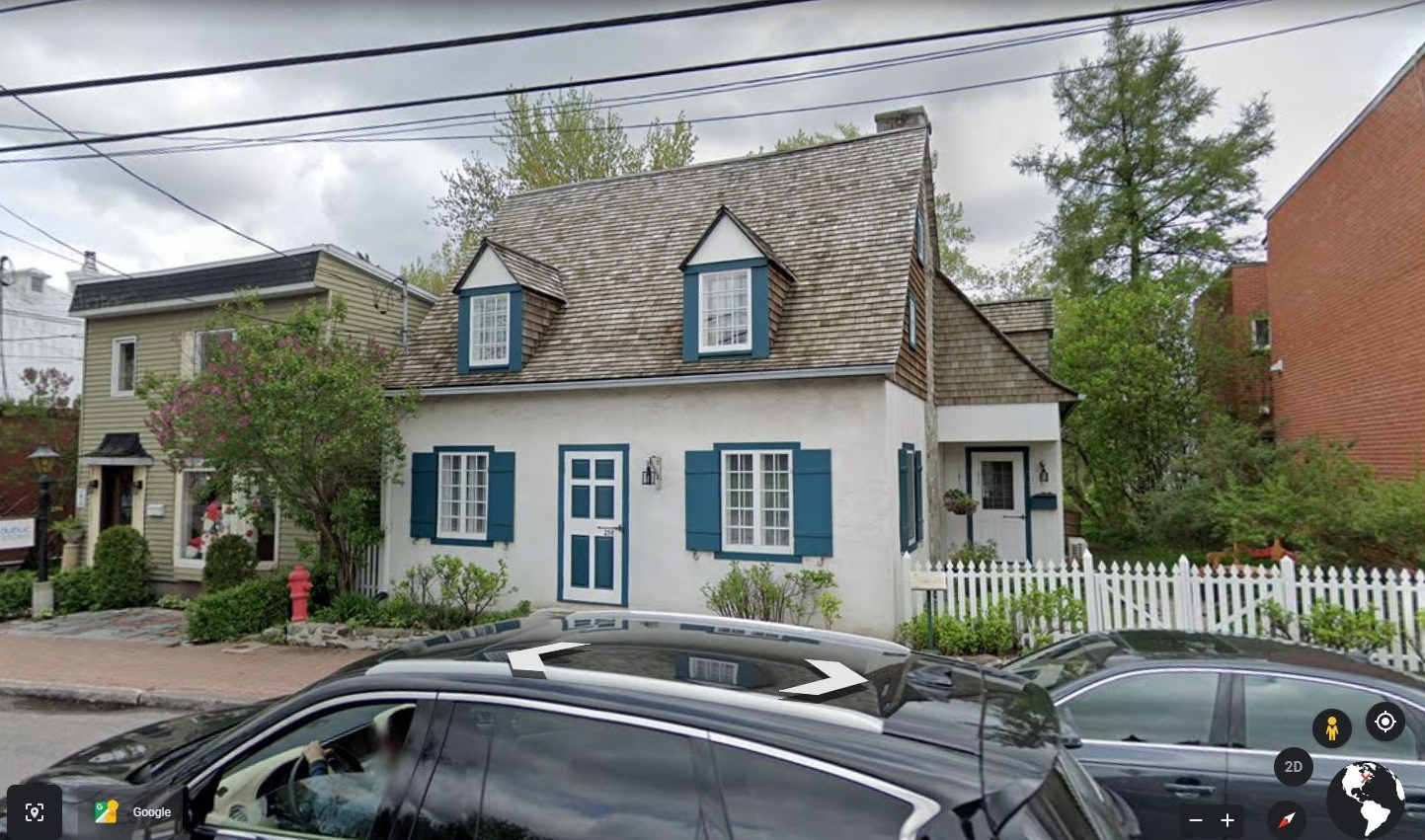
The home is still standing, thanks to the tireless efforts of André Charbonneau. It is the oldest home in Pointe-Claire and one of the oldest on the island of Montreal.  Records indicate the many owners over the 300+ years.

Capture.JPGAP HOUSE Googlw

A Google Earth street view of the Antoine Pilon House 258 Bord du lac Pointe-Claire

History of the Owners and the Land Transactions 1.

1707 -2020

Below is a list of the many landowners who lived in the Antoine Pilon house over the years. Several owners inherited the property, while others purchased theirs.

The house lies on lot 88 of the present survey, forming a part of lot number 154 in the original land registry of the Island of Montreal.2

  • Lot 154-D was conceded by the Sulpicians to Pierre Sauvé dit Laplante on November 24th, At the time it was property of 3 acres of frontage and 60 acres deep, on the shore of Lac Saint-Louis.
  • Pierre Sauvé and his wife Marie-Michel sold this land to Jean du Tartre dit Desrosiers on October 27th,
  • Du Tartre gave the concession to Madeleine LeMoyne, widow of Jean-Baptiste Beauvais, September 19th,
  • Dame LeMoyne immediately sold lot 154-D September 19th,1706 to Antoine Pilon, who had already purchased from her the adjoining lot 155-D
  • Antoine Pilon built his house in 1707 on this property
  • Marie-Anne (Brunet) Pilon’s widow gave the land to her son Mathieu on January 22nd, 1729, land of 5 acres of frontage to 20 acres deep, consisting of lots 154-D and 155-D.
  • Gabriel Pilon, son of Mathieu and Marie-Josephte Daoust, became the next owner purchasing it from his parents’ – lot 154-D measuring 3 acres by 28 acres.
  • Pierre Pilon, the farmer and inn-keeper son of Gabriel and Suzanne Meloche, inherited the land on December 7th,
  • The Pilons left the property for good on July 1st, 1826 after 4 generations of family ownership. The home passed from mother to son and then father to son during 120 years.
  • W. Glasford, Carpenter purchased the property on July 1st, 1826.
  • Félix Amesse, carpenter, husband of Marguerite Pilon purchased it on March 1st,1832
  • Francois Larivée, shoemaker, became the new owner on April 5th,1834
  • Jean-Baptiste Legault dit Deslauriers, son, painter obtained the home May 11th,1865
  • Damase Alexandre Valois bought the property July 19th,1873.
  • Isidore Valoix inherited it in 1914.
  • Charles-Benoît Valois acquired the property December 31st,1921.
  • Joseph Duhame, next owner purchased the property on February 21st,1944.
  • André Charbonneau bought the property in 1968 and is the current owner- (2020).

There was a total  of 18 landowners over nearly 320 years.

Pilon property


The area in green indicates the extent of the Pilon Property right to the shore line.                   Capture.JPG map text

Capture.JPG current map of village

Current map of Pointe-Claire Village

André Charbonneau purchased the large property when he was 25 years old. At the time he was a young hairdresser living in Pointe-Claire.3. He is now retired and has hopes and dreams that his efforts to refurbish the 300+-year-old home could become a museum or an interpretation center. If so, this would promote the history of the area. André is also the founder of la  Société pour la Sauvegarde du Patrimoine de Pointe-Claire, https://patrimoinepointeclaire.org/ and has spent time educating the citizens about the history of their community3. Over the years Charbonneau has attempted to have the home declared a Heritage site.  He has approached the City of Pointe-Claire to develop the home.

Funding for a  project of that type is usually based on the following percentages:

25% Municipality,     25% Private donations.           50% Federal funding.

Several years ago, a feasibility study estimated the cost of the project would be approximately $1 million.

Charbonneau lived in the home for a short time until 1973. Time was spent researching, notably at the National Archives, with the aim of restoring the house and having it classified by the Ministry of Cultural Affairs. His request for classification was denied. Despite the refusal, he chose to restore the home to the original plans according to the French Regime, using the building methods of that era.4.

Andre in house

Owner, André Charbonneau

The better part of Andre’s life has been focused on reconstructing the Pilon home to its former glory. He began using an architectural technique of numbering all the stones and wooden planks to rebuild the house.5.

The original size of the house is 25’ x 23’ and he added an extension of 20’ x 18’  He took great pains to research minute details such as the nails used in the new roofing and the flooring on the first floor, made from new wooden beams giving the appearance of the wood of the time. He left no stone unturned, including as noted, enlarging the home . He has maintained the original appearance of the first floor, a single open room. Behind the fireplace there was an oven, over the years had been condemned and hidden. The major work on the home was done by reliable,  workers, carpenters, and a blacksmith. They all worked using the same skills as those of 17th century craftsmen.

André Charbonneau has received numerous awards and recognition for his dedication and ongoing efforts in his attempt to establish a heritage site. In 2002 he received the Distinguished Heritage Award and in that same year won the Heritage Emeritus Prize for the neighbouring house that he also owns. There have been other awards over the years, but, his main goal  is yet to be accomplished.

La  Société pour la Sauvegarde de la Patrimoine de Pointe-Claire continues to this day to find a way to showcase this home that has been so painstakingly restored. If you have an opportunity, take a drive through the Village of Pointe-Claire and note the many homes that have been lovingly preserved.

Sources:

  1. http://www.piloninternational.ca/international/histoires/maison/maisonantoinf.html
  2. https://www.wikitree.com/photo/jpg/Pilon-239.
  3. https://patrimoinepointeclaire.org/
  4. https://www.lapresse.ca/maison/architecture/maisons/200711/12/01-871145-la-maison-pilon-revit-grace-un-proprietaire-tenace.php
  5. https://montrealgazette.com/news/world/trying-to-keep-a-piece-of-pointe-claire-history-alive

Notes:

http://home.globility.com/~pilon/photos.html – contains several interesting photographs

https://shariblaukopf.com/2015/07/09/the-garden-at-antoine-pilon-house/ -an artist’s point of view


Antoine Pilon Google earth

Google Street View – Pilon Home 258 Bord du lac. Pointe-Claire, Québec https://earth.google.com/web/data=Mj8KPQo7CiExX2c2cFNQNjR2SlhwODBIZTI3R0Vtc2ZyN2UwVzVENUESFgoUMEE3OTk3NjlGNTE0NUY0M0VCMTM

Capture.JPG Aerial Google Pilon House

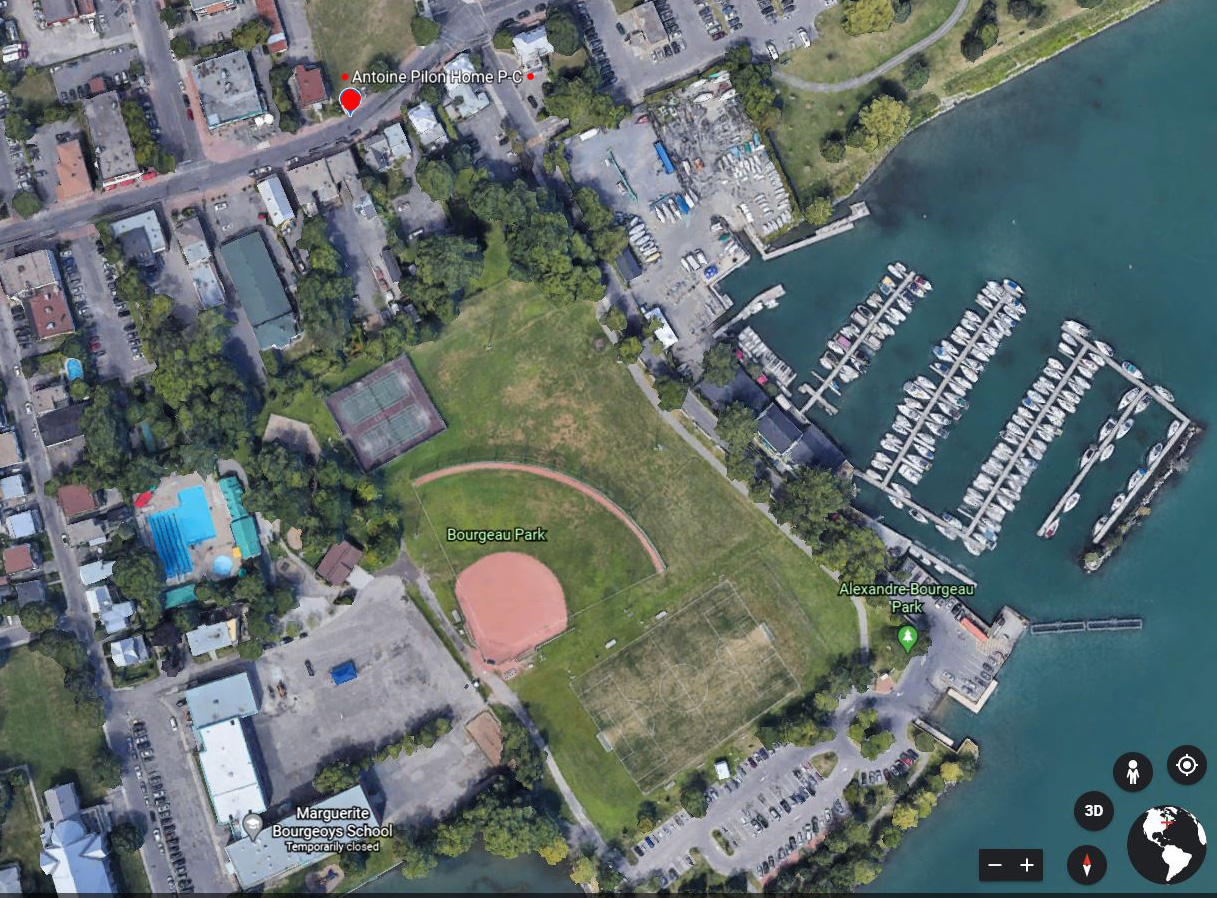
Google Aerial View of Antoine Pilon Home

https://earth.google.com/web/@45.42828134,-73.82327819,19.97449138a,670.74299124d,30.00000005y,0h,0t,0r/data=MicKJQojCiExX2c2cFNQNjR2SlhwODBIZTI3R0Vtc2ZyN2UwVzVENUE

Dear Miss Bulford – Part Four

RAF Upavon Crest

In the first three parts below, of “Dear Miss Bulford” I describe my [1] entry into the WRAF – Women’s Royal Air Force, [2] the basic training [3] posting to a trade training camp, and this part four, my first posting as a trained Medical Assistant.

  1.   https://genealogyensemble.com/2020/01/02/dear-miss-bulford/

2.   https://genealogyensemble.com/2020/04/22/dear-miss-bulford-part-two/

3.  https://genealogyensemble.com/2020/04/29/__trashed-4/

Arriving in Salisbury, Wiltshire by train, I made my way to the bus station. wearing my ‘best blue’ uniform.  As I was searching for the camp bus,  two army men also in uniform approached me, and asked if I was going to RAF Upavon? [1] I said yes, so they offered me a lift in their car. They were stationed a few miles from RAF Upavon, at the Larkhill Army Garrison.  I accepted their offer. Something I now think was not too wise, but it was the 1960’s. However, they were very polite and pleasant and I enjoyed the ride to the camp. They said they often came to our mess to dance and drink so I would see them in the future,  which I did.

Arriving at RAF Upavon the Duty Officer at the main gate, directed me to the arrival office where I waited for someone to take me to my new quarters. RAF Upavon was small compared to my last posting. Only one block for the WRAF and one for the men,  each side of a parade square. From the window of my new single room-  wow! this was great- I could spot the mess hall.

The sergeant of our block, two-storied as usual but only three or four to a room, came and introduced herself, and offered to take me to the mess for tea. On the way, she told me about the SSQ (Station Sick Quarters)  I would be working at and who made up the staff. There was a  civilian Doctor, who drove up from the Upavon village each day,  a Sergeant, two Senior Aircraft men, and a civilian nurse who was retiring. I was to take her place.

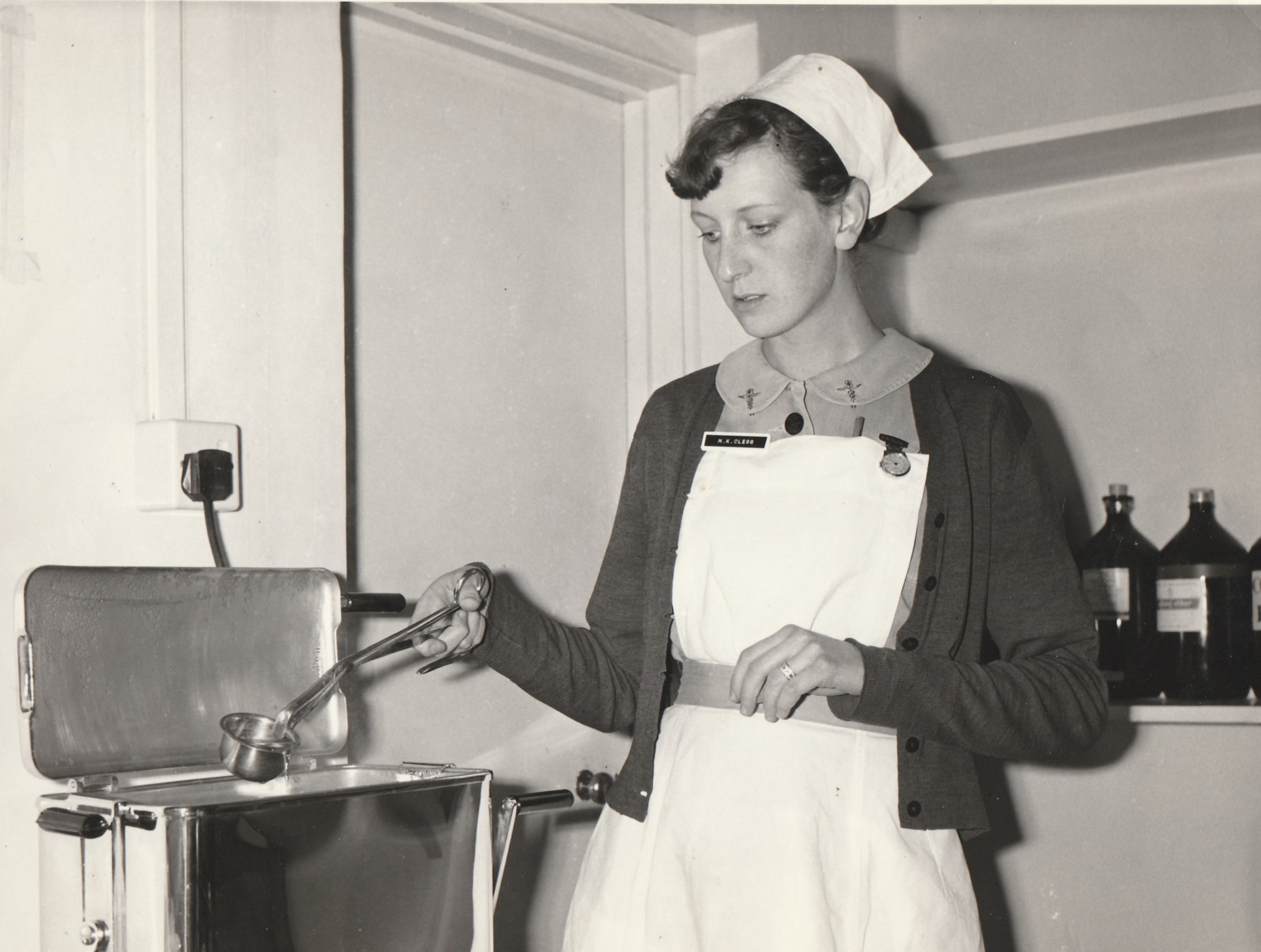
Next morning, dressed in my nurses uniform, I nervously made my way to the SSQ. I met the civilian nurse, Mrs Bowes who showed me her routine. Unlike her, I would be ‘on-call’ a shared duty with everyone else in the SSQ.  (Which was why I had the enviable single room!).

Me at RAF Upavon SSQ

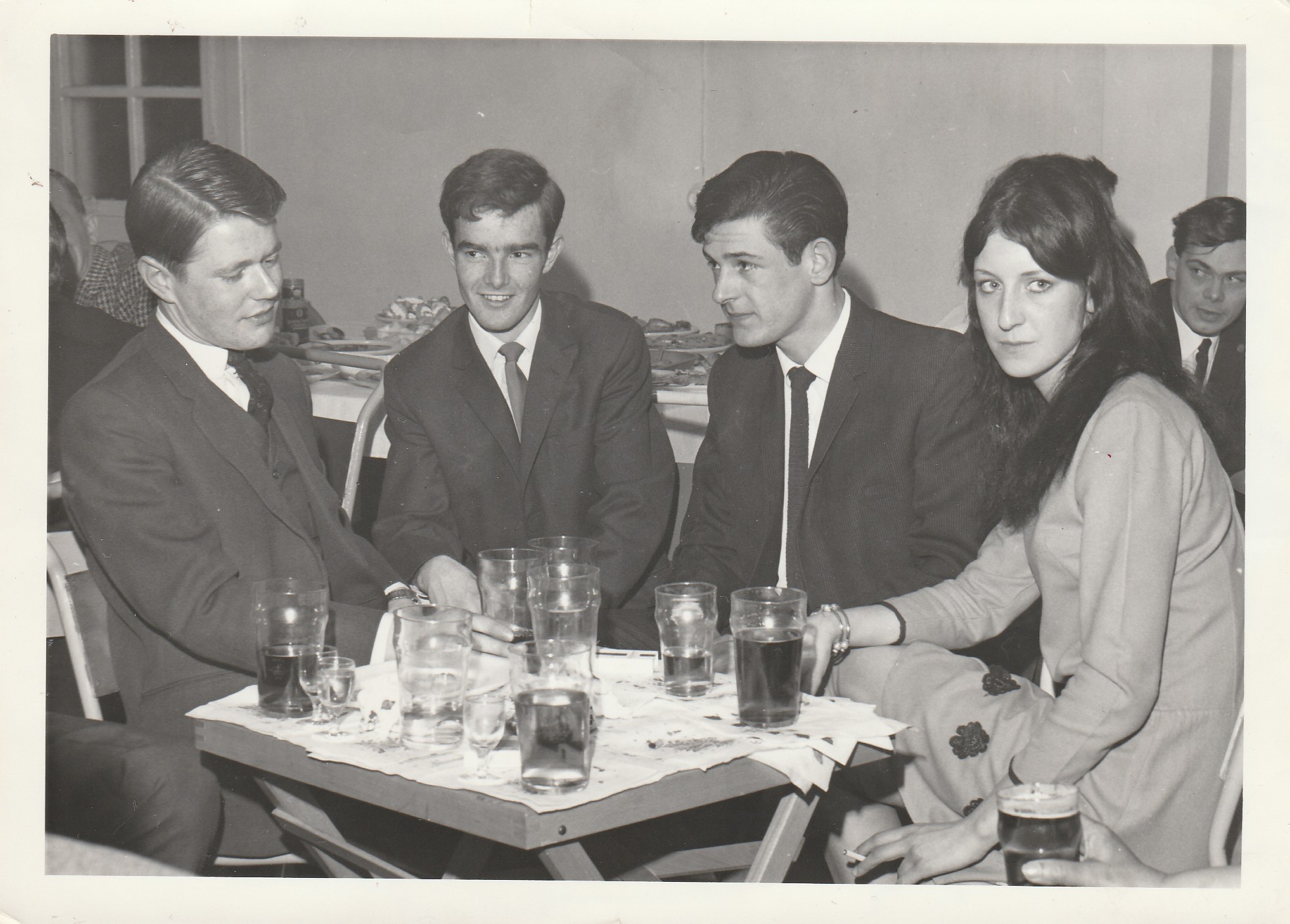
A few months after I arrived I went to the weekly ‘hop’ a Saturday night dance drinks and general fun. There, I met John, who had only just arrived on camp himself. He was an admin assistant and worked in the HQ (Headquarters) for Sir Thomas Prickett, RAF Upavon’s Commanding Officer. He walked me back to my barracks and we arranged to meet at breakfast in the mess, the next morning. We spent the weekend together, getting to know one another walking around the camp and talking about our lives so far.

Saturday night dance. John on the far left, shortly after we met, with SSQ staff Dave and Mick, and me.

On Monday morning, when I went to the waiting room, there sat John! In he went in to see the Doctor. When he came out, his medical notes said ‘Mononucleosis’ (otherwise known as the kissing disease!). We sent him to sickbay and put him on antibiotics. The male nursing assistant stayed the night with him.

After one night in sickbay, John had not improved and now had a high temperature, so he was sent to the RAF Wroughton Hospital [2] by ambulance.  I accompanied him on the ambulance trip. I told him he would be spending time in isolation at the hospital but that we could meet again when he got back to camp. We had a date that night!

Seven days later he returned to RAF Upavon and we resumed our getting to know each other routine.  We would see each other at breakfast, lunch and tea, so we got to know each other pretty quickly and very well. We would take the bus to Salisbury on Saturdays to shop and come back in time for the Saturday dance.  We babysat for the local personnel on the camp and spent our days off, together. We took leave and went to my home to visit my parents and up to Liverpool where John was born to meet his Mum.

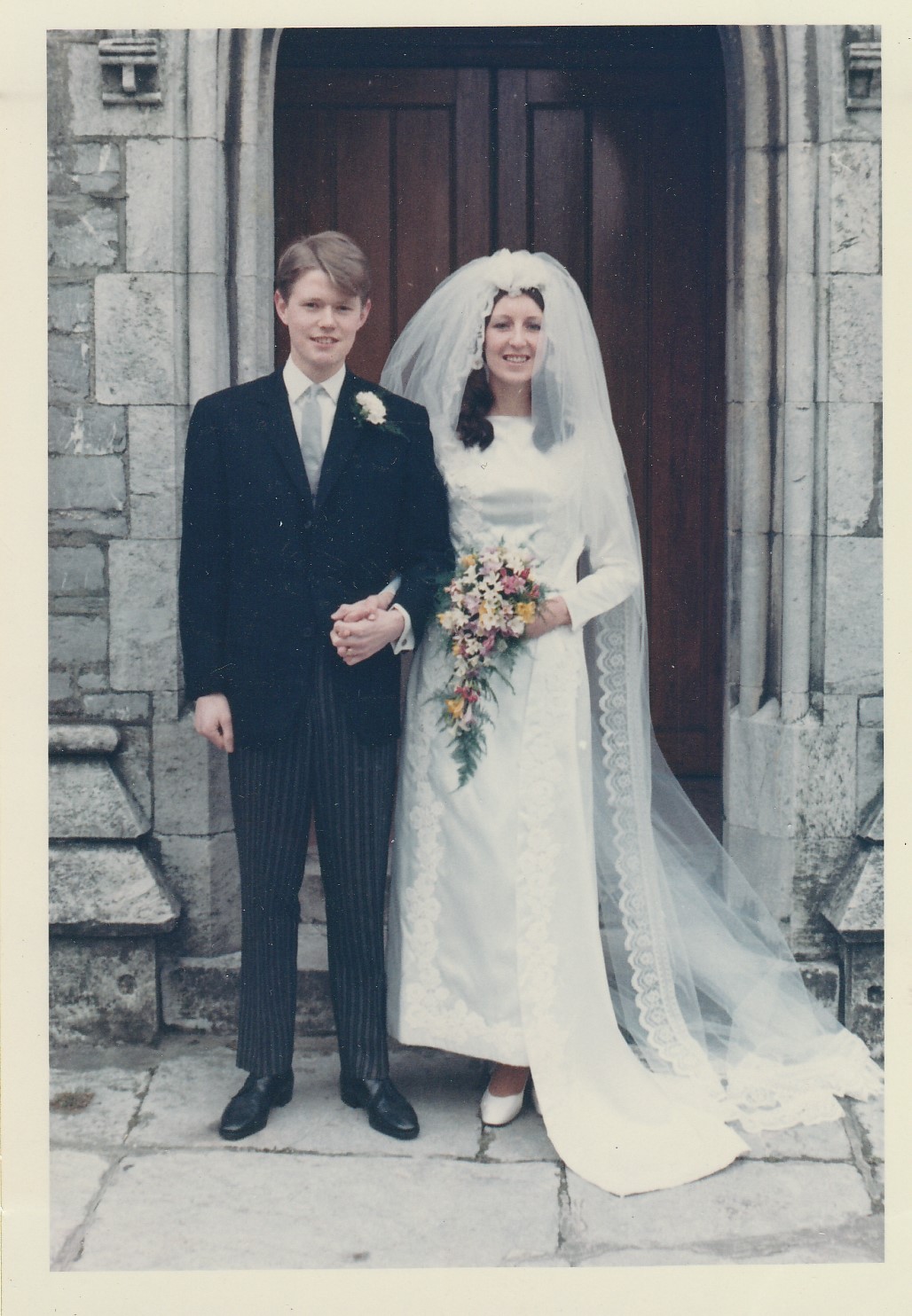
One year later, on the anniversary of the day we met, March 2nd 1965, we got married. in Plymouth Devon. John’s Commanding Officer, Sir Thomas Prickett sent us a Congratulatory Telegram, as was usual in the days of snail mail and telephones.

Wedding Day 2 March 1968

Telegram from John’s Officer In Command,  Air Marshall Sir Thomas Prickett and Lady Prickett.

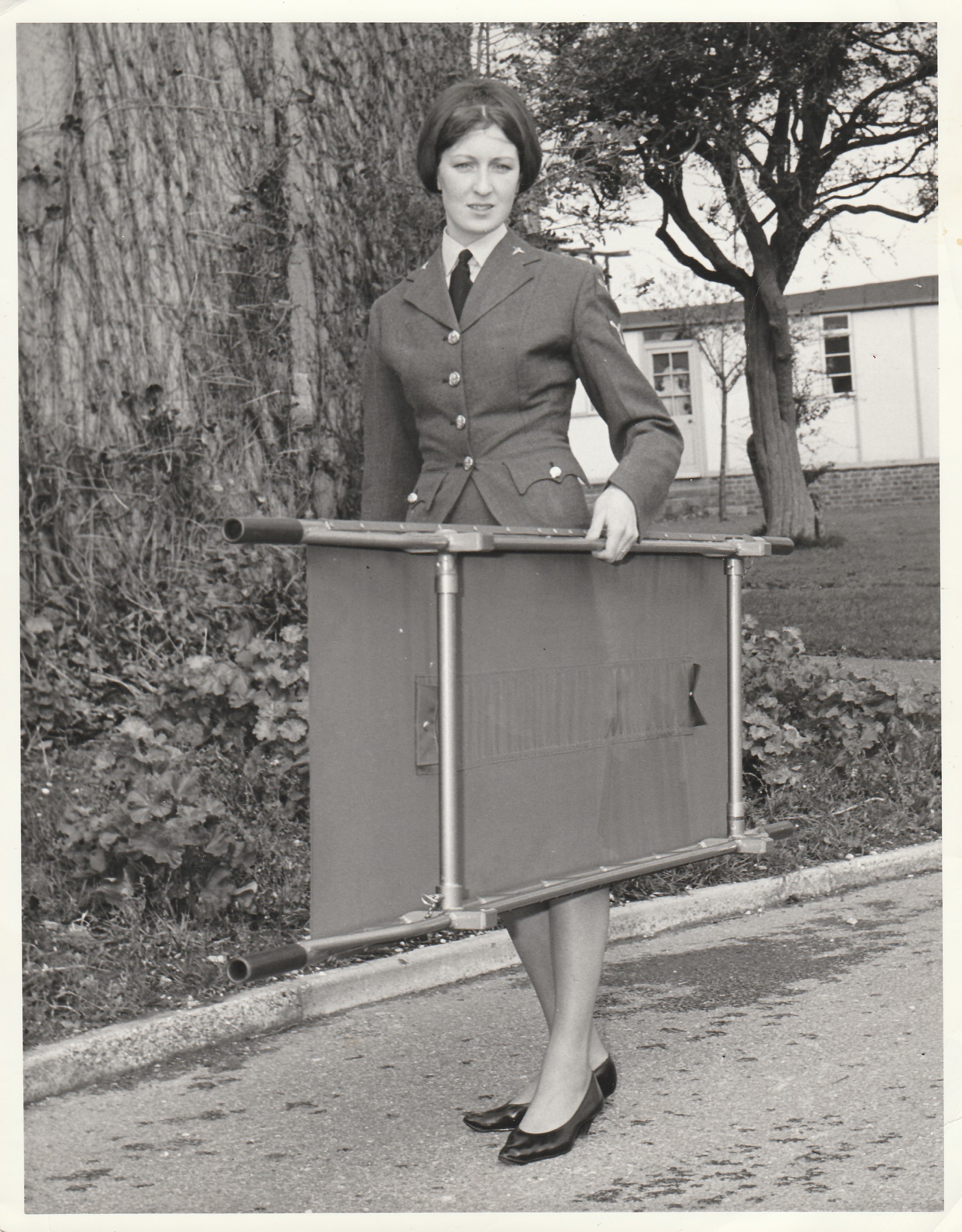
After our marriage, I stayed on in the WRAF and RAF Upavon. After all, what was I going to do in the middle of Salisbury Plain for a job? Besides, I was enjoying my life at RAF Upavon. Here, I was photographed demonstrating a new lightweight stretcher for the RAF Magazine – so light even a woman could lift it!

It was considered very unusual for me to continue in the WRAF, as most girls got married to ‘escape’ the WRAF.  However, I loved it so we applied for married quarters, completely forgetting that John was not 21 years of age yet, so he was not eligible!  Whilst I was certainly eligible being a little older than John,  nobody had ever experienced a married 22-year-old WRAF applying for married quarters before, so my request was denied. We just took in  our stride, but today I would have strongly questioned it.

So, for a few months, we lived on camp in our separate barracks and looked around for a place to rent close by. We were lucky to find ‘Dairy Cottage’ an early 19th century run-down, thatched cottage but rental affordable in the village of Upavon, just a bus ride from the camp. We lived there, for 18 happy months. We did some house painting and a few repairs on the inside. There were pheasants and various birds in the overgrown garden and we had get-togethers with our friends.

Our first home together, Dairy Cottage
The SSQ I was posted to was small and intimate and I quickly learned the routine. The staff were very helpful. I soon realised that I was the only female nurse at the camp. Soon, everyone called me Florence, as in Florence Nightingale! I was flattered. As the SSQ was right in the middle of Salisbury Plain, I was not too thrilled as I am a city girl and this place was very ‘country’.  Still, I made some great friends and soon settled in.

We treated the RAF personnel on camp and the civilians from the Village and so the daily ‘surgery’ was usually full.  We did all the necessary vaccinations for overseas postings and dealt with minor sicknesses. We took and developed x-rays and had our own dispensary, where we dispensed medicines and pills. We had a four-bed ‘sick bay’ for things like flu or contractible diseases. The RAF Hospital Wroughton was an ambulance ride away for more serious problems.

One night I was on ‘call’ and my first problem was at 9 pm. The Duty Officer called to alert me to the fact two Army men were at the guardroom, injured. I opened up the SSQ and waited for them. Both men had injuries. They had been on night manoeuvres and had fallen in the dark.  They undressed and I examined them. One had difficulty breathing so I diagnosed a fractured rib. The other man had the same problem but head scratches and a bloody nose.

As I was dressing their wounds and binding their ribs two more men showed up! At that point, I called the other two medics on camp with an urgent tannoy (public address system) message and they also arrived to assist me.  We sent them by ambulance to RAF Wroughton Hospital.

After our marriage,  John decided to change trades and become an Air Cartographer, so he was posted to RAF Northolt to learn his trade.  I tried for a posting there, but no luck. However, I did get a posting to RAF Uxbridge in the SSQ in the same area. So here we were, John at RAF Northolt and me at RAF Uxbridge! Once again we hunted for accommodation and a few months later, found a bed-sitter in Uxbridge for rent. Now, John was ‘of age’ for married quarters and entitled to payment of the rent until we could get a married quarter home at RAF Northolt. I finished my 6 happy, enjoyable years in the WRAF and found a job at a doctors office in the area until I became pregnant with the birth of our first son. This year we have been married 52 years.

Post Script:  When I told my family where I was to be posted, my Gramps told me, that in WW1, he had been at RAF Upavon for his training as an air gunner. However, HE was –  in his own words – ‘under canvas’ What a coincidence!

[1] A Short History of RAF Upavon 

The station motto was In Principio Et Semper, and translated from Latin means “In the Beginning and Always”. The station crest had a pterodactyl rising from rocks, which symbolised the station’s connection with the early days of flying, and was also a reference to the location of the station near to the ancient monument Stonehenge.

Smaller camps such as these were fully functioning  RAF Stations with small Medical Centres and a few beds plus an RAF Hospital nearby in case of emergencies. The nearest hospital to RAF Upavon was RAF Wroughton a Royal Air Force airfield near Wroughton, in Wiltshire, England, about 4 miles south of Swindon.

RAF stations in post-war England were many, and quite historical as most were built in the early 1900s. Unfortunately, most of them, have now closed or like my posting to RAF Upavon, taken over by the Army.  The station opened in 1912 and closed in 1993 when it transferred to the British Army and became known as Trenchard Lines.

[2] A Short History of RAF Wroughton

RAF Hospital Wroughton was part of the station and stood near the eastern boundary of the site, about 1 12 miles (2.4 km) west of Chiseldon. The RAF General Hospital (as it was known) opened on 14 June 1941 and by the end of March 1944, its bed capacity was 1,000. Wroughton continued as a General Hospital treating military patients, and from 1958 took NHS (National Health Service) cases as well to relieve backlogs in the Swindon area.  Following a visit to the hospital by  Princess Alexandra on 4 July 1967, the Queen conferred the prefix “Princess Alexandra’s” on the hospital on 4 October 1967.

The hospital was the primary destination for returning casualties of the Falklands War in 1982. When the hostages from Beirut were released in August 1991, Wing Commander Gordon Turnbull, a psychiatrist based at Wroughton, with his team, debriefed John McCarthy, Terry Waite and Jackie Mann and provided the counselling necessary to ease them back into freedom.  The hospital closed on 31 March 1996 as part of the Conservative Government’s defence cuts at the end of the cold war. The hospital was demolished in 2004 and the site, called Alexandra Park, used for housing and a conference centre; a memorial commemorates the former hospital.

petticoat pioneer

Charlotte Haines (1773-1851) was only ten years old when the breakaway 13 colonies won the War of Independence in April 1783. Those residing in the new United States of America, who had remained loyal to the British Crown, were persecuted and forced out of their homes and their belongings seized. Chaos reigned everywhere and families were torn apart.

One fateful day around this time, young Charlotte sneaked away to visit her British Loyalist cousins, against the expressed wishes of her American Patriot stepfatheri. Upon her return, standing outside the front door, he refused her entry back into the family home.

Charlotte was my three-times great-grandmother. Her daughter Margaret Ann Peters married Daniel Hanington and their son James Peters Hanington was my grandmother’s father.

The British government came to the aid of these Loyalists and arranged for transportation for those who wished to leave the new America. Charlotte’s grandparents, Gilbert and Anna Pugsley, rescued young Charlotte and her brother David. Together they sailed from New York for ten days on the “Jason”ii, with 124 other “refugees” as part of the final large scale evacuation and landed in New Brunswick (then still part of Nova Scotia) in October 1783…just in time for the brutally cold winter.

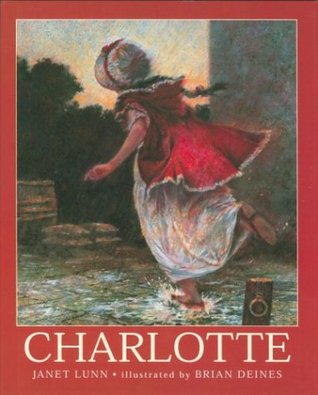
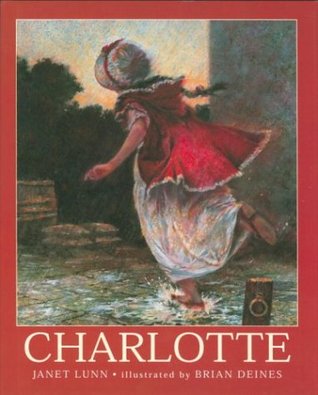
Charlotte has been the favourite subject of a couple of books and several folktales. She warranted her own chapter in “Pioneer Profiles of New Brunswick Settlers”iii and is the main character in a children’s book titled “Charlotte”iv. One folktale claimed that she was the first Loyalist to set foot ashore (not true) and in doing so, she lost her “slipper” in the mud (possibly). The matching slipper (unlikely) was donated to the New Brunswick Museum years later, however, it looks somewhat too big and stylish for a ten-year old girl. But they make wonderful stories and fully recognize young Charlotte as one of the first “petticoat pioneers” of New Brunswick.

Children’s story about Charlotte Haines by Janet Lunn

Fourteen thousand Loyalists established a new settlement in 1783 along the St. John River and shortly afterwards they petitioned for their own colony. In 1784, Great Britain granted their request and divided Nova Scotia into two — New Brunswick and Nova Scotia. The Loyalists, who made up 90 percent of the population of New Brunswick, became a separate colony with its capital, Fredericton, 90 miles upriver from Saint John.

The Loyalists and their children were entitled to free land once they provided the necessary proof. Charlotte, as the biological daughter of John Haines, a Loyalist on record, appears in 1786 documentation as one of the grantees of 84 lots on Long Island, Queen’s County, along with several other prominent Loyalists – although she was only 13 at the time. I can imagine her grandfather Pugsley nodding discreetly in her direction as he looked after her interests.

For their first three years, the British provided the Loyalists with a few simple tools, blankets, material for clothing and seeds for wheat, peas, corn and potatoes. The rations of basic food supplied by the British supplemented the abundance of game and fish available to them in the forest and streams. Most lived in tents on dirt floors until they were able to build primitive log cabins. Tree by tree, stump by stump, the fertile uplands were cleared to widen the fields making them ready for crops.

The Loyalists kept meaningful social contacts through various community events. Neighbours organized “frolics” whereby the men would work together to clear land, move rocks, build a barn or complete some other task which proved impossible for one or two people. At the same time, the women prepared meals and the children had a chance to play with friends. Women also held their own frolics to make quilts, card wool or shell corn. These Loyalist neighbours were dependent on one another in times of sickness, accidents and childbirth and supported one another at gatherings for weddings, funerals and church services.

Perhaps Charlotte met her future husband at one of these popular frolics. At 17, Charlotte married William Peters (also from a United Empire Loyalist family) in 1791 in Gagetown. Soon afterwards, the happy couple moved downriver, settled in Hampstead and built a home where the St. John River widens to a magnificent view.

At that time, there existed only ten miles of roadway in the whole province and another 20 years would pass before there would be an 82-mile long road linking Fredericton and Saint John. However, in the meantime, the river served as a “highway” enabling the transport of passengers and necessary goods between the two cities.

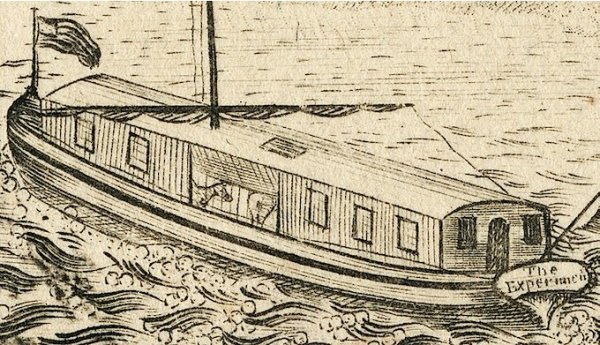
When the steamboats first chugged noisily up the river in 1816, William decided to compete with them and he built a 100-foot long side wheeler powered by 12 horses walking up and down the deck and propelling the boat along.

A drawing of The Experiment – an example of another horse powered side wheeler.

William actively pursued his interest in politics, and as the first representative of Queen’s County in the New Brunswick Legislature, he spent a lot of time in Fredericton (50 miles away) attending the sessions of Parliament.

Meanwhile, back home, Charlotte managed their entire land-holding on her own. Eventually they had 15 children, five sons and ten daughters. She bore her last child at 50 years old according to the baptismal certificate. They all survived except their son John who drowned at 21 attempting to save another man’s life.

Not only did she clothe, feed and care for them all (including the servants) but also provided much of their early education as well. On Saturday evenings in the summer, the fiddlers would play rollicking tunes and the tapping of dancing feet could be heard in big houses and cabins alike. When winter shut down the fields, and with food plentifully stored in the cellar, the spinning wheels would begin to hum during those coldest months.

By the time William died in 1836, they had recently relocated to Woodstock (100 miles upriver from Hampstead) with two of their younger children, James and Caroline. Their older children were married with homes of their own scattered along the St. John River Valley. Around this time, she wrote a letterv to her daughter Susan, Mrs. Thomas Tilley:

I take my pen to address a few lines to you to inquire after the health of you and all of your family.  The grate distance we are from you prevents me from hearing.  You heard of the death of your Father at Woodstock.

Charlotte described William’s death in some detail and then continued:

I hop [sic] this may find you all well.  I am not well.  My head troubles me very much.  There is not one day that it don’t ake [sic] so that I cant hardly stir.  My cough is something better.  James and Caroline is well and harty [sic] and quite contented hear.  I like the place and if your Father has lived and been hear to see to it we might have made a good living.  It is pleasant and a good place for business but we must try to due the best we can.  The place is out of repair and soon would have been a common if we had not come hear.  I should be glad if my friends was near to us.  I don’t know as ever I shall see you all again.  I thought to have gon [sic]to see you all before I came up hear but I was so sick that I could not go down to see you.  James and Caroline wishes to be remembered to you and all the family.  I desire to be remembered to Thomas and the children and tel them I should be glad to see them and you.  Give my love to all inquiring friends and except a share for yourself.
This from you afectionet [sic] Mother, Charlotte Peters

Although she had her share of aches and pains at that time, she lived another 15 years and ultimately enjoyed the blessing of 111 grandchildren.

She had a powerful influence over all her family for she believed that their heritage carried a great responsibility to others. When the grandchildren would visit, her graceful hands were always busy winding yarn or knitting a sock while patiently answering their questions and reciting passages from the bible.

One of her grandchildren, Samuel Leonard Tilley, later known as Sir Leonard, served as Premier of New Brunswick and went on to became one of the Fathers of Confederation.

Sir Samuel Leonard Tilley 1864

A common tale states that Tilley proposed the term “Dominion” in Canada’s name, at the London conference in 1866, which he gleaned from Psalm 72:8 – “He shall have dominion also from sea to sea, and from the river unto the ends of the earth”. Ultimately, as Minister of Finance in the federal government, he was also instrumental in seeing the transcontinental railway completed.vi

Young Charlotte Haines might have felt all alone in the world at age ten but, when she died 68 years later, the epitaph on her tombstone proclaimed her legacy: “…Lamented by a large circle of descendants and friends by whom she was universally beloved and respected.”

The gravestone of Charlotte Haines Peters and family – St.John’s Anglican Church, Gagetown, Queens County, New Brunswick

iCharlotte’s mother, Miss Pugsley, died when she was very young. Charlotte’s father remarried Sarah Haight before he died. Then Sarah remarried Stephen Haviland who was Charlotte’s stepmother’s husband (step step father?)

iiThe Ship Passenger Lists, American Loyalists to New Brunswick, David Bell, http://www.uelac.org/Loyalist-Ships/Loyalist-Ships.php as seen 2020-03-28

iiiCharlotte Gourlay Rovinson, Pioneer Profiles of New Brunswick Settlers, (Mika Publishing Company), 1980, p.143.

ivJanet Lunn, Charlotte, (Tundra Books), 1998.

v https://queenscountyheritage.wordpress.com/2011/09/28/loyalist-of-the-day-charlotte-haines-peters/ as seen 2020-04-02

vi Conrad Black, Rise to Greatness: The History of Canada, (Random House), 2014.

Image – https://wiki2.org/en/Experiment_(horse-powered_boat) as seen 2020-06-11

How to Find Protestant Abjurations in Quebec

Over the past several years, I have posted several articles about the Huguenots, or French Protestants, who came to New France. Once here, many of them signed abjurations, or declarations in which they renounced their faith, and they became Catholic.

The act of ‘’abjuration’’ was the first step to be taken by a Protestant individual. The second step was an act of ‘’confirmation,’’ conducted by a Catholic priest at a local or regional parish or at a regional convent. Guy Perron in his superb blog refers to this subject as Confirmations.

Recently, the Bibliothèque et Archives nationales du Québec (BAnQ) has replaced its online research tool Pistard with a much better search engine, Advitam, https://advitam.banq.qc.ca/ and this has made the task of finding these abjurations and confirmations much easier. The first six entries in the attached research guide were obtained by using Advitam.  See https://genealogyensemble.com/2020/04/19/banq-advitam/

Through BAnQ Advitam, BAnQ Numérique or BAnQ Ask a Question/BAnQ Poser une question, you can obtain an online download for free within days simply by searching for the ‘’cote #’’ (Shelf # at BAnQ) and an approximate date of an event.

The nine-page research guide attached here   Abjurations in New France   includes links to registers of abjuration, to the bulletin of the historical society of French-speaking Protestants of Quebec, to Guy Perron’s excellent blog, and to a list of books and articles on the subject.

Over the last few years, Genealogy Ensemble has posted three listings of Huguenot Family Names of New France and Quebec. The links to these lists are at the end of the PDF.

  • Huguenot family names listed by the Huguenot Trails periodical of the Huguenot Society of Canada prior to 2002.
  • Huguenot family names issued by Michel Barbeau, a retired genealogist. (Michel Barbeau’s work is highly precise but is a short list in comparison to other sources.)
  • Huguenot family names compiled by myself from books, essays, papers issued over four centuries by leading historians, academics, archivists, authors, librarians in Canada and in France.

This last list was compiled from books stored at the Collection nationale within the Grande Bibliothèque de Montréal, books and dossiers at BAnQ Vieux-Montréal and books which can be researched online at BAnQ Numérique and through various online sociétés savantes (literary societies) and finally from the online pages of Fichier Origine (www.fichierorigine.com.)

Over the past few years, I have posted a series of research guides to finding Protestants in France. Here are links to my articles about the Protestants who came to Quebec:

Huguenot Refugees, April 2, 2014, https://genealogyensemble.com/2014/04/02/huguenot-refugees/

The Trail of the Huguenots in Europe, the U.S.A. and Canada, April 4, 2014, https://genealogyensemble.com/2014/04/04/the-trail-of-the-huguenots-in-europe-the-u-s-a-and-canada/

Register of Abjurations, Feb, 3, 2015, https://genealogyensemble.com/2015/02/03/register-of-abjurations/

Huguenots – Index of Names, March 6, 2015, https://genealogyensemble.com/2015/03/06/848/

The Protestant Churches of Quebec City, 1629-1759, Feb. 3, 2019,   https://genealogyensemble.com/2019/02/03/the-protestant-churches-of-quebec-city-1629-1759/

The merchants and Fur Traders of New France, part 2, H-Z, May 10, 2019, https://genealogyensemble.com/2019/05/10/the-merchants-and-fur-traders-of-new-france-part-2-h-to-z/

Protestants in Quebec, Dec. 22, 2019, https://genealogyensemble.com/2019/12/22/protestants-in-quebec/

Also of interest: Marian Bulford’s articles about the Huguenots who immigrated to England. After the British Conquest of 1759 at the Plains of Abraham, British Governors James Murray, Guy Carleton, Frederick Haldimand, Lord Dorchester (Carlton) appointed chief justices, judges and a few lieutenant-governors and senior military officers who were at ease in the French language and all of the above were descendants of Huguenot families who had settled in the London region and also in Northern Ireland. These Huguenot administrators and military officers under Murray, Carleton, Haldimand, Dorchester attended the same churches mentioned by Marian.

Marian Bulford, Huguenot of England, Part 1, April 25, 2018, https://genealogyensemble.com/2018/04/25/the-huguenot-of-england-part-1/

Marian Bulford, Huguenot of England, Part 2, June 15, 2018, https://genealogyensemble.com/2018/06/15/the-huguenot-of-england-part-2/

For help finding Protestant families s in France in the 16th and 17th centuries, see my series of regional research guides, posted on Genealogy Ensemble in 2019-2020, as well as:

How to Search for Huguenot Ancestors in France, May 20, 2018, https://genealogyensemble.com/2018/05/20/how-to-search-for-huguenot-ancestors-in-france/

Huguenot Family Lineage Searches, June 3, 2018, https://genealogyensemble.com/2018/06/03/huguenot-family-lineage-searches/

Researching Your French Ancestors Online, May 13, 2018, (the attached updated PDF describes how to research in the Archives départementales de France, the country’s 95 regional archives)  https://genealogyensemble.com/2018/05/13/researching-your-french-ancestors-online/


Working together to help genealogists discover their ancestors