Tag Archives: Bagg

Huntly Ward Davis, Montreal Architect

With additional research from Justin Bur

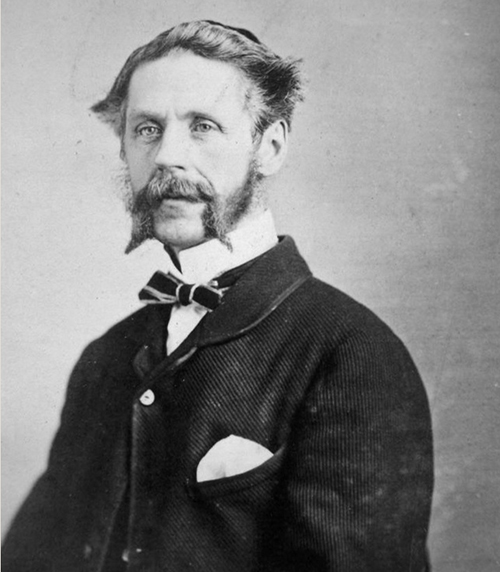
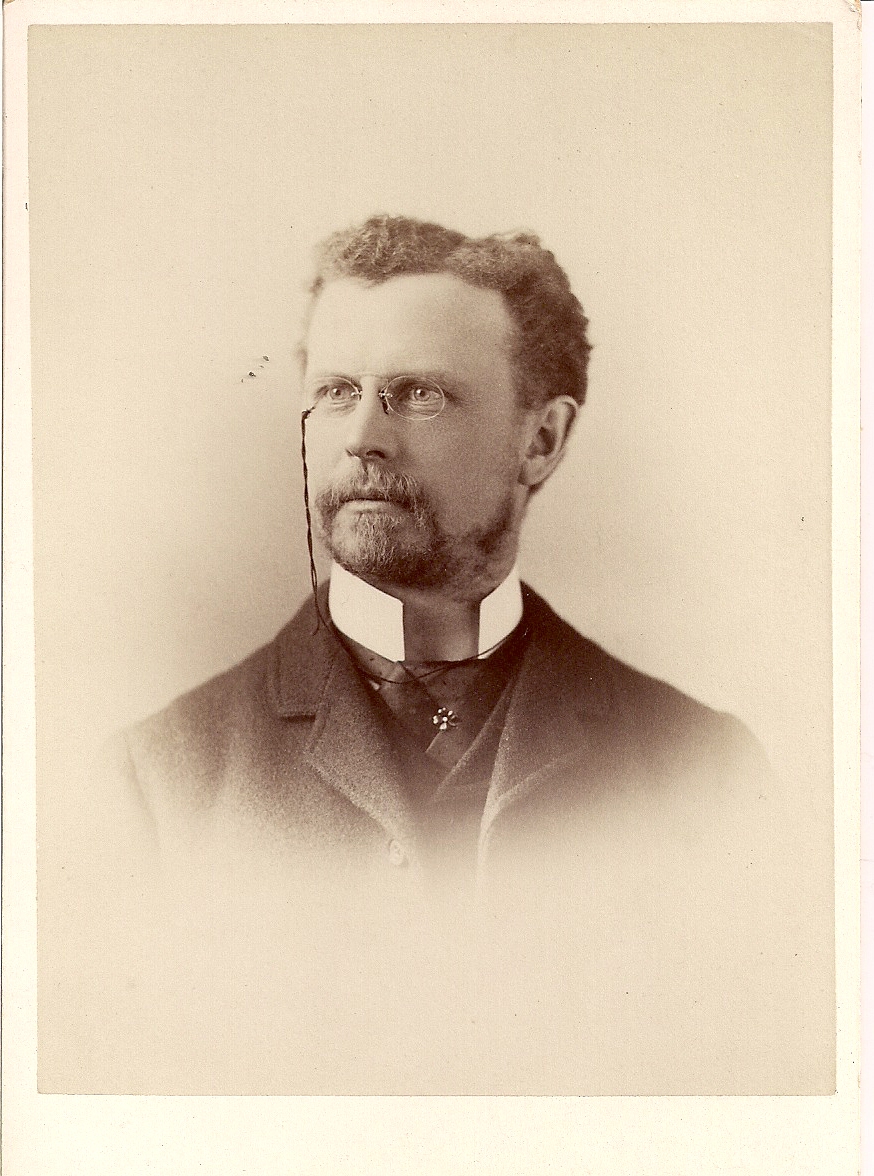
Huntly Ward Davis (1875-1952) was a Montreal architect who designed elegant downtown homes, banks and institutional buildings in the first half of the 20th century. Some of those buildings still stand today, others have disappeared. Many of Montreal’s heritage buildings, built when the city was Canada’s most important business and banking center, have been demolished and replaced by high-rise office towers and apartment buildings. As a result, Davis has been largely forgotten by the public, but his descendants – my cousins – are proud of his architectural legacy.

Huntly Ward Davis. Bagg family collection

Huntly was born in Montreal on October 22, 1875, the oldest son of Moses Davis (c. 1847-1909), head of a customs brokerage firm, and Lucy Elizabeth Ward (1850-1924). Moses was originally from St. Andrews, Quebec, a village on the Ottawa River between Ottawa and Montreal.1  

His mother’s father was well known in business and in politics. James Kewley Ward (1819-1910), was born on the Isle of Man, located in the Irish Sea. James immigrated to New York State in 1842 and married his first wife, Elizabeth King, there. The family moved to Lower Canada in the early 1850s and James bought a lumber mill on the Maskinongé River, northeast of Montreal.

Elizabeth died when daughter Lucy was four years old. James remarried and he and his second wife, Lydia Trenholm, had a large family. Lucy’s granddaughter later recalled how warm and compassionate Lucy was, so perhaps she grew up helping her younger siblings.

In the 1870s, the Ward family moved to Montreal, where James opened a sawmill on the Lachine Canal and expanded his business interests to cotton. A Liberal in politics, he served as mayor of the village of Côte St. Antoine (now the City of Westmount) from 1875 to 1884, and in 1888 he was appointed to the Legislative Council of Quebec. He was known for his generosity to charities.2

Moses Davis and Lucy Ward were married in Montreal in 1874, and Huntly, the eldest of their three sons, was born the following year. Huntly attended school in Montreal, then studied architecture in Boston, graduating from the Massachusetts Institute of Technology in 1898. He returned to Montreal and eventually went into partnership with architect Morley Hogle. After Hogle’s sudden death in 1920, Huntly worked on his own.3 He was a member of the Quebec Association of Architects and of the Royal Architectural Institute of Canada.

House at 1814 Sherbrooke Street W. near St. Mathieu, designed by Hogle and Davis in 1908. The ground floor window was added later and the house is still there today. Photo, taken 1986, from Repetoire d”architecture traditionelle sur le territoire de la Commununaute Urbaine de Montreal, Architecture domestique 1, Les Residences.

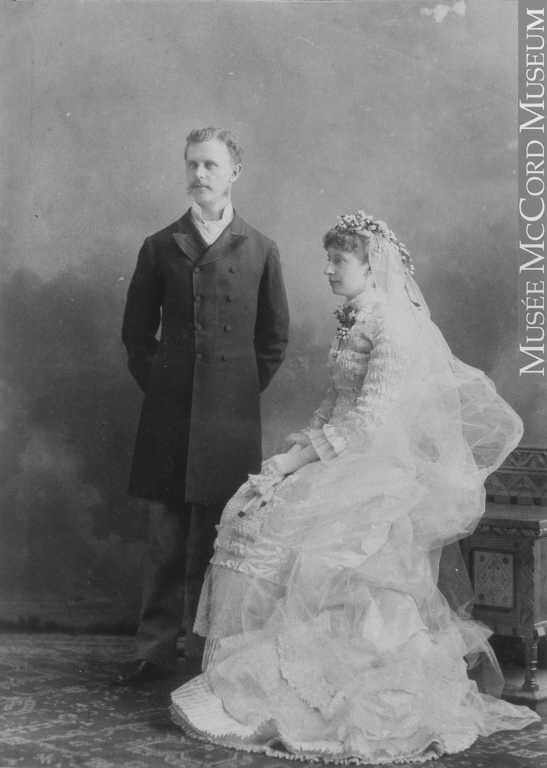
Huntly married Evelyn St. Clair Stanley Bagg (1883-1970), eldest daughter of Robert Stanley Bagg and his wife Clara Smithers, on Oct. 26, 1910, at Montreal’s Anglican Church of St. James the Apostle. The following day, The Gazette’s society reporter called the event “one of the prettiest of the season’s fashionable weddings” and described the bride’s ivory satin gown, embroidered with seed pearls.4

Huntly and Evelyn lived in an apartment building that Huntly had designed on Summerhill Avenue, a short street off Côte des Neiges Road, just up the hill from the house where Evelyn had grown up. Evelyn lived on Summerhill for the rest of her life and the couple’s granddaughter still remembers the spacious eight-room apartment and the furniture Huntly had designed.

Huntly and Evelyn also had a country house at Ste. Marguerite, in the Laurentian mountains north of the city. That was where Huntly died, suddenly, on October 12, 1952, at age 76.5 His name is on a plaque in the Bagg family mausoleum at Mount Royal Cemetery.

Huntly and Evelyn had one daughter, Clare Ward Davis (1911-2007). As an adult, she often repeated expressions she had learned from him as a child that reflected his simple sense of justice: “never assume”; “I divide, you choose”; and “a nectarine is a plum’s mistake”.

This down-to-earth approach to life was alsoreflected in the buildings he designed. Son-in-law Norton Fellowes, who was also a Montreal architect, prepared an obituary of Huntly, focusing on his professional activities and published in the Royal Architectural Institute of Canada Journal.

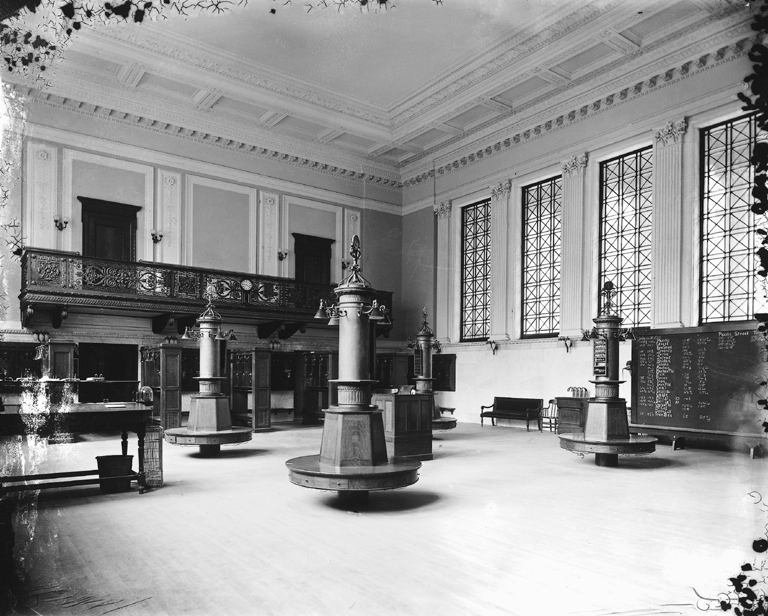
Norton wrote, “In the early years of the 20th century, Mr. Davis was a ‘contemporary architect’ for during this era of post-Victorian vulgarity, he allied himself with that small group of young architects who saw beyond the ornate fashion of the day and consistently designed quiet, dignified town houses, country homes, banks and institutes of learning, always in the tradition of fine craftsmanship and classical proportion. The Greenshield and Townsend country houses still grace the bays of Lake Manitou in the Laurentians and the main building of the Children’s Memorial Hospital, the Trafalgar Institute, the Walter Molson residence on McGregor Street, and the head office of the Bank of Toronto in Montreal are all still permanent monuments to a man who followed the highest traditions of the profession.

“During the last few years, although well beyond the age when others retire, Mr. Davis, at the age of 75, was still young enough to understand the trend to more functional design and it was not surprising that in 1952, he designed and supervised the building of several small, efficient new branches for the Bank of Toronto in the Montreal area. Mr. Davis thus worked with dignity and courage for a full half century as a member of the architectural profession.”6
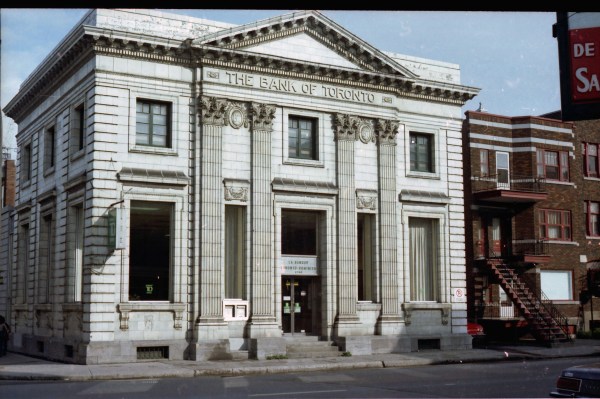
Hogle and Davis designed this branch of the Bank of Toronto in Montreal’s Hochelaga-Maisonneuve district. It features a white vitrified terracotta facade. Source: : l’Atelier d’histoire Mercier-Hochelaga-Maisonneuve (AHMHM).

Neither is it surprising that he designed at least one building for his wife’s family. The Bagg family had extensive properties in Montreal, mostly in the Mile End area, just east of Mount Royal, but they also owned a few properties downtown. In 1926, Huntly designed a brown brick apartment block on Ste-Catherine Street West, near Guy, for the Stanley Bagg Corp. It was three stories, with small shops on the ground floor.

He may have been involved with another project on land that belonged to the Baggs, a commercial building at the southwest corner of Ste-Catherine Street and Peel. It was built in 1911, shortly after Huntly and Evelyn were married, however, no architect’s name was mentioned in any newspaper reports or in the building’s lease. All building permits were destroyed in a 1922 fire at city hall.

The gleaming, white vitrified terracotta façade (a treatment popular between 1910 and 1915) of the H&M clothing store still stands out at this busy intersection in the heart of downtown. Thousands of people pass by it every day. Although his name was never officially associated with it, this may be the most familiar building Huntly designed.

Notes

Some sources, including the Biographical Dictionary of Architects of Canada, spell his name Huntley, however, his baptism record and a letter written by his mother spell it Huntly. I have used his mother’s spelling. Most architectural references say H.W. Davis.

The lot on Ste-Catherine just west of Guy (St. Antoine Ward, lot 1679, minus a strip of land previously detached for a laneway,) was purchased by the Estate of the late Stanley Clark Bagg in 1885, probably as a rent-generating property. At the time, a three-story brick building and several other buildings were on the lot. The property passed to the Stanley Bagg Corp. when it was founded in 1919. The current building, designed by Huntly Ward Davis, was constructed in 1926. The property was sold in 1957.

The property at Ste-Catherine and Peel (Saint-Antoine Ward, lot 1477) was purchased by the Bagg Estate in 1879. At the time there were three, three-storey stone-front brick houses on the lot. In 1886, these buildings were converted to shops with flats above. They were demolished in 1911 and construction began on the current building, at a cost of $60,000. The Stanley Bagg Corp. sold the property in 1951. 

Sources

  1. “Mr. Moses Davis Died Suddenly Last Night”, The Montreal Star, April 17, 1907, p. 6. Newspapers.com, accessed Oct. 28, 2025.
  2. Leslie Quilliam and Victor Neale, “James Kewley Ward”, Kelly Dollin, editor, New Manx Worthies, Manx Heritage Foundation/Culture Vannin, 2006, iMuseum, https://imuseum.im/search/collections/people/mnh-agent-94625.html, accessed Oct. 27, 2025.
  3. “Huntley Ward Davis”, Biographical Dictionary of Architects in Canada, 1800-1950, Robert G. Hill, editor, http://dictionaryofarchitectsincanada.org/node/825, accessed Oct. 27, 2025.
  4. Social and Personal, The Gazette, Oct. 27, 1910, p. 2. Newspapers.com, accessed Oct. 27, 2025.
  5. Huntly Ward Davis, Obituary, The Gazette, Oct. 15, 1952, p. 14, Newspapers.com, accessed Oct. 27, 2025.
  6. Norton A. Fellowes, “The Late Huntley Ward Davis, Montreal Architect,” Royal Architectural Institute of Canada, Nov. 13, 1952

This article also appears on my family history blog http://www.writinguptheancestors.ca

A Neighbourhood of Rural Villas

In collaboration with Justin Bur

Montreal in 1832, painting by James Duncan. McCord Stewart Museum.

This view of the city of Montreal from the slope of Mount Royal was painted by artist James Duncan in 1832. In the distance, the city lay on the banks of St. Lawrence River, while in the foreground, the foot of the mountain was rural and traversed by only one road – today’s Saint-Laurent Boulevard.  

This area is now a dense neighbourhood of homes, shops and commercial buildings, but 200 years ago, it was described as a neighbourhood of rural villas. Several of those buildings belonged to my ancestors, including butcher John Clark (1767-1827) and merchant Stanley Bagg (1788-1853). These homes were all torn down years ago, but fortunately, artists and photographers captured them before they disappeared. This article tells their stories.  

Saint-Laurent Boulevard began as a country road passing through a landscape with a mix of rural functions. In the 1700s, a large tannery was located nearby, to the east along Mount Royal Avenue. Later, numerous quarries were excavated to provide the grey limestone used for much of Montreal’s Victorian architecture – churches, civic buildings, places of business and attractive houses. The Beaubien family acquired a large tract of land along the east side of the road in 1842, as well as property in what later became the municipality of Outremont. A railway line was built across the Bagg and Beaubien land in 1876, along which an industrial corridor emerged in the early 1900s.

During the lifetimes of the Clarks and Baggs, their property, on the west side of Saint-Laurent, was farmland. The soil was mostly sandy and rocky. Hay to feed cattle and horses was the main crop, but vegetables and fruit trees could be grown in fertile areas. Back from the road, rising up toward the side of the mountain, there were a handful of rural villas belonging to the Baggs and a few neighbours, including the Perrault-Nowlan and the Hall families.

Butcher John Clark, my four-times great-grandfather, was the first member of my family to live in this area. He brought his wife and young daughter to Montreal around 1797 from County Durham, in northern England, and began investing in land. In 1804, Clark purchased a farm on the west side of Saint-Laurent, and over the next few years, he added adjacent parcels of land. He called the property Mile End Farm, probably inspired by Mile End in London, England.1 His choice of name is still familiar today, as this neighbourhood is known as Mile End. In 1810, he leased the farm to American-born Phineas Bagg (c. 1751-1823) and his son Stanley,2 and they ran an establishment called the Mile End Tavern there until 1818.

Montreal Hunt Club at Mile End Road, Montreal, QC, 1859. photograph by J. Henry, MP-1978.29.8, McCord Stewart Museum. The corner of the building on the right is likely the Mile End Tavern.

After Phineas retired and Stanley moved on to other business interests, various tenants operated the Mile End Tavern. It was demolished in 1902 when the local municipality expropriated the land to widen Saint-Laurent Boulevard. New owners purchased the lot in 1905, and the following year a department store opened on the corner of Saint-Laurent and Mount Royal Avenue, where the tavern had stood for so long.3 The department store was converted into a commercial building during the Great Depression. Today, a Couche Tard convenience store and a Tim Horton’s coffee shop are on its ground floor.

By 1891, both Stanley Bagg and his son Stanley Clark Bagg had died and most of the Mile End Farm property was sold by the late Stanley Clark Bagg’s five adult children to developers McCuaig and Mainwaring.4 An economic depression and lack of basic services such as sewers and tramways delayed development for a few years. Meanwhile, the most valuable lots – the ones that faced Saint-Laurent Boulevard – were divided into five equal shares and allocated at random to the five Bagg siblings.5

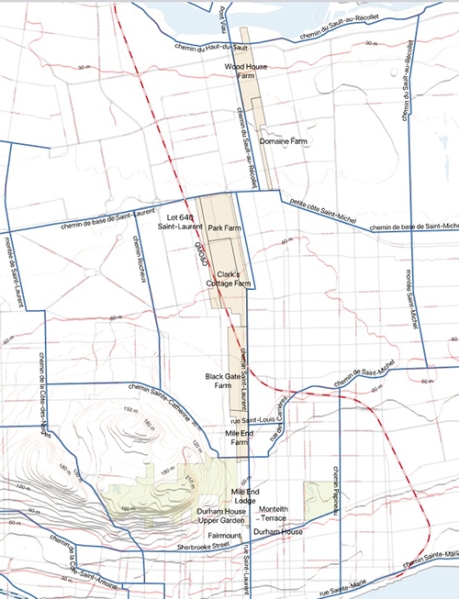
Map of Mile End Farm and the locations of Mile End Tavern, John Clark’s Mile End Lodge, Stanley Bagg’s Durham House and Stanley Clark Bagg’s Fairmount Villa, prepared by Justin Bur, 2024.

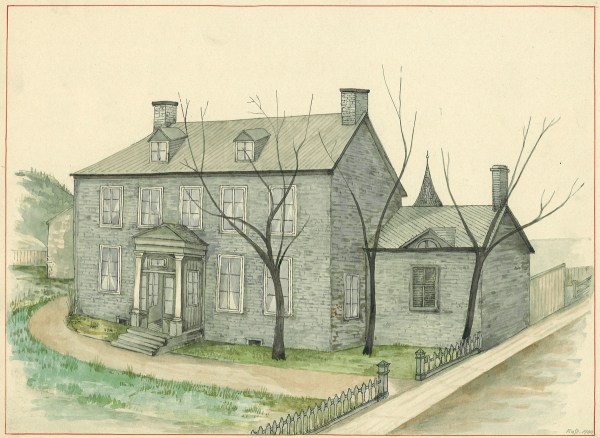
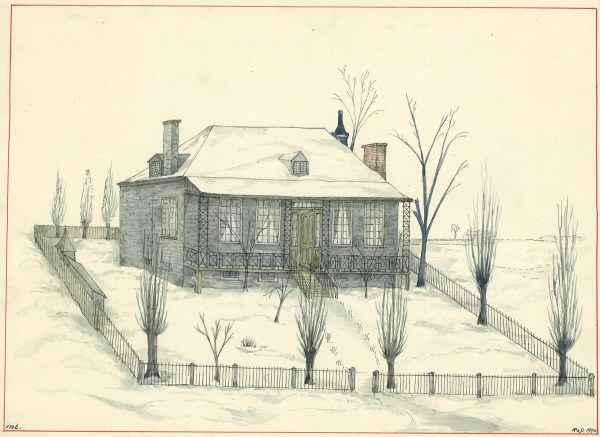
John Clark’s house was not as well known as the nearby tavern. In 1815, Clark sublet a 16-acre square of land back from the Baggs, a “piece of ground on which is erected a new house of butchery called by the said John Clark, Mile End Lodge”6 – in reality, a two-storey stone house for his family. Facing south, toward the city and the river, it was located between the current Bagg and Duluth Streets, just above what was then the Montreal city limit.

After Clark’s death in 1827, his widow, Mary Mitcheson Clark, moved to a smaller house at the current northwest corner of Bagg and Clark Streets. An inscription noting that this was once the location of the Mitcheson Cottage can still be seen on the foundation of the house that stands there today,

Mrs. Mitcheson’s Cottage, watercolour painting by John Hugh Ross, Stewart Museum collection, McCord Stewart Museum, Montreal.

As for Mile End Lodge, although it remained in the hands of Clark’s descendants, no family members ever lived there again. Various tenants rented it over the years. The land around it was subdivided, with a chunk sold in 1873 and the rest in 1893, but the house itself was not sold until 1914. The badly deteriorated building was demolished soon after that, and there is now a large commercial building in that location.7

Mile End Lodge, watercolour painting by John Hugh Ross. Stewart Museum collection, McCord Stewart Museum, Montreal.

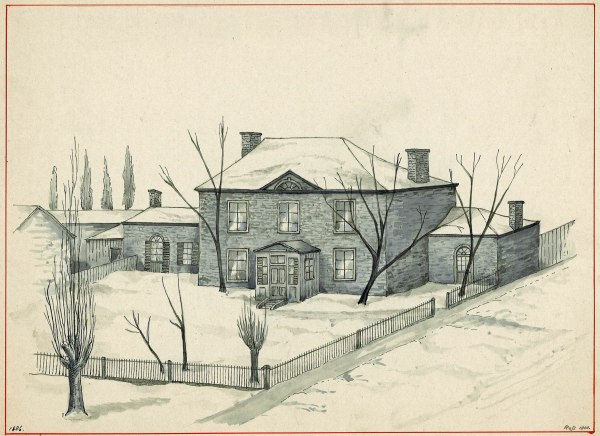
Durham House, the home of my three-times great-grandparents Stanley Bagg and Mary Ann Clark, was located south of the tavern and Mile End Lodge. John Clark purchased the property in December, 1814 and gave it to his daughter as a wedding present in 1819. Durham House was on Saint-Laurent Boulevard, at the current southwest corner of Prince Arthur. Early references describe its address as Côte à Baron.

Durham House, watercolour painting by John Hugh Ross, Stewart Museum collection, McCord Stewart Museum, Montreal.

This two-storey stone building also faced south. There was a covered well on the property, a barn and several other outbuildings. The original Durham House property measured 6 ¾ x 4 arpents, so it was a large piece of land, including property between Prince Arthur and Guilbault Streets, known as the Upper Garden.

After Stanley Bagg’s death in 1853, Durham House was briefly used as a school, then it housed a fruit store for a number of years. Meanwhile, the large property that surrounded it was one of the first to be subdivided for building lots. Stanley Clark Bagg subdivided it in 1846, and the Upper Garden was subdivided by his heirs in 1889. The house was demolished in 1928 to allow for the expansion of the modern TD Bank branch which sits on the spot today.

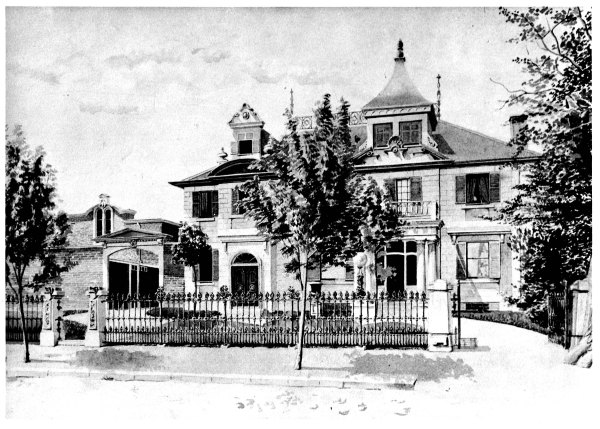
Stanley Bagg also purchased land near the corner of Sherbrooke Street and St. Urbain at a sheriff’s sale in 1837, and sold it to his son in 1844. Stanley Clark Bagg and his wife, Catharine Mitcheson Bagg (1822–1914), built a large house they called Fairmount Villa on that lot and raised their five children there. The house included a small chapel, while the irregularly shaped property, which extended to the boundary of the Durham House land, had a garden with lilac trees, statues and flower beds. The house was likely named after Fairmount Park in Philadelphia, where Catharine grew up.

Fairmount Villa. photograph, Bagg family collection.

Stanley Clark Bagg died in 1873, but Catharine remained at Fairmount Villa for the rest of her life. The house was sold in 1915, and it was demolished in 1949 when Saint-Urbain Street was widened.

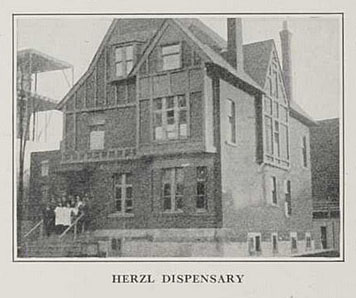
The Fairmount property (lot 100 of the cadastre of St. Lawrence Ward) was subdivided in 1872, then redivided in 1922. In 1884, Stanley Clark Bagg’s son, Robert Stanley Bagg (1848-1912), built a house on one of the subdivided lots, at 436 (later 3470) Saint-Urbain. He and his young family moved to a bigger house in a more exclusive neighbourhood on Sherbrooke Street West a few years later, and his sister Mary Heloise Lindsay and her family lived in the house on Saint-Urbain from 1890 until 1906. The house changed street numbers several times, then changed vocations: it became part of the Herzl Jewish Hospital, was subdivided into apartments, and was finally demolished in the early 1960s.

This house on St. Urbain Street was designed for Robert Stanley Bagg by architect William McLea Walbank. When this photo was taken the building was a medical clinic known as the Herzl Dispensary.

Today, two large buildings that once housed Montreal’s school of fine arts are located on the former Fairmount property. The smaller one, of yellow brick, at 3450 Saint-Urbain, was designed by celebrated architects Omer Marchand and Ernest Cormier in 1923 for the École des beaux arts de Montréal. It will soon be home to Montreal’s new Afro-Canadian Cultural Centre.

The larger building, at 125 Sherbrooke St. W., a heritage building constructed in 1905 as the Commercial and Technical High School, later became the Marie-Claire Daveluy building of the Bibliothèque nationale du Québec (1982–1997). It has housed l’Office québécoise de la langue française since 1999. 

Notes

Built by the Sulpician priests in 1717, Saint-Laurent Boulevard was initially known as a grand chemin du Roy – Great King’s Highway. Over the years it has been known by many names, both English and French, including Chemin Saint-Laurent, St. Lawrence Street and “the Main”. Since 1905, it has been designated Boulevard Saint-Laurent.

The name Côte à Baron, or Coteau Baron, cannot be found on today’s city maps, but in the late 19th century, this was the name of a sloping stretch of Saint-Laurent Boulevard just below Sherbrooke Street and extending a short distance north of there. Côte à Baron was described as a neighbourhood of rural villas. The first-ever Lovell’s city directory for Montreal, published in 1842, listed Stanley Bagg’s home at Côte à Barron.  (https://numerique.banq.qc.ca/patrimoine/details/52327/3652365). Another building with a Côte à Baron address, at the northwest corner of Sherbrooke Street and Saint-Laurent, was an extravagant mansion nicknamed Torrance’s Folly. It was built around 1815 by businessman Thomas Torrance and sold to John Molson in 1832. A gas station is now located at that corner.

An arpent is a French unit of measurement that can refer to either area or length. It is equivalent to an acre of land, or about 58 metres in length. It has been replaced by metric measures since 1970, but can still be found in old property records.

Source of the photo of the Herzl Dispensary: The Jew in Canada: a complete record of Canadian Jewry from the days of the French régime to the present time, ed. Arthur Daniel Hart, 1926 (on BAnQ numérique).

This article is also posted on my personal family history blog, Writing Up the Ancestors. It was updated on Sept. 16, 2025 to add the photo of the Herzl Dispensary.

See also:

Janice Hamilton, “The Mile End Tavern”, Writing Up the Ancestors, October 21, 2013   https://www.writinguptheancestors.ca/2013/10/the-mile-end-tavern.html

Janice Hamilton, “John Clark, 19th Century Real Estate Visionary”, Genealogy Ensemble, May 22, 2019, https://genealogyensemble.com/2019/05/22/john-clark-19th-century-real-estate-visionary/

Janice Hamilton, “The Life and Times of Stanley Bagg, 1788-1853”, Writing Up the Ancestors, October 5, 2016, https://www.writinguptheancestors.ca/2016/10/the-life-and-times-of-stanley-bagg-1788.html

Janice Hamilton, “A Home Well Lived In”, Writing Up the Ancestors, January 21, 2014, https://www.writinguptheancestors.ca/2014/01/a-home-well-lived-in.html

Janice Hamilton, “Fairmount Villa”, Writing Up the Ancestors, Dec. 18, 2019, https://www.writinguptheancestors.ca/2019/12/fairmount-villa.html

Janice Hamilton, “Bagg Family Dispute Part 2: Stanley Clark Bagg’s Estate”, Genealogy Ensemble, Feb. 14, 2024, https://genealogyensemble.com/2024/02/14/the-bagg-family-dispute-part-2/

Janice Hamilton, “History of a Downtown Montreal Property”, Writing Up the Ancestors, Dec. 31, 2022, https://www.writinguptheancestors.ca/2022/12/history-of-a-downtown-montreal-property.html

Justin Bur, “À la recherche du cheval perdu de Stanley Bagg, et des origines du Mile End.” A la recherche du savoir: nouveaux échanges sur les collections du Musée McCord; Collecting Knowledge: New Dialogues on McCord Museum Collections. Joanne Burgess, Cynthia Cooper, Celine Widmer, Natasha Zwarich. Montreal: Éditions MultiMondes, 2015.

Mile End Memories, http://memoire.mile-end.qc.ca/en/

sources:

1.  Justin Bur, Yves Desjardins, Jean-Claude Robert, Bernard Vallée, Joshua Wolfe, Dictionnaire historique du Plateau Mont-Royal (Montreal, Éditions Écosociété, 2017), p 256.

2.  J.A. Gray, n.p. no 2874, 1810-10-17

3.  Justin Bur, Yves Desjardins, Jean-Claude Robert, Bernard Vallée, Joshua Wolfe, Dictionnaire historique du Plateau Mont-Royal (Montreal, Éditions Écosociété, 2017), p 258.

4.  William de Montmollin Marler n.p. no 17571, 1891-11-20

5.  John Fair n.p. no 3434, 1892-05-18

6.      Henry Griffin, n.p. no 931, 1815-04-15

7.   Justin Bur, Yves Desjardins, Jean-Claude Robert, Bernard Vallée, Joshua Wolfe, Dictionnaire historique du Plateau Mont-Royal (Montreal, Éditions Écosociété, 2017), p 259.

The Silver Spoon

In this article I refer to Robert Stanley Bagg by his middle name since it was the name by which he was best known. In other articles I have referred to him as RSB to differentiate him from his father, Stanley Clark Bagg (SCB) and his grandfather, Stanley Bagg.

My great-grandfather Robert Stanley Clark Bagg, or R. Stanley Bagg (1848-1912), was born with the proverbial silver spoon in his mouth, however, working in the family real estate business was not what he really wanted to do in life. It wasn’t until after he retired that he was able to follow his true passion: politics.

I never heard any family stories about Stanley, perhaps because he died several years before my mother was born. It wasn’t until Montreal’s two major English-language newspapers were digitized a few years ago that I learned about his various interests and activities. In fact, his name appeared in Montreal newspapers frequently, especially after the late 1890s when he became active in the Conservative party.  

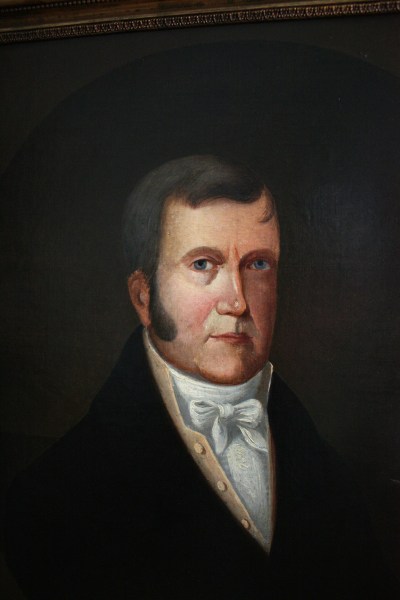
Portrait of Robert Stanley Bagg by Adam Sheriff Scott. Private collection.

Stanley was the second child of Montreal notary and land-owner Stanley Clark Bagg (1820-1873) and Philadelphia-born Catharine Mitcheson (1821-1914). The couple’s first child died before Stanley was born. Three younger sisters, Katharine, Amelia and Mary, were born in 1850, 1852 and 1854, and a fourth sister, Helen, arrived in 1861. Even as a child, Stanley must have been told that he would have a leadership role in the family, not only as the eldest, but also as the only male.

According to his obituary in the Montreal Gazette,1 Stanley studied law at McGill University and passed the bar in 1873. He then left Montreal for England, intending to further his studies, however, his father died unexpectedly in August of that year and Stanley came home. For a short time, he was in partnership with lawyer Donald Macmaster, sharing an office on St. James Street, in the old business heart of the city, but he gave up his legal practice to concentrate on the administration of his late father’s real estate. Nevertheless, throughout his life, Stanley identified himself as a lawyer or an advocate, a term used to refer to the practice of Quebec’s civil law.  

The job Stanley undertook as administrator of his father’s estate was not an easy one. Montreal was growing rapidly, with thousands of new immigrants arriving, manufacturing, railroads and industries expanding and construction of new residences ongoing. The farmland that comprised the vast S. C. Bagg Estate, mostly located on the west side of St. Laurent Boulevard in a corridor north of Sherbrooke Street, increased in value as the city grew. Sales, mainly of residential properties, became a profitable business.

This map shows the extent of the late Stanley Clark Bagg’s properties, shaded in beige, in 1875, when an inventory was made of his estate. These properties are overlaid over a modern map of the island of Montreal. At that time, the actual city of Montreal was south of Sherbrooke Street, extending down to the banks of the Saint Lawrence River. The eastern slope of Mount Royal is adjacent to the Mile End properties. Map created by Justin Bur, based on two open data sources: physical geography from CanVec, Natural Resources Canada and modern streets from Geobase, City of Montreal.

Stanley does not seem to have been interested in developing and promoting housing or commercial real estate projects himself, but he did decide which pieces of land to subdivide into lots and he supervised sales. The Estate also rented small residential and commercial buildings, and some of the land was sold to the city for civic projects such as parks.

He encountered many unexpected headaches over the years. He had to ask the provincial government to pass a special law in 1875 to override a provision in SCB’s will in order to make the lot prices competitive.2 There were misunderstandings in 1889-91 over which properties were part of the estate and which belonged to the five children. And sister Helen’s husband disappeared under mysterious circumstances in 1897, owing the family large sums of money.

Although Stanley was the main administrator of his father’s estate, several family members acted as advisors. His mother had a great deal of input, and sister Amelia kept track of some of the property sales. When a major decision had to be made, family members got together to discuss it, or if that was not possible, they communicated through letters.

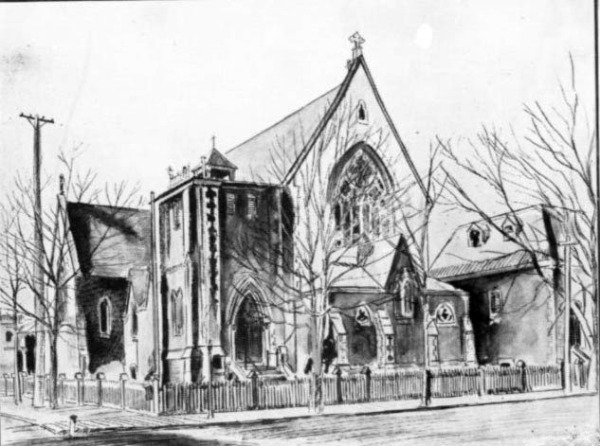
Robert Stanley Bagg and Clara Smithers were married in 1882 at St. Martin’s Anglican Church, on what was then the corner of Saint Urban and Bagg Streets. Bagg Street was later renamed Prince Arthur and the current Bagg Street is located several blocks further north. St. Martin’s never acquired a spire and it was eventually demolished. Image source: St. Martin’s Church, Historical Sketch of St. Martin’s Church : 1874-1902, Montreal, Canada, 1902?; Canadiana, https://www.canadiana.ca/view/oocihm.85997  Accessed June 14, 2023.

When Stanley announced his retirement as of January, 1901, his mother arranged to hire someone to succeed him, and she wrote Stanley a thank-you letter.3 She described her husband’s unexpected death as a calamity for the family, especially for Stanley who was “so young and inexperienced in the ways of the world.”  She commended him for the “able, honourable and efficient manner” in which he had performed his arduous duties for 27 years. She added, “I am most anxious that you should have a complete rest from all the worry and anxiety that is unavoidably connected with the responsible position you have occupied for such a long time – and while personally I shall greatly miss you, I hope that your absence and a complete change will allow you to regain your usual health and strength.”

One activity Stanley found helped to restore his health was travel, especially ocean voyages.  Perhaps he got the travel bug when he was 20 and spent a year exploring the highlights of Europe with his parents, his aunt and his sisters.

In 1875, Stanley visited England again with his mother and one of his sisters, and he returned to Europe with his new wife, Clara Smithers, on their two-month-long honeymoon in the summer of 1882.

In 1891, he and Clara spent an extended period of time in England, taking along their two young daughters. That year’s Census of England showed Stanley, Clara, the children, a governess and a cook staying in a lodging house in St. George Hanover Square, in central London. Ten years later, after his retirement, Stanley returned to Europe, this time touring for eight months.

While real estate management, legal training and travel seem to have been family traditions, so was military service. Stanley’s father had served in the military, and his grandfather had been a major in the 1st Battalion Loyal Volunteers during the Rebellion of 1837. His great-grandfather Phineas Bagg had served during the American Revolution ((1775-1783) before immigrating to Canada.

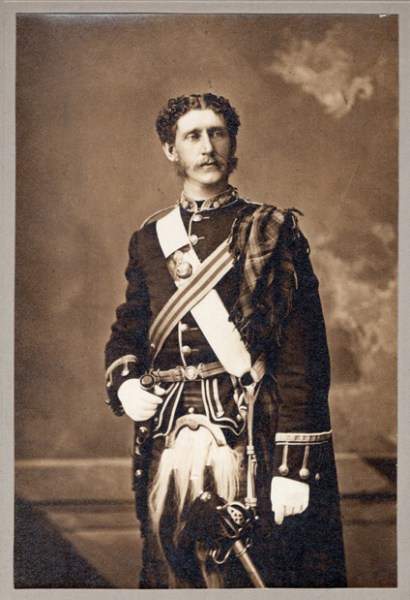
In 1877, the Canada Gazette reported that R. Stanley Bagg, gentleman, began his military service as an ensign with the 5th Battalion, Royal Fusiliers, Montreal. When he retired in 1882, he retained the rank of captain from what had become the Royal Scots Fusiliers. Although his military career was relatively short, it appears to have been a success. The Montreal Star quoted the following article about Stanley that had appeared in the paper 30 years earlier:4

“There are few better-known figures in Montreal than Captain Stanley Bagg. He was an enthusiastic volunteer and belonged to the old 5th Royals before and after they had become a kilted regiment. At the time of the ship labourers’ riots in Quebec, when several regiments of Montreal were sent to restore order and liberate the regular garrison, who were practically prisoners in the Citadel, the 5th Royal Scots were marched up Mountain Hill and the honour of leading them was conferred by the colonel of the regiment on Captain Bagg owing to his height and commanding presence. Captain Bagg has always been an ardent supporter of and participant in athletic sports. A good rider and one of the old Dowell school of boxers, he kept himself in such first-class condition that he can stand almost any fatigue.”

I had read the letter written by Stanley’s mother about his retirement many years ago, and it had left me with an image of my great-grandfather as a tired and anxious man. This newspaper article made me realize that he had indeed once been a strong leader and an good athlete.

This article is also posted on http://www.writinguptheancestors.ca
Footnotes:

1. “R. Stanley Bagg Died Yesterday,” The Gazette, July 23, 1912, p. 4, accessed June 9, 2024.

2. “38 Vict. cap. XCIV, assented to 23 February 1875”, Statutes of the Province of Quebec passed in the thirty-eighth year of the reign of Her Majesty Queen Victoria, part 1, p. 474, https://books.google.ca, accessed June 9, 2024.

3. Catharine Mitcheson Bagg, Correspondence, P070/B6.4, Bagg Family Fonds, McCord Stewart Museum, https://collections.musee-mccord-stewart.ca/en/objects/details/176488; classification scheme; personal documents; correspondence. Accessed June 14, 2024.

4. “From the Star Files 30 Years Ago Today” The Montreal Star, Sept. 17, 1909, p. 10, www.newspapers.com, accessed June 9, 2024.

See also:

Janice Hamilton, “Bagg Family Dispute part 1: Stanley Clark Bagg’s Estate”, Writing Up the Ancestors, Dec. 13, 2023, https://www.writinguptheancestors.ca/2023/12/bagg-family-dispute-part-1-stanley-clark-baggs-estate.html

Janice Hamilton, “The Bagg Family Dispute part 2”, Writing Up the Ancestors, Feb. 14, 2024, https://www.writinguptheancestors.ca/2024/02/the-bagg-family-dispute-part-2.html

Janice Hamilton, “Helen Frances Bagg: A Happy Exile”, Writing Up the Ancestors, Jan. 6, 2016, https://www.writinguptheancestors.ca/2016/01/helen-frances-bagg-happy-exile.html

Janice Hamilton, “Continental Notes for Public Circulation”, Writing Up the Ancestors, April 8, 2020, https://www.writinguptheancestors.ca/2020/04/continental-notes-for-public-circulation.html

Janice Hamilton, “Aunt Amelia’s Ledger”, Writing Up the Ancestors, April 26, 2023, https://www.writinguptheancestors.ca/2023/04/aunt-amelias-ledger.html

Clara Smithers Weds R. Stanley Bagg, Writing Up the Ancestors, March 2, 2014, https://www.writinguptheancestors.ca/2014/03/clara-smithers-weds-r-stanley-bagg.html

Janice Hamilton, “The Life and Times of Stanley Bagg, 1788-1853”, Writing Up the Ancestors, Oct. 5, 2016, https://www.writinguptheancestors.ca/2016/10/the-life-and-times-of-stanley-bagg-1788.html

The Bagg Family Dispute, part 2

In collaboration with Justin Bur

When my great-great grandfather Stanley Clark Bagg died in 1873, his wife and five children inherited large tracts of farmland on the island of Montreal, land that they made a family business of selling.1 But misunderstandings over who owned what and how to keep track of the income created a lot of difficulties. 

Stanley Clark Bagg (I usually refer to him as SCB to differentiate him from his father, Stanley Bagg, and his son, Robert Stanley Bagg,) had inherited most of this property from his grandfather John Clark (1767-1827).2 But there were conditions attached to some of these bequests: Clark’s 1825 will stated that land that comprised the Durham House property, and land comprising Mile End Farm, should pass down through three generations of descendants before it could be sold. The legal term for this, in civil law, is a substitution. However, a change in the law, passed in 1866, limited substitutions to two generations.3 That meant that the generation of Robert Stanley Bagg and his sisters Katharine, Amelia, Mary and Helen were the last generation affected by the substitutions and they could do what they liked with these properties.

The substitution clause referring to Durham House was part of the 1819 marriage contract between SCB’s parents, in which John Clark gave that property to his daughter as a wedding present.4 (It is shown in dark green on the map below.)

Robert Stanley Bagg, # II-57308.1, 1880, Notman & Sandham, McCord-Stewart Museum; Bagg family collection.

When SCB died at age 53, none of his family members was ready to manage these properties. His only son, Robert Stanley Bagg, or RSB, (1848-1912) had recently graduated in law, but he had no experience in renting or selling properties. Furthermore, neither the notary who completed the inventory of SCB’s estate in 1875,5 nor SCB’s widow, nor his children were aware of the substitutions. The Durham House and Mile End Farm properties were treated as though they were no different than the other properties belonging to the late SCB’s estate.

The 22-acre Durham House property (lots 19–28 and 101–115, cadastre of the Saint-Laurent ward) was located north of Sherbrooke Street, on the west side of today’s Saint-Laurent Boulevard. SCB had subdivided part of it and sold lots from it as early as 1846. In 1889, RSB, who was an executor of his father’s estate, subdivided the Upper Garden of Durham House (lot 19, Saint-Laurent ward) and began to sell those lots. He signed the property documents as “R. Stanley Bagg for the estate,” and his mother, Catharine Mitcheson Bagg, also signed.

But the Durham House property actually belonged jointly to the five Bagg siblings. It was not part of SCB’s estate, and his widow could not inherit this land, sell lots from it or acquire income from it. Yet that is what she did: the name Dame Catharine Mitcheson, widow of Stanley Clark Bagg, appeared on five deeds of sale in 1889.  

It is not clear who discovered the error, but perhaps someone close to the Bagg family took a good look at the property documents and noticed these details. SCB’s middle daughter, Amelia Bagg, was to marry Joseph Mulholland the following year, and he worked as a real estate agent for the Stanley Clark Bagg Estate. Also, Joseph’s brother-in-law, John Murray Smith, was about to purchase several of the Durham House lots. Any one of these people could have discovered the marriage contract and John Clark’s will, which SCB had registered at the provincial land registry office.6

This map shows details of several of the late Stanley Clark Bagg’s properties in 1875, when an inventory was made of his estate. Durham House and its upper garden, as well as a small part of the Mile End Farm and SCB’s home, Fairmount Villa, are overlaid over a modern map of the island of Montreal. Mile End Lodge had been John Clark’s home. At that time, the densely populated part of Montreal was south of Sherbrooke Street. Mount Royal Park, opened in 1876, is on the left. Map created by Justin Bur, based on two open data sources: physical geography from CanVec, Natural Resources Canada and modern streets from Geobase, City of Montreal.

As soon as they became aware of the situation, the Bagg siblings tried to remedy it with a notarized document called a Ratification.7 It said that, as the actual owners, they ratified and approved the five sales made by their mother. A few weeks later, in January and April of 1890, the Bagg siblings sold five lots to John Murray Smith and four to James Baxter, and this time, the vendors named in the deeds were correct.

Next, Catharine and her five children took a step to sort out the income from lots from the Durham House property that SCB had sold in his lifetime. They did not involve a notary, but tried to look after the issue as a family, signing a document called an Indenture on May 12, 1890.8

The indenture stated that neither Catharine nor her children had known about the marriage contract until December, 1889. The Bagg children (by now all were adults) declared the love and affection they had for their mother and their desire to settle the matter amicably, and released her from all claims and demands. For her part, Catharine agreed to repay to her children the capital sums she had received from the sale of these properties. Because she had paid taxes and expenses on them, the children made no claim for the interest payments she had received.

Action Demanded

No doubt confident that everything had been resolved, RSB took his wife and two young daughters on an extended trip to England, leaving his mother and sisters to handle offers for land sales during his absence. After his return, however, the family dispute blew up once more, this time over the Mile End Farm property. Two of the married sisters, Katharine Sophia Mills and Mary Heloise Lindsay, hired a notary to represent their interests.

Notary Henry Fry sent a complaint on their behalf to the three living executors of SCB’s will — Catharine Mitcheson Bagg, Robert Stanley Bagg and notary J.E.O. Labadie – demanding immediate action. Dated July 22, 1891 and titled Signification and Demand,9   this document stated that the executors of SCB’s will were bound, upon his death, to deliver over the Durham House and Mile End Farm properties to his children, and to produce an account of the administration of these properties.

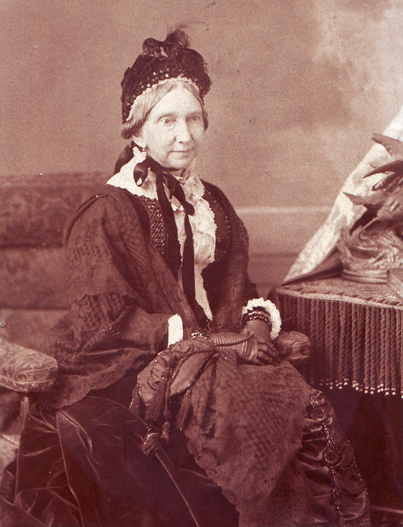
Catharine Mitcheson Bagg, #71147, 1883, William Notman & Son, McCord-Stewart Museum; Bagg family collection.

It stated that the executors “have wholly failed and neglected to render such account, but on the contrary, have, since the death of the said Stanley Clark Bagg, continued in possession of the said substituted property and have even sold and alienated portions thereof and have received the consideration money of such sales and have received and retained the entire revenues therefrom and that although they have been recently requested to render such account, the said executors have neglected and refused to do so.”

The executors had until August 10 to provide an account of the property belonging to the substitutions. They must have met this demand because no further complaints have turned up. Furthermore, the Bagg siblings seem to have found a better solution to their dilemma: they partitioned the Durham House property and sold a large chunk of the Mile End Farm.

In September 1891, the remaining unsold lots of the Durham House property were grouped into five batches, and the five siblings pulled numbers out of a hat to determine who got which ones.10 They could then sell these lots, or keep them, as they pleased.

Two months later, the five siblings sold 145 arpents of land, including most of the Mile End Farm and a section of the adjoining Black Gate Farm, to Clarence James McCuaig and Rienzi Athel Mainwaring,11 These Toronto land developers had plans to develop an exclusive housing development they called Montreal Annex in the area.12

As for keeping track of property sales, Amelia, the middle Bagg sibling who was now married to Joseph Mulholland, took on that responsibility. Starting in 1892, she kept a ledger in which she wrote down the dates, names of purchasers and prices paid for each of the lots that were part of the Mile End Farm and Durham House properties.13

This article is also posted on my personal family history blog, www.writinguptheancestors.ca

See also:

Janice Hamilton, “Bagg Family Dispute Part 1: Stanley Clark Bagg’s Estate”, Writing Up the Ancestors, Dec. 13, 2023, https://www.writinguptheancestors.ca/2023/12/bagg-family-dispute-part-1-stanley-clark-baggs-estate.html

Janice Hamilton, “Aunt Amelia’s Ledger” Writing Up the Ancestors, April 26, 2023,  https://www.writinguptheancestors.ca/2023/04/aunt-amelias-ledger.html

Janice Hamilton, “Stanley Clark Bagg’s Family”, Writing Up the Ancestors, Feb. 29, 2020,  https://www.writinguptheancestors.ca/2020/02/stanley-clark-baggs-family.html

Janice Hamilton, “My Great-Great Aunts, Montreal Real-Estate Developers”, Writing Up the Ancestors, October 11, 2017, https://www.writinguptheancestors.ca/2017/10/my-great-great-great-aunts-montreal.html

Janice Hamilton, “A Home Well Lived In”, Writing Up the Ancestors, Jan. 21, 2014, https://www.writinguptheancestors.ca/2014/01/a-home-well-lived-in.html

Notes:

The Indenture, the Deed of Ratification and several other documents mentioned in this article were donated to the archives of the McCord Stewart Museum in Montreal around 1975 by my cousin.

This article was written in collaboration with urban historian Justin Bur. Justin has done a great deal of historical research on the Mile End neighbourhood of Montreal (around Saint-Laurent Blvd. and Mount Royal Ave.) and is a longtime member of the Mile End Memories/Memoire du Mile-End community history group (http://memoire.mile-end.qc.ca/en/). He is one of the authors of Dictionnaire historique du Plateau Mont-Royal (Montreal, Éditions Écosociété, 2017), along with Yves Desjardins, Jean-Claude Robert, Bernard Vallée and Joshua Wolfe. His most recent article about the Bagg family is La famille Bagg et le Mile End, published in Bulletin de la Société d’histoire du Plateau-Mont-Royal, Vol. 18, no. 3, Automne 2023.

Sources:

  1. Stanley Clark Bagg will, J.A. Labadie, n.p. no 15635, 7 July 1866
  2. John Clark will, Henry Griffin, n.p. no 5989, 29 August 1825
  3. In 1866 the government of Lower Canada enacted the Civil Code. This was a compilation and revision of the civil law inherited from the French regime; article 932 of the code put a two-generation limit on substitutions.
  4. Marriage contract between Stanley Bagg and Mary Ann Clark, N.B. Doucet, n.p. no 6489, 5 August 1819
  5. Stanley Clark Bagg inventory, J.A. Labadie, n.p. no 16733, 7 June 1875
  6. John Clark’s will and the marriage contract between Stanley Bagg and Mary Ann Clark are still publicly available at the Registre foncier du Québec. John Clark’s will had been transcribed there in 1844 (Montréal ancien #4752). The marriage contract (Montréal Ouest #66032) was transcribed in 1872. SCB’s will was transcribed into the register (Montréal Ouest #74545) in 1873.
  7. Deed of Ratification, Adolphe Labadie, n.p. no 2063, December 12, 1889, register Montreal Est #25109, McCord Stewart Museum (P070/66,3) This notary was a son of notary J.E.O. Labadie, who was an executor of the will, and grandson of notary J.A. Labadie, who had handled SCB’s will and the inventory of his estate.
  8. Indenture, May 12, 1890, McCord Stewart Museum (P070/B6,3).
  9. Signification and Demand, Henry Fry, n.p. no. 2234, 22 July 1891, McCord Stewart Museum (P070/B6,3).
  10. Deed of Partition, John Fair, n.p no 3100, Sept. 10, 1891, register Montreal Est #29503, McCord Stewart Museum (P070/B8,4).
  11. Deed of Sale, William de Montmollin Marler, n.p. #17571, 20 November, 1891, register Hochelaga-Jacques-Cartier #40225
  12. Justin Bur, Yves Desjardins, Jean-Claude Robert, Bernard Vallée, Joshua Wolfe, Dictionnaire historique du Plateau Mont-Royal (Montreal, Éditions Écosociété, 2017), p 271.
  13. Amelia Josephine Bagg Mulholland, Grand livre, 1891-1927, McCord Museum, Fonds Bagg, P070/B07,1. https://collections.musee-mccord-stewart.ca/en/objects/293626/a-j-mulholland-ledger (accessed April 3, 2023)

The Bagg Family Dispute, part 1: Stanley Clark Bagg’s Estate

Written by Janice Hamilton, with research by Justin Bur

Note: there were three generations named Stanley Bagg, so for the sake of brevity I use their initials: SCB for generation two, Stanley Clark Bagg, and RSB for generation three, Robert Stanley Bagg.

   Be careful what you wish for, especially when it comes to writing a will and placing conditions on how your descendants are to use their inheritance. That was a lesson my ancestors learned the hard way.

It took a special piece of provincial legislation in 1875 and what appears to have been a family crisis before these issues were finally resolved many years later. 

The estate at the heart of these problems was that of the late Stanley Clark Bagg (1820-1873), or SCB. He had owned extensive properties on the Island of Montreal. Several adjacent farms, including Mile End Farm and Clark Cottage Farm, stretched from around Sherbrooke Street, along the west side of Saint Lawrence Street (now Saint-Laurent Boulevard), while three other farms extended along the old country road, north to the Rivière des Prairies. SCB had inherited most of this land from his grandfather John Clark (1767-1827).  Although he trained as a notary, SCB did not practise this profession for long, but made a living renting and selling these and other smaller properties.  

This map shows the extent of the late Stanley Clark Bagg’s properties, shaded in beige, in 1875, when an inventory was made of his estate. These properties are overlaid over a modern map of the island of Montreal. At that time, the actual city of Montreal was south of Sherbrooke Street, extending down to the banks of the Saint Lawrence River. The slope of Mount Royal is just west of the SCB estate. Map created by Justin Bur, based on two open data sources: physical geography from CanVec, Natural Resources Canada and modern streets from Geobase, City of Montreal.

At age 52, SCB suddenly died of typhoid. In his will, written in 1866, he named his wife, Catharine Mitcheson Bagg (1822-1914), as the main beneficiary of his estate, to use and enjoy for her lifetime, and then pass it on to their descendants. He also made her an executor, along with his son Robert Stanley Bagg (RSB, 1848-1912). There were two other executors: Montreal notary J.E.O. Labadie and his wife’s brother, Philadelphia lawyer McGregor J. Mitcheson.

But SCB’s estate was large and complicated, and no one was prepared to handle it. RSB had recently graduated in law from McGill and was continuing his studies in Europe at the time of his father’s death. As for Catharine, she became involved in decisions regarding property sales over the years, but she must have felt overwhelmed at first.

Notary J.A. Labadie spent two years doing an inventory of all of SCB’s properties, listing where they were located, their boundaries, and when and from whom they had been acquired, but he did not mention two key documents. One of these was the marriage contract between SCB’s parents, the other was John Clark’s will.

John Clark, a butcher, was born in County Durham, England and came to Montreal around 1797. Bagg family collection.

In the marriage contract, John Clark gave a wedding present to his daughter, Mary Ann Clark (1795-1835), and her husband, Stanley Bagg (1788-1853): a stone house and about 22 acres of land on Saint Lawrence Street. Clark named the property Durham House. But it was not a straight donation; it was a substitution, similar to a trust, to benefit three generations: Mary Ann’s and Stanley’s child (SCB), grandchildren (RSB and his four sisters) and the great-grandchildren. Each intervening generation was to have the use and income from the property, and was responsible for transmitting it to the next generation. That meant SCB could not bequeath it in his will because his children automatically gained possession, and so on, with the final recipients being the great-grandchildren.

In his 1825 will, Clark had made an even more restrictive condition regarding the Mile End Farm. This time the substitution was intended to be perpetual “unto the said Mary Ann Clark and unto her said heirs, issue of her said marriage and to their lawful heirs entailed forever.”

Perhaps Clark imposed these conditions on his descendants for sentimental reasons. Durham House was his daughter’s family home, and Stanley Bagg had probably courted Mary Ann on the Mile End Farm while he was running a tavern there with his father. Or maybe Clark simply believed that these provisions would give the best financial protection to his future descendants. SCB must have thought this was a good idea because his will also included a substitution of three generations.

Clark and SCB did not foresee, however, that the laws regarding inheritances would change. In fact, the provincial government changed the law regarding substitutions a few months after SCB wrote his will. This new law limited substitutions to two generations. Meanwhile, when SCB died in 1873, no one seems to have remembered that the substituted legacies Clark had created even existed. 

Stanley Clark Bagg, Montreal, QC, 1863, William Notman, McCord Stewart Museum #1-5660.1

Real estate sales practices also changed over the years. Clark had written a codicil specifying that any lot sales from the Mile End Lodge property, where he and his wife lived and which he left to her, were subject to a rente constituée. The buyer paid the vendor an amount once a year (usually 6% of the redemption value), but it was like a mortgage that could never be paid off. In the early 1800s this had been a common practice in Quebec, designed to provide funds to the seller’s family members for several generations.

SCB similarly stipulated that nothing on the Durham House property could be sold outright, but only by rente constituée. By the time he died, some of the properties located near the city outskirts were becoming attractive to speculators and to people wanting to build houses or businesses, but the inconvenience of a rente constituée was discouraging sales. It became clear that the executors had to resolve the issue.

They asked the provincial legislature to pass a special law. On February 23, 1875, the legislature assented to “An Act to authorize the Executors of the will of Stanley C. Bagg, Esq., late of the City of Montreal, to sell, exchange, alienate and convey certain Real Estate, charged with substitution in said will, and to invest the proceeds thereof.” (According to the Quebec Official Gazette, this was one of about 100 acts that received royal assent that day after having been passed in the legislative session to incorporate various companies and organizations, approve personal name changes, amend articles in the municipal and civil codes, etc.)

This act allowed the executors of the SCB estate, after obtaining authorization from a judge of the superior court, and in consultation with the curator to the substitution, to sell land outright, provided that the proceeds were reinvested in real estate or mortgages for the benefit of the estate. In other words, the rente constituée was no longer required, and sales previously made by the estate were considered valid.

No more changes were made until 1889, when family members realized that part of SCB’s property actually belonged to his children, and not to his estate, and a family dispute erupted. The story of how they resolved this issue and remained on good terms will be posted soon.

This article is also posted on my personal family history blog, http://www.writinguptheancestors.ca
Notes and Sources:

I could not have written this article without the help of urban historian Justin Bur. Justin has done a great deal of historical research on the Mile End neighbourhood of Montreal (around Saint-Laurent Blvd. and Mount Royal Ave.) and is a longtime member of the Mile End Memories/Memoire du Mile-End community history group (http://memoire.mile-end.qc.ca/en/). He is one of the authors of Dictionnaire historique du Plateau Mont-Royal (Montreal, Éditions Écosociété, 2017), along with Yves Desjardins, Jean-Claude Robert, Bernard Vallée and Joshua Wolfe. His most recent article about the Bagg family is La famille Bagg et le Mile End, published in Bulletin de la Société d’histoire du Plateau-Mont-Royal, Vol. 18, no. 3, Automne 2023.

Documents referenced:

Mile End Tavern lease, Jonathan Abraham Gray, n.p. no 2874, 17 October 1810

Marriage contract between Stanley Bagg and Mary Ann Clark, N.B. Doucet, n.p. no 6489, 5 August 1819/ reg. Montreal (Ouest) 66032

John Clark will, Henry Griffin, n.p. no 5989, 29 August 1825

Stanley Clark Bagg will, J.A. Labadie, n.p. no 15635, 7 July 1866

Stanley Clark Bagg inventory, J.A. Labadie, n.p. no 16733, 7 June 1875

Quebec legislation: 38 Vict. cap. XCIV, assented to 23 February 1875

See also:

Janice Hamilton, “Stanley Clark Bagg’s Early Years,” Writing Up the Ancestors, Jan. 8, 2020, https://www.writinguptheancestors.ca/2020/01/stanley-clark-baggs-early-years.html

Janice Hamilton, “John Clark, 19th Century Real Estate Visionary,” Writing Up the Ancestors,   May 22, 2019, https://www.writinguptheancestors.ca/2019/05/john-clark-19th-century-real-estate.html

A Montreal Landmark

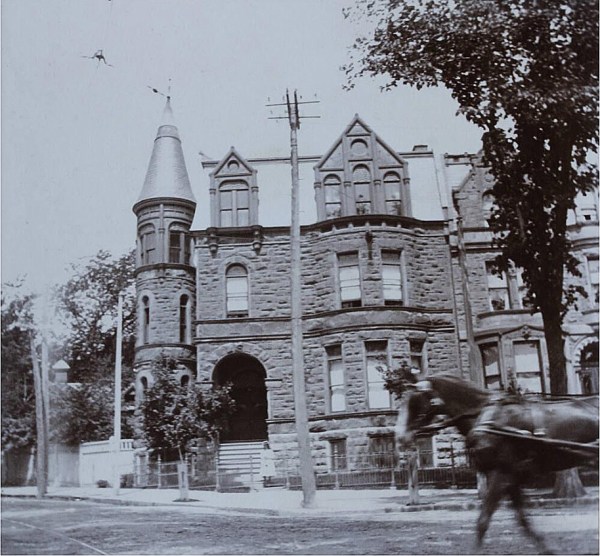
The Robert Stanley Bagg home at the corner of Sherbrooke Street West and Cote-des-Neiges. My grandmother, Gwen Bagg, took this photo in 1903 and it is now in the possession of the McCord Museum.

The old house at the corner of Sherbrooke Street West and Cote des Neiges in downtown Montreal pops up regularly on the internet sites devoted to historical photos of the city, but often the information that accompanies those photos is incorrect. Frequently, people erroneously identify the owner as Montreal landowner Stanley Clark Bagg (1820-1873). In fact, the house belonged to his son, Robert Stanley Clark Bagg (1848-1912).

The building is prominently located on the corner of Sherbrooke Street West and Côte-des-Neiges, which leads up the hill toward Mount Royal. Thousands of people pass by daily, and it is hard not to notice the four-story red sandstone building with its pink tiled top floor.

It has gone through several reincarnations over the years. When it was built in 1891, it formed the south-west anchor of the Golden Square Mile, the neighbourhood where Canada’s wealthiest businessmen, manufacturers and bankers lived. Today it is a commercial building, surrounded by other small businesses and medical offices.

The original owner, R. Stanley Bagg (I will refer to him as RSB), grew up in a house called Fairmount Villa that was at the corner of Sherbrooke Street and Saint-Urbain. His father, Stanley Clark Bagg (SCB), was one of the largest landowners on the Island of Montreal, having inherited several adjoining farm properties along St. Laurent Boulevard from his grandfather, John Clark.

RSB studied law at McGill University and went abroad to continue his studies after graduation, but when his father died of typhoid in 1873, RSB came home. He practised law in Montreal for a short time, but quit to manage the properties belonging to his father’s estate, a position he held until 1901.

He married Clara Smithers (1861-1946) in 1882, and for several years the couple lived just around the corner from Fairmount Villa, where RSB’s mother still resided. Eventually they decided to build a new house in a more fashionable part of the city. When they moved, they had two daughters, Evelyn (1883-1970) and Gwendolyn (1886-1963)—my future grandmother. Their only son, Harold Stanley Fortescue Bagg (1895-1945), was born a few years after the move.

Many houses in Montreal were built of locally quarried grey limestone because it was abundant and cheap, but RSB chose red sandstone, probably imported from Scotland. Originally designed by architect William McLea Walbank, the house was renovated twice in the eleven years RSB lived there, with a major addition constructed in 1902 and other changes in 1906.

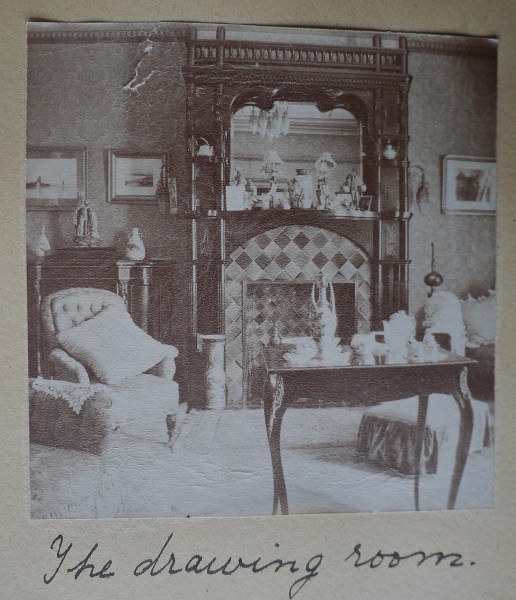
It was a large, even for a family of five, but the Baggs employed at least two live-in domestic servants—a cook and a maid—and perhaps a man to do the heavier chores. The interior was ornately furnished, as shown in photos my grandmother took of the drawing room, with a carved mantlepiece over the fireplace, heavy floor-to-ceiling drapes, and pillows and knickknacks everywhere. She also took photos of the interior of the tower on the Côte-des-Neiges side of the building. It must have been a sunny spot for reading and a good place to watch people struggle up the hill during a snowstorm.

The drawing room (living room) of the house was ornate. This is another photo from my grandmother’s 1903 album, now at the McCord Museum.

RSB died of cancer while on vacation in Kennebunkport, Maine in 1912. Clara (who was usually identified as Mrs. Stanley Bagg) divided the house into two apartments and continued to live there until her death, at age 85, in 1946.

After she died the house was sold and renovated, with a new entrance facing Côte-des- Neiges, and Barclay’s Bank (Canada) moved in. Many of Montreal’s elite families became customers of this British-based institution. In 1956 the Imperial Bank of Canada took over Barclay’s (Canada) and five years later, it became the Canadian Imperial Bank of Canada (CIBC). In 1979 CIBC decided it could no longer upgrade the old Bagg building to the modern requirements of banking and it moved its customers to a branch down the street at the Ritz Carlton Hotel.

For the next few years, the building was home to a jazz bar on the main floor and a bookstore upstairs, until a fire destroyed the interior in 1982. It may have been that fire that destroyed the cone-shaped roof of the tower. Many years earlier, my mother noticed that a stained-glass window displaying the Bagg family crest had disappeared.

The building was restored in 1985-86 and two art galleries moved in, but the interior featured bare brick walls, a style that was popular at the time in some older parts of the city, but was not appropriate for this Victorian-era building. An oriental carpet store rented the main floor in the mid-1990s.

Today, Adrenaline Montreal Body Piercing and Tattoos has been located there for many years. I suspect my great-grandparents would not be impressed.

Note: Lovell’s Directory of Montreal shows the address of this building changed several times over the years. It was at 1129 Sherbrooke in 1894-97, and 739 Sherbrooke W. in 1908-1910. The attached house, on the right, had a separate address – 737 Sherbrooke West—and belonged to another family. The Bagg house had been divided into apartments 1 and 2 at 739 Sherbrooke W. by 1927-28, and the address had changed to 1541 Sherbrooke W. apartments 1 and 2 by 1935-36.

Sources:

Edgar Andrew Collard, “A sandstone house on Sherbrooke St.”, The Gazette, October 20, 1984.

Répertoire d’architecture traditionnelle sur le territoire de la communauté urbaine de Montréal. Les residences. Communauté urbaine de Montréal, Service de la planification du territoire, 1987.

Charles Lazarus, “Farewell to Landmark”, The Montreal Star, April 30, 1979.

This article is simultaneously posted on my family history blog, https://writinguptheancestors.ca.

A Montreal Stockbroker…and much more

Montreal, Quebec, was booming early in the 20th century just before World War I (1914-1919).

During this time, immigration surged setting new records and the population of Montreal grew to half a million people. Skilled workers from England found employment in the city’s factories and European immigrants, especially Jews fleeing persecution, made up the biggest group. Local people were also migrating from rural areas attracted by the city’s remarkable economic growth and the available opportunities.

Montreal offered all these people hope of a better life.

Canada’s first stock exchange, The Montreal Stock Exchange founded in 1832, grew to prestigious levels during this time of great expansion. In 1910, the total number of trades was more than double that of The Toronto Stock Exchange. This growth led to the merger of several small companies creating larger corporations which in turn traded their shares1 on the Exchange.

Montreal_Stock_Exchange_1903
The Montreal Stock Exchange 1903

My great grandfather, Robert Lindsay (1855-1931), was a stockbroker during this exciting and prosperous period of Montreal history. Robert was the son of the successful banker, Robert A. Lindsay (Bank of Montreal), as well as the nephew of the prominent politician, William Burns Lindsay. Wisely, he left banking and politics to his elders and forged his own career in finance.

Robert Lindsay
Robert Lindsay – Montreal Stock Broker 1881

Robert was born in Montreal in 1855, the oldest of four children, three boys plus a girl who died in infancy. His mother, Henrietta Dyde, passed away in 1864, ten weeks after her baby daughter died. Robert was only nine years old at the time. His father remarried two years later and he and his new wife, Charlotte Anne Vennor, had six more children.

Mary Heloise Bagg, one of the daughters of Stanley Clark Bagg and Catherine Mitcheson, became his bride in 1881. The Baggs, a prominent Montreal family with real estate interests, welcomed their first stockbroker into the family.

Robert and Mary Heloise Wedding day
Mr and Mrs Robert Lindsay -1881

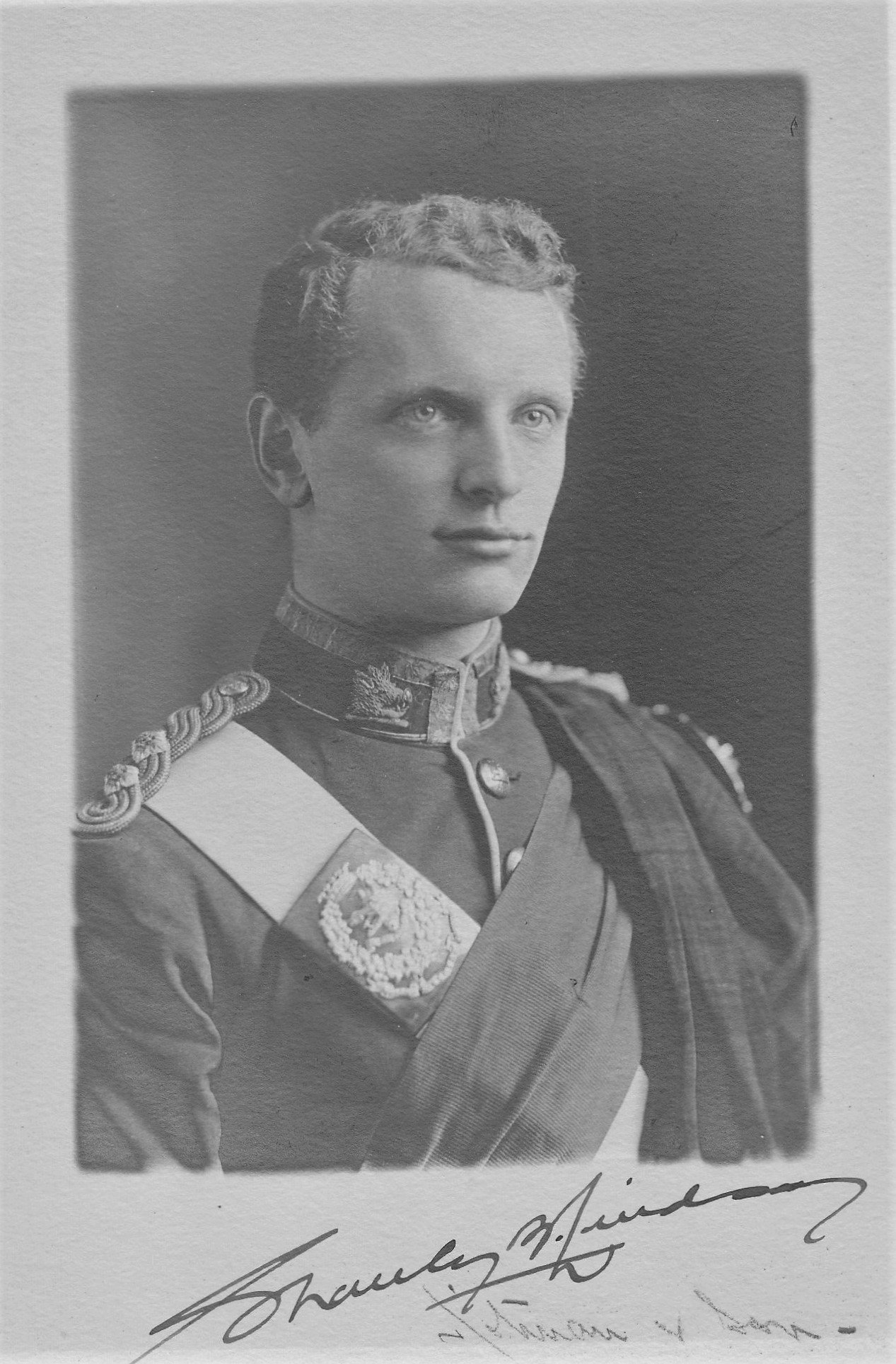
Robert retired in 1906 from his long and successful career as a stockbroker at the age of 51. In 1914, during one of his periodic trips to England, he arrived just days before the outbreak of WW1. His son, Stanley (1889-1963), had enlisted as a lieutenant2 with the Royal Highlanders of Canada so Robert decided to take up residence with the rest of his family.

He joined forces with Canadian philanthropist Lady Drummond and Lady Perley as founders of the first of The King George and Queen Mary Maple Leaf Clubs3. Several sizeable London homes were donated and refurbished to provide for the welfare of Canadian Expeditionary Force (CEF) soldiers on leave from the front. The safe well organized environment provided lodgings, meals, recreational activities, up-to-date military information and even savings accounts for the soldiers thus preventing drinking, idleness and any opportunity to pursue “morally questionable activities”. London became their “home away from home” where they could recover from trench life, boost their morale and heal physically and mentally before returning to the front.

Three years later, in 1917, Robert’s ill health led to his withdrawal as the Treasurer-Secretary and his return home to Montreal. “The committee and workers of “The Maple Leaf Clubs” greatly regretted his departure… As a souvenir of his services, they presented him with a massive silver cigar box…”4

Robert’s son became “Captain” Stanley Lindsay and survived the Second Battle of Ypres (and the first German gas attack). Eventually he recovered his health and also returned home to Montreal in 1919.

Stanley Bagg Lindsay
Captain Stanley Lindsay 13th Battalion Royal Highlanders of Canada

Once home again, Robert and his wife committed their lives to helping others. He was a member of the Anglican Church, a life governor on the board of three main hospitals as well as the Church Home (for the elderly) and a member of The Mount Royal Club.

One such commitment catered to his great interest in art. Robert had been active in the Art Association of Montreal (now the Montreal Museum of Fine Arts) since his retirement from the financial world. He was honorary president at the time of his death and had previously held executive positions for many years.

His obituary remembered him as “a kindly man of retiring nature… a supporter of many charity campaigns, and who preferred to remain anonymous in all his undertakings”5.

Edited by author 2020-07-13

1“Shares are units of ownership interest in a corporation or financial asset that provide equal distribution in any profits, if any are declared, in the form of a dividend”. Www.Investopedia.com as seen 2020-07-13

2Stanley B. Lindsay worked his way up to Captain with the 13th Battalion of the Royal Highlanders of Canada

4Maple Leaf Clubs Lose Treasurer, Mr. Robt Lindsay Back From England After Four Years’ Absence – Friend of Soldiers – Newspaper article -August 7, 1917.

5Robert Lindsay is claimed by death in his 77th year, Newspaper Obituary, June 5, 1931.

A Visit to the Old Burying Ground of Westfield, MA

I have always been fascinated by the carved images found on early American gravestones. Imagine how thrilling it was to discover that this kind of tombstone marked the final resting place of one of my colonial New England ancestors in Westfield, Massachusetts. I found it when I visited Westfield’s Old Burying Ground a few years ago, en route to the New England Regional Genealogical Conference which was being held in nearby Springfield.

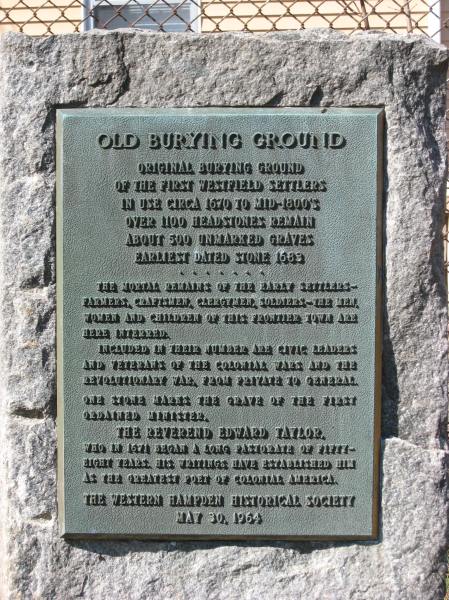
Westfield was founded in 1669. The oldest known gravestone in the burying ground is that of Abigail Noble, who died in 1683. Childbirth, consumption, dysentery, smallpox and accidents were common causes of death, but a surprisingly large number of those interred here lived to more than 80 years of age.

IMG_8808Among the more than 1100 gravestones and several hundred more unmarked graves in this cemetery, I was looking for the resting places of three of my direct ancestors: my six-times great-grandfather Daniel Bagg, his father-in-law, Isaac Phelps, and his son’s father-in-law, Consider Moseley. I found them in the southeast section of the cemetery where many of the oldest plots are located.1
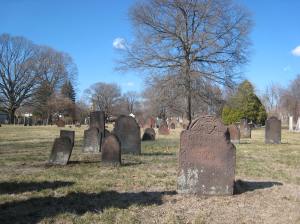
My first stop was the Athenaeum (the public library) to pick up the key to the cemetery. From there, it was a short walk to what is known as the Mechanic Street Cemetery. Set back from street between two houses, the wrought iron gate was a bit hard to find, but once I entered the cemetery, I was amazed at how large it is, and how well cared for. This old burying ground, which is included in the U.S. National List of Historic Places, was carefully weeded and mowed, protected by a fence and shaded by mature trees. The historic tombstones have been cleaned over the years, and local citizens are trying to find the funds to better preserve them..2

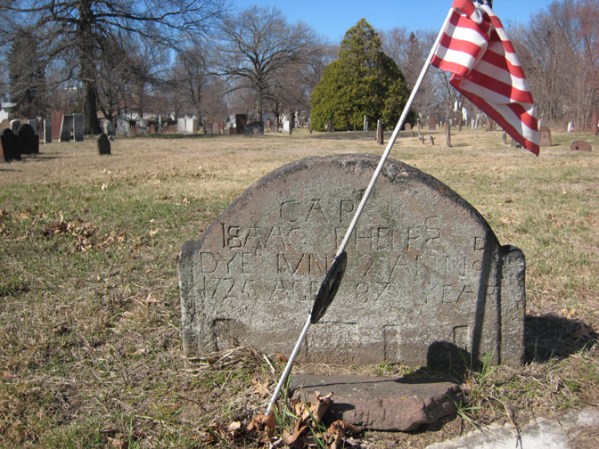
capt Isaac Phelps d 1725 age 87

The grave of Captain Isaac Phelps (1638-1725) was easiest to find because there was a small American flag next to it. Carved in capital letters on his gravestone are, the words, “Capt. Isaac Phelps Anno 1725  age 87 year.” Westfield lay at the western edge of the Massachusetts Bay Colony and the tiny settlement was vulnerable to attack from American Indians, so Isaac probably played a role in protecting the community, and a military title to acknowledge that contribution.

Born in Windsor, Connecticut to George Phelps and Philura Randall, Isaac Phelps married Ann Gaylord around 1663 and moved his family to Westfield around 1670. Isaac carried out many civic duties in Westfield over the years: he was town clerk, assessor, surveyor, town treasurer and schoolmaster.3

Isaac and Ann had 11 children, four of whom died young.4 He and Ann were my seven-times times great-grandparents through daughter Hannah, who married Daniel Bagg (1668-1738).

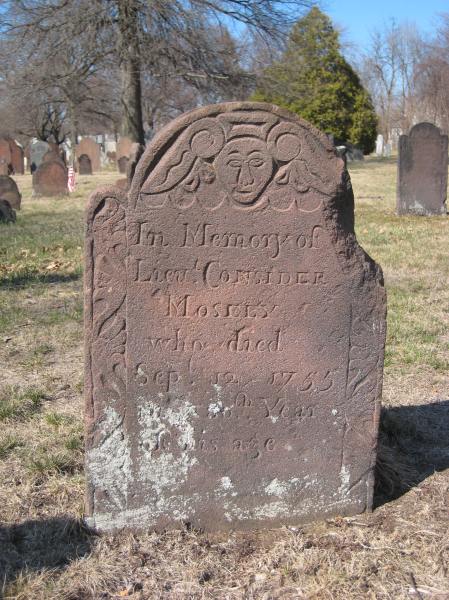
Consider MoseleyLieut. Consider Moseley’s red sandstone tombstone, with a carved face, crown and wings symbolizing everlasting life, was close to Isaac’s.5 Consider (1675-1755) was the fifth of 10 children of John Maudsley (the name was spelled various ways) and Mary Newberry. The Maudsley/Moseley family moved from Windsor to Westfield around the time of Consider’s birth. In 1709, when Consider was 34 years old, he married Elizabeth Bancroft. They had eight children, including twins Elizabeth and Daniel, born in 1714. After his first wife died, Consider married widow Rebecca Dewey. His daughter Elizabeth married David Bagg, the son of Daniel Bagg and Hannah Phelps, in 1739.
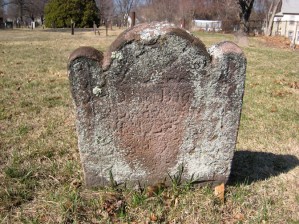
According to a history of Westfield, Lieut. Consider Moseley was “one of the wealthiest and most influential men of the town,” however, I have found few details of his life.6 He died on Sept. 12, 1755, age 80.

possibly Daniel Bagg

The grave of Daniel Bagg was more difficult to identify. The stone that I suspect marks his grave is almost illegible. The other problem is that there are three individuals named Daniel Bagg buried in this cemetery. The Daniel Bagg I was seeking was the son of John Bagg and Hannah Burt of Springfield. Many of Springfield’s younger residents moved to Westfield. Daniel became a farmer in the Little River area of Westfield. He and his wife Hannah Phelps had 10 children, and their son David and his wife Elizabeth Moseley were my direct ancestors.

Consider Moseley 3

Ann Gaylord, Elizabeth Bancroft, Hannah Phelps and Elizabeth Moseley are also likely buried in the Old Burying Ground, but their graves are not marked.

All photos by Janice Hamilton

This article is also posted on https://writinguptheancestors.blogspot.ca

Sources:

  1. Old Burying Ground Mechanic Street Cemetery. http://www.cityofwestfield.org/DocumentCenter/View/419a, accessed March 11, 2018. (The name Bagg is misspelled Back in this 1995 inventory.)
  2. Dan Warner. “After 350 Years, Old Burying Ground in need to a fix-up in Westfield.” Masslive.com, June 27, 2014, http://www.masslive.com/news/index.ssf/2014/06/after_350_years_old_burying_gr.html, accessed March 11, 2018.
  3. Oliver Seymour Phelps and Andrew T. Servin, compilers. The Phelps Family of America and their English Ancestors, with copies of wills, deeds, letters and other interesting papers, coats of arms and valuable records. Vol. II, Pittsfield, MA: Eagle Publishing Company, 1899, p. 1269.
  4. Henry R. Stiles. The History of Ancient Windsor, Vol. II, a facsimile of the 1892 edition, Somersworth: New Hampshire Publishing Co., 1976. p. 509.
  5. Bob Clark, Stories Carved in Stone: Westfield, Massachusetts, West Springfield, Dog Pond Press, 2008.
  6. Rev. John H. Lockwood. Westfield and its Historic Influences, 1669-1919: the life of an early town. Springfield, MA, printed and sold by the author, 1922, p. 384. https://archive.org/stream/westfieldandits00lockgoog#page/n413/mode/2up, accessed March 23, 2018.

Part of the Bagg Family Fonds Now Online

Many people have old family treasures such as letters and albums in the attic. In my family, a collection of 200-year-old business records made their way from the attic to a Montreal museum, and now some them have been digitized and placed online for everyone to explore. Part of the Bagg Family Fonds housed at the McCord Museum, these newly digitized images include records from the store where the workmen who built the Lachine Canal in the early 1820s bought their bread and rum.

The project to digitize these and other documents was financed by Library and Archives Canada to mark the 150th anniversary of Canadian Confederation and Montreal’s 375th anniversary. The McCord Museum in Montreal is posting some 75 000 images from its collection of textual archives to its website (http://collections.musee-mccord.qc.ca/en/keys/collections/).

The website provides an introduction to the Bagg family and to the scope of the Bagg Family Fonds (P70): http://collections.musee-mccord.qc.ca/scripts/explore.php?Lang=1&tableid=18&tablename=fond&elementid=31__true.  At the bottom of this page are links to four sets of digitized documents: the Laprairie Brewery (1821-1832), the workmen’s store in Lachine (1822-1823), a child’s scrapbook and a young woman’s autograph book that probably dates from around the turn of the century.

My three-times great-grandfather Stanley Bagg was one of the four main contractors in charge of building the Lachine Canal in Montreal in the 1820s. He also ran the store that supplied the workers with bread, tea, sugar, pork and occasionally fish, eggs and butter, although rum and beer seem to have been the most popular items. Some pages list the names of the customers, the items they purchased and the prices they were charged.

Other images record cash payments related to the canal construction, including planks, nails, wheelbarrows, hay (probably for the horses), blasting powder and wages for day labourers.

Another set of records is related to the brewery owned by Stanley’s brother, Abner Bagg. The LaPrairie Brewery account books list expenses such as barley, charcoal, transportation costs and wages. Both the store and the brewery records contain many names of suppliers and customers.

Both of these collections provide a window into life in Montreal some 200 years ago. For example, Quebec historian Donald Fyson used these records as a basis for his thesis, “Eating in the city [electronic resource]: diet and provisioning in early nineteenth-century Montreal” Montréal: McGill University, 1989. http://www.collectionscanada.ca/obj/thesescanada/vol1/QMM/TC-QMM-55597.pdf

No one really knows who had the foresight to save these records, or how they ended up at the McCord. According to one of my cousins, these account books were found in the basement of the Redpath Museum at McGill University, but no one knows who put them there in the first place. Clare Fellowes, daughter of Evelyn (Bagg) Davis, gave an additional gift of textual documents to the museum in 2002 and 2003.

Documents in the Bagg Family Fonds that have not been digitized includes copies of letters that Stanley and Abner wrote to each other and to business colleagues, and a ledger belonging to butcher John Clark, Stanley Bagg’s father-in-law. Documents related to another generation of the family date from the final decades of the 19th century when the Baggs were property owners and real estate developers. This includes a ledger showing property sales, and letters between the Bagg siblings as they discussed and sometimes disagreed about business decisions. There are also personal documents such as a list of wedding presents, recipes and several albums of family photos, taken in the early 1900s by my grandmother, Gwendolyn Bagg. More recently, the late Joan Shackell, a descendant of Abner Bagg, donated a number of items related to her line of the family.

Members of the public can visit the archives at the McCord Museum to consult the Bagg Family Fonds and other collections, but they must make an appointment weeks in advance. It is encouraging to see that some of these documents are now available online.

(This article is also posted on http://writinguptheancestors.blogspot.ca)

See also

Janice Hamilton, “Abner Bagg, Black Sheep of the Family?” Writing Up the Ancestors, April 9, 2015, http://writinguptheancestors.blogspot.ca/2015/04/abner-bagg-black-sheep-of-family.html

Janice Hamilton, “Stanley Bagg and the Lachine Canal, Part 2: Rocks and Water,” Writing Up the Ancestors, March 13, 2015, http://writinguptheancestors.blogspot.ca/2015/03/stanley-bagg-and-lachine-canal-part-2.html