It constantly amazes me how technology can influence where people live.
When I was examining the lives of my great great grandparents and their predecessors on my fathers’ side for instance, I noticed that their moves usually followed easier travelling circumstances.
In 1815, for example, a small settlement known as Bear Brook arose along the border of a small creek by the same name. The area is now in Russell County. Initially, settlers from Montreal used the waterway to get there. By 1820, a new road from Montreal replaced it to link then-Bytown (Ottawa) through Cumberland, Clarence Point, Plantagenet Mills, L’Orignal and Hawkesbury.
My great great great grandparents were among many French-Canadian families from Lower Canada who travelled along the new road to settle in the area in 1854 to farm.
There must have been some Irish among them too, because part of the community was renamed Sarsfield twenty years later to honour Irish hero Patrick Sarsfield.
By then, loggers used the old creek and to float timber to mills in Carlsbad Springs. They were still doing so when Gustave Hurtubise was born in Sarsfield in 1884. Gustave, the elder brother of my great great grandfather was the first child from our family born in the town. Two years later, our cousin Sévère D’Aoust built the Roman Catholic Church in the village where my great grandfather Jean-Baptist would be christened. That same year, the community lobbied for a local stop along J.R. Booth’s Railway line in 1886. They built a small building to entice Booth.
Jean-Baptist Hurtubise arrived in Sarsfield on February 16, 1889. His future wife, Marie-Berthe (known as Martha) Gourdine, was born in a neighbouring town, Clarence Creek, October 3 the same year.
The year the youngsters turned eight, the Old Montreal Road got paved and engineers constructed the Canadian Northern Railroad through Cumberland to Hawkesbury.
They were only 16 years old when the two got married in Clarence Creek on January 7, 1915
My grandmother, Anne Marguerite Hurtubise was born in the same town the following November. Her sister Donna came a year and a half later.
The family left Sarsfield and moved to Cluny, Bow River, Alberta, sometime between Donna’s birth in 1917 and the 1921 Canadian Census. By this time, the train was established across the country, so they and others took it to go west.
Somehow, the couple got land and a home. In 1921, the Census reported that 31-year-old Jean owned a farm with a three-bedroom wooden house on it.1 It was located in section 7, township 22, range 21, Meridian 4. His wife Martha and the two girls didn’t work.
Unfortunately, they arrived just in time for five successive droughts that we now know as the Prairie Dry Belt Disaster.
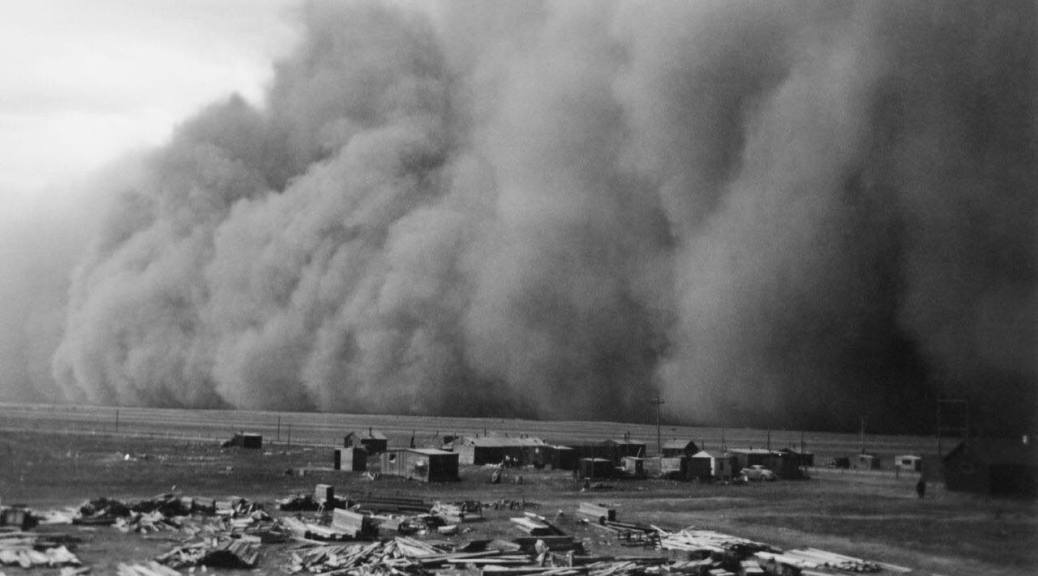
In 1931 and 1932 they suffered from the dustbowl, when top soil was so dry that it blew into homes.
Then the locusts came in 1933.
I grew up listening to stories about those times, but got a better understanding of what they faced when looking at the photos on a University of Saskatchewan website https://drc.usask.ca/projects/climate/.
My great great grandparents were among 750,000 farmers who had to abandon their farms between 1930 and 1935.
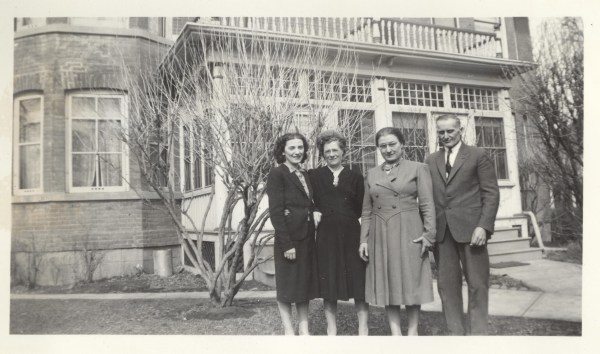
By 1938, the family had moved to Edmonton and my grandfather and his wife had to depend on the incomes from their daughters’ jobs, my grandmother as a nurse and her sister as a clerk, to survive.
1Data from the 1921 Census of Canada, Enumeration District 2, Bow River, Alberta, section 7, township 22, range 21, Meridian 4, page 6, line 28.
I used to hate Sundays. I had to go to Sunday school. I really didn’t understand why I had to attend because my parents just dropped me off. That’s right. They didn’t even go to church. And no one asked me if I wanted to go.
After they picked me up, things got worse. It was homework time until lunch. Of course, I could have done my homework on Friday night but Fridays were reserved for movies on the television and reading in bed with a flashlight until all hours.
And worst of all, some Sunday afternoons were for Visiting the Elderly Relatives. In my mind, my aunts and uncles were ancient. Plus my brother, being a boy and older than me, was apparently able to take care of himself, as he always seemed to be absent from these visits. So I would sit in the living rooms of my aunts and uncles, with no toys or any other amusements, and listen to the adults talk.
I now cherish the memories of these visits because they provided me with an appreciation of the social history of Montreal, as well as significant events such as the Depression and World War II.
The stories about the Depression are the ones that struck me the most. During the Depression, a quarter of Canada’s workforce was unemployed.1 My dad, Edward McHugh, was a young man out of work in Montreal and he joined his older brother and sister in Drummondville, to work for the Celanese. At the peak of the Depression, the Celanese employed 1,757 workers.2
None of the McHughs had cars in those days so they must have travelled back and forth to Drummondville by train. And Uncle Thomas McHugh married a local girl. I can just imagine the McHughs, from Verdun, arriving in Drummondville for the wedding. I doubt very many people spoke English in Drummondville at the time. The culture shock must have been intense.
My aunts and uncles, even into the 1960s, were thankful that they were able to have had some work during the Depression. Uncle Al Scott worked for the Northern Telecom for 40 years, although with reduced hours during the Depression. Luckily Uncle Frank McHugh worked for the Montreal Tramway Company so he was able to keep working during the Depression. He was a tram driver for tram number 24 that started in Montreal West and crossed the city on Sherbrooke Street. His job was safe.
Dad’s siblings loved to have a good time and the Depression did not stop them. My Aunt Elsie used to describe their card parties. There was only one bottle of scotch, some ginger ale, one can of salmon and one loaf of sliced white bread. My aunt was able to spread the salmon so thinly that she could make sandwiches out of the whole loaf of bread.
It was very clear to me that the Depression was a very frightening time in their lives. During this period, the future must have seemed bleak. Life was a struggle to make ends meet. But they made the most of it and persevered. Today I feel lucky to have listened and to remember their stories.
Some of the most interesting information about my ancestors comes from documents detailing what they ate.
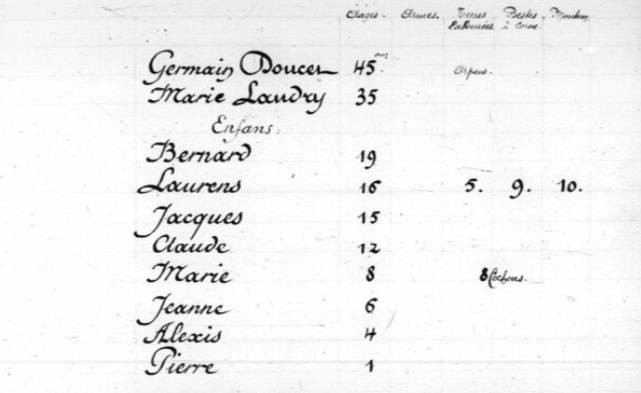
The 1686 Acadian Census, for example, shows my ancestor Alexis Doucet at four years old living in Port Royal with his parents and seven brothers and sisters on “5 arpents of cultivable land with 9 cattle, 10 sheep and eight pigs.”1
The census detailed our ancestors’ cattle and livestock along with the cultivated land because those elements were the primary elements of wealth in North America at that time. The settlers’ ability to nourish themselves determined whether they would be able to thrive, multiple, and permanently inhabit a place on behalf of whichever European colony to which they belonged.
Doucet’s family and their neighbours were ingenious at this task, as Caroline‐Isabelle Caron points out in her delightful booklet about Acadians in Canada.
Indeed, the Acadians set roots in the marshy salines left untouched by the First Nations, in the tidal flood plain which they proceed to dry and put into culture thanks to a complex system of dykes (levées) affixed with drying valves called aboiteaux. This technology was imported from France, probably from the Loudunais region where some early settlers originated. The vast network of dykes the Acadians created inside and beyond the marshlands before 1755, ensured the fertilization of vast meadows for the culture of wheat but also the growth of salt‐hay pastures, a particularly attractive source food for cattle. At this time, Acadian agriculture ranked among the most fertile in the world, boasting near constant, abundant crops.
A typical Acadian farm consisted of one house with one or two rooms on the first floor, a barn, outdoor latrines, a cellar, and a well. Dwellings were usually built up from the ground without foundation, the walls sided with whitewashed cob walls surmounted by a thatched roof. In addition to an enclosure to keep farm animals (chickens, sheep, pigs), the courtyard contained a fenced garden to grow legumes and root vegetables (carrots, turnips, radishes, but not potatoes), herbs (for both cooking and apothecary), and berries. The Acadians planted, among a vast array of fruit trees, the first apple trees the Annapolis valley is reputed for today.
Abundant food supply stimulated strong demographic growth. It is believed that between 1650 and 1755, the growth rate of the population increased annually by 4.5 percent. Birthrates alone explains this growth, the result of a near 100 percent marriage rate and very high fertility rates, as well as low mortality rates due to the quasi absence of epidemic diseases or famine, and easy access to arable land and drinking water. Despite tentative estimates, experts agree that the Acadian population grew from over 400 people in 1671 to more than 1400 in 1730, for a total of 10,000 to 18,000 people in 1755.2
By the way, the dykes made by Acadians like my ancestor, still exist today. The most successful examples allow only a third of the territory to be farmed, with the other two thirds dedicated to natural wetland rejuvenation and rough cover.3
These early settlers’ ingenuity at bringing old world technology to their new circumstances enabled them to cultivate land that wasn’t already being farmed by the First Nations communities already in the area. That fact meant that they weren’t seen as a threat by their First Nations neighbours and became friends and neighbours. Some of the French settlers fell in love with First Nations people, as Alexis’ grandmother had. According to recent DNA research, Germain’s last name “Doucet” is presumed to be an adopted name, because his father, Germain Doucet, definitely descended from First Nations.4
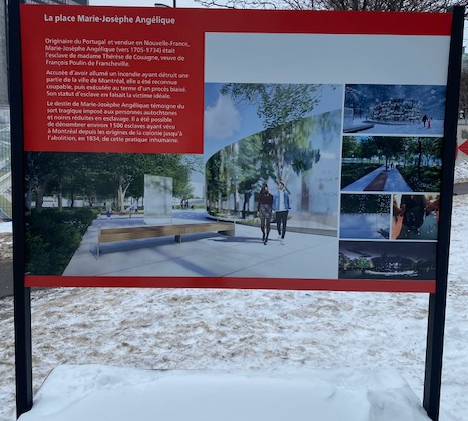
Since this story was originally published, the City of Montreal has added a poster next to Metro Champs de Mars to make it clear that Marie-Josèphe Angélique’s park will be within the Place de Montrealais!
Thanks to Annie for letting me know, and thanks for everyone who made sure that her story is not forgotten!
Original Story
For an hour on the first cold day of the year last month, I wandered around City Hall looking for the memorial park named after an enslaved woman whose torture led to her conviction for arson in 1734. She was then ridiculed, hanged, and her body was burned to ashes and thrown to the wind.
I couldn’t find it.
I’m not sure what happened from the time the park was created in 2012 to today, thirteen-and-a-half years later, but the one-time park still appears on Google Maps. In person, I couldn’t find anything to indicate where it might be.
According to various articles on the web, a green space just west of Champs de Mars métro station honours Marie-Josèphe Angélique’s memory. The official inauguration of the park took place on Aug. 23, International Day for the Remembrance of the Slave Trade and its Abolition, 2012.
As I walked through the area last month, the one-time park seemed to be encompassed in a massive construction site underway for Place des Montréalais, a new public space being created next to the Champ des Mars metro on Viger Street. The posters on site explaining the current project included nothing about Marie-Josèphe Angélique.
Despite being honoured with an award-winning film, a bronze plaque, lilies and a presentation by Governor General Michaelle Jean in 2006, and a public park created by the city of Montreal in 2012, she’s disappeared again.
Before this experience, I was already struggling to see Angélique as the symbol of freedom and resistance she serves for many, but I don’t want her to be forgotten. Did she set the fire or was she a convenient scapegoat? If she didn’t, who did? As I began exploring her story last month as part of a project for NANOWRIMO (the National Novel Writing Month), she served as a reminder of the kind of unnecessary suffering a biased political, policing and justice system can create. Despite the fact that she was a victim of slavery, hatred, spite, racism, class bullying and the worst that a mob could throw at her, her spirit remained strong and unrelenting.
Angélique proclaimed her innocence until the day she was tortured, throughout the court case, and through questioning. Despite that, three weeks after the fire, she was hanged, ridiculed publicly, then burned with her ashes tossed into the wind. Clearly, the authorities at the time wanted her punishment to be seen and remembered.
I read the details about Marie-Josèphe Angélique’s case on Torture and the Truth, a fabulous website set up in 2006 by multiple people, including one of my genealogical mentors, Denyse Beaugrand-Champagne and one of my historian mentors, Dorothy W. Williams. Both of these women have researched, written, spoken and taught many people about the history of Montreal and why studying it is so important.1
The site is one of thirteen different “historical cold cases” established for classrooms across Canada. It was created through the work of six writers, a photographer, an artist, and two translators collaborating with six funding agencies, seven production partners, and 15 archive and museum partners.
It is one of the best historical websites I’ve ever read. If you do nothing other than read through this site, you will get a good overview of the community, the victim arsonist, and life in early Montreal.
As I read about Angélique’s story, she sounded like just the kind of person anyone would like to get rid of. She was a woman who told people she would burn them alive in their homes. She said so to her owner for refusing to grant her freedom, to other slaves for making her work harder than she wanted and to others too. To anyone who slighted her, she threatened the worst thing she could think of. She would burn their homes down.
When 45 houses in her small community did in fact burn down, people blamed her. In retrospect, it may have been an accidental kitchen fire that caused the flames, but her words came back to haunt them all.
The fire began at 7 p.m. on a Saturday evening in spring, April 10, 1734. In only three hours, it destroyed 45 homes and businesses on Rue Saint Paul. Even the Hôtel-Dieu hospital and convent, where people initially took shelter, burned to the ground. Hundreds of people were left in the cold; supplies from many merchants burned, never to be seen again.
Plus, who knows how many caches of fur got wiped out. At that time, Montreal was the centre of the fur trade, more than half of which was illegal trading with the Dutch and English communities in Albany, Boston and other communities to the south. According to a 1942 thesis by Alice Jean Elizabeth Lunn, furs were stored in the backs of shops and even buried just beyond the Montreal wall, which was still under construction at that time, in order to be shipped without being seen by New France authorities. A lot of money went up in smoke that day.2
Everyone in Montreal knew about the fire, given that all the church bells throughout the city began ringing when it started and continued until it was over and people were safe again. Although stone buildings existed at the time, most of the buildings were made of wood; fire could destroy them all.
I had ancestors who lived in Montreal then, the Hurtubise clan on my father’s mothers side. One of them, Jean Hurtubise, the grandson of Étiennette Alton and Marin Hurtubese, was thirty-nine years old, ten years older than Angélique when the fire took place. He and his wife Marie-Jeanne (Marie-Anne ou Marianne) Tessereau had been married for seven years in 1734.
Jean was born in Ville Marie and lived in Montreal for his entire lifetime, so he and his family would have experienced the fire, at least from a distance. They certainly would have seen the ordinance compelling witnesses to appear, given that “it was posted and cried out everywhere in the city and its suburbs.”
Jean and his family farmed a 3×20 arpent property they bought three years earlier from Raphael Beauvais and Elisabeth Turpin on Rue Côte Saint-Antoine.”3 The property was in a part of Montreal that was considered the countryside at that time. Their home was then one of four wood houses on Côte Saint-Antoine in 1731.4
Given that the area was still very rural, and on a major hill, I can’t help but wonder. Did they see the smoke rising into the sky as the hospitals and 45 other buildings in Ville Marie were destroyed?
They certainly had strong links to Ville Marie, particularly the hospital. His grandmother, Etionnette Alton, had died there in her 84th year twelve years earlier. They couldn’t have helped wondering what would happen to others like her, being treated in the hospital that the fire destroyed. Were they among the crowd clamouring for revenge? Did they go to Ville Marie to see Angelique hanged? Did they watch her corpse burning? Did they see her ashes spread into the wind? Did they care at all?
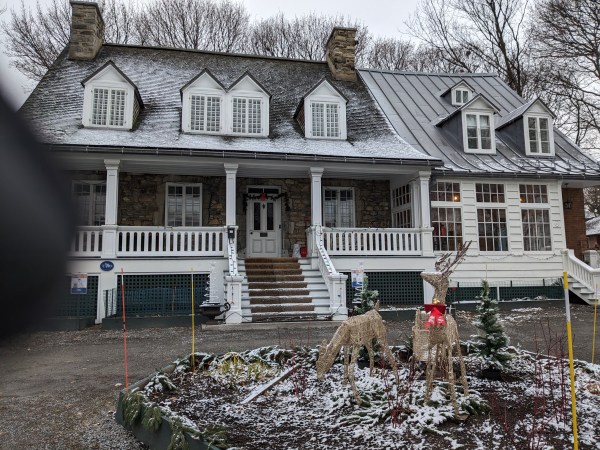
I can’t help but imagine that the controversial hanging effected all 2000 people who lived on the island that year. Five years after Angélique’s death, Jean built Hurtubise House, a storey-and-a-half fieldstone structure on land originally rented by his father in 1699 on Mount Royal. The family built the gabled home out of stone to protect themselves from fire, as required by a law passed the summer after Angelique’s death. You can still visit the home today.5
Sources
1 Beaugrand-Champagne, Denyse, Léon Robichaud, Dorothy W. Williams, Marquise Lepage, and Monique Dauphin, “Torture and Truth: Angélique and the Burning of Montreal,” the Great Unsolved Mysteries in Canadian History Project, 2006, https://www.canadianmysteries.ca/sites/angelique/accueil/indexen.html.
3 Roy, Pierre-Georges,, Inventaire des greffes des notaires du Régime français, Québec, R. Lefebvre, Éditeur officiel du Québec, 1942, 28 vol. ; 25-27 cm, Collections de BAnQ.
Genealogy is usually of little interest to children probably because their parents already seem from the Dark Ages and their grandparents from the times when Tyrannosaurus Rex tramped the planet.
It was the same thing for me way back in the 1960’s – except for the one day when I was about twelve years old. My mother came home all excited with some important news passed on to her by a cousin who had researched the Crepeau family tree.
My mom’s father, Jules Crepeau of Montreal, was descended from one Abraham Martin dit L’Ecossais, a pioneering (boat) pilot and land-owner in New France. My French Canadian mom found this fact highly entertaining. “I am descended from a Scotsman,” she told me, laughing. “What a joke.”
I remember this episode only because of another part of the story. Apparently, this Abraham Martin fellow owned the Plains of Abraham. THOSE Plains of Abraham. Now that I could sink my tweenage incisors into.
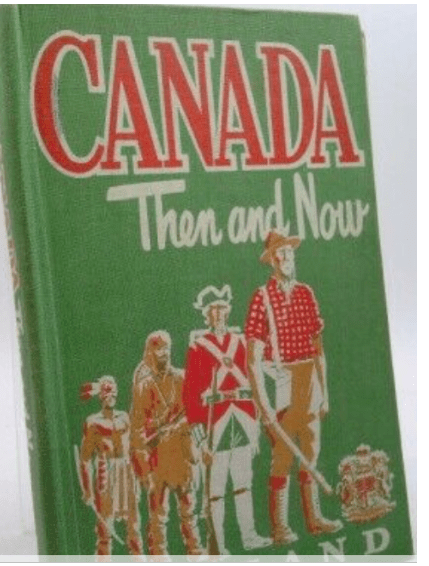
You see, I was learning about Canadian history in school. Our text was Canada Then and Now, a bright green text with a very iconographic cover pic.
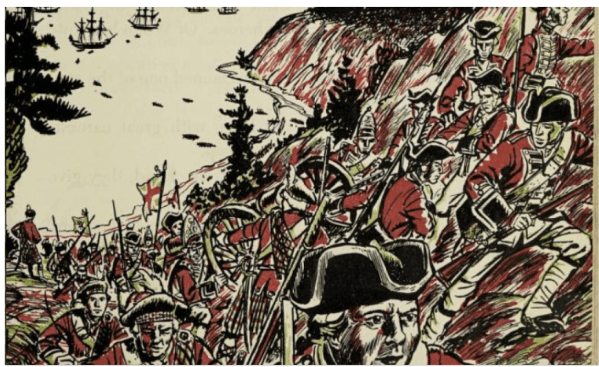
From this textbook, I was learning for the first time how the French and British were always at war with each other, way back then, in Europe and in North America. In North America, the fought over control of the lucrative fur trade and, apparently, it all came to a head one morning on the 1th of September, 1759 when a British general named Samuel Wolfe, after being rebuffed a few times by the superior French forces, led a cagey attack on the French General named Louis Joseph Marquis de Montcalm on the cliffs of Quebec City, cutting off his supplies and defeating his superior forces. This was all part of something called The Seven Years War.
All night long kept quietly landing the men on Wolfe’s cove. By morning, 5000 British soldiers were drawn up ready on the Plains of Abraham. The French had avoided battle, believing they were safe because they had more men than the British and plenty of supplies. They knew the British wold have to withdraw before freeze up. But now tht the British had landed above the town and cut off supplies from Quebec. The time had come for battle.
The textbook instructed us Canadian children, in subtle terms, to take no especial pride in this seminal event:
Wolfe and Montcalm were great generals and gallant men. Today, on the Plains outside of Quebec, a monument stands to honor them both. Wolfe’s name is on one side, Montcalm’s on the other. There is a Latin inscription that says, “Valour gave them a common death. History a common fame and posterity a common memorial.”
Illustration from Canada Then and Now. Storming the Plains of Abraham
Today, I am much older and predictably I am into genealogy. I have written many many family stories from both sides of my tree.
My mother’s French Canadian side was easy-peasy to patch together thanks to all those fabulous Catholic church records on Drouin available. And yes, if the Mons Origins website information is correct, my mom was indeed descended from this Abraham Martin.
Should I write about this pioneer ancestor? I have long wondered.
Truth be told, I would very much like to puzzle out the story of my earlier French Canadian ancestors, as Tracey Arial and Claire Lindle have done so brilliantly on this blog. I’d like to discover exciting new tidbits of information about my ancestors to add to the historical record (perhaps using some of the stellar resources catalogued on Genealogy Ensemble by Jacques Gagne) but it all seems so difficult, so labour intensive and so hard on the eyes.
In the past, I have explored the lives of Les Filles de Roi – because I am particularly interested in the lives of women ancestors – only to find there doesn’t exist much detailed information about these pioneering females from Normandy and Ile de Paris. It seems no one bothered to document the day-to-day lives or unique personal stories of these ‘mothers of millions’ back then– either in Europe or New France.
When it comes to this Abraham Martin dit L’Ecossais character, it would be a real waste of time to try to find a new angle or to write something fresh about him. There are already reams and reams (or pixels and pixels) of information written about him. It appears that Abraham Martin dit L’Ecossais is one of the most famous French Canadian pioneers and a father to millions of North Americans, including Madonna and Justin Bieber – and, ah, little ole me.
Long story short: He married Marguerite Langlois. Had 14 children. I am descended through Vitaline Forget-Despatie, my mother’s father’s mother.
The kicker to this non-story of mine: Abraham wasn’t necessarily Scottish. He could have invented the epithet to avoid criminal prosecution or he was a war deserter. His name might have generated from the fact that he had visited Scotland many times in his youth.*1
Now, lately I have dug out one very interesting fact about my mom’s French Canadian ancestors on her dad’s side, one she didn’t know about. My mother always told me that the name Crepeau meant “curly haired one.” She had very very curly hair herself, as did her father. I have no idea how long she had known this fact or who originally informed her.
If that same cousin, back in 1967, had provided her with a paper genealogy, my mother would have noticed that the original Crepeaus, going back six to eight generations, were Crespeaus, from Poitou Charent. I have recently learned that the name Crespeau almost certainly came from Crespo, a very Spanish name – and not only that a Sephardic Jewish name.
I found this tidbit on sephardim.com:
“The name Crespo has been identified by the Holy Office of the Church of Spain as a Sephardic Jewish surname.”
How fascinating.
So, it seems, even genealogically-timid I can dig out an interesting fact or two about a distant French Canadian ancestor. Maybe I should keep trying.
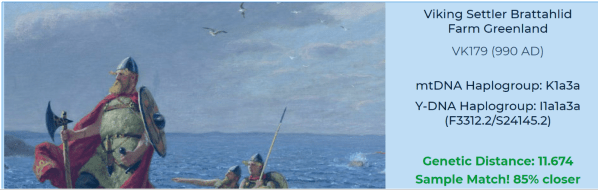
1. Even if Abraham Martin wasn’t born to the Tartan, he likely had English, Scottish and even Viking dna. Normandy, Normans, North men, Norsemen. Ancestry gives most of my many many French Canadian cousins a little bit of Norwegian ethnicity. I have a very vague 0-8 percent.
Wouldn’t it be funny if my mom were related to Eric the Red, chronicled in the second chapter of Canadian Then and Now, after the first chapter on “Indians” and “Eskimos.”
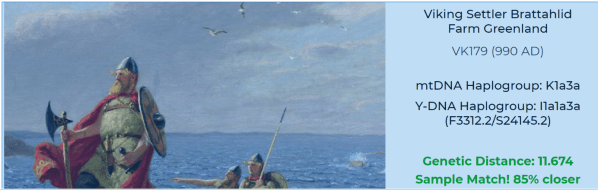
If you believe mytrueancestry.com, my husband, whose Mom comes from Isle of Lewis Scots, apparently is connected genetically to Eric’s clan. How very romantic! If I didn’t love him before, I’d have to love him now!
2. I checked the Y dna lists online at Family Tree and someone is trying to see if French Canadians have Semitic genes. There are very few members. On a regular French from France Y dna site I can see that some French Canadians have J M172, an Anatolian line, often thought of as the Greek Diaspora. Cote and Leger are the names that crop up. There are no Crespos, Crespeau’s or Crepeaus.
If your ancestors lived in Quebec between 1640 and 1940, you may find them mentioned in a periodical called Bulletin des Recherches Historiques, published by one of the province’s senior archivists and his sons. Searching this publication takes a little effort, and it helps if you can read some French, but your time may be well spent.
Archivist Pierre-George Roy and two of his sons did their research over several decades and published the Bulletin between about 1920 and 1943. In 1920, Roy was the first archivist at the Archives de la Province duQuébec, the precursor of the Archives nationales du Québec (BAnQ), and he later became senior archivist at the Archives nationales du Québec in Quebec City. His two sons were also archivists.
Roy obtained the majority of his material from notarial documents. His father, Joseph-Edmond Roy, was a notary in Québec City from 1880 to 1911, and other Roy family members were also notaries.
The Bulletin includes a variety of articles including family genealogies, profiles of individuals, amusing anecdotes and accounts of historical interest. Some articles focus on high-profile people such as land owners and civil servants in the days of colonial New France. Others look at Catholic religious orders, laws and the courts, but there do not seem to be many women mentioned.
The articles are not exclusively about French Canadians; they also include Acadian, British, Scottish, Irish, Germanic, American, Jewish, Loyalist and Huguenot families and individuals. Ancestors of at least four members of Genealogy Ensemble are covered in the pages of the Bulletin.
When the BAnQ copied these periodicals, it named the database Le Bulletin des Recherches Historiques 1895-1968, however, it appears that the articles cover the period 1642 to 1942, not 1895 to 1968.
To find out whether any of your ancestors is mentioned in the Bulletin, start by scrolling through the 818-page PDF of the index. The volume number is underlined and the second number is the page number. Here is a link to the index: http://numerique.banq.qc.ca/patrimoine/details/52327/2656928
Once you have found your family’s name in the index, the next step is to go to the database that includes the actual volumes of the Bulletin. Open http://numerique.banq.qc.ca/ and, on the right hand side, put in your search terms: Bulletin des Recherches Historiques, as well as the volume number in roman numerals and the name of the month the issue appeared in French.
For example, according to the index, the name Bagg appeared in volume 49, page 59, so the search term is “Bulletin des Recherches Historiques XLIX Fevrier” You may have to guess the month, depending on the page number. Then scroll down to find your ancestor. You can also find hard copies of this publication at la Societé généalogique canadienne-française (https://www.sgcf.com/) in Montreal.
The language level of the magazine is not difficult, and you can use Google Translate or a similar online tool to help with the translation.
Here are links to a few samples of the Bulletin that I found interesting:
If your ancestors date back to Nouvelle France, as Quebec was known in its early days as a colony of France, you will be happy to hear about this wonderful New France research portal created by Library and Archives Canada. The New France Archives site can be found at http://nouvelle-france.org
The project brings together results from four archives in France and Canada: LAC – Library Archives Canada / Bibliothèque et Archives Canada, A.N.O.N – Archives nationales d’outre-mer (France), Archives nationales (France) and BAnQ – Bibliothèque et Archives nationales du Québec. It also accesses digitized documents in several other governmental and private archives centres.
Researchers with French Canadian, Acadian, Franco-American, Franco-Manitoban, Cajun, and Huguenot heritage will be able to use this one search engine, and voilà. The collection may not help with genealogy questions, but it will give access to a vast array of documents dating from New France.
First, spend some time on the home page learning how to search. Then explore the list of themes and LAC’s online exhibition, New France, New Horizons.
You can use the basic or advanced search and you can search in English or French, but a search in French brings much better results.
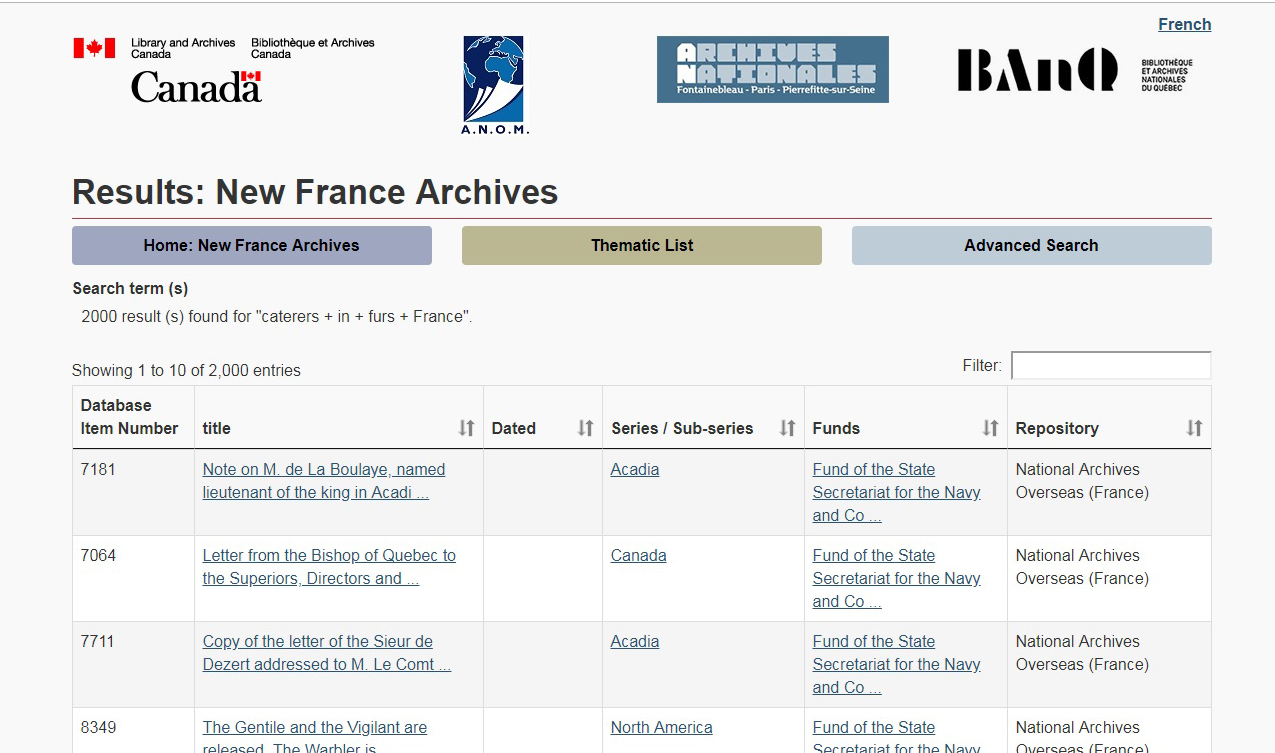
For example, I searched for the words “traiteurs+en+fourrures+France” (fur traders France, although the word traiteur now generally means caterer,) and found links to some 2000 documents stored in Canadian and French archives. A search for “commerçants en fourrures” or “commerçants de fourrures” also brought hundreds of results, but a search for “fur traders” only brought a handful. Try using Google translate before you put in your search term.
The results were in French, but a box appeared in the upper right hand corner, offering to translate into English. The page then looked like this:
Hundreds of special events are taking place in 2017 to mark the City of Montreal’s 375th birthday, but the one that means the most to me is the publication last month of a history of the Mile End district of Montreal. Some 200 years ago, that was where my three- and four-times great-grandparents lived.
There, at the intersection of the only two roads for miles around, Stanley Bagg and his father Phineas ran an establishment called the Mile End Tavern. Their landlord and future in-law, an English-born butcher named John Clark, probably came up with the name Mile End. The tavern was at the corner of what is now Saint-Laurent Boulevard and Mont-Royal Avenue, and the whole area eventually acquired the same name.
Mile End has no formal boundaries, but it is essentially just to the northeast of Mount Royal, as far as the railroad tracks. Some of the area’s streets are known far beyond Montreal: Saint-Urbain, for example, was made famous by author Mordecai Richler, and both Saint-Viateur and Fairmount streets have bagels named after them. Other well-known streets include Laurier, Parc, Saint-Joseph and Jeanne-Mance.
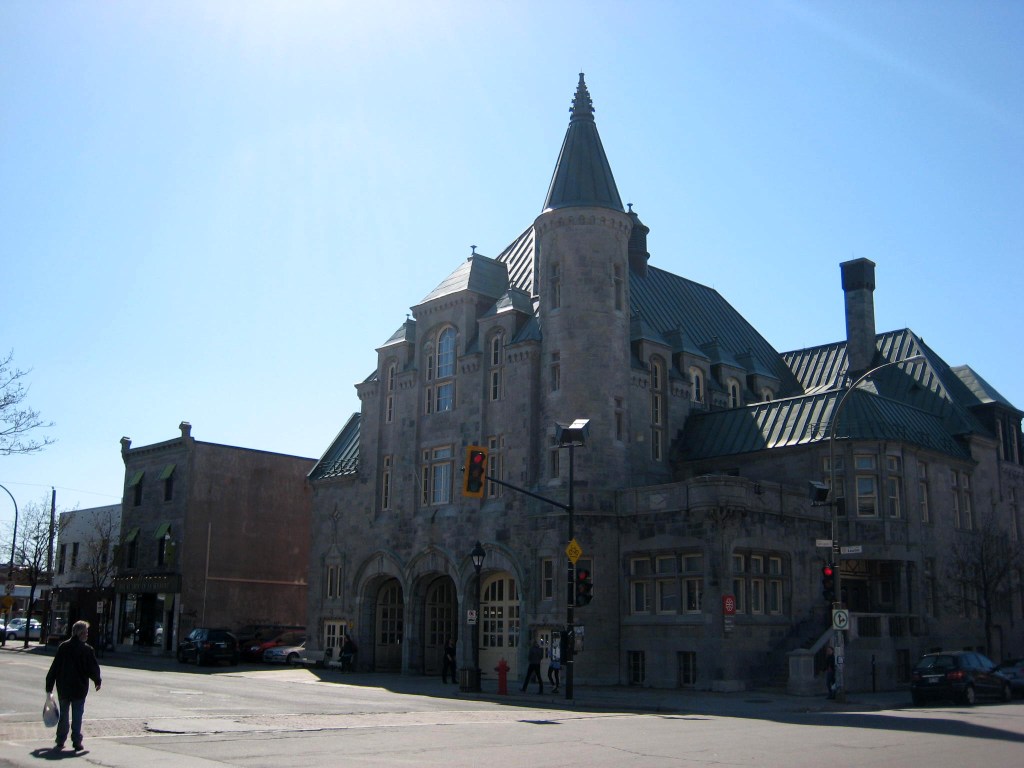
This fire station at Laurier and Saint-Laurent was once town hall of the suburban Ville de Saint-Louis. jh photo.
It is a vibrant neighbourhood, home to musicians, teachers and software developers, trendy restaurants, second-hand shops and rows of triplex and duplex dwellings, often featuring Montreal’s iconic outdoor staircases.
Histoire du Mile End, the first book to focus on the area’s history, was written by former journalist Yves Desjardins. His journalism background shows: he has researched his subject thoroughly in newspaper accounts, archival sources and academic articles, and pulled it all together in clear, concise language. I can attest to how readable it is because, although the book is in French, I have had no trouble reading it. It helps that the book is generously illustrated with historic photos and maps.
Over the decades, Mile End has been home to waves of immigrants, starting with French Canadian job-seekers who moved to the city from the Laurentians, and including Jewish immigrants from Eastern Europe, Italians, Portuguese and Greeks. Many of the area’s residents worked in the nearby Peck Building, labouring in low-paying jobs in the garment industry; today, the Peck Building is home to Ubisoft, a major player in the video game industry.
Just as it takes a village to raise a child, sometimes it takes a community to write a book. Yves had help from friends and neighbours — many of them members of the local history group Mile End Memories — who gave him access to their own research and expertise. I provided him with information about my ancestors the Baggs and the Clarks, and the collaboration paid off for both of us: I was able to fill in family information he didn’t have, and he helped me understand the historical context of my ancestors’ lives.
I learned that Saint-Laurent Boulevard, the traditional dividing line between the western part of the city, where the majority of English-speaking Montrealers live, and the eastern part, which is overwhelmingly French-speaking, was the only road leading north out of the city in the early 1800s. The Baggs owned much of the land on the western side of Saint-Laurent, and it remained primarily rural until the 1890s. Much of the land on the east side was owned by the Beaubien family, and early residents worked in local tanneries and quarries.
At the end of the 19th century, a group of real estate promoters from Toronto tried to develop a “strictly high class suburb” in Mile End called the Montreal Annex. While they did manage to attract a few professionals and their families, the scheme eventually failed. For decades, most of Mile End’s residents were strictly working class, or worked at skilled trades such as shoe-making and carriage-making.
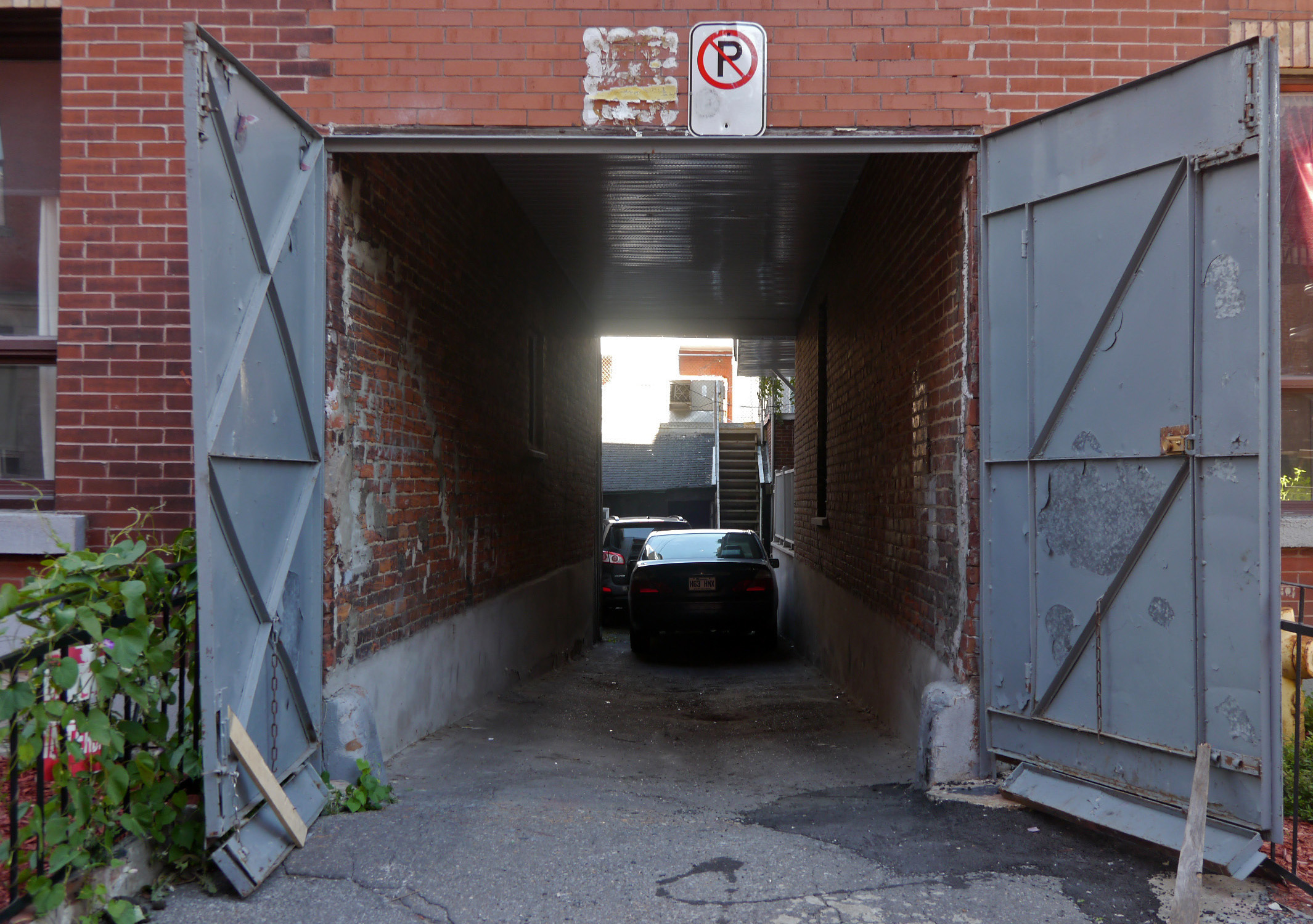
Carriages, not cars, once used this entrance between row houses. jh photo.
Meanwhile the area experienced many growing pains as politicians argued over taxes and infrastructure, and promoters battled to provide the public transportation (by electric tram and rail) that was key to the area’s growth.
Today, as the city of Montreal rebuilds its infrastructure and controversy surrounds plans for future residential projects and transportation corridors, it seems that some things haven’t changed much.
Yves Desjardins. Histoire du Mile End, Québec: Éditions du Septentrion, 2017.
Mile End Memories, http://memoire.mile-end.qc.ca/en/ This site includes articles in English and in French, photos, an interactive map that indicates the location of many historic buildings, including the Auberge du Mile End (Mile End Tavern), and a link to summer walking tours of the area.
The Literary and Historical Society of Quebec, Canada’s first learned society, was founded by the Earl of Dalhousie, Governor of Lower Canada, in 1824 in Quebec City. Today, the society has evolved into the Morrin Cultural Centre and includes Quebec City’s English-language library.
The original aims of the Literary and Historical Society of Quebec were diverse. It gathered historical documents about Canada, republished many rare manuscripts and encouraged research in all fields of knowledge. Over the years, the society played a part in creating new institutions that would eventually take over some of its traditional roles. For example, the society helped to save what was left of the historic battlefield on the Plains of Abraham, and it participated in the creation of the Historic Sites and Monuments Board of Canada.
In the late 1800s, the Morrin Centre’s library incorporated the collection of the Quebec Library, the oldest subscription library in Canada, founded in 1779. The current collection includes a number of old volumes, some of which date to the 16th century, rare historical books and manuscripts and many articles published by the society between 1824 and 1924.
Iron Bars and Bookshelves: A History of the Morrin Centre, tells the story of the former prison in which the cultural centre is housed, and the history of the Literary and Historical Society of Quebec. Published in 2016, it was written by Louisa Blair, Patrick Donovan and Donald Fyson. Louisa Blair is author of The Anglos: The Hidden Face of Quebec City 1608-1850, Patrick Donovan is a doctoral student in history at Université Laval and Donald Fyson, a professor at Université Laval, has published extensively on the history of crime, justice, and the law in Canada and Quebec.
The Morrin Centre does not have any research tools designed specifically for genealogists, but staff are willing to help genealogists find other historical resources. Upon request, members can access the centre’s historical collection for on-site consultation. The documents in this collection are listed in the library’s online catalogue, http://www.morrin.org/en/explore-the-library/library-catalogue/. For further details, contact the library manager (see above).
“The Archives nationales du Québec in Montréal on Viger Avenue are the repository of a wonderful and unique collection of books of marriages, baptisms, deaths of French Canadian families who left the Province of Québec between 1840 to 1930 for destinations south of the border. For it is estimated that during that 90 year period, 900,000 French Canadians left the regions along the shores of the St. Lawrence River, the Richelieu River, the Chaudière River for the U.S. ”
As part of this research guide, Jacques Gagné has also included the exodus of Acadians to the same New England States, New York State and other points within the United States of America including the Acadian families who were deported to Louisiana.


 Genealogy Ensemble