All posts by Jacques Gagné

The Loyalists at BAnQ Numerique

Loyalists of the Province of Quebec

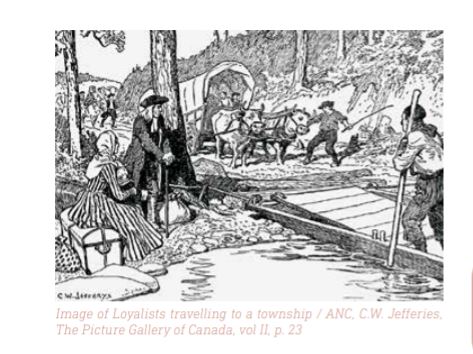
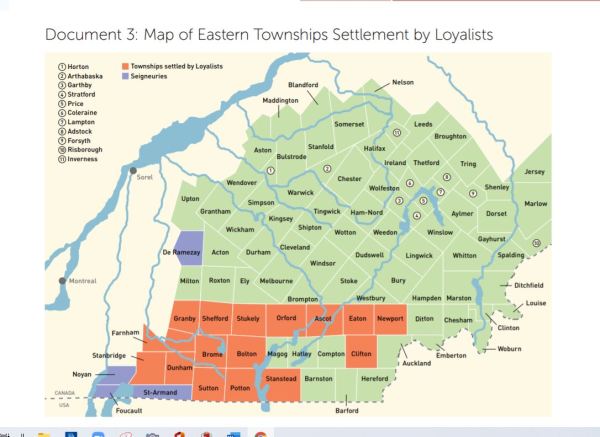
Following the American War of Independence, the Thirteen Colonies became the United States. Those who wished to remain faithful to the British Crown were obliged to leave their home to reach British territory. Consequently, following the 1783 Treaty that ended the War of Independence, Loyalists moved to British-occupied territories. Fifty thousand Loyalists reached British territories. Today, these territories make up Ontario, Quebec and New Brunswick. Of these 50 000 Loyalists, 500 fled to the Upper Richelieu Valley, to Noyan, Focault and St. Armand, unoccupied seigneuries of the Province of Quebec. These lands were ideal for clearing and their geographical location facilitated trade with the United States.

Excerpt from: https://www.etrc.ca/wp-content/uploads/2019/04/Loyal_cahier_documentaire_prim_ENG.pdf

Various online databases at BAnQ (Bibliothèque et Archives nationales du Québec) list books, papers, original documents, government decrees, proclamations by the British authorities during the British Military period and during the Lower Canada time frame about who the Loyalist people of Québec were.

Click the link below to access the database. Open link in a new window.

Premiere Nation Malecite de Viger

Maliseet Viger First Nation

Maliseets.net

Maliseet Viger First Nation / Première Nation Malécite de Viger

A people who are still residing in 2021 in Lower St. Lawrence – Bas Saint-Laurent, Western New Brunswick at the junction with the Maine / Quebec borders, Northwestern Maine at same USA-Canada border.

A number of First Nation families resisted living among the  families in traditional First Nation Reserves organized by the Federal Government and the Quebec Government. This was the main reason, why so many villages, towns, and cities are listed in the links.

They are a peaceful people who fully integrated with the descendants of European nations  who had settled in said Lower St. Lawrence, Northwestern Maine and Western New Brunswick.

Example: In this database the following link on page 14 for Saint-Mathias-de-Cabano  – consists of 4 pages of lists of baptisms, marriages and deaths.

There are many  pages like the example above  which also contain lists of baptism, marriages and deaths for the parish wherever the https://numerique… followed by Documents online is indicated.

Click the above link and open in a new window.

Atikamekw Nations of Québec

Atikamekw Nations of Manawan (Manouane) of Québec

The Atikamekw of Central Quebec is the smallest First Nation in Quebec regarding the number of residents within their territory. Authors and historians have researched the Atikamekw. They have written numerous articles.

https://numerique.banq.qc.ca/patrimoine/details/52327/3961544?docsearchtext=La%20Tuque

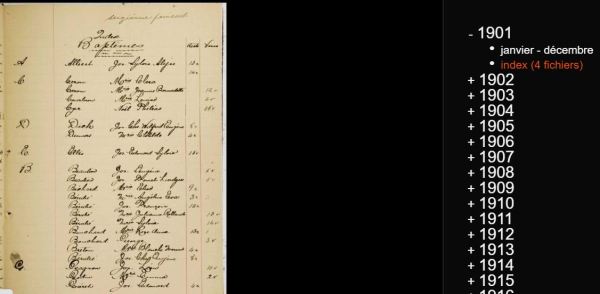
Included within this database one can access numerous Parish Church Register documents as noted in the example below. BanQ numerique documents of baptism, marriage and deaths are accessible through the many BanQ numerique links throughout the database.

Click the above link and open in a new window

Refugees in Quebec

https://www.canada.ca/en/immigration-refugees-citizenship/services/refugees/history.html

Canada: A History of Refuge

What Does “Refugee” Mean?

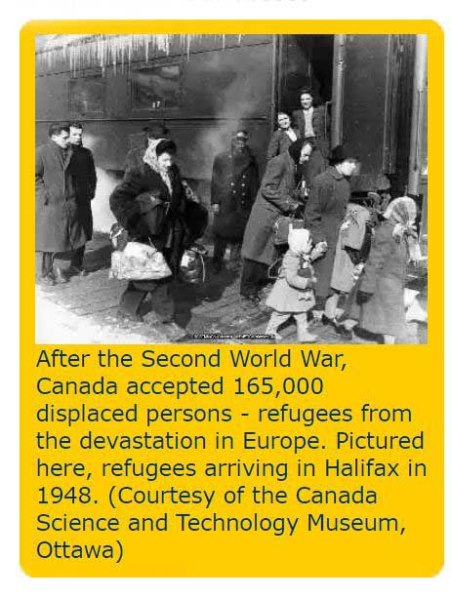
It is not as easy to define “refugee” as one might expect. In its simplest meaning, a refugee is a person who flees his or her home country because of fears of persecution or abuse, particularly by their own government. However, the meaning is affected by political change, public perception and history. According to Immigration, Refugees and Citizenship Canada and the United Nations High Commissioner for Refugees, refugees are people who have been forced to leave their country and who are afraid to return because of war, violence or persecution based on race, religion, nationality, political opinion or membership in a particular social group.

Navigate through the exposition to learn more about refugees in Canada.

This above database prepared by Jacques Gagné consists of books, articles and theses written by numerous authors on the subject of refugees that have come to Quebec and their contributions.

Open the link in a new window.

Plaisance (Placentia) 1655-1713 & Le French Shore 1713-1783

The European presence in Newfoundland goes back to the early 16th century. In their autobiographies, John Cabot and Jacques Cartier, explorers, both indicated the presence of Basque fishermen along the shores of the Gulf of St. Lawrence, the Strait of Labrador, the southern and northern regions of the Island of Newfoundland.

The extraction of oïl from whales caught off the coast of the Gulf of St. Lawrence and the cod fish industry along the coasts of Newfoundland and Labrador were major industries with market places in Continental Europe, the British Isles.

This database contains a selection of authors who have written books, articles, and dissertations about the great fishing era off the Grand Banks of Newfoundland.

Plaisance
(Placentia)
1655-1713
&
Le French Shore
1713-1783

A History of Québec
Québec Past and Present 1608-1876 Part Two

This image has an empty alt attribute; its file name is 51lu9dojs3l._sx331_bo1204203200_-1.jpg

Sir James MacPherson Le Moine, author of Quebec Past and Present was born in Quebec in 1825 and was a Law Professor at Laval University. From 1869 to 1899, he was an inspector of revenue for the district of Quebec.

He was also a founding member of various organizations such as the Institut Canadien de Québec, the Royal Society of Canada and the National Archives of Canada.

He was an accomplished author and wrote many books. One of those that garnered much attention,  Maple Leaves, Les Pêcheries du Canada, and several books on Canadian history. He was a true fact finder and  his eyewitness accounts were of interest to his readers.

Sir James MacPherson Le Moine was involved with the Literary and Historical Society of Quebec. He served as president in 1871, 1879–1882, and 1902-1903.

Click the link to access the file. Open in a new window

Quebec Past and Present

A History of Quebec

1608-1676

Part One of two

This compilation consists of various books and documents that have been written about the Carignan-Salière Regiment and their contribution to the development of New France.

Click the link below and open it in a new window:

Sovereign Council

&

Superior Council of New France

Sovereign Council & Superior Council of New France

1663-1769

The following database consists of books, and documents relating to the Sovereign Council.

The Canadian Encyclopedia’s defines Sovereign Council as noted below.

https://www.thecanadianencyclopedia.ca/fr/article/conseil-souverain

Court of appeal in civil and criminal matters where cases arise from lower courts of justice, its judgments are revocable only by the King’s Council.

Sovereign Council

 In 1663, the Compagnie des Cent Associés surrendered its rights to NOUVELLE-FRANCE . Louis XIV then established a royal government. He thus endowed New France with a complete administrative apparatus, on the model of those who manage the provinces of France. The Sovereign Council, which became the Superior Council in 1717, compared itself to the parliaments of these provinces. The Council is initially made up of the GOVERNOR , the bishop, the STEWARD and five councilors. In 1703, this number was increased to 12, to which were added in 1742, four assessors. Its members are generally recruited from the French gentry and are appointed initially by the governor and bishop, then by the king.

Court of appeal in civil and criminal matters where cases arise from lower courts of justice, its judgments are revocable only by the King’s Council. It crowns a judicial structure established in each government of the colony: the provost of Quebec (1663), the royal jurisdiction of Trois-Rivières (1665), that of Montreal (1693) and the Admiralty (1703)

Click the link to access the database:

Open in a new window.

The Protestant Families of Québec City

from 1759 to about the 1850 and The British, Scottish, American, Irish, Welsh, Germanic families of Trois-Rivières (Three Rivers) from 1767 to 1875

Quebec City
This image has an empty alt attribute; its file name is trois-rivieres.jpg
Trois Rivières

The following database contains list of family names of families who resided in Quebec City and Trois Rivières during the years 1759-1875.

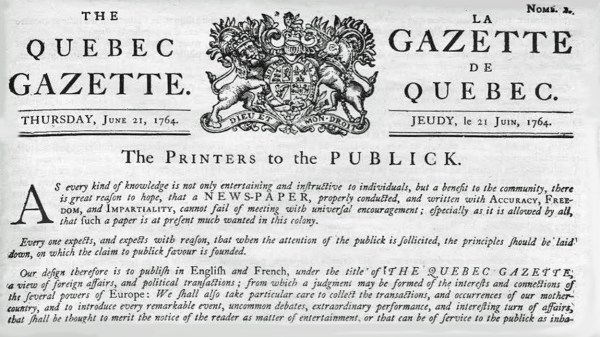
Newspaper proprietors, editors, publishers and reporters in British Quebec, Lower Canada, Québec from 1764 onward.

The following database consists of

Pages 5-36 Authors who have contributed to newspapers from 1764 onward

Pages 36-40 Lists of Quebec Newspapers and BanQ Numerique

Pages 40-48 History of Newspapers

Pages 48-52 Repositories

“But along came the likes of Fleury Mesplet, Pierre du Calvet, John Neilson, James Brown, William Brown, Jocelyn Weller, Daniel Tracey, Henry-Antoine Mézière, Samuel Neilson, Ludger Duvernay, François-Xavier Garneau and many others who were the prime movers, the instigators who educated the people and also they were the ones who through their printed pages influenced the people and politicians of Lower Canada and Québec during the formative years of Confederation.”

Excerpt from notes by Jacques Gagné

Click on the above link to access the database.