It has always bothered me that on the passenger lists of the S.S. Grampian, sailing from Glasgow to Quebec City, my grandfather, Thomas McHugh, was not listed with his wife, Elsie McHugh and their seven children.
My father was always clear that Thomas arrived ahead of his large family in the early 1900s. The plan was that Thomas would have time to find work and a place to live, and get settled in.
I first found my grandmother, Elsie McHugh and the seven children listed on the passenger list of the S.S. Grampian, leaving Glasgow and arriving in Quebec City. The year was 1912. I knew that I also had to find out when Thomas arrived. I returned again and again to passenger lists for travel between Scotland and Canada in 1910 and 1911. No luck. It was only when I started to research my great-uncle, Edward McHugh that I discovered Thomas also on the passenger list of the S.S. Grampian in 1912, leaving Glasgow and arriving in Quebec City. Thomas was accompanied by his mother and two brothers.
Harrumph. It seemed as if Thomas didn’t leave ahead of time. But why in the world were Elsie and the children not listed with Thomas? Were they separated because of the children? This didn’t make sense. Elsie would have needed all the help she could get. Little Adam was just three and his brother, Thomas was one year old.
I kept going back to these entries. There was something about them that bothered me. I looked up potential reasons to be separated on a ship. I looked up whether families would be divided for any reason in the list of passengers. No luck.
Also, I kept getting mixed up whether it was May or October 1912. I would look at my notes and if it said May, I realized that the date was October and I would change it. I would then go back later and change it back to May. Argh. I needed to get it right.
This week I decided to establish definitely whether Thomas came over to Canada first. Perhaps he came to Canada and then went back to Scotland for his mother, his brothers, his wife, and his children. This would make perfect sense. This would explain why my father was so sure that he came ahead of the family and all the evidence that I had said that he came over with his family.
Well, I could find no trace of Thomas on passenger lists of 1910 or 1911. He wouldn’t have come before 1910, I would think. I did find him again on the passenger list of the S.S. Grampian, May 1912. And I found Elsie again. Wait a minute. October 1912! The penny dropped. They both travelled over on the S.S. Grampian but at different times of the year. I was so blinded by the name of the ship that I did not realize that even though they were on the same ship, they travelled on different dates.
While this was not a brick wall, it was certainly a puzzle for me. A puzzle of my own making. Once again, this reaffirms that, while primary genealogical research is important, it is also valuable to revisit assumptions, documents, and notes. Look and look again and again. Most genealogists I know enthusiastically forge ahead and tend to neglect reviewing previous finds. I am no exception.
“Those of us already deep in the accumulation may also benefit from revisiting our past research.”
Brenda Dougall Merriman, Genealogical Standards of Evidence: A Guide for Family Historians
I used to hate Sundays. I had to go to Sunday school. I really didn’t understand why I had to attend because my parents just dropped me off. That’s right. They didn’t even go to church. And no one asked me if I wanted to go.
After they picked me up, things got worse. It was homework time until lunch. Of course, I could have done my homework on Friday night but Fridays were reserved for movies on the television and reading in bed with a flashlight until all hours.
And worst of all, some Sunday afternoons were for Visiting the Elderly Relatives. In my mind, my aunts and uncles were ancient. Plus my brother, being a boy and older than me, was apparently able to take care of himself, as he always seemed to be absent from these visits. So I would sit in the living rooms of my aunts and uncles, with no toys or any other amusements, and listen to the adults talk.
I now cherish the memories of these visits because they provided me with an appreciation of the social history of Montreal, as well as significant events such as the Depression and World War II.
The stories about the Depression are the ones that struck me the most. During the Depression, a quarter of Canada’s workforce was unemployed.1 My dad, Edward McHugh, was a young man out of work in Montreal and he joined his older brother and sister in Drummondville, to work for the Celanese. At the peak of the Depression, the Celanese employed 1,757 workers.2
None of the McHughs had cars in those days so they must have travelled back and forth to Drummondville by train. And Uncle Thomas McHugh married a local girl. I can just imagine the McHughs, from Verdun, arriving in Drummondville for the wedding. I doubt very many people spoke English in Drummondville at the time. The culture shock must have been intense.
My aunts and uncles, even into the 1960s, were thankful that they were able to have some work during the Depression. Uncle Al Scott worked for the Northern Telecom for 40 years, although with reduced hours during the Depression. Luckily Uncle Frank McHugh worked for the Montreal Tramway Company so he was able to keep working during the Depression. He was a tram driver for tram number 24 that started in Montreal West and crossed the city on Sherbrooke Street. His job was safe.
My aunts and uncles loved to have a good time and the Depression did not stop them. My Aunt Elsie used to describe their card parties. There was only one bottle of scotch, some ginger ale, one can of salmon and one loaf of sliced white bread. My aunt was able to spread the salmon so thinly that she could make sandwiches out of the whole loaf of bread.
It was very clear to me that the Depression was a very frightening time in their lives. During this period, the future must have seemed bleak. Life was a struggle to make ends meet.
I spent my entire career writing corporate documents. I could spin with the best of them. It is very different from writing family history stories. When I joined the Genealogy Ensemble family history writing group, I had to learn a whole new way of writing.
In a corporate document, you are always trying to get something from someone. It could be funding, agreement on how to proceed, approval for a project, agreement with your point of view, or understanding and approval of why you did what. The list goes on and on. Your objective is to sway your audience to your point of view.
When I would write corporate documents, it was important that I provide the reader with the context of the request. I usually started with the background, then the current situation, followed by a description of the issue, and concluding with the desired outcome.
Family history stories should start with a lead that will grab the reader’s attention, much like a news story. Simply put, a good lead will incite the reader to continue.
Writing family history stories is intensely personal. After all, you are writing about your own family. Your voice must come through. When I would write corporate documents, I was always the anonymous writer. No one knew me personally, even if I signed the document. The corporation always spoke in the document, not me. Family history writing is all about you and your journey discovering your ancestors. Your family history stories are an important part of the family archives.
Corporate writing is full of the third person. Organization X believes. Organization Y has decided. Organization Z recommends. When it is your family, feel free to put your emotion into it. Writing about your ancestors is a way to bring them alive and to celebrate their struggles and achievements. You can bring compassion and understanding to stories of their lives.
Most importantly, have fun writing about your ancestors. In a way, it’s a little like writing about yourself.
Aren’t birthday parties fun? I was thinking this recently when we celebrated my daughter’s 30th birthday at the Auberge Saint-Gabriel in Montreal. I was also thinking how a birthdate is such an important indicator in genealogy research.
A birthdate and a place of birth places a family member in a period of time and in a location that can tell us a lot about the social context in which the person lived. Buildings and their uses can also tell us a lot about a place.
The Auberge Saint-Gabriel in Montreal is one of the oldest buildings in the city. It was built by Etienne Truteau, a French soldier in 1688. 1 In 1754, it was the first inn in North America to be issued a liquor license. 2 Over the centuries it has had many vocations, including the Beauchemin printing press operation founded in 1860 and that printed the newspaper Le Patriote.3
And who doesn’t love a good ghost? It is said that the Auberge Saint-Gabriel is haunted by a little girl who lost her life when a fire raged through the ground floor, trapping her and her grandfather upstairs while her grandfather was teaching her to play the piano.4
Today, the Auberge Saint Gabriel is a trendy restaurant and reception centre right in the middle of Old Montreal. If you go inside, you can see that the owners continue to maintain the building as much as they can in the style that it was built. You can appreciate the thick brick walls, stained glass windows, and the many antiques that grace its rooms. If you like, you can go down to the basement to visit the place where there was a fur trading post. Today, this fur trading post is a speakeasy, called The Velvet.5
I am quite confident that almost all of my ancestors who lived in Montreal would have at least walked by or had business in or around the Auberge Saint Gabriel. And who knows? Maybe our descendants would be pleased to know that we dropped off our car at the door of the Auberge Saint Gabriel for a fun-filled night at the speakeasy.
What buildings are important to your family’s history?
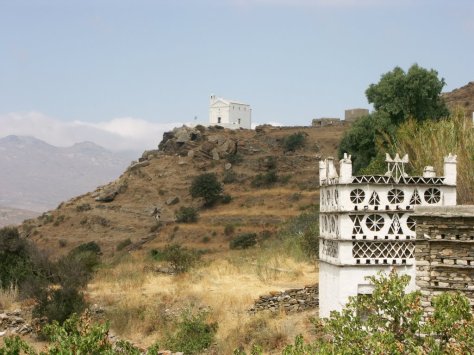
I have lucked out. My husband comes from the island of Tinos, Greece and we go there every year. I am always struck with the breathtaking beauty of the island. Some villages nestle in the valleys and others perch on the hillsides. The hills are terraced with stone walls and sheep, goats, and cows graze in the fields. Tinos may resemble other islands in the Cyclades, but what is unique to Tinos is the number of dovecotes scattered across the landscape. If you were to visit Tinos, you would be astonished at how many of them there are. While the exact number of them is not known, it is believed that there are over 1,000. This is quite impressive for an island that is 195 square kilometers. 1
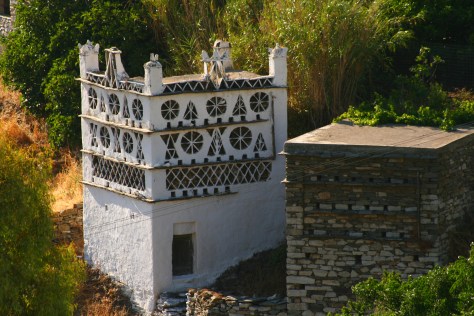
They are truly beautiful as you can see in these photographs below. This dovecote used to belong to my husband’s grandfather.
Dovecotes are not just decoration. During the 1900s, dovecotes significantly contributed to the family finances. They were kept in the family and passed on from generation to generation. My husband inherited a dovecote from his father, who had inherited it from his uncle. While very few people eat dove today, my husband remembers his grandmother serving dove, more specifically in soups made with the meat and carcass of the doves. Most importantly, the family also used the dove droppings as manure. The droppings were well known as high quality fertilizer.
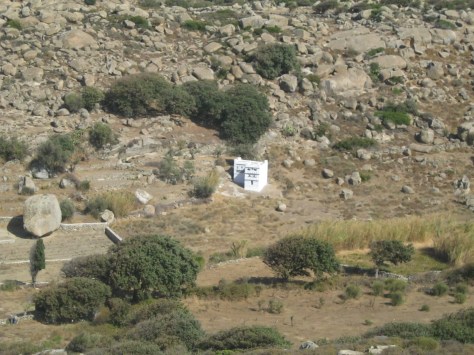
Here Is a picture of my husband’s dovecote, nestled in the valley.
It was the Venetians who originally introduced breeding of doves to the island of Tinos when they conquered the island in 1204. They ruled the island for five centuries until 1715. During Venetian rule, dove breeding was only practised by the noble, or ruling classes. The noble families had ‘le droit des colombiers’ or the right to possess doves. These were concessions bestowed by the Doge of Venice. In 1715, the Turks ruled the island, but did not inhabit it. The island was returned to Greece in 1821. 2
Most of the dovecotes were built during the 17th and 18th centuries. During this time, dove meat was not limited to local consumption. It was considered a delicacy and exported as far as Smyrna and Constantinople. 3
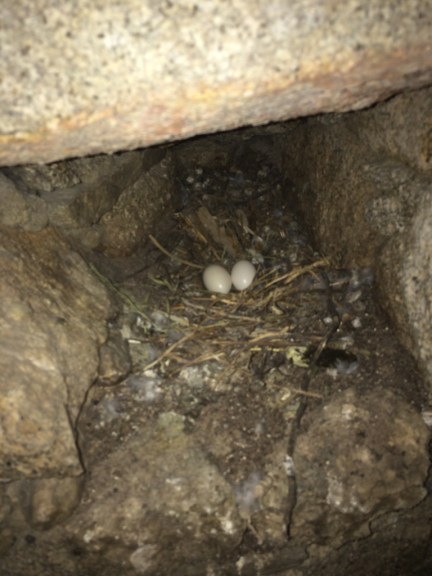
When the Venetians ceased to rule Tinos, concessions to practice dove breeding were no longer necessary. The inhabitants started to build their own dovecotes. They were built in areas conducive to breeding, such as rural areas near cultivated fields and where a water supply was available. 4 They were built on slopes that took into consideration the wind and would allow the doves to fly easily in and out of the dovecotes. The doves nest in the square holes built in a single or double row. Small stone slabs that protrude provide perches for the doves. 5
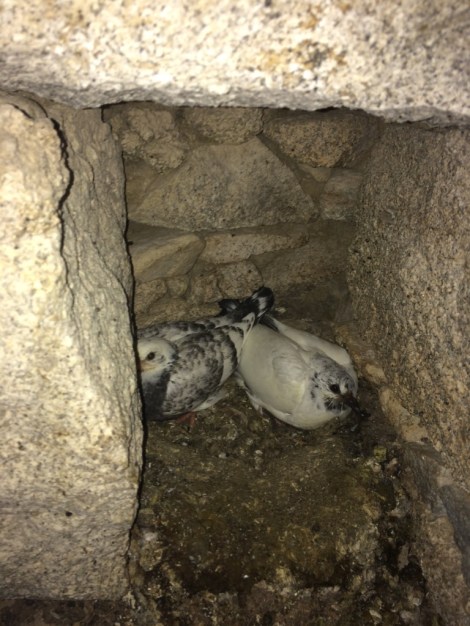
Here is a picture of some doves nesting and some eggs.
Dovecotes are made out of slate clay and are whitewashed. They are two stories high. The doves live on the second floor and the first floor is used for storing tools and agricultural equipment. They are elaborately decorated with geometric patterns and non-geometric patterns such as cypress trees. It is believed that these patterns attract the doves. 6
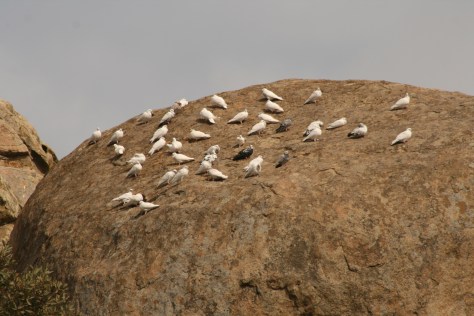
Here is a close up picture of my husband’s dovecote. These doves are fed and their only predators are snakes. There are about 30 doves living in this dovecote at any one time. We know approximately how many doves are living here by counting them in a picture. There is great pleasure in continuing to breed doves, a practice that has lasted centuries.
When I say that my grandfather, Thomas McHugh, worked as a cipher, Bletchley Park, MI5, and Russian spies immediately come to mind. He was neither a Russian spy nor did he work as a cipher during the war. His employer was the Bank of Montreal and it was his first job when he came to Canada in 1912.
The decision to immigrate to Canada was not easy for Thomas. He was in his mid-30s and already had seven children, between the ages of one and fifteen. For over 40 years, the jute manufacturers of Dundee, Scotland had been providing employment for his parents, aunts, uncles, siblings, wife, and for him. However, by the early 1900s, he was facing a precarious future for his children.
By the early 1900s, Dundee had suffered a serious decline in the textile industry and more significantly, the jute industry. Jute was imported from India, however, the mill owners realized that it would significantly lower the cost of production to open mills in India to prepare the jute and import the finished product to Scotland. Once mills were established in India, the jute production in the mills in Dundee decreased substantially.1
So when Thomas arrived in Canada, a little ahead of his wife and his children, he was eager and prepared to do any job so that he could. The Bank of Montreal had its headquarters in Montreal, Quebec. In the early 1900s, the bank had significant dealings with Great Britain and there were correspondence and banking instructions back and forth between Canada and Great Britain daily. These instructions were mainly sent by telegraph overnight. There were two reasons for this. Some of these instructions were confidential and it was preferred that they remain so. Overnight instructions reduced the number of people who would have access to them. Another reason was the time difference between Montreal and the United Kingdom. The banks in London and Edinburgh were open for business while Montreal was still asleep.
Even in those days, the banks were concerned about security, privacy, and confidentiality. The banking instructions and transactions were submitted by telegraph and were encrypted. It was the job of the cipher clerk to decipher them so that the bank staff could then ensure that the instructions were carried out as required.
To be a cipher clerk, one had to be reliable, meticulous, and honest, and ensure the confidentiality of the bank’s business. The cipher clerk used a cipher handbook to decipher the information. Also, the cipher clerk worked overnight, so it was a difficult job for a man with a family.
So while my grandfather, the cipher, did not work in espionage, I still think that his first job in Canada was rather interesting.2
As we all know, genealogical research is never-ending. Facts need to be checked and re-checked. Leads must be followed. New research beckons. Research on-line can also quickly add up to quite a lot of money. So whenever a site offers free access, I try to take advantage of it as much as possible.
Last year, I found out that my great-grandfather, John Hunter, enlisted in World War I In November 1914 when he was in his late forties. I was actually looking for him as potentially serving in the Boer War because I could not find him in the 1901 census of Scotland. So it was quite a surprise to learn that he had enlisted in World War I. I also learned that he was honourably discharged in March 1915 as he was then unfit for service. It would appear that he was injured.1 This year, when Find My Past offered free access to military records during the Remembrance Day weekend, another surprise was in store. John Hunter reappeared in the military records in 1917. He had another service number, but it was cross-referenced to his old number.
This is a long introduction to explain why I find my great-grandfather’s service record so interesting. It is because he was a Sapper. He came from a long line of miners in Scotland that can be traced back to the 1600s. In World War I, he was part of the Royal Engineers. Their military history is long and honourable. Royal Engineers can claim over 900 years of service to the Crown, dating back to the era of William the Conqueror.2 As a Sapper in the Royal Engineers, his duties would have included “bridge-building, laying or clearing minefields, demolitions, field defences and general construction, as well as road and airfield construction and repair.”3 In civilian life, he was a coal miner, so it is a safe assumption that he was a tunneller. “Royal Engineer tunnelling companies were specialist units of the Corps of Royal Engineers within the British Army, formed to dig attacking tunnels under enemy lines during the First World War.”4 Mining and tunnelling were so important to the British offensive positions that they enlisted experienced coal miners, even those who would not normally have been recruited. “The desperate need for skilled men saw notices requesting volunteer tunnellers posted in collieries, mineral mines and quarries across … Scotland.”5 This policy explains why John Hunter, working in a coal mine in Scotland, and already in his late forties, would have volunteered.
When John Hunter returned to active service in 1917, he was part of the newly formed 326th Quarrying Company.6 As part of this Quarrying Company, he would have received his training at Buxton and then sent to France, to work in the quarries around Marquise, near Calais.7
Sources:
1 John Hunter: Enlistment, Medal Card, Attestation for Short Service, Dependents, Territorial Force for Pension
Genealogy is much more than filling in names and dates on a family tree. It is also about the social history and context in which our ancestors lived. It is about technological, economic, and social advances and how they affected our ancestors and changed their lives. This is why I love local historical societies and what they bring to local and personal histories.
The Montreal metro system changed everything about Montreal. It improved the public transportation system and allowed people to go back and forth from work comfortably and quickly. It also enhanced neighbourhoods and created synergies between different areas of Montreal.
The metro system was inaugurated on October 14, 1966 during the tenure of Montreal mayor Jean Drapeau.1 Montreal City council voted to build the metro system in 1961, and a year later, in 1962, Montreal’s bid for the world fair was granted and therefore the push was on to have the system completed in time for Expo 67.2 Expo 67, a celebration of Canada’s centennial, was held from April 1967 to October 1967.3
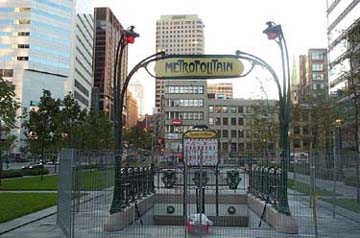
Montreal’s metro system is renowned for its architecture and public art. Each station is unique. Today, more than fifty stations are decorated with over one hundred works of art. Some of the more noteworthy pieces of art include the stained glass window at the Champs de Mars Station by Quebec artist Marcelle Ferron and the Guimard entrance to the Square Victoria Station. This is the only authentic Guimard entrance outside of Paris, although there are other subway systems around the world that have reproductions of Guimard entrances. 4
Guimard entrance to Square Victoria Station
In celebration of Montreal metro’s system and its fifty years, Heritage Montreal is offering architectural walking tours of the Montreal metro system that include information on how the metro stations transformed the surrounding neighbourhoods. These tours are open to all for a modest fee and will run every weekend until September 25. Heritage Montreal is a non-profit organization that “promotes and protects the architectural, historic, natural and cultural heritage of Greater Montreal.”5 You can find information on these walking tours here:
In 2017, Montreal will be celebrating its 375th anniversary. Over the centuries, the building of bridges, roads, the railroad, trams, and bus and metro systems have shaped and transformed the economic, social, and cultural aspects of Montreal. The Montreal metro system is a beautiful and integral part of Montreal’s heritage. Let’s appreciate it.
I particularly like the series Downton Abbey. It portrays the upstairs and downstairs of the upper classes during the beginning of the twentieth century. I like to imagine what it would have been like to work as part of the domestic staff. In 1922, my grandmother, Grace Graham Hunter, worked as a domestic, probably a cook, in Edinburgh for Dr. W. Kelman MacDonald, an osteopath.1 She was young and unmarried and looking for adventure.
Her experience as a cook in one of the homes of the upper class of Edinburgh surely stood her in good stead when she became head cook at the McGill University Faculty Club in Montreal. When my grandmother was looking for adventure, Canada badly needed domestic workers. The Canadian government favoured immigrants from Great Britain to ensure the predominance of British values. The British Parliament passed the Empire Settlement Act, which entitled my grandmother to free third-class passage from Scotland to Canada.2
Given that the need for domestic workers was acute, government hostels, partially financed by both the Canadian government and the provinces, welcomed these immigrants to the major urban centres of Canada and referred them to Employment Services of Canada who then found them employment.3
The McGill University Faculty Club was established in 1923. I assume that my grandmother was one of the first employees as this is the year she met my grandfather and she used to tell me stories of letting him come in the back door to eat a dessert or two.
My grandmother also used to tell me many stories of the people who were members of the Faculty Club and their guests and of the pressure of preparing the food just right. I used to wonder about the famous people who dined there, who they shared their meals with, and what they discussed.
The Faculty Club was originally located on University Street. It was only in 1935 that it was moved to its current location in the Baumgarten House on McTavish Street, the former resident of Sir Arthur Currie. 4 It was only when it moved that the Faculty Club allowed women members. Notably, Maude Abbott became the first woman member of the Faculty Club. She was a remarkable Montreal citizen. She started practising medicine in 1894. In 1910, McGill University awarded her an honorary degree and a lectureship in the Department of Pathology.5 In 1924, she founded the Federation of Medical Women of Canada. 6 Somehow, it seems fitting that such an extraordinary woman should be the first woman member of the McGill University Faculty Club.
1 This is derived from my grandmother’s address on the passenger list of the S.S. Montclare that sailed from Greenock, Scotland to Saint-John, New Brunswick on February 16, 1922. Her address was listed as 41 Drumshegh Gardens, Edinburgh. Dr. W. Kelman MacDonald, Osteopath, is listed as the owner linked to architectural drawings of work that was done in 1922. As my grandmother’s job was a domestic, I assume that she worked for Dr. MacDonald.
2Immigration Form 30-A of Grace Graham Hunter.
3 Crawford, Ruth, 1924, “Canada’s Program for Assimilation”, The Rotarian, May 1924, p. 16
During his lifetime, Edward McHugh made several trips back and forth across the Atlantic Ocean, but there was a world of difference between his first trip and his last.1
Edward was 19 when he immigrated from Scotland to Canada in 1912 with his widowed mother, his two brothers, his sister-in-law and his brother’s seven children. Destined for Montreal, they traveled on the steamship S.S. Grampian in third class, or steerage. Edward would have slept on a bunk bed and shared his room with other family members, and meals would have been served at long communal tables in the dining room.2
Forty years later, in 1951, he traveled first class from Southampton to New York on the luxurious R.M.S. Queen Elizabeth ocean liner.3 He would have enjoyed a spacious stateroom, first class lounges and formal dining. He could have ordered anything he wanted from room service.4 There would have been plenty of space to store his eleven pieces of luggage.5
By that time, Edward had retired and was able to afford first class passage because of his successful career as a musician. This is the story of how a talented, working-class young man from Scotland and Montreal became famous in America as the Gospel Singer.
Edward, born in 1893 in Dundee, Scotland, came from a family of jute-factory workers of Irish heritage. His father was a yarn dyer.6 When the family arrived in Canada, they settled in Verdun, a district of Montreal located close to the factories that would have provided employment for the three McHugh brothers. Edward worked as a manual labourer in the rail yards on the locomotives.7
Shortly after his arrival in Canada, he made his public singing debut at Montreal’s Hunt Club, singing God Save the King. The Duke of Connaught, then the Governor General of Canada, heard him sing and was instrumental in sending him to study at London’s Royal College of Music.8 This college accepted both students who paid tuition and students who won entry through competitions.9 Given Edward’s humble background, it is probable he had a scholarship.
By 1919, Edward had decided to pursue a musical career so he left Montreal, settled in New York City and continued his studies .10
It took a few years for Edward’s career to take off, but in 1927, Edward was invited to sing The Old Rugged Cross, an evangelical hymn written in 1912,11 on Boston radio station WEEI.12 The next day, the station received 2,300 letters praising Edward’s baritone voice. His choice of hymn and the timing were excellent. Gospel songs had become increasingly popular as they were easier to sing than traditional hymns. 13
In 1938, Edward published a compilation of gospel hymns and poems.14 His fame grew and, by the 1940s, he was nicknamed the Gospel Singer and he was a regular on NBC radio.16
In 1947, an ad for Edward’s 15-minute radio program appeared in Billboard Magazine. It claimed, “Edward MacHugh, Your Gospel Singer, [. . .] who is said to have the most perfect diction of any singer without sacrificing warmth . . . ”19
It wasn’t just the quality of his voice that made him popular; he seems to have tapped into a need for comfort in troubled times. During World War II, his fans often requested he sing God Will Take Care of You,17 a song that must have soothed people whose loved ones were risking their lives serving their country.
When asked about gospel music, Edward replied, “A lot of people think that hymn-singing is ‘corny.’ That’s okay with me. I get my satisfaction in giving real pleasure to a great number of people and perhaps in being some small help in times of trouble and affliction.”18
It is clear that Edward’s beautiful baritone voice moved many listeners. He popularized hymns and gospel songs through his radio shows, compilations, records and concerts,20 and he sang songs of simplicity, devotion and encouragement in times of pain.
After he retired in the 1940s, Edward and his wife Jennie lived a quiet life in Norwalk, Connecticut. They had no children. During his retirement, Edward continued to make records and take part in religious festivals and church anniversaries. He passed away in 1957 at the age of 63 in Fort Lauderdale, Florida.21
Add footnote about change in name
“UK, Outward Passenger Lists, 1890-1960,” database, Ancestry.com, Edward McHugh, Grampion, Glasgow to Quebec, leaving May 11, 1912.
1920 United States Federal Census, 1920, Manhattan, New York City, New York, Enumeration District (ED) 829, sheet 2, Ward 11 a.d., Dwelling 250, apt. 39, Edward McHugh: digital image, Ancestry.com (http://www.ancestry.com: accessed 27 February 2017)