Category Archives: Quebec

Thinking about my Filles du Roi Ancestors


mapancestry

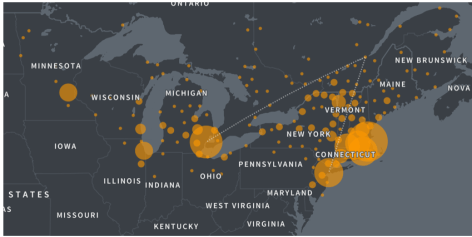
Filles du Roi: Mothers of Millions. According to a map on my Ancestry DNA page, these orange dots are where French Settlers of the St. Lawrence ended up by 1900. 1


“Women’s work consists of household work and feeding and caring for the cattle; for there are few female servants; so that wives are obliged to do their own housework; nevertheless, those who have the means employ valets who do the work of maidservants.”


So, begins and ends the one paragraph devoted to women’s work in Pierre Boucher’s seminal book Canada in the 17th Century. 2 In fact,  Boucher spends more time in his book describing native women and their unusual ways than he does describing these pioneering French women. He either thought women’s work too obvious to detail or he didn’t actually know much about it.

This is a problem for writers like me who desire to write a story about their filles du roi ancestors. There’s little information out there about them that is not statistical, transactional, or speculative.3 In my case, I wanted to write about Francoise Boivin, whom I have at least twice in my mother’s tree. According to Nos Origines, Francoise, who gave birth to eight children, has around 700,000 to one million descendants.

Boivin is especially interesting because there appears to be some question as to whether she was, indeed, a genuine fille du roi; whether she married her husband Louis Lamoureux twice, once in France and once in Quebec, and whether she was an orphan, like so many of these women, or she came to New France with both her parents.

So, fun stuff.

Suzanne Desrochers, a York University scholar, used her 2007 Master’s thesis to explore the challenges involved in researching background about the filles du roi.  Desrochers, too, wanted to write an historical fiction piece about such an ancestor, but was stymied by the lack of evidence.

“In Quebec,” she writes, “ the 17th century belongs to religious figures or saintly women such as Marie de l’Incarnation, Marguerite Bourgeoys and Jeanne Mance while virtually no biographies of lay women exist.”4

Also, no records were kept in France  side with regard to filles du roi emigrations, and the story of women in France in that era is undocumented, too.

Historian James B. Collins*5 investigated this issue in an article he wrote in 1989. By digging through wills and notarial records he uncovered a paradox of sorts: French women had fewer public rights in the 17th century compared to before and afterwards but some of them had economic clout in the private sphere.

This is because wives’ sidelines were often what kept a poorer family afloat. These sidelines often involved the producing of alcoholic beverages like cider and wine, activities Boucher doesn’t describe in his book. One wonders, did some of these women transfer these lucrative skills to New France?

In her thesis, Desrochers suggests that women in New France, by virtue of their rarity, probably enjoyed higher status than their equivalents back home where women outnumbered men, but nothing can be proved. It would be nice to think it was so, wouldn’t it? This would be a perk, perhaps, to make up for the fact that Canadian women back then gave birth on the cold floor, even in the dead of the  winter, so as not to soil the family bed.

Whatever the humble origins of most filles du roi in France, 6 these female pioneers produced more progeny and were longer lived than their sisters back in Normandy and the Ile de Paris. This fact alone suggests that life in the New World was better than in France. Or at least the food was better.7

And, it is unlikely that these filles du roi had been prostitutes prior to emigration, despite all the longstanding rumours to the effect. Prostitutes were afflicted with venereal disease that leads to infertility – and these filles du roi, mothers of millions of North Americans, were anything but infertile.8

_

Notes and Resources

(Thanks to Claire Lindell for lending me her books on Les Filles du Roi)


  • 1. According to Peter J. Gagné in King’s Daughters and Founding Mothers, a true fille du roi is one of the ‘girls, women, or widows who went to Canada at the expense of the King in convoys recruited and conducted by French authorities, who were established in Canada by the Intendant and who received at marriage a King’s gift of 50 livres for commoners and 100 livres for demoiselles and sometimes, (but rarely) even more.’ P. 42.  Gagné’s meaty two volume set contains extensive bios about each fille du roi, and a lengthy introduction revealing, for instance, the clothing in the ‘trousseau’ given each King’s Daughter and the conditions of the ocean voyage they had to endure. (All information is gleaned from bits and pieces of evidence out of New France.) It is said that while waiting for husbands in New France, these fille du roi were taught cooking, needlework, knitting and how to make home remedies. Still, there is only speculation as to the truth of these women’s  lives: their particular origins, circumstances, hopes, fears and motivations.  These females are spoken of, for the most part, as commodities. An example: the introduction contains an anecdote claiming that the future husbands preferred, for practical reason, fatter girls over the thin pretty ones, rural girls over city girls. At the same time, it is assumed any fille du roi was in the driver’s seat with respect to courtship, because, by contract, she could turn down any marriage proposal.  One line in Gagné’s book is especially irksome. An observer who has met two young filles du roi claims that their personal stories are such, they would fill novels, but he gives no further details. What a missed opportunity! This is exactly what everyone today is looking for!


  • 2. Boucher, Pierre, Canada in the 17th Century. Translated by Edward Louis Montizambert. Archive.org.


  • 3. Nos Origines at nosorigines.qc.ca has Francoise (born 1646) marrying Louis Lamoureux, Quebec born, in New France, although it is indicated that no record of their marriage can be found. Other sources claim that the couple married in France. Could the Boivins have been Protestants from Rouen? Protestants hid among the emigrants to New France and converted to Catholicism upon arrival. (Leslie Choquette)


  • 4. Desrochers, Suzanne. Women of their Time: Writing Historical Fiction on the Filles du Roi of 17th Century New France. York University, 2007. Electronic thesis available at the Theses Portal, Library and Archives Canada.


  • 5. Collins, James, B. The Economic Role of Women in 17th Century France. French Historical Studies. Volume 16. No. 2 Autumn. 1989.


  • 6. According to Desrochers, it is estimated that 1/3 of the filles du roi came from La Salpêtrière, a Jesuit-run Paris hospital/workhouse for orphans and widows and other unfortunates including young and older women ‘of good moral character’ who  were trained in the household arts and likely forced to emigrate to New France and other French colonies like Martinique. Desrochers wonders whether the fille du roi immigration was voluntary. Records indicate that many French men of similar backgrounds who emigrated to New France in the 1600s did not stay, but the filles du roi mostly stayed. Gagné claims that around 50 filles du roi returned to France.


  • 7. Choquette, Leslie. Frenchman into Peasants: Modernity and Tradition in the Peopling of French North America. (Copyright American Antiquarian Society) includes a 1684 quote from army officer La Hontan. “The peasants here are very comfortable and I would wish such a good cuisine on the whole petty nobility of France…They hunt and fish freely. In a word, they are rich.”


  • 8. Landry, Yves. Les Filles du roi au XVIIe siècle. Bibliotheque Quebecois. This is a topic of great debate among historians, whether these ladies were filles du roi or filles de joie. Desrochers says there is no way to tell. The VD theory is postulated by Yves Landry in his book, where he cites statistics about fille du roi fertility and longevity. It is important to note that families in New France were offered financial bonuses for having a slew of children.


Census Results for New France Online

If you think the census is a modern invention, think again. The Nouvelle-France.org collection of archival treasures includes a number of censuses taken in New France. They can be found on the New France Archives site http://nouvelle-france.org by searching for recensements (censuses). The search brings you to this page: http://nouvelle-france.org/eng/Pages/list.aspx?k=Recensements&

This database includes 265 population census returns of New France (Nouvelle-France) and Acadia (Acadie). All are digitized versions of the original documents. Beyond 1760, the census results include pockets of former French citizens in small regions of Quebec or in the Maritime Provinces. The 1756-09-27 census (database item 12496) addresses the Acadian refugees on Ïle-St-Jean, which is present-day Prince Edward Island.

These documents have not been indexed so you will have to browse through them to find your own ancestors, but they are fun to look at. It helps if you have at least a rudimentary French vocabulary, and the beautiful old handwriting is an additional challenge, or bonus, depending on how you look at it. If you have difficulty reading it, try this website on paleography, the study of handwriting: https://paleography.library.utoronto.ca/

For example, database item number 30692, is a census of Canada, including the Quebec City area, Montreal and Trois-Rivières, taken in 1666, and stored today at the Archives nationales d’outre-mer (the Overseas National Archives) in France.


On the first page of this document, you will see an entry for a habitant family. The heading reads Quallitez et Mestiers, or quality (meaning discerning) and trade or occupation. The first family is that of Estienne Racine (Estienne or Etienne means Steven) habitant (tenant farmer), age 59, his wife (sa femme), his sons (fils) and daughters (fille.) and a hired domestic. Many of the other people counted in this census were members of religious orders.

The New France Archives project brings together digitized results from four archives in France and Canada: Library Archives Canada/Bibliothèque et Archives Canada, A.N.O.N Archives nationales d’outre-mer (France), Archives nationales (France) and BAnQ Bibliothèque et Archives nationales du Québec.


Seigneuries, Notaries and Cemeteries of the Montreal Region

This post is an update from an earlier version. In the attached 161-page research guide to the seigneuries, notaries and cemeteries of Montreal, I have enlarged the content of the notaries.

Here is the link to the updated compilation (as a PDF): Seigneuries Region of Montréal rev

If you had ancestors in Quebec before 1854, chances are they lived on a seigneury. The seigneur (the owner of the seigneury) granted the land to tenants, who were usually called habitants or censitaires. The seigneurs and the habitants owed certain obligations to each other. The system, based on a feudal one, dates back to the mid-1600s when the government of France was trying to ensure its colony of New France would be settled in a systematic manner.

Seigneurs were usually people of noble backgrounds, military leaders or civil administrators, or they were religious institutions. Some seigneuries were well run, other seigneurs were absentee landlords or excessively demanding. In 1854, the seigneurial system was abolished and the tenants were allowed to acquire the land they farmed. The seigneuries had a lasting impact on Quebec society and geography and the names of many seigneuries and seigneurs live on in the names of towns and streets.

In the days of New France, Montreal was a small city on the shores of the St. Lawrence and the rest of the Island of Montreal was rural farmland. For many years, the priests of Saint Sulpice were the seigneurs of most of the island. The seigneurial system began to disappear from the Montreal region before it did elsewhere because it held back development of the growing city.

The compilation in the attached PDF includes links to a variety of articles related to seigneuries and seigneurs who lived in the Montreal region, both on and off the island. Some articles are in English, others are in French. If you cannot understand the French, copy and paste the text into a translation app such as Google Translate. Included in the compilation are links to articles from the Dictionary of Canadian Biography about some of the leading figures in the history of Montreal, as well as background information about the seigneuries, Catholic parish churches and cemeteries in the region.

This compilation provides links to information on the many seigneuries, fiefs, arrière-fiefs on the island of Montreal and in nearby areas. Various historians work have described these fiefs under different names. For example, from various sources in the City of Saint-Laurent in 1720, the following seigneuries and fiefs were named: Seigneurie Saint-Laurent, Côte Saint-Laurent, Côte Notre-Dame-des-Vertus , Notre-Dame-de-Liesse and Côte-du-Bois-Franc.

In 1854, the Assemblée nationale in Québec issued a decree which halted new seigneuries from being created in the province. However, in order to satisfy the concerns of many of the existing seigneurs, the censitaires, or tenants, continued to pay rents on an annual basis. Finally, in 1935, the Assemblée nationale du Québec issued a new law. The first URL address on the attached research guide links to the rent abolition act which facilitated the freeing of all lands from constituted rents. From 1854 to 1901, the government of Québec issued payments to large land owners (seigneurs). These payments were referred to as Créanciers de rentes.

Up to 1935, notaries were involved in the creation of new documents addressing lands. This is the main reason I have extended the content of this compilation: to include notaries during this late period of time.

The largest portion of this revised research guide refers to notaries. In this update, I verify the notaries whose dossiers were digitized and are available on the Bibliothèque et Archives nationales du Québec (BAnQ) database of notaries http://binnum2.banq.qc.ca/bna/notaires/. Additional notarial acts can be found online on Ancestry.com, FamilySearch.org and Généalogie Québec (Drouin Institute).

In the regions served by the BAnQ Gaspé, BAnQ Gatineau, BAnQ Rimouski, BAnQ Rouyn-Noranda, BAnQ Saguenay, BAnQ Sept-Îles, BAnQ Sherbrooke, BAnQ Trois-Rivières, about 70% to 80% of the acts written by local and regional notaries can be accessed online at BAnQ, Ancestry, FamilySearch and/or Drouin online.

The BAnQ Montréal and BAnQ Québec (City) are the two largest repositories of the Archives nationales du Québec, and they get the most visitors. With regard to notarial acts being accessible through the BAnQ online database, probably only 40 percent of the notaries who served within the judicial districts of these two cities have had their files digitized as of 2018.

Furthermore, I have noticed over the years that the BAnQ Montréal and BAnQ Québec have not included many of the Royal Notaries (Notaires royaux), either under the French Regime of Nouvelle-France or under British military rule prior to the Lower Canada period of 1791, in the BAnQ database. However, some of the acts of Royal Notaries in the Montreal and Quebec City Judicial Districts, can be found on Ancestry.com and FamilySearch.org. Other notaries can simply not be found online at all.

Here is an overview of the contents of this research guide:

p. 1 Seigneurs, governors, religious and civic leaders of Montreal

p. 7 Seigneuries of the Montreal region, including those owned by religious orders. The seigneuries include Lachine, Riviere des Prairies, St. Anne de Bellevue, Ahuntsic, St. Leonard, Chateauguay, Boucherville, St. Rose, Longueuil, Ste. Therese, Mille-Iles, Vaudeuil.

p. 7 Regional cemeteries

p. 45 Notaries who worked in the area from the beginning of settlement until 1954, and where to locate their acts.

p. 157 Repositories for archival material and other resources, such as books and databases.

p. 159 Authors and online historical resources.

Researching the New France Archives

If your ancestors date back to Nouvelle France, as Quebec was known in its early days as a colony of France, you will be happy to hear about this wonderful New France research portal created by Library and Archives Canada. The New France Archives site can be found at http://nouvelle-france.org

The project brings together results from four archives in France and Canada: LAC – Library Archives Canada / Bibliothèque et Archives Canada, A.N.O.N – Archives nationales d’outre-mer (France), Archives nationales (France) and BAnQ – Bibliothèque et Archives nationales du Québec. It also accesses digitized documents in several other governmental and private archives centres.

Researchers with French Canadian, Acadian, Franco-American, Franco-Manitoban, Cajun, and Huguenot heritage will be able to use this one search engine, and voilà. The collection may not help with genealogy questions, but it will give access to a vast array of documents dating from New France.

First, spend some time on the home page learning how to search. Then explore the list of themes and LAC’s online exhibition, New France, New Horizons.

You can use the basic or advanced search and you can search in English or French, but a search in French brings much better results.

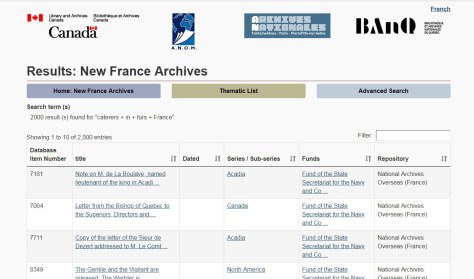
For example, I searched for the words “traiteurs+en+fourrures+France” (fur traders France, although the word traiteur now generally means caterer,) and found links to some 2000 documents stored in Canadian and French archives. A search for “commerçants en fourrures” or “commerçants de fourrures” also brought hundreds of results, but a search for “fur traders” only brought a handful. Try using Google translate before you put in your search term.

The results were in French, but a box appeared in the upper right hand corner, offering to translate into English. The page then looked like this:

new france archives results fur

Seigneuries of the Trois-Rivières Region

I originally wrote this research guide to the seigneuries of the Trois-Riviè,res region, on the north shore of the St. Lawrence River between Montreal and Quebec City, several years ago, but it was not posted at that time. Recently I improved and expanded it.

The portion about the seigneurs has been expanded by about 80% and the content of notarial acts has increased by 30%. In addition, I expanded the research process to also include local history groups, including scholars associated with the Université du Québec à Trois-Rivières (UQTR), and information from sources such as Persée, Érudit, Université Laval, University of Toronto, Ciéq, Scap and Séminaires de Nicolet.

When I began researching seigneuries of New France through Google, I usually confined the research process to Canadian-based organizations, archives and research groups. I ignored research results addressing seigneurs and seigneuries of New France which Google indicated could also be found among the 95 Archives départementales de France, the Archives nationales de France in Paris, the Archives de la Marine (France), Archives nationales d’outre-mer (France).

During the 155-year period from 1604 to 1759 when New France was a French colony, thousands of records were simply sent to France, including documents addressing the creation of a seigneury or the appointment of a bourgeois or military officer to the post of seigneur. These original documents are still in France.

Finally, by reading all of the biographies of the seigneurs listed within the attached compilation, I realized that many, if not most, of the explorers and military officers who were assigned seigneuries were also merchants, exporters, and sometimes ship owners. Most of them derived their incomes from the fur trade industry, and Trois-Rivières was a port of departure for destinations in France.

Following the British Conquest of 1759 and the arrival of Scottish immigrants, the fur industry moved from the Trois-Rivières region to Montréal and the creation of the Scottish Fur Barons of Montreal had its birth.

Click to view this PDF research guide: Seigneuries Region of Trois-Rivières 2018-09-13

The contents of this 97-page guide are as follows:

page 1,  The seigneurs, governors, explorers, military officers, fur traders and leaders of the Jesuit, Recollet and Ursuline religious orders in the area, from the beginning of the colony to the British conquest.

page 16, The seigneuries found in the following areas: on the north shore: Trois-Rivières, Maskinongé, Sainte-Anne-de-la-Pérade, Saint-Maurice, Yamachiche; on the south shore: Nicolet, Saint-Francois-du-Lac, Yamaska, Gentilly, Bécancour, Baie-du-Febvre

page 44, Regional cemeteries.

page 45, Notaries who worked in the area from the beginning of settlement until 1953, and where to locate their acts.

page 93, Links to information about the Acadians and Loyalists who came to the region.

page 94, Repositories for archival material and other resources, such as books and genealogical databases.


The Canadian Celanese and the Great Depression

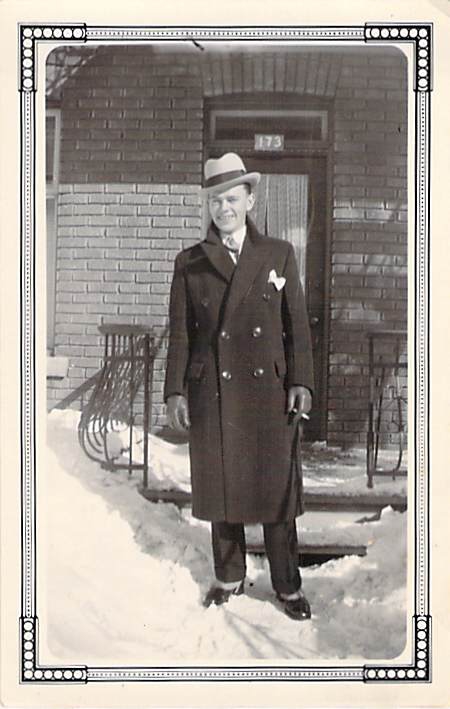
“Damn!” My dad, Edward McHugh, cursed to himself. He thought ruefully that his great idea to change his job ten months ago did not work out very well. His first job after school was in the office of Henry Birks & Sons. While he was working there, he decided to take a bookkeeping class at night at Sullivan College and the A.R. Whittell Can Company thought that he showed initiative, was a snappy dresser, and would make a good salesperson. So they hired him. It was now 1931 and he had just been laid off because sales were dropping.1

McHugh, Ed Verdun

Edward McHugh in Verdun, Quebec, in the 1930s

Now what? Edward knew that the prospects of getting a job were bleak. Luckily Edward still lived at home with his parents and his father was a foreman at the Atlas Absestos Company.2 Still, it was worrisome.

It would be two years before Edward would find employment. He spent many evenings with his brothers and sisters, playing cards. During these evenings, their supper was sandwiches, made out of a loaf of white bread, some butter, and one can of salmon. 3

Maybe the idea to go altogether to Drummondville was hatched at one of the card parties. In any event, in 1933, in the depth of the Depression, the McHugh siblings, Edward, Thomas, Sarah Jane, and Sarah’s husband Jack, decided to move to Drummondville, Quebec to find work.

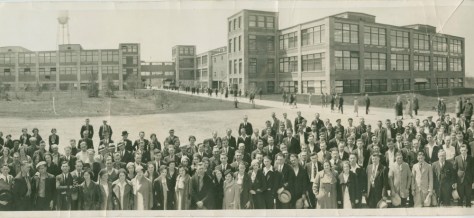
At that time and even though Quebec was hard hit by the Depression, the Canadian Celanese Company in Drummondville was a significant employer in the province, with 1,757 employees. The picture below shows the employees of the Canadian Celanese Company in that year.4

Celanese 1931

Moving to Drummondville would have been equivalent to immigrating to a new country. None of the members of the family would have had an automobile so the trip from Montreal to Drummondville would have had to be by train. As with many immigrants, their motives were financial.

As far as I know, they were all employed by the Canadian Celanese Company. The Celanese Corporation was founded in 1915 by two Swiss chemists, Camille and Henri Dreyfus and enjoyed significant success during WWI because of its development of synthetic fiber. The Canadian plant was built in 1926 in Drummondville. This location was chosen due to its proximity to a large expanse of forest, it was close to Montreal that was the centre of the textile industry at the time, and inexpensive hydro power  supplied by Southern Canadian Power was available.5

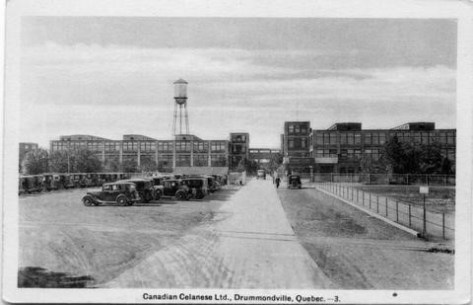
This picture of the Celanese, taken in the 1920s, shows that it was a significant manufacturing plant: 6

Celanese 1920s

My dad was hired as an electrician and worked in what was called the silk factory.7 The Celanese required electricians to work full time to ensure that the machines were never idle.

My dad and his siblings settled in and made a life in Drummondville. Both my dad and his brother, Thomas, played on the Celanese football team.8 Thomas married Simone Cloutier in 1937 and then died a year later in 1938 of an illness. Thomas is buried in the cemetery of the St. Frederic Church in Drummondville.9

Edward continued to work for the Celanese until the outbreak of the war. He signed up for duty in August 1940 at the Ste. Hyacinthe recruiting centre. The Celanese agreed to hire him once the war had finished but he did not go back.10

  1. Military records from WWII, Edward McHugh, Royal Canadian Air Force Attestation Paper. This information was in his employment records. It states that he left Henry Birks and Sons for a better job and that he was let go from A.R. Whittell because of lack of work.
  2. Although Thomas McHugh, Edward’s father, was deceased when the RCAF Attestation Paper was filled out, Thomas’ job at his death was noted. It is an assumption that he was working there in 1933. There is no indication that he was out of work during the Depression.
  3. As told to the author by her aunt, Elsie McHugh.
  4. The Ministry of Patrimoine Culturel, Province of Québec, http://www.patrimoine-culturel.gouv.qc.ca/rpcq/detail.do?methode=consulter&id=14311&type=pge#.W6gnEWhKiUk, accessed September 23, 2018.
  5. Ibid.
  6. Eastern Townships Archives Portal, https://www.townshipsarchives.ca/canadian-celanese-ltd 192?, accessed September 24, 2018.
  7. Military records from WWII, Edward McHugh, Royal Canadian Air Force Attestation Paper.
  8. Death of Thomas McHugh, “The Drummondville Spokesman,” “Thomas McHugh Passes Away,”May 27, 1938, accessed March 19, 2015. This article states that Thomas McHugh was on the Celanese football team. It is assumed that Edward was also on that team as his Attestation Paper said that he played football extensively.
  9. Marriage and death certificates of Thomas McHugh. Drouin Collection. St. Frederic Parish, Drummondville, Quebec.
  10. Military records from WWII, Edward McHugh, Royal Canadian Air Force Attestation Paper.

Using the BAnQ’s Pistard to Research Your Ancestor’s Life

Some family history researchers complain that Pistard, (pistard.banq.qc.ca), the online search tool for documents stored at the Bibliothèque et Archives nationales du Québec (BAnQ), is too complicated difficult to use because it is only in French. I beg to disagree.

The site offers its own online translation tool, users can buy their own French/English dictionaries or they can use online translation tools such as Google Translate. As for the complaint that Pistard is too complicated, I think that is a myth. Pistard by BAnQ is easy to navigate in both the normal search option and the advance search option.

Remember, Pistard is not an online database of marriages, baptisms and deaths. At the BAnQ, there is an online search engine addressing such events, and it is a good one. See http://www.banq.qc.ca/archives/genealogie_histoire_familiale/ressources/bd/

Nor does Pistard address notarial acts including marriage contracts, land purchases and sales, after-death inventories or guardianship of minors after the death of both parents. BAnQ has a superb online search engine addressing notaries. See http://bibnum2.banq.qc.ca/bna/notaires/ You can search each notary’s index of acts and, when there is an asterisk beside the notary’s name, the acts have been digitized. (Ancestry.ca also has a collection of Quebec notarial records. For hints on using it, see the blog Genealogy a la carte, Oct. 6, 2016, http://genealogyalacarte.ca/?p=16520)

Pistard does include archival resources including letters and other text documents, diagrams, land surveys, photographs, drawings and items on microfilm. It includes an online database addressing issues that were dealt with by judicial courts, judicial appointees by Governors or Lieutenant-Governors of New France or by Intendants of New France and appointees of the latter who acted on behalf of the King of France on subjects such as fraud, breach of contracts, unpaid debts, illegal transactions such as the sales of liquor to first nation people, or simply the removal of a fence.

Let me give a couple of examples using, with her permission, several ancestors of my friend and fellow genealogist Claire Lindell. Two of her pioneer ancestors were Claude Jodoin and Julien Fortin. I searched for each name in Pistard.

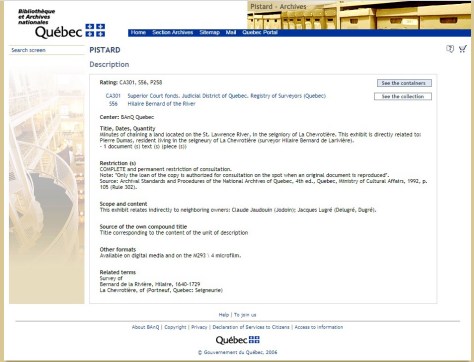
Jodoin was a neighbour of two farmers in the Seigneurie de La Chevrotière. When these two farmers argued about the location of a fence between two farms, the regional Justice of the Peace had to settle the issue.

Jodoin in Pistard EN
This is a screen shot of the search result for Claude Jodoin, translated by the BAnQ

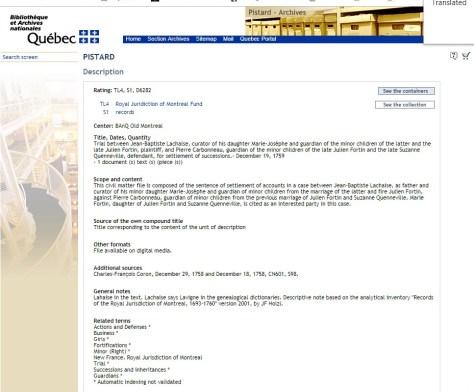
The second case I have selected deals with the children of Julien Fortin and Suzanne Quenneville. It appears that, after the death of both parents, their daughter Marie was placed under the care of a Jean-Baptiste Lachaise and/or a Pierre Charbonneau. This one is not clear: only the actual document could clarify the reason the judicial system had to solve the issue.

Fortin Pistard
A search in Pistard for Julien Fortin brought up this result, and I then applied the BAnQ’s online translation tool. 


The online description of each document posted on Pistard is only a recap of the real document, which is stored in one of the 12 branches of the BAnQ across Quebec. In some cases, Pistard will link you to an image of the original document and a brief description of the case. If not, you can obtain the complete file through an email request.

For each query on Pistard, search results indicate the Cote (Shelf)  #, the Judicial District or Region and the Dossier (file) #. Then, through an email to the repository where the document is kept, you can obtain a download within a few days, for free.

A few months back, I had a telephone conversation with a clerk at BAnQ Vieux-Montréal. I asked her, if you receive an email in the English language, will you reply in English? She replied yes, adding that she was then working on a query from Australia. The person said his ancestor, who had been a Quebec Patriot during the Rebellions of 1837-1838, had been deported to Australia. The BAnQ clerk sent this researcher numerous documents about his ancestor at no charge.

Searching the BAnQ for books and documents

The Bibliothèque et Archives nationales du Québec (BAnQ), the Quebec provincial library and archives, is making some changes to its online search tool that will impact you if you are looking for some books about history.

Pistard pistard.banq.qc.ca will continue to be the primary search tool if you are searching for documents owned by BAnQ. For example, Pistard is the place to search for records of non-criminal offenses such as unpaid purchases of goods, as well as letters and various documents, maps, diagrams and photographs. You can also find documents that were issued by Judicial Districts of New France, Quebec under British Military Rule, Quebec under Lower Canada and Quebec under Confederation.

What the BAnQ has removed from the Pistard search tool is published books which are not owned by BAnQ. You must now look for such books through the Catalogue cap.banq.qc.ca

A search for the name Bagg through Pistard, for example, brings up a list of 24 documents, several of which are plans (diagrams) of property that belonged to a member of the Stanley Bagg family. You can view images of some documents returned by a Pistard search by clicking on the word Coll. on the far right-hand side of the list of results. You can also try researching this database directly from Google by searching, for example, the words Pistard and Bagg together.

One result from Pistard refers to the records of notary Stanley Clark Bagg, but it just describes the collection. To see the index of his notarial acts, you must search on http://bibnum2.banq.qc.ca/bna/notaires/

A search for the name Bagg through the Catalogue brings up 123 results, only one of which is a book that refers to the family – an archaeological report on the house of Abner Bagg, built in 1821.

If you wish to borrow the excellent book by John Francis Bosher, Négociants et navires du commerce avec le Canada de 1660 à 1760, you would now (2018) conduct your online search through the BAnQ Catalogue.

If you want to borrow the English-language version of the same book by J.F. Bosher, Men and ships in the Canada Trade, 1660-1760A biographical dictionary by J.F. Bosher, the online search process is also done through the new BAnQ Catalogue.

The publisher of these two books, Canada Environment – Canadian Parks Services, has discontinued the sales of the English-language version of this superb book. According to the policy of BAnQ in regard to Canadian authors and Canadian publishers, once a book has been removed from the marketplace, BAnQ will digitize that book and the digitized version can be viewed at two of the 12 repositories of the BAnQ: the Collection nationale within the Grande Bibliothèque de Montréal; and BAnQ Québec – Archives nationales du Québec at Université Laval in Quebec City.

You must reserve such digitized books by email. Only the person who has ordered a book by email can have access to these precious and discontinued books. I did so about a month ago, but I have yet to visit the Collection nationale. At my next visit, I will be reminded politely by one of the librarians or technicians that I have not yet reviewed that book on one of the four library computers reserved for such services.

I will explain other aspects of searching on Pistard in future posts.

Seigneuries of the Lower St. Lawrence and of the Côte-du-Sud

If some of your ancestors lived along the south shore of the Lower St. Lawrence River (the Bas Saint-Laurent, as it is often called today,) the attached PDF compilation is designed to help you learn more about their lives.

See PDF:  Seigniories of the Lower St. Lawrence – Revised Version 2018-09-03

The river is tidal here, and so broad that the far north shore is hardly visible. This beautiful area of rolling farmland and salt marshes has been settled for generations, with many residents making a living fishing, building boats and transporting goods and people on the river.

south shore egret
South shore of the Lower St. Lawrence River

Until the 1850s, almost all the land was owned by a few individuals, known as seigneurs, who rented it out to the censitaires, or tenant farmers. Most seigneurs were honest and caring individuals who took care of their tenants. They granted lands to the settlers and financed their first years with money, food, cattle and other animals, farm equipment, wood-cutting tools, building tools and rifles.

In return, the censitaires would repay on a yearly basis their seigneur with beaver furs and other types of fur. They also repaid them with hard-wood, a precious commodity in the 17th century in Europe, for most hard-wood forests no longer existed on the European continent. If the seigneur and his family resided on the seigneury, the censitaires would bring them eggs and meat, as well as fresh milk.

south shore famrland
Farmland along the south shore of the Lower St. Lawrence

Many of the seigneurs on the attached list were merchants or fur traders, and obtained most of their revenue from the sale of wild furs and hard-wood. Some were importers and exporters and dealt with merchants in French port cities such as La Rochelle, Bordeaux, Rouen and Le Havre.

The compilation on the PDF attached includes six main sections:

The Seigneurs: this section focuses on the historic landowners on the south shore of the Lower St. Lawrence, including links to biographies of these individuals.

Regions: the geographic regions described in this compilation are Montmagny, l’Islet, Kamouraska, Témiscouata, Rivière-du-Loup, Les Basques, Rimouski, Neigette, La Mitis (Métis), Matapedia and Matane in the Gaspé.

Cemeteries: a list of historic cemeteries in this area.

Notaries: this compilation includes the names of notaries who worked in this region, the places and years they practised, and the archives where their acts can be found today. The notaries handled important legal documents for people, including wills, marriage contracts, business agreements, land rental and sales agreements, and protests in cases of disagreement.

Bibiothèque et Archives nationales du Québec (BAnQ): locations and contact information for the archives, and how to order documents online.

Genealogical and historical societies in the region: contact information

With regard to the notaries listed in the attached PDF, the majority of the notarial acts can be obtained through the BAnQ online (free, http://bibnum2.banq.qc.ca/bna/notaires/ or http://www.banq.qc.ca/archives/genealogie_histoire_familiale/genealogie_banq/guide/archives-notariales/index.html), FamilySearch.org (free), or Ancestry.com (subscription). Ancestry has two distinct databases covering different time periods during the lifetime of a notary. Also listed are the notarial acts which can be obtained through Généalogie Québec (Drouin Institute online), (https://www.genealogiequebec.com/en/.

For each notary selected, if a URL address has been posted, this indicates that the genealogy provider’s online databases contains notarial acts. If a URL address has not been posted, this simply indicates that the provider does not own fonds of this particular notary.

Keeping Up with the Montgomerys

autoshow

Montreal Auto Show. 1914. McCord Museum photograph

Roads trips. They have been a staple of life in North America for over one hundred years and it all began around 1910 in American and Canadian towns.

In big cities like New York or Montreal there was little need for an automobile, what with the streetcars and subways. As silent film footage from the era shows, the city roads were preposterously chaotic.

But, in the  towns during the warmer months, anyway, an auto was both useful to get around and quite the status symbol for the well-off professional man.

Case in point: Dufferin Street in Richmond, Quebec, a leafy stretch lined with red-brick homes in the Queen Anne Revival style.(1)

In 1910, the Skinners, the Nicholsons and the Montgomerys are neighbours on the north side of Dufferin.

Floyd  Skinner, a dentist, buys his first auto in 1909. So does Nathan Montgomery, a man in his forties who is already retired. (2)

Margaret Nicholson, my husband’s great grandmother, living in the pretty house called “Tighsolas” between them, doesn’t think much of these extravagant testosterone-fueled impulse purchases. She writes this in a letter to her husband, Norman, who is away in Northern Ontario working on the railroad:

“Mr. Montgomery is going to buy an automobile. He is getting rid of his horse. Don’t you think he’s foolish?  I would not want one. They are too dangerous.” (3)

TheNicholsos

Norman and Margaret Nicholson, daughters Edith and Marion and Aunt Christine Watters.

 The Nicholsons, you see, never, ever, get to own an automobile. In 1910, they are house-rich but cash poor. They cannot begin to afford a ‘motor’ because in 1910  autos can cost as much as a fine house, in the 2,000 to 4,000 dollar range. (4)

If Margaret Nicholson is very wary of the newfangled horseless carriage, her daughter, Marion, my husband’s grandmother, is not. In fact, she accompanies the Montgomerys on their 1909  auto-buying excursion in Montreal.  Marion, a teacher in the city, tells her mother about it in a letter but wrapped in a little white  lie. “I bumped into the Montgomerys on the street. He is buying an auto and she is in for a shirtwaist suit.”

I suspect this is a lie because in the Nicholson family album there is a photograph of Marion and Mr. and Mrs. Montgomery posing in front of the Motor Import Company of Canada on Atwater and St. Catherine. Marion likely had planned to meet the Montgomerys all along.

MarionMON.PNG

Marion, left, caught in the act of accompanying her neighbours on an auto-buying excursion.

If Margaret felt autos were dangerous, her eldest daughter, Edith, also a teacher, clearly did not.  In the summer of 1911, Edith traveled all the way to Montreal by motor with the Skinners.  Here’s how Edith described her trip in a letter to her dad:

“As you will see by the address, I am in Montreal. I came in with Dr. and Mrs. Skinner in the motor Friday. Left home at 10 am and got to Waterloo at 12.30 had dinner. Saw all we could of the town and left at 2 for Montreal, got here at quarter past six. Without one break down. It was a beautiful day and we enjoyed every minute of it.

I will name the places we passed through so you will know the country we passed through. Melbourne, Flodden, Racine, Sawyerville, Warden, Waterloo, Granby, Abbotsford, St Caesar, Rougemont, Marieville, Chambly, Longueil, St. Lambert, Pointe St Charles.

Don’t you think I was a very fortunate girl to have such a trip?


Itineray

1911 itinerary.  6 ½ hours for 93 miles.  The speed limit in the city was 8 miles an hour and 15 miles an hour in the country.

 The Eastern Townships is a very hilly place so this pleasure trip must have been quite the  roller-coaster ride for Edith and possibly a bit hard on the, ahem, lower body, especially if Edith was wearing a tight corset under her ‘duster coat.’ (5)

In 1910, autos were considered toys. Motoring was considered a fad, a pastime. The preface to the special insert promoting the 1910 Westmount Horse Show in the Montreal Gazette claims, “The automobile will never replace the horse in Man’s affection.” (6)

So wrong.

Although it was wealthy males who kick-started the automobile revolution, it was women and teenagers who had the most to gain from it.  They were free at last to travel far and wide on their own.

freeatlast.PNG

Free at Last! Margaret’s youngest daughter Flora and friends on an automobile ride in the country circa 1920.

So, here we have three houses on Dufferin Street in Richmond, Quebec – and already two automobiles.

Still, if you pay attention to her actions and not her words, it  is clear that Margaret Nicholson doesn’t really hate autos. Margaret often allows Mr. Skinner or Mr. Montgomery to take her to the mail to post letters to her husband.

 What she says to Norman in her letters is to soothe his prickly pride, that’s all.

To make things worse, just around the corner on posh College Street live Isabella and Clayton Hill, Margaret’s sister and brother-in-law. Clayton is a prosperous stone-mason and, much to Margaret’s chagrin, he owns an especially fine automobile.

Clayton'sauto

Magical Mystery Tour Car. Clayton’s Auto. A Pierce Arrow, perhaps. Very expensive at about 5,000 dollars.

Margaret is always feuding with Clayton and her sister mostly over the care of her elderly mother.

She remains bitter about her relations’ good fortune. In another letter to her husband she writes: “Clayton’s auto has broken down again. Isabel says the repairs are costing a fortune. Aren’t we lucky not to have one.”

Then, again, she accepts rides from her brother-in-law on occasion.

In 1910, there was no resisting the lure of the motorcar. The swanky male ‘toy’  was already proving to be indispensable even to its most vocal female critics.

Nichsolsonhomeafewdaysago

Tighsolas as it looks today.

  1. Richmond was a railway town, on the decline, between Portland, Maine and Montreal, Quebec. Queen Anne Revival style homes had irregular roofs, turrets, and lots of gingerbread moulding.
  2. On the 1911 Canada Census
  3. Nicholson Family Letters. Author’s collection.
  4. This was all changing with the Model-T Ford, and mass assembly. In 1910 Ford claimed his factory was putting out 1,000 autos a day. And he paid his people good salaries so they too could buy an auto. Soon, average middle class families could own a motorcar at around 400 to 600 dollars.
  5. Duster coats were long affairs meant to keep women’s clothes clean. Cars with an internal combustion engine were notoriously dirty.  Steam driven cars were dangerous and noisy. Electric cars, clean but slower-moving, were aimed at women in advertising, and, maybe, just for that reason, they did not catch on, at least until 100 years later.
  6. Magazine articles of the era were already pointing out that ‘the Billion Dollar Toy’ was creating significant waves in the economy, a sign that the auto wasn’t merely a toy but here to stay. By mid-century automobiles and automobile parts were the driver of the US economy.