Category Archives: Quebec

Using the BAnQ’s Pistard to Research Your Ancestor’s Life

Some family history researchers complain that Pistard, (pistard.banq.qc.ca), the online search tool for documents stored at the Bibliothèque et Archives nationales du Québec (BAnQ), is too complicated difficult to use because it is only in French. I beg to disagree.

The site offers its own online translation tool, users can buy their own French/English dictionaries or they can use online translation tools such as Google Translate. As for the complaint that Pistard is too complicated, I think that is a myth. Pistard by BAnQ is easy to navigate in both the normal search option and the advance search option.

Remember, Pistard is not an online database of marriages, baptisms and deaths. At the BAnQ, there is an online search engine addressing such events, and it is a good one. See http://www.banq.qc.ca/archives/genealogie_histoire_familiale/ressources/bd/

Nor does Pistard address notarial acts including marriage contracts, land purchases and sales, after-death inventories or guardianship of minors after the death of both parents. BAnQ has a superb online search engine addressing notaries. See http://bibnum2.banq.qc.ca/bna/notaires/ You can search each notary’s index of acts and, when there is an asterisk beside the notary’s name, the acts have been digitized. (Ancestry.ca also has a collection of Quebec notarial records. For hints on using it, see the blog Genealogy a la carte, Oct. 6, 2016, http://genealogyalacarte.ca/?p=16520)

Pistard does include archival resources including letters and other text documents, diagrams, land surveys, photographs, drawings and items on microfilm. It includes an online database addressing issues that were dealt with by judicial courts, judicial appointees by Governors or Lieutenant-Governors of New France or by Intendants of New France and appointees of the latter who acted on behalf of the King of France on subjects such as fraud, breach of contracts, unpaid debts, illegal transactions such as the sales of liquor to first nation people, or simply the removal of a fence.

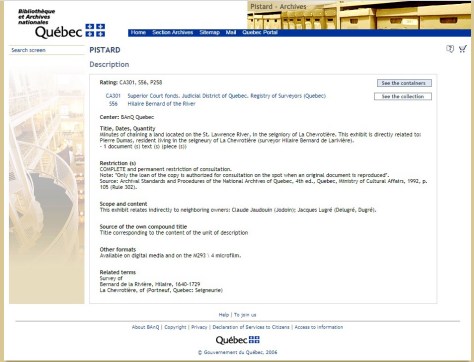
Let me give a couple of examples using, with her permission, several ancestors of my friend and fellow genealogist Claire Lindell. Two of her pioneer ancestors were Claude Jodoin and Julien Fortin. I searched for each name in Pistard.

Jodoin was a neighbour of two farmers in the Seigneurie de La Chevrotière. When these two farmers argued about the location of a fence between two farms, the regional Justice of the Peace had to settle the issue.

Jodoin in Pistard EN
This is a screen shot of the search result for Claude Jodoin, translated by the BAnQ

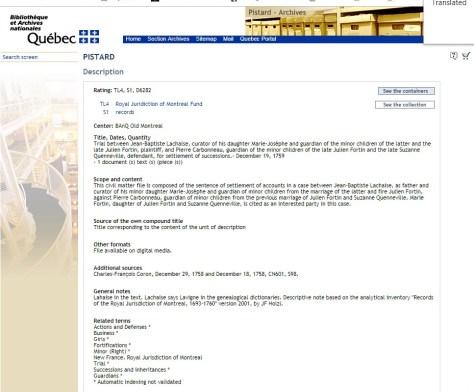
The second case I have selected deals with the children of Julien Fortin and Suzanne Quenneville. It appears that, after the death of both parents, their daughter Marie was placed under the care of a Jean-Baptiste Lachaise and/or a Pierre Charbonneau. This one is not clear: only the actual document could clarify the reason the judicial system had to solve the issue.

Fortin Pistard
A search in Pistard for Julien Fortin brought up this result, and I then applied the BAnQ’s online translation tool. 


The online description of each document posted on Pistard is only a recap of the real document, which is stored in one of the 12 branches of the BAnQ across Quebec. In some cases, Pistard will link you to an image of the original document and a brief description of the case. If not, you can obtain the complete file through an email request.

For each query on Pistard, search results indicate the Cote (Shelf)  #, the Judicial District or Region and the Dossier (file) #. Then, through an email to the repository where the document is kept, you can obtain a download within a few days, for free.

A few months back, I had a telephone conversation with a clerk at BAnQ Vieux-Montréal. I asked her, if you receive an email in the English language, will you reply in English? She replied yes, adding that she was then working on a query from Australia. The person said his ancestor, who had been a Quebec Patriot during the Rebellions of 1837-1838, had been deported to Australia. The BAnQ clerk sent this researcher numerous documents about his ancestor at no charge.

Searching the BAnQ for books and documents

The Bibliothèque et Archives nationales du Québec (BAnQ), the Quebec provincial library and archives, is making some changes to its online search tool that will impact you if you are looking for some books about history.

Pistard pistard.banq.qc.ca will continue to be the primary search tool if you are searching for documents owned by BAnQ. For example, Pistard is the place to search for records of non-criminal offenses such as unpaid purchases of goods, as well as letters and various documents, maps, diagrams and photographs. You can also find documents that were issued by Judicial Districts of New France, Quebec under British Military Rule, Quebec under Lower Canada and Quebec under Confederation.

What the BAnQ has removed from the Pistard search tool is published books which are not owned by BAnQ. You must now look for such books through the Catalogue cap.banq.qc.ca

A search for the name Bagg through Pistard, for example, brings up a list of 24 documents, several of which are plans (diagrams) of property that belonged to a member of the Stanley Bagg family. You can view images of some documents returned by a Pistard search by clicking on the word Coll. on the far right-hand side of the list of results. You can also try researching this database directly from Google by searching, for example, the words Pistard and Bagg together.

One result from Pistard refers to the records of notary Stanley Clark Bagg, but it just describes the collection. To see the index of his notarial acts, you must search on http://bibnum2.banq.qc.ca/bna/notaires/

A search for the name Bagg through the Catalogue brings up 123 results, only one of which is a book that refers to the family – an archaeological report on the house of Abner Bagg, built in 1821.

If you wish to borrow the excellent book by John Francis Bosher, Négociants et navires du commerce avec le Canada de 1660 à 1760, you would now (2018) conduct your online search through the BAnQ Catalogue.

If you want to borrow the English-language version of the same book by J.F. Bosher, Men and ships in the Canada Trade, 1660-1760A biographical dictionary by J.F. Bosher, the online search process is also done through the new BAnQ Catalogue.

The publisher of these two books, Canada Environment – Canadian Parks Services, has discontinued the sales of the English-language version of this superb book. According to the policy of BAnQ in regard to Canadian authors and Canadian publishers, once a book has been removed from the marketplace, BAnQ will digitize that book and the digitized version can be viewed at two of the 12 repositories of the BAnQ: the Collection nationale within the Grande Bibliothèque de Montréal; and BAnQ Québec – Archives nationales du Québec at Université Laval in Quebec City.

You must reserve such digitized books by email. Only the person who has ordered a book by email can have access to these precious and discontinued books. I did so about a month ago, but I have yet to visit the Collection nationale. At my next visit, I will be reminded politely by one of the librarians or technicians that I have not yet reviewed that book on one of the four library computers reserved for such services.

I will explain other aspects of searching on Pistard in future posts.

Seigneuries of the Lower St. Lawrence and of the Côte-du-Sud

If some of your ancestors lived along the south shore of the Lower St. Lawrence River (the Bas Saint-Laurent, as it is often called today,) the attached PDF compilation is designed to help you learn more about their lives.

See PDF:  Seigniories of the Lower St. Lawrence – Revised Version 2018-09-03

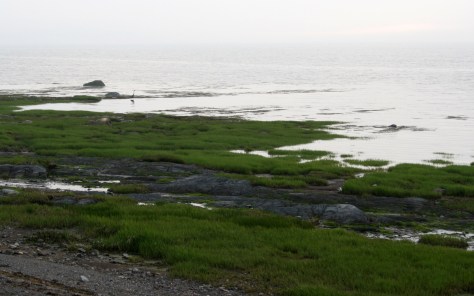
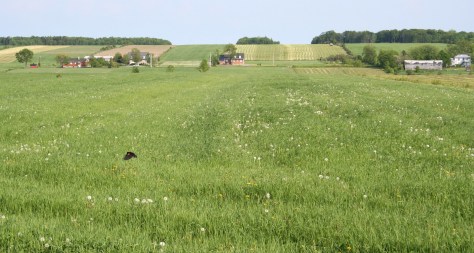
The river is tidal here, and so broad that the far north shore is hardly visible. This beautiful area of rolling farmland and salt marshes has been settled for generations, with many residents making a living fishing, building boats and transporting goods and people on the river.

south shore egret
South shore of the Lower St. Lawrence River

Until the 1850s, almost all the land was owned by a few individuals, known as seigneurs, who rented it out to the censitaires, or tenant farmers. Most seigneurs were honest and caring individuals who took care of their tenants. They granted lands to the settlers and financed their first years with money, food, cattle and other animals, farm equipment, wood-cutting tools, building tools and rifles.

In return, the censitaires would repay on a yearly basis their seigneur with beaver furs and other types of fur. They also repaid them with hard-wood, a precious commodity in the 17th century in Europe, for most hard-wood forests no longer existed on the European continent. If the seigneur and his family resided on the seigneury, the censitaires would bring them eggs and meat, as well as fresh milk.

south shore famrland
Farmland along the south shore of the Lower St. Lawrence

Many of the seigneurs on the attached list were merchants or fur traders, and obtained most of their revenue from the sale of wild furs and hard-wood. Some were importers and exporters and dealt with merchants in French port cities such as La Rochelle, Bordeaux, Rouen and Le Havre.

The compilation on the PDF attached includes six main sections:

The Seigneurs: this section focuses on the historic landowners on the south shore of the Lower St. Lawrence, including links to biographies of these individuals.

Regions: the geographic regions described in this compilation are Montmagny, l’Islet, Kamouraska, Témiscouata, Rivière-du-Loup, Les Basques, Rimouski, Neigette, La Mitis (Métis), Matapedia and Matane in the Gaspé.

Cemeteries: a list of historic cemeteries in this area.

Notaries: this compilation includes the names of notaries who worked in this region, the places and years they practised, and the archives where their acts can be found today. The notaries handled important legal documents for people, including wills, marriage contracts, business agreements, land rental and sales agreements, and protests in cases of disagreement.

Bibiothèque et Archives nationales du Québec (BAnQ): locations and contact information for the archives, and how to order documents online.

Genealogical and historical societies in the region: contact information

With regard to the notaries listed in the attached PDF, the majority of the notarial acts can be obtained through the BAnQ online (free, http://bibnum2.banq.qc.ca/bna/notaires/ or http://www.banq.qc.ca/archives/genealogie_histoire_familiale/genealogie_banq/guide/archives-notariales/index.html), FamilySearch.org (free), or Ancestry.com (subscription). Ancestry has two distinct databases covering different time periods during the lifetime of a notary. Also listed are the notarial acts which can be obtained through Généalogie Québec (Drouin Institute online), (https://www.genealogiequebec.com/en/.

For each notary selected, if a URL address has been posted, this indicates that the genealogy provider’s online databases contains notarial acts. If a URL address has not been posted, this simply indicates that the provider does not own fonds of this particular notary.

Keeping Up with the Montgomerys

autoshow

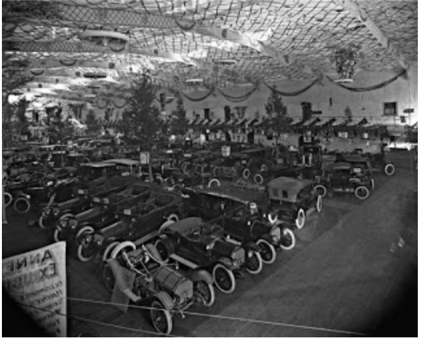
Montreal Auto Show. 1914. McCord Museum photograph

Roads trips. They have been a staple of life in North America for over one hundred years and it all began around 1910 in American and Canadian towns.

In big cities like New York or Montreal there was little need for an automobile, what with the streetcars and subways. As silent film footage from the era shows, the city roads were preposterously chaotic.

But, in the  towns during the warmer months, anyway, an auto was both useful to get around and quite the status symbol for the well-off professional man.

Case in point: Dufferin Street in Richmond, Quebec, a leafy stretch lined with red-brick homes in the Queen Anne Revival style.(1)

In 1910, the Skinners, the Nicholsons and the Montgomerys are neighbours on the north side of Dufferin.

Floyd  Skinner, a dentist, buys his first auto in 1909. So does Nathan Montgomery, a man in his forties who is already retired. (2)

Margaret Nicholson, my husband’s great grandmother, living in the pretty house called “Tighsolas” between them, doesn’t think much of these extravagant testosterone-fueled impulse purchases. She writes this in a letter to her husband, Norman, who is away in Northern Ontario working on the railroad:

“Mr. Montgomery is going to buy an automobile. He is getting rid of his horse. Don’t you think he’s foolish?  I would not want one. They are too dangerous.” (3)
TheNicholsos

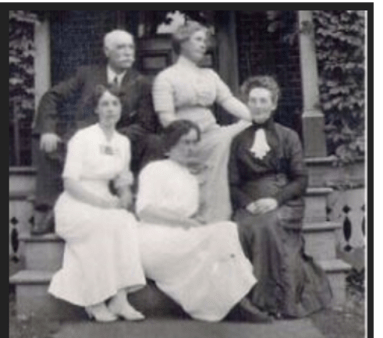
Norman and Margaret Nicholson, daughters Edith and Marion and Aunt Christine Watters.

 The Nicholsons, you see, never, ever, get to own an automobile. In 1910, they are house-rich but cash poor. They cannot begin to afford a ‘motor’ because in 1910  autos can cost as much as a fine house, in the 2,000 to 4,000 dollar range. (4)

If Margaret Nicholson is very wary of the newfangled horseless carriage, her daughter, Marion, my husband’s grandmother, is not. In fact, she accompanies the Montgomerys on their 1909  auto-buying excursion in Montreal.  Marion, a teacher in the city, tells her mother about it in a letter but wrapped in a little white  lie. “I bumped into the Montgomerys on the street. He is buying an auto and she is in for a shirtwaist suit.”

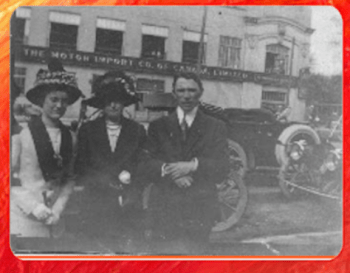
I suspect this is a lie because in the Nicholson family album there is a photograph of Marion and Mr. and Mrs. Montgomery posing in front of the Motor Import Company of Canada on Atwater and St. Catherine. Marion likely had planned to meet the Montgomerys all along.
MarionMON.PNG

Marion, left, caught in the act of accompanying her neighbours on an auto-buying excursion.

If Margaret felt autos were dangerous, her eldest daughter, Edith, also a teacher, clearly did not.  In the summer of 1911, Edith traveled all the way to Montreal by motor with the Skinners.  Here’s how Edith described her trip in a letter to her dad:

“As you will see by the address, I am in Montreal. I came in with Dr. and Mrs. Skinner in the motor Friday. Left home at 10 am and got to Waterloo at 12.30 had dinner. Saw all we could of the town and left at 2 for Montreal, got here at quarter past six. Without one break down. It was a beautiful day and we enjoyed every minute of it.

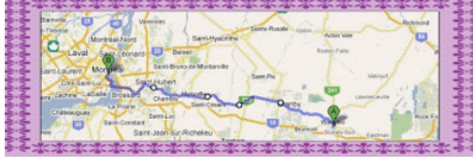
I will name the places we passed through so you will know the country we passed through. Melbourne, Flodden, Racine, Sawyerville, Warden, Waterloo, Granby, Abbotsford, St Caesar, Rougemont, Marieville, Chambly, Longueil, St. Lambert, Pointe St Charles.

Don’t you think I was a very fortunate girl to have such a trip?
 

Itineray

1911 itinerary.  6 ½ hours for 93 miles.  The speed limit in the city was 8 miles an hour and 15 miles an hour in the country.

 The Eastern Townships is a very hilly place so this pleasure trip must have been quite the  roller-coaster ride for Edith and possibly a bit hard on the, ahem, lower body, especially if Edith was wearing a tight corset under her ‘duster coat.’ (5)

In 1910, autos were considered toys. Motoring was considered a fad, a pastime. The preface to the special insert promoting the 1910 Westmount Horse Show in the Montreal Gazette claims, “The automobile will never replace the horse in Man’s affection.” (6)

So wrong.

Although it was wealthy males who kick-started the automobile revolution, it was women and teenagers who had the most to gain from it.  They were free at last to travel far and wide on their own.
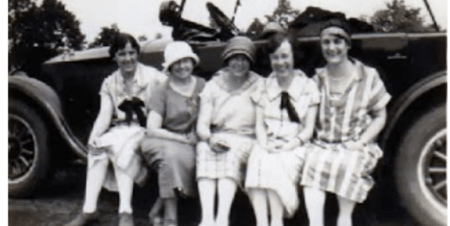
freeatlast.PNG

Free at Last! Margaret’s youngest daughter Flora and friends on an automobile ride in the country circa 1920.

So, here we have three houses on Dufferin Street in Richmond, Quebec – and already two automobiles.

Still, if you pay attention to her actions and not her words, it  is clear that Margaret Nicholson doesn’t really hate autos. Margaret often allows Mr. Skinner or Mr. Montgomery to take her to the mail to post letters to her husband.

 What she says to Norman in her letters is to soothe his prickly pride, that’s all.

To make things worse, just around the corner on posh College Street live Isabella and Clayton Hill, Margaret’s sister and brother-in-law. Clayton is a prosperous stone-mason and, much to Margaret’s chagrin, he owns an especially fine automobile.
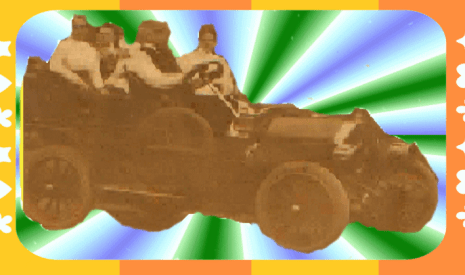
Clayton'sauto

Magical Mystery Tour Car. Clayton’s Auto. A Pierce Arrow, perhaps. Very expensive at about 5,000 dollars.

Margaret is always feuding with Clayton and her sister mostly over the care of her elderly mother.

She remains bitter about her relations’ good fortune. In another letter to her husband she writes: “Clayton’s auto has broken down again. Isabel says the repairs are costing a fortune. Aren’t we lucky not to have one.”

Then, again, she accepts rides from her brother-in-law on occasion.

In 1910, there was no resisting the lure of the motorcar. The swanky male ‘toy’  was already proving to be indispensable even to its most vocal female critics.
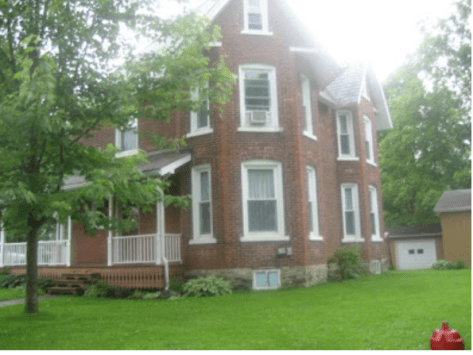
Nichsolsonhomeafewdaysago

Tighsolas as it looks today.

  1. Richmond was a railway town, on the decline, between Portland, Maine and Montreal, Quebec. Queen Anne Revival style homes had irregular roofs, turrets, and lots of gingerbread moulding.
  2. On the 1911 Canada Census
  3. Nicholson Family Letters. Author’s collection.
  4. This was all changing with the Model-T Ford, and mass assembly. In 1910 Ford claimed his factory was putting out 1,000 autos a day. And he paid his people good salaries so they too could buy an auto. Soon, average middle class families could own a motorcar at around 400 to 600 dollars.
  5. Duster coats were long affairs meant to keep women’s clothes clean. Cars with an internal combustion engine were notoriously dirty.  Steam driven cars were dangerous and noisy. Electric cars, clean but slower-moving, were aimed at women in advertising, and, maybe, just for that reason, they did not catch on, at least until 100 years later.
  6. Magazine articles of the era were already pointing out that ‘the Billion Dollar Toy’ was creating significant waves in the economy, a sign that the auto wasn’t merely a toy but here to stay. By mid-century automobiles and automobile parts were the driver of the US economy.

 

Uncle Paul to All

(Updated – “Be Kind” is my new motto and Uncle Paul was one of the kindest people ever!)

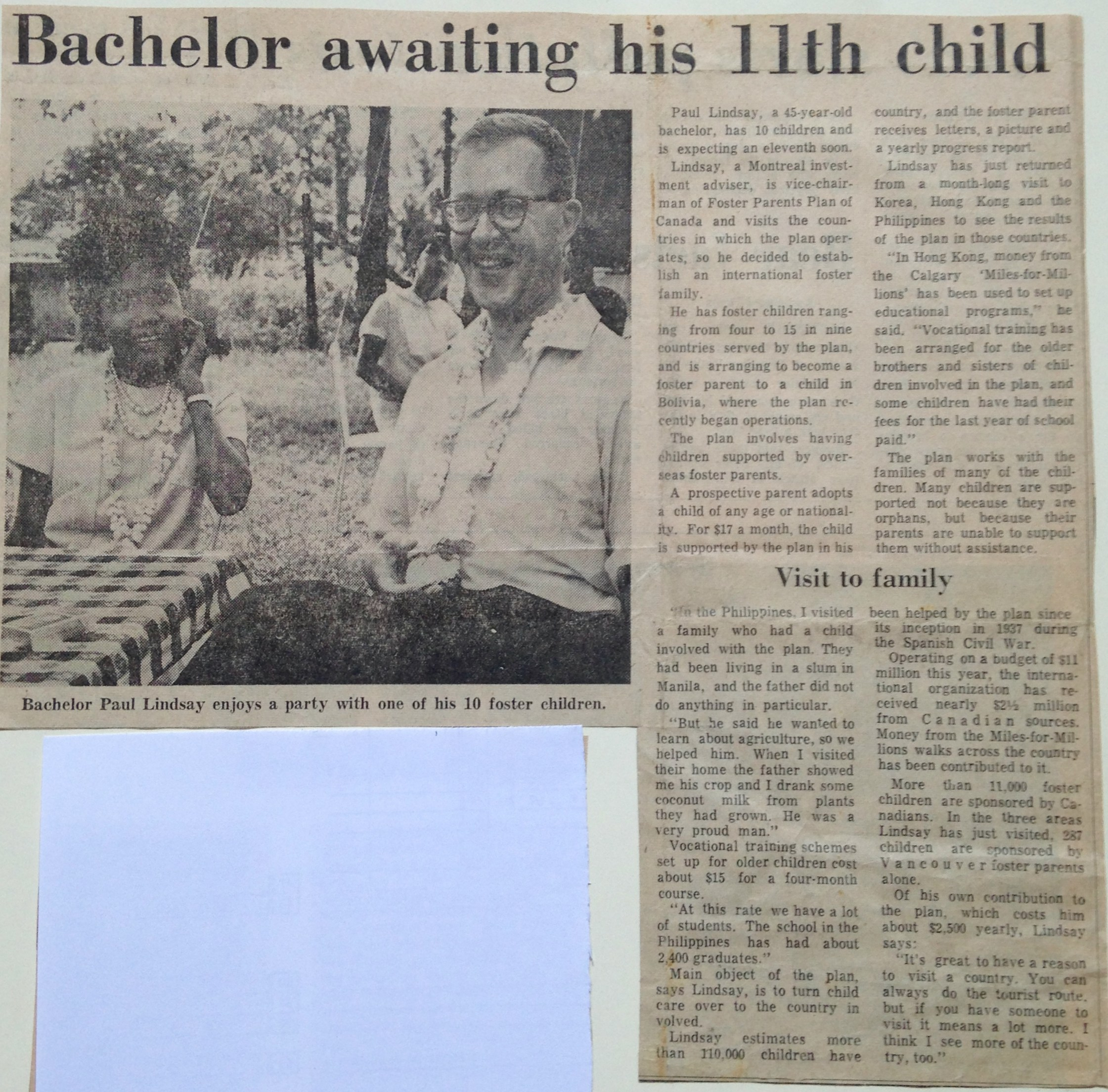
The headline read: “Bachelor awaiting his 11th child”. The 1969 newspaper article covered my Uncle Paul’s month-long trip to Korea, Hong Kong and the Philippines to visit “all his children”[1]. He sponsored his first foster child in 1961 and, eight years later, he had 11 foster children.

IMG_3028
1969 – Uncle Paul travels internationally to visit his foster children.

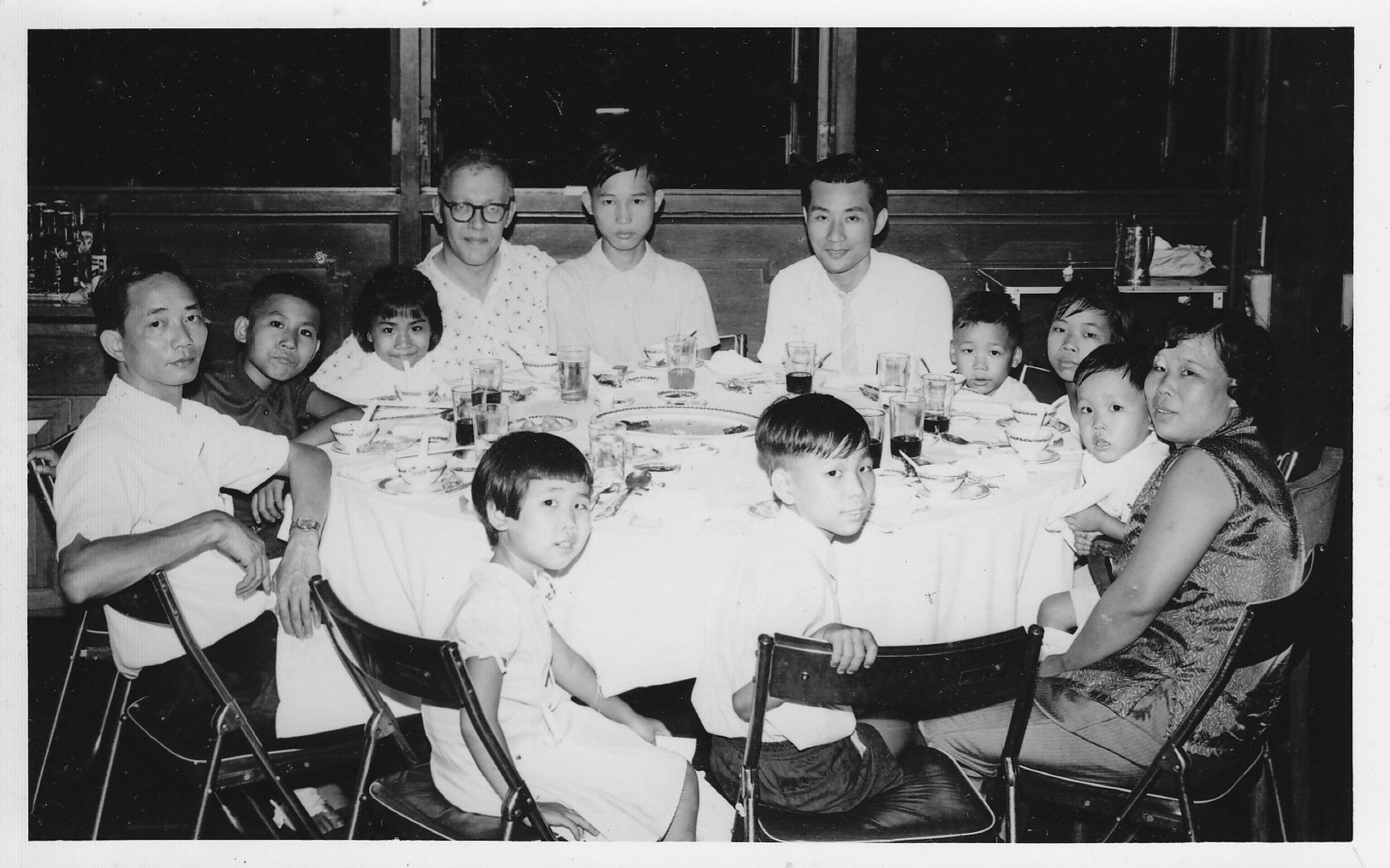
My uncle, Paul Lindsay (1923-1987), was my mother’s only brother. He was interested in how the money raised by the Foster Parents Plan[2] was spent helping children and their families in developing countries. So, in 1969, he booked the first of several trips at his own expense and visited all his foster children in person. He was greeted like a hero everywhere – sometimes with a banner across the main street reading “Welcome Uncle Paul”.

Foster Kids 1969
Uncle Paul with some of his foster children and their family.

He served for 20 years as a director of both the Canadian and international organizations of Foster Parents Plan (now known as Plan International).  His ultimate dream was to have two children, a boy and a girl, in each of the areas served by the organization.

Uncle Paul worked as a stockbroker with the Montreal brokerage firm MacDougall, MacDougall, MacTier.  Every weekday afternoon, he left work early and volunteered two hours of his time at The Montreal Children’s Hospital, playing with the kids in the orthopaedic ward. He was much appreciated and recognized as one of their principal volunteers during that time. Years later, I wrote and dedicated a children’s book to him called Bonnie – The Car with a Heart.[3] All proceeds from the sale of the book were donated to the Montreal Children’s Hospital in his memory. But not even “Bonnie” had a heart as big as Uncle Paul!

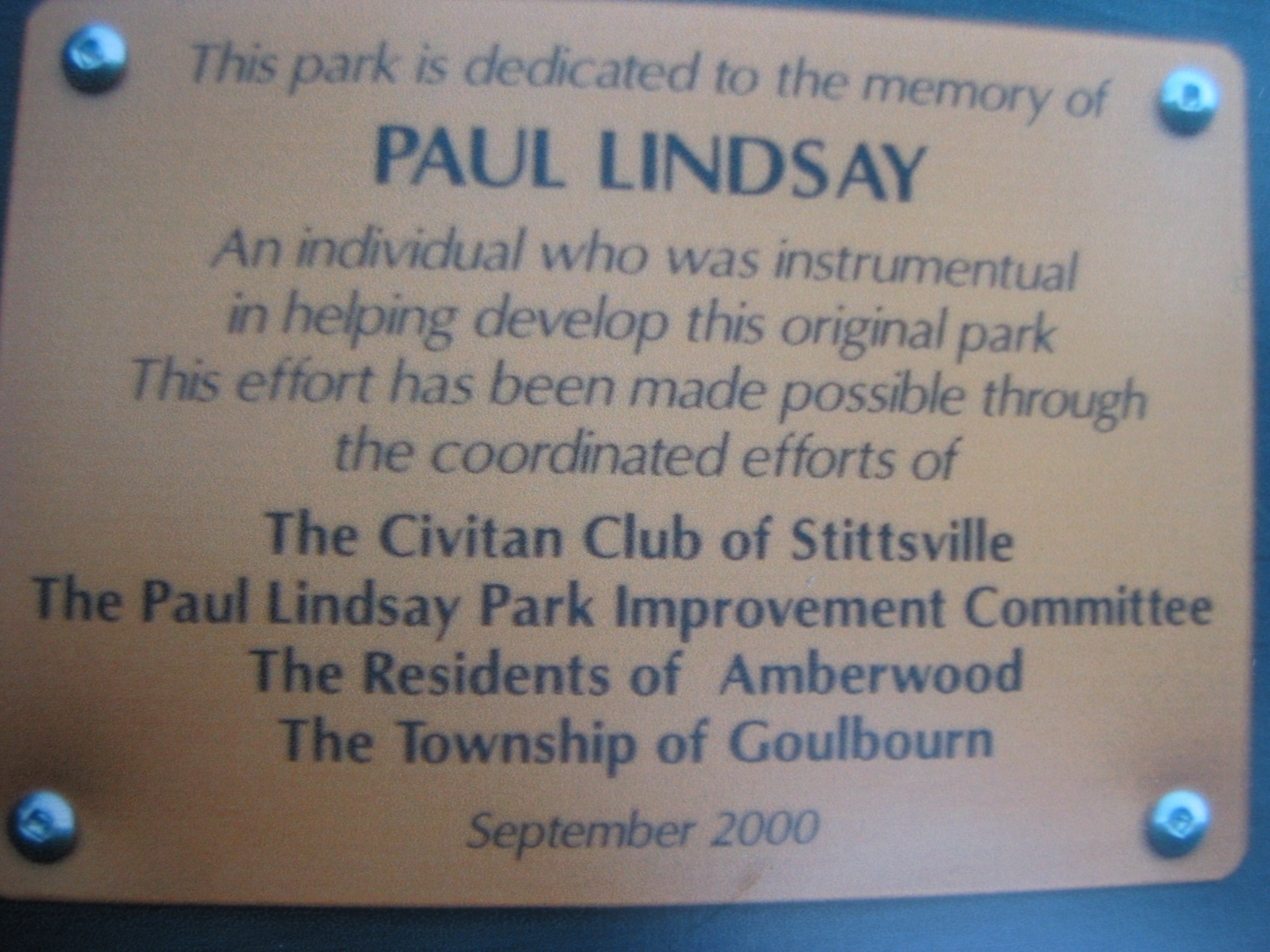
After his retirement in 1983, he moved from Montreal to Amberwood, a small community in Stittsville  just west of Ottawa. He quickly became a well-known member of his new community. One of his proudest moments was being approved as a “block parent” with their official sign posted in his window. In the year 2000, shortly after his death, the local park he helped develop for the neighborhood children was named after him.

Paul Lindsay memorial
Paul Lindsay Park Dedication
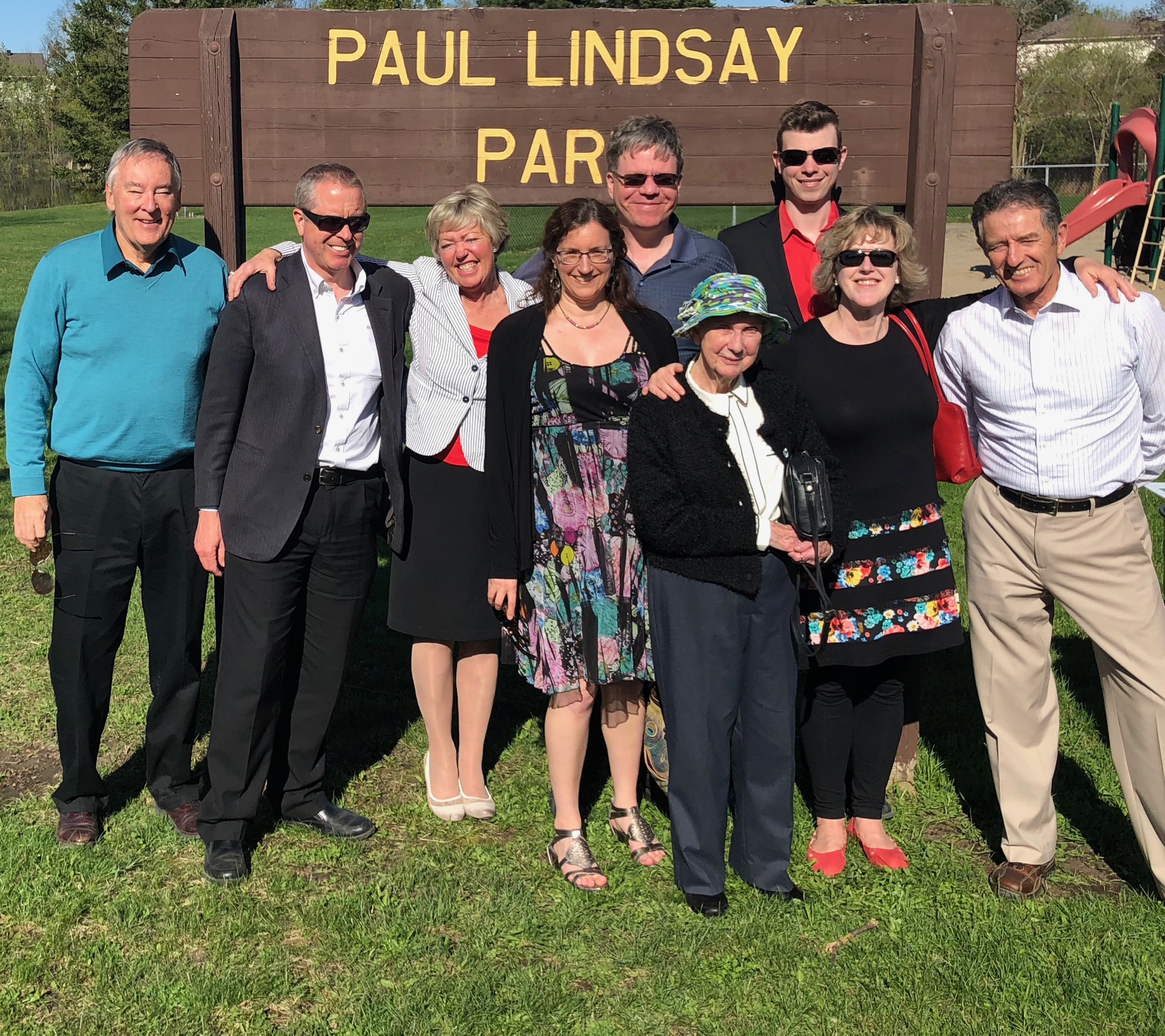
IMG_0839
Uncle Paul’s Nieces, Nephews and Family – May 2018

Another of his passions in life was music, listening to his high-end audio system as well as singing with the Montreal Elgar Choir for 30 Years[4]. When I was very little, he would cup my ear and say my pet name, “Little Lou”, in his deep baritone voice. The vibration tickled and made me shiver with delight.

Uncle Paul loved games! Perhaps it was the child in him. All kinds of games: golf, bowling, cards, Scrabble … and betting games at racetracks and casinos! He had a holiday apartment in the French Riviera (possibly purchased with his casino winnings? Who knows!) When in town, the French children would gather at the local café waiting for “Oncle Paul,” eager for the promised coin or two. I stayed there with him one night in 1974 while backpacking around Europe with a friend. The next day, he bid us “au revoir” both of us with our own bottle of French perfume as a gift.

My cousins and siblings all have fond memories of our Uncle Paul.  We never minded sharing him though; after all, he was Uncle Paul to all!

[1] The Province, Vancouver, BC – August 12, 1969

[2] https://wiki2.org/en/Plan_Canada – as referenced August 12, 2018

[3] Bonnie – The Car with a Heart, written and published by Lucy H. Anglin – September 2010

[4] https://www.thecanadianencyclopedia.ca/en/article/montreal-elgar-choirchorale-elgar-de-montreal-emc/ – as referenced August 12, 2018

The Seigneuries and Townships of Beauce, Bellechasse, Dorchester and Lotbinière

(Note, this is my last post until September. I have many more compilations ready to post then. Meanwhile, happy summer! Jacques)

The region south of the St. Lawrence River between Quebec City and the U.S. border is a tranquil area of forests and farmland. The main highway hugs the shore of the broad St. Lawrence, crossing tributaries such as the Chaudière River, and the land rises gently to the south into the Appalachian Mountains. Today, this area is known as the Chaudière-Appalaches region of Quebec.

The region has a long history of human habitation. Before the 1600s, the people of the Abenaki First Nation lived here. The French founded Quebec City in 1608 and started to grant large tracts of land called seigneuries to aristocrats and military officers. Each seigneury was long and narrow so it could border the St. Lawrence River, the only transportation corridor. Most of the early Europeans were men, including soldiers and fur traders, and the population remained small. In 1663, women arrived in the colony, chose husbands and started families. The population of New France grew quickly.

In 1759, the British defeated the French at the Battle of the Plains of Abraham, and a new era of British rule began. Chaudière-Appalaches saw many new settlers arrive from England, Scotland and Ireland, and for the most part they got along well with their French-speaking neighbours. Today, the area remains primariiy French-speaking.

This 59-page guide in PDF format is designed to help you find the records of people who lived in this region. Click on this link to access the PDF:

The_Seigneuries of Beauce Lotbiniere Dorchester and Bellechasse

Contents:

  1. 1 Information on the seigneurs who owned much of the land, including the Lotbinière and Taschereau families.
  2. 5 Descriptions and histories of the region’s seigneuries.
  3. 20 Descriptions of the area’s townships, which were established by the British and date from the 1790s and 1800s. This guide includes links to the churches and cemeteries in these townships.
  4. 27 Descriptions and history of the counties in the region, including when they were created and how they were named and settled.
  5. 30 Towns that changed names over the last 240 years. If the town where your ancestor lived had different names over the years, this will help you identify it.
  6. 44 A list of regional cemeteries in each county or municipality.
  7. 45 Notaries prepared a variety of legal documents for their clients, including land transfers, wills and business agreements. The list of notaries shows where each one worked, the years he practiced and the location of his records at the archives today.
  8. 59 Contact information for the Bibliothèque et Archives nationales du Québec in Quebec City.

My Formidable Tante Marie

I trail closely behind my petite 97-year old aunt as she pushes her walker towards the residence dining room. Her recently repaired hip doesn’t appear to bother her as she purposefully maneuvers herself to the front of the line.

Ironically, she was born with a curvature to her spine and the doctors pronounced baby Mary “delicate” informing her parents that she would not have a long life.

“Ha!” she has been known to utter on many an occasion.

Another favourite saying has become “I shall never surrender!”[1] It is stated with such passionate theatrical flair leaving no doubt that she means what she says.

Her parents, Millicent and Sydenham Lindsay, provided their first born child with numerous quiet diversions such as books, art supplies and writing materials during her childhood. She was not to tax herself physically much to the dismay of her brother and two sisters. Consequently, her artistic talents and imagination flourished and by the time she completed high school, she was ready to perform!

Mary was a talented actress and enjoyed memberships in several different theatre groups in and around Montreal during the 40’s and 50’s. She also occasionally designed store windows in connection with the theatre that drew the attention of the local paper.

“A departmental store window display, depicting characters in a scene from Kings in Nomania has aroused considerable interest and admiration to the gratification of Mary Lindsay, talented young display artist who designed the window.”[2]

In 1950, Trinity Players and The Montreal Repertoire Theatre produced the play “Jupiter in Retreat” and 30-year old Mary won the best actress award for the Western Quebec Region in the Dominion Drama Festival for her leading role. The Herald raved about her:

“Mary Lindsay Kerr, actress playing a leading role, gave a performance of confidence, sincerity and absolute conviction. This artist didn’t put a foot wrong. She played right from the beginning with ease, and she had the power of making lines appear spontaneous.” [3]

The prize was a beautiful handcrafted painted wooden bowl that she later passed on to me. It currently hangs on my kitchen wall as a proud memento from my much-loved aunt.

Mary was blessed with a true soulmate when she married Robert Black-Byrne Kerr in 1946.  Not only did he continue to look after her but he shared her love of the theatre! They were known to host house parties with themes like “Ye Gods” where guests dressed in togas as Roman Gods and probably ate and drank excessively!

Lively games of charades were played at every family gathering. Halloween was a fabulous excuse for a little play-acting! Mary would dress up as a witch and stir a giant pot of steaming “witch’s brew” in the large front window while Bob handed out treats to anyone who dared to come close enough!

In the 50’s, they moved to Vancouver for Bob’s job and Mary was welcomed enthusiastically as “a prize winning actress” into the Vancouver Theatre Guild. She also developed a reputation for radio work (Trans-Canada Matinee on CBC) and several TV and screen appearances (she was the voice of Clarence the Caterpillar on the children’s “Peppermint Prince” program).

As they didn’t have children of their own, Mary and Bob took great pleasure in doting on their nieces and nephews. When they moved back to Montreal in the late 60’s, Mary taught me how to bake a “four egg sponge cake” folding in the stiffly beaten egg whites just so. Weekly tea parties featuring just the two of us were a real treat. Sometimes she would serve “backwards dinner” starting with dessert first!

Over the years, we were often treated to hand painted watercolour cards sent to us for every special occasion. Her joie de vivre was obvious throughout her notes by the abundant use of exclamation marks. They were always lovingly signed: “Big Hugs, Tante Marie!”

(Tante Marie is presently residing in Ottawa, Ontario, where she is now doted on by her nieces and nephews.)

[1] Based on Sir Winston Churchill’s famous WWII speech.

[2] Newspaper clipping, personal collection – “Novel Store Window illustrates C.A.T. Play (Canadian Art Theatre), December, 1944.

[3] The Herald, Montreal , Friday, March 10, 1950.

The townships of the Eastern Townships and the seigneuries of the Upper Richelieu River Valley

Today, Quebec’s Eastern Townships and Richelieu Valley areas feature fertile farmland and forests, lakes and rivers, wineries, ski hills and cycling trails for tourists, but at the end of the 18th and beginning of the 19th centuries, these areas were being newly settled by former colonial soldiers, British families, new immigrants from Scotland and Ireland, and Loyalists from south of the border.

This extensive guide to the settlement of these areas includes a description of the counties and townships in southern Quebec where these people settled. It does not attempt to cover any of the First Nations people who lived here before the European settlers arrived.

Quebec’s Eastern Townships and the Upper Richelieu Valley

Here are the topics you will find in this 120-page PDF:

Page 1   Biographies of the governors, land surveyors, missionaries and seigneurs who were influential in this area. Also geographical information about the Eastern Townships and a map of the area in 1792.

Page 6   An alphabetical list of the townships and counties of southern Quebec, with a brief history of the settlement of each area. Places highlighted in the Eastern Townships include Acton, Barford, Brome County, Bury, Compton, Drummondville, Magog, Megantic County, Missisquoi County, Richmond, Sherbrooke, Sutton, Stanstead and Thetford Township. The list of places in the Upper Richelieu Valley begins on p. 68 and includes Lacolle, and Saint-Valentin.  Where place names or jurisdiction have changed, I have indicated the old and new information. I have included links to a variety of web pages including archival sites, cemetery lists, and information about area churches.

Page 72   A list of links to cemeteries in these areas.

Page 75   A list of judicial districts and information on some of the notaries who worked in these communities. This section includes links to the more detailed articles I have written and published on Genealogy Ensemble about important notaries in these areas such as Louis Chaboillez and Peter Lukin.

Page 109   A list of repositories, including branches of the BAnQ, Bishops University and Protestant church archives.

Page 114   Links to some of my own articles on topics such as the saddlebag preachers and the German presence in the Eastern Townships.

Page 115   A list of authors, historians, genealogists and archivists who have contributed to our understanding of the history and people of the Eastern Townships.

Most people do not combine the Eastern Townships (better known in Quebec as les Cantons de l’Est, or l’Estrie,) with the Upper Richelieu River Valley. The Richelieu River lies to the west of the Eastern Townships and connects Lake Champlain to the St. Lawrence River. I did so because, following the British Conquest of 1759 at the Plains of Abraham, British officers, British and Scottish soldiers, and Loyalist families fleeing the United States after the American Revolution began to emigrate to the shores of the Richelieu River.

They settled along the length of the Richelieu, from the fortified town of Sorel on the St. Lawrence River to the village of Lacolle at the U.S. border, populating towns such as Chambly, St. Johns (also referred to as Dorchester in the 1780s and later renamed Saint-Jean-sur-Richelieu, the original name under French rule), Abbotsford, McMasterville, Otterburn Park, Mount Johnson (Mont-St-Grégoire), the Seigneury of Sir John Johnson, the Seigneury of Gabriel Christie, Henryville, Christieville, Odelltown, Clarenceville, Noyan, Fadden Corner and hamlets along the western sector of Missisquoi Bay.

One reason people chose to live in these areas was that much of the land in Quebec was owned by a few landowners called seigneurs. This system of land ownership, based on feudal principles borrowed from France, continued until the middle of the 19th century. The  Loyalists especially, who had owned their own land in the Thirteen Colonies, did not wish to settle on seigneurial lands and pay a rent yearly to a seigneur whom they had never met. So Governor Frederick Haldimand decided to create the Eastern Townships of Quebec and Governor Guy Carleton (Lord Dorchester) who replaced Haldimand (second term as governor) supported Haldimand’s decision.


Huguenot Family Lineage Searches

This week’s compilation, “France Huguenot Family Lineage Searches,” is designed to help you find your Protestant ancestors in 16th to 18th century France. It includes links to books and societies that can help you find your ancestral name in France prior to the French Revolution, and it focuses on Protestant aristocratic families. Click on the link to read the pdf document:

France Huguenots Family Lineage Searches

This guide complements the compilation published May 20, 2018 on Genealogy Ensemble on finding Huguenot families in France, “How to Search for Huguenot Ancestors in France”  https://genealogyensemble.com/2018/05/20/how-to-search-for-huguenot-ancestors-in-france/

In the past, a great deal of research was done on the Huguenots who came to Canada, however, many of the researchers who contributed to this field are now retired or have died. For example, Huguenot Trails (a periodical published by the Huguenot Society of Canada) addressed the Huguenot families who settled in Canada. This periodical stopped publishing in 2002, and the society closed its doors in 2006. The lead authors were Ken Annett and René Péron.  See my post, “Huguenots – Index of Names,” March 6, 2015  https://genealogyensemble.com/2015/03/06/848/  This article consists of a list of family names that appeared in “Huguenot Trails.”

Another fine piece of research is Fichiers Huguenots en Nouvelle France, by Michel Barbeau (http://pages.infinit.net/barbeaum/fichier/index.htm). This database includes only the Huguenot families who settled in New France prior to 1759.  See also, Huguenot Family Names in Nouvelle France, Québec under British rule, Lower Canada, Québec under Confederation – Various Authors. This and other reference works can be found at the Grande Bibliothèque de Montréal or at the Collection nationale (same building, different collections.)

Here are some other compilations I have prepared in the past on the Huguenots:

“British, Irish, Scottish, Loyalist, American, German, Scandinavian, Dutch, Huguenot Families in Lower Canada and Quebec 1760,” April 8, 2015

https://genealogyensemble.com/2015/04/08/british-irish-scottish-loyalist-american-german-scandinavian-dutch-huguenot-families-in-lower-canada-and-quebec-1760/

This compilation is a list of villages, towns and townships in Quebec where various groups of people settled. Many of these places have changed names or disappeared over the years.


French Protestant Churches in Quebec,” Nov. 22, 2015

https://genealogyensemble.com/2015/11/22/french-protestant-churches-in-quebec/

This compilation includes an article by Huguenot researcher René Péron, the names of Protestant ministers who served these French-speaking congregations and a bibliography for further reading. It includes brief histories of 187 churches, including Anglican, Baptist and other denominations, in which Protestant Quebecers have worshipped between 1600 and today. Finally, this extensive compilation tells you where to find the parish records of these churches.


The Trail of the Huguenots in Europe, the USA and Canada,” April 4, 2014

https://genealogyensemble.com/2014/04/04/the-trail-of-the-huguenots-in-europe-the-u-s-a-and-canada/

This short post is a quote from a book in the library of the Quebec Family History Society in Montreal, The Trail of the Huguenots in Europe, the USA and Canada, by G. Elmore Reaman, that points to the important role the Huguenots played in New France. According to worldcat.org, this book is available in more than 1000 libraries around the world. It is also available online, https://archive.org/details/trailofhuguenots00ream


Huguenot Refugees,” April 2, 2014

https://genealogyensemble.com/2014/04/02/huguenot-refugees/

This post links to several databases and websites.


Register of Abjurations,” Feb 3, 2014

https://genealogyensemble.com/2015/02/03/register-of-abjurations/

This post covers records of renouncements of faith by Huguenots in New France.


My Uncle Frank: German or French?

supr8

1958 St-Eustache, Quebec. Super 8 film ‘capture.’

I never thought I would write about my Uncle Frank Walter, my Aunt Flo’s husband and my mother’s brother-in law.  He is, perhaps, the least controversial figure in our family. One might even call him boring. I never heard a word uttered for or against him – and, believe me, that’s saying a lot .

Frank married Flo her late in life, in 1955, when she was 50 and he was 63. He was a tile painter by trade. He was French from France, my mother told me, but in Quebec that’s hardly exotic.  My mother also told me his last name “Walter” was really pronounced “Valter,” but that didn’t seem important.

Frank and Flo, the giddy ‘newlyweds’ would visit us occasionally, in St. Eustache, north of Montreal, where we lived in the mid 1950’s. They had a big black Buick and they took it everywhere on day trips. They also had a Super 8 movie camera and I have a few seconds of faded film of Aunt Flo and me by the swing set. On another visit, they brought me a giant stuffed panda bear. I was enraptured. My brothers later beat the stuffing out of it, out of jealously, I imagine.

My family visited them at Christmas at their apartment in the city on West Hill Avenue in 1964.  I have a colour photo with my Dad and us kids sitting on their fancy pink French Provincial style couch that I would inherit much later in the 1980’s and put in our basement.

Frank was very old (in my eyes). He was the closest I came to having a grandfather around.  He had grey hair on the thin side and sported a debonair pencil moustach. He was always smoking a pipe.  I could sense, even as a child, that he was a bit on the vain side.  He had a twinkle in his eye and he still flirted with my Aunt Flo who happily flirted back. They made quite a pair.

Frank died in 1977 and I clearly recall the scene at the grave on a hill with trees in Notre Dame des Neiges Cemetery on the mountain, as Aunt Flo wept uncontrollably and the tears rolled down my cheeks in empathy. She was crushed at the loss of her “Ptoutsi.”

I thought of Uncle Frank again, in 1990, when Aunt Flo went into a retirement home.  Helping her clear out her apartment, I found a photo album from his WWII service. The album contained many pictures of younger female servicewomen. His girlfriends?  He was a ladies man, after all!  The album creeped me out, so I tossed it in the garbage.

At the same time, my aunt gave us her ‘junk’ to sell in a garage sale in our suburban garden. One piece was Frank’s foot locker from WWI. (Yes, he participated in two world wars.) A collector came around before the start of the sale, gave the tables in the yard a quick scan and immediately pointed to the foot locker.

“I guess French Infantry foot lockers from WWI are worth something,” I said to my husband, suddenly wishing I’d held on to it.

uncleffrank2 unlcef1

Intimate ‘captures’ of Frank and Flo from a Super 8 film taken in the mid to late 1950’s in their home.

flo1 flo3

Left: Domestic life on West Hill, in NDG. Right: A visit to a war memorial in Montreal.

Aunt Flo died in 1999.

The other day, checking up on Aunt Flo in Notre Dame des Neiges cemetery1 where she was laid to rest, I realized she wasn’t in the family plot but buried with Frank and his family.

So, I took a closer look.  To my surprise, I saw that Uncle Frank’s full name, at least as listed at the cemetery, was Ferdinand Francois Walter and that he was named after his father, who was buried beside him.

Frank’s Mom, Octavie Turgeon, was there, too. A Quebecois name, that’s for sure. So Frank had a German-sounding father and a French Canadian mother.  He wasn’t even from France. He was Canadian-born.

I checked on Drouin and sure enough, Frank’s father, Ferdinand married his mother Octavie in Quebec, in 1890.2  Ferdinand, an engineer, was from Willers, Alsace Lorraine, the son of Francois, and Octavie was from Levis, Quebec.

(Willers, by the way, is one of those achingly picturesque towns in the Haut Rhine.) Ferdinand’s mother was a Berkertz, also German sounding.

Ferdinand’s signature on the marriage document was remarkable in that it was executed in a meticulous ornamental font. I can see where Uncle Frank got his artistic talent. Octavie’s brother signed for her indicating she was illiterate.

The couple sounds like a mismatch. Maybe she was beautiful or rich.

Other Drouin records reveal that Ferdinand Francois, my Uncle Frank, was born in Montreal in 1893.3  WWI military records at LAC reveal Frank enlisted in the Canadian Army in 1916.

“Frank Fern” is how he is registered. So, that prized foot-locker was Canadian Army issue. Fern? Is that a typo, or, back in 1916, did Ferdinand sound too German?

Was Uncle Frank, French or German?  Actually, he was something in-between.

I checked the 1891 census to see that Frank’s father, Ferdinand Walter, emigrated to Canada in 1878, a few years after the Franco Prussian war, when Alsace was turned over to the Germans in the Treaty of Frankfurt, 1871. He is listed as “French” and “Catholic.”

I further learned that in 1872 residents of Alsace who wanted to remain French citizens had to make French Citizenship Declarations or automatically become German citizens. These declarations have been digitized and are available on Ancestry with an explanation. Apparently, there were 124 Walters from Alsace who were determined to keep their French citizenship. Five are listed under Francois.

I wonder if most in the Walter clan wanted to remain French.  That would take a lot more research.

In the end, I picked up some interesting European history while I learned a rather boring truth about my still very uncontroversial “French” Uncle Frank Walter – the “W” pronounced like a V.

Sorry if I led you to believe otherwise.

Still, I wonder how my young uncle felt in 1916 going  back ‘home’ to shoot at his cousins. Perhaps it was just business-as-usual. Alsace-Lorraine was been the site of a vicious tug-of-war between Germany and France for generations.

Ferdinand

Ferdinand’s pretty signature on his wedding certificate.

  1. Notre Dame des Neiges Cemetery: Locate a deceased person. https://www.cimetierenotredamedesneiges.ca/en/recherche-defunt
  2. Ancestry.ca. Quebec, Canada, Vital and Church Records, (Drouin Collection) 1621-1968. Marriage and death.
  3. Ancestry.ca. Quebec, Canada, Vital and Church Records, (Drouin Collection) 1621-1968. Marriage and death.
  4. Ancestry. ca. Quebec, Canada, Vital and Church Records, (Drouin Collection) 1621-1968. Marriage and death.