
Eastern Townships Resource Centre – ETRC
The Archives Department
Bishop’s University
2600 College Street, Sherbrooke QC J1M 1Z7
www.etrc.ca/archives-department/about-the-archives.html
Jody Robinson
Archivist
819-822-9600 – ext. 2261
If you had English-speaking ancestors in the Eastern Townships of Quebec (the south eastern region of the Province of Quebec, near the Vermont border,) do not overlook the Eastern Townships Resource Centre (ETRC). Many of the early residents of this region of forests and farmland came from the United States and from Scotland and were either Presbyterian or Methodist. You may find their birth, marriage and death records at their local Presbyterian, Methodist, or United churches in the archives of the ETRC.
The Archives Department of the Eastern Townships Resource Centre is devoted to the preservation and promotion of the region’s rich heritage. Accredited by Bibliothèque et Archives nationales du Québec and by the ministère de la Culture, des Communications et de la Condition feminine du Québec, the Archives Department acquires, preserves and gives access to archival materials that illustrate the development of the Eastern Townships’ English-speaking community. A variety of documents such as diaries, letters, photographs, postcards, maps and audio-visual materials are made available to researchers. Assistance is also provided to genealogists tracing their family roots.
Here, you can explore close to 300 collections including historical information on Eastern Townships families, political figures and writers, societies and institutions, and newspapers. The United and Presbyterian churches together provide more than 100 fonds.
Archival Collection
www.etrc.ca/archives-department/online-resources/archival-collection.html
Presbyterian & United Churches Archives
Part One: Guide to the fonds in numerical sequence
Part Two: Alphabetical sequence by towns
Presbyterian Church Archives
PC 001 – Scotstown (Compton County) – St. Paul’s Presbyterian Church – Organized in 1925 – Registers of baptisms, marriages, burials (1926-1994) – St. Paul’s Presbyterian in Scotstown from 1925 onward grew, amalgamating surrounding Presbyterian congregations, among them, St. Andrew’s Presbyterian in Lake Megantic and Bethany Presbyterian Church in Milan in 1980 –
PC 002 – Marsboro (Frontenac County) – Marsboro Presbyterian – Organized in 1858 – From 1881 to 1890 it was apparently attached to the Lake Megantic Presbyterian Church, subsequently it became independent – Registers of baptisms, marriages, burials (1882-1984)
PC 003 – Lake Megantic (Frontenac County) – St. Andrew’s Presbyterian – Organized in 1874 as Knox Presbyterian > Registers of baptisms, marriages, burials (1927-1963, 1979)
PC 004 – Winslow (Compton County) – St. John’s Presbyterian – First organized in 1851- The fonds might also contain Civil registers from Saint Luke’s Presbyterian in Hampden – Whitton – Registers of baptisms, marriages, burials (1864-1938) -.
PC 005 – Hampden (Compton County) – St. Luke’s Presbyterian – Organized in 1877 – Registers of baptisms, marriages, burials (1877-1936)
PC 006 – Milan (Frontenac County) – Bethany Presbyterian -Organized in 1875 – Registers of baptisms, marriages, burials (1899-1980)
PC 007 – Danville – Asbestos (Richmond County) – St. Andrew’s Presbyterian – Organized in 1872 – Registers of baptisms, marriages, deaths (1872-1981)
PC 008 – Sherbrooke (Sherbrooke County) – St. Andrew’s Presbyterian – Established in 1864 – Registers of baptisms, marriages, deaths (1865-1983)
PC 009 – Sawyerville (Compton County) – Quebec Presbytery – No Registers of baptisms, marriages, burials
PC 010 – Melbourne (Richmond County) – St. Paul’s Presbyterian – Organized in 1968 – No Registers of baptisms, marriages, burials, only a fond described as Congregation (1968-1988)
PC 011 – Melbourne (Richmond County) – St. Andrew’s Presbyterian – Organized in 1925 – No Registers of baptisms, marriages, deaths – Only one fond described as Congregation (1962-1994)
PC 012 – Flodden (Richmond County) – Knox Presbyterian – Organized in 1893 – Initially established as the Free Church of Brompton-Gore – No Registers of baptisms, marriages, burials – Only one fond described as Communion rolls (1893-1909)
PC 013 – St. George – Kennebec Road – Marlow (Beauce County) – Jersey Mills Presbyterian – Organized in 1878 – Registers of baptisms, marriages, deaths (1883-1948)
PC 014 – Richmond (Richmond County) – Chalmers Presbyterian – St. Andrew’s Presbyterian – Organized in 1878 – No Registers of baptisms, marriages, burials – Fonds consist of annual reports and historical information.
PC 015 – Inverness (Megantic County) – St. Andrew’s Presbyterian – Organized in 1838 – Registers of baptisms, marriages, burials (1848 only)
PC 016 – Gould (Compton County) – Chalmers Emmanuel Presbyterian – Organized in 1845 – Registers of baptisms, marriages, burials (1931-1946)
PC 017 – Lemesurier (Megantic County) – Reid’s Presbyterian – Organized in 1854 – The fonds might also contain Civil registers from Leeds Village Presbyterian & Candlish Presbyterian in Kinnear’s Mills – Registers of baptisms, marriages, burials (1855-1943)
PC 018 – St. Sylvester (Lotbinière County) – St. Sylvester’s Presbyterian – Organized in 1844 – Registers of baptisms, marriages, burials (1844 & 1866-1882)
PC 019 – Adderley – Inverness Township (Mégantic County) – Adderley Presbyterian Church – Also known as St. Andrew’s or South Kirk werte first organized in 1856 – Church building was erected in 1873 – No Registers of baptisms, marriages deaths, only documents described as Congregation (1960-1983)
United Church Archives
UC 001 – Sherbrooke (Sherbrooke County) – Plymouth United – Congregational Church – Organized in 1837 – Registers of baptisms, marriages, burials (1837-1965)
UC 002 – Sherbrooke (Sherbrooke County) – Trinity United – Trinity Methodist – Organized in 1846 – Registers of baptisms, marriages, burials (1848-1971)
UC 003 – Sherbrooke (Sherbrooke County) – Sangster Memorial United – Organized in 1946 – Registers of baptisms, marriages, burials (1947-1966)
UC 004 – Sherbrooke (Sherbrooke County) – Plymouth Trinity United > Congregational – Unitarian – Organized in 1897 – Registers of baptisms, marriages, burials (1965-1987)
UC 005 – Lennoxville (Sherbrooke County) – Lennoxville United > Methodist – Organized in 1838 – The fonds might also contain Civil registers from Johnville – Capelton – Minton – Registers of baptisms, marriages, burials (1838-1959)
UC 006 – Magog (Stanstead County) – St. Paul’s United > Methodist – Organized in 1884 – Registers of baptisms, marriages, burials (1890-1906)
UC 007 – Beebe (Stanstead County) – Wesley United > Wesleyan Methodist – Organized in 1875 – Registers of baptisms, marriages, burials (1942-1966)
UC 008 – Granby (Shefford County) – Granby United – Congregational – First organized in 1830 – Granby United was formed in 1925 with the amalgamation of Trinity United and Drummond Street United – Registers of baptisms, marriages, burials (1879-1999)
UC 009 – Knowlton (Brome County) – Knowlton United – Methodist – Organized in 1855 – Registers of baptisms, marriages, burials (1860-1994)
UC 010 – Sawyerville (Compton County) – Sawyerville United – Methodist – Organized in 1850 – The fonds might include BMD’s from churches located in Maple Leaf – Randboro – Clifton – Registers of baptisms, marriages, burials (1860-1994)
UC 011 – Stanstead (Stanstead County) – Stanstead Centenary United > Wesleyan Methodist – Episcopalian – First organized in 1804 – In 1869 it was renamed Stanstead Wesleyan Methodist – The fonds might contain BMD’s from Hatley – Compton – Barnston – Registers of baptisms, marriages, burials (1831-1860)
UC 012 – Granby (Shefford County) – Drummond Street United – Methodist – First organized in 1850 as the Methodist Church of Granby – Registers of baptisms, marriages, burials (1857-1925)
UC 013 – North Hatley (Stanstead County) – North Hatley United – Organized in 1955 – No Civil registers – see Waterville, see Hatley
UC 014 – Hatley (Stanstead County) – Hatley United – Methodist – Organized in 1836 – Registers of baptisms, marriages, burials (1861-1927)
UC 015 – Scotstown (Compton County) – St. Andrew’s United – Presbyterian – First organized in 1876 as St. Andrew’s Presbyterian – Registers of baptisms, marriages, burials (1877-1981)
UC 016 – Ayer’s Cliff (Stanstead County) – Beulah United – Methodist – Adventist – Anglican – First organized in 1879 as the Union Meeting House Church of Ayer’s Flat, the church was also used by the Adventist and Anglican Churches – No Civil registers, see Ayer’s Cliff, see Coaticook, see Way’s Mills
UC 017 – Birchton (Compton County) – Birchton United – Methodist – Baptist – Congregational – Anglican – Organized in 1879 as the Birchton Union Church Society with the participation of the Methodist, Baptist and Congregationalist Societies – The church was also used by the Anglican Church – No Civil registers at ETRC
UC 018 – Bury (Compton County) – Bury United – Methodist – Organized in 1863 – Registers of baptisms, marriages, burials (1868-1902 & 1930s to an undisclosed year)
UC 019 – Coaticook (Stanstead County) – Sisco Memorial United – Methodist – Organized in 1853 – Registers of baptisms, marriages, burials (1860-1962)
UC 020 – Danville – Asbestos (Richmond County) – Trinity United – Congregational – Organized in 1832 as the first Congregationalist church in the Eastern Townships – In 1842 the church would unite with the Presbyterians in forming the Federated Church of Danville – In 1860, the church joined the Methodist Church – Registers of baptisms, marriages, burials (1834-after 1950)
UC 021 – Waterloo (Shefford County) – St. Paul’s United – Wesleyan Methodist – Anglican – Organized 1832 as a Methodist church – Starting in 1862, the church was shared with the Anglican congregation – Registers of baptisms, marriages, burials (1933-1978)
UC 022 – Waterville (Compton County) – Waterville United – Congregational – Organized in 1862 – Registers of baptisms, marriages, burials (1862-1978)
UC 023 – United Church – Yamaska Region – St. Francis Region (Richmond – Sherbrooke – Stanstead – Drummond) – Eastern Region (Compton – Megantic – Frontenac – Lotbiniere – Beauce) – Quebec & Sherbrooke Presbytery – Registers of baptisms, marriages, burials (1924-1984)
UC 024 – Ayer’s Cliff – Magog (Stanstead County) Ayer’s Cliff – Magog Pastoral Charge – Registers of baptisms, marriages, burials (1968-1979) of churches located in Ayer’s Cliff – Coaticook – Way’s Mills – Magog – Georgeville
UC 025 – Eaton (Compton County) – Eaton United – Congregational – Registers of baptisms, marriages, burials (1838-1901)
UC 026 – Bulwer (Compton County) – Bulwer United – Methodist – No Civil registers at ETRC – Fonds contains Church Boards (1866-1990)
UC 027 – Birchton (Compton County) – Birchton Pastoral Church – Wesleyan Methodist – Organized in 1894 by the Wesleyan Methodist Congregation in Birchton – Bulwer – Eaton – No Civil registers at ETRC – Fonds contains Church Boards (1894-1967)
UC 028 – East Angus (Compton County) – Emmanuel United – Methodist – Organized in 1901 – No Civil registers at ETRC – Church Boards (1901-1978)
UC 029 – Abbotsford (Rouville County) – Abbotsford United – Congregational & Methodist – Organized in 1835 – Registers of baptisms, marriages, burials (1835-1836 & 1865-1879)
UC 030 – Cookshire (Compton County) – Trinity United – Methodist – Organized in 1863 – Registers of baptisms, marriages, burials (1871-1957)
UC 031 – Cowansville (Missisquoi County) – Emmanuel United – Congregational & Methodist – Both organized in 1844 – Registers of baptisms, marriages, burials (1856-1960)
UC 032 – Georgeville (Stanstead County) – Georgeville United – Methodist – Organized in 1859 – Registers of baptisms, marriages, burials (1859-1890)
UC 033 – Dunham (Missisquoi County) – Dunham United – Methodist – Organized in 1806 – Registers of baptisms, marriages, burials (1806-1950 & 1960s)
UC 034 – Fitch Bay (Stanstead County) – Fitch Bay United – Congregational – Organized in 1854 as the North Stanstead Congregational Church – Registers of baptisms, marriages, burials (1854-1888)
UC 035 – Lake Megantic (Frontenac County) – Knox United – Presbyterian – Organized in 1890 as Knox Presbyterian – Registers of baptisms, marriages, burials (1900-1962)
UC 036 – Foster (Shefford County) – Creek United – Free Will Baptist – Organized in 1878 – In 1885 the church became South Stukely Methodist – No Civil registers at ETRC – see South Stukely
UC 037 – Austin (Brome County) – Austin United – New Connexion Methodist – Organized in 1855– Also known as New Connexion Methodist of Bolton Centre – Registers of baptisms, marriages, burials (1855-1963)
UC 038 – Island Brook (Compton County) – Island Brook United – Methodist – Organized in 1868 – Registers of baptisms, marriages, burials (1878-1916) & church memberships (1884-1969)
UC 039 – Rock Island (Stanstead County) – Stanstead South United > Congregational – Organized in 1816 – Also known as Stanstead South Congregational – From 1817 to 1827, the Congregationalists worshipped with the Methodists, Episcopalians and the Baptists in the Union Meeting House in North Plain – No Civil registers at ETRC – see Stanstead
UC 040 – Ulverton (Drummond County) – Ulverton United > Congregational & Wesleyan Methodist – Organized in 1837 as Ulverton Congregational and in 1842 as Durham Wesleyan Methodist, the two churches would later be amalgamated into one – Registers of baptisms, marriages, burials (1837-1925 & 1963)
UC 041 – Sutton (Brome County) – Calvary United – Methodist – Organized in 1799 – Registers of baptisms, marriages, burials (1856-2001)
UC 042 – Drummondville (Drummond County) – Trinity United – Organized in 1927 – Registers of baptisms, marriages, burials (1927-1996)
UC 043 – Tomifobia (Stanstead County) – Tomifobia United – Methodist – Organized in 1890 – No Civil registers at ETRC – see Georgeville
UC 044 – Leeds Village (Megantic County) – Leeds Wesleyan Methodist – Organized in 1830 as part of the New Ireland Circuit, which included churches in Lower Ireland – Upper Ireland – Inverness – St. Sylvester – Leeds – Kinnear’s Mills – Ireland – Registers of baptisms, marriages, burials (1834-1902), the latter might include registers from the above mentioned churches
UC 045 – Kinnear’s Mills (Megantic County) – Candlish United – Presbyterian – Organized in 1854 with three preaching points: Leeds Village Presbyterian, Reid’s Presbyterian in Lemesurier, and Kinnear’s Mills’ Candlish Presbyterian – Registers of baptisms, marriages, burials (1854-1935) – This selection might include registers for the above churches
UC 046 – Asbestos (Richmond County) – Asbestos United – Methodist – Organized in 1925 – No Civil registers at ETRC, fonds include Membership Registers (1927-1972)
UC 047 – Way’s Mills (Stanstead County) – Way’s Mills Union Church – Baptists – Crises Adventists – Herald Adventists – Methodists – Organized in 1881 by the Baptists, the Crises Adventists, the Herald Adventists, the Methodists. The Methodists of this Union Church were part of Barnston Methodist Circuit with missions in Hatley, Way’s Mills, Cassville, Ayer’s Cliff, Coaticook – No Civil registers at ETRC – see Barnston, the next item
UC 048 – Barnston (Stanstead County) – Barnston Methodist – Organized in 1875 – Registers of baptisms, marriages, burials (1875-1915) – see also UC 047
UC 049 – Compton (Compton County) – Compton United – Methodist – Organized in 1861 as part of the Compton Methodist Circuit which included Clifton – Martinville – Ives Hill > No Civil registers at ETRC but a Membership Register (1861-1954)
UC 050 – Acton Vale (Bagot County) – Acton Vale Circuit – Methodist – Organized in 1898 as a Circuit Ministry which included the preaching points of Acton Vale – Acton – Bethany – Registers of baptisms, marriages, burials (1915-1927)
UC 051 – Leeds (Megantic County) – Leeds United – Presbyterian – Organized in 1854 as part of the Leeds Presbyterian which included three preaching points: Leeds Village (Leeds Presbyterian), Lemesurier (Reid’s Presbyterian) and Kinnear’s Mills (Candlish Presbyterian) – Registers of baptisms, marriages, burials (1882-1914 & 1928-1942) – Church Memberships (1882-1944)
UC 052 – East Clifton (Compton County) – East Clifton United – Methodist – Organized in 1860 – No Civil registers at ETRC – see Eaton
UC 053 – Mansonville (Brome County) – Mansonville United – Methodist – Organized in 1873 – Registers of baptisms, marriages, burials (1873-2002) Church Memberships (1874-1983)
UC 054 – Inverness (Megantic County) – St. Andrew’s United – Methodist – Presbyterian – Organized in 1832 as Inverness Methodist which was part of the Inverness Circuit, which included missions in Upper Ireland – Lower Ireland – Leeds – New Ireland – Kinnear’s Mills – Belcher Range – Walsh’s Hamilton Range – Adderly – Registers of baptisms, marriages, burials (1864-1899) Membership Registers (1850s-1893)
UC 055 – Randboro (Compton County) – Randboro United – Methodist – Organized in 1887 – No Civil registers at ETRC – see Sawyerville
UC 056 – Chester (Megantic) – Mission Unie de l’Église Unie aux Saint Martyrs Canadiens – Presbyterian – Organized in 1896 – Registers of baptisms, marriages, burials (1895-1975)
UC 057 – Maple Leaf (Compton County) – Maple Leaf Methodist – Organized in the 1850s, this church was part of the Sawyerville Methothist Circuit – Maple Leaf Methodist closed its doors in 1929 – No Civil registers at ETRC, see Sawyerville
UC 058 – Minton (Stanstead County) – Minton United – Methodist – Organized in 1894 as part of the Minton Methodist Circuit, which included Minton – Reeds – Belvidere – Albert Mines – Eustis – No Civil registers at ETRC – Membership Registers (1898-1936)
UC 059 – Lingwick – Gould (Compton County) – Chalmers United – Presbyterian – Organized in 1845 – Registers of baptisms, marriages, burials (1849-1890)
UC 060 – Agnes – Lake Megantic (Frontenac County) – Agnes Methodist – Organized in 1883 – Registers of baptisms, marriages, burials (1894-1909) Membership Registers (1894-1906)
UC 061 – Farnham (Missisquoi County) – Grace United – Methodist – Organized in 1856 – Registers of baptisms, marriages, burials (1856-1968) Membership Registers (1860-1975)
UC 062 – Sherbrooke (Sherbrooke County) – Église Missionnaire Méthodiste Française – Methodist – Organized in 1875 – No Civil registers at ETRC – Church Boards (1875-1888)
UC 063 – Bishopton – Bishop’s Crossing (Wolfe County) –Bishopton United – Methodist – Organized in 1860 as part of the Dudswell Methodist Ministry Registers of baptisms, marriages, burials (1860-1924 & 1967) – Church Memberships (1919-1976)
UC 064 – Farnham’s Corner (Missisquoi County) – Farnham’s Corner United – Methodist – Organized in 1843 – No Civil registers at ETRC – Church Boards (1963-1968)
UC 065 – West Brome (Brome County) – West Brome United > Methodist – Organized in 1856 – Registers of baptisms, marriages, burials (1888-1925) Membership Registers (1884-1921)
UC 066 – Thetford Mines (Megantic County) – Thetford Mines United – Methodist – Organized in 1905 – Registers of baptisms, marriages, burials (1905-1946)
UC 067 – Boyntown (Stanstead County) – Boynton United – Congregational – Organized in 1892 – No Civil registers at ETRC – Committees (1892-1907 & 1916-1932) – see Stanstead
UC 068 – Lawrenceville (Shefford County) – Lawrenceville Methodist – Organized in 1871 – No Civil registers at ETRC – Membership Registers (1871-1905)
UC 069 – East Roxton (Shefford County) – Église Méthodiste Française de Roxton – Organized in 1856 – Registers of baptisms, marriages, burials (1877-1915)
UC 070 – East Farnham (Missisquoi County) – East Farnham United – Congregationalist – New Connexion Methodist – Baptist – Anglican – Organized in 1843 as East Farnham Union Church. It was used by Free Will Baptists – Wesleyan New Connexion Methodists – Anglicans – Baptists – Congregationalists – No Civil registers at ETRC – Church Boards (1889-1992 & 1897-1927 & 1955-1983)
UC 071 – Erie (Wolfe County) – Erie United – Methodist – Organized 1890 as part of the Methodist Missions of Erie – Marbleton – Bishop’s Crossing (Bishopton) – No Civil registers at ETRC – Church Boards (1896-1959)
UC 072 – Warden (Shefford County) – Warden United – Methodist – Organized in 1861 – No Civil registers at ETRC – Church Boards (1897-1971)
UC 073 – Windsor (Richmond County) – St. Andrew’s United – Presbyterian & Methodist – Organized in 1859 as the Presbyterian Free Kirk in Lower Windsor – In 1867 the Presbyterian Church and Methodist Church were organized in Windsor Mills – In 1925, all became St. Andrew’s United – Registers of baptisms, marriages, burials (1876-1981) Membership Registers (1867-1942) Board Members (1867-1984)
UC 074 – Richmond – Melbourne (Richmond County) – Richmond & Melbourne United – Presbyterian – Methodist – Organized in 1836 and in 1939 with the amalgamation of Richmond Methodist – Melbourne Methodist – Chalmers Presbyterian of Melbourne the congregation became Richmond & Melbourne United – Registers of baptisms, marriages, burials (1836-1994) – Membership Registers (1942-1970) – Board Members (1887-1972 & 1901-2000)
UC 075 – Melbourne Ridge (Bagot County) – Melbourne Ridge United – Organized in 1837 – No Civil registers at ETRC – Membership Registers (1880s-1957)
UC 076 – Abercorn (Brome County) – Abercorn United – Methodist – Presbyterian – Congregationalist – Baptist – Organized in 1870, the Methodists belonged to the Union Church Society of Abercorn with the Methodists-New Connexion, the Congregationalists, the Presbyterians and the Baptists – No Civil registers at ETRC – Church Boards (1901-1955)
UC 077 – Danville (Richmond County) – Congregational Church of Danville – Organized in 1832, this fond contain the personal documents of Rev. Ammi J. Parker, the leader of the Congregationalist movement in the Eastern Townships in the early 1830’s. It deals with the various missions and churches established by Rev. Parker – No Civil registers at ETRC – Missionary Work (1820s-1870s)
UC 078 – Heathton – South Barnston (Stanstead County) Heathton United – Methodist – Established in 1898 – Registers of baptisms, marriages, burials (1898-1953 & 1971)
UC 079 – Brigham (Brome County) – Brigham United – Congregational – Organized in 1873 by Congregational ministers from Cowansville – Registers of baptisms, marriages, burials (1888-1983) – Church Boards (1867-1997)
UC 080 – Kingsbury (Richmond County) – St. Andrew’s United – Presbyterian – Organized in the 1850s – In 1885 it was part of the Melbourne Charge along with Knox Church in Brompton-Gore (also known as Flodden) – In 1879 St. Andrew’s Kingsbury and Knox Brompton-Gore were united into one charge – Registers of baptisms, marriages, burials (1880-1956) – Church Memberships (1930s-1970s)
UC 081 – Trenholm (Drummond County) – Trenholm United – Methodist – Organized in 1845 – No Civil Registers at ETRC – see Melbourne – Board Members (1845-1902 & 1898-1922)
UC 082 – Cowansville-Dunham (Missisquoi County) – Cowansville-Dunham Pastoral Charge – Organized in 1950 – No Civil Registers at ETRC – Church Boards (1956-1971)
UC 083 – Cowansville – (Missisquoi County) – Cowansville Area Pastoral Charge – Registers of baptisms, marriages, burials (1968-1993) – Membership Registers (1972-1978)
Guide to fonds in alphabetical sequence
Abbotsford (Rouville County) – #UC-029 – Congregational – Methodist (United)
Abercorn (Brome County) – #UC-076 – Union Church – Methodist – Congregational – Presbyterian – Baptist
Acton (Bagot County) – #UC-050 – see Acton Vale Circuit Methodist
Acton Vale (Bagot County)- #UC-050 – Methodist Circuit Ministry with preaching point in Acton, Bethany
Adderley – Inverness Township – (Megantic County) – #UC-054 – Inverness Methodist Circuit
Adderley – Inverness Township – (Megantic County) – #PC-019 – Presbyterian Church
Agnes (Lake Megantic) – (Frontenac County) – #UC-060 – Methodist
Albert Mine (Stanstead County) – #UC-058 – Minton Methodist Circuit
Asbestos (Richmond County) – #UC-046 – Methodist (United)
Asbestos – Danville (Richmond County) – #PC-007– Presbyterian
Asbestos – Danville (Richmond County) – #UC-020 –Congregational (Federated Church)
Austin (Brome County) – #UC-037 – Methodist (United)
Ayer’s Cliff (Stanstead County) – #UC-016 – Union Church – Methodist – Adventist – Anglican – United
Ayer’s Cliff (Stanstead County) – #UC-024 & #UC-047– Ayer’s Cliff & Magog Pastoral Charge (Churches located in Ayer’s Cliff – Coaticook – Way’s Mills – Magog – Georgeville)
Ayer’s Flat (Stanstead County) – #UC-016 – Union Church – United
Barnston (Stanstead County) – #UC-011 & #UC-047 & #UC-048 – Methodist – Episcopalian – United
Beauce County – #UC-023 – Quebec & Sherbrooke Presbytery -Eastern Region
Beebe (Stanstead County) – #UC-007 – Methodist
Belcher Range (Megantic County) – #UC-054 – Inverness Methodist Circuit
Belvidere (Belvedere) – Stanstead County – #UC-058 – Minton Methodist Circuit
Bethany (Bagot County) – #UC-050 – see Acton Vale Circuit Methodist
Birchton (Compton County) – #UC-017 & #UC-027 – Union Church – Methodist – Baptist – Congregational – Anglican – United
Bishopton (Bishop’s Crossing) – (Wolfe County) – #UC-063 – Dudswell Methodist Circuit
Bolton Centre (Brome County) – #UC-037 – Methodist – United
Boynton (Stanstead County) – #UC-067 – Congregational
Bulwer (Compton County) – #UC-026 & #UC-027– Methodist
Bury (Compton County) – #UC-018 Methodist – United
Capelton (Sherbrooke County) – #UC-005 – Methodist – United
Cassville (Stanstead County) – see Way’s Mills #UC-047
Chester (Megantic County) – #UC-056 – Presbyterian
Clifton (Compton County) – #UC-010 & #UC-049 – Methodist
Coaticook (Stanstead County) – #UC-019 & #UC-047 – Methodist – United
Coaticook (Stanstead County) – #UC-024 – Ayer’s Cliff & Magog Pastoral Charge (Churches located in Ayer’s Cliff – Coaticook – Way’s Mills – Magog – Georgeville)
Compton (Compton County) – #UC-011 & #UC-049– Methodist – Episcopalian (United) & Compton Methodist Circuit Ministry with preaching points in Clfton, Martinville, Ives Hill
Compton County – #UC-023 – Quebec & Sherbrooke Presbytery Eastern Region
Cookshire (Compton County) – #UC-030 – Methodist – United
Cowansville (Missisquoi County) – #UC-031 – Congregational – Methodist – United
Danville – Asbestos (Richmond County) – #PC-007– Presbyterian
Danville – Asbestos (Richmond County) – #UC-020 & #UC-077– Congregational – Federated Church
Drummond County – #UC-023 – Quebec & Sherbrooke Presbytery St. Francis District
Drummondville (Drummond County) – #UC-042 – United
Dudswell (Wolfe County) – #UC-063 – Methodist
Dunham (Missisquoi County) – #UC-033 – Methodist – United
Durham (Drummond County) – #UC-040 – Methodist – United
East Angus (Compton County) – #UC-028 – Methodist – United
East Clifton (Compton County) – #UC-052 – Methodist
East Farnham (Missisquoi County) – #UC-070 – Union Church – Methodist – Free Will Baptist – Baptist – Anglican – Congregational
Eaton (Compton County) – #UC-025– Congregational
Eaton (Compton County) – #UC-027– Methodist
Erie (Wolfe County) – #UC-071 – Methodist
Eustis (Stanstead County) – #UC-058 – Minton Methodist Circuit
Farnham (Missisquoi County) – #UC-061 – Methodist
Farnham’s Corner (Missisquoi County) – #UC-064 – Methodist
Fitch Bay (Stanstead County) – #UC-034 – Congregational – Methodist
Flodden (Richmond County) – #PC-012 – Presbyterian – Free Church
Foster (Shefford County) – #UC-036 – Baptist – United
Frontenac County – #UC-023 – Quebec & Sherbrooke Presbytery Eastern Region
Georgeville (Stanstead County) – #UC-024 – Ayer’s Cliff – Magog Pastoral Charge (Churches located in Ayer’s Cliff – Coaticook – Way’s Mills – Magog – Georgeville)
Georgeville (Stanstead County) – #UC-032 – Methodist – United
Gould (Compton County) – #PC-016 & #UC-059– Presbyterian
Granby (Shefford County) – #UC-008 – Congregational – United
Granby (Shefford County) – #UC-012 – Methodist – United
Hampden (Compton County) – #PC-005 – Presbyterian
Hatley (Stanstead County) – #UC-011 & #UC-014 & #UC-047 – Methodist – Episcopalian – United
Heathton (Stanstead County) – #UC-078- Methodist
Inverness (Megantic County) – #PC-015 – Presbyterian
Inverness (Megantic County) – #UC-044 & #UC-054 – Methodist & Inverness Methodist Circuit Ministry with preaching points in Upper Ireland – Lower Ireland – Leeds – New Ireland – Kinnear’s Mills – Belcher Range – Walsh’s Hamilton Range – Adderly.
Ireland (Megantic County) – #UC-044 – Methodist
Island Brook (Compton County) – #UC-038 – Methodist (United)
Ives Hill (Compton County) – #UC-049 – Compton Methodist Circuit Ministry
Jersey Mills (Beauce County) – #PC-013 – Presbyterian
Johnville (Sherbrooke County) – #UC-005 – Methodist – United
Kennebec Road (Beauce County) – #PC-013 – Presbyterian
Kinnear’s Mills (Megantic County) – #PC-017 & #UC-045 & #UC-051 – Presbyterian & Leeds Presbyterian Circuit Ministry
Kinnear’s Mills (Megantic County) – #UC-044 & #UC-054 – Methodist & Inverness Methodist Circuit
Knowlton (Brome County) – #UC-009 – Methodist
Lake Megantic (Agnes) – (Frontenac County) – #PC-003 & #UC-035 & #UC-060– Presbyterian – Methodist (United)
Lawrenceville (Shefford County) – #UC-068 – Methodist
Leeds Village (Megantic County) – #PC-017 & #UC-045 & #UC-051– Presbyterian & Leeds Presbyterian Circuit Ministry with preaching points in Leeds Village, Lemesurier, Kinnear’s Mills
Leeds Village (Megantic County) – #UC-044 & #UC-054– Methodist & Inverness Methodist Circuit
Lemesurier (Megantic County) – #PC-017 & #UC-045 & #UC-051 – Presbyterian & Leeds Presbyterian Circuit Ministry
Lennoxville (Sherbrooke County) – #UC-005 – Methodist – United
Lingwick (Compton County) – #UC-059 – Presbyterian
Lotbinière County – #UC-023 – Quebec & Sherbrooke Presbytery Eastern Region
Lower Ireland (Megantic County) – #UC-044 & #UC-054 – Methodist & Inverness Methodist Circuit
Magog (Stanstead County) – #UC006 – Methodist
Magog (Stanstead County) – #UC-024 – Ayer’s Cliff – Magog Pastoral Charge (Churches located in Ayer’s Flatt – Coaticook – Way’s Mills – Magog – Georgeville)
Mansonville (Brome County) – #UC-053 – Methodist – United
Maple Leaf (Compton County) – #UC-010 & #UC-057 – Methodist & Sawyerville Methodist Circuit
Marlow (Beauce County) – #PC-013 – Presbyterian
Marsboro (Frontenac County) – #PC-002 – Presbyterian
Martinville (Compton County) – #UC-049 – Compton Methodist Circuit Ministry
Melbourne (Richmond County) – #PC-010 & #PC-011 – Presbyterian
Megantic County – #UC-023 – Quebec & Sherbrooke Presbytery Eastern Region
Melbourne (Richmond County) – #UC-074 – Presbyterian & Methodist
Melbourne Ridge (Bagot County) – #UC-075 – United
Milan (Frontenac County) – #PC-006 – Presbyterian
Minton (Stanstead County) – #UC-005 & #UC-058 – Methodist (United) & Minton Methodist Circuit with preaching points in Minton – Reeds – Belvidere (Belvedere) – Albert Mines – Eustis
New Ireland (Megantic County) – #UC-044 & #UC-054 – Methodist & Inverness Methodist Circuit
North Hatley (Stanstead County) – #UC-013 – United
North Plain (Stanstead County) – #UC-039 – Union Church – Congregational – Methodist – Episcopalian – Baptist – United
North Stanstead (Stanstead County) – #UC-034 – Congregational – United
Plymouth (Sherbrooke County) – #UC-001 & #UC-004 – Congregational
Plymouth (Sherbrooke County) – #UC-004 – Unitarian
Randboro (Compton County) – #UC-010 & #UC-055 – Methodist
Reeds (Stanstead County) – #UC-058 – Minton Methodist Circuit
Richmond (Richmond County) – #PC-014 & #UC-074 – Presbyterian & Methodist
Richmond County – #UC-023 – Quebec & Sherbrooke Presbytery St. Francis District
Rock Island (Stanstead County) – #UC-039 – Congregational – United
Roxton (Shefford County) – #UC-069 – Methodist
Sawyerville (Compton County) – #PC-009 – Quebec Presbytery
Sawyerville (Compton County) – #UC-010 & #UC-057 – Methodist & Sawyerville Methodist Circuit
Scotstown (Compton County) – #PC-001 & #UC-015- Presbyterian (United)
Sherbrooke (Sherbrooke County) – #PC-008 & #UC-062 – Presbyterian
Sherbrooke (Sherbrooke County) – #UC-001 & #UC-002 & UC-004– Congregational
Sherbrooke (Sherbrooke County) – #UC-003 – Sangster – United
Sherbrooke (Sherbrooke County) – #UC-004 – Unitarian
Sherbrooke County – #UC-023 – Quebec & Sherbrooke Presbytery – St. Francis District
South Barnston (Stanstead County) – #UC-078 – Methodist
South Stukely (Shefford County) – #UC-036 – Methodist – United
Stanstead (Stanstead County) – #UC-011 – Methodist – Episcopalian – United
Stanstead County – #UC-023 – Quebec & Sherbrooke Presbytery St. Francis District
Stanstead South (Stanstead County) – #UC-039 – Congregational – United
St. Francis District – #UC-023 – Quebec & Sherbrooke Presbytery for the Region of St. Francis – Saint-Francois
St. George (Beauce County) – #PC-013 – Presbyterian
St. Sylvestre (Sylvester) (Lotbinière County) – #PC-018 – Presbyterian
St. Sylvestre (Sylvester) (Lotbinière County) – #UC-044 – Methodist
Sutton (Brome County) – #UC-041 – Methodist – United
Thetford Mines (Megantic County) – #UC-066 – Methodist
Tomifobia (Stanstead County) – #UC-043 – Methodist – United
Ulverton (Drummond County) – #UC-040 – Congregational – Methodist – United
Upper Ireland (Megantic County) – #UC-044 & UC-054 – Methodist & Inverness Methodist Circuit
Walsh’s Hamilton Range (Megantic County) – #UC-054 – Inverness Methodist Circuit Ministry
Warden (Shefford County) – #UC-072 – Methodist
Waterloo (Shefford County) – #UC-021– Methodist – Anglican – United
Waterville (Compton County) – #UC-022 – Congregational – United
Way’s Mills (Stanstead County) – #UC-024 – Ayer’s Cliff – Magog Pastoral Charge (Churches located in Ayer’s Cliff – Coaticook – Way’s Mills – Magog – Georgeville)
Way’s Mills (Stanstead County) – #UC-047 – Union Church – Baptist – Crises Adventist – Herald Adventist – Methodist (The Methodist churches were part of Barnston Methodist Circuit with preaching points in Hatley – Way’s Mills – Casscille – Ayer’s Cliff – Coaticook)
West Brome (Brome County) – #UC-065 – Methodist
Windsor (Richmond County) – #UC-073 – Presbyterian
Windsor Mills (Richmond County) – #UC-073 – Presbyterian & Methodist
Winslow (Compton County) – #PC-004 – Presbyterian
Yamaska County – #UC-023 – Quebec & Sherbrooke Presbytery Yamaska Region
Compiled by Jacques Gagné gagne.jacques@sympatico.ca 2016-03-10


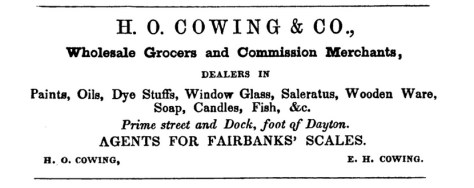 Harrison Cowing was a grocer and merchant in Buffalo and became the official head of the household. In 1850, the Cowing family, Lucie and William and their unmarried daughters were living in the brick family home at Pennsylvania and Tenth.15, 16 At that time, William’s occupation was land dealer. He died two years later.17
 Genealogy Ensemble