The Fur Traders and Coureurs de bois of Quebec, Northern Ontario and Labrador
This is the first part of a two part series The first part of this database consists of an extensive list of authors who have written on the subject of the fur trade in the specific areas of Quebec, Northern Ontario and Labrador.
The second section consist of historical documents on the fur trading industry. While the third section lists the many repositories containing information on the fur traders.
Part two will follow in the next session.
Please note that this database contains numerous books, documents, articles and reports that are free to either read online or download. These are highlighted in green text for easy recognition.
The following database consists of a compilation of information with extensive links to The Company of One Hundred Associates of New France. 1627-1663.
The fur industry attracted investors , bankers, administrators, ship owners, fur traders, explorers, military officers, merchants, notaries, first nation language interpreters, civil servants, seigneurs, governors and coureurs de bois of the French colonies of Nouvelle-France and Acadie.
The database is divided into sections:
Page 1-5 Various Companies, the Elite, Pioneer Families, Census, of families.
Page 6-78 Leaders, explorers, fur traders, officers, merchants, etc.
Page 78-125 Authors noting where complete documents are available online.
Page125-148 History – reference links to biographies, publishers, socieities, universities, etc.
Page 148-159 Repositories in France
Page 159-163 Repositories in Canada
Complete document available online is written under any link that opens up to a document that can be read online or is available for download. Where restrictions apply, they are indicated.
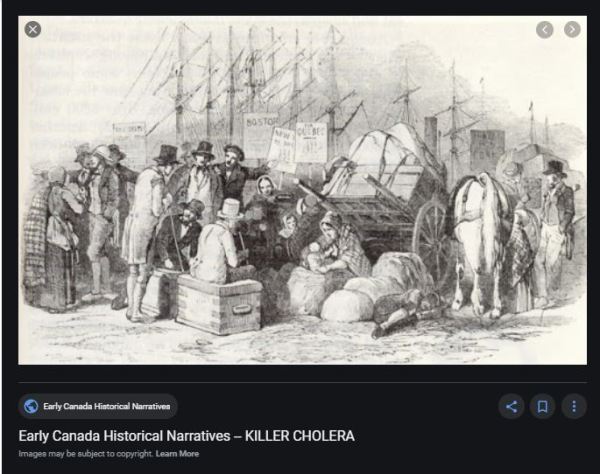
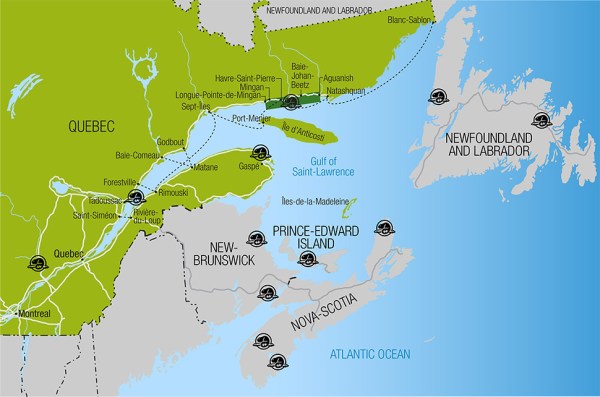
The database is divided into several sections. The first part discusses the Historical background referring to records kept at the time. These records state that the epidemic started in India, then made its way to England, followed by the great immigration of Irish citizens going to Quebec. The government set up quarantine stations in both the Gaspe and Grosse Ile. Today Grosse Ile is National Historical site.
The next two sections refer to the doctors who were in charge of the stations and the authors who wrote and documented the epidemic. Many of these documents, thesis, dissertations, articles and books are available to download or read online.
The database concludes with a list of Repositories and Historical Societies referring to the epidemic
The above blog was originally posted in August of 2015.
***
The following database “Protestant Churches of Northern Quebec” is an extensive list of churches recently prepared by the Archivists noted below.
Archivist Jody Robinson at the Anglican Archives Quebec Diocese at Bishop’s University (ETRC)
Julie Roy – Archivist at BAnQ Sherbrooke in regard to the United Church of Canada Fonds addressing acts of baptisms, marriages, deaths of regions north of the St. Lawrence River, east and north of Quebec City.
Marthe Brown – Archivist Anglican Archives Diocese of Moosonee at Laurentian University in Sudbury, ON.
There is a section that includes Historical societies listed by county
Alphabetical listing of voyageurs (wood runners / bush-lopers) who navigated by canoes from the villages of Lachine and Sainte-Anne-de-Bellevue on the shores of the St. Lawrence River near Montreal to the far regions of Western North America from 1788 to 1821
Below is a map by Ernest Voorhis. It includes the numbers in this database indicating all the forts that coincide with the fort numbers in each of the links..
Open this database link below in the incognito window
Family Names in 59 Ancient Regions of France, Belgium, Switzerland and Luxembourg
This database consists of a list of authors, book sellers and publishers containing the family names in the regions. Most of the books are in the French language.
The list contains several complete books online which can be downloaded.
For many of the regions there is a short description of the region.
For exmple :
Auvergne
The origin of the name auvergne comes from the Gallic people of the Arvernes. On the death of Charlemagne and then Louix-le-Pieux,the Carolingian empire was divided between his sons and Auvergne finally returned to Charles the Bald. In the 12th century the county of Auvergne was the subject of a conflict between William VII, the rightful heir returning from the Crusades, and his uncle William VIII. The county will eventually be divided between a new county of Auvergne and the Dauphiné d’Auvergne. This conflict will be in line with the war between France and England since the new county of Auvergne will depend on the Aquitaine and therefore the Plantagenêts,the Dauphiné d’Auvergne will take the side of the King of France. During the French Revolution, the territory formed the departments of Haute-Auvergne (then Cantal), Lower Auvergne (then Puy-de-Dôme), Haute-Loire and Allier and an accompanying map indicating the region.
This week’s blog is a repetition of a previous blog with the addition of a reference to the article in the Gaspesian HerItage Webmagazine that contains an overview of “The Great Upheaval.”
French Canadian and Acadian Family Lineage in Quebec
“In 1755, the British authorities began to dismantle the former Acadian colony by deporting its entire population… unleashing a French-speaking exodus to various regions, including many areas of Québec”.
“At the time of the Deportation, many Acadians made their way into Québec, where they were granted farmlands.”
“It is estimated that today, among Québec’s population, more than a million (or more than 15%) people bear Acadian origins.”
…….
This database focuses on the Historical and Genealogical Societies in Quebec counties and includes books by authors who have written about the various communities.








 Genealogy Ensemble