The following database consists of a compilation of information with extensive links to The Company of One Hundred Associates of New France. 1627-1663.
The fur industry attracted investors , bankers, administrators, ship owners, fur traders, explorers, military officers, merchants, notaries, first nation language interpreters, civil servants, seigneurs, governors and coureurs de bois of the French colonies of Nouvelle-France and Acadie.
The database is divided into sections:
Page 1-5 Various Companies, the Elite, Pioneer Families, Census, of families.
Page 6-78 Leaders, explorers, fur traders, officers, merchants, etc.
Page 78-125 Authors noting where complete documents are available online.
Page125-148 History – reference links to biographies, publishers, socieities, universities, etc.
Page 148-159 Repositories in France
Page 159-163 Repositories in Canada
Complete document available online is written under any link that opens up to a document that can be read online or is available for download. Where restrictions apply, they are indicated.
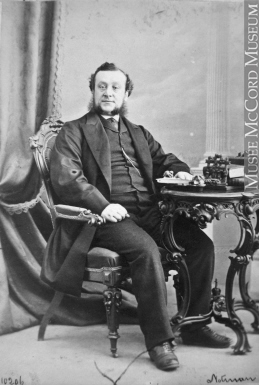
Circumstances beyond his control* compelled the third William Lindsay to abandon a brilliant career as a lawyer. In 1841, at the age of 17, he entered the public service as an Extra Clerk in the Legislative Assembly of Canada while also studying law.
I wonder what those circumstances may have been?
The third William Lindsay (1824-1872), my three times great-uncle, exhibited great potential in his law studies as well as becoming an accomplished scholar. He spoke French as fluently as English – a must as the Clerk – but could also speak Latin and Greek as well.
William studied law with such an impressive ability that even before his admission to the Bar many of his teachers predicted a very successful career ahead of him.
But why did he never practise law in the end ?
Perhaps the established family tradition influenced his decision. Like his father and grandfather before him, he became the third William Lindsay to progress to the senior positon of Clerk for the Legislative Assembly. It’s certainly the most plausible explanation. But who knows, maybe there were lucrative perks that came with the “clerkship” that enticed him.* It seems we will never know for sure.
All that to say he certainly had big shoes to fill! There must have been high expectations placed on him not only as the son of the most recent Clerk of the Legislative Assembly but also as the grandson of William Robert Lindsay who held the same office for twenty years in the early 1800’s during the time Lower Canada possessed a separate government and legislature. A multitude of historical changes in the structure of today’s Canada have all been recorded by the “Lindsay” hand.
William was born in Quebec City. He had six brothers and five sisters. One of his brothers, Robert A. Lindsay (1826-1891), was my two times great grandfather who followed their father’s other profession and enjoyed a life long banking career with the Bank of Montreal.
In November 1845, at the age of 21 and just after completing his law studies and passing his Bar exams, William married Marie Henriette Bourret in Quebec City. Eventually, they had 13 children, although four of them died in infancy.
William’s career as a clerk progressed quickly. He was promoted from Extra Clerk to Assistant Law Clerk and Translator to the Legislative Assembly of the then Province of Canada. The progression continued until he ultimately became the Clerk of the Legislative Assembly.
In 1867, The House of Commons came into existence, when the British Parliament passed the British North America Act, uniting the Province of Canada (which was divided into Quebec and Ontario), Nova Scotia and New Brunswick into a single federation called the Dominion of Canada.
William was appointed the first Clerk to this newly established House of Commons1.
William Burns Lindsay 1824-1872
The multiple steps taken toward Canadian independence in the past, during the clerkship of William’s father and grandfather, had finally come to fruition.
William’s main duty as the Clerk of the House began with the reading of petitions and bills, and later progressed to recording the House’s proceedings. Those notes on the proceedings were kept in journals which tracked the decisions and other important transactions of the House.
In September 1872 at age 48, just five years after becoming Clerk to the House of Commons, William’s career ended abruptly. He died in Ottawa during the smallpox pandemic2. He left a family of several children and a widow who then died two months later. His mother-in-law also succumbed to the disease at the same time. The youngest of their orphaned children was only five years old at the time.
Nine years later, according to the 1881 Census, William’s eldest daughter Maria Louisa (then aged 30) was still looking after her three teenage siblings and living in Quebec City. Her older brothers Crawford (and his family) and Lionel (a priest) also lived nearby and perhaps offered support of some kind.
William was the third and last of the Three William Lindsays. His eldest son “Crawford William” went by the name Crawford and did not become a clerk, however, he did inherit his father’s talent with languages and became a translator.
Limestone Sculpture of William Burns Lindsay by Christopher Fairbrother 1979
Notes:
1.As the family genealogist, I research my ancestors and write their stories. Recently, I found three generations of ancestors with the same name and the same role in an evolving Canada.
Their birth and death dates were vital as the first step to sorting them out. I noticed, however, that previous genealogists also struggled to sort them, as two of the three were sometimes labelled “Senior” and “Junior” (and sometimes in reverse order) and then “The Elder” and “The Younger” were assigned to another two. To keep things simple in my story, I will label them first, second and third – in the order of their births.
2.* Handwritten notes – Stanley Bagg Lindsay – dated March 1939
3. My cousin Ian Lindsay recently shared the following in an email 2021-05:
Somewhere I saw the report of the parliamentary committee that looked into the work of the Clerk’s office. By that time, while it was never going to be a sinecure, it was an opportunity to make friends, at the very least with stationers. (An old friend explained the best job was Minister of Supply and Services, where one could feather all your friends’ nests, and bide your time.) In any case, the Committee asked about the qualifications for the job were, and WBLII explained that the clerk had to be fluently bilingual and versed in all the relevant technical terms of both languages. Here, I point out that his son was fluently bilingual and versed in technical terms. The Committee next asked the same question of the Assistant Clerk, who explained that, when needed, he just asked one of the French guys for help. I think a grave injustice was done.
It has been almost 200 years since my paternal ancestors came to Upper Canada from Scotland and took up farming here. It has been about 12 years since I started researching and writing about them. Now that I have pulled all their stories together into the pages of a book, it is time to celebrate.
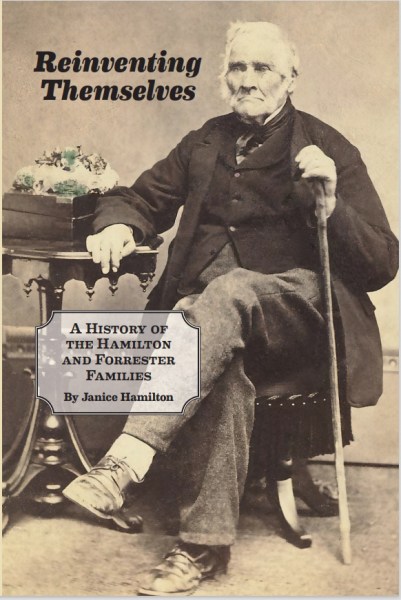
Earlier this week, relatives and friends helped me launch Reinventing Themselves: A History of the Hamilton and Forrester Families. We got together on Zoom, a solution that was perfect considering that the descendants of this family are spread from Montreal to Toronto, Winnipeg, Vancouver and across the United States.
This collection of short articles traces the descendants of weaver Robert Hamilton and carpenter David Forrester. The two Scottish immigrants and their families came to Upper Canada in the 1830s and became part of strong farming communities. Fifty years later, both families moved west. The Hamiltons were founding settlers of a temperance community that eventually became Saskatoon. The Forresters took up prairie farming in southern Manitoba.
The following generations continued to reinvent themselves, with several pursuing careers in Winnipeg, Manitoba. Among them were physician Thomas Glendenning Hamilton and his wife, nurse Lillian Forrester – my grandparents. After their young son died in the 1919 influenza pandemic, the couple began holding seances, and their research into psychical phenomena brought them international fame.
Many of the articles about the Hamilton family have previously appeared on my blog, Writing Up the Ancestors, but pulling them together into a cohesive thread makes the ancestors’ story easier to follow. Much of the material about my grandmother’s family, the Forresters, will be new to most readers.
The process of reinvention is continuing, as the book has inspired two videos. Tracey Arial interviewed me for her podcast Unapologetically Canadian (the link is coming) and Frank Opolko, a friend who recently retired from the CBC, also interviewed me. Here is the video he made, incorporating some my photos of Scotland and some of the photos that appear in the book:
I learned a great deal while doing this project, best of all I discovered several living cousins who were previously unknown to me. One new cousin instantly felt like an old friend, and the mystery person who is my closest match on Family Tree DNA has turned out to be a Forrester descendant from Michigan.
This project reminded me how challenging it is to write about genealogy. All I know about many distant ancestors is their dates and places of birth, marriage and death. While this is essential information, such lists can make for boring reading. The family stories are the good stuff, and they have been the focus of the articles on my blog. Of course, there are two types of family stories: anecdotes that may or may not be true, and well-documented facts.
I was also reminded how much discipline it takes to complete a project of this magnitude. I recently overheard my husband tell someone that he didn’t dare come near my office while I was working on the book because I would chase him away. There are so many distractions, especially on the Internet, that it really takes discipline to stay focused, and a project this size inevitably takes longer than expected.
Now it is time to take a break from family history, catch up on reading novels and enjoying summer before turning my attention to my mother’s family.
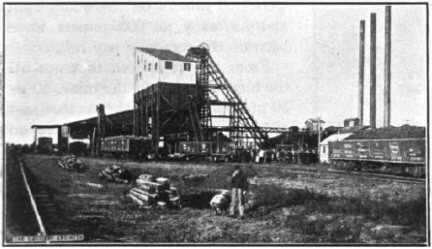
“No Hope for 20 Men Entombed in Mine Afire,” declared the headline in the September 29, 1918 edition of the Chicago Tribune.1
Sadly, 21 men died in the gas explosion on September 27, 1918 in the mine of the Franklin Coal and Coke Co. in Royalton, Illinois. On the preceding night a fire had been discovered and the firefighters sealed off two of the rooms. They had nailed a door shut but an employee pried it open and ignited the fire with his naked light. He was blown back and he survived until the next day and was able to explain how the explosion happened.2
My great-uncle, John Hynd, a mine examiner, died in this explosion. He was forty-nine and had three young children.3
Rescue operation after Royalton explosion, courtesy of Wayne’s World of History and Genealogy
John came from a long line of coal miners and was born at the Wellwood Colliery in Dunfermline, Scotland. This means that his parents lived on the site of the mine. John’s father, also John Hynd, was illiterate and signed his son’s birth registration with an X.4 Most sons of the miners in the colliery also worked there and started at a young age.
Parliament in the U.K. established the Children’s Employment Commission in 1842 to investigate the conditions of children in mines and factories. With respect to the Wellwood Colliery, James Spawort testified that “the age at which children are taken down depends on the circumstances of their parents, if they are destitute, they are taken early. “ The schoolteacher, William Craig, further testified that “there is no hope of the children being better instructed until some stoppage is put to the practice of working infants in mines. “5
While conditions were still grim, John, born in 1869, had better employment circumstances than his father and forefathers. As a result, the Mines and Collieries Act arising out of the Commission inquiry prohibited girls and women to work down the mine, and ruled that males could only start working at 10 years of age. The work day for any child under 13 was limited to twelve hours.6
The 1881 census shows that John was already working in the mine at the age of 13. He was a doorkeeper in a pit.7 Ten years later, John had been promoted to coal miner. His brother, James was also working at the mine by then and his sister, Mary, was a pit head worker at the mine in Cowdenbeath, Scotland.8
John Hynd arrived in the U.SA. in January 1905. He arrived with a friend.9 He probably came to the U.S. looking for work in a mine. Mines in the U.S. needed qualified workers and hired employment agents in the U.K. to attract workers. It was also usual to advertisement on public bulletin boards. Perhaps this is how John knew about opportunities for miners. 10 While he travelled only with a friend when he arrived, his wife, Elizabeth (Lizzie) Milne and child also immigrated. 10 He possibly settled in Illinois because of the many opportunities for employment in the coal mines and he was living in Benld, a small village that happened to have a coal mine. However, at the time of the census it says that John was working as a bartender. His brother, William was also living with him and working as a miner. William had arrived in 1908 and had also been a miner in Scotland.12 U.S.A. naturalization records show that John’s two other brothers, Andrew and James also immigrated to Benld and probably worked in the mine.13
By 1918 John is back in the mine working as a mine examiner at the Franklin Coal and Coke Co. in Royalton, Illinois, about 130 km away from the village of Benld. This was a supervisory job that meant he was responsible for assessing the risk of danger in the mine, such as gas leaks and fires. It is not clear whether he lived in Royalton at the time of explosion or he traveled for work. He was buried close to the village of Benld, in Gillespie.14
After John’s death, Elizabeth did not stay in a small village in Illinois. As she had three small children to take care of, she would have had to work. The 1920 USA census tells us that she was living with her three children and working as a confectioner in St. Louis, Missouri.15 Elizabeth died 43 years later in 1961 and was buried beside her husband, John.16
John’s death was the third tragedy in the Hynd family in three years. His father, John, had to bear the burden three deaths. John Hynd’s (senior) wife, Euphemia, died in 1916 of abdominal cancer.73 Then his daughter, Mary Hynd, my great-grandmother, died of liver cancer in 1917.18 And then John’s shocking and tragic death in 1918.
Clipping from Newspapers.com, accessed May 22, 1921.
If a British novel penned in the first part of the 20th century contains a Canadian character (for exampleBrideshead Revisited, or Bridge on the River Kwai) that character is inevitably English and from Montreal. Most UK readers of the era would have been unfamiliar with any other Canadian city, including Toronto.
Founded in 1642 as a fur-trading fort, Montreal’s port is strategically located on the St. Lawrence River. By 1900 the city was the financial and industrial capital of Canada– and only increasing in wealth and influence as the rest of the country became more and more industrialized.
The city (majority English in the early going) expanded greatly around that time, gobbling up the mostly French suburbs and flipping the balance of power at City Hall. This expansion also put a strain on city services, especially the housing, water works and transportation systems. Businessmen of all stripes scrummed for the right to improve these services – and make a bundle in the process. The question of the day: were water and power and transportation monopolies good or bad for the average citizen.
The city saw unprecedented immigration in the 1910 era, the numbers peaking in 1912. This influx of mostly poorer people from both Northern and Southern Europe further strained the already inadequate city infrastructure, generating some scary, well-publicized urban problems (including typhoid and ‘the social evil’ of prostitution) and giving rise to a prominent social reform movement. This reform movement was led by McGill professors, clergymen and the elite wives of successful businessmen whose good intentions, often handicapped by an intransigent value system5, inevitably got entangled with the dirty politics and deep dark prejudices of the day.1
The Beck Detectaphone Affair: Tawdry Tabloids and Tasty Tortieres
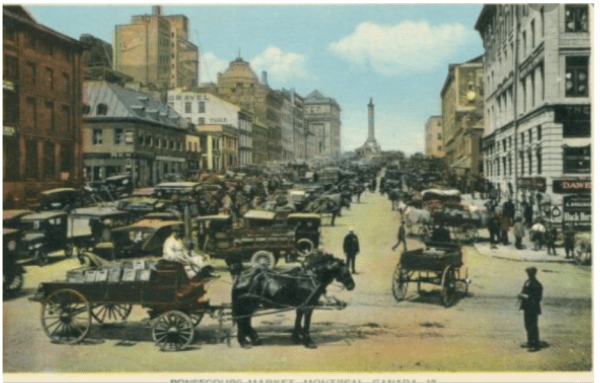
Jules Crepeau’s first scandal of record at Montreal City Hall was small potatoes. In 1900, as Secretary in charge of Bonsecours Market (the main farmer’s market in the city) he was called to testify on behalf of one Germain Tessier, Clerk-in-Chief, who apparently forced vendors to pay ‘bonuses’ to him for the rental of stalls. It was all on the up and up, said my grandfather. Mr. Tessier was honest and these costs arise naturally and are not, as some butchers were claiming, ‘a surcharge to pay for the next municipal elections.’
My grandfather’s second scandal was much more substantial, a meaty pulp fiction style fiasco involving all levels of government that almost put an early end to his brilliant City Hall career.
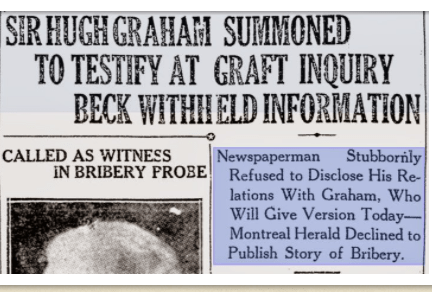
Indeed, as the Toronto World tabloid loudly reported in a March, 1914 headline: “Most highly-seasoned stew that has ever been uncovered in Canada. Beats all other scandals put together.”
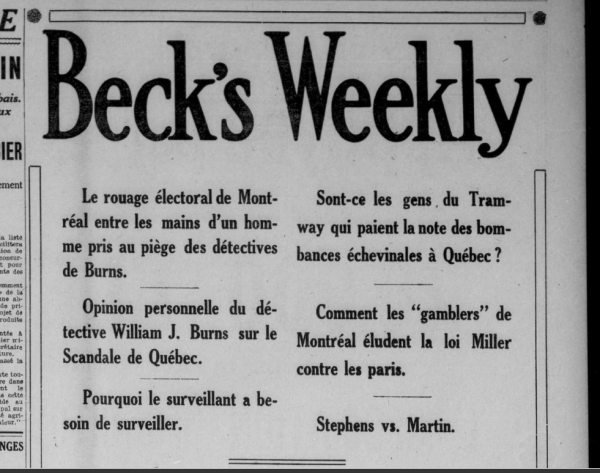
Jules, along with a handful of members of the provincial legislature, allegedly got caught accepting bribes in a sting set up by journalist Edward Beck, former Editor-in-Chief of the Montreal Herald who had recently started his own tabloid Beck’s Weekly with the help of former Herald publisher Lorne McGibbon,2 just so he could write about it.
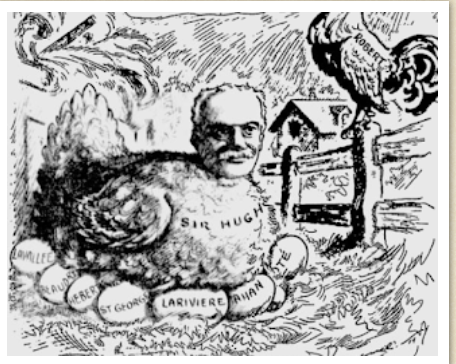
McGibbon was livid over a proposed 40 year tramways deal that would greatly benefit his arch-rival, Montreal Star publisher, Hugh Graham. McGibbon and Beck hired Burns detectives from the US armed with ‘detectaphones’ in the hope of proving that the tramways people were bribing members of the legislative assembly.
That didn’t work out. Instead, the American detectives posed as members of the Montreal Fair Association, a group hoping to get a private bill passed at Quebec so that they could start up a horse-racing and liquor business. They allegedly got my grandfather to accept 3,500 dollars a year in return for insider help, effectively doubling his salary as second assistant city clerk – were the charges true.
Sir Hugh Graham nuturing his aldermen from La Patrie 1914.
This all came down a month before the 1914 municipal election where it looked like the municipal Reform party, that had been elected in 1910 with help from Montreal suffragists, would be thrown out paving the way for the much despised tramways deal.
Now, it helps to have a background in the complicated Montreal/Quebec politics of that era -and thanks to a 1972 Masters thesis, my own decade-long research as well as BANQ fonds, I do.3
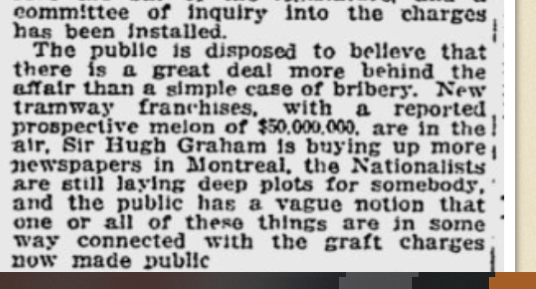
But let this excerpt from the Toronto World summarize the bribery situation (and its myriad mysteries) for you.
Yes, my grandfather got caught up in something much bigger than himself:a series of feuds between the municipal reformers, mostly ‘benign’ English businessmen who wanted to clean up what they saw as a corrupt political system and the ‘machine,’ an informal alliance of aldermen arranged in a hierarchy, who made sure their poorer wards got all the infrastructure improvements while they allegedly pocketed pork, as well as much bitterness between two English publishing titans, Hugh Graham and Lorne McGibbon, who had once been partners in a scheme to control Montreal’s newspapers.4
My small potatoes second assistant city clerk of a grandfather was held up to the voting public5 by Beck as an example of a corrupt (see “impure”)4 French City Hall when the real flash point was a transportation mega deal that would pour millions into the coffers of various Square Mile multi-millionaires, most of them Anglos.5
My grandfather’s name was dragged through the mud in many English and French tabloids, all of whom quoted Beck’s Weekly.
By the look of Beck’s purple prose, he really had it in for my grandfather. It seems personal.
“The City Hall is a sweet-scented sink hole of pollution if men like Crepeau speak the truth. Their greedy official hands take toll of contracts, levy tribute on ordinances, and prey upon the poor city labourers. Graft, graft, graft is written over the doorways, the lintels and on the doorposts.” 6
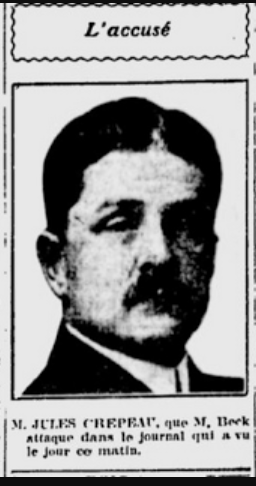
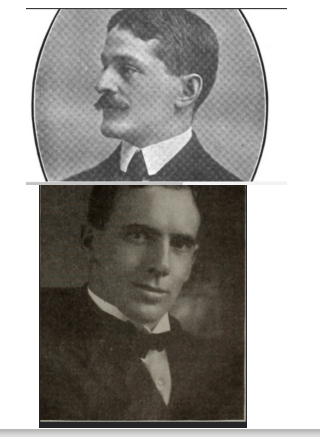
According to the newspaper Le Devoir, my grandfather’s mustachioed face filled up the entire front page of Beck’s first edition. Ouch! La Patrie tabloid put a smaller pic cropped from grandpapa’s official City Hall picture in their newspaper the next day. (It’s probably the same pic.)
The Beck’s Weekly account also made my grandfather look very stupid. “The endurance of the operators (of the detectaphone) were sorely tried by the gabbiness of the Handy Man of City Hall.”
Now, Jules Crepeau was anything but stupid. He was an energetic man – with complete recall – who hustled and muscled his way up the municipal ladder over a 32 year period. “Affable, intelligent, ambitious and active, with pride of purpose,” were words used to describe him*7, as were “a model of courteousness and a living encyclopedia of municipal affairs.” Upon his forced retirement in 1930 the Montreal Star said he had ‘ready tact, a suave manner and a keen intellect” that allowed him ‘to get to the root of the problem, saving time and money at City Hall. ” Apparently, he didn’t join the civil service for “security and repose.”8 He also had powerful people in the Liberal Party of Canada on his side.10
In 1888, Jules was a message boy in short pants in the Health Department (my mother like to say he started out ‘sweeping the floors’) and by 1921 he was Director of Services in a dark power suit, his office overseeing basically everything that came down in the city.
Back in 1914, my ‘handyman’ grandfather had clearly earned a reputation for being useful, but I think he was merely a willing (?) pawn of ‘the machine’ and of some very powerful politicians and industrialists – on both sides of the English and French divide and at all levels of government.
If he were greedy, as Beck so salaciously writes, he didn’t seem to prosper above his salary grade. *9. Even at the height of his career in the 1920’s, my grandmother Maria Roy was no ermine-draped socialite. She herself swept the floors in their three storey grey stone at 72 Sherbrooke West (right beside the Liberal Reform Club of Canada, a watering hole for political bigwigs); she herself rolled out the dough on her fabulously fatty tourtieres; and she gave away to Catholic charities most items from the roomful of ‘gifts’ Jules received at Christmas – keeping only the cigars and certain beautiful pieces of Chinoiserie.
In April 1914, my grandfather sued Beck and McGibbon (and Tarte of La Patrie) for libel and won. He was awarded 100 dollars in reparations and two thousand in legal costs by the Court. He donated the 100 dollars to a children’s hospital, as reported in the Liberal l’Autorite newspaper. (See bottom)
It is no coincidence that Jules was defended by R.L Perron11, distinguished Montreal lawyer, Quebec Liberal MLA, lawyer for the Tramways people and President of the Reform Club (Liberal) of Canada. Thanks to Perron, the detectives’ evidence was deemed inadmissable in court. Of course, it had already been printed word-for-word in numerous newspapers.
Beck’s Weekly ceased publication in 1915 during WWI. It is said that Hugh Graham made sure Beck couldn’t get the newsprint.
In 1916 Beck went West to work for a Winnipeg newspaper12 (where he was sentenced to prison for contempt of court – but won an appeal) and then he left journalism and moved into public relations, working for the pulp and paper industry headquartered in Ste Anne de Bellevue, Quebec. He stayed there until his death in 1930, occasionally planting stories in the Toronto Press about corrupt Montreal politics.
My grandfather kept his job as second assistant city clerk, soon rising to first assistant city clerk, occasionally earning some strategically-placed praise in the left-liberal newspapers l’Autorite and Le Canada until in 1921 he was unanimously appointed Director of City Services. This was a new post created with a new city charter – and after broad public consultations. This lofty post was specifically created to ensure that the city services were distributed evenly between the wards. Ha ha.
But this politically sticky post (being at the centre of all municipal activity; the designated liaison between top elected officials and the seven city department heads, including the Chief of Police) put my dear grandpapa in the way of other ugly scandals.
I will write about those in parts 2, 3 of this series: My Grandfather’s Brilliant City Hall Career in Four Scandals.
For more information: Montreal, City of Tomorrow (in French) by Honorable Nantel, 1910. Internet Archive. I found this book entering my grandfather’s name. The author is describing the city in 1910 and how its recent vast expansion has created opportunities and problems. He wants to pattern Montreal after Paris. He thanks my grandfather, among others, for providing him with information.
2. Lorne McGibbon was a prominent Conservative Party organizer who had brought the bribery scheme idea to a certain Thomas Chase Casgrain, Postmaster General in Borden’s Conservative party, who claimed it was ‘criminal’ – so he went it alone. During WW1 McGibbon spoke at Win the War rallies in support of Premier Borden and conscription. Indeed, he claimed in a speech, that any man who didn’t serve in the war shouldn’t be given work at home.
3.. The Municipal Reform Movement in Montreal: 1886-1914, University of Ottawa Master’s Thesis by Michel Gauvin. 1972.
4. The terms ‘benign’ and ‘machine’ from the Gauvin Thesis. ‘Machine’ refers to an earlier administration, but I think it still applies here. “Benign” is used in the sense that these businessmen believed their motives to be pure and beneficial to both their pocketbooks and the citizenry.
5. Montreal had universal male suffrage with exceptions. It could be said that many (most?) male British citizens could vote in municipal elections: they had to live in a house above a certain rental price, pay off their water tax. There were other stipulations. Widows and unmarried women with property could also vote.
In 1910, inspired by a 1909 visit from Britain’s Ethel Snowden, a moderate ‘maternal’ suffragist, the Montreal Council of Women mounted an effort to get the female vote out and ‘purify’ City hall. Their words. Widows and unmarried women of property could vote in the municipal elections. Council of Women volunteers went door-to-door and sure enough, their Reform candidates and Mayor, John James Guerin, was elected. The women were elated, assuming they had won the battle for their key interests, child welfare, temperance, etc. Guerin gave up the post within two years, claiming that as Mayor he was powerless do to anything.
In 1914, populist Mayor, Mederic Martin, a cigar manufacturer, won the election. He would remain Mayor for many years.
It was these women reformers who liked to refer to City Hall as ‘impure.’ Martin, irked by a letter they sent to him about the Tramways Affair, dared call them out in the press as women of leisure, “idlers” but he had to publicly retract his statement. These women were anything but lazy. He got them back: at the public consultations into the Tramways Affair the Council of Women was asked only silly questions: “Why can’t women get the ticket from their purses before getting on the tram instead of holding up the line.” Why can’t women shoppers shop outside of rush hour?” OUCH.
When the Montreal Council of Women helped get the Reform ticket elected in the 1910 municipal elections, Carrie Derick, President of the Council and Montreal’s No. 1 suffragist, wrote an ecstatic piece in The White Ribbon (the magazine of Christian Temperance Union) about how they had cleansed City Hall of impurities. Purity was a loaded concept in 1910, an era of tainted water and milk and of heavy immigration from Southern Europe. Here’s a bit from her article:
“Self-seeking and dishonour, which would have been scorned in private life, long characterized the Municipal Government of Montreal.
The Citizens appeared to be indifferent or helpless, allowing corrupt officials to display open disregard of all right principles. Associations and leagues to purify the administration of Municipal affairs sprang into being and died.
The result of our united efforts and public-spiritedness paid off (in the election of 1912). An unusually heavy vote was registered. Practically the whole of the reform candidates were elected.
Men united with women in urging women electors to do their duty by voting in order that civic reform might be secured, reform which alone would diminish the unceasing supply of sick, poor, the weak and depraved...”
Derick’s ideas were inspired by the eugenics theory. She was a gold-medal McGill geneticist, educated in Europe, and she gave many lectures, some of them mixing her areas of expertise, social reform, suffrage and social engineering. Her stature lent these ideas weight. The movement would accelerate after WWI and culminate in 1924 in the Coderre Inquiry into Police Malfeasance which would again ensnare my grandfather Jules, by this time the Director of City Services. I will write about that in Part 3 of this series.
5.The group included McConnell and Sir Rodolphe Forget who supported Mayor Martin in in 1914. (My grandfather was kin to the Forget’s, supposedly, but he was a Conservative Senator and my grandfather was aligned with the Liberals, so…)
6. Beck’s Weekly was quickly founded when Sir Hugh Graham bought the Herald from under McGibbon after Beck, as Editor in Chief, complained about the Tramways Deal in the Herald in March 1913, with a full page rant in huge 20 point enboldened type. “The Tramways Company’s Brazen Demands: It is well-known that the Tramways Company has City Hall under its thumb and works its sweet will with the people working there. It is known to have an alliance with a sector of the newspaper industry, stifling public opinion. The President of the Tramway and his henchmen occupy seats in the legislature and vote away people’s rights.”
Beck also invited the Montreal Suffrage Association to create a multi-page insert in return for their support of his point of view. That group passed a resolution against the deal (not in their usual purview) soon thereafter. The suffrage insert was published, with a front page letter from Christobel Pankhurst hiding out in Paris. The Montreal Suffrage Association and Beck then had an argument over the profits.
7. From his obituary in Le Devoir, 1938. It was here where it is said that grandpapa had complete and utter knowledge of every detail, however minuscule, of municipal government “like a bank vault.” (This sentiment was widely held.) He was the go-to-guy even at the Quebec legislature, the most influential man when it came to private bills, said the obit.
Another newspaper article said, “Jules Crepeau went grey teaching aldermen their jobs.” In those days, the federal Liberals were aligned with the provincial Liberals who were aligned (claimed the Editor of Le Devoir in 1930 upon the force ‘resignation’ of my grandfather) with Mederic Martin’s regime. Of course, my grandfather, as a civil servant, was supposed to be neutral in his allegiances, but the very nature of his job as defined by the City Charter made this next to impossible.
8. From an article in L’Autorite newspaper upon his installation as Director of City Services in 1921.
9. I met someone online whose grandfather, a corrupt cop-on-the-beat of the era, had managed to buy four homes, at a time when few working class men in Montreal owned their own homes. It is possible that my father needed money to buy his way up the ladder, but it also seems unnecessary, considering his connections and his boundless energy and sharp mind.
My grandfather’s home at 72 Sherbrooke West was right beside the Liberal Reform Club of Canada, where Canada’s Liberal Party power brokers socialized over the decades. No coincidence, I suspect.
I can see that Mme Guerin-Lajoie also lived a few doors down. She’s the famous Quebec suffragist. I wonder if my grandmaman knew her. I assume my grandpapa did.
10. https://numerique.banq.qc.ca/patrimoine/details/52327/3584769?docsearchtext=Jules%20Crepeau%20BeckL’Autorite newspaper’s explanation of the Beck affair, March 1914. It’s all bait and switch tramways business, apparently. The story is put on a back page with the headline being “A tissue of lies,” my grandfather’s quote. This liberal anti-clerical newspaper was started in 1913 by one Tancrede Marcil, who was a disciple of Sir Wilfrid Laurier. BANQ’s blurb claims Laurier was the real ‘chef’ of this newspaper. Marcil also worked on the start up of Le Devoir newspaper.
The elite newspaper praised and promoted and acted as cheerleader for my grandfather throughout his late City Hall career. I’m not surprised that the Liberal Party of Canada was on my grandfather’s side. I just wish I knew more. It looks as if my grandfather was part of Sir Wilfrid Laurier’s plan to rebuild the Liberal Party of Canada and get re-elected. The party had been turfed out in 1911. That was working for Laurier at the beginning, but then WWI happened and the infamous Conscription Crisis killed his chances. He died, anyway, in 1919. WWI broke out a few months after the Beck business, in August.
The article at bottom appeared in l’Autorite in1915, when it seemed that the Chief City Clerk, Patrician lawyer/journalist/scholar L 0 David, my grandfather’s boss, might win a seat in Parliament. (He didn’t). (I got it off BANQ). They are rehabilitating Jules’ reputation after the Beck scandal. LO David, a Senator, made some unsuccessful attempts at winning political seats federally and provincially. It is said that this cultured, learned man preferred writing his histories over the day-to-day minutia of his important day job as Chief City Clerk. That allowed my grandfather, a self-made, humbly-educated ‘detail’ man, son of a mere house painter, to punch above his weight at work.
In a front page editorial in March 1914, Publisher Marsil derided those people who said his newspaper was started up by Pro-Tramways people, much as Beck’s Weekly was started up by anti-tramways people. Nonsense, his newspaper was independent, Marcil said.
Louis Dupire Editor of Le Devoir wrote in 1930, upon Jules’ forced resignation from his position at City Hall that attacks such as Beck’s only served to increase his prestige.
11. RL Perron would benefit, it seems, in 1927 from the Montreal Water and Power Deal, my grandfather’s next scandal.
12. This was during the Galt Inquiry into some Conservative Government impropriety involving legislative building contracts. Beck refused to testify claiming the inquiry was illegal. He died in 1930, after an appendicitis operation, but he lived to see my grandfather turfed out of City Hall by Camillien Houde, so he likely died happy. He got a short obit in the New York Times, where where the bribery scandal was mentioned as his crowning achievement.
Below: Young Grandpapa and Edward Beck. Archive.org. Bitter adversaries or politics as usual? I suspect Beck hated my grandpapa because they were equal in social standing, pretty much earning the same salary.
My grandfather “The Handyman of City Hall.” According to Beck, my second-assistant city clerk of a grandfather ran the show. This is from Beck’s Weekly as republished in the Quebec Chronicle. BANQ
My unique story of the 1910 suffrage movement in Montreal.
My Story about Montreal during Prohibition, using two families, mine and my husband’s.
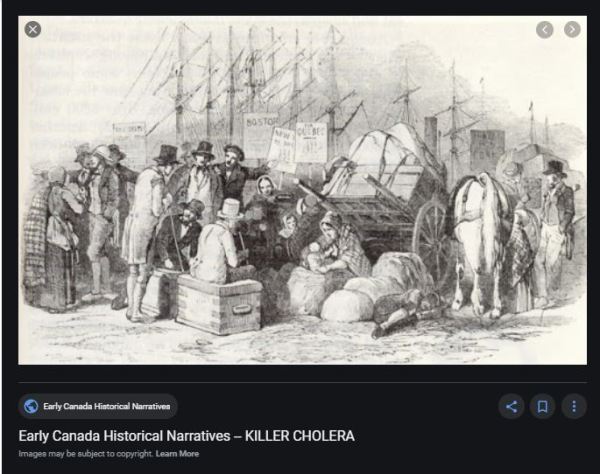
The database is divided into several sections. The first part discusses the Historical background referring to records kept at the time. These records state that the epidemic started in India, then made its way to England, followed by the great immigration of Irish citizens going to Quebec. The government set up quarantine stations in both the Gaspe and Grosse Ile. Today Grosse Ile is National Historical site.
The next two sections refer to the doctors who were in charge of the stations and the authors who wrote and documented the epidemic. Many of these documents, thesis, dissertations, articles and books are available to download or read online.
The database concludes with a list of Repositories and Historical Societies referring to the epidemic
One night in 1837, a party of twenty-five to thirty masked men, armed with rifles, axes and sticks invaded the home of Antoine Bruneau, my three times great grandfather. They forced him to renounce his commission as a Militia Captain by threatening to destroy his life and the lives of his wife and family. “That the said party, the same evening compelled the depositor to say that he was a Patriot and to shout hurrah for Papineau three times.” 2
Antoine Bruneau, probably participated in the War of 1812 but definitely served as a Militia Captain during the Rebellions of 1837-38. He did not fight with Les Patriots under the leadership of Louis Joseph Papineau, rather his loyalty was to the governing British.
He was born in La Prairie, Lower Canada, now Quebec, in 1773. The French had earlier been defeated on the Plains of Abraham, so he grew up under British rule. Antoine farmed in St Constant south west of Montreal, married Marie Josephte Robidoux, raised his family of ten children and attended the local Catholic Church. A seemingly simple life.
When war with the United States seemed imminent in 1812, all citizens of Upper and Lower Canada banded together to fight the Americans. Sedentary Militia were organized and men 16-60 were called upon to serve. Most of the Militia Captains were career officers. Others were doctors, lawyers, notaries and seigneurs, all people of “superior backgrounds”. It was a chance to improve ones social standing and gain power. Few farmers became Militia captains so did Antoine at this time? Initially, the best, healthiest and strongest men continued to work on the farms while the unproductive men were sent to the military.
After the war, Louis Joseph Papineau, then the elected speaker of the Assembly of Lower Canada wanted self government. The Governor General of British North America ignored all demands for more local control of the Legislature. Members were elected but Britain had veto power over all legislation. Papineau began organizing protests and rallying the French citizens who became know as Les Patriots. The French farmers suffered through an economic depression during the 1830s so many willingly joined the armed insurrection. These men wanted to free themselves from British rule. The continued protest rallies and calls for armed conflicts from the radical Patriots lost the support of the French moderate wing, most of its anglophone support as well that of the Catholic Church. The Church wanted a return to calm so as to continue their control of the population and preached their position to their congregations. The revolt came to a head in 1837 with the battles of St Denis and St Charles in the Richelieu Valley and later the battle of Ste. Eustache, just north of Montreal.
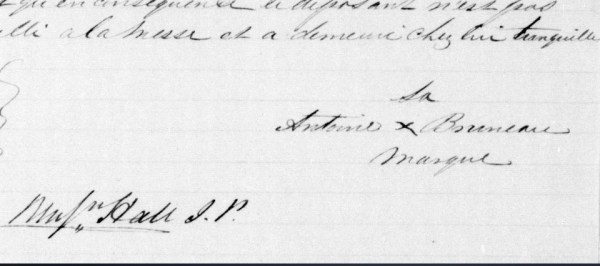
Antoine didn’t remain silent. He spoke out against the rebellion and gave numerous depositions to the government against his neighbours. These depositions were all signed Antoine Bruneau with his mark and an “X”.
One deposition recorded a time when his son told him that his life was in danger so Antoine loaded his gun and kept watch all night as at least 350 men engaged in the revolt passed by. He knew which of his neighbours were rebels and that they had secret signs he wasn’t party to.
In December of 1837 Antoine reported that after a reading of a proclamation from the Governor-General and the loyalist’s address to the Queen, Etienne Longtin, a member of his militia, responded with the coarsest expressions against the Queen and the British government. Antoine said that Longtin forgot his duties as a Militia officer and attempted to excite the people by the most seditious and revolutionary speeches that one could imagine. “He is a dangerous man in a word a rebel who seeks harm at every opportunity to help the revolutionary party.” 3
Later after another revolt, he reported that Augustin Beauvais, a tanner from La Prairie, was using his utmost influence to effect a rising of his neighbours to overthrow her Majesty Queen Victoria. Antoine believed Augustin Beauvais to be a determined rebel to anything British and the British government. He knew Beauvais left the province the previous winter during the troubles and had only recently returned. Last winter he was a principal leader and disturber in furthering the view of the rebel agitators to annihilate the British population of the province. 5
Antoine wasn’t deterred by attacks on his person or beliefs and continued to serve in the St-Constant militia as did his sons Barnabé and Medard. After his flurry of depositions the depositor said nothing more.
Notes:
All I knew about Antoine Bruneau, my three times great grandfather besides the BMD facts was that he was a Militia Captain. In looking to prove this fact I entered his name in the search function Advitam on the BAnQ (Bibliotheque et Archives Nationales du Quebec) website: https://www.banq.qc.ca/accueil/. After limiting the time frame to his life, up came all the depositions around the time of the Rebellions of Lower Canada.
These documents are difficult to read as they are hand written and mostly in French. Some had been transcribed and typed. The quotes are my translations of these documents.
1.Affidavit d’Antoine Bruneau, capitaine de milice, de Saint-Constant, contre Edouard Lanctot et Joserige, (dit Laplante) de Saint-Constant. 11 Decembre 1837. E17,S37,D79 Fonds Ministere de la Justice – BanQ Quebec.
2. Affidavit d’Antoine Bruneau, capitaine de Milice, Saint-Constant de de Saint-Constant, contre Charles Allard, meunuisier, de Saint-Philippe, maintenant de Montreal. 17 Decembre 1837. E17,S37,D87 Fonds Minirtere de la Justice – BanQ Quebec.
“Que le dit parti aurait le meme soir contraint le deposant de dire qu’il etait Patriote et crier Houra pour Papineau trois fois.”
3. Affidavit d.Antoine Bruneau, capitaine de milice, de Saint-Constant, contre Etienne Longtin, cultivateur de Saint-Constant, un homme dangereux. 6 Fevrier 1838. E17, S37, D78. Fonds Ministere de la Justice – BanQ Quebec.
” Que le dit Etienne Longtin est un homme dangereux en un mot un Rebelle qui ne cherche en tout que l’occasionde nuire et aider le parti revolutionnaire.”
4.Deposition d’Antoine Bruneau père, de Saint-Constant, contre Francois Camire et A. Dugas. 16 Novembre 1838. E17, S37, D1926. Fonds Ministère de la Justice – BanQ Quebec.
5.Deposition d’Antoine Bruneau pere vcontre Augustin Beauvais, de Laprairie. 20 Novembre 1838. E17, S37, D1899. Fonds Ministere de la Justice – BanQ Quebec.
Antoine Bruneau born June 2, 1773, La Prairie, Quebec to Joseph Bruneau and Marie Anne Longtin and died February 1847 in St Constant, Quebec.
He married Marie Josephte Robidoux April 15, 1796 in St Constant, Quebec. She was born Feb 10 1775 in St Phillipe, Laprairie, Quebec to Francois Robidoux and Marie Josephte Bourdeau and died in St Constant, Roussillion, Quebec.
They had 10 children:
Marie Josephte 1796-1880 m. Basile Emond
Marie Louise,1798-1885 m. Basile-Leon Lefebvre
Antoine, 1802-1844 m. Adelaide Dupuis
Julien 1804-1837
Vincent de Paul 1805
Joseph Barnabe 1807-1880 m. Sophie Marie Prud’homme
Medard 1811- m. Louise Dupuis then Seraphine Maigret
Simon 1813
Leon 1815- 1839
Marie Marguerite 1816-1834
The British defeated the French on the Plains of Abraham in 1759.
The Patriots took refuge in the church in Ste. Eustache which was fired on with cannons and cannon ball damage can be seen to this day.
The above blog was originally posted in August of 2015.
***
The following database “Protestant Churches of Northern Quebec” is an extensive list of churches recently prepared by the Archivists noted below.
Archivist Jody Robinson at the Anglican Archives Quebec Diocese at Bishop’s University (ETRC)
Julie Roy – Archivist at BAnQ Sherbrooke in regard to the United Church of Canada Fonds addressing acts of baptisms, marriages, deaths of regions north of the St. Lawrence River, east and north of Quebec City.
Marthe Brown – Archivist Anglican Archives Diocese of Moosonee at Laurentian University in Sudbury, ON.
There is a section that includes Historical societies listed by county
During the past year racism and the Covid19 pandemic have been uppermost in the news. The Black Lives Matter movement protesters have been out in full force, particularly since the death of George Floyd. People from all walks of life around the world have been expressing their desire, their dreams and hopes for change.
In the United States in 1947 Jackie Robinson broke the color barrier in Major League Baseball, prior to that he played for the Montreal Royals as a stepping stone toward the big leagues!
New York Amsterdam News
In 1955 Rosa Parks was arrested and fingerprinted for refusing to give up her seat. At the time people of color were designated seats in the back of the bus.
britannica.com
Martin Luther King Jr. had not yet come upon the scene. It was in1963 that the famous march on Washington, DC took place. It was there that he gave a powerful “I Have a Dream “speech.
AP/REX Shutterestock.com
The current turmoil of systemic racism is slowly being addressed and is changing. Will the Black Lives Matter movement leave a lasting positive message?
Growing up in a small mining town in the Eastern Townships in the 50s the population was predominantly Caucasians, either French or English speaking . There were no other ethnic groups at the time. When I made frequent trips to the orthodontist in Montreal, I became aware of many diverse groups in our country. That was not the case in our small town. There were no people of African American descent or other ethnic groups.
Life’s adventures are ongoing learning experiences.
On a crisp October morning in 1956 the ’54 Hudson was all packed and we were looking forward to our long trip. Sarasota, Florida was our destination. At that time it was the winter home of the Ringling Brothers and Barnum and Bailey Circus.
The three of us were embarking on a long journey. Mac, the golf professional, and his wife Midge would be spending the winter months in their home in Sarasota. Every spring they would make their way back to Canada where Mac was the manager of the local golf course. I, on the other hand had just finished High School and was too young to pursue further studies. The plan was for me to spend the winter in Florida with them and broaden my horizons.
Among the many stops on our journey south was one that brings bac memories. Winston Salem, North Carolina was on our itinerary and we planned to spend the weekend with Midge’s sister, Elsie. She and her family lived in a luxurious home. Like most wealthy folks in the south, they had servants. Their daughter, Lucretia and I were about the same age. She began showing me around their home. Most likely we had just finished breakfast and she wanted me to meet the cook and her little granddaughter.
Looking at this little four-year-old who had the biggest smile, my first instinct was to go toward her, bend down and chat. In the process of moving toward her I froze and could not budge. No matter how hard I tried, I could not bring myself to go near her. What was happening? What was preventing me from touching her and chatting.
Shortly after this occurred I began to realize how much we are swayed and influenced by others.
The experience has left a lifelong impression. To this day, I get goose bumps thinking about my actions and the way I handled the situation as a young teenager. It was a valuable lesson at the time and still is.
With so much of the news revolving around Black Lives Matter will the movement be a major turning point in eradicating systemic racism?










 Genealogy Ensemble