Sisu, Saunas and Ida Susanna

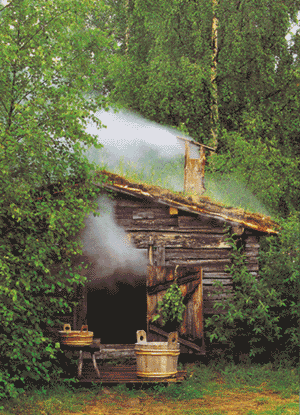
oldsauna

The Webster dictionary gives the following definitions of sauna:   A Finnish steam bath is a room in which steam is provided by water thrown on hot stones.   The sauna is a small room or hut heated to around 80 degrees Celsius.  It is used for bathing as well as for mental and physical relaxation.

There was a time, in the not too distant past when there were more saunas in Finland than there were cars.

*****

On a bright sunny morning in southern California, the week before Christmas 1967  at the age of eighty-one, Ida Susanna decided to enjoy what had long ago become a ritual. The sauna had been heated. It was ready. She and several family members were enjoying the heat, steam, warmth and comfort of the sauna when suddenly Ida began feeling uneasy and within a short time she succumbed on the spot, right then and there! Her last breath was in her beloved sauna, a Finnish tradition she had enjoyed throughout her life. Now, she had come full circle.

Ida Susanna Karhu drew her first breath and saw the light of day in a sauna on a cold morning in the dead of winter, March 12, 1886, in the rural village of Isokyro, on the banks of the River Kyro, in Western Finland, the Ostrobothnia Region,  where St. Laurence Church built in 1304 still stands to this day, twenty minutes from Vaasa, Finland near the Gulf of Bothnia.

As a youngster,  she played with friends and watched her younger brother and sister. She went to school and dreamed of a new life in a far-away country where her father was waiting for the family. Johan had left for America several months earlier. At that time the United States was actively recruiting immigrants. He was up to the challenge.

The time had finally come for the family to be reunited. In early spring of 1896 Ida, her mother, Sanna, 42, her brother Jakko and sister Lisa Whilemena, had taken all the necessary steps toward making their way to ‘Amerika’. The Finnish passport containing all four names was in order, having undergone rigorous scrutiny prior to being issued. Four tickets were purchased at the cost of FIM 138 per passenger. The date for departure had been set for May 16, 1896.

It must have been a harrowing thirteen-day voyage for Sanna, with the responsibility of three young children although Ida was able to help with the little ones. They made their way to Hango, Finland, on to Hull, England, aboard the SS Urania, then by train to Liverpool, England. The travellers then boarded the SS Lucania, a Cunard Liner, destination New York City with two thousand eager passengers. Some were either homesick or seasick or both.

They passed the Statue of Liberty as they approached Ellis Island on May 29, 1896, where the lengthy registration process began before they could go down the ‘stairway to freedom and a new life’.

There were new horizons for the ten year  Ida,  and her family as they  made their way to Ashtabula, Ohio. She went to school, was a diligent student who learned to read and write in English while maintaining her Finnish language and heritage.*

In 1903 at the age of sixteen, she married a fellow Finn, nine years her senior, had nine children. Johan (John), blacksmith, provided for the family for forty years until he was fatally struck by a young fellow driving a forklift. After his passing Ida had several suitors. She remarried, however, her new husband, Herman Haapala died within several  years.

Ida Susanna was a lady with sisu*, a Finnish word for perseverance, courage and determination. She married for the third time to a gentleman named Gust Gustafson and enjoyed a good numberof years living on a large dairy farm in Cook, Minnesota. For almost ten years they travelled., One summer they visited her son in Canada, and wintered in Florida.

Was she visiting or had she decided to leave Gust and the cold weather  for sunnier climes? We may never know. She made her way to southern California where several of her children were living. It was there in the sauna that she passed away. She had come full circle.

She lived life to the fullest throughout those many years in “Amerika” her adopted country.  She is buried beside her first love, her husband of forty years, Johan Hjalmar Lindell, in  Edgewood Cemetery in Ashtabula, Ohio.
14064096_1081867268515430_62847858429363514_n1

images

*Sisu is a Finnish term and when loosely translated into English signifies strength of will, determination, perseverance, and acting rationally in the face of adversity. However, the word is widely considered to lack a proper translation into any other language. Sisu has been described as being integral to understanding Finnish culture. The literal meaning is equivalent in English to “having guts”, and the word derives from sisus, which means something inner or interior. However sisu is defined by a long-term element in it; it is not momentary courage, but the ability to sustain an action against the odds. Deciding on a course of action and then sticking to that decision against repeated failures is sisu.

.
The Dovecotes of Tinos

By Sandra McHugh

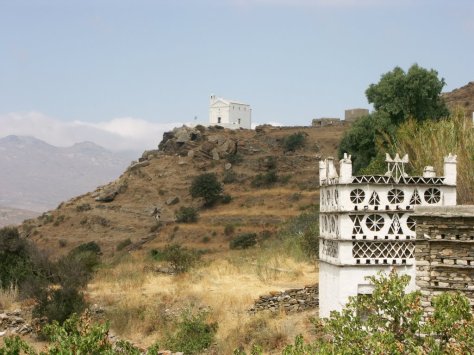
I have lucked out. My husband comes from the island of Tinos, Greece and we go there every year. I am always struck with the breathtaking beauty of the island. Some villages nestle in the valleys and others perch on the hillsides. The hills are terraced with stone walls and sheep, goats, and cows graze in the fields. Tinos may resemble other islands in the Cyclades, but what is unique to Tinos is the number of dovecotes scattered across the landscape. If you were to visit Tinos, you would be astonished at how many of them there are. While the exact number of them is not known, it is believed that there are over 1,000. This is quite impressive for an island that is 195 square kilometers. 1

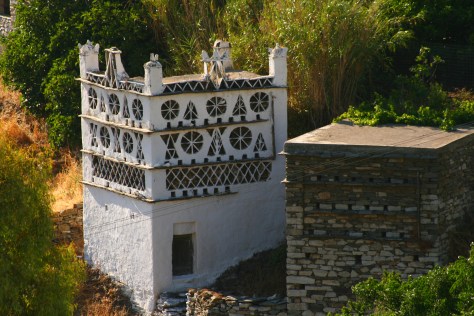
They are truly beautiful as you can see in these photographs below.  This dovecote used to belong to my husband’s grandfather.

Antonios' dovecote

IMG_7044

Dovecotes are not just decoration. During the 1900s, dovecotes significantly contributed to the family finances. They were kept in the family and passed on from generation to generation. My husband inherited a dovecote from his father, who had inherited it from his uncle. While very few people eat dove today, my husband remembers his grandmother serving dove, more specifically in soups made with the meat and carcass of the doves. Most importantly, the family also used the dove droppings as manure. The droppings were well known as high quality fertilizer.

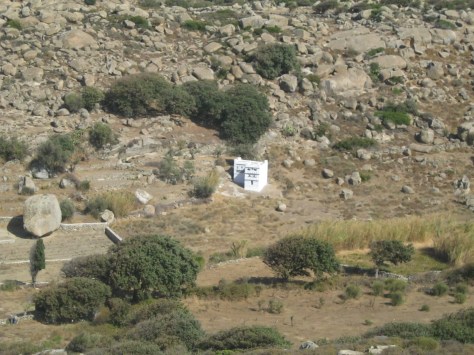
Here Is a picture of my husband’s dovecote, nestled in the valley.

IMG_4251

It was the Venetians who originally introduced breeding of doves to the island of Tinos when they conquered the island in 1204. They ruled the island for five centuries until 1715. During Venetian rule, dove breeding was only practised by the noble, or ruling classes. The noble families had ‘le droit des colombiers’ or the right to possess doves. These were concessions bestowed by the Doge of Venice.  In 1715, the Turks ruled the island, but did not inhabit it. The island was returned to Greece in 1821. 2

Most of the dovecotes were built during the 17th and 18th centuries. During this time, dove meat was not limited to local consumption. It was considered a delicacy and exported as far as Smyrna and Constantinople.

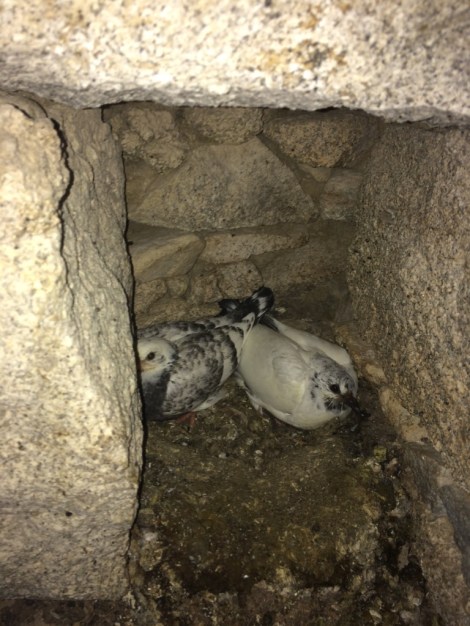
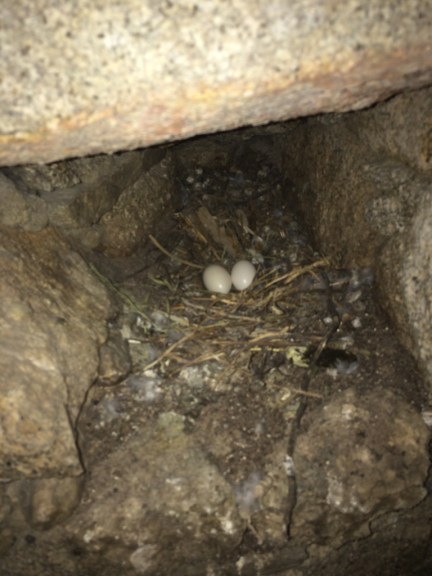
When the Venetians ceased to rule Tinos, concessions to practice dove breeding were no longer necessary. The inhabitants started to build their own dovecotes. They were built in areas conducive to breeding, such as rural areas near cultivated fields and where a water supply was available. 4 They were built on slopes that took into consideration the wind and would allow the doves to fly easily in and out of the dovecotes. The doves nest in the square holes built in a single or double row. Small stone slabs that protrude provide perches for the doves. 5

Here is a picture of some doves nesting and some eggs.

UNADJUSTEDNONRAW_thumb_57UNADJUSTEDNONRAW_thumb_54

Dovecotes are made out of slate clay and are whitewashed. They are two stories high. The doves live on the second floor and the first floor is used for storing tools and agricultural equipment. They are elaborately decorated with geometric patterns and non-geometric patterns such as cypress trees. It is believed that these patterns attract the doves. 6

Here is a close up picture of my husband’s dovecote. These doves are fed and their only predators are snakes. There are about 30 doves living in this dovecote at any one time. We know approximately how many doves are living here by counting them in a picture.  There is great pleasure in continuing to breed doves, a practice that has lasted centuries.

DSC06981[1]

IMG_2679

1 https://tinos360.gr/paradosi_eng.html

2 Author not identified, PDF document entitled Dovecotes of Tinos in Archnet.org

3 https://tinos360.gr/paradosi_eng.html

4 http://www.greeka.com/cyclades/tinos/tinos-other/tinos-dovecotes.htm

5 https://tinos360.gr/paradosi_eng.html

6 http://www.greeka.com/cyclades/tinos/tinos-other/tinos-dovecotes.htm


Church Registers: A Wonderful Resource for Researching Quebec Ancestors

APR 2

Posted by Jacques Gagné

Quebec’s Church Registers are a happy fact for anyone researching ancestors in that Canadian province.

From the early days of New France in the 17th century, a record was kept in a register for every Catholic birth, marriage and death. Priests kept a religious copy of the register at the parish and filed another state copy with the tribunal serving the relevant territory.

After the British Conquest in 1760, the right to keep registers of civil status was gradually extended – over the next century – to non-Catholics. At present, BAnQ’s Church Register collection contains the digitized records of births, marriages and deaths for Catholic, Anglican, Presbyterian, Methodist, Baptist, Evangelical, Jewish and Lutheran churches.

Today, these records can be accessed from the Drouin Institute on Ancestry.com, as well as through the BAnQ (the National Library and Archives of Quebec) http://bibnum2.banq.qc.ca/bna/ecivil/as

and familysearch.org: https://familysearch.org/search/collection/1321742

The BAnQ website is available in French, but the above link will take you directly the Church Registry page. Records can be accessed in three ways: by the place where the act was established (parish, congregation, synagogue, etc); by the judicial district, according to the list established by the Territorial Division Act (L.R.Q., chapter D-11); or by region.

To consult the registers, select one of the headings on the left side of the screen. To display the pages in large format (PDF format, image mode) click on the headings for the desired pages.

What will you find at the BANQ Online Church Registers 1768-1912?

Protestant churches – English – 686 churches

Jewish Synagogues – 20 synagogues

Protestant churches – French – 28 churches

Catholic parishes – French & English – 1,027 churches

Catholic parishes – Italian & others – 15 churches

Catholic missions – French & English – 8 missions

Catholic Religious Communities – 18 convents

Hospitals (French & English) – 12 medical centers

Hospices – (French & English) – 5 institutions

Psychiatric hospitals (Asylums) –3 institutions

BAnQ and Family Search

Civil Registers (Parish Registers)

Catholic & Protestant Churches

Civil Registers (Parish Registers)

1621 to 1916

Births (baptisms), marriages, deaths: http://bibnum2.banq.qc.ca/bna/ecivil/

 BAnQ Catholic & Protestant Church Registers & Jewish Synagogue Registers: http://bibnum2.banq.qc.ca/bna/ecivil/

Consult the following PDF document to see a list of all the churches (Catholic and Protestant) and synagogues in the BAnQ online collection.

BAnQ Online Collection of Church and Synagogue Registers

Arthur’s Baby Book

hambabybookarthur-10

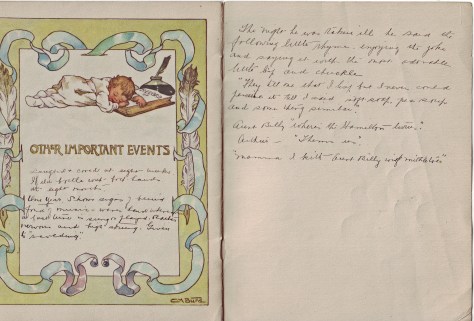
The night before three-year-old Arthur Hamilton became ill, he was reciting a rhyme and joking about lisps and kisses and mistletoe with a family friend who was helping put the children to bed. Someone – his mother or the friend – recorded those words in his baby book.

The following day, Arthur came down influenza. In fact, everyone in the house – his parents, his twin brother and his two older siblings – got sick. The others recovered, but Arthur did not.

When the influenza pandemic reached the Hamiltons’ Winnipeg home in January 1919, it was at its deadly peak. Arthur was among more than 1,200 Winnipeg residents and 50,000 Canadians killed by the pandemic, which was brought to Canada by troops returning from the trenches of World War I.1   Some 21 million people died from the virus worldwide.

Today, Arthur’s baby book, and that of his twin (my father) is in the University of Manitoba Archives as part of the Hamilton Family collection. These cheerfully illustrated booklets include important milestones, such as the twins’ first steps. Arthur’s book is especially moving because of the entry about the jokes he made just before he became ill.2

Archivist Shelley Sweeney has used Arthur’s baby book in the classroom many times. For example, she took it to a religious studies class that was exploring how people react to death by expressing regret and memorializing the person who has passed.

“It strikes people as so unbearably sad,” she says. “There are always sympathetic expressions and murmurs when I talk about it.”3

The death of a young child like Arthur seems especially sad, but the influenza pandemic traumatized whole communities. Some people lost family members to the flu after having already lost sons and brothers in the war. Many of those who died were between 20 and 40 years old, in the prime of their lives. Children were left without parents, families without income earners, businesses without customers, and manufacturers without workers. Poor neighbourhoods had the highest death rates.

Some people compared the pandemic to the Black Death of medieval times. The government banned large public gatherings to try to control the spread of the virus. Hospitals and physicians were overwhelmed.

My grandfather was a physician and my grandmother had trained as a nurse, but they couldn’t save their son. They tried everything they knew, but there were no effective treatments in 1919.

Their older son, Glen, a future a physician himself, later recalled being taken in to see Arthur’s body. He said, “I can remember on the floor beside his crib there was an enamel basin with boiling water in it – Friars Balsam [eucalyptus oil] – that aromatic stuff you put into body rub, and a little tank of oxygen. And those were the weapons to fight the flu. That was all!”4

My grandfather, Thomas Glendenning (T.G.) Hamilton, was devastated by his son’s death. Not only had he failed as a physician, but, as Glen Hamilton suggested in an interview, T.G. may have felt that he had been too attached to Arthur. “Dad was a very strict Calvinist Presbyterian and he felt that in some way, because he was so fond Arthur …. that he was being punished by the Lord ….”5

hamtwins1918winnipeg-01

Arthur’s death was a pivotal event for the Hamiltons in a way that seems surprising today, but was typical for the time. Many people were deeply religious and believed in personal survival after death. Grieving families wanted to communicate with loved ones who had passed, so they turned to mediums and séances. Between the two world wars, a strong spiritualist movement developed in Canada and elsewhere.6 Glen suggested that Arthur’s death stimulated his parents’ interest in the psychic field.

What made the Hamiltons unusual was the effort they put into exploring psychic phenomena. For more than 10 years, until T.G.’s death in 1935, they held almost weekly séances with a small group of regular participants.7 T.G. became known across Canada, the United States and England for his psychic research, while Lillian played a key organizing role in the background. T.G. emphasized the “scientific” nature of his enquiry, but his grief must have coloured these experiences.

Around 1980, Margaret (Hamilton) Bach donated her parents’ research notes, speeches and photographs to the University of Manitoba Archives, and a few years ago I added a few items, including the twins’ baby books. Today, many people consult the Hamilton Family fonds. Some are interested in psychics, several have used the collection as inspiration for plays and visual art, and other researchers are using the collection to explore how people cope with trauma.

Although many people, including myself, are skeptical about the authenticity of their experiments, it is wonderful to see that T.G.’s and Lillian’s passion is still contagious in so many different ways.

(This article is also posted on http://writinguptheancestors.blogspot.ca.)

Notes and Sources

T.G. Hamilton and Lillian (Forrrester) Hamilton had four children: Margaret Lillian (1909-1986), Glen Forrester (1911-1988), and twins James Drummond (1915-1980) – my father — and Arthur Lamont (1915-1919).

To read more about the Hamilton Family fonds, see http://umanitoba.ca/libraries/units/archives/digital/hamilton/index.html

1 Janice Dickin, Patricia G. Bailey, “Influenza”, The Canadian Encyclopedia, Historica Canada, http://www.thecanadianencyclopedia.ca/en/article/influenza/ (accessed March 20, 2017)

2. Baby book of Arthur Lamont Hamilton. University of Manitoba Archives and Special Collections (UMASC), Hamilton Family fond, A10-01, Winnipeg.

3. Personal email communication with Shelley Sweeney, March 23, 2017.

4. James B. Nickels. “Psychic Research in a Winnipeg Family: Reminiscences of Dr. Glen F. Hamilton”, Manitoba History, June 2007, p. 5.

5. Ibid.

6. Esyllt Jones, “Spectral Influenza: Winnipeg’s Hamilton Family, Interwar Spiritualism and Pandemic Disease,” in Magda Fahrni and Esyllt W. Jones, editors, Epidemic Encounters: Influenza, Society and Culture in Canada, 1918-20, Vancouver: UBC Press, 2012, p. 195.

7. Janice Hamilton “Bring on Your Ghosts!” Paranormal Review, winter 2016, p. 6. This edition of the magazine, published by The Society for Psychical Research in England, is entirely devoted to the psychic research carried out by the Hamiltons.


Finding Great Great Grandmother: Elizabeth Mowat Sutherland

img_4691

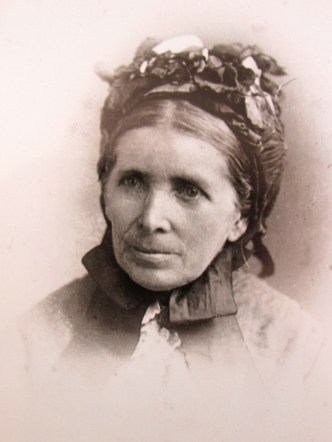
Elizabeth Mowat is my great great grandmother. I didn’t even know her name before I began my genealogy quest. I still don’t know much about her but I now have a photograph, a portrait of her in her “go to church clothes” with the requisite black bonnet.

There were no pictures of her in the box that started my family history search, although there was a family photograph of her husband William, her son Donald, his wife Alice and three of their children, William, Mary and James Dickson. I originally thought Elizabeth was alive at the time, so why on such an occasion was she not with them at the photographers? It later turned out she died in 1883 and not the assumed 1888.

It was through the internet and RootsWeb that I finally saw her face. Robert Harkness, from her daughter-in-law Alice’s line, said his family had lost all their old photos and information in a house fire but his uncle might know some family history. I wrote to his uncle, Bruce Harkness but did not hear anything. Then a couple of months later I received a letter from a George Dickson with photos and stories. He was also a relative of Alice’s and lived in the same apartment building as Bruce, in Belmore, Ontario. Bruce had shared my letter and it was George who responded. In the package was a picture of Elizabeth.

She was born in 1829 in Pulteneytown, Caithness, Scotland. Her parents were James Mowat and Isabelle Houston. It doesn’t appear that she had any siblings or at least any that survived to the 1841 census.

She married William Sutherland a shoemaker and 13 years her senior, May 1845, in Pulteneytown and they set out for Canada soon after. They sailed with two of William’s nephews and their wives so he had some family with him, but Elizabeth left her family and her life, never to see them again. There are Sutherland letters that have survived which reported on all the neighbours and friends so I assume the Mowats also heard about their daughter’s new life and family.

Elizabeth and William had seven children, William, James, Donald, Christina, Isabella, George, and John. They moved from Toronto to West Gwillimbury and finally to their own land in Carrick, Bruce County Ontario. After clearing the land and farming for a number of years they gave up the hard work and moved back to Toronto.

Elizabeth died in 1883 and William died in 1887. My sister Jeannie and I visited Mount Pleasant Cemetery and found their tombstone. The names were readable but not the inscription. As Jeannie went to the car to get some paper to try a rubbing, the sun came out and it’s angle made the inscription jump out,“The dead in Christ shall rise first”.

Notes:

Ancestry.com. Scotland, Select Births and Baptisms, 1564-1950 [database on-line]. Provo, UT, USA: Ancestry.com Operations, Inc., 2014.Original data: Scotland, Births and Baptisms, 1564-1950. Salt Lake City, Utah: FamilySearch, 2013

Extracts of entries in an Old Parochial Register. Proclamations of Banns and marriages Parish of Wick, County of Caithnes general register Office, New Register House Edinburch on 26 September 2000.

Archives of Ontario; Toronto, Ontario, Canada; Series: MS935; Reel: 36 Source InformationAncestry.com. Ontario, Canada, Deaths, 1869-1938, 1943-1944, and Deaths Overseas, 1939-1947 Provo, UT, USA: Ancestry.com Operations, Inc., 2010.Cert.

“The dead in Christ shall rise first.” 1 Thessalonians 4:16

The story of Elizabeth’s daughter Christina can be found at:   https://wordpress.com/post/genealogyensemble.com/2743

How to Bring a Voice to Your Personal Essay

Writing stories about your ancestors can seem a bit self-indulgent.  Who wants to hear about your long dead aunties and uncles? Your own relatives may roll their eyes when you pull out your tablet and talk about the blood, sweat and tears that went into a year-long investigation into an-all-but-forgotten life.

Sure, the genealogy writing exercise may start out as a purely personal exploration (as in Why am I here?) but with careful attention to detail and a sense of humility on your part, the practice can become so much more than that.

Exploring ancestry through prose provides you with a versatile platform to inform and delight your readers.  Your stories even may inspire others to take the plunge and explore their own roots while polishing their writing skills.

Genealogy writing is often personal in nature, as in “My great grandmother, Lydia Tittle, was born in 1897 in the poorest part of Ulster,” and it sometimes it comes in the form of the personal essay, as in “When I was a little girl growing up in rural Georgia, I was very close to my Ma Tante Mathilde, my father’s French sister.”

It may sound counter-intuitive, but my top tip to avoid sounding self-indulgent when writing about yourself and/or your ancestors is to use your own natural voice.

What is ‘voice’? Well, storytelling was once a sacred art.  The storyteller invoked a muse to tell a certain tale to an enraptured audience. I like to think of ‘the writing voice’ as something similar. Before I get down to writing a first draft, I invoke a piece of my personality to tell the story. For me, it’s a feeling I conjure up, much like I’m told a method actor does before walking onto the stage, and sometimes, as with acting, it can be a bit unsettling to bring up this feeling/personality, even scary. It certainly doesn’t feel self-indulgent.  Enveloped in this character/feeling, it’s easier for me to choose the appropriate words and expressions while writing and to maintain a consistent tone for the piece.

The biggest mistake any beginning writer can do is to try to imitate someone else’s voice because   readers will pick up quickly on the deception, but if you write stories in your own voice, even if you are still developing your style and technical skills (and what writer isn’t?) your readers will be inclined to be generous with you because they will sense you are ‘opening up’ to them, taking a risk, giving them a little piece of your heart, as it were.

Ask yourself these questions before you embark on the personal essay writing journey:

  1. Are you using your own unique voice?
  2. Is your essay and the information contained within worthy of the time the reader will spend on it?
  3. Does your story have substance? Is it useful, as in informative; diverting as in surprising or funny; or moving, as in sentimental or touching?
  4. Does your story have universal human appeal so that all readers can relate, or is it aimed at a specific reader with a specific interest?
  5. Does your story have a take-away, a gift that keeps on giving such as a fascinating fact or two, a broader insight, or some useful research tips that the reader can call upon later?

Happy St. Patrick’s Day

Montrealers really enjoy a parade and this year marks the 194th Saint Patricks Day Parade organized by the Irish Society of Montreal. On Sunday, March 19th people will line St Catherine’s Street, mostly on the sunny side, to cheer the floats, dance to the bands and even have a “little something” to help them stay warm.

This is a great time to start researching your ancestors. You never know what stories you will uncover. Some of you may find Irish roots even if your name is Tremblay or Gagnon. Many Irish came to Canada in the mid-1800’s, before and after the potato famine. Sandra McHugh’s great-grandparents left Ireland at this time but moved to Scotland rather than  North America. Read about their journey in Everyone is Irish on St Patricks Day. https://genealogyensemble.com/2016/03/16/everyone-is-irish-on-st-patricks-day/

Most of the Irish immigrants to Canada arrived in Quebec City and then traveled on to Montreal. Some of the Irish Catholics did settle in towns and villages all around Quebec while most of the Protestants moved on to Upper Canada. Jacques Gagne’s The Irish of Frampton Quebec https://genealogyensemble.com/2016/09/11/the-irish-of-frampton-quebec/ and The Irish Catholic Churches of Quebec https://genealogyensemble.com/2014/05/20/irish-catholic-churches-of-quebec/ are great sources of information on the lives of these people who populated Quebec.   

Janice Hamilton shows that persistence pays off in genealogy research in her Breaking Through My Sherman Brick Wall about the Irish origins of her great great grandmother Martha Bagnall Shearman. https://genealogyensemble.com/2016/07/06/breaking-through-my-shearman-brick-wall/ Census, birth, marriage and death records are harder to find in Ireland as a fire destroyed the Public Records Office in1922 but information can still be found. Janice found that aside from Canada the family has spread to the United States and New Zealand. There are Irish everywhere.

My Irish ancestors were all Protestants and more apt to celebrate the glorious twelfth than Saint Patricks Day. The Orangemen would march on July 12th to celebrate the battle of the Boyne when the protestant king, William of Orange defeated catholic James II. Susan Dodds and Alexander Bailey came from County Monaghan in Northern Ireland and their story is told in The Sampler. https://genealogyensemble.com/2016/04/20/susan-dodds-sampler/

So whether you have the ancestors or just want to pretend, have corn-beef and cabbage, drink a green beer and celebrate being Irish!

Montreal Cemeteries

Genealogists tend to visit a lot of cemeteries, so if those are beautiful places, the experience can be a pleasure. Anyone with Montreal ancestors in either Notre-Dame-des-Neiges (Catholic) Cemetery or in the non-denominational Mount Royal Cemetery can consider themselves lucky: both cemeteries are located on the slopes of Mount Royal, both are filled with trees and wildlife, and both have services to assist genealogists find their relatives.

These cemeteries were opened in the middle of the 19th century after the city’s population expanded, putting earlier burial grounds too close to residential areas. Hygienic concerns became particularly important when cholera epidemics swept the continent.

In fact, because of epidemics, poor sanitation and a lack of clean drinking water, many of the city’s dead were children.

P1130029
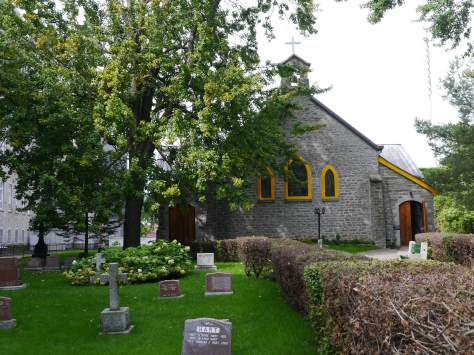
The cemetery at St. Stephen’s Anglican Church, Lachine.     jh photo

Since Mount Royal Cemetery opened in 1852, more than 300,000 people have been buried there. To check the location of a grave in Mount Royal Cemetery, go to  https://mountroyalcem.com/index.php/en/our-services/genealogy-menu.html. The Quebec Family History Society (QFHS) sells a book of 4600 monument inscriptions from Hawthorn-Dale, Montreal’s second-largest Protestant Cemetery and an affiliate of Mount Royal Cemetery. See http://www.qfhs.ca/forsale.php.

Notre-Dame-des-Neiges Cemetery, the largest graveyard in Canada, has been in operation since 1874. To find a grave there go to http://www.notredamedesneigescemetery.ca/en/research/locate.htm and click on locate deceased.

When the older cemeteries were closed, people were told they could move the remains of their relatives, but that did not always happen. Every now and then, human remains turn up when repairs are done to Dorchester Square, a former cemetery that is now a park in the heart of downtown. And in addition to proper cemeteries, there are some unusual burial places in the city. Priests and nuns were buried in the crypts of Catholic churches and other religious buildings. Some 6000 Irish immigrants who died of ship fever in 1847 are buried in a mass grave, marked with a commemorative stone, near the Victoria Bridge.

Because so many of the city’s old cemeteries were closed and eventually built upon or used for other purposes, anyone who comes to the city looking to find the grave of an ancestor who died before the mid-1800s will probably be disappointed.

For a list of 110 Montreal cemeteries, current and closed, including crypts and military cemeteries, see http://www.leslabelle.com/Cimetieres/ListerCims.asp?MP=E3&TY=M&SS=52

To find out about Jewish burials, see the following article posted on the Jewish Genealogy Society of Montreal website: http://jgs-montreal.org/burials.html

The QFHS has a number of publications related to cemetery histories and monument inscriptions in its library. Go to http://www.qfhs.ca/libraryRecords.php and put cemetery in the keyword space.

Following is a list of old cemeteries primarily used by the city’s English-speaking community. Most of them no longer exist. The links will tell you their locations and other information.

Montreal General Old Cemetery   http://www.leslabelle.com/Cimetieres/AfficherCim.asp?MP=E3&CID=2148

 Montreal Old Negro Cemetery – St-Jacques Street at St-Pierre Street in Old Montreal http://www.leslabelle.com/Cimetieres/AfficherCim.asp?MP=E3&CID=826

Dufferin Square Cemetery – Dorchester Boulevard at St. Laurent Boulevard http://www.leslabelle.com/Cimetieres/AfficherCim.asp?MP=E3&CID=828

Montreal Old Military Cemetery – Papineau Street at Lafontaine Street in Southeast Montreal  http://www.leslabelle.com/Cimetieres/AfficherCim.asp?MP=E3&CID=831

St. Mary’s Anglican Burial Ground – Malo Street and Bordeaux Street in Southeast Montreal  http://www.leslabelle.com/Cimetieres/AfficherCim.asp?MP=E3&CID=837

St-Hélène Island Old Military Cemetery http://www.leslabelle.com/Cimetieres/AfficherCim.asp?MP=E3&CID=846

St. Stephen’s Old Anglican Cemetery Lachine  http://www.leslabelle.com/Cimetieres/AfficherCim.asp?MP=E3&CID=2081

Goose Village Ancient Irish Cemetery   http://www.leslabelle.com/Cimetieres/AfficherCim.asp?MP=E3&CID=2717

Field of Honor Military Cemetery Pointe Claire   http://www.leslabelle.com/Cimetieres/AfficherCim.asp?MP=E3&CID=858

Lakeview Memorial Gardens Pointe Claire  http://www.leslabelle.com/Cimetieres/AfficherCim.asp?MP=E3&CID=861

Research: Jacques Gagné

Additional writing: Janice Hamilton


The Jamieson Sampler

There’s a mystery behind the sampler I inherited from my great, great grandmother.
The sampler itself is quite lovely and very detailed, most of the colours still vibrant today. It is edged with a border of stylized red roses. Inside are the traditional bands of letters and numbers in various stitches, along with a large two-storied house, trees, birds, animals, two baskets of flowers and a verse about the challenges of life. The creator’s name is written clearly: Jane Jamieson, Her Sampler, Quebec and a date. 1819? 1844? The numbers are unclear and therein lies the mystery.
Jane Jamieson was born in 1818 in Drum, Ireland to Samuel Jamieson and Jane Stewart. A sampler date of 1819 is therefore not possible, Jane would have been an infant.
Jane’s father was a tenant farmer and according to family legend, had at one time belonged to the Irish Constabulary. He was also a Protestant and a Loyalist. After suffering a series of irritating incidents at the hands of his Irish landlord, Samuel decided to quit Ireland and take his family to where he could farm his own land. In 1836 he, his wife, and their six children immigrated to Canada.
The Jamiesons, along with twenty-six other families, settled in the “highlands” of Megantic County south of Quebec City. Samuel was given Lot 5 S.W. on the First Range of Inverness Township in what was to become known as South Ireland (now Saint-Jean-de-Brebeuf). Their first home was an old cabin that an earlier squatter had left behind.
The land grants were part of a complex government scheme, beginning in 1791 and now known to be largely unworkable, to settle the vast wilderness between Quebec City and the American border. It took until 1869 before Samuel’s 100-acre grant was finally legalized in his name.
Life in Inverness was not easy. The settlers were expected to cut down the forest and unearth rocks to build their homes and to farm. The winters were long and brutal.
They were also very isolated. Craig’s Road, the dirt road to and from Quebec City, was mountainous, narrow, and heavily rutted with the only means of transportation being by foot, by ox cart or, in winter, by sleigh. It could take three days to reach Quebec or up to a full week when hauling a load of wood or charcoal to sell.
Two of Samuel’s daughters eventually left Inverness to find employment in the city. Both Jane and Sarah went into service. Jane worked two jobs, house maid and parlour maid, for a cash total of $3.00 a month.
In 1846 Jane married William Kelly, a wealthy coal merchant from Quebec City, and became mistress of her own home. There is no record of how they met and courted. Perhaps Jane worked in his family home. Jane and William had five children: James, Eliza, Samuel, Annie and Emma, my great grandmother.
If the date on the sampler is actually 1844, then Jane made the sampler as an adult, two years before her marriage, and not as a child as was the norm at the time. She perhaps learned the various stitches from a fellow domestic, or even her mistress, and created the sampler in her free time, likely something to be tucked away in her hope chest until the day she married. The large house in the sampler may have been the one in which she was employed. One might even suggest that the trees, the birds and the animals were reminiscent of her earlier life in Inverness. So too might have been the reference to the challenges that she “would overcome in the by and by”.

Sources:
Jamieson Harper, Helen. The Jamieson Family, 1995 (part of a research project by Gwen Barry Rawlings)
Barry Rawlings, Gwen. The English 180 years in rural Quebec-Megantic. The Canadian Genealogist, Vol. 3, No.2, 1981
The Kelly Family Bible – now owned by the writer

The Dowry

72 sherbrooke.JPG

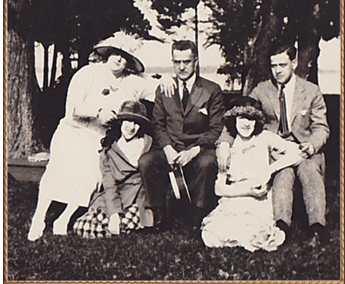
Maria Roy Crepeau and three daughters and a granddaughter in front of 72 Sherbrooke West in 1926 or so.

In the Edwardian Age, an ambitious young man, however resourceful, usually needed a solid financial foundation to kick-start his career.  If he didn’t have family money, he had to marry well. Take my grandfather, Jules Crépeau, (1873-1938). The son of a mere house painter, he rose up in 30 years from Messenger Boy in the Health Department to Director of City Services, the top civil servant at Montreal City Hall.

Jules didn’t have the advantage of a superior education; indeed, he completed his regular studies at night. He did have a workaholic nature, an affable disposition, a memory like a steel trap,*1 as well as a connection to the powerful French Canadian industrialists, the Forgets.

New information I found on the Internet reveals that the make-or-break-point for young Jules was in 1901, the year of his marriage. Back then, Jules was making only $600 a year, not a terrible salary for a single man, but certainly not enough to get married on.*2 So, Jules, like so many others, had to choose his wife very carefully.

My grandmother, Maria Roy, the daughter of a master butcher, brought a huge $40,000 dowry to their 1901 marriage, so I’m told. The next year, Jules had a house built for them on Amherst, near Ontario Street, and by a noted architect, at that.*3 Maria’s money!

Lovell’s Directory shows that in 1905 the Crépeau family moved to a tony stretch of St. Hubert Street.  Jules is listed as Head Clerk.  City Hall.   In 1918, they moved to St. Denis Street, just a few doors down from J. A. Brodeur, “Montreal’s Napoleon,” and Head of the Executive Committee. My grandfather was, by then, Second Assistant City Clerk, with a salary of $2,500 -$3,500.


julesfamily1.PNG

Crépeaus around 1918. My mother wasn’t born yet. Doesn’t Jules, center, look stressed?

In 1921, Jules was promoted to the newly-minted post of Director of City Services*4, almost tripling his salary to $8,000, and soon thereafter, to $10,000. In 1922, his family moved to a three storey greystone at 72 Sherbrooke West.

It’s during this period, the Roarin’ Twenties, that my grandmother, Maria, finally started earning dividends on her dowry, taking  shopping trips to New York City to stock up on bourgeois bric-a-brac like marble urns, porcelain statuary, and art nouveau lamps; a complement to the whole roomful of ‘gifts’ the family received from various community groups, especially at Christmas. Jules and Maria needed a good supply of breakables. Family legend has it that the crockery flew over the stairs throughout their tumultuous 37 year marriage.

mtflo.PNG

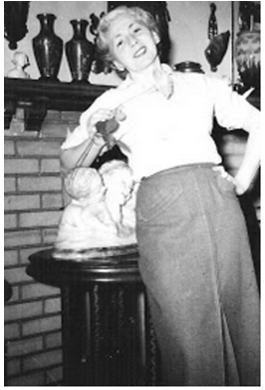
Aunt Flo posing in front of some Crépeau bric-a-brac on Harvard in the late 1940’s. The marble bust of three children actually ended up in my mother’s possession, gracing our upper duplex apartment in the 1960’s, but rather out of place among the melamine furnishings and artwork from Woolworth’s. Today, I own the orange art nouveau-deco Le Verre Francais “Amourettes” vase at top right.

In 1931, Jules Crépeau was forced to resign by the new populist Mayor Camillien Houde, but not before negotiating a huge life pension of $8,000 a year. But, soon,  my grandfather, who had no hands-on business experience, lost all of his savings with bad investments.*5  In 1937, Jules also lost his pension when Montreal City Hall passed an emergency bill to abolish it as a cost-saving measure. *6

Just two weeks later, Grandpapa was hit by a car driven by a plain clothes city policeman. He died the next year from complications. Jules probably threatened someone with a long reach.

Living out her life in the final family home on Harvard in Notre Dame de Grace, Jules’ wife, Maria Roy Crépeau (1879-1951) never complained about her situation as an impoverished widow, and this despite the fact her fat dowry financed the first years of the choppy Crépeau-Roy merger. Still, I suspect her story wasn’t at all unique, especially in the Depression Era.

Jules Crepeaurue.PNG

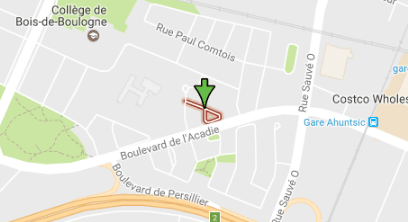
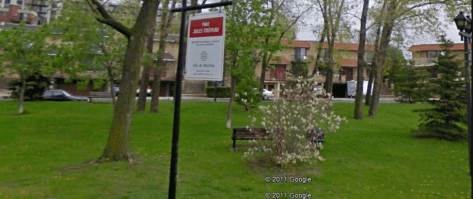
Rue Jules Crépeau, Ahunsic, Montreal. Designated in the 1980’s. Funny story. In the late 80’s, when my husband and I were buying our first computer, the ONLY place in Montreal we knew that sold them was in  Ahunsic, where we seldom ventured. We got lost and stumbled upon this road and park. I had to find a phone booth to phone my mother to tell her that a street had been named after her father. Serendipity or what? Jules’ nemesis, Camillien Houde, has the huge road winding through the mountain named after him.

park.PNG

  1. Le Devoir was the only Montreal newspaper to publish a long obit of my grandfather, in 1938, saying that Jules was the go-to guy for any information about how City Hall ran. Affable is their term.
  2. The 1911 census shows that a $600 a year salary was average/above average for a family. Many era workers were ‘day workers’ with unsteady employment, but, even that $600 salary was not enough for the big families of the era to live on. Terry Copp, the sociologist who wrote An Anatomy of Poverty,claims that $1500. was the minimum salary for a family to live in dignity in Montreal in 1910.  In the Edwardian Era, in England and elsewhere, a working class couple might start out in good shape, with a decent salary for a small family, but as more and more kids came, the family fell into poverty.  Such might have been Jules’ fate, save for this huge dowry.
  3. Louis Zephirin Gauthier specialized in churches. His partner was a Monsieur Roy, so maybe he was a relation. Back then few Montrealers owned their own home, in the 20 percent range. Since 1899, male renters could vote in the municipal elections; women had to be single and own their home to vote. Montreal has long been known as a city of renters, but, just lately, this appears to be changing.
  4. The post of Director of City Services was created in 1921 after much deliberation and input from citizens to ensure an equitable distribution of money among the city districts. The post was a liaison between the seven city departments and the Executive Committee. Newspaper accounts of the time reveal that my Grandfather’s office did everything from organizing events for the visiting Royal Princes to being on the City Clean-Up Committee, to testifying in Quebec with respect to Private Bills. When someone had a beef at City Hall, they wrote to his office. My grandfather was the first to testify at the inquiry in to the fatal Laurier Palace Fire, in January 1927, which was ironic, as I suspect  the fire may have been started by organized crime to get at him. (Just my theory, though.)
  5. Jules’ brother, Isadore, Insurance broker and VP Of United Theatre Amusements, the company that erected many of the famous 1920 era movie houses in Montreal, ‘fell’ out of his 7th floor office while waving for his chauffeur in 1933.
  6. Kristian Gravenor, journalist at Coolopolis.blogspot.ca http://coolopolis.blogspot.ca/2017/01/ndg-coincidence-undercover-cop-slams.html wrote a bit about Jules and dug out the info about the cancellation of his pension.

Working together to help genealogists discover their ancestors