Category Archives: Genealogy

The Thunderbird

by Claire Lindell

Every year, even after all these years when the Feast of the Annunciation draws near, my memory is flooded with the events that transpired more than fifty years ago. Decisions that would change my life seem to come to the forefront of my mind.  I think back to that weekend.

Early on the bright spring Thursday morning of March 25th, 1965  the chauffeur driven car pulled up beside the convent. My father walked up to the front door and welcomed me with opened  arms. He had come to bring me home.

For almost six years Joan of Arc House had been my convent home. Taking the Holy Habit, becoming a bride of Christ,  two years in the Novitiate, studying theology, teaching Kindergarten, daily prayers and community living were the  way of life. Leaving  all this behind was not an easy decision.

We set out on the  long drive from Ottawa to Asbestos. We had much to talk about, but to this day I can not for the life of me remember any of our conversation. Heading in to the unknown can be rather daunting. There was a great deal to ponder.

Mom was waiting for us at home. The following day, Friday morning, she took me to the hairdresser to have my hair cut and permed. It was in dire need of something. I had worn a veil while a nun and “one’s crowning glory” was not a priority under a veil! I came away from there somewhat transformed and ready to face the challenges that lay ahead. That afternoon we  drove to Richmond where I signed a contract to begin teaching Grade One beginning the following Monday morning. Arrangements had been made earlier when a friend knew I was leaving the convent and they needed a teacher at her school.

The weekend flew by as I tried to come to grips with my new surroundings, not to say anything about a new look! Life was so different. No bells. No prayers. No meals in silence. No community time.

Monday morning arrived and my Dad suggested I use his  car to drive the fifteen miles to Richmond until I could buy my own. His  car was a 1962  white Ford Thunderbird convertible with bright red leather interior! It was a very snazzy sports car for an ex-nun to be driving. It was a perfect way to get back in to “the real world” and forge ahead on to the next chapter.

T-Bird

That Monday morning I could only chuckle to myself wondering what my new colleagues were thinking when they saw this “to die for car” pull in to  the parking lot and out I came, the new teacher, an ex-nun  who was the driver of the Thunderbird convertible! Can you imagine?

Since that day in 1965 life has been good and there have never been any regrets about the decisions made. Within two weeks I had my own car and I can assure you, it was nothing like that 1962 white Ford Thunderbird with the beautiful red leather interior!

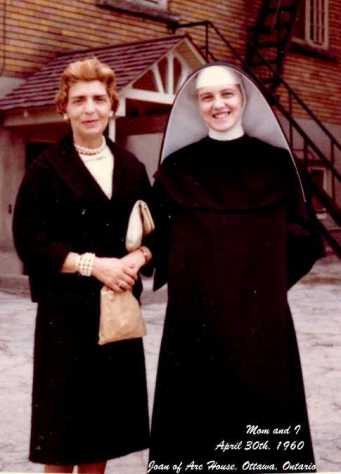
Me and my Mom   on Holy Habit Day

April 30th, 1960

The German Presence in the Lower Laurentians

This compilation looks at the towns and villages in the Lower Laurentian area, north of Montreal, where German-speaking immigrants settled, and lists the churches these people may have frequented. It also lists several books and articles that discuss these people and their communities. There is a list of repositories and addresses at the end of the compilation that will help you find records of births, marriages and deaths.

German Presence – Lower Laurentian Region of Quebecl Mar 19-1

Everyone is Irish on St. Patrick’s Day

Everyone is Irish on St. Patrick’s Day.  We all love to be Irish for a day on March 17.  In my case, I treasure my Irish roots.  Today, I will raise a pint of Guinness and toast my ancestors.

Although my grandparents were Scottish, my great-great-grandparents, John McHugh and Mary Garret, were Irish.  They were both born around 1820 in Ireland.  They would have been young adults when the Great Famine, also known as the Great Hunger and the Irish Potato Famine happened between 1845 and 1852, when potato blight ravaged potato crops throughout Europe.  Ireland was significantly affected and, as a result, one million Irish immigrated to other countries. We commonly hear about the Irish that moved to North America and Australia but a significant number of them immigrated to Scotland.1 John and Mary McHugh were among those who decided to go to Scotland.

At the beginning of the 19th century, it was already common for Irish agricultural workers to move to Scotland temporarily to work during the harvesting season.  By the 1840s, the number of these workers had increased from a few thousand per year to 25,000.  By 1851, the Irish-born population in Scotland had risen to 7.2% of the total population.2

The economic difficulties in Ireland, combined with the industrialization of Scotland that included the expansion of coal and iron ore mining, and the building of shipyards and railways, as well as the significant expansion of the textile industry in Scotland, made Scotland an attractive destination for the Irish.3

The Irish were ideally qualified to work in Scotland’s textile industry as many of them already had knowledge and experience in the textile and jute industry.  Linen and yarn production was already established in Ireland.4The economic conditions in the 1840s in both Ireland and Scotland provided John and Mary McHugh with the impetus to move to Scotland to work in the textile factories in Dundee. Not only John, but Mary also, would have been assured of a regular wage, as many of the textile workers were women. 5

While Scotland would have been a choice destination for John and Mary, it would have been a difficult adjustment.  Sadly, this is because of their religion.  They left communities in which everyone was Roman Catholic to go and live in Protestant Scotland. The Irish Roman Catholics did not have an easy time of it in Scotland. “Anti-Catholic Scots were active in the Scottish Reformation Society and sometimes caused riots.”6 These anti-Catholic sentiments probably encouraged the Irish Catholics to remain in their distinct communities and delayed their integration into Scottish communities.

The following quote illustrates that the Irish were victims of discrimination.

“As late as 1923, the Church of Scotland could still publish a pamphlet entitled ‘The Menace of the Irish Race to our Scottish Nationality’. The Irish were seen as drunken, idle, uncivilised and undermining the moral fibre of Scottish society. They were also seen as carriers of disease. Typhus, for example, was known as ‘Irish fever’.”8

Unlike the above quote, we know the Irish to be hard working, disciplined and adaptable.  I am proud to have Irish roots.

So, despite what would have been great adversity, John and Mary settled in Scotland, lived in a Roman Catholic community and had children and grandchildren who worked in the textile industry. The generations of McHughs working in the textile industry in Dundee came to an end when their grandson, my grandfather, Thomas McHugh, could no longer find regular work in the textile industry in Dundee and decided in 1912 to move to Canada.

A toast to the Irish!  I wish you all a very happy St. Patrick’s Day.


1 https://en.wikipedia.org/wiki/Great_Famine_(Ireland)

2 http://www.irish-genealogy-toolkit.com/Irish-immigration-to-Scotland.html

3 https://en.wikipedia.org/wiki/Industrial_Revolution_in_Scotland

4 http://www.irish-genealogy-toolkit.com/Irish-immigration-to-Scotland.html

5 https://en.wikipedia.org/wiki/History_of_Dundee

6 http://www.irish-genealogy-toolkit.com/Irish-immigration-to-Scotland.html

7 Idem.

8http://www.educationscotland.gov.uk/higherscottishhistory/migrationandempire/experienceofimmigrants/irish.asp

John Buchan: Author, Pacifist, Canadian

People often wonder why no one tried to stop Hitler before 1939. One answer is the influence of pacifists, including John Buchan.

His desire to come up with some way to achieve peace in Europe led Buchan to hold secret meetings with Roosevelt on behalf of Chamberlain while serving as Canada’s Governor General, writes Kate Macdonald, in her book  “Reassessing John Buchan: Beyond the Thirty Nine Steps.”

The most obvious constructive outcome of Buchan’s partly secret, partly public approach was a series of high-level meetings and state visits involving Buchan and President Roosevelt during the late 1930s. From Washington, Roosevelt made active use of Buchan as an informal—but high-level—channel of communication with British political leaders in London, doing so, it seems, to circumvent the influence of the American State Department and British Foreign Office. Buchan, as focused as Roosevelt on the vital issue of peace in Europe, was only too happy to oblige the president by acting in this way, even though he should not (as governor-general) have engaged in this subterfuge.”[1]

Buchan’s public popularity made him invaluable as an go-between for British and American interests. The Scottish National’s novel The Thirty-Nine Steps had just become a mystery thriller movie by Alfred Hitcock and he was also he was voted Time Magazine’s man of the year when the The British Government appointed him Lord Tweedsmuir in 1935. The Lordship was a necessary step to allow him to be appointed Governor General of Canada on August 10 that same year.

His appointment as Governor General of Canada was meant to signal a new era. Leaders were buoyant that the depression would end and employment would rebound. The dust bowl storm of the previous spring was over and a new government had taken power. Unemployment was still high and many people were still struggling to feed themselves, but countries that had been closed to exports were opening up.

As Lord Tweedsmuir, Buchan outlined two international trade agreements in his speech from the throne which began Canada’s 18th parliamentary session on Thursday, February 6, 1936.

I am happy to be able to inform you that a trade agreement between Canada and the United States of America was concluded on Armistice Day, 1935, and that the trade dispute with Japan, which had seriously affected the trade of both countries, was adjusted before the end of the old year. The Canada-United States Trade Agreement will be submitted for your approval. You will also be forthwith advised of the basis on which normal trade relations between Canada and Japan have been restored.[2]

In addition to travelling throughout Canada, welcoming the new King and Queen, establishing the first proper library at Rideau Hall, and founding the Governor General’s Literary Awards, Buchan represented three different Kings during his five year reign. George V died in January 1935. Edward VIII abdicated eleven months later. George VI took office in May 1937.

He spent most of his time, however, supporting desperate Canadians and meeting with leaders to convince them not to go to war.

Their efforts to build a European peace failed.

On Thursday, September 7, Tweedsmuir made the following speech:

Honourable Members of the Senate:

Members of the House of Commons:

As you are only too well aware, all efforts to maintain the peace of Europe have failed. The United Kingdom, in honouring pledges given as a means of avoiding hostilities, has become engaged in war with Germany. You have been summoned at the earliest moment in order that the government may seek authority for the measures necessary for the defence of Canada, and for co-operation in the determined effort which is being made to resist further aggression, and to prevent the appeal to force instead of to pacific means in the settlement of international disputes.

Already the militia, the naval service and the air force have been placed on active service, and certain other provisions have been made for the defence of our coasts and our internal security under the War Measures Act and other existing authority.

Proposals for further effective action by Canada will be laid before you without delay.

Members of the House of Commons: You will be asked to consider estimates to provide for expenditure which has been or may be caused by the state of war which now exists.

Honourable Members of the Senate: Members of the House of Gommons: I need not speak of the extreme gravity of this hour. There can have been few, if any, more critical in the history of the world. The people of Canada are facing the crisis with the same fortitude that to-day supports the peoples of the United Kingdom and other of the nations of the British Commonwealth. My ministers are convinced that Canada is prepared to unite in a national effort to defend to the utmost liberties and institutions which are a common heritage.[3]

After both houses voted to support the plan, Canada went to war with Germany on September 9, 1939.

[1] Macdonald, Kate, Reassessing John Buchan: Beyond the Thirty Nine Steps, London: Pickering and Chatte, 2009, , 1851969985 p 113.

[2] Journals of the House of Commons of the Dominion of Canada, Session 1936, 18th Parliament of Canada, J.O. Patenaud I.S.O., February 6 to June 23rd, 1936, Thursday, February 6, 1936, p 12.

[3] Journals of the House of Commons of the Dominion of Canada, 5th Special War Session, 18th Parliament of Canada, J.O. Patenaud I.S.O., Thursday, September 7, 1939, p 1.

The German Presence in the Eastern Townships, Central Quebec, the Richelieu River Valley and South-West Quebec

As in other parts of Quebec, German-speaking immigrants, including some Loyalists with German roots, integrated well into life in the Eastern Townships and surrounding regions. This compilation describes the towns and villages where some of these people have lived from the late 1700s to the 20th century. It names the churches they attended and the cemeteries where they were buried, and it helps the researcher locate these records.

The German Presence in the Eastern Townships Final Mar 6

Plymouth Navy Days

by Marian Bulford

Our group or ‘gang’ never went out with the local lads. Every Saturday night we went dancing at the NAAFI and met up with the young sailors from all over the British Isles who were stationed in Devonport. The NAAFI was a huge social club ….
It was always with the young sailors stationed in Devonport, from all over the British Isles that we met every Saturday night when we all went dancing at the NAAFI – the Navy Army Air Force Institute – a social club for all the services and service families situated in the centre of Plymouth and covered a whole city block. At one end, it was a hotel for service families and the other end was a restaurant three bars and a huge dance floor.

I was an excited 16 year old, with the whole world in front of me. Plymouth Devon, in the UK was my home town.

It was a naval port and had been for centuries. Who has not heard of Sir Frances Drake, the celebrated Tudor seafarer, famous for circumnavigating the world on the Golden Hind and fighting the Spanish Armada? Or the Mayflower, the tiny ship that transported the first English Separatists, known today as the Pilgrims, from Plymouth to the New World in 1620? [1]

Most of my family on both mother and father’s side, were Royal or Merchant Navy and had lived in or around the areas for centuries the same places I lived as a teenager.

Ships of all sizes were always in and out of Devonport, the area I lived in and when a ship arrived ‘home’ there was much celebration in the local pubs and dance halls. This was my town and I loved it.

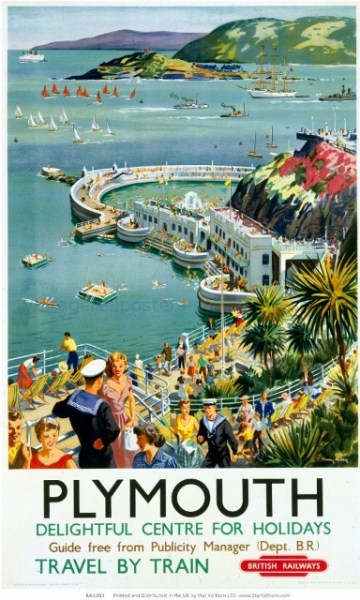
It was also a very popular summer holiday area with lovely hotels and guest houses. This area of Devon was described as the ‘Riviera of the South’ we even had our own palm trees.

This poster shows ‘Plymouth Sound’ and ‘Drake’s Island ‘ in the background, the beautiful Tinside Art Deco Lido Pool and of course, the sailors. I could have been one of those girls in the poster……

Holiday Poster

Over the last year, my 16 year old school friends and I had built up a close group of boy sailors, ‘Matelot’s’ as we called them, the young 15 to 16 year old Navy boys learning their trades as apprentices on board various ships at the Devonport Dockyard, where many of my ancestors had worked over the centuries.

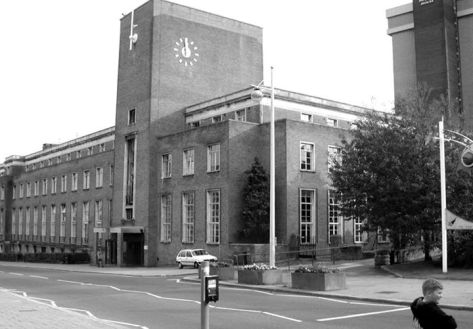
NAAAFI Building, Plymouth Devon c. 1961

The Plymouth NAAFI Club

We were all very excited in 1961 because the NATO [2] fleet arrived in Plymouth!
About 15 foreign ships would be arriving and the population would swell. The local population was pleased as money would be made and our group noticed a lot of ‘strangers’ in town when the fleet arrived. Lots of ‘ladies’ from London arrived, or ‘unfortunates’ as my Gran called them, and they stood out because of their accents.

Many foreign languages were also heard in the streets of Plymouth, some I was only hearing for the first time, and we tried to communicate with some of the sailors with lots of miming laughing and hand waving.

The biggest ship in town was a United States Aircraft carrier, USS Wasp, which caused great excitement: it was as big as a small town.

But imagine our reaction on the following Saturday, when we went to our usual dance at the NAAFI and saw our very first black men in the flesh AND they were doing the twist, the dance craze at the time!

We had never seen black people before, there were none in our part of England, and especially not ones doing the twist! Boy, they were ever good! Not a patch on us or the local sailors and we could not wait to copy them. But that is another story….

[1] https://en.wikipedia.org/wiki/Mayflower

[2] NATO Fleet: Belgium, Canada, Denmark, France, Iceland, Italy, Luxembourg, the
Netherlands, Norway, Portugal, the United Kingdom, and the United States. In 1952,
Greece and Turkey became members of the Alliance, joined later by West Germany.

Save

Dissenters and Poets


john

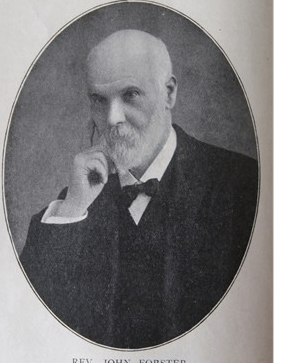
Reverend John Forster. Published with the permission of the Primitive Methodist Ancestor Website.

Late in his life, Somebody Forster, my great-grandfather, awakened from his night’s sleep to ask his wife of many decades, ‘Woman, what are you doing in my bed?”  It was dementia.

Until lately, this serio-comic anecdote was the only thing I knew about my father’s mother’s father, other than that he was a Methodist Minister from the North of England. But, just last month, I accessed the 1901 UK Census, (for free, yea) and it took me about thirty minutes to find out all I could want about my great-grandfather Somebody.

First, I looked up my grandmother, Dorothy Forster, who I knew was born in 1895 in Middleton-on -Teesdale, County Durham, UK,  to see that her father was a Reverend John from Knockburn, Northumberland; her mother Emma, a former Cowen from Crook,  and, more importantly, that John was a Primitive Methodist Minister. (I checked. PM’s were dissenters; socialists and pacifists, apparently.) *1

Then, googling the keywords “John Forster” and “Primitive Methodist,”  I  landed on a webpage from a genealogy site, myprimitivemethodistancestors.org , with a short biography of Great-granddad John, with  grainy photos of him and wife Emma taken in 1914.

Apparently, John Forster, a bookish, self-educated son of a farmer, was an accomplished essayist who penned over fifty articles for the Connexions Magazine of the Primitive Methodists on sundry weighty topics including “Heredity in Relation to Morals” and “Primitive Methodism and the Labour Question.”(He also served as a Temperance Committee; amusing, as his daughter, my Grandma Dorothy*, could really slug back the gin!)

I was most intrigued, though, to see that John had published a book of poetry, in 1923, shortly after my father, his grandson, was born at the European Hospital near Kuala Lumpur, Malaya. The author claims that Reverend John’s poems ‘contain lyrics of extraordinary charm and grace.’

(Well, I know the Wasteland was published in 1922, ushering in modernity, it is claimed, but no one said anything as nice about T.S. Eliot’s poem 😉

Curious, of course, about these verses, I contacted the Primitive Methodism Website’s administrator, asking for help. She immediately emailed me back a longer biographical article about John Forster, but no examples of his poems.  The volume in question, Pictures of Life in Verse seems to have gone missing from the church/museum library.

Quelle Bummer!

There’s good news, though. This longer article lists Reverend John’s assignments or ‘circuits’ in chronological order.  The Forster family moved often, it seems, around the area:  Thornley, Crook, Middleham, Bradford, Middleton-in-Teesdale, (a very pretty sheepy village) about six other towns, then, it said, “his present one (1912) being Helmsley.”

Bingo!  I know from the 1911 UK Census, that Helmsley is the hometown of my grandfather, Robert Nixon.  Clearly, alliances were made in that era that resulted  in the marriage of John and Emma’s second daughter, Dorothy, to Robert Nixon, son of a delver in the local Rievaulx quarry, although a Great War would delay official matrimony.

Dorothy would have been 17 in 1912 and fresh out of her co-ed Quaker boarding school and Robert Nixon just 22, and working in service as a footman.3

Perhaps Robert’s prospects weren’t good enough for the righteous Reverend John. In 1913, according to online records,4 Robert, travelled to Malaya to work as a labourer in a rubber plantation. During WWI, Dorothy worked as a land girl, leading enormous Clydesdales through the woods, a comical sight as she was only 5 foot tall.*5

The same records also reveal that Robert returned to England in 1916, now the plantation’s Assistant Manager. This trip home was very likely to secure a wife for real as rubber company officials insisted their employees return to the UK to find respectable British (see: white) wives.

Whatever transpired back in Helmsley, North Yorkshire in 1916,  on December, 1921, *6 Reverend John Forster, perhaps taking time off from penning one of his charming verses, sent his second daughter, Dorothy  off to  Selangor, Malaya. She’d become pregnant almost immediately upon arrival. I know because my father, Peter, was born on October 23, 1922.7


  1. Checking into Emma Cowan’s parentage, I see that her ancestors belonged to this same church, Redwing Chapel, that has an online presence! United Congregation of Red Wing Chapel, Garrigill, and Low Chapel, Alston, Cumberland; http://www.fivenine.co.uk/family_history_notebook/source_extracts/parish_registers/cumberland/redwing_registers.htm
  2. Website: Myprimitivemethodistancestors.org
  3. UK Census 1911
  4. UK Immigration and Transportation Records http://www.familysearch.org
  5. Family Lore
  6. UK Immigration and Transportation Records. After WWI, there were many, many more unmarried women than men in England, so perhaps this had something to do with Dorothy’s decision to go to Malaya to marry Robert Nixon. They did not get married in the UK, or at least I can’t find any record of a marriage.
  7. Family lore, (my Aunt Denise, who died last month) said that Robert kept his Asian mistress after marriage. Dorothy eventually got her own boyfriend, a colonial lawyer who remained faithful to her until her death in 1971. Both Dorothy and Robert were interned at Changi Prison in Singapore during WWI. Dorothy was Women’s Camp Commandant for a term. I only met my grandmother once in 1967, when she came to visit. Robert  died while she was at our house in Montreal’s Snowdon district.  He fell off a ladder at his daughter’s, Denise, in Farnborough, Hants, UK.  I recall the telegram. I recall, also, that my grandmother managed to wipe a tear or two from her eyes. I’ve written about my Colonial Grandmother in a play Looking for Mrs. Peel, which makes it all the more amusing that my great-grandparents were named John and Emma.

German-speaking Quebecers in the Trois Rivières area

German-speaking individuals and families have been immigrating to Quebec for almost 350 years. The first German-speaking family in New France was that of Hans Bernhardt, who arrived in 1663. A few more families settled in New France between 1668 and 1690 and the first small wave of emigration from the Palatinate (German Rheinpfalz) region to North America occurred in 1673.

Following the War of 1812-1814, some soldiers and officers of the Regiment of Watteville and the Regiment de Meuron, who had fought alongside the British against the Americans, settled in central Quebec, primarily in Drummond, Arthabaska, Wolfe and Bagot counties.

Between 1815 and the creation of Germany in 1871, people emigrated from various germanic principalities, dukedoms and electorates. These German-speaking families settled in Montreal, Quebec City, Western Quebec, the Eastern Townships, the Laurentian Region and the south shore region of Montreal.

Much of this information comes from Dictionnaire des souches allemandes et scandinaves au Québec, by Claude Kaufholtz-Couture & Claude Crégheur, published by Septentrion, 2013. This book includes 4,500 biographies of Germanic settlers, identifies where they came from in Continental Europe, notes their marriages in Quebec and the marriages of their children.

This link leads to a short compilation of information on the records of German-speaking Quebecers in the Trois Rivières area, northeast of Montreal:

The German Presence in the Trois Rivieres area

Earlier posts include:

The German Presence in the Montreal Region (Feb. 7, 2016) https://genealogyensemble.com/2016/02/07/the-german-presence-in-the-montreal-region/

the Germanic Presence in Quebec City (Jan. 24, 2016) https://genealogyensemble.com/2016/01/24/germanic-presence-in-quebec-city/

German Churches and Cemeteries in Western Quebec and the Upper Ottawa Valley (Jan. 17, 2016) https://genealogyensemble.com/2016/01/17/german-churches-and-cemeteries-of-western-quebec-and-the-upper-ottawa-valley/

There are three more compilations on Germanic records to come.

A Death-Forged Bond

On August 18, 1943 Royal Canadian Air Force (RCAF) Flight Sergeant Colin Angus was posted as missing and presumed dead following a devastating air raid made on the missile research laboratories at Peenemunde, Germany. Forty one bombers and one fighter plane were lost that night. Colin’s plane did not return.

Peenemunde was Colin’s second mission. He was initially rejected by the Air Force on medical grounds – a damaged mastoid bone, the legacy of a childhood illness. As the war took its toll, the physical requirements were downgraded. Colin was accepted and trained as a navigator.

The target of Colin’s first mission was Cologne, Germany’s military command center. Other comrades and other aircraft did not return that night.  “We can only hope for them”, Colin wrote in a letter to his brother Ian.

Two days before Colin flew his second and final mission, he wrote in another in another letter that should he “take a cropper”‘ would Ian, also a RCAF pilot stationed in England, send from his personal effects “such stuff as should go home”.

The family of the missing exist in a liminal zone. How long did my grandparents hold out hope that their son would be found? They may have reasoned that he lay wounded and yet unidentified or that he would soon be listed as a prisoner of war.

How powerless they must have felt during the days and weeks and months that followed. When Colin had hovered between life and death as a child, they could hold him, soothe and tend to him. Now they could do nothing but wait. Did they rant at the unfairness? Did they make pacts with God? How did they get through the long nights when daytime activities could no longer offer a sense of normalcy and hold the pain at bay? Were they able to share their fears and support each other, or did they suffer alone, neither willing to expose their despair to the other?

It took seven months for the RCAF to confirm their son’s death. On April 30th, 1944, a memorial service was held providing the family a semblance of closure. There was no coffin. His body, along with those of his crew members, had been buried in German soil far from loved ones.

“Such stuff that should go home” eventually reached my grandparents. It was a very small package that included Colin’s watch and glasses.

When I was sixteen, my grandmother was chosen to be Mother of Honor at the annual Armistice ceremony in Quebec City. The night before the event she carefully unwrapped the package. As I watched, she stroked each item, tears streaming down her cheeks. I was yet too young to fully understand her grief. I could only fixate on the glasses, so very fragile, and marvel that they could survive the crash that killed the uncle I would never know.

Yet that uncle left me a treasured gift. The bond I had with my grandmother was forged because of his death. I have since come to understand that her joy in the birth of a grand-daughter the year following her son’s death enabled her to move beyond her sorrow. I believe that I was her salvation and the reason she held me close all her days.

Sources

Service Record of Sergeant David Colin Brodie Angus, Library and Archives Canada

Personal letters between Colin and his brother Ian – on file with author, Ian’s daughter

Service Held for Colin Angus, Quebec Chronicle Telegraph, May 1, 1944 – clipping on file with author

Great Granny Bagg (Kittens on the Wedding Dress)

Mary Heloise Bagg Lindsay (1854-1938)

The Anglican Church and her philanthropy were most likely what grounded Mary Lindsay and enabled her to properly cope with her family. It is my belief that as the educated daughter of a wealthy Montreal family, the wife of a successful Montreal stockbroker and a busy mother – she appreciated the solitude of her Sunday morning church service and the rewarding challenges of her chosen charities. Her obituary, in 1938, summarized Mary Heloise Bagg Lindsay’s life as having “been a life member of the Women’s Auxiliary of the Church of England, Governor of the Royal Victoria Montreal Maternity Hospital and Children’s Memorial Hospital and greatly involved in a great many charities. She also regularly attended services at The Church of St. John the Evangelist1.

My great grandmother, Mary, was one of four surviving daughters of Stanley Clark Bagg and Catherine Mitcheson. Born in 1854 at the Fairmount Villa, in the Golden Square Mile of Montreal, she grew up to marry Robert Lindsay in 1881. Her only brother, Robert Stanley Bagg, was heir to the family fortune, her two older sisters married men in the clergy and her younger sister married a scandalous real estate tycoon who mysteriously disappeared when his debts caught up with him.

Robert and Mary Heloise Wedding day
Mr and Mrs Robert Lindsay -1881

Her first matrimonial home, in 1881, was located at 436 St-Urbain2, which was a subdivision of a very large villa lot stretching down to Sherbrooke, near the Fairmount Villa where her mother still lived. Eventually she and Robert moved to 6 Prince of Wales Terrace3, at 455 Sherbrooke Street West (the address later became 1009 Sherbrooke Street West) where she raised her family and lived there until she died in 1938 at age 84.

Mr & Mrs R Lindsay - 6 Prince of Wales Terr -1917
Mr & Mrs R Lindsay – 6 Prince of Wales Terrace – 1917

Although Mary was petite in size and considered “frail” she and Robert had six healthy children.

Ada was her firstborn child. On her wedding day, it was discovered that the family cat had had her litter of kittens on the wedding dress that had been laid out on the bed!4 Somehow they were able to acquire another dress.  

This still remains one of my favourite family tales.

Ada - wedding - 1911
Ada Lindsay Griffith – 1911

Lionel, her eldest son, studied medicine all over Europe and became a well-loved family doctor in Montreal after he retired from the Canadian Army Medical Corps in 1915. Her second son, Sydenham, (my grandfather) The Priest became a well known Anglican Priest in the Montreal area, despite the warning from his stockbroker father that there was “Not much money in it!”

Her last three children did not marry.

1891-Children of RobertLindsay&MaryHBagg
Ada, Marjorie, Lionel, Stanley and Sydenham – 1891 (Marguerite was born in 1896)

Stanley served as a captain in WWI and survived the Battle at Ypres in 1915. Afterward he returned home to follow in his father’s footsteps and became another successful Montreal stockbroker. He remained the bachelor uncle who enjoyed doting on his nieces (especially my mother) and nephews. Beautiful Marjorie, however, remained a spinster when permission to marry her one true love across the Atlantic was denied for her own safety5. And sadly, Mary’s youngest child, Marguerite, died at age 26 as a summer volunteer with the Grenfell Mission in Labrador.Miss Lindsay – Part 1

Mary must have drawn great strength and comfort from her faith to support her adventurous children in their respective challenging worlds.

Updated and edited – 2023-03-27 by author

1 The Montreal Gazette, August 15, 1938.

2 Lovell’s 1890 – 1906.

3Commissioned 1860 to honour the Prince of Wales, Prince of Wales Terrace consisted of a row of nine houses which presented a unified, Montreal limestone facade in the Classical Greek style.

4 As told to me by my aunt, Katharin Lindsay Welch, telephone conversation – June 2013

5 As told to me by my aunt, Katharin Lindsay Welch, telephone conversation – June 2013