The Black Out

On September 15, 1943 Police Inspector James Scales stopped my father, Edward McHugh, on the road between Easingwold and Tholthorpe. It was the middle of WWII and my father was probably in a hurry to get back to the RCAF base in Tholthorpe, Yorkshire, England. As he was part of the maintenance ground crew of RCAF Iroquois Sqaudron 431, he may have had to get up early to prepare the aircraft for an early morning sortie.

Officer Scales stopped my dad while he was riding a bicycle in the dark. He had left Easingwold, a small village about a half hour bicycle ride from the base. More specifically, it was 10:15 p.m.  I have the Summons that he received to report to the Court of Summary Jurisdiction in Easingwold.1

McHugh, Edward Summons.jpg

Dad was riding a “certain pedal bicycle” during the hours of darkness. He had unlawfully failed to attach the “obligatory lights” in conformance with the Lighting (Restrictions) Order, 1940.2

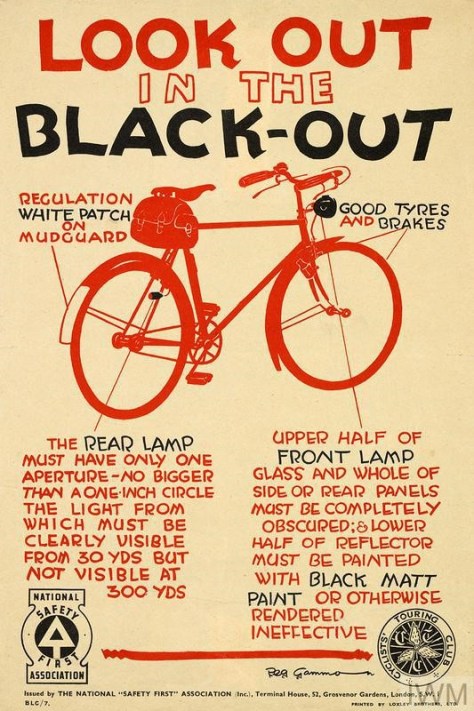
Great Britain, together with France, declared war on Nazi Germany on September 3, 1939.3 By January 1940, the Lighting (Restrictions) Order established a country-wide blackout during the hours of darkness.4 This restricted and forbade public lighting in towns. It required that street lamps be dimmed and that business and private residences black out their windows with blackout curtains so that light could not seep out. It also provided specifications for dimming the lights of motor vehicles and bicycles.5

Here is a poster that gives instructions on how to outfit a bicycle so that the lights are dimmed and facing the ground.6
Look out Black Out.jpg

My father would have known that the blackout was important and all his life he scrupulously followed the law. So he was not stopped because he didn’t care about the blackout. He was stopped because he didn’t have any lights at all.7

Once Britain imposed a country wide blackout through the Lighting (Restrictions) Order, car accidents increased and pedestrian fatalities doubled.8 Citizens were discouraged from nights out at the pub and were told to carry a newspaper or a white handkerchief so that they could be seen.9 Police Inspector Scales had decided to impose the letter of the law.10

I like to imagine that my dad had cycled into Easingwold for an evening out at the pub for a pint and a game of darts. He learned to play darts during the war and he continued to enjoy the game his whole life.  Bicycles were used on the base, so I assume that he borrowed one of them.11

In any event, while he must have been frustrated at being summoned to court for failing to have a light on the bicycle, it does seem a little dangerous to be travelling on a country road with no lights during a total blackout. But surely a smaller risk than fighting in a war that lasted five years.


  1. Summons to Edward McHugh, LAC, No. R. 6278 of 431 Squadron, RCAF Station Tholthorpe dated September 21, 1943, in author’s possession.
  2. Ibid.
  3. Wikipedia web site, “Declarations of war during World War II,” https://en.wikipedia.org/wiki/Declarations_of_war_during_World_War_II, accessed April 22, 2018.
  4. Wiggam, Marc Patrick, The Blackout in Britain and Germany in World War II, Doctoral thesis, University of Exeter, March 2011, page 107.
  5. The Guardian, online edition, “Life during the blackout,” November 1, 2009, https://www.theguardian.com/lifeandstyle/2009/nov/01/blackout-britain-wartime, accessed April 22, 2018.
  6. Used with the kind permission of the Royal Society for the Prevention of Accidents. rospa.com.
  7. Summons to Edward McHugh, LAC, No. R. 6278 of 431 Squadron, RCAF Station Tholthorpe dated September 21, 1943, in author’s possession.
  8. Spartacus Educational web site, Blackout World War 2, http://spartacus-educational.com/2WWblackout.htm, accessed April 22, 2018.
  9. The Guardian, online edition, “Life during the blackout,” November 1, 2009, https://www.theguardian.com/lifeandstyle/2009/nov/01/blackout-britain-wartime, accessed April 22, 2018.
  10. Summons to Edward McHugh, LAC, No. R. 6278 of 431 Squadron, RCAF Station Tholthorpe dated September 21, 1943, in author’s possession.
  11. Joost, Mathias (Major), The unsung heroes of the Battle of Britain: The ground crew of No. 1 (RCAF) Squadron, September 11, 2017, Royal Canadian Air Force web site, http://www.rcaf-arc.forces.gc.ca/en/article-template-standard.page?doc=the-unsung-heroes-of-the-battle-of-britain-the-groundcrew-of-no-1-rcaf-squadron/idw3fd9t, accessed April 22, 2018.


The Seigneuries and Townships of Beauce, Bellechasse, Dorchester and Lotbinière

(Note, this is my last post until September. I have many more compilations ready to post then. Meanwhile, happy summer! Jacques)

The region south of the St. Lawrence River between Quebec City and the U.S. border is a tranquil area of forests and farmland. The main highway hugs the shore of the broad St. Lawrence, crossing tributaries such as the Chaudière River, and the land rises gently to the south into the Appalachian Mountains. Today, this area is known as the Chaudière-Appalaches region of Quebec.

The region has a long history of human habitation. Before the 1600s, the people of the Abenaki First Nation lived here. The French founded Quebec City in 1608 and started to grant large tracts of land called seigneuries to aristocrats and military officers. Each seigneury was long and narrow so it could border the St. Lawrence River, the only transportation corridor. Most of the early Europeans were men, including soldiers and fur traders, and the population remained small. In 1663, women arrived in the colony, chose husbands and started families. The population of New France grew quickly.

In 1759, the British defeated the French at the Battle of the Plains of Abraham, and a new era of British rule began. Chaudière-Appalaches saw many new settlers arrive from England, Scotland and Ireland, and for the most part they got along well with their French-speaking neighbours. Today, the area remains primariiy French-speaking.

This 59-page guide in PDF format is designed to help you find the records of people who lived in this region. Click on this link to access the PDF:

The_Seigneuries of Beauce Lotbiniere Dorchester and Bellechasse

Contents:

  1. 1 Information on the seigneurs who owned much of the land, including the Lotbinière and Taschereau families.
  2. 5 Descriptions and histories of the region’s seigneuries.
  3. 20 Descriptions of the area’s townships, which were established by the British and date from the 1790s and 1800s. This guide includes links to the churches and cemeteries in these townships.
  4. 27 Descriptions and history of the counties in the region, including when they were created and how they were named and settled.
  5. 30 Towns that changed names over the last 240 years. If the town where your ancestor lived had different names over the years, this will help you identify it.
  6. 44 A list of regional cemeteries in each county or municipality.
  7. 45 Notaries prepared a variety of legal documents for their clients, including land transfers, wills and business agreements. The list of notaries shows where each one worked, the years he practiced and the location of his records at the archives today.
  8. 59 Contact information for the Bibliothèque et Archives nationales du Québec in Quebec City.

My Formidable Tante Marie

I trail closely behind my petite 97-year old aunt as she pushes her walker towards the residence dining room. Her recently repaired hip doesn’t appear to bother her as she purposefully maneuvers herself to the front of the line.

Ironically, she was born with a curvature to her spine and the doctors pronounced baby Mary “delicate” informing her parents that she would not have a long life.

“Ha!” she has been known to utter on many an occasion.

Another favourite saying has become “I shall never surrender!”[1] It is stated with such passionate theatrical flair leaving no doubt that she means what she says.

Her parents, Millicent and Sydenham Lindsay, provided their first born child with numerous quiet diversions such as books, art supplies and writing materials during her childhood. She was not to tax herself physically much to the dismay of her brother and two sisters. Consequently, her artistic talents and imagination flourished and by the time she completed high school, she was ready to perform!

Mary was a talented actress and enjoyed memberships in several different theatre groups in and around Montreal during the 40’s and 50’s. She also occasionally designed store windows in connection with the theatre that drew the attention of the local paper.

“A departmental store window display, depicting characters in a scene from Kings in Nomania has aroused considerable interest and admiration to the gratification of Mary Lindsay, talented young display artist who designed the window.”[2]

In 1950, Trinity Players and The Montreal Repertoire Theatre produced the play “Jupiter in Retreat” and 30-year old Mary won the best actress award for the Western Quebec Region in the Dominion Drama Festival for her leading role. The Herald raved about her:

“Mary Lindsay Kerr, actress playing a leading role, gave a performance of confidence, sincerity and absolute conviction. This artist didn’t put a foot wrong. She played right from the beginning with ease, and she had the power of making lines appear spontaneous.” [3]

The prize was a beautiful handcrafted painted wooden bowl that she later passed on to me. It currently hangs on my kitchen wall as a proud memento from my much-loved aunt.

Mary was blessed with a true soulmate when she married Robert Black-Byrne Kerr in 1946.  Not only did he continue to look after her but he shared her love of the theatre! They were known to host house parties with themes like “Ye Gods” where guests dressed in togas as Roman Gods and probably ate and drank excessively!

Lively games of charades were played at every family gathering. Halloween was a fabulous excuse for a little play-acting! Mary would dress up as a witch and stir a giant pot of steaming “witch’s brew” in the large front window while Bob handed out treats to anyone who dared to come close enough!

In the 50’s, they moved to Vancouver for Bob’s job and Mary was welcomed enthusiastically as “a prize winning actress” into the Vancouver Theatre Guild. She also developed a reputation for radio work (Trans-Canada Matinee on CBC) and several TV and screen appearances (she was the voice of Clarence the Caterpillar on the children’s “Peppermint Prince” program).

As they didn’t have children of their own, Mary and Bob took great pleasure in doting on their nieces and nephews. When they moved back to Montreal in the late 60’s, Mary taught me how to bake a “four egg sponge cake” folding in the stiffly beaten egg whites just so. Weekly tea parties featuring just the two of us were a real treat. Sometimes she would serve “backwards dinner” starting with dessert first!

Over the years, we were often treated to hand painted watercolour cards sent to us for every special occasion. Her joie de vivre was obvious throughout her notes by the abundant use of exclamation marks. They were always lovingly signed: “Big Hugs, Tante Marie!”

(Tante Marie is presently residing in Ottawa, Ontario, where she is now doted on by her nieces and nephews.)

[1] Based on Sir Winston Churchill’s famous WWII speech.

[2] Newspaper clipping, personal collection – “Novel Store Window illustrates C.A.T. Play (Canadian Art Theatre), December, 1944.

[3] The Herald, Montreal , Friday, March 10, 1950.

The Huguenot of England, Part 2

French Persecution of the French Huguenots

At the end of the 17th century, 60,000 to 80,000 Huguenots settled in the South West of England and were known as Britain’s first refugees.

The ‘Currant Examiner’ of September 1681, contains this quote that resonates today:

Plymouth Septem. 6. This day came in hither a small bark from Rochel, (La Rochell) with thirty nine poor Protestants, who are fled for their Religion: They report that five or six Boats more full of these poor distressed Creatures parted from those parts at the same time; and we hear that one of them is already put into Dartmouth. [1]

As I read the piece it appeared that the refugees were, in fact, heading towards Plymouth, where for centuries, the Devon ports were very familiar just as the Devon mariners were familiar with the Channel Islands and the continental seaboard.

This article continues my story of the Huguenot of England and in particular, South West Devon. https://genealogyensemble.com/2018/04/25/the-huguenot-of-england-part-1/

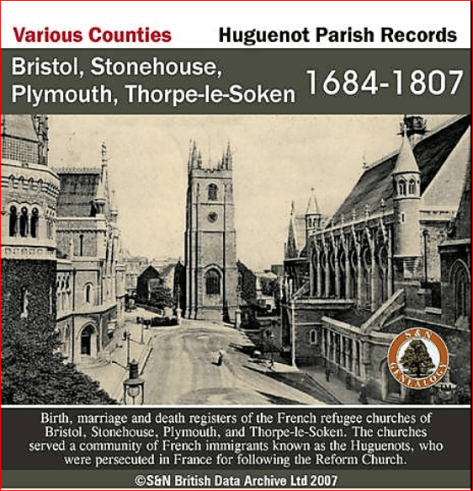
Bristol, Stonehouse, Plymouth, Thorpe-le-Soken Parish Registers of the English Huguenots

What prompted my interest in Huguenots? Well, I was searching online for places to visit on my next trip ‘home’ when I came across a reference to the Artist Dennis Severs’ house. The website told me: “Dated from approximately 1724, Dennis Severs had purchased a house at 18, Folgate Street, next to Spitalfields in East London and there, he created a time capsule of a Huguenot silk weaver family from 1724”. [₂]

I had no idea what a ‘Huguenot’ was so I decided to find out. I took a trip around the internet and discovered some interesting tidbits.

For instance, the Huguenot Society of Great Britain and Ireland (Yes! we have a society!) tells us that the Huguenots were known as Britain’s first refugees and goes on to say “there are many inhabitants of these islands who have Huguenot blood in their veins, whether or not they still bear one of the hundreds of French names of those who took refuge here – thus bringing the word ‘refugee’ into the English language” Who knew? [3]

They were actually welcomed to England by King William III in a Declaration.

Dr William A. Pettigrew, Reader, School of History, University of Kent wrote:

As King William III’s Declaration above makes clear, a distinguishing feature of this migration was the explicit state support it received. Six months after William of Orange had landed to take the throne of England The Declaration was printed in London in April 1689. William had long supported the plight of the Huguenots. His support was not altruistic because he understood the assistance this powerful group of refugees could offer him in his war with the French King who had persecuted the Huguenots – Louis XIV. The Declaration offers the historian a useful insight into the official government approach to the Huguenot arrival.

The Declaration clearly shows how William expected the English to welcome Huguenot refugees because of a presumed empathy with them born of the shadow of state persecution extended by William’s predecessor, James II”

Here’s one Huguenot refugee’s success story from the Independent newspaper.

For 270 years after 1724, a Hampshire paper firm, Portal had – literally – a license to print money. In 1685, Henri de Portal and his brother, Pierre Guillaume were terrified refugee children, smuggled out of France in wine casks and sent on a perilous sea journey. It took the young Portals from Bordeaux to Southampton. Henri opened his mill in Whitechurch in 1712. Within a decade he had found his fortune through a banknote paper contract”. [4]

Although I was born and raised in Plymouth, England, I was very surprised to learn that the Huguenot and Walloons settled in my hometown and Stonehouse.

Kathy Chater in her book “Tracing your Huguenot Ancestors” states: “One of the major problems researching Huguenots in Devon is the impact of the bombing of the Exeter record office during the Second World War when many documents were destroyed. All the wills, for example, have been lost, although a project to reconstruct them is underway. However, it seems that even before this the records of the two Exeter Huguenot churches had disappeared”[5]

This could be one reason that I had no idea that Huguenots lived and worked in my part of the country. I wonder, is there a possibility of Huguenot ancestors in my family? Another avenue to explore!

Our ‘Mother Church’ in Plymouth is called St. Andrews and is designated a minster which is “A church that was established during Anglo-Saxon times as a missionary teaching church, or a church attached to a monastery”. [6]

An interesting note concerning St. Andrews Church is this:

Plymouth and East Stonehouse: A nonconformist congregation formed in Plymouth 1681, and closed c1762, the remaining members joining the Batter Street Presbyterians. Some records of their children are listed as ‘births of dissenters’ in the Plymouth St Andrews and the East Stonehouse Anglican registers. A conformist congregation was formed in 1681 in Plymouth, from which an East Stonehouse congregation split off in 1691. These congregations used St Andrews Church and first its Chapelry at East Stonehouse and then a Church (with separate registers) there. The Plymouth and East Stonehouse congregations merged in 1785 and were dissolved in 1810. For details of the extant pre-1840 registers see under Church Records in the respective parish pages. [7]

Some churches allowed Huguenot worship outside of normal C of E services. (C of E means Church of England) and St Andrew was one of the main parishes in Plymouth that has registers where the Huguenots recorded baptisms starting at the back of the register.

This has been a very interesting journey and learning experience about a group of people who lived worked and died in my part of the World and of whom I knew nothing – until now.

SOURCES

http://www.huguenotsofspitalfields.org/the-huguenots-of-dartmouth.html [1]

https://www.dennissevershouse.co.uk/ [2]

https://www.huguenotsociety.org.uk/history.html [3]

https://www.independent.co.uk/news/uk/home-news/refugee-week-the-huguenots-count-among-the-most-successful-of-britains-immigrants-10330066.html [4]

Book “Tracing your Huguenot Ancestors” by Kathy Chater Page 38“ [5]

virtuallinguist.typepad.com/the…/the difference-between-a-minster-and-a-cathedral.html [6]

http://www.genuki.org.uk/big/eng/DEV/ChurchHistory/Huguenot [7]

NOTES

These books on the Huguenot of South West England are of interest.

Bracken, C.W. The Huguenot churches of Plymouth and Stonehouse. Trans. Devon. Assoc. 66, (1934) pp.163-179.

Currer-Briggs, Noel and Gambier, Royston. Huguenot Ancestry, Phillimore & Co. (2001) 160 pp. [ISBN: 1860771734]

Lart, Charles E. The Huguenot Settlements and Churches in the West of England, Proceedings of the Huguenot Society of London, vol. 8, (1901-4) pp.286-298.

Lart, Charles Edmund. (ed.) Registers of the French Churches of Bristol, Stonehouse, and Plymouth. Huguenot Society of London pubs. vol. 20. Spottiswoode and Co. (1912) [Includes Plymouth baptisms 1733-1807; marriages 1734-1740; burials 1733-1734.]

Peskett, Hugh. Guide to the Parish and Non-Parochial Registers of Devon and Cornwall, 1538-1837, Torquay, Devon and Cornwall Record Society; extra ser., v (Printed for the Society by The Devonshire Press) (1979).

Pickard, Ransom. The Huguenots in Exeter. Trans. Devon. Assoc. 68, (1936) pp.261-297; 76, (1944) pp.129-131.

Rogers, Inkerman. The Huguenots of Devonshire, Bideford, Gazette Printing Service? (1942). [BL DSC L70/1555]

Smiles, Samuel. The Huguenots: Their Settlements, Churches, and Industries in England and Ireland, (1972) 448 pp. [ISBN: 0806304979]2    


Tea Leaves

Who knew that simple tiny tea leaves could create such joy and laughter?

Almost seventy years ago, my mother drove us to Sudbury, Ontario for a family visit and it was during an afternoon tea at our Aunt Alice’s home that one of the most memorable moments of that trip occurred. There were many wonderful moments, however, this one has stood the test of time.

Gran


Granny Jodouin and Aunt Alice 1893

Aunt Alice was the first-born child to Louis Joseph and Louisa Jodouin. They had nine healthy children, six girls and three boys.

Mary Louise Alice was born on the 10th of October 1893, a nineteenth century baby.1. Not for long, though. She was a woman ahead of her time and would more than likely be comfortable in today’s world.

As a child she was taught by her mother and learned to play the piano. A talent which served her in good stead later in life, one she came to rely on when tragedy struck.

When her father, Louis purchased one of the first cars in Sudbury, but was unable to drive, due to a soccer accident,  this pert young woman began driving his car. She became his personal chauffeur. All the “Jodouin girls” learned to drive a car when they were young. Mom was fourteen and didn’t think twice about driving the family to Temiskaming to visit relatives.

William France Percival , a clerk dispatcher working for the railroad, originally from Antigua,  British West Indies became very fond of Alice and asked for her hand in marriage. They were married July 3rd, 1917 in Ste Anne’s Church in Sudbury.2. Together they had five daughters and lost a son at birth.

Uncle Bill passed away at a very young age. I have yet to find any documents, however, according to my brother, Karl who knew him, he believed it was in the early 1940s. Aunt Alice, now a single parent had the responsibility of providing for her five daughters and she relied on what she knew best. She became an organist at a local parish and continued to do so for many years.

Aunt Alice border


Freddie, Billy, Natalie, Aunt Alice, Mary and Madelyn

During the summer of 1948 while on our trip to Sudbury we spent an afternoon at Alice’s home. Granny, Mom, Aunt Alice, Aunt Ted (Adele) and Aunt Dickie (Louise) and I were outside on a warm sunny afternoon in July. Aunt Alice served tea and cookies while the ladies chatted. Before long the tea cups were empty and then the fun began. Each one in turn began reading their tea leaves. (tea leaves were not in little satchels back in the 40’s) Each one was trying to outdo the other. If the leaves looked anything like the Eiffel Tower, then there was a trip to Paris in the offing for the owner of that teacup. If the leaves looked remotely like a dollar sign, that person was going to inherit money. This went on for quite some time. They all had their turn. As a child it was marvellous to witness these sisters with their mother, regaling each other with their creativity and vivid imaginations. All in good fun!

teacup


Sources:

  1. Ancestry Sources, Archives of Ontario: series: MS929; Reel: 114. Ontario, Canada, Catholic Church Records (Drouin Collection), 1747-1967
  2. Ancestry.com and Genealogical Research Library (Brampton, Ontario, Canada) Ontario, Canada, Marriages, 1825-1936 {database on-line}. Provo, UT. USA: Ancestry.com Operations, Inc, 2010
  3.  https://www.twinings.co.uk/about-twinings/latest-news-and-articles/the-basics-   of-reading tea leaves.

The townships of the Eastern Townships and the seigneuries of the Upper Richelieu River Valley

Today, Quebec’s Eastern Townships and Richelieu Valley areas feature fertile farmland and forests, lakes and rivers, wineries, ski hills and cycling trails for tourists, but at the end of the 18th and beginning of the 19th centuries, these areas were being newly settled by former colonial soldiers, British families, new immigrants from Scotland and Ireland, and Loyalists from south of the border.

This extensive guide to the settlement of these areas includes a description of the counties and townships in southern Quebec where these people settled. It does not attempt to cover any of the First Nations people who lived here before the European settlers arrived.

Quebec’s Eastern Townships and the Upper Richelieu Valley

Here are the topics you will find in this 120-page PDF:

Page 1   Biographies of the governors, land surveyors, missionaries and seigneurs who were influential in this area. Also geographical information about the Eastern Townships and a map of the area in 1792.

Page 6   An alphabetical list of the townships and counties of southern Quebec, with a brief history of the settlement of each area. Places highlighted in the Eastern Townships include Acton, Barford, Brome County, Bury, Compton, Drummondville, Magog, Megantic County, Missisquoi County, Richmond, Sherbrooke, Sutton, Stanstead and Thetford Township. The list of places in the Upper Richelieu Valley begins on p. 68 and includes Lacolle, and Saint-Valentin.  Where place names or jurisdiction have changed, I have indicated the old and new information. I have included links to a variety of web pages including archival sites, cemetery lists, and information about area churches.

Page 72   A list of links to cemeteries in these areas.

Page 75   A list of judicial districts and information on some of the notaries who worked in these communities. This section includes links to the more detailed articles I have written and published on Genealogy Ensemble about important notaries in these areas such as Louis Chaboillez and Peter Lukin.

Page 109   A list of repositories, including branches of the BAnQ, Bishops University and Protestant church archives.

Page 114   Links to some of my own articles on topics such as the saddlebag preachers and the German presence in the Eastern Townships.

Page 115   A list of authors, historians, genealogists and archivists who have contributed to our understanding of the history and people of the Eastern Townships.

Most people do not combine the Eastern Townships (better known in Quebec as les Cantons de l’Est, or l’Estrie,) with the Upper Richelieu River Valley. The Richelieu River lies to the west of the Eastern Townships and connects Lake Champlain to the St. Lawrence River. I did so because, following the British Conquest of 1759 at the Plains of Abraham, British officers, British and Scottish soldiers, and Loyalist families fleeing the United States after the American Revolution began to emigrate to the shores of the Richelieu River.

They settled along the length of the Richelieu, from the fortified town of Sorel on the St. Lawrence River to the village of Lacolle at the U.S. border, populating towns such as Chambly, St. Johns (also referred to as Dorchester in the 1780s and later renamed Saint-Jean-sur-Richelieu, the original name under French rule), Abbotsford, McMasterville, Otterburn Park, Mount Johnson (Mont-St-Grégoire), the Seigneury of Sir John Johnson, the Seigneury of Gabriel Christie, Henryville, Christieville, Odelltown, Clarenceville, Noyan, Fadden Corner and hamlets along the western sector of Missisquoi Bay.

One reason people chose to live in these areas was that much of the land in Quebec was owned by a few landowners called seigneurs. This system of land ownership, based on feudal principles borrowed from France, continued until the middle of the 19th century. The  Loyalists especially, who had owned their own land in the Thirteen Colonies, did not wish to settle on seigneurial lands and pay a rent yearly to a seigneur whom they had never met. So Governor Frederick Haldimand decided to create the Eastern Townships of Quebec and Governor Guy Carleton (Lord Dorchester) who replaced Haldimand (second term as governor) supported Haldimand’s decision.


Huguenot Family Lineage Searches

This week’s compilation, “France Huguenot Family Lineage Searches,” is designed to help you find your Protestant ancestors in 16th to 18th century France. It includes links to books and societies that can help you find your ancestral name in France prior to the French Revolution, and it focuses on Protestant aristocratic families. Click on the link to read the pdf document:

France Huguenots Family Lineage Searches

This guide complements the compilation published May 20, 2018 on Genealogy Ensemble on finding Huguenot families in France, “How to Search for Huguenot Ancestors in France”  https://genealogyensemble.com/2018/05/20/how-to-search-for-huguenot-ancestors-in-france/

In the past, a great deal of research was done on the Huguenots who came to Canada, however, many of the researchers who contributed to this field are now retired or have died. For example, Huguenot Trails (a periodical published by the Huguenot Society of Canada) addressed the Huguenot families who settled in Canada. This periodical stopped publishing in 2002, and the society closed its doors in 2006. The lead authors were Ken Annett and René Péron.  See my post, “Huguenots – Index of Names,” March 6, 2015  https://genealogyensemble.com/2015/03/06/848/  This article consists of a list of family names that appeared in “Huguenot Trails.”

Another fine piece of research is Fichiers Huguenots en Nouvelle France, by Michel Barbeau (http://pages.infinit.net/barbeaum/fichier/index.htm). This database includes only the Huguenot families who settled in New France prior to 1759.  See also, Huguenot Family Names in Nouvelle France, Québec under British rule, Lower Canada, Québec under Confederation – Various Authors. This and other reference works can be found at the Grande Bibliothèque de Montréal or at the Collection nationale (same building, different collections.)

Here are some other compilations I have prepared in the past on the Huguenots:

“British, Irish, Scottish, Loyalist, American, German, Scandinavian, Dutch, Huguenot Families in Lower Canada and Quebec 1760,” April 8, 2015

https://genealogyensemble.com/2015/04/08/british-irish-scottish-loyalist-american-german-scandinavian-dutch-huguenot-families-in-lower-canada-and-quebec-1760/

This compilation is a list of villages, towns and townships in Quebec where various groups of people settled. Many of these places have changed names or disappeared over the years.


French Protestant Churches in Quebec,” Nov. 22, 2015

https://genealogyensemble.com/2015/11/22/french-protestant-churches-in-quebec/

This compilation includes an article by Huguenot researcher René Péron, the names of Protestant ministers who served these French-speaking congregations and a bibliography for further reading. It includes brief histories of 187 churches, including Anglican, Baptist and other denominations, in which Protestant Quebecers have worshipped between 1600 and today. Finally, this extensive compilation tells you where to find the parish records of these churches.


The Trail of the Huguenots in Europe, the USA and Canada,” April 4, 2014

https://genealogyensemble.com/2014/04/04/the-trail-of-the-huguenots-in-europe-the-u-s-a-and-canada/

This short post is a quote from a book in the library of the Quebec Family History Society in Montreal, The Trail of the Huguenots in Europe, the USA and Canada, by G. Elmore Reaman, that points to the important role the Huguenots played in New France. According to worldcat.org, this book is available in more than 1000 libraries around the world. It is also available online, https://archive.org/details/trailofhuguenots00ream


Huguenot Refugees,” April 2, 2014

https://genealogyensemble.com/2014/04/02/huguenot-refugees/

This post links to several databases and websites.


Register of Abjurations,” Feb 3, 2014

https://genealogyensemble.com/2015/02/03/register-of-abjurations/

This post covers records of renouncements of faith by Huguenots in New France.


William the Conqueror and Me

William the Conqueror must have thousands of descendants, but it seems quite a coincidence that I had thoroughly researched his life before I was aware there was a direct connection between us.

I learned about that connection from Gary Boyd Roberts, Senior Researcher Emeritus of the New England Historic Genealogical Society (NEHGS) and author of many books, including The Royal Descents of 600 Immigrants to the American Colonies of the United States. A half-hour meeting with Roberts was part of a weekend research event at the NEHGS that I attended a few years ago.

Roberts was a bit intimidating. He insisted I not look at my notes, but look at him, and he was baffled that I was interested in my ancestors’ lives. For him, the births, marriages and deaths were all that mattered. He seemed to have memorized the lineages of just about every family in colonial New England, and he indicated the pages of the family history books I should photocopy. When he learned I am Canadian, Roberts remarked that I have a “nice chunk of Yankee.”

He then pointed to the name Margaret Wyatt on my family tree and stated, “she was of royal descent.”

That royal ancestor was King Henry I, but the name did not ring any bells until I returned home and looked up Henry I on the Internet. Then I realized that Henry was the youngest son of William the Conqueror, about whom I had written a book!1 The book told the story of how William, Duke of Normandy, became King William I of England almost thousand years ago. Titled The Norman Conquest of England, it is one of several non-fiction books I have written for children.

William and I
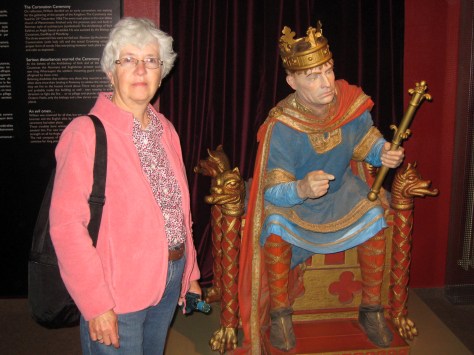
When I posed for this photo with a wax William at the Bayeux Tapestry exhibit in France in 2009, I had no idea he was my ancestor.

William’s own ancestry was actually Viking: the Normans were people from Scandinavia who began raiding northern France around 800 A.D. In 911, William’s ancestor Rolf the Viking took control of the area that became known as Normandy.

William was born in Normandy around 1028, the illegitimate son of Duke Robert I of Normandy and a young woman named Herleve, who was probably the daughter of a tanner. Even as a child, William had many rivals, but eventually he succeeded his father as Duke of Normandy. In 1066, he famously crossed the English Channel and defeated the English troops at the Battle of Hastings. He was a powerful and violent man, and a good military commander.

The story of how William the Conqueror evaded his enemies and invaded England is full of intrigue and coincidences. After writing about these events, my husband and I toured northern France, including Bayeux, home of the Bayeux Tapestry that illustrates the Norman Conquest. Little did I know at the time that William was one of my ancestors.

After William I’s death in 1087, his son William Rufus became king of England. Following the death of Rufus, William the Conqueror’s youngest son became King Henry I. Henry, who had been born in England, ruled from 1100 to 1135. Well educated, decisive and energetic, he was known as the Lion of Justice.

Henry married Matilda of Scotland, but the line of descent that leads to America was through an unnamed mistress. Their illegitimate child was Robert of Caen, 1st Earl of Gloucester. At generation 19 came Margaret Wyatt ( –  c. 1675).2 She married Matthew Allyn (1605-1671) in Devonshire, England in 1626/27 and a few years later they sailed across the Atlantic, settling in Hartford and later in Windsor, Connecticut.

From there, my line goes through their daughter Mary Allyn who married Benjamin Newberry; their daughter Mary Newberry who married John Moseley; their son Consider Moseley, who married Elizabeth Bancroft; and their daughter Elizabeth Moseley who married David Bagg in Westfield, Massachusetts. Their son Phineas Bagg, my four-times great-grandfather, left New England for Montreal, Quebec with his children around 1795.4

This article is also posted on https:writinguptheancestors.blogspot.ca

Sources.

  1. Janice Hamilton, The Norman Conquest of England, Minneapolis: Twenty-First Century Books, 2008.
  2. Gary Boyd Roberts, compiler, Ancestors of American Presidents, 2009 Edition. Boston: New England Historic Genealogical Society, 2009, p. 408.
  3. The Great Migration Begins: Immigrants to New England 1620-1633, Volumes I-III.(Online database: AmericanAncestors.org, New England Historic Genealogical Society, 2010), (Originally Published as: New England Historic Genealogical Society. Robert Charles Anderson, The Great Migration Begins: Immigrants to New England 1620-1633, Volumes I-III, 3 vols, 1995) https://www.americanancestors.org/DB393/i/12107/42/235171345
  4. Janice Hamilton, “An Economic Emigrant,” Writing Up the Ancestors, Oct. 16, 2013, http://writinguptheancestors.blogspot.ca/2013/10/an-economic-emigrant.html


A Coal Mining Heritage

Scottish coal miners in the late 1800s began their 12 hour shifts in the early morning darkness. Slowly they made the long descent into the pit, the only sounds being the drone of the winding gear and the clunking of the open cage carrying the men. The blackness became thicker and thicker as they neared the pit head. Each man carried a safety lamp and wore a token around his neck for identification. A series of tubs carried the men to the coal seams until the roof became too low for the men to stand upright. Then they would begin a crouching walk. Each man carried a simple lunch of water, bread and jam for the crouching position caused indigestion if the stomach was too full.

The men were assigned work positions and began the grueling task of hewing coal from the rock face. The coal was loaded into tubs and pulled by ponies to the bottom of the shaft where they were then hauled to the surface by the crane.  The work was hot, dirty and dangerous in cramped and claustrophobic conditions. Seams were prone to collapse and noxious gases collected. Most colliers suffered from significant breathing difficulties and persistent coughs. The ponies become blind from a life in the dark. Once every summer they were brought above ground for two weeks to graze, their eyes carefully wrapped to protect them against the light. 1

Such a coal miner was Allan Syme of Blantyre, my husband’s grandfather, born in 1882. He was the son of coal miner Hugh Syme and his wife Isabella.2 Allan was said to be fifteen when he first entered the mine.3

What was Allan thinking as he descended into the darkness that first time? Perhaps it was of the Blantyre Disaster of 1877 some twenty years earlier, Scotland’s worst coal mining disaster that had killed 207 miners and left 92 widows and 250 fatherless children. 4 Not a soul in the village was left untouched by the loss. Exploding gas, called firedamp, caused the disaster and firedamp was still ever present in the tunnels. Would this be his fate?

Or perhaps Allan was simply thankful he had a job. Generations of Blantyre men were able to feed their families by working underground, sons following their fathers into the depths time and again. Only a few were able to escape the mine, the most famous being the African missionary David Livingston.

Allan eventually took a wife, Elizabeth Sneddon 5, and raised a family of six: Hugh, Allan, Peter, Isabelle, Mary and Betty. Their home was a two bedroom flat in a four-plex on Bruce Terrace, initially owned by the mine and then by the parish council. It boarded The Dandy, a wooded area leading down to the River Clyde and a view of the ruins of Bosworth Castle. Hugh would follow his father into the mine. Mary would marry a Royal Navy officer and become the mother of my husband.

Slowly conditions improved in the mines, as did Allan’s position with the mining company. The last years of his career were spent above ground as a contractor hiring the men to work in the pit. 6.

At the age of 58, Allan’s life ended tragically in the darkness of night, not the darkness of the mine. He was killed by a car as he crossed a road on his way to deliver a pay packet to an ill employee.  His skull and multiple bones were fractured by the impact and he died at the scene. The driver had not been able to see him in the blackout imposed by WWII. 7

Allan’s widow, bound to a wheelchair by rheumatoid arthritis, would be cared for by his children in the house on Bruce Terrace until her own death.


  1. http://blantyre.biz/mining-in-blantyre/blantyre-history-of-mining/6159-2/
  2. https://www.scotlandspeople.gov.uk/view-image/nrs_stat_births/42004712?image=1&viewed_images=true
  3. Allan is listed as a coalminer in the 1901 census. https://www.scotlandspeople.gov.uk/view-image/nrs_census/26961400?image=44&viewed_images=true
  4. http://blantyre.biz/mining-in-blantyre/blantyre-history-of-mining/blantyre-mining-disaster-1877/
  5. https://www.scotlandspeople.gov.uk/view-image/nrs_stat_marriages/3498462
  6. Personal recollection of granddaughter Elaine Shane
  7. https://www.scotlandspeople.gov.uk/view-image/nrs_stat_deaths/9267528?image=1&viewed_images=true

How to Search for Huguenot Ancestors in France

Many people know that the Huguenots were French Protestants who suffered persecution and left France around the 1600s to live in other countries where they felt more welcome. But not many genealogists know that it may be possible to trace their Huguenot ancestors in France. Doing this search online is possible but difficult, so the PDF document below is designed to help.

The Huguenots were members of the Église réformée de France (Reformed Church of France).  Some historians estimate that Protestants accounted for 10% of the population of France in the 16th century. That changed following the 1572 St. Bartholomew’s Day massacre in Paris. Over the next 200 years, the Huguenots left France for England, Sweden, Switzerland, Prussia, Ireland, South Africa, Dutch East Indies, and other countries. A few families settled in New France (Quebec) and Russia. Today, the descendants of these Protestant families can be found around the world.

This research guide has been created in two sections:

1600-1685 – Protestant families in France: where they lived. This section is a general overview of the regions of France under the Old Regime, prior to the French Revolution of 1789-1799. It is only a reference tool since family lineage searches in France are not conducted by regions or provinces under the Old Regime, but under modern-day Départements

The 93 départements of France in which Protestant families resided during the 16th, 17th and 18th Centuries (1565-1721) A département is like a state. Since the end of the French Revolution (1789-1799), France has been divided into 95 such states, and each département keeps its records in its own regional archives. There are no archives for Bretagne, Normandie, Aquitaine, Aunis or Bourgogne, nor for any of the more than 40 ancient provinces of France that existed prior to the French Revolution.

Before you search for your ancestor, you need to know where the family originated in France. All online family lineage searches in the 95 archives départementales of France (Regional Archives) are done by communes, meaning villages, towns, townships or cities.

From 92 of the 95 archives départementales of France (regional archives), you can look for your ancestor’s commune and then search church registers (registres des paroisses) from 1535 to 1789 or thereabout, civil registers after 1789, tables décennales (civil registers from 1789 onward by 10-year periods), notarial records. Notarial records are some of the oldest online documents you can access online.

Other online databases on the archives départementales de France will probably not help you in determining the places of origin of your Huguenot ancestors, because these date from after the French Revolution.

I have prepared a research guide to the archives départementales of France (See Jacques Gagne, “Researching French Ancestors Online,” Genealogy Ensemble, May 13, 2018, https://genealogyensemble.com/2018/05/13/researching-your-french-ancestors-online/) In that PDF, I have described the documents which can be viewed online for free. If you are looking for Huguenots, concentrate on the Parish Registers (Church Registers, Registres paroissiaux or Registres de paroisses) from as early as 1535, and Notarial Acts (Actes des notaires.) A few of the notarial acts are from the 15th century, but most from the 16th or 17th centuries.

A third option deals with Protestant Church Registers (Registres protestants or Registre pastoral or Registres des Pasteurs), These are the few Protestant church registers that have survived.

Another option for searching the Archives départementales de France is, once you have determined the name of the ”commune” your ancestor resided in, go through the index of family names within the ”commune” section of the search engine and see if your family names are listed, even if the church registers are Catholic.

If you don’t know where your ancestors resided, for each of the 95 archives départementales of France, I have included websites indicating where certain families lived.

Don’t forget that not all members of a particular family became a Protestant. Some family members may have stayed with the Catholic Church.

Finally, just to add one more complication, your family name in France would have had a different spelling than the modern one. My family name in America is Gagné, but the same family in France is Gasnier or Gagnier: same pronunciation, different spelling. When I research online in France, I enter Gasnier or Gagnier as the family name, never Gagné.

Huguenot Families in France 1565-1721

A note about sources:

Much of the information I have compiled about the Huguenots of 16th, 17th and 18th-century France comes from old books that have been digitized. Over a 12-year period, whenever I came across a book dealing with the Huguenots of France, I would extract the names of the communes in which these families resided and add the names of those communes to my database.

I also discovered a database with the names of the Archives des consistoires de France, in which the communes are listed, as well as the Protestant Seigneurs, the Protestant pastors and the names of some of the Protestant families affected by court decisions.

In addition, to these books, I looked at Michelin maps and Larousse dictionaries. They helped me find out, for example, that the town of Bergerac is part of modern Dordogne, a département within the south-west region of France. This region was home to many Protestant families in the 16th, 17th and 18th centuries.

You will find about 15 to 20 regional online databases of Protestant communes in 16th to 18th century France, but only for certain regions. A national listing of the modern départements of France in regard to the Huguenots of past centuries does not exist online.

Working together to help genealogists discover their ancestors